© 2016, IRJET ISO 9001:2008 Certified Journal Page 870
Implementation of Noise Removal methods of images using discrete
wavelet transform & Filters
Priyanka Rathore 1 ,Papiya Dutta 2
1Student, Dept of EC ,Gyan Ganga College of Technology
2Assoc. Prof. , HOD, Dept of EC ,Gyan Ganga College of Technology
Abstract-In the field of Image handling, amid the transmission and procurement, pictures are adulterated by the diverse sort of commotion. In light of the commotion, nature of picture is diminished and different elements like edge sharpness and example acknowledgment are likewise severely influenced. DWT denoising is done only in detail coefficient, this offer advantage of smoothness and adaption. Reducing noise from single image, natural images, etc. is the challenge for the researchers in digital image processing.in this paper . The denoising methodology uses hybridization of filters & amp; DWT The denoised signal reconstructed from the remodel can gift various overshoot and undershoot. These peak price don't seem to be contained in original signal itself. they're created by artificial interference in remodel method. to beat the disadvantage mention over HYBRID methodology is employed.
© 2016, IRJET ISO 9001:2008 Certified Journal Page 871 II Literature Survey-so many researches are worked on this area some work areas follows. S.Kother Mohideen, Dr. S. Arumuga Perumal, Dr. M.Mohamed Sathik [14] projected to research the suitableness of various rippling bases and also the size of various neighbourhood on the performance of image de-noising algorithms in terms of PSNR Their paper investigates the suitableness of various rippling bases and also the size of various neighbourhood on the performance of image de-noising algorithms in terms of PSNR and also the image de-noising exploitation separate rippling remodel is analyzed. D.Giaouris, J.W.Finch [15] showed that the denoising theme supported the WT failed to distort the signal and also the noise element once the method was found to be tiny. however this method obligatory a definite delay on the signal and was comparatively sophisticated. In mounted frequency case, no improvement had been noted. Vidhyalavanya. R, Madheswaran. M [5] during this paper, a constant quantity multiwavlet with sureshrink threshold is projected to handle the problem of image recovery from its clattering counterpart. it's supported the generalized statistical distribution modelling of subband coefficients. comparative study of peak signal-to noise magnitude relation with varied levels of noise intensities shows the improved reconstruction quality. Another advantage of the projected theme is that denoising within the image is found to enhance the SNR of the complete image.
S.Sudha, G.R.Suresh and R.Sukanesh [11] their paper presents a wavelet-based thresholding theme for noise suppression in ultrasound pictures. Quantitative and qualitative comparisons of the results obtained by the projected methodology with the results achieved from the opposite speckle noise reduction techniques demonstrate its higher performance for speckle reduction. In their work introduced a comparatively easy context-based model for adjustive threshold choice among a rippling thresholding framework.
© 2016, IRJET ISO 9001:2008 Certified Journal Page 872 detailed coefficients (high frequency components) whose amplitudes are smaller than a certain statistical threshold value to zero while retaining the smoother detailed coefficients to reconstruct the ideal image without much loss in its details.
Proposed Algorithm
RGB to 2-D (Gray)
Input image
1
stlevel decomposition of
LL band for filtering
DWT (Decomposition)
2
ndlevel decomposition
of 1
stlevel LL band
3
rdlevel decomposition
of 2
ndlevel LL band
Inverse transform of all
Y2 DWT w.r.t order
Inverse transform of all
Y1 DWT w.r.t order
Inverse transform of all Y
DWT w.r.t order
Ym=Median(Y)
© 2016, IRJET ISO 9001:2008 Certified Journal Page 873 Algorithm for Denoising Block
I=Input Image
Taking I into the Denoising Block
Convert I from RGB to Gray Colour MAP say Igray
(Because the multidimensional matrix not supported by many digital filters & functions)
Let, dwt=Wavelet transform and THfilt=Wavelet filtering with respect to threshold
(cA, cH, cV, cD)= dwt(Igray);
Here, cA, cH, cV and cD are approximation, Horizontal, Vertical and Diagonal Coefficients respectively.Update the approximation coefficients by filtering it.
cA=THfilt(cA);
THfilt is the thresholding function that we considered, by taking following points as a filtering criteria
Eliminate in the wavelet representation those elements with small coefficients, and
Decrease the impact of elements with large coefficients.
In mathematical terms, all we are doing is thresholding the absolute value of wavelet coefficients by an appropriate function.Similar operation will be perform for multi-level decomposition
For second level
(cA1, cH, cV, cD)= dwt(cA);
cA1=THfilt(cA1);
For third level
(cA2, cH, cV, cD)= dwt(cA1);
© 2016, IRJET ISO 9001:2008 Certified Journal Page 874
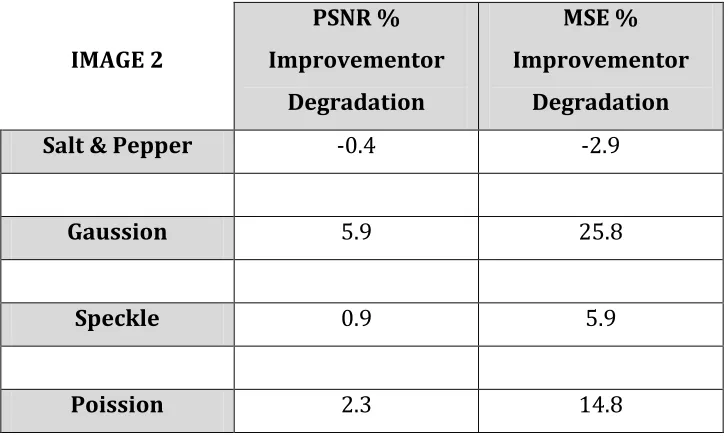
IV. Results- At first we evaluated various types of noise which causes the ill effect in the image and produces a undesired effect in the readability of exact information that need to be extracted from the image taken from different sources. A comparative study of various types of noise is done and their effect is studied under different types of images.
discussion, data and analysis which carried out for four different images (Salt & pepper, Gaussion, Speckle and Poisson noise) for standard variance of 0.01 and different values of PSNR, MSE, WPSNR, SSIM for various noise types are found. We observed that the test images has shown some improvement in most of the parameter in consideration (PSNR, MSE,
© 2016, IRJET ISO 9001:2008 Certified Journal Page 875
IMAGE 1 RECENT
PSNR
PREVIOUS PSNR
RECENT MSE
PREVIOUS
MSE
Salt & Pepper 31.71 31.83
43.81 42.59
Gaussion 29.81 28.15 67.85 91.43
Speckle 29.42 29.16 74.18 78.81
[image:6.612.54.482.130.333.2]
Poission 30.81 30.12 53.84 63.2
Tabel 1: Comparision of new (filters applied in sequence Median, Average & Diffussion) PSNR, MSE,
IMAGE 2
PSNR % Improvementor
Degradation
MSE % Improvementor
Degradation
Salt & Pepper -0.4 -2.9
Gaussion 5.9 25.8
Speckle 0.9 5.9
Poission 2.3 14.8
[image:6.612.125.489.425.646.2]© 2016, IRJET ISO 9001:2008 Certified Journal Page 876 V.Conclusion- From the simulation analysis, the wavelet transform in image denoising in particular stationary images, can effectively remove noise and improve SNR. With regard to complexity of image structure wavelet transform denoising can play the advantages compared to traditional denoising, wavelet can better demonstrate its advantages. From the simulation results, we also obtain that use the principle can effectively reduce noise, and can retain a useful component of image. capability of Attenuating Gibbs oscillation and adaptation to discontinuities gave an advantage to provide better result.
Refrences-
[1] Sachin D Ruikar, Dharmpal D Doye “Wavelet Based Image Denoising Technique” (IJACSA) International Journal of Advanced Computer Science and Applications,Vol. 2, No.3, March 2011
[2] Abhishek Raj, Alankrita, Akansha Srivastava, and Vikrant Bhateja “Computer Aided Detection of Brain Tumor in Magnetic Resonance Images” IACSIT International Journal of Engineering and Technology, Vol. 3, No. 5, October 2011
[3] Manish Goyal , Glenetan singh sekhon/ “Hybrid Threshold Technique for Speckle Noise Reduction using wavelets for Grey scale images” IJCST Vol. 2, Issue 2, June 2011.
[4] Kother Mohideen, Arumuga Perumal, Krishnan and Mohamed Sathik, “Image Denoising And Enhancement Using Multiwavelet With Hard Threshold In Digital Mammographic Images” International Arab Journal of e-Technology, Vol. 2, No. 1, January 2011
[5] Vidhyalavanya. R, and Madheswaran.M “An Improved Denoising Algorithm using Parametric Multiwavelets for Image Enhancement” International Journal of Advanced Science and Technology Vol. 16, March, 2010.
© 2016, IRJET ISO 9001:2008 Certified Journal Page 877 [7] S.S.Patil, A.B.Patil, S.C.Deshmukh, M.N.Chavan” Wavelet Shrinkage Techniques for Images”
International Journal of Computer Applications (0975 – 8887) Volume 7– No.1, September 2010
[8] Sachin Ruikar D D Doye “Image Denoising Using Wavelet Transform” 2010 International Conference on Mechanical and Electrical Technology (ICMET 2010).
[9] J S Bhat, B N Jagadale, Lakshminarayan H K “Image De-noising with an Optimal Threshold using Wavelets” International Conference on Image and signal processing (ICSIP) 2010
[10] LIU Wei “New Method for Image Denoising while Keeping Edge Information” 2nd International
conference on image processing CISP 2009.
[11] S.Sudha , G.R.Suresh and R. Sukanesh, “Speckle Noise Reduction in Ultrasound Images by Wavelet Thresholding based on Weighted Variance” International Journal of Computer Theory and Engineering, Vol. 1, No. 1, pp.1793-8201, April 2009