Munich Personal RePEc Archive
Financial integration in the four Basins:
a quantitative comparison
alessandrini, sergio
Università di Modena e Reggio Emilia - Facoltà di Giurisprudenza
July 2010
Online at
https://mpra.ub.uni-muenchen.de/26080/
Financial integration in the four Basins: a quantitative comparison
Sergio Alessandrini1
July 27, 2010
Paper presented at the International Seminar “The four sea basins and the global economy: do the
EU 4 freedoms work?”, ICPS Kyiv, Ukraine, June 9-10, 2010
1
University of Modena and Reggio Emilia, Italy [email protected]
Abstract
This paper presents some stylized features of the financial integration of the four basin regions
(Baltic Sea, Black Sea, Caspian Sea and Mediterranean Sea regions) and discusses the
developments, trends and features of the IIP in the regions. Chapter 3 identifies the gaps in them,
distinguishing the EU e non-EU members and provides an overview of the asymmetries and the
convergence as a result of the financial integration in the different markets. After the review the
trends the final chapter points to areas where further efforts are needed for achieving greater
regional integration.
JEL Classification
Keywords: international financial integration, convergence, asymmetries, current account openness,
1. Introduction
Since the 1990s the European Union undertook a series of reforms in order to complete the full
liberalization of capital transactions among the member states and with third parties. The aim was to
realize the full financial integration of the European capital markets along the same principles of the
common market for good and services2. In 2004, the Wider Europe and the ENP projects proposed
a “comprehensive prudential regulatory framework for the financial services area”3, that would
reinforce the undergoing benefits of the capital account liberalization in the partner countries.
In combination with the completion of the internal market and the implementation of the EMU, the
original conceptual framework suggests, that over time, more financial integration will promote the
stability of financial markets and help enhance the overall economic performance with financial
innovations and organisational improvements.
One of the main benefits of financial integration is the development of the financial sector, allowing
domestic financial markets to become deeper and more sophisticated. Thus, banks and financial
institutions may increase the financial alternatives for borrowers and investors4.
2 European Commission (1996).
3 European Commission (2004), pp. 15-16. “It will be key to the creation of business and the
promotion of investments that these countries ensure that companies are able to operate on a level
playing field. In combination with the above measures, access to European financial markets
should, over time, add to the stability of partners’ financial markets and help enhance their overall
economic performance. The further liberalising of capital movements will provide new
opportunities.”
4 For a critical analysis of the benefits of capital liberalisation see STIGLITZ (2004), in particular
This paper takes a comparative look at the patterns of international financial integration and
addresses the thematic issues with the aim to benchmark the four basin regions. It is well known
that they represent four groups of countries with different institutional and economic characteristics.
In particular the regions are the following:
The Baltic Sea region: EU: Estonia, Latvia, Lithuania, Denmark, Finland, Sweden, Germany,
Poland; Non EU: Russia, Belarus
The Black Sea region: EU. Bulgaria, Greece, Romania; Non EU: Turkey, Georgia, Russia, Ukraine,
Moldova, Armenia, Azerbaijan
The Caspian Sea region: EU: none; Non EU: Iran, Azerbaijan, Russia, Kazakhstan, Turkmenistan,
Georgia, Armenia, Turkey, Uzbekistan
The Mediterranean Sea region: EU: France, Greece, Italy, Slovenia, Spain, Malta, Cyprus; Non EU:
Turkey, Lebanon, Syria, Israel, Egypt, Jordan, Libya, Tunisia, Algeria, Morocco, Bosnia and
Herzegovina, Croatia, Montenegro, Albania, Serbia, Macedonia.
There are some overlapping among the groups: Russia and Turkey have borders in three basins,
while Azerbaijan and Greece are in two basins.
2. Two questions
The first question is related to the theoretical models of financial integration.
The standard economic theory suggests that liberalisation of capital flows, in particular long-term
capital flows, and financial development are important policy instruments, because they provide a
favourable support for the integration of neighbouring countries on a regional scale. In this regard,
enterprise restructuring5. In recognition of these potential benefits, governments of these countries
have undertaken widespread capital account liberalization over the past quarter-century.
In the 1990s, capital account liberalization was an important part of the market reforms introduced
by governments in the transition economies6. Because of the capital account liberalization, these
countries attracted large amounts of foreign capital and the main benefit was the development of
their financial system, which involves more complete, deeper, better-regulated financial markets
and more credit to foster the transition and the economic growth.
There are two main channels through which financial integration promotes financial development.
First, financial integration implies that a new type of capital and more capital is available to
neighbouring countries. Among other things, new and more capital allows these countries to better
smooth consumption, deepens financial markets, and increases the degree of market discipline.
Second, financial integration leads to a better financial infrastructure, which mitigates information
asymmetries and, as a consequence, reduces problems such as adverse selection and moral hazard7.
The second question is addressed to the empirical measurement of the financial integration and it
call for quantitative analysis for accessing how open are the capital markets of these countries and
how is progressing the financial integration among the basins.
The definition of “financial integration” consider two broad categories of indicators: Quantity or
volume-based indicators are used to investigate the extent to which investors have internationalised
5 See PRASAD, 2003 and EDISON, 2004.
6 Capital account liberalization is considered an important precursor to financial integration. See
KOSE et al. 2009.
their portfolios. In financially integrated markets investors will increase their holdings of
non-domestic assets in order to benefits from the international diversification.
Instead, price-based indicators measure discrepancies in asset prices on the basis of their
geographic origin. In a perfectly integrated market, prices of assets with similar characteristics
should be the same or at least largely influenced by common area factors.
In this paper we approach the comparison using volume-based indicators.
3. Financial integration in the four basins
3.1 The evidence and the practices
Liberalization of capital flows is a general feature in almost all countries of the four basins, but the
degree of openness and its timing has been the subject of specific policy decisions. Most
neighbouring countries undertook a series of market reforms and adjusted their monetary policies to
allow for a higher openness of the capital account openness over the decade. Only 7 countries
decided to lift all capital controls according to the acquis communitaire and became full members of
the EU.
While the integration policies of the European Union (EU) had the explicit aim of removing legal
barriers on capital cross-border transactions8 and promoting the financial integration in the single
currency area, the non EU partners adopted a broad variety of different exchange rate regimes and
capital liberalisation policies.
Only four partner countries opted for pegging the euro with currency boards arrangements
(Bulgaria, Bosnia) or conventional fixed peg arrangements (Macedonia, Croatia). The large
8 The EU Banking Directives (1977, 1988), the Financial Services Action Plan (1999), the White
majority of partners opted for a fixed peg arrangements anchored to the US dollar (Belarus, Jordan,
Kazakhstan, Lebanon, Morocco, Russia, Tunisia, Turkmenistan) or to the SDR as Libya. Other
countries decided to pursue a more flexible approach and introduced a crawling peg system with a
composite basket of currencies as Iran or a managed float system as Turkey, Ukraine, Algeria,
Egypt, Moldova and Romania.
Capital account liberalisation was also mixed, with the Baltic states proceeding towards the
accession to the EU and the Caspian and Mediterranean countries lagging behind.
In order to obtain a comparable measure of capital account restrictions of the 17 EU members and
29 non EU countries we use the annual data from the IMF’s Annual Reports on Exchange Rate
Arrangements and Exchange Restrictions (AREAER)9, as suggested by the majority of studies on
capital account liberalization. These data, from an institutional point of view, or a de jure measure,
have several advantages: they provide a consistent measure of restrictions on capital account
transactions as well as foreign exchange arrangements; they are available on an annual basis across
a wide range of countries. Their major disadvantage is that such “rule based” data generate a simple
“on-off” indicator, which doesn’t not tell us the relative degree of capital restrictions (or capital
mobility) or how legal restrictions are enforced.
However, the recent empirical research tried to overcome these shortcomings. For example, Chinn
and Ito10 proposed a composite index (KAOPEN) which incorporates information not only on
restrictions on capital account transactions, but also on current account transactions and exchange
rate arrangements. The index takes positive values when the level of restrictions is low and negative
values when the countries have a higher intensity of capital controls.
9 Among others, de-jure measures based on information on the AREAER have been developed by
QUINN 1997, JOHNSTON and TAMIRISA 1998, MINIANE 2004, CHINN and ITO 2002, 2008.
Figure 1: Capital Account Openess (KAOPEN) and Foreign Exchange Regime
KAOPEN and Exchange rate arrangements
-2,00 -1,50 -1,00 -0,50 0,00 0,50 1,00 1,50 2,00 2,50
2000 2001 2002 2004 2004 2005 2006 2007 Floating
EURO
EU pegged EU Flo ating
P egged
Crawling peg
KAOPEN- non EU countries
-2,00 -1,50 -1,00 -0,50 0,00 0,50
2000 2001 2002 2004 2004 2005 2006 2007 Baltic Non EU
M editerranean No n EU
Caspian No n EU Black Non EU
The analysis presented in table 1 shows that countries which adopted the Euro or pegged their
currencies to Euro during the period of observation from year 2000 to year 2007 had the best
growth of financial integration (Kaopen index higher than 1,50). Instead those counties that pegged
their currencies to US dollar or SDR or other composite baskets (in particular the Black Seaand the
Caspian Sea regions) had the lowest growth of financial integration, with negative Kaopen indices.
Not surprisingly, countries with pegged their rates to the EU had considerably higher financial
integration, confirming the conventional discipline. When the national rules converge to EU norms,
regional financial integration improve substantially with greater participation of domestic banks and
private investors.
These are, of course, simple observations. It is, however, possible to suggest how much financial
integrations was in fact due to the introduction of euro (the highest level) or the pegging to euro. In
particular the Baltic Sea region shows the best experience, not only for the large concentration of
EU members, but also for the “Russian factor” which has been supported by the institutional
liberalization of the capital accounts in the most recent years and the consequent convergence
eased in recent years, the financial integration has increased significantly with positive values of the
endex11.
The history of the European Union and of some individual countries has recognized the importance
of financial cooperation, which has been institutionalized in three regions: the EIB, FEMIP for the
Mediterranean (the oldest and the largest), the Nordic Investment Bank (with the extension to the
three accession countries in 2005), the Black Sea Trade and Development Bank (the smallest). Only
the Caspian Region has not yet received due attention. The level of regional cooperation has
increased over time, adding new projects on the portfolio and increasing the resources to the
planned needs.
However, the financial resources are limited and the total asset exposure is only a small fraction of
the total capital flows in the regions. Consequently, over time the resources have been properly
addressed on projects of mutual interest, from energy, to transport, to environment, to SMEs,
keeping a marginal role, while capital liberalization, combined with market deregulation, was
creating opportunities in term of economic growth and employment. The result is that the savings of
the EU economies had the possibility to finance investments in the neighbouring partners, to
differentiate the risk and attain a more efficient allocation of capital. However, capital outflows
have also less desirable side-effects. In a context of incomplete structural reforms, as in the
Mediterranean and Caspian Sea regions, the international capital flows carry considerable risks
which could magnify the underlying macroeconomic and structural weaknesses.
In brief, the empirical evidence shows that capital flows are influenced by many factors, some of
them general, other more country specific: liberalisation of international capital transactions;
regulatory reforms of capital markets; improvements in the macroeconomic performance of
countries; rapid progress in communication technologies, and privatisation and structural economic
policies in countries.
3.2 The domestic perspective
Financial market integration plays a special role in neighbouring countries which are all transition
or emerging countries. It is widely known that the financial market is one of the most important
elements of the transition, as it is the central institution for transforming savings into investments
and thus generating long-term economic growth.
Previous studies have shown that the financial integration can be analysed from two different
perspectives.
From the domestic perspective, financial markets in neighbouring countries still remain
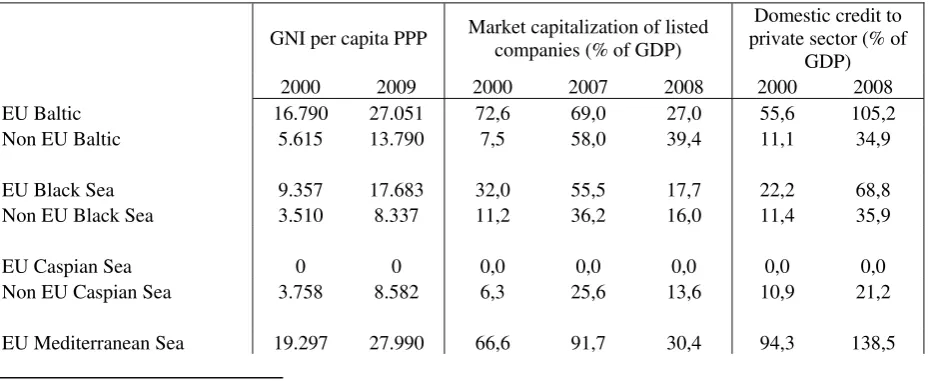
underdeveloped and rudimentary, which is clearly shown in Table 1.
The Baltic Sea basin has the highest average level of GNI per capita compared with the other
regions, followed by the Mediterranean Sea basin. The difference between EU and Non EU member
states, measured by the standard deviation, is also lower in the Baltic Sea basin then in the
Mediterranean, with the highest differences in the Black Sea basin.
The ranking remains essentially the same if we look at the two other indicators of financial
development: the Market capitalisation of the listed companies and the Share of lending to private
sector.
The indicators show two different aspects of the financial divide between EU and non-EU
members, and between regions. Where the process of financial liberalization is more advanced, as
for the stock exchange, the gap is much smaller. But where national restrictions prevail on the
harmonization to international rules, as in the commercial banking system, the gap is much wider
The share of private claims on GDP can help to access the degree of financial liberalization and
financial deepening. Table 1 indicates that the gap in financial deepening has been reduced during
the decade, but it still remains considerably high, one third in average of the euro area. Also the
differences among the countries or region are important: a low 20-35% in the Caspian and Baltic
region, with the predominant presence of Russia, compared to a 50% in the Mediterranean region
which has a relatively well developed commercial banking system.
Instead, for the market capitalization index, the differences disappeared during the decade as a
result of the improvements of the corporate governance of the listed companies and the government
policies. Financial activities have been boosted by increased listings of companies, mostly made
possible through privatization of state-owned enterprises. In addition, the growth of their economies
has been well above that of the EU, and the attractiveness of these new stock markets has grown
considerably in size and volume. For example, the Egyptian equity market is one of the most
developed in the Mediterranean region with 306 listed companies in 2009 (down from 1148 in
2002), a respectable number comparable to the listed companies in the Stock exchanges of Turkey
and Russia, 315 and 333 respectively. The cumulative result is that the average capitalization index
in the four regions increased to 50-60% in 2007 from 10-15% in the nineties, compared to the high
80% of the Eurozone. Therefore, considering the good performance of these markets, some of these
countries have been included in the MSCI composite index12. According to the classification of
markets and the accessibility measures that reflect the international investors’ experience and
excluding the Eurozone countries, 12 countries are defined as frontier markets13; other four as
emerging countries, and one, Israel, as developed market.
In this context of large differences in volume and in scale, the international financial integration has
provided additional resource to supplement domestic savings and increased the competition in
domestic financial systems. On the way to adapt their rules and regulations to the new environment,
these countries faced several problems that concern not only the development of a national financial
intermediation system but the economy in general.
Some of these problems have an institutional nature, as the low profitability of the economy and its
industries, the lack of a common corporate and economic culture or the inadequate protection of the
minority shareholder rights during the privatisation phase. And on more than one occasion, the
monopolisation of some sectors of the economy had a significant and negative influence in the
[image:13.595.59.524.486.678.2]financial markets.
Table 1: Domestic financial integration
GNI per capita PPP Market capitalization of listed companies (% of GDP)
Domestic credit to private sector (% of
GDP) 2000 2009 2000 2007 2008 2000 2008 EU Baltic 16.790 27.051 72,6 69,0 27,0 55,6 105,2 Non EU Baltic 5.615 13.790 7,5 58,0 39,4 11,1 34,9
EU Black Sea 9.357 17.683 32,0 55,5 17,7 22,2 68,8 Non EU Black Sea 3.510 8.337 11,2 36,2 16,0 11,4 35,9
EU Caspian Sea 0 0 0,0 0,0 0,0 0,0 0,0 Non EU Caspian Sea 3.758 8.582 6,3 25,6 13,6 10,9 21,2
EU Mediterranean Sea 19.297 27.990 66,6 91,7 30,4 94,3 138,5
13 Frontier markets: Estonia, Lituania; Kazakhstan; Romania, Bulgaria, Ukraine; Croatia, Lebanon,
Jordan; Serbia, Slovenia, Tunisia. Emerging markets: Russia, Turkey, Egypt, Morocco; Developed
Non EU Mediterranean Sea 5.524 11.144 12,3 53,9 27,7 35,9 48,9
Euro Area 23.275 33.193 86,9 85,0 37,9 97,9 126,4
3.3 The international perspective
From an international perspective the main contribution of integration is the source of financing,
with the traditional tripartition of international capital flows: (1) Foreign direct investment (FDI)
which are flows between firms and their foreign subsidiaries or foreign partners and may be the
result of earnings of the same foreign subsidiary that are retained abroad; (2) Portfolio investments,
which are private transaction in equity securities and debt securities between banks and financial
intermediaries; (3) Debt instruments, which are financial flows between financial intermediaries and
firms and governments which supports trade and investment activities.
All indicators of cross-border transactions from the IMF of the BIS suggest an ever increasing
interdependence within the countries of the four basins and the EU.
For the analysis we use the database of Lane and Milesi-Ferretti (2000-2007)14 with the update for
the year 2008. According to the authors’ methodology, international financial transactions are
divided into broad categories: portfolio equity investment, FDI, foreign exchange reserves, and debt
(which includes portfolio debt securities as well as other instruments, such as loans, deposits, and
trade credits).
The analysis will consider stocks, which is typical for such kind of structural analysis, instead of
flows. The net external position, given by the difference between total external assets and total
external liabilities, measures the net creditor or debtor position of the four regions vis-à-vis the rest
of the world. Therefore, the net external position is similar to the IMF definition of “Net
International Investment Position”, which is the measure of the cross-border financial net flows
(over time) plus the changes in the value of the holdings of these assets. We used the Lane
Milesi-Ferretti database because the IIP statistics diffused by the IMF do not yet cover all neighbouring
countries of the four basins.
From the elaboration of data we can derive a number of broad trends or stylized facts.
3.4 Two big trends
The pattern of international financial integration have changed significantly over the decade. It
seems that the direction of capital flows is no longer a one-way, top-down element of the European
pyramid of external relations. There are some partner countries with the highest assets close to the
highest liabilities, resulting in almost flat net position and others with increasing unbalances,
positive or negative. The traditional characterization of capital-rich and capital-poor no longer
follows the EU's external borders, so as to emphasize the traditional separation between the North
and the South that has governed the debate in the seventies. Today the role of financial
intermediation will hold for both: not only supplementing the domestic savings as proposed by the
traditional European institutional literature, but mobilizing the accumulated financial resources in
some countries or “swapping” assets and liabilities in order to diversify the risk.
In presenting the data, we divide countries into four basins. In addition in order to identify the EU
members within each group, we subdivide the 4 Seas groups in EU e non EU. The separation is
necessary in order to remark the different institutional character of the country and its association
with the foreign exchange regime.
The indicators follow the definition proposed by Lane and Milesi-Ferretti (2003)15 for measuring
the International Financial Integration as a stock to GDP ratio:
(1) IFI = (FA + FL) / GDP
where FA (FL) denotes the stock of external assets (liabilities). This ratio is a volume-based
measure of international financial integration.
The indicator can also be expressed as a difference between gross foreign assets and foreign, as
defined by the net external position, and GDP.
(2) NEP = (FA - FL) / GDP
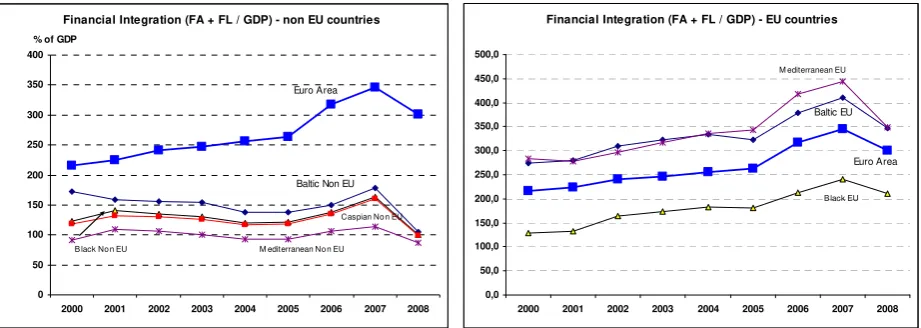
Figure 2 plots the IFI ratio, as a weighted average, for each of the four groups of countries over the
period 2000-2008. Since most of the adjustment of the liberalization of the capital accounts were
implemented rather quickly in the nineties, the share of capital flows has finally stabilized at a ratio
between 1,0 and 1,5, while continuing to increase in the euro area.
For the non-EU economies, we notice a deceleration of the financial integration that stops in 2004
with a resumption of bilateral flows that led these countries to overcome the initial levels of
integration. The financial crisis of 2008 has dissolved the progress achieved in a decade. The
development is however not comparable to the strength and the speed of financial integration within
the Union, with a ratio three time higher than the GDP.
This is, of course, consistent with the theory of financial harmonisation pursued by the Union since
the end of the seventies: no doubts that the international financial integration has increased
markedly, particularly among the EU economies. While the trend towards increased international
asset trade has been visible since the early 1970s, it has accelerated in the mid-1990s with the
implementation of the three stages of the EMU (Economic Monetary Union). Total assets of the
Euro Area increased from 6.590 billion USD to 19.239 billions in 2008. The IFI ratio increased
for both debt and equity instruments (the latter including FDI and portfolio equity) and in other debt
instruments.
The situation is completely different in the non-EU countries. We observe a general increase in
cross-border equity holdings, particularly FDI, but the overall stock of debt instruments on GDP
(debt assets and debt liabilities) has decreased over the decade. The pattern are similar for the four
basins, while we notice important differences in term of intensity. The non EU Baltic economies
have the highest IFI index for FDI and Portfolio equity instruments, 90% of GDP in 2007, while the
lowest 50% is reported by non EU Mediterranean countries. Furthermore, all four Neighbouring
regions show a common trend towards a smaller share of debt instruments, which is also converging
[image:17.595.62.523.460.624.2]to 50% of GDP.
Figure 2: International Integration Index (Gross position)
a) Gross capital flows
Financial Integration (FA + FL / GDP) - non EU countries
0 50 100 150 200 250 300 350 400
2000 2001 2002 2003 2004 2005 2006 2007 2008 % of GDP
Baltic Non EU
M editerranean No n EU Caspian No n EU
B lack No n EU
Euro Area
Financial Integration (FA + FL / GDP) - EU countries
0,0 50,0 100,0 150,0 200,0 250,0 300,0 350,0 400,0 450,0 500,0
2000 2001 2002 2003 2004 2005 2006 2007 2008 Baltic EU
M editerranean EU
B lack EU
Euro Area
Financial Integration (FA & FL equity and FDI / GDP) - non EU countries 0,0 20,0 40,0 60,0 80,0 100,0 120,0 140,0 160,0
2000 2001 2002 2003 2004 2005 2006 2007 2008 Baltic Non
M editerranean No n EU Caspian No n EU B lack No n EU
Euro Area
Financial Integration (FA & FL equity and FDI / GDP) - EU countries 0,0 20,0 40,0 60,0 80,0 100,0 120,0 140,0 160,0 180,0
2000 2001 2002 2003 2004 2005 2006 2007 2008 Baltic EU
M editerranean EU
B lack EU
Euro Area
c) Gross Other Investment (Portfolio Securities Debt and Other Investment)
Other FA+FL / GDP - non EU
0,0 50,0 100,0 150,0 200,0 250,0
2000 2001 2002 2003 2004 2005 2006 2007 2008 Baltic Non EU
M editerranean No n EU
Caspian No n EU B lack No n EU
Euro Area
Other FA + FL / GDP - EU
0,0 50,0 100,0 150,0 200,0 250,0 300,0
2000 2001 2002 2003 2004 2005 2006 2007 2008 Baltic EU
B lack EU
Euro Area
M editerranean EU,
Clearly, factors such as the increase in trade linkages, the reduction in capital controls, the foreign
exchange regime, advances in telecommunications, and the increased availability of information are
important in driving the acceleration of international financial integration in the four regions, but
the trends (in particular those referring to other investments) underscore the deep difference that
separates the European economy and that of neighbouring countries.
However, the structure and the quality of capital stocks has improved, in the sense that FDI has
become the most dynamic source of net capital flows in all regions. The “Russian factor” is relevant
here. In fact, the non-EU Baltic countries double their advantage on the Mediterranean region,
while considering the relative size to GDP, and they are also more integrated than the EU Black Sea
countries. During the decade FDI seems the most desirable type of flows, in that it tends to be more
know-how. Additionally we can notice that the announcement of the ENP project in 2004 has contributed
positively in accelerating the FDI inflows in all regions.
But there is another fundamental trend concerning the convergence effect of a deeper integration.
The EU imbalances have increased during the decade after the accession of the Eastern and Nordi
countries, while for the non EU partners the convergence was the main effect of the European
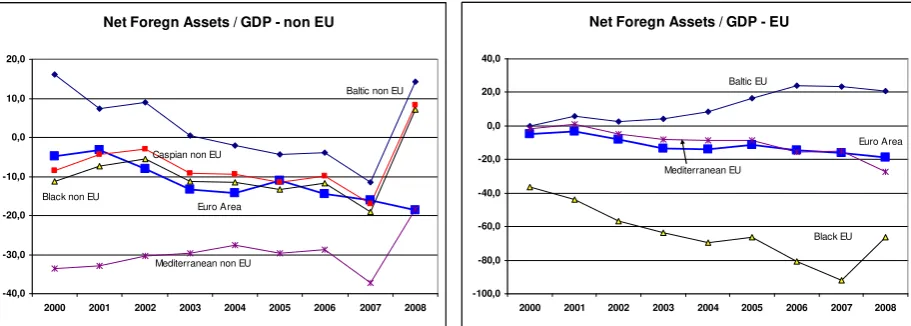
integration project until the disruption caused by the financial crisis in 2008. The Euro Area
consolidated its position of net exporter of capital, with a net negative position near to 20% of GDP.
Non EU Mediterranean decreased their net debt position from 35% to 21% of GDP, while the non
EU Baltic region (Russia, for clarity) shifted from a net positive position to a negative one since
2004.
These trends confirm that the evolution of the neighbouring countries may be different from the
other emerging market economies, which on the contrary, suffered the contraction of external
capital flows during the same period. In this perspective the favourable expectations of the
international lenders to the Baltic region, and Russia in particular, differ from the relative
contraction of external financing (in particular bank loans) affecting the Southern Mediterranean
region. These convergence patterns were interrupted by the financial crisis of the summer 2008. In
fact, the net creditor position in 2008 in the three regions (Baltic, Caspian and Black sea) is
essentially due to the contraction of portfolio liabilities of Russia.
Instead, for the EU economies the imbalances increased, with a positive net position for the Baltic
region (net position of Germany) and a deterioration of the Black Sea region (Greece) and
Mediterranean Region (Spain).
Which are the largest creditors and debtors, relative to their GDP levels? Even though richer
countries tend to be creditors (Germany, with a net position of 25% of GDP in 2007 - 7% in 2001
creditor with net foreign credits higher than 30% of GDP (230% for Libya). In the Caspian region
the foreign assets accumulated by the governments during the decade of high oil and gas prices now
exceed the total foreign debt and inward FDI in countries like Azerbaijan, Turkmenistan and
Uzbekistan, with an average net external position higher than 30%. Iran too, has a net positive
position.
Several neighbouring countries have successfully build up foreign assets and funds that help
mitigate the impact of the economic setback in the industrial countries, but the longer-term goal of
economic diversification remain elusive. This is partly because these countries in the Mediterranean
and Caspian basin are dependent on wealth from natural resources and they lack of the sound
institutional framework that would support the creation of a more diversified economy.
France become net debtor in 2008, with a remarkable contraction of the value of FDI. The EU
largest net debtors are Spain, with a NEP index higher than 80% (from a 24% in 2000), Greece
(more than 100%) and Italy (21%). Indeed, in addition to the level of development (measured by the
GNI), several other factors—including demographics, the size of public debt and FDI, and natural
resources—influence significantly the net external position of the four basin.
From the perspective of private capital flows the asymmetries between EU and non EU have
increased, with a negative net external position higher than 35% of GDP in all regions and with
only five capital exporting EU countries (Denmark, Germany and Sweden) in the Baltic Sea, Italy
and France in the Mediterranean Sea. Among the neighbouring countries only Libya is a net
investor (Portfolio Investments). For the non-EU Mediterranean countries and Baltic region, the
downward trend in their external position was reversed in 2008, primary because of a deterioration
of Russian Federation (contraction of inward FDI) and the stability of the Caspian ad Black sea.
For the Baltic the improvement in 2008 is due to the contraction of foreign investments in the same
The comparative look for the net debt position (debt assets less debt liabilities) shows the common
convergence to lower level of external exposure, around 10% of GDP, while in 2000 the non EU
Mediterranean countries were exposed by more than 30% of their GDP. Here, the shift from
indebtedness to FDI has been made possible by the instruments of the first pillar of the
euromediterranean partnership within the Barcelona Process. Instead, the financial integration
within the EU has encouraged a credit boom and over-borrowing which have increased the
unbalances in the Black sea basin (Greece in particular and Romania), the Mediterranean (again
Greece and Spain), in contrast with the Baltic Sea basin that is near the balance or in net creditor
[image:21.595.63.519.427.590.2]position.
Figure 3: Net External Position Index
a) Gross capital flows
Net Foregn Assets / GDP - non EU
-40,0 -30,0 -20,0 -10,0 0,0 10,0 20,0
2000 2001 2002 2003 2004 2005 2006 2007 2008 Baltic non EU
Mediterranean non EU Caspian non EU
Black non EU
Euro Area
Net Foregn Assets / GDP - EU
-100,0 -80,0 -60,0 -40,0 -20,0 0,0 20,0 40,0
2000 2001 2002 2003 2004 2005 2006 2007 2008 Baltic EU
Mediterranean EU
Black EU Euro Area
Net PF + FDI / GDP - non EU -35,0 -30,0 -25,0 -20,0 -15,0 -10,0 -5,0 0,0
2000 2001 2002 2003 2004 2005 2006 2007 2008 Baltic Non EU
M editerranean No n EU
Caspian No n EU
B lack No n EU
Euro Area
Net PF + FDI / GDP - EU
-40,0 -30,0 -20,0 -10,0 0,0 10,0 20,0 30,0
2000 2001 2002 2003 2004 2005 2006 2007 2008 Baltic EU
M editerranean EU
B lack EU
Euro Area
c) Gross Other Investment (Portfolio Securities Debt and Other Investment)
Net Other FA / GDP - non EU
-40,0 -30,0 -20,0 -10,0 0,0 10,0 20,0
2000 2001 2002 2003 2004 2005 2006 2007 2008 Baltic Non EU
M editerranean No n EU Caspian No n EU
B lack No n EU
Euro Area
Net Other FA / GDP - EU
-70,0 -60,0 -50,0 -40,0 -30,0 -20,0 -10,0 0,0 10,0 20,0
2000 2001 2002 2003 2004 2005 2006 2007 2008 Baltic EU
M editerranean EU
B lack EU
Euro Area
3.5 Opportunities and risks for neighbouring countries
The large increase in cross-border equity and direct investment holdings and the shifting patterns in
international borrowing and lending in the non EU partners can be viewed positively, as factors
reducing the vulnerability of the neighbouring markets to external shocks. Equity liabilities
(including FDI) now account for about 40% of total external liabilities as a whole, compared to
20% of EU countries. Only the non EU Mediterranean countries, while showing a gradual growth
of private capital inflows, remained below 33%, offsetting the difference with a greater share of
Financial integration also relates to the foreign assets and here we see an important systemic
innovation, the growth of the outward FDI, which were enhanced by the removal of legal
restrictions and the increased integration of the economies. The basins concerned are those of the
Baltic and Black Sea, which are interconnected by the foreign investment activities of the Russian
firms. The critical aspect in these financial relations is the lack of dynamism of the Mediterranean
countries, with a share of direct investment of less than 10% of their foreign assets
Consequently, all neighbouring economies have dramatically reduced the share of debt to their
external liabilities to level well below the EU average, thus clearly reducing the risks of financial
crises by linking more closely the return on external liabilities to domestic economic performance.
However, as can be seen in figures 4, the financial crisis of 2008 as reversed the good performance
[image:23.595.60.522.488.653.2]of the previous years.
Figure 4: Share of FDI and Indebtedness
a) Share of Other Foreign Investment over total Foreign liabilities
Share of other FL / Total Liabilities - non EU
0,0 10,0 20,0 30,0 40,0 50,0 60,0 70,0 80,0 90,0
2000 2001 2002 2003 2004 2005 2006 2007 2008 Baltic Non EU
M editerranean No n EU
Caspian No n EU B lack No n EU
Euro Area
Share of other FL / Total Liabilities - EU
30,0 40,0 50,0 60,0 70,0 80,0 90,0
2000 2001 2002 2003 2004 2005 2006 2007 2008 Baltic EU
B lack EU
Euro Area
M editerranean EU,
Share of FDI out - non EU 0,0 5,0 10,0 15,0 20,0 25,0 30,0 35,0 40,0
2000 2001 2002 2003 2004 2005 2006 2007 2008
Baltic Non EU
M editerranean No n EU Caspian No n EU
B lack No n EU
Euro Area
Share of FDI out - EU
0,0 5,0 10,0 15,0 20,0 25,0 30,0 35,0 40,0
2000 2001 2002 2003 2004 2005 2006 2007 2008 Baltic EU
M editerranean EU
B lack EU
Euro Area
c) Share of inward FDI over total Foreign Liabilities
FDI in / Total FL - non EU
0,0 5,0 10,0 15,0 20,0 25,0 30,0 35,0 40,0 45,0
2000 2001 2002 2003 2004 2005 2006 2007 2008 Baltic Non EU M editerranean No n EU
Caspian No n EU
B lack No n EU
Euro Area
FDI in / Total FL - EU
0,0 5,0 10,0 15,0 20,0 25,0
2000 2001 2002 2003 2004 2005 2006 2007 2008 Baltic EU
M editerranean EU
B lack EU
Euro Area
3.6 Stock market capitalization
In terms of their stock market capitalization, The Mediterranean and Baltic Sea Regions are in a
better position. Particularly, Egypt, Jordan, Morocco, Croatia, in the Mediterranean basin and
Russian Federation in the North show a clear upward trend between 2003 and 2007 (Figure 5).
Nevertheless, the stock market capitalization still remains considerably below the relevant quotients
of developed economies in Tunisia, Algeria, Turkey, Syria, Belarus and in the Caspian basin.
Because the stock market is of relevance in financing enterprises, further efforts especially to attract
[image:24.595.58.524.72.236.2]foreign investors can be very important.
Market capitalisation / GDP - non EU 0,0 10,0 20,0 30,0 40,0 50,0 60,0 70,0 80,0 90,0 100,0
2000 2001 2002 2003 2004 2005 2006 2007 2008 Baltic Non EU
M editerranean No n EU
Caspian No n EU
B lack No n EU
Euro Area
Market capitalisation / GDP - EU
0,0 10,0 20,0 30,0 40,0 50,0 60,0 70,0 80,0 90,0 100,0
2000 2001 2002 2003 2004 2005 2006 2007 2008 Baltic EU
M editerranean EU
B lack EU
Euro Area
3.7 Reserves
Finally, international reserves that are the liquid external assets under the control of the central
bank. Here we notice a great asymmetry between the EU and the non EU regions. Not only the
reserves-GDP ratios are ten time larger in non EU countries but the ratios increased substantially
during the decade, 30% of GDP in the Mediterranean basis and 35% in the Baltic region (Russia in
particular).
In a period of greater flexibility of the exchange rates it is debatable this huge accumulation of
reserves in line with the predictions of the buffer stock model (Adjustment costs, volatility of
foreign trade, exposure volatile short-term inflows of capital)16.
These reserves have a cost, a “social cost”, that Rodrik (2006)17 estimated trough the spread
between the private sector’s cost of short-term borrowing abroad and the yield that the Central Bank
earns on its liquid foreign assets. The estimated spread is 3 to 7 percent, a spread undoubtly very
high especially for capital scarce economies. Therefore, it can be suggested that the central bank
either curtail the size of reserves accumulation or invest the excess reserves for more profitable
returns in term of employment (Mediterranean basin) and growth (Baltic basin).
16 CALVO, G. (1998); EDWARDS, S. (2004).
Figure : Stock of International Reserves in the 4 Seas 2000-2008, in percent of GDP
Reserves / GDP - non EU
0,0 5,0 10,0 15,0 20,0 25,0 30,0 35,0 40,0
2000 2001 2002 2003 2004 2005 2006 2007 2008 Baltic Non EU
M editerranean No n EU Caspian No n EU B lack No n EU
Euro Area
Reserves / GDP - EU
0,0 2,0 4,0 6,0 8,0 10,0 12,0
2000 2001 2002 2003 2004 2005 2006 2007 2008 Baltic EU M editerranean EU
B lack EU
Euro Area
4. Conclusions
The experience of the South Mediterranean countries suggest that, despite the improvements in the
FDI inflows and in deeper financial integration to some countries (Morocco, Tunisia, Egypt,
Jordan) its sectoral destination does not always correspond to the real needs of the recipient
economies. Excluding privatizations and investments in oil and gas concessions, foreign promoters
invested only 1% of GPD, and the results were disappointing when confronted with the “ritual”
declarations to stimulate local production capacity and to create additional employment and
revenue.
Therefore the essential policy issue is not simply to deepen the financial integration of the
neighbouring counties into the global market, but how to build competitive and dynamic sectors and
to improve the composition of the exports along the competitive advantages that require continuous
investment, especially in skills and information.
Despite these weaknesses, foreign investors could increase the chances of domestic enterprises to
realize trade and investment opportunities through partnership, networking and exchange of
For understanding the factors behind the financial integration and the necessary policy measures,
one needs to look at the role of the various institutions in the financial markets, not only in the
markets for goods and services, which are the main interest of the FTA project.
Financial cooperation, rather than financial integration, is still seen as a tool for targeted assistance
to partner countries and the financial resources allocated the EU supported financial Institutions are
still marginal compared to the financial flows of interest to the partner countries. In three basins the
financial cooperation is assisted and promoted by regional Financial Institutions supported by EU
member states: FEMIP in the Mediterranean, the IEB, the Black Sea Trade and Development Bank,
the Nordic Investment Bank. It is obvious that the institutionalization of financial cooperation is in
itself an incentive, but at the same time is not the sole condition for the success of economic
integration with the neighbouring countries.
Financial integration need the presence of foreign banks which are expected to strengthen the
economic relationships among the EU and the partner countries or among the partner countries.
Financial integration need also a more open attitude from the central authorities, which include also
the reconsideration of the exchange rate regime, since recent experience shows that countries that
anchored their currencies to the Euro at the end they get better results in term of growth and
References
CALVO, Guillermo,“Capital flows and capital-market crises: the simple economics of sudden
stops”. Journal of Applied Economics, 1998,1, 35–54.
CHINN, Menzie and Ito Hiro, “Capital Account Liberalization, Institutions and Financial
Development: Cross Country Evidence,” NBER Working Paper No. 8967, 2002.
CHINN, Menzie D and ITO, Iro, What Matters for Financial Development? Capital Controls,
Institutions, and Interactions, NBER Working Paper No. 11370, 2005
CHINN, Menzie D and ITO, Iro, A New Measure of Financial Openness, Journal of Comparative
Policy Analysis, Volume 10, Issue 3 September 2008 , p. 309 - 322.
EDISON, Hali. J, KLEIN, Michael., RICCI Luca Antonio. and SLOK Torsten., “Capital Account
Liberalization and Economic Performance,” IMF Staff Papers, 2004, Vol. 51, issue 2, pages 220.
EDWARDS, Sebastian, “Thirty years of current account imbalances, current account reversals, and
sudden stops”, IMF Staff Papers, 2004, 51 (Special Issue), 1–49.
EICHENGREEN, Barry., 2002. “Capital Account Liberalization: What Do the Cross Country
Studies Show Us?” World Bank Economic Review, Vol 15, No.3, pp. 341-366.
EUROPEAN COMMISSION, “Capital Market Liberalization”, The Single Market Review Series,
Subseries III - Dismantling of Barriers, Bruxelles, August 1996.
EUROPEAN COMMISSION, Communication from the Commission, European Neighbourhood
Policy, Strategy Paper, Bruxelles, Brussels, 12.5.2004, COM(2004) 373 final.
KOSE, M. Ayhan PRASAD, Eswar S., ROGOFF, Kenneth, WEI, Shang-Jin, “Financial
Globalization: A Reappraisal”,2009, IMF Staff Papers, Vol. 56, No. 1, pp. 8-62.
JOHNSTON, R. Barry and TAMIRISA, Natalia T., 1998. “Why do countries use capital controls?”,
LAGOARDE-SEGOT, Thomas and LUCEY, Brian M., “The Capital Markets of the Middle East
and North African Region. Situation and Characteristics”, Emerging Markets Finance & Trade,
September–October 2008, Vol. 44, No. 5, pp. 68–81.
LANE, Philip R., and MILESI-FERRETTI Gian Maria, “The External Wealth of Nations: Measures
of Foreign Assets and Liabilities for Industrial and Developing Countries, ”Journal of International
Economics, 2001, Vol. 55, pp. 263–94.;
LANE, Philip R., and MILESI-FERRETTI Gian Maria, “International Financial Integration,” IMF
Staff Papers, 2003, Vol. 50, Special Issue, pp. 82–113 (Washington: International Monetary Fund).
MASSAD, Carlos, “Capital Flows in Chile: Changes and Policies in the 1990’s,” in Financial
Globalization and the Emerging Economies, J. A. Ocampo, S. Zamagni, R. Davis and C. Pietrobelli
(ed.), 2000, United Nations. pp.219-233.
MINIANE, Jacques., 2004. “A new set of measures on capital account restrictions,” IMF Staff
Papers, 1004, vol. 51, issue 2, pages 4.
MSCI, MSCI Global Market Accessibility Review, June 2010
MÜLLER-JENTSCH, Daniel, Deeper Integration and Trade in Services in the Euro-Mediterranean
Region: Southern Dimensions of The European Neighbourhood Policy., Washington, D.C., World
Bank and European Commission, 2004.
PRASAD, Eswar S., ROGOFF, Kenneth, WEI, Shang-Jin, and KOSE, M. Ayhan, Effects of
Financial Globalization on Developing Countries: Some Empirical Evidence, 2003, IMF
Occasional Paper No. 220 (Washington: International Monetary Fund)
QUINN, Dennis, “The Correlates of Change in International Financial Regulation,” American
Political Science Review, 1997, 91(3), pp. 531-551.
SCHMUKLER, Sergio L., “Financial Globalization: Gain and Pain for Developing Countries,”
Federal Reserve Bank of Atlanta Economic Review, 2004, Second Quarter.
STIGLITZ, Josef E., “Capital-market Liberalization, Globalization, and the IMF”, Oxford Review
Biographical note
Sergio Alessandrini joined the University of Modena and Reggio Emilia (Faculty of Law) in 1991
and is currently Full Professor of Economics. He is member of the Steering Committee of FEMISE
(Forum Euro-méditerranéen des Instituts économiques ), Marseille. He Graduated in Economics
from Bocconi University (Milan, Italy) in 1972. He did post graduate studies in economics at
Chicago University (Dept of Economics) and Cambridge University (UK).
Professor Alessandrini is the author of some fifty publications and articles related to a wide range of
topics and international issues including European integration, economics of transition and foreign
direct investment.
He has been on the board of directors of the PhD programme at Bocconi University (Italy) and
Maastricht School of Management (Netherlands).
Also, he has served as President of the Economic programme Committee of the Lombardy Region
during 2000-2005, and is consultant of the European Commission and international organisations