Munich Personal RePEc Archive
Gun control and suicide: The impact of
state firearm regulations, 1995-2004
Hempstead, Dr. Katherine and Andres, Dr. Antonio
Rodriguez
2009
Online at
https://mpra.ub.uni-muenchen.de/20728/
Institute for Advanced Development Studies
Development Research Working Paper Series
No. 17/2009
Gun control and suicide:
The impact of state firearm regulations, 1995–2004
by:
Katherine Hempstead
Antonio Rodríguez Andrés
December 2009
Gun control and suicide:
The impact of state firearm regulations, 1995–2004
♦Katherine Hempstead*
Antonio Rodríguez Andrés$
December 2009
Abstract:
Suicide is a major cause of preventable death. Restricting access to lethal means has been identified as an effective approach to suicide prevention, and firearms regulations are one way to reduce gun availability. This study examines the relationship between state firearms regulations and suicide among males, using negative binomial regression and state panel data for the years 1995–2004. Results suggest that firearms regulations which function to reduce overall gun availability have a significant deterrent effect on suicide, while prohibited persons categories have less of an effect. Overall, the results suggest that gun control measures such as permit and licensing requirements might have public health benefits.
Keywords: suicide; guns; state regulations; panel data.
JEL classification: I18.
♦ The authors thank Sara Markowitz, Camelia Minoiu, and Gary Kleck for helpful comments and
suggestions. *
The Center for State Health Policy Rutgers, The State University of New Jersey 55 Commercial Avenue, 3rd Floor New Brunswick, NJ 08901-1340 (E-mail:[email protected]). (Tel:
732-932-3105; Fax:732-932-0069)
$ School of Public Health, Department of Health Services Research, University of Aarhus, Bartholins
1. INTRODUCTION
1.1 Firearms and suicide
Suicide is a major cause of preventable death. In 2006, more than 32,000 suicides occurred in the United States, as compared with approximately 18,000 homicides. Suicide is the 8th leading cause of death for males, and the 19th leading cause for females in the United States. For every suicide, there were more than ten hospitalizations from non-fatal attempts. In 2006, an average of 46 Americans committed suicide daily with a firearm, accounting for approximately 50 percent of all suicides (CDC, 2009).
There is a considerable body of empirical work that has documented a positive relationship between access to firearms and suicide (Miller and Hemenway, 2008; Miller et al., 2005). In fact, much of the decline in suicide in the United States over the past decades has been linked to the reduced prevalence of firearms (Miller et al., 2005; Miller et al., 2007; Cook and Ludwig, 2006). Although the respective roles of self-selection and availability in explaining the relationship between guns and suicide have not been completely resolved, the implication in either case is that reducing access to firearms should reduce suicide (Duggan, 2003) Restricting access to firearms has been recommended as a suicide prevention strategy by national and international organizations such as the CDC and the WHO. Gun control policies can serve to reduce overall gun availability by creating barriers to firearm ownership. Additionally, firearms policies can also prevent individuals who are at a relatively higher risk of suicide from purchasing firearms.
Gun Control
ownership deters crime. In the academic literature, the efficacy of gun control in reducing violence has received considerable attention, although little consensus has emerged from the empirical work (Cook and Ludwig, 2006; Lott and Whitley, 2000; Kleck and Kates, 2001; Kleck, 2004).
The current era of gun control in the United States originated with the Brady Handgun Violence Prevention Act (1993)1, more commonly known, as the Brady Bill. The Brady Bill established a federal requirement for a waiting period of up to five days before the transfer of a handgun to a purchaser. During this period, a background check is performed, which is intended to prohibit individuals with criminal backgrounds from purchasing firearms. The transfer of the handgun is completed whether or not the background check is finalized within the five-day period. The federal waiting period was phased out in 1998 with the development of the National Instant Criminal Background Check System (NICS), administered by the Federal Bureau of Investigation (FBI). Over time, many states have passed laws which matched or surpassed the federal minimums.
There are many different types of state firearm regulations. Some seek to establish general oversight over individuals owning firearms, and mainly consist of permit, registration, and/or license requirements, and bans on the purchase of firearms by minors. These laws also facilitate the tracing of firearms used in crimes to original purchasers. Other state laws seek to prevent gun trafficking and the use of firearms in crimes. These consist of bans on the sale of certain types of firearms, and restrictions on the number of firearms that can be sold to individuals. Restrictions on carrying concealed weapons serve a similar purpose. A number of laws are designed to prevent firearm ownership by individuals considered disproportionately likely to commit gun crimes. These laws include prohibitions on gun ownership by those with criminal histories, such as conviction for a felony, misdemeanor, or domestic violence offence, as well as those with a history of mental illness, and alcohol or drug problem, and minors. The requirement of a “cooling off” period of some specified period before the purchase can be completed is a measure designed to reduce the consequences of impulsive firearm purchases.
There is considerable variation in the comprehensiveness of firearm regulation across U.S. states. Some states have almost no firearm regulation of their own. Forty-four states have a provision in their state constitutions similar to the Second Amendment of the Bill of Rights (the exceptions are California, Iowa, Maryland, Minnesota, New Jersey, and New York). Firearm license holders are subject to the firearm laws of the state in which they are carrying and not the laws of the state in which the permit was issued. Reciprocity between states may exist for certain licenses such as concealed carry permits. These are recognized on a state-by-state basis.
Some firearms regulations are more relevant to suicide prevention than others. Restrictions banning the purchase of guns by convicted felons, or laws banning the sale of “Saturday Night Specials”, for example, have little obvious applicability to suicide. Yet other categories of restriction are potentially more salient, particularly those that reduce overall firearm availability. Permit requirements create barriers to gun ownership and may also serve to prevent impulsive purchases. The prohibition of purchases by minors serves a similar function. Some of the “prohibited persons” categories, such as those related to mental illness, a drug or alcohol problem, or history of domestic violence problems may theoretically be relevant to suicide prevention, but in all likelihood are not.2 Mental illness is the single most important risk factor for suicide, and substance abuse and domestic violence are also risk factors. However, while the criteria for “prohibited persons” categories varies by state, they are generally based on fairly serious incidents, such as hospitalization against one’s will or conviction records. Such bans are likely to identify only a fraction of the population with mental health, substance abuse, or domestic violence problems.
At the state level, the comprehensiveness of gun control laws tends to be correlated with firearm prevalence. The causality most likely runs in both directions, since restrictive gun control regimes reduce gun ownership, yet these laws are more likely to be passed in states where overall gun ownership rates are relatively low and the
2 In some states, the alcohol regulation means that sale of firearms are prohibited to people who are
population of gun rights advocates is relatively small. In general, Western and more rural states have fewer gun control restrictions and higher rates of gun ownership as compared with more urbanized states in the Northeast. These states also have significantly higher rates of suicide, particularly firearm suicide.
1.2 Gun Control and Suicide
The literature on gun control and suicide has in general found a negative relationship between firearm restrictions and suicide. However, most of these studies lack a strong design and are essentially pre- and post- comparisons (Killias et al., 2001). Lambert and Silva (1998) perform a literature review of studies in the United States and Canada and conclude that available information generally supports the notion that gun control can reduce suicide rates, particularly among males. Another review of gun control in the United States, framed within the context of historical and rational choice theory, covers attempts to curb firearm violence in that country and the success of such measures (Cook et al., 2001). A recently published analysis suggests that states where background checks are conducted locally have lower rates of firearm suicide and homicide (Sumner et al., 2008)
Several studies in other countries where regulations restricted general access to firearms have found evidence of an effect on suicide. Cheung and Dewa (2005) examine the relationship between suicide and the implementation of new restrictions on firearms (Bill C-17), using time series data from Canada. They concluded that there was a relationship between means used by young people and the imposition of the restrictions. In the case of New Zealand, Beautrais et al. (2006) find that after the introduction of legislation restricting ownership and access to firearms, firearm suicides significantly decreased, particularly among the young. Ozanne-Smith et al. (2004) conclude that the implementation of a strong reform in New Zealand lowered firearms deaths, particularly suicides. An evaluation of the 1996 National Firearms Agreement (NFA) in Australia documents a decline in firearm suicides after the implementation of the agreement (Klieve et al., 2009). However, these findings may be confounded with an overall decline in gun ownership that preceded the NFA. Additionally, there was some evidence of increased suicides by hanging.
In Europe, a study of the E.U. countries as a group and the U.K. in particular has found that changes in firearm legislation have led to fewer firearm suicides (Kapusta et al., 2007; Hawton et al., 1998; Haw et al., 2004). An analysis of firearm legislation reforms enacted in 1997 in Austria also found a statistically strong effect on suicide rates (Wahlbeck and Mäkinen, 2008).
2. EMPIRICAL MODEL AND DATA
2.1 Empirical model
prohibition of a relatively small proportion of people at risk. Firearms regulations designed to prevent gun trafficking or other criminal activity involving guns are not expected to influence suicide rates.
There are several potential complications to this simple model. The first is that of state variation in views towards guns is likely to affect both firearm prevalence and the comprehensiveness of gun control regulation. Additionally, views toward gun ownership evolve over time. Finally, there is the problem of the mismeasurement of gun ownership.
The basic model can be expressed with two equations:
1. S=α + βG + µ
2. G=δ - ∆R + Φ
Where S is suicide, G is firearm prevalence, and R is firearms regulation. The reduced form is:
3. S= α+ βδ – β∆R + βΦ + µ
The potential endogeneity of firearm prevalence with respect to gun control is reflected in the identifying equation,
4. R=ω + ηG+φ
However, G is not measured annually. For our main specification we estimate the reduced form equation (3), thereby assuming that η is zero. In an alternative specification, we instrument for G with the number of hunting licenses per capita, a statistic which is collected annually for all states.
For the main specification, the estimating equation is:
5.
where the subscript i indexes each age group with i = 15–24, 25–44, 45–64, and 65+ ,
j indexes each state with j=1,…,50 and t indexes time period with t = 1995,…, 2004. Equation (5) specifies that the number of male suicides for age group i in state j
during the year t is a function of laws regulating the possession of firearms (Zit), other
socioeconomic characteristics (Xit), state effects (αi), year effects (λt), and
ε
ittheclassical error term. The sample contains 500 state-year observations. The sample period (1995-2004) was chosen because gun data before and after 1995 is not readily
) , , , ,
( jt it i t it
ijt f Z X
comparable, and there are in fact relatively few state firearms regulations prior to
1995.
The dependent variable— male suicides by state, year and age group— violates the
Poisson assumption that the conditional mean is equal to the conditional variance.
Instead, the suicide data are overdispersed: the variance exceeds the mean. The
over-dispersion can cause a downward bias in the standard errors resulting from Poisson
regression. To avoid such bias, we estimate a negative binomial model via maximum
likelihood. The variance of the distribution is modeled as a quadratic function of the mean, E [Yi] = µ, so that σ2 = µ + αµ2, where α is the dispersion parameter (Cameron and Trivedi, 1998). In our case, the negative binomial model has a significantly better
goodness of fit than the Poisson model. A likelihood ratio test of the negative
binomial dispersion parameter leads to the conclusion that the Poisson distribution is
inappropriate for the data. We do not use zero-inflated specifications since there is no
excess of zeros in the dependent variable.
Each model includes the relevant population as a right hand side control variable to
normalize by exposure. The specification includes fixed effects that account for
unobserved heterogeneity across states. The fixed effects model is appropriate in this
case given the almost complete population coverage by the sample (Kennedy, 1998, pp. 227) and it is likely that the omitted variables captured by the αi are correlated
with some of the included covariates. Since nearly ninety percent of firearm suicides
are committed by males, we have excluded females from the analysis (CDC, 2009).
We estimate separate models for males of all ages and in four different age groups:
15–24, 25–44, 45–64, and 65 years and older.
We face several identification challenges. The first is that gun control regulations by
state tend to change slowly, so there tends to be relatively little within-state year–on-
year change. Further, once states adopt particular gun control regulations, they never
remove them. For these reasons, it is not possible to analyze leads and lags, which
would be a desirable robustness check. To maximize variation, we have created
several indices of categories of gun control regulations, which are additive measures
2.2 Data
a. Dependent variable
Data on the number of suicides in states over the period 1995–2004 come from the
Centers for Disease Control (CDC). Deaths included in the study are those
categorized as suicides according to the International Classification of Diseases
(ICD). In 1999, there was a change in the classification system from ICD–9 to ICD–
10. In the case of suicide, this change in ICD version is thought to have a negligible
effect on the classification of suicides. For 1995–98, suicide deaths were coded as
E950–E959. Starting in 1999 and later, suicide deaths were coded as X60–X84,
Y87.0, and U03.
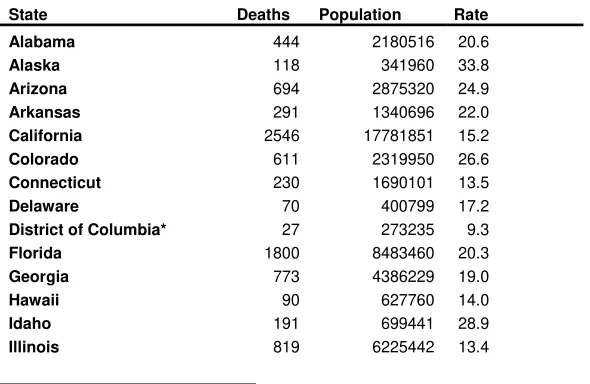
Table 1 displays the age adjusted male suicide rates across US states for the year
2004.3 Reported suicide rates in the US vary considerably across states. The suicide rate in Nevada (30.2), for example, is nearly thrice that in New York (10.4). The
District of Columbia is excluded, since it has essentially banned the possession of
[image:11.612.96.391.442.634.2]handguns.
Table 1. Age-adjusted male suicide rates, by state, 2004
State Deaths Population Rate
Alabama 444 2180516 20.6
Alaska 118 341960 33.8
Arizona 694 2875320 24.9
Arkansas 291 1340696 22.0
California 2546 17781851 15.2
Colorado 611 2319950 26.6
Connecticut 230 1690101 13.5
Delaware 70 400799 17.2
District of Columbia* 27 273235 9.3
Florida 1800 8483460 20.3
Georgia 773 4386229 19.0
Hawaii 90 627760 14.0
Idaho 191 699441 28.9
Illinois 819 6225442 13.4
3
Indiana 563 3054027 18.9
Iowa 287 1448679 19.7
Kansas 291 1351179 21.8
Kentucky 464 2024358 22.9
Louisiana 437 2176259 20.8
Maine 137 637824 21.0
Maryland 403 2675138 15.3
Massachusetts 343 3114101 10.9
Michigan 875 4960895 17.8
Minnesota 427 2523241 16.8
Mississippi 295 1395815 21.8
Missouri 562 2799494 20.4
Montana 142 462398 30.6
Nebraska 132 861390 15.4
Nevada 342 1181165 30.2
New Hampshire 104 636504 16.4
New Jersey 482 4202733 11.4
New Mexico 291 931748 31.5
New York 972 9335736 10.4
North Carolina 796 4170787 19.5
North Dakota 63 318958 19.0
Ohio 1036 5570983 18.7
Oklahoma 395 1731819 23.3
Oregon 415 1775505 23.3
Pennsylvania 1130 5981910 18.5
Rhode Island 70 517179 13.1
South Carolina 391 2041647 19.4
South Dakota 94 385163 24.7
Tennessee 627 2880226 22.0
Texas 1803 11163013 17.4
Utah 310 1227347 28.4
Vermont 77 303996 24.7
Virginia 657 3651909 18.6
Washington 639 3073759 21.4
West Virginia 236 880805 26.4
Wisconsin 507 2732268 18.4
Wyoming 67 253954 27.5
United States 25,566 144,060,672 18.0
Note: *The District of Columbia is excluded from the remainder of the analysis because it had virtually outlawed the possession of guns during the study period.
b. Independent variables
Firearms regulations
In order to maximize variation across states and over time in the measure of gun
control, we created three additive indices that reflect different intensities of firearms
prevention–– measures general prohibitions. It is the sum of two indicator variables
reflecting the presence of permit requirements and on firearm, purchases by minors.
This index thus varies between 0 and 2.
The second index measures prohibitions based on behavioral problems, some of
which have been identified as risk factors for suicide, but which are not likely to
actually affect suicide. This index is the sum of five indicators variables reflecting the
presence of bans on persons with mental health, alcohol, or drug problems, as well as
prohibitions on those with prior convictions for misdemeanors and domestic violence
offenses.
Our third and last index captures four types of prohibitions reflecting criminal
concerns. We include this variable primarily as a robustness check, since the
prohibitions captured are least likely to affect suicide. The index, varying between 0
and 4, is the sum of indicator variables measuring the presence of prohibitions against
“aliens”4, convicted felons, fugitives from justice, and those who committed serious offenses as juveniles.
Gun ownership
Given the relationship between firearm regulations and firearm prevalence, as well as
that between firearm prevalence and suicide, it is necessary to control for gun
ownership in the alternative specification. Gun ownership is available every several
years from the CDC’s Behavioral Risk Factor Surveillance System, but there is no
annual data at the state level, and the available data only dates back to 2001. The most
commonly used proxies for gun ownership are the proportion of homicides and the
proportion of suicides committed with firearms (see, Lester, 1987; Lester, 1989;
Hemenway et al., 2001; Miller et al., 2002; Shenassa et al., 2006; Azrael et al., 2004).
These variables are combined to create an index called Cook’s index. However, given
that the dependent variable for this analysis is the total number of suicides, it was felt
that this proxy was inappropriate. As an alternative, the number of hunting licenses
per capita from the Fish and Wild Life Service5 was used as a control for gun
4 In some states, this prohibition refers to undocumented immigrants, while in others to individuals
who have “forsaken their allegiance to the United States.”
ownership6. Hunting licenses per capita and firearm suicides as a proportion of suicides were highly correlated (r =0.74, p-value <.05). Data on state gun regulations
was obtained from the Bureau of Justice Statistics.7
Data on state personal income (income) were obtained from the Bureau of Economic
Analysis and deflated by the consumer price index (CPI) extracted from the Bureau
of Labor Statistics (BLS). Unemployment rates (unemployment) also come from the
BLS. Data on per capita ethanol consumption of beer (beer), an estimate for the
amount of pure ethanol consumption per capita, was extracted from the NIIA
Surveillance Reports. Alcohol consumption and economic conditions have been
linked to suicide in a number of population level studies (Yang, 1992; Markowitz et
al., 2003) The percentage of people over 65 (psh65) years of age and the proportion
of the population which is non-Hispanic white (white) were obtained from the US
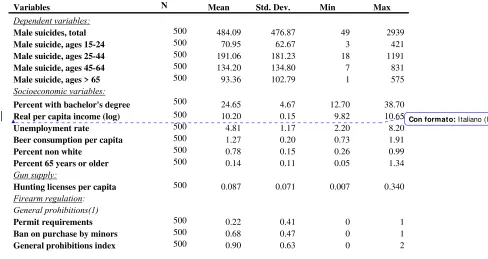
Census Bureau (2007). Table 2 reports summary statistics for the variables used in
[image:14.612.87.575.352.611.2]regressions.
Table 2. Summary statistics
Variables N Mean Std. Dev. Min Max
Dependent variables:
Male suicides, total 500 484.09 476.87 49 2939
Male suicide, ages 15-24 500 70.95 62.67 3 421
Male suicide, ages 25-44 500 191.06 181.23 18 1191
Male suicide, ages 45-64 500 134.20 134.80 7 831
Male suicide, ages > 65 500 93.36 102.79 1 575
Socioeconomic variables:
Percent with bachelor's degree 500 24.65 4.67 12.70 38.70
Real per capita income (log) 500 10.20 0.15 9.82 10.65
Unemployment rate 500 4.81 1.17 2.20 8.20
Beer consumption per capita 500 1.27 0.20 0.73 1.91
Percent non white 500 0.78 0.15 0.26 0.99
Percent 65 years or older 500 0.14 0.11 0.05 1.34
Gun supply:
Hunting licenses per capita 500 0.087 0.071 0.007 0.340
Firearm regulation: General prohibitions(1)
Permit requirements 500 0.22 0.41 0 1
Ban on purchase by minors 500 0.68 0.47 0 1
General prohibitions index 500 0.90 0.63 0 2
6 The model was also estimated using the firearm suicide proxy, and results were very similar. We do
not report them here for brevity.
7
http://www.ojp.usdoj.gov/bjs/
Behavioral prohibitions(2)
Mental health problem 500 0.47 0.50 0 1
Alcohol problem 500 0.34 0.47 0 1
Drug problem 500 0.41 0.49 0 1
Misdemeanor conviction 500 0.36 0.48 0 1
Domestic violence conviction 500 0.29 0.45 0 1
Behavioral prohibitions index 500 1.87 1.70 0 5
Criminal prohibitions(3)
Alien 500 0.15 0.36 0 1
Felony 500 0.73 0.45 0 1
Juvenile offense 500 0.41 0.49 0 1
Fugitive 500 0.17 0.38 0 1
Criminal prohibitions index 500 1.46 1.11 0 4
3. RESULTS
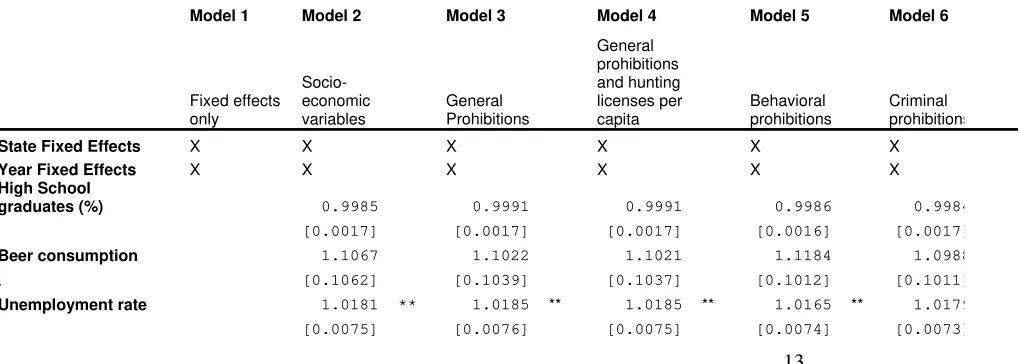
The regression results are reported in Table 3. The estimations include year and
individual state specific effects which are statistically significant in all regression
models. All coefficients have been put on an exponential scale; thus the parameters (β) obtained from the negative binomial regression should be interpreted as incidence rate ratios (henceforth, IRR). The IRR are obtained by exponentiation of the
regression coefficients, that is, exp (β). The expression 100*(exp (β)-1) is the
percentage change in the incidence or risk of suicide mortality for each unit increase
[image:15.612.62.572.486.668.2]in the independent variable.
Table 3: Results of Negative Binomial Regression, all males, 1995-2004 (N=500).
Dependent variable is number of male suicides, exposure variable is male population
Model 1 Model 2 Model 3 Model 4 Model 5 Model 6
Fixed effects only Socio-economic variables General Prohibitions General prohibitions and hunting licenses per capita Behavioral prohibitions Criminal prohibitions
State Fixed Effects X X X X X X
Year Fixed Effects X X X X X X
High School
graduates (%) 0.9985 0.9991 0.9991 0.9986 0.9984
[0.0017] [0.0017] [0.0017] [0.0016] [0.0017]
Beer consumption 1.1067 1.1022 1.1021 1.1184 1.0988
. [0.1062] [0.1039] [0.1037] [0.1012] [0.1011]
Unemployment rate 1.0181 ** 1.0185 ** 1.0185 ** 1.0165 ** 1.0179
Log of median HH
income 0.6394 ** 0.6433 ** 0.6428 ** 0.6376 ** 0.6375
[0.1424] [0.1418] [0.1429] [0.1338] [0.1435]
Percent White 3.5333 *** 3.5115 *** 3.5152 *** 3.3638 *** 3.5250
[1.5326] [1.5247] [1.5171] [0.0145] [1.5327]
Percent > 65 years 1.1245 *** 1.1232 *** 1.1232 *** 1.1166 *** 1.1261
[0.0147] [0.0153] [0.0153] [0.0145] [0.0157]
General prohibitions
(1) 0.9440 *** 0.9438 ***
[0.0093] [0.0099]
Behavioral
prohibitions index (2) 0.9946 *
[0.0030]
Criminal prohibitions
index (3) 1.0035
[0.0068] Hunting Licenses Per
Capita 0.9692
[0.4548]
Log likelihood -2228.3 -2199.2 -2199.1 -2199.1 -2200.3
Ln alpha -7.0532 -7.6410 -7.6475 -7.6477 -7.6692 -7.6597
Notes:
(1) General prohibitions index: permit requirement, ban on purchase by minor. Range 0-2
(2) Behavioral prohibitions index: mental health, alcohol problems (or intoxication), drug problems, domestic violence conviction, misdemeanor conviction. Range: 0-5
(3) Criminal prohibitions index: alien, prior felony conviction, fugitive from justice, serious offense as a juvenile. Range:0-4 District of Columbia is excluded.
(4) Standard errors in brackets. Constant term included but not reported.
*=p<.10
** p<.05
***p<.01
The first two models show the effects of fixed state and year effects (Model 1), and
the fixed effects in addition to a set of socio-demographic variables namely
education, income, alcohol consumption, the proportion of the population over age
65, and the proportion of non-Hispanic white population (Model 2).
Model 3 introduces the index of general prohibitions – namely gun control
regulations which affect the largest number of people and which create general
barriers to entry. We find the general prohibition index to be statistically significant,
both individually and when we include our proxy for gun prevalence, hunting licenses
per capita, which enters insignificantly (Model 4).
The next model includes the second index of gun control measures, which aims to
health or alcohol/drug problems. While significant, the IRR is 0.9946 in this model
compared to 0.9440 in Model 3 that includes the general prohibition index; and the
coefficient is only significant at the 10 percent level. Model 6 includes our last index,
which captures gun control measures that are least unlikely to affect suicide. They are
designed rather to prevent criminal behavior. As expected, this variable does not enter
with a statistically significant coefficient.
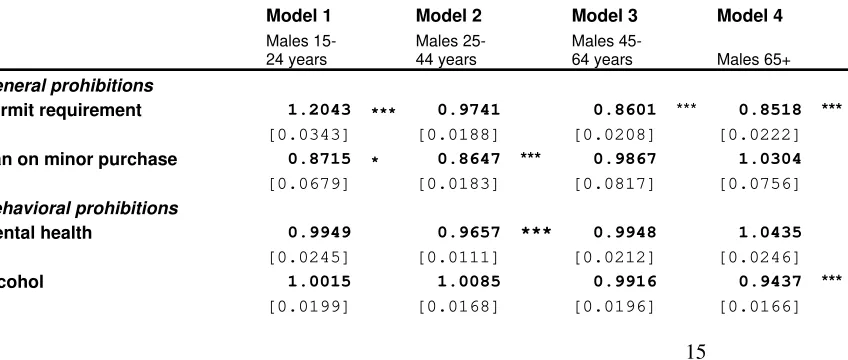
Table 4 shows the effects of individual state level firearm restrictions on the
phenomenon of the suicide for particular age groups. In all models, we control for
gun prevalence with the number of hunting licenses per capita, and include the
standard covariates. We find that gun control measures do not affect all age groups
identically. For instance, a ban on firearm purchases by minors affects suicides
particularly among younger males, while restrictions on permits and waiting period
requirements have a more deterrent effect on for older males. Among behavior related
prohibitions that based on a history of mental illness prohibition is only significant for
males aged 25-44 years, and that against alcohol abusers only matters for 65 + males.
The drug and misdemeanor conviction bans do not enter significantly for any of the
age groups, and the prohibition linked to a history of domestic violence only affects
suicides among the middle aged. None of the criminal prohibitions enter significantly
[image:17.612.111.535.491.671.2]for specific age groups, and are therefore omitted.
Table 4: Selected gun control measures, males by age, 1995-2004 (N=500).
Dependent variable is number of male suicides, exposure variable is male population, within age groups
Model 1 Model 2 Model 3 Model 4
Males 15-24 years
Males 25-44 years
Males
45-64 years Males 65+
General prohibitions
Permit requirement 1.2043 *** 0.9741 0.8601 *** 0.8518 ***
. [0.0343] [0.0188] [0.0208] [0.0222]
Ban on minor purchase 0.8715 * 0.8647 *** 0.9867 1.0304
[0.0679] [0.0183] [0.0817] [0.0756]
Behavioral prohibitions
Mental health 0.9949 0.9657 *** 0.9948 1.0435
. [0.0245] [0.0111] [0.0212] [0.0246]
Alcohol 1.0015 1.0085 0.9916 0.9437 ***
Drugs 0.9723 0.9972 1.0017 1.0086
. [0.0229] [0.0167] [0.0220] [0.0241]
Misdemeanor conviction 1.0169 0.9848 0.9758 1.0062
[0.0216] [0.0159] [0.0160] [0.0293]
Domestic violence conviction 0.9812 1.0048 0.9630 ** 0.9700
[0.0261] [0.0190] [0.0167] [0.0185]
Note: All models include state and year fixed effects, as well as control variables for the level of education, unemployment rate, income per capita, and the percent of Non-Hispanic white population. A proxy for gun prevalence (hunting licenses per capita) is also included. District of Columbia is excluded. Standard errors in brackets. Constant term included but not reported.
*=p<.10
** p<.05
***p<.01
4. DISCUSSION
Access to lethal weapons is an important risk factor for suicide. Our study suggests
that general barriers to firearm access created through state regulation can have a
significant deterrent effect on male suicide rates in the United States. Permit
requirements and bans on sales to minors were the most effective of the regulations
analyzed. These findings have important implications for U.S. gun control policy,
which remains exceptionally heterogeneous across states. While all states except
Wyoming have banned sales of handguns to minors, twelve states still allow the sale
of long guns to minors. Furthermore, only twelve states currently require purchase
permits for firearms. While gun control remains a controversial issue both at the state
and federal level in the U.S., this analysis suggests that there are clear public health
benefits to restricting access to firearms through regulation.
6. References
Azrael D, Cook P, Miller M. 2004. State and local prevalence of firearms ownership measurement, structure and trends. Journal of Quantitative Criminology 20: 43-62.
Beautrais A, Fergusson D, Horwood L. 2006. Firearms legislation and reductions in firearm-related suicide deaths in New Zealand. Australian and New Zealand Journal of Psychiatry 40: 253-259.
Centers for Disease Control and Prevention (CDC), National Center for Injury
Prevention and Control, 2009. http://www.cdc.gov/ncipc/dvp/suicide/suicide_data_sheet.pdf [2 February 2009].
Cheung A, Dewa C. 2005. Current trends in youth suicide and firearm regulations. Canadian Journal of Public Health 96: 131-135.
Clarke R, Jones P 1989. Suicide and increased availability of handguns in the United States. Social Science and Medicine 28: 805-809.
Conner K, Zhong Y. 2003. State firearm laws and rates of suicide in men and women. American Journal of Preventive Medicine 25: 320-324.
Cook P, Ludwig J. 1998. Defensive gun uses: New evidence from a National Survey. Journal of Quantitative Criminology 14: 111-131.
Cook P, Moore M, Braga A. 2001.Gun Control, Working Paper Series SANO1-14, Sanford Institute of Public Policy, Durham, NC.
Cook P, Ludwig J. 2006. Aiming for evidence based on gun policy. Journal of Policy Analysis and Management 25: 691-735.
Cook P, Ludwig J. 2006. The social costs of gun ownership. Journal of Public Economics 90: 379-391.
Cutler D, Glaeser E, Norberg K. 2001. Explaining the Rise in Youth Suicide, in Gruber J, ed., Risky Behavior Among Youths: An Economic Analysis, University of Chicago Press: Chicago.
Duggan M. 2003. Guns and Suicide: Correlation or Causation? In, in Evaluating Gun Policy, Cook P, Ludwig J, eds., Brookings Institution Press: Washington.
Gallup Poll, 2009. Do you have a gun in your home?
http://www.gallup.com/poll/1645/Guns.aspx [5 November 2009]
Grossman D, Mueller B, Riedy C, Dowd M, Villaveces A, Prodzinski J, Nakagawara J, Howard J, Thiersch N, Harruf R. 2005. Gun storage practices and risk of youth suicide and intentional firearm injuries. Journal of American Medical Association
293: 707-714.
Haw C, Sutton L, Simkin S, Gunnell D, Kapur N, Nowers M, Hawton K. 2004. Suicide by gunshot in the United Kingdom: A review of the literature. Medicine, Science and the Law 44: 295-310.
Hemenway D, Kennedy B, Kawachi R. 2001. Firearm prevalence and social capital. Annals of Epidemiology 11: 484-490.
Kaplan M, Geling O, 1998. Firearm suicides and homicides in the United States: Regional variations and patterns of gun ownership. Social Science and Medicine 46: 1127-1233.
Kapusta N, Etzersdorfer E, Krall C, Sonneck G. 2007. Firearm legislation reform in the European Union: Impact on firearm availability, firearm suicide and homicide rates in Austria. British Journal of Psychiatry 191: 253-257.
Kennedy P. 1998. A Guide to Econometrics. Blackwell: Oxford.
Killias M, van Kesteren J, Rindlisbacher M, 2001. Guns, violent crime and suicide in 21 countries. Canadian Journal of Criminology, October 2001: 429-448.
Kleck G, Kates D. 2001. Armed: New Perspectives on Gun Control. Prometeus:Amherst.
Kleck G. 2004. Measures of gun ownership for macro level crime and violence research. Journal of Research in Crime and Delinquency 41: 3-36.
Klieve H, Barnes M, De Leo D. 2009. Controlling firearms use in Australia: has the 1996 gun law reform produced the decrease in rates of suicide with this method? Social Psychiatry and Psychiatric Epidemiology 44: 285-292.
Lambert M, Silva P. 1998. An update of the impact of gun control legislation on suicide. Psychiatric Quarterly 69: 127-134.
Lester D. 1987. Availability of guns and the likelihood of suicide. Sociology and Social Research 71: 287-288.
Lester D.1989. Gun ownership and suicide in the United States. Psychological Medicine 19: 519-521.
Lester D. 1992. Why people kill themselves. Charles Thomas: Springfield.
Lester D, Clarke R. 1991. Note on suicide and increased availability of handgun in the United States: The influence of firearm ownership on accidental deaths. Social Science and Medicine 32: 1311-1313.
Lott J, Whitley J. 2000. Safe storage, gun laws: accidental deaths, suicides, and crime. Working Paper # 237 Yale Law School.
Markowitz S, Chatterji P, Kaestner R. 2003. Estimating the impact of alcohol policies on youth suicide. Journal of Mental Health Policy and Economics 6: 37-46.
Miller M, Azrael D, Hemenway D. 2002. Rates of household firearm ownership and homicide across US Regions and States, 1988-1997. American Journal of Public Health 92:1988-1993.
Miller M, Hemenway D, Azrael D. 2004. Firearms and suicide in the northeast. The Journal of Trauma, Injury, Infection and Critical Care 57: 626-632.
Miller M, Azrael D, Hepburn L, Hemenway D, Lippman S. 2005. The association between changes in household firearm ownership and rates of suicide in the United States, 1981-2002. Injury Prevention 12: 178-182.
Miller M, Lippman S, Azrael D, Hemenway D. 2007. Household firearm ownership and rates of suicide across the 50 United States. The Journal of Trauma, Injury, Infection and Critical Care 62: 1029-1035.
Miller M, Hemenway D. 2008. Guns and suicide in the United States. The New England Journal of Medicine 4: 989-991.
Open Society Institute, 2000. Gun control in the United States: A comparative survey
of State firearm laws.
http://www.soros.org/initiatives/usprograms/focus/justice/articles_publications/public ations/gun_report_20000401 [30 November 2009]
Ozanne-Smith J, Ashby K, Newstead S, Stathakis V, Clapperton A. 2004. Firearm related deaths: The impact of regulatory reform. Injury Prevention 10: 280-286.
Price J, Thompson A, Dake J. 2004. Factors associated with state variations in homicide, suicide, and unintentional firearm deaths. Journal of Community Health
29: 271-283.
Rosengart M, Cummings P, Nathens A, Heagerty P, Maier R, Rivara F. 2005. An evaluation of state firearm regulations and homicide and suicide death rates. Injury Prevention 11: 77-83.
Shennasa E, Dasklakis C, Buka S. 2006. Utility of indices of gun availability in the community. Journal of Epidemiology and Community Health 60: 44-49.
Sumner S,Layde P, Guse C. 2008. Firearm death rates and association with level of firearm purchase background check. American Journal of Preventive Medicine 35 :1-6.
Wahlbeck K, Mäkinen M. (Eds). 2008. Prevention of Depression and Suicide. Consensus paper. Luxembourg: European Communities.
http://ec.europa.eu/health/ph_determinants/life_style/mental/docs/Cyprus.pdf [30
November 2009]