ISSN: 2374-2208 (Print), 2374-2194 (Online) Copyright © The Author(s). 2014. All Rights Reserved. Published by American Research Institute for Policy Development DOI: 10.15640/jibe.v2n3a1 URL: http://dx.doi.org/10.15640/jibe.v2n3a1
Financialization of the Management Model of Public Institutional Investors: a Case Study
Lilia Rekik1 & Frédéric Hanin2
Abstract
This article proposes an analysis of the financialization of public pensions by asset managers through a case study of Canada’s largest. The 2008 fallout is the result of structural changes in the regulation and management of organization. Two elements here are at the core of financialization. First, the new business model was built on a different analysis of the institution’s mission of. Second, the creation of "value added" was expected through the use of interactions between portfolios, facilitated by the development of structured financial products. This case study is also useful to analyze the transformation of the financial sector’s governance structure.
Keywords: Financialization; business model; institutional investors; governance; risk management; derivatives
1. Introduction
One of the striking changes in the financial sector that developed nineties was the growing importance of institutional investors among the managers of financial assets (Davis and Steil, 2001; Plihon 2002; Amable et al . 2005). For OECD countries, growth in assets managed by financial players since 1995 has, on average, been 6.6% per year reaching 40.3 trillion in 2005. In Canada, the amount of assets managed by institutional investors has doubled during this period (Gonnard et al., 2008).
1 Assistant prfessor, Business and administration department, TELUQ-University of Quebec, 455 rue
du parvis, Québec (Qc) G1K 9H5. Tél: 418 657-2262 # 5582, Email: [email protected]
2 Assistant professor, Industrial relations department, University of Laval, Office 3176, Pavillon
J.-A.-DeSève, Québec (Québec) G1K 7P4, CANADA.
Aglietta (1998) interprets this transformation of the financial sector as the manifestation of a new patrimonial capitalism based on the management of "social" debt (pension, social security, group insurance, etc..). If we want to focus on institutional changes underlying this model of capitalism, then we should consider financialization (Orhangazi, 2008). The main effect of financialization is to create forms of domination of capital over labor and the industry financial sector. The 2008 financial crisis can therefore be read as a financial liquidity crisis, not a crisis of profitability (Orlean, 2009).
The recent financial crisis was driven by institutional investors, financial corporations with multiple connected activities whose fund management structure allows for a broad diversification of investments. In this context, the governance of financial conglomerates has become a central issue in this sector (Blanchard, 2008 Goodhart, 2008; Arner and Norton, 2009). In Quebec, the financial crisis was mainly presented through the debate on the major losses incurred by the Caisse de Depot et Placement du Québec (Caisse hereafter). Though we can certainly see losses announced by the Fund as a cyclical event related to the international financial crisis, we also believe that the internal factors that contributed to the financialization of the institution should not be overlooked either.
Two research questions will be addressed:
1) How the financialization of funds management in the financial sector has affected the regulation of public institutional investors and their mission to contribute to local economic development?
2) In the context of financialization, what were the changes in the management of public institutional investors that may explain their increased sensitivity to stock market fluctuations?
The analysis is based on a historical approach, highlighting changes in the fund management model. The first level of analysis is the legislative changes that support the implementation of a new management model. The second level is that of investment practices through the use of derivatives. The links between these two levels are constructed across risk management devices established by the financial institution. The epistemological assumption underlying the analysis considers the institutional investors as collective actors whose activity cannot be construed as a "reductionist" analysis, element by element, all things being equal. Instead, institutional investors should be considered collective actors who are embedded in public policy issues, management strategies, and in the professional culture of the financial community.
The research is presentation as follows: Section 2 presents the financialization Fund management model. Section 3 shows the increase in the sensitivity of public institutional investors to stock market fluctuations in the context of financialization. Section 4 analyzes the governance arrangements facing the financialization model management conglomerates.
2. Financialization and Changes in Managing Firms: the Caisse Case
Institutional investors such as the Caisse have a very strong organizational culture that depends on the context of the emergence of these institutions and the various activities they have been forced to develop. The salience of the historical context is the basis for the construction of the political legitimacy of these "hybrid" organizations involved in both the development of forms of financing and the development of economic activity and employment. Analysis of the business model necessitates an explanation of the historical construction of collective devices that serve to reconcile the fund’s performance and the development of public policies that have had a positive impact on employment.
2.1 A Public Fund Manager with a Dual Mandate
The first dimension concerns the relationship with the government. The relationship between the Caisse and its depositors is probably unique among asset managers. Depositors do not have a choice of manager, the Caisse automatically receives the funds from the public institution by government decision. At the time, the provincial government wanted to create an institution that was both a central bank to manage the public debt market and also serve as an investment bank that can fund the province’s development.
In the relationship between the depositors and the Caisse and between the Caisse and the government influences the decisions of the Caisse via the appointment of a Chief Executive Officer and the Board members. The Premiere at the time stated that "one of the principles that must be established is that the coordination of operations of the Caisse and the general policy of the state" (Lesage, 1965, cited in Pelletier 1988: 294). The Caisse also has links with social actors through the Board’s composition. At its creation, the Caisse’s Board of Directors included social actors (trade unions, NGOs, associations) as long as they participated in the social and economic development of Quebec. For the designers of the institution, its board of directors served as a meeting place to compare different points of view. "In this way, the board should reflect the most critical trends in the economy of Quebec" (Lesage, 1965, cited in Pelletier 1988: 295).
Based on J. Lesage’s speech, we can legitimately think that the objective of return on assets was not a key role in the creation of the organization. Asset returns play a secondary role and were primarily used at the time to establish the credibility of the institution in the financial sector as a signal of competence and to maintain the nominal value of the assets.
The third dimension concerns the financing through investment policy. The Caisse is involved in many business sectors. Since its inception, it has played an important role in supporting the liquidity of bonds issued by the Government of Quebec, while this activity is usually enforced by the central banks. Through its investment policy, the Caisse also works with investment banking because it operates in the real estate (21.6% of assets in 2008) and the of non-equity private placements fields, making it is the largest investor in Canada (8.3% of assets in 2008). It therefore practices diversified investment management over a long-term perspective with an important social support.
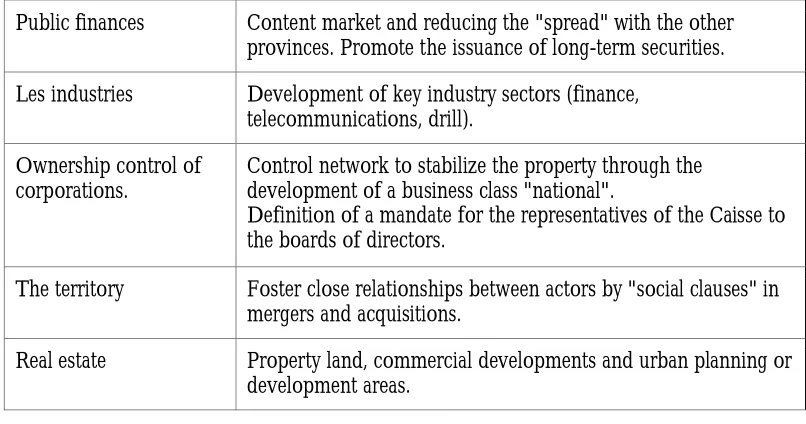
There are four action areas of public institutional investors: public finance, industry development, business ownership and industry groups, regional and territorial development, and real estate. Table 1 shows the different management devices used by the Caisse.
Table 1: Management Devices of the Fund's Assets
Public finances Content market and reducing the "spread" with the other provinces. Promote the issuance of long-term securities.
Les industries Development of key industry sectors (finance, telecommunications, drill).
Ownership control of corporations.
Control network to stabilize the property through the development of a business class "national".
Definition of a mandate for the representatives of the Caisse to the boards of directors.
The territory Foster close relationships between actors by "social clauses" in mergers and acquisitions.
For public institutional investors such as the Caisse, the issue of governance arises in different terms than the private sector when the legitimacy of these institutions is based on the performance of services provided to the community. Unlike the principles of corporate governance in the private sector, there can be no separation between management and capital ownership. Profits do not constitute compensation that is proportional to the individual investment risk and the identity collective is not associated with the products and services sold but rather to the political legitimacy of the institution.
2.2 Implementation of Financial Governance
Legislative reform of the Caisse passed by the Quebec National Assembly in 2004 led to a weakening of the concern for the development of jobs in Quebec and a strengthening of its financial control on investment through three elements: a reformed double mandate, a reformed board and links with depositors, and reformed rules on investment.
2.2.1 Reform of the Double Mandate
The government proposed a bill that includes an amendment to the 1965 Act to legally define the Caisse’s objectives in 2004. The amendment is as follows: "The Caisse's mission is to receive moneys on deposit in accordance with the law and manage them the best return on depositors in respect of their investment policy while contributing to Québec's economic development" (Article 4.1, Caisse Act, 2010). The Caisse itself participated in the legal definition of its mandate by producing a paper on the governance of the institution. In this paper, an alternative definition of the institution's mandate was proposed:
"The mission the Caisse is to manage collective assets of depositors and seek the return of their capital in respect with their investment policy. Pursuing this objective, the Caisse contributes to Québec's economic development "(Caisse, 2003, p.6).
President of the Caisse asserted that "we cannot say it enough: the first way for the Caisse to contribute to Québec's economic development is to seek and obtain the best possible return on its investments under constraint an acceptable level of risk for pension depositors "(Rousseau, 2005, p. 3).
The government also changed its position with respect to the Caisse by becoming a direct depositor. It chose to develop autonomous sinking funds pension to contribute to the state pension plans in the public sector pension plans. The government is therefore removed from the management of the Caisse while retaining its status as a depositor in full. However, these pension funds come from the government borrowing through the issuance of bonds. The State is therefore betting that the cost of long-term debt will be lower than short-term returns achieved by the Fund. This new position of the State promoted the search for financial returns at the expense of economic development and employment.
2.2.2 Reform of the Board of Directors
The 2004 reform also changed the role of the Board regarding the organization of internal control procedures and investment policies. It introduced directors chosen by the government on the basis of their competence and not on the basis of their social representativeness. According to the new legislation "The Caisse shall advise depositors on their investments. A service agreement can be concluded with each of its depositors wherein it determines the services it offers, the duties and responsibilities it assumes the forms of information and communication that should be used as well as the terms of accountability to which it is committed. "(Article 22.1). Such applicants have their institutional status changed to a customer who receives a service.
2.2.3 Reform of the Investment Universe
The third reform concerned authorized investments traded by the Caisse. The Caisse is authorized to use financial products (derivatives) to hedge investments against changes in exchange rates, interest and against price volatility; to implement the investment strategies of depositors; to implement strategies for short-term performance decided by the Caisse’s managers and to optimize the Caisse’s performance. These legislative changes followed other changes in the mid 90s to allow the Caisse to transact and issue structured products such as asset-backed commercial paper and increase the share of products traded on stock markets by 40% to 70% of total assetsi. In consideration of the liberalization of the use of derivatives, the Caisse’s Board of Directors are responsible for determining the limits of risk.
The 2004 reform implemented a financial management governance fund at the Caisse as financial expertise superseded its industrial expertise, where depositors are primarily considered as customers and not as depositors of public funds and managers are allowed to use derivatives more widely.
3. Financialization and the Increased Sensitivity of Public Institutional Investors to Stock Market Fluctuations
The financial crisis that affected the Caisse from August 2007 with the loss of liquidity in asset-backed commercial paper (Chant, 2009) revealed an unprecedented sensitivity of the institution to market fluctuations even though in the past, the management strategy taken during the crisis had been to use available cash to purchase securities that became undervalued with crisis.
3.1 The Influence of the Financial Context
Table 2: The Global Economic Sphere (Thousand Billion Dollars)
2002 2007
Financial Economy
Derivativea market 693.1 2 288.0
Exchange market 408.2 1 058.3
Financial market 39.3 77.9
Real Economy
World GDP 32.3 54.3
Total transactions 1 172.9 3 478.5
Source : http://www.financeglobale.com (accessed 01/11/2012).
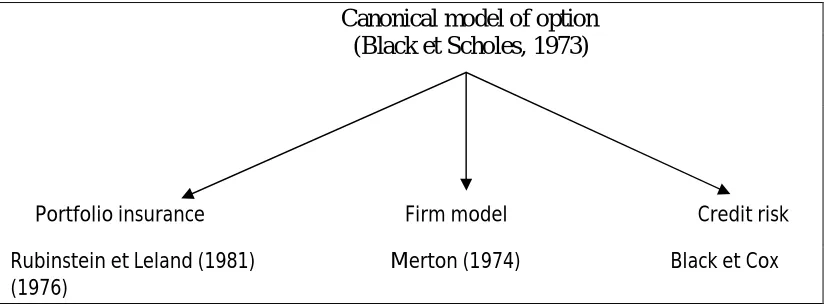
The increased use of derivatives can be explained by their use in economic transactions, to the extent that one can speak of an option paradigm as part of economic transactions (Hanin, 2007). Model optionsii for the formatting and supervision of economic activities are mainly based on the "securitization" support of economic activity. Figure 1 summarizes the areas of application for this options theoryiii that has developed since the seventies as proposed by Black and Scholes’ (1973) canonical model for the option.
Figure 1: The Development of Option Theory
Canonical model of option (Black et Scholes, 1973)
From an innovative theoretical model, Black and Scholes’ model will build a set of applications in various financial areas such as corporate governance (Haas, 2003), portfolio insurance (Black and Perold, 1992), Banking (Huault and Rainelli-Le Montagner, 2009), or business investment (Dixit, 1992). The concept of financialization of the economy (Krippner, 2005) summarizes the qualitative transformation that has occurred since the 1990s and which led to the explosion of the use of derivatives, mainly from institutional investors such as asset managers.
3.2 A new Business Model Based on Derivatives
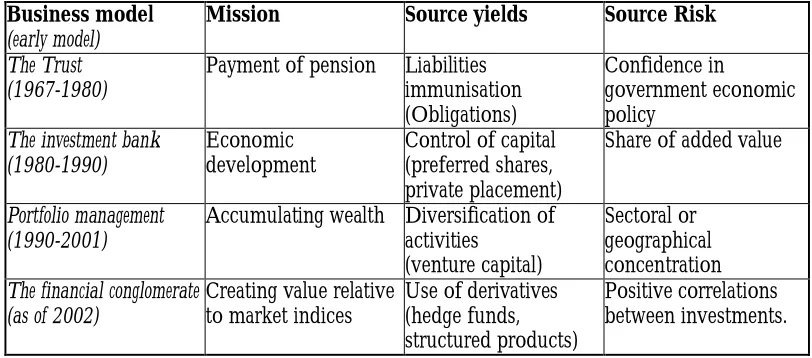
In the case of the Caisse, the use of derivatives is part of a new business model for a financial conglomerates. Table 3 shows the construction of all Caisse activities from successive business models that have been developed within the institution.
Table 3: Business Models of the Caisse in its History
Business model
(early model)
Mission Source yields Source Risk
The Trust (1967-1980)
Payment of pension Liabilities immunisation (Obligations)
Confidence in
government economic policy
The investment bank (1980-1990)
Economic development
Control of capital (preferred shares, private placement)
Share of added value
Portfolio management (1990-2001)
Accumulating wealth Diversification of activities
(venture capital)
Sectoral or geographical concentration
The financial conglomerate (as of 2002)
Creating value relative to market indices
Use of derivatives (hedge funds, structured products)
Positive correlations between investments.
Source : adapted from Pelletier (2009), annual Report (2008).
In this model, the main source of risk for asset management focuses on the confidence of other investors in public infrastructure and policies that are financed by issuing government bonds or state companies.
The investment bank was the second model, implemented in the 1980s and was primarily intended to invest assets to promote economic development in Quebec and fund social programs with surplus funds (contributions - benefits) deposited at the Caisse. In this model, the main source of return was the payment of dividends by companies and control of the property to stabilize the ownership and limit fluctuations in the value of shares. The asset value risk was then induced by the distribution of value-added business between shareholders and employees.
The third model is the portfolio management that took place in the 1990s and is based on the accumulation of wealth by diversifying investments. It is part of a movement of strong external growth in asset management, both in terms of amounts managed and the level of activity. The risk in this model was the high concentration of investment in a few titles located in high-growth sectors of the economy (new information technology) and that were concentrated geographically in small areas (Silicon Valley, for example).
The 2002 model created a full range of financial services for depositors who were perceived primarily as clients. The foremost contribution of the Caisse to its customers was the creation of added-value compared to market indices through active management that relied on a high level of expertise in new financial products. These required the use of large-scale products, either directly to take advantage of market fluctuations (arbitrage) or indirectly through securitization. The increase in the expected return was based on the use of debt to increase assets managed by the institution for a total of $ 30 billion, using the repo (lending short-term securities in exchange for cash) of $ 20 billion and the use of derivatives in hedge funds and commodities totaling $ 7.7 billion (Annual Report, 2008: 57).
The use of derivatives within the various financial activities of the Caisse should not be construed as being isolated from the rest of its activities or as an additional source of financial performance activity, but as the result of a general business model case that guides the management of the entire organization.
3.3 The Diffusion of "Toxic" Products
Since its creation in 1965, the Caisse has held a dual mandate to increase the savings of Quebecers and make funds available for the economic development of Quebec. At first, the management of the Caisse was extremely prudent "to the point that it’s [been] accused of not respecting its second mission" (Parenteau, 1983). Since 2002, the policy of the new president at the time, Mr Rousseau, had intended circumnavigate traditional investment products which were considered to have anemic returns. To achieve its new performance goals, it was no longer sufficient for the Caisse to invest in fixed income securities such as bonds. The Caisse could not avoid more profitable assets but it was riskier. It is in this new context of search performance that was justified under Fund Act derivatives (RSQ, c. C-2), the act did not limit the use of these financial instruments for hedging purposes, but was also extended to speculation:"derivatives can be used in a framework covering investment, in whole or in part, in order to protect against yield fluctuations ..." and "investment strategies based on the evolution of fluctuations ..." or "performance optimization sum received on deposit."
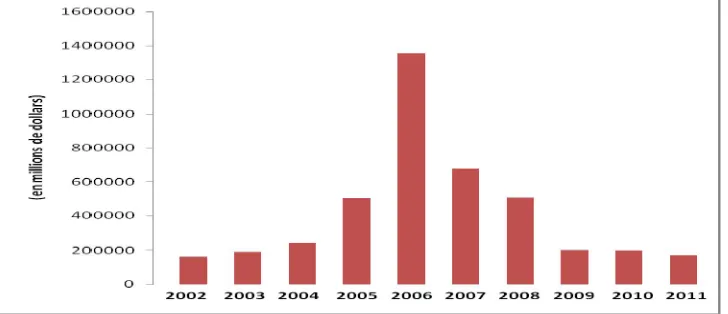
Figure 2: The Evolution of Notional Amount of Derivatives in the Caisse 2002-2011 (Millions of Dollars)
From 1.1 billion in terms of assets in 2002, the use of derivatives grew to nearly 16 billion in 2008. The situation was even more problematic than thought as the Caisse was left with $ 13 billion invested in asset-backed commercial paper; these are the infamous ABCPs that were the origin of one of the biggest losses seen by the Caisse in its history.
3.4 Financial Crisis and the Extent of Losses Related to Derivatives
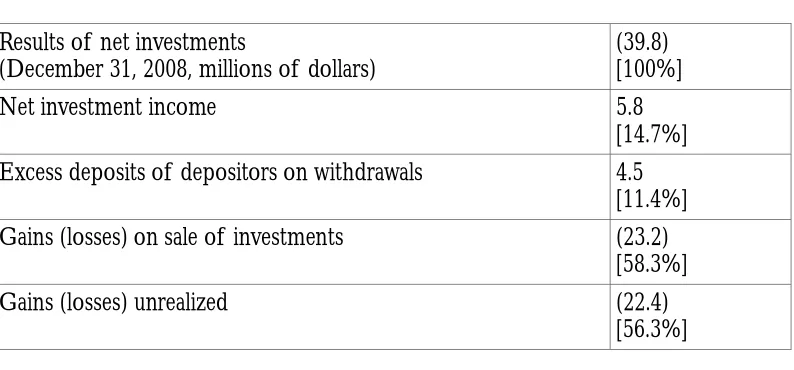
Table 4: The results of the Caisse in 2008
Results of net investments
(December 31, 2008, millions of dollars)
(39.8) [100%]
Net investment income 5.8
[14.7%]
Excess deposits of depositors on withdrawals 4.5
[11.4%]
Gains (losses) on sale of investments (23.2)
[58.3%]
Gains (losses) unrealized (22.4)
[56.3%]
Source: CDP, Annual Report, 2008.
Table 5: The Results of the Caisse per Financial Products at 2008
Derivatives (11.7)
Asset-backed commercial papers (ABCP) (3.4)
REPOs (0.2)
Mezzanine loans (0.3)
Source: CDP, Annual report, 2008.
According to Table 5, the activities related to these financial products lead to a negative result of $ 15.6 billion. The table also shows that the loss associated with the ABCP is significant but that it is more related to derivatives. Although the 2008 crisis was widely considered a crisis of the use of asset-backed commercial paper (ABCP), the fact is that the Caisse had difficulty managing all of its activities on the derivatives markets.
The magnitude of the amounts invested in ABCP created a liquidity problem which led it to sell securities at a loss in the financial markets in order to satisfy the need for cash related to positions on the derivatives markets. The Caisse responded to this situation by convening a crisis meeting with market participants to reach an agreement and avoid contagion across all Canadian financial markets (Boyd et al, 2007. IIROC, 2009). An agreement was reached to convert the commercial paper securities to long-term securities which would regain their long-term liquidity after the crisis. However, this agreement took a year and a half to materialize and during this time, the liquidity of the Caisse, which was concentrated in the ABCP, was not available.
4. Responsibilities of Stakeholders Facing the Financialization of the Conglomerate Management Model
4.1 Internal Control through Integrated Risk Management Policy and Rating Securities
In 2003, in a context marked by increased complexity and a diversity of financial instruments, the Caisse adopted a comprehensive policy aimed at all the Caisse’s managers: the Integrated Risk Management Policy (IRMP). It was established under the authority of the risk management committee and approved by the Boardiv. This policy of integrated risk management provided a general framework for managing risk, it defined the governance of risk management within the Caisse, determined the level of risk that was deemed acceptable and connected this level of risk to the objectives of value-added targets.
This then raises the question of rating ABCPs (Zelmer, 2007, Chant, 2009). The risk management policy of the Caisse had no overall limits for holding AAA rated monetary income instruments. However, ABCP was not AAA rated as per Canadian obligations, but have an R-1 rating from DBRS (high) which is the highest rating for short-term securities. It is also important to note that initially, ABCP was rated by three rating agencies operating in Canada: Dominion Bond Rating Service (DBRS), Moody's, and Standard & Poor's. From 2000, DBRS was the only agency to assess the risk of the ABCP. Therefore, in 2000, the risk management committees should have sounded the alarm about the fact that renowned agencies such as Moody's and Standard & Poor's did not want to rate ABCP. The members of these committees and risk management officers seem to have put too much confidence in the DBRS R-1 rating (high). However, in a Bank of Canada publication on synthetic collateralized debt, Armstrong and Kiff (2005) noted that investors in synthetic ABCPv should require more than one credit rating to properly measure risk. Over $ 10G of ABCP $ 12.8 billion of the Caisse were classified as synthetic ABCP.
As the ABCP case shows, risk management policies underestimated the risk inherent in these instruments and the different hierarchical levels were not able to assess the real risks. The Caisse’s managers even continued to purchase ABCP despite the warning signals that the market could collapse.
4.2 The External Monitoring by Depositors
Depositors, in consultation with the Caisse, develop an investment policy that is reviewed periodically. However, depositors do not always have real control over the investments because it is part of the asset manager’s margin of autonomy.
4.3 The Late Intervention of Governments
In the area of public policy, governments favored legislative reform that aimed to make the Caisse an independent government organization. This reform redefined the institution’s mandate so much that it facilitated the goal of financial returns over economic development (Gouvernement du Québec, 2004).
A year later, this lack of connection with the government resulted in using forced securities to cover cash requirements on foreign exchange markets sales(at a loss). This situation resulted in the absence of government intervention to ensure its temporary liquidity needs for the asset managers of pension schemes. The liquidity needs agreement with the government occurred in December 2008. The institutional investors crisis which followed in the third quarter of 2008 can be explained by questionable links with public policies and non-recognition of the role of the state as collateral or last resort credit lender. The management of risks associated with these financial innovations were only effective once the crisis was triggered and only served to stabilize investor expectations. It was therefore the management of external risk events that prevailed on the basis of model portfolio management, while securing this activity involved cooperation with government agencies that guaranteed loans (the Canadian Mortgage and Housing Corporation), which oversaw the banking system (the Office of the Superintendent of Financial Institutions), and monitoring the monetary liquidity (Central Bank).
4.4 The Legislative Control: a Regulation a Priori
The use of derivatives by the Caisse’s managers is a process that is the result of uncontrolled financial innovations as it is now part of the culture of the financial sector itself. However, this does not mean that institutional investors should use all the financial innovations that come their way. There are rules that govern the use of new financial products. The use of derivatives may therefore be subject to legislative control on several levels.
In addition, the Board shall establish the guidelines and framework policies of risk management and approve investment policies (Article 13.1 Fund Act, 2007). However, the law did not provide for the creation of a risk management committee within the Board of Directors (Article 13.3 Caisse Act, 2007). The law does not provide for the existence of a supervisory board (parliamentarians, for example) as is the case for example of the Caisse des Dépôts et Consignations in France.
A second level concerns the investments that are an important part of the Act on the Caisse. The law indicates which investments may be held without limitation, investments that may be held and the rules that apply to each type of permitted investments, as well as the limits that apply in proportion to total assets. For derivatives, the Caisse may use any type of product without restriction if it finds a financial benefit (Article 33.1 Caisse Act, 2007). The article does not specify the limits in terms of risk or proportion of total assets. Risk limits are mentioned in the article on the investment policy for each specialized portfolio, independent of each other (Article 36.2, Caisse Act, 2007). In addition, section 36.1 of the Act states that the Caisse may perform any activities that aim "to make the best financial return" (Caisse Act, 2007, p. 17). Section 37 of the Act also provides for investment in organizations that use derivatives.
The Caisse Act therefore played a dual role in the regulation of activities and the potential impact of these activities on the community. At the same time, it established tags indicating what activities are allowed and under what rules. However, it also shows the Caisse’s preferred management philosophy indicating neither usage limits for certain investments as a proportion of total assets, or the terms of risk management. However, legislative control is mainly based on the principle of the standard that defines what is allowed and what is not.
In this context, any increase in financial performance is limited to the direct contribution of the government, whether in the form of directly funding programs, or as an employer to fund the pension plans of employees.
5. Conclusion
The 2008 financial crisis has highlighted weaknesses in the regulation of institutional investors, especially managers who underwent a financialization of their business model. The case of the Caisse de Depot et Placement du Quebec shows that this process was made possible by the combination of policy reform and the adoption of financial sector practices. This dual movement led investors to make them very vulnerable to stock market volatility and spillovers between these markets. Investment diversification did not have the desired effect of reducing risk. In the context of financialization, it was rather only increased the level of financial losses under a crisis.
The case presented here analyzes the connections between risk assessment and governance structure when the mission of the organization is redefined under the influence of changes to the institutional context (financialization). Governance structure influences the practices of portfolio managers and these practices in turn affect the level of risk when taking into account the interactions between portfolios. Risk assessment is not independent of the governance structure nor is the interpretation of the mission of the organization by executives.
The case of the Caisse allows for at least three key issues for the management of any organization.
Secondly, what should be the model for managing the managers of the social debt? The case of the Caisse has shown that it had recently turned to a new model of economic development-oriented research which was considered to be "success stories" to increase performance through risky investments (Asset-backed commercial paper, Hedge Fund Leverage Buyout, public-private partnerships outside of Quebec). Unlike individual investors, manager performance as a financial group is not simply the sum of the financial returns of different portfolios but it must also take into account the structuring effect of investment in society.
Thirdly, what is the legitimacy of the business model? Managers derive their legitimacy from the mission of the organization. From the incorporation of the Caisse, this link rested on financial contribution to Quebec government policy. Since then, the Caisse has developed "commercial" activities beyond its original mandate. Today, the contents of the development mission must be redefined. This will allow for the development of complementary activities to its mission.
These three dimensions of organizational management could serve as a basis for the construction of an analytical framework for comparison between the performance of public fund managers in several countries.
References
Aglietta, M. (1998). "Capitalism tomorrow", Notes of the Saint-Simon Foundation, n. 101, November.
Amable, B., Ernst, E. et Palombarini, S. (2005). "How do financial markets affect industrial relations: an institutional complementarity approach", Socio-Economic Review, 3, 311-330.
Armstrong, J., & KIFF, J. (2005). "Of Synthetic Collateralized Debt Obligations: analysis of benefits and risks", Financial System Review, June, 55-63.
Arner, W., & Norton, J. (2009). "Building a Framework to Address Failure of Complex Global Financial Institutions", Hong Kong Law Journal, 39, 95-128.
National Assembly of Quebec (2009). "Hearings on the results of the Caisse de dépôt et placement du Québec", Journal of Debates, Commission of Public Finance, 39th Parliament, 1st Session, March 13, 9:30 to 11:30.
Black, F., Perold, A. (1992). "Theory of constant proportion portfolio insurance", Journal of Economic Dynamics and Control, vol. 16, p. 403-426
Bodnar, G., Hayt, G., Marston, R. (1998). "1998 Wharton survey of financial risk management by U.S. non-financial firms", Financial Management, vol. 27, n° 4, p. 70-91.
Boyd, E., McNish, J., Perkins, T., & Scoffield, H. (2007). "The ABCP black box explodes". The Globe and Mail, 16 November.
Caisse de dépôt et de placement du Québec, Annuels Reports, Different years.
Chant, J. (2009). "The ABCP Crisis in Canada: The Implications for the Regulation of Financial Markets", Report for the Expert Panel on Securities Regulation.
DAVIES, E. P. and STEIL, B. (2001). Institutional Investors, Boston : MIT Press, 556 p.
Dixit, A. (1992). "Investment and Hysteresis", Journal of Economic Perspectives, vol. 6, n° 1, p. 107-132.
Goodhart, C. (2008). "The Background to the 2007 Financial Crisis", International Economics and Economic Policy, 4, 331-346.
Gonnard, E., Jung Kim, E. et Ynesta, I. (2008). "Recent Trends in Institutional Investors Statistics",
OECD, Financial market Trends, 22 p.
Government of Québec. (2004). Act amending the Law on Caisse de dépôt et placement du Québec, Bill No. 78, National Assembly.
Haas, F. (2003). "Towards a continuum of market? Structural models and interactions between market and credit actions", Financial Stability Review, June, Bank of France, p. 80-97.
Huault, I., Rainelli-Le Montagner, H. (2009). "Market Shaping as an Answer to Ambiguities: The Case of Credit Derivatives", Organization Studies, vol. 30, p. 549-575.
IIROC. (2009). Study of the regulatory framework applicable to members of IIROC review and recommendations concerning the creation and placement of commercial paper backed securities issued by third parties companies in Canada. Report, Canadian Regulatory Organization of Securities.
Krippner, G. (2005), "The financialization of the American economy", Socio-Economic Review, vol. 3, n° 2, p.173-208.
Orhangazi, Ö. (2008). "Financialization and capital accumulation in the non-financial corporate sector", Cambridge Journal of Economics, 32(6), 863-886.
Orlean, A. (2009). "From euphoria to panic think the financial crisis", Paris, Editions de la rue d'Ulm, Collection CEPREMAP Opuscule no16, May.
Pelletier, M. (1988). The machine billion :the history of the Caisse de dépôt et placement du Québec, Editions Carte Blanche.
Plihon, D. (2002). Profitability and risk in the new growth. Paris: The French Documentation. Rousseau, H-P. (2005). Investment strategy in venture capital and private equity, CDP,
Presentation to the French Chamber of Commerce in Canada, February 14.
Rouzier, R. (2008). The Caisse de depot et placement du Quebec: Portrait of a general interest’s
institution (1965-2000). Paris : L'Harmattan, 214 p.
i See Regulations on the determination and use framework contracts or instruments of a financial
nature of the Caisse de dépôt et placement du Québec, RQ c. C-2, r.1.1.
iiThe assets acquired through the option (the underlying) must be uniform, durable, have a low cost of
storage and have a liquid secondary market. Note that the option value is not based on the future income stream that can provide the assets acquired. It relies solely on the capital gain related to the purchase and sale of assets acquired through option.
iiiThe "canonical" model of the Black-Scholes option used to assess the value of options based on a
number of simplifying assumptions that are not always satisfied in the markets. In particular, we consider that the volatility of the option is constant depends only on the volatility of the underlying asset (and not its trend) and that the price of the option can be represented by a differentiable function and there is an arbitrage process in which the underlying asset is publicly traded. The use of this theory by financial actors can influence their investment behavior when the model assumptions are not completely satisfied. In particular, the increase in volatility is a general phenomenon in the equity markets since 1996. Volatility of an asset, which is an approximate measure of risk is measured either from the observation of price changes of considered active (historical volatility) or from option prices (implied volatility). One of the paradoxes of modern finance is that the growth of traded assets should lead to a decreased risk in equity markets. However, most financial sector grows, the higher the volatility and hence the risk is high.
ivRisk management is ultimately the responsibility of the board, but it is delegated to managers at all
levels to integrate daily in the exercise of their functions (Caisse employees, agents and consultants). Governance risk management is based on three levels of control. Top of the scale are the Board of Directors and its Audit Committee and risk management policy approving the various policies and procedures for risk management. They ensure that the means used are aligned with the best practices in the industry and enable compliance with risk limits set. In the middle of the scale are the Depositors and Risks Committee supported by the Group Risk Management. The depositors and risk committee, based on the reports and risk analysis established periodically by the Risk Management Group monitors compliance with risk limits defined in the Integrated risk management policy. Bottom of the scale, there are managers who are the first line of defense risk management. A mechanism of accountability is provided by the Integrate risk management policy for each of these levels.
vABCP based on two types of assets, conventional assets and synthetic assets. Conventional assets are