http://dx.doi.org/10.4236/ijmnta.2013.24034
The Effects of Void-Reactivity Feedback and Neutron
Interaction on the Nonlinear Dynamics of a
Nuclear-Coupled Boiling System
Jin Der Lee
Nuclear Science and Technology Development Center, National Tsing Hua University, Hsinchu, Taiwan Email: [email protected]
Received October 31,2013; revised November 30, 2013; accepted December 6, 2013
Copyright © 2013 Jin Der Lee. This is an open access article distributed under the Creative Commons Attribution License, which permits unrestricted use, distribution, and reproduction in any medium, provided the original work is properly cited.
ABSTRACT
The present study explores the effects of void-reactivity feedback and neutron interaction on the nonlinear phenomena of a seven-nuclear-coupled boiling channel system with a constant total flow rate. The results show that the void-reac- tivity feedback and the neutron interaction both have significant effects on the nonlinear characteristics of this system. The complex nonlinear phenomena may depend on the magnitudes of the void-reactivity coefficient and neutron inter-action parameter. The results demonstrate that complex nonlinear phenomena, i.e. various complex periodic oscillations and complex chaotic oscillations, can appear in the present system as the variations over certain values of void-reactivity coefficient and neutron interaction parameter under some specific operating states. These imply multiple complex peri-odic and chaotic attractors, with very interesting and peculiar shapes on the phase space, exist in this system.
Keywords: Multiple Channel; Multi-Point Reactor; Void-Reactivity; Neutron Interaction; Nonlinear Oscillation
1. Introduction
Complex nonlinear phenomena, significantly chaotic oscillations, may exist in different two-phase flow sys-tems. Rizwan-Uddin and Dorning [1] reported theoreti-cally a chaotic attractor in a two-phase flow system with periodically oscillating external pressure drop. Clausse and Lahey [2] identified a chaotic attractor occurring in a boiling channel with very low inlet flows. Lin et al. [3] illustrated a series of period-doubled bifurcation at high inlet subcoolings in an autonomous nuclear-coupled boiling system. Eventually, chaotic oscillations appeared in their forced circulation system. Lee and Pan [4] recog-nized a route from the periodic oscillation to the chaotic oscillation through period-doubled bifurcation for a nu-clear-coupled boiling natural circulation loop with a strong void-reactivity feedback. Prasad and Pandey [5] also reported such a route to chaos through period-dou- bled bifurcation in a nuclear-coupled natural circulation system. Moreover, Wu et al. [6] presented experimental observations on the evolution of periodic oscillations toward chaos at high inlet subcoolings in a low pressure, two-phase natural circulation loop.
Most two-phase flow systems, i.e. boiling water reac-
channel by strengthening the nuclear-coupled effects. Complex nonlinear phenomena, such as various periodic oscillations and complex Rossler type chaotic oscilla-tions, might appear in the system of three boiling chan-nels coupled with a three-point reactor under the condi-tion of strong void-reactivity feedbacks and weak sub-core-to-subcore neutron interactions.
The above brief review reveals complex and interest-ing nonlinear phenomena in different two-phase flow systems investigated in the literature. In a multiple nu-clear-coupled boiling channel system, there are two cou-pling and competing nuclear effects on the system stabil-ity, i.e. the unstable effect of the void-reactivity feedback versus the stable effect of the neutron interactions [9]. Our previous studies [9,10] suggested that these two ef-fects might have prominent influences on the dynamic characteristics of a nuclear-coupled boiling system. And, their effects on the nonlinear dynamics of a seven nu-clear-coupled boiling channel system will be further in-vestigated in the present study.
2. The Model
On the basis of the design of an advanced boiling water reactor (ABWR) [11], the multiple boiling channel mod-el coupled with multi-point reactors [9] are adopted to analyze the nonlinear dynamics of the system numeri-
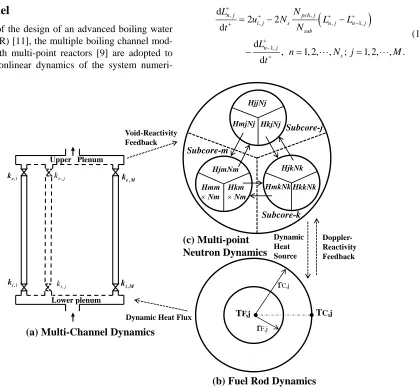
cally. The present study considers the multiple coupling dynamics among multiple channels, fuel rods and mul-ti-point reactors as shown in Figure 1. The dynamics of multi-channel thermal-hydraulics may affect the dynam-ics of neutron field through void-reactivity feedbacks. This can further affect the dynamics of fuel rod heat transfer resulted by the dynamic heat generation rates. The dynamics of fuel rod can produce effects on the multi-channel thermal-hydraulics with the dynamic heat fluxes and on the neutron field dynamics through Dop-pler-reactivity feedbacks, and etc.
2.1. Multi-Channel Thermal Hydraulics
By adopting the homogeneous two-phase flow model and considering the j-th channel in the system of M parallel channels shown in Figure 1(a), the following dimen-sionless set of ordinary differential equations for the dy-namics of multiple boiling channels, with a constant total mass flow rate and the same dynamic channel pressure drop, can be derived [12]:
, ,
, , 1,
1,
d
2 2
d
d
, 1, 2, , ; 1, 2, , d
n j pch j
i j s n j n j sub
n j
s
L N
u N L L
N t
L
n N j t
M.
(1)
HjjNj
HmjNj HkjNj
HjkNk
HmkNk HkkNk HjmNm
Hmm
Nm Hkm
Nm
Subcore-j
Subcore-k Subcore-m
Lower plenum Upper Plenum
1
, e
k
1
, i
k ki,M
M , e
k
TF,j TC,j
r
C,jr
F,j (a) Multi-Channel Dynamics(b) Fuel Rod Dynamics (c) Multi-point
Neutron Dynamics
j e
k,
j i
k,
Void-Reactivity Feedback
Dynamic Heat Flux
Dynamic Heat Source
[image:2.595.115.534.332.719.2]Doppler-Reactivity Feedback
Figure 1. The multiple coupling feedbacks and interactions among multiple channels, fuel rods and multi-point reactors.
,
, , ,
d
, 1, 2, , d
ch j
i j e j e j
M
u u j
t
M . (2)
,
, , , ln 1 1e j e j
ch j j j
e j
M
(3)
, , , 1
e j i j pch j j
u u N
(4)
, , , , , , , 2 , , , d d 1d 1 d
1
1 1
e j e j e j j
e j e j i j e j
e j
j e j e j
n u u t t n (5) , ,1 d d
, 2, 3, , .
d d
i j i
j j
u u
A B j M
t t
(6)
,1 , , 2 2 d 1 d M M i
x s j j x s j j
j j
u
A B A
t
A (7)
,1 , j ch ch j
A M M (8)
,1 ,
,j H H j ch
B P P M j
(9)
2.2. Dynamics of Fuel Rod Heat Transfer
Treating the fuel rod by a two-node lumped system re-vealed in Figure 1(b), the dynamics of fuel rod heat transfer can be described by the following two dimen-sionless dynamic equations for the average temperature of the fuel pellet
F j, and cladding respec-tively in the j-th subcore [3]:T
TC j,
, , , , d d F jq j j f j F j C j T
N T T
t ,
(10)
, , , , , d d C j , g j F j C j C j C j TT T T
t (11) where
0,
,
j H
q j
s p F sat
q L
u
C T
(12)
, 2 1 1 4 H f jF p F s gap F F L
r C u h r k
(13)
2
, 2 2
p
F F
, g j
C F p C C r
r r C
f j (14)
,
, 2 2
2C H C j C j
C F s p C h r L
r r u C
(15)
As a result, the dynamic heat flux on the j-th fuel rod
0, , ,
j j C j qq h Tsat CT
j (16)
2.3. Multi-Point Neutron Dynamics
ong subcores Considering the neutron interactions am
illustrated in Figure 1(c), the dimensionless dynamic equation for the neutron density in the j-th subcore can be expressed as in [9]:
0 0
0 0
dN L H 1 1
d
j H j jj j jj
j j s M M jm jm m m m
m j j m j j
H N C u t H H N N N N N
(17) d d j HC j j
s C L N C u t
(18)
where the delayed neutrons are treated by the one-group approximation. The interaction coefficient, Hjm , ac-counts for the fraction of neutrons generated in m-th subcore that migrate to the j-th subcore. The modified definition of
the
jm
H given by [9] can be applied to the case no matter what each subcore has an equal or a dif-ferent steady-state heat generation rate. Thus,
0 0 1 exp N exp j jm jm M k jk k H N
(19)where
jm
on
is the neutron interaction parameter. If the definiti of Hjm in Equation (19) for jm is adopted to desc the neutron interactions a the different subcores,
ribe mong
jj
H should be defined differently to satisfy the zero initial conditions [9].
0 0 1 M m jj jm
m j j N
H H
N
(20)Neglecting Doppler-reactivity feedback, the reactivity change is calculated on the basis of the following equa-tion:
, , , , ,
j new j old Cj j new j old
(21)
The void-reactivity coefficient
C,j e j-tis, in ge a
3. Solution Method
tally consists of
neral, function of the void fraction in th h channel; how-ever, it is assumed to be constant in the present study.
The numerical model to M
Ns7
y setting the nonlinear, ordinary differential equations. B
parameter values of M 7 and Ns 3, these dynamic equations are treated same sol n method as in [9]. The numerical simulations will be performed on the platform of Visual Fortran Composer. The steady-state
by the utio
inlet velocity of each channel and the other variables are determined by solving the set of equations with time de-rivative terms set to zero, thereby resulting in a set of nonlinear algebraic equations. This set of equations is solved numerically using the subroutine SNSQE of [13], employing the Powell Hybrid Scheme. The nonlinear dynamics of the system at a given initial steady state are obtained by solving the set of nonlinear, ordinary differ-ential equations by perturbing the inlet velocity in one of the channels using the subroutine SDRIV2 of [13]. The SDRIV2 employs the Gear multi-value method.
Table 2. The co ition for a seven nuclear-coupled boiling
4. Results and Discussion
[image:4.595.58.286.404.729.2]properties used in the
able 1. The geometries and properties used in the present
meter Value
Table 1 lists the geometries and
present study. This set of data is extracted from the Pre liminary Safety Analysis Report of an ABWR [11]. For a seven nuclear-coupled boiling channel system consider-ing in this study, a radial heat flux distribution of 1.3:1.2:1.1:1.0:0.9:0.8:0.7 is set on the basis of a given average heat flux. The inlet loss coefficient in each channel, as listed in Table 2, is selected such that all the heated channels have approximately the same exit quality at a typical normal operating condition given in Table 1.
T
study [11].
Para
P 72.7 bar
0
Q
nd
channel system under the normal operating condition given in Table 1, Nsub0.665 and Npch5.518.
Channel No. 1 2 3 4 5 6 7
Heat flux ratio 1.3 1.2 1.1 1.0 0.9 0.8 0.7
i
k 0.01 8.75 23.27 42.48 68.25 105 158
4.1. The Effects of Void-Reactivity Feedback on
By c teractions among
the Nonlinear Phenomena
onsidering the channel-to-channel in
the multiple channels and the neutron interactions among the subcores, the transient responses for each channel and the corresponding subcore can be examined by the time evolutions of dependent variables following a perturba-tion in the inlet velocity of one channel, i.e. channel 1, at given steady state conditions. For a given value of neutron interaction parameter, jm 5, which corresponds to a weak subcore-to-subcore n ron interaction condition, the effects of void-reactivity feedback on the system dy-namics are evaluated at a fixed subcooling number,
3.394 sub
N
eut
. Four select operating states, with an aver-a e phaver-ase chaver-ange number of Npch 5.702, 5.715, 5.741 and 5.774 respectively, are considered in the present analysis. For such four analytical cases, Figure 2 illus-trates the nonlinear oscillations of inlet velocity
g
ui in the representative channel (channel 1) of this se nu-clear-coupled boiling channel system with a heat flux ratio of 1.3:1.2:1.1:1.0:0.9:0.8:0.7 under different void- reactivity coefficients. By setting the void-reactivity coef-ficient at 2C
ven
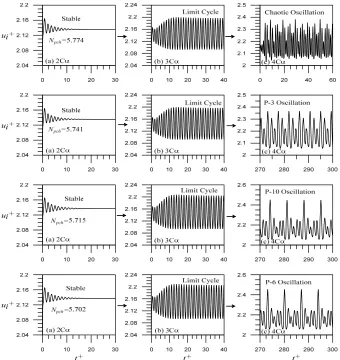
, two times of the reference void-reactivity coefficient given in Table 1, the results in Figure 2(a) reveal that the magnitudes of the oscillations in all the four cases are dampened out and the system quickly re-turns to the corresponding initial steady state. Thus, these four cases belong to stable operating states. By tripling the magnitude of the reference void-reactivity coefficient
3C
, the results in Figure 2(b) show that strengthening v activity feedback leads to an unstable effect on the system dynamics. The magnitudes of nonlinear oscilla-tions in one typical channel (channel 1) for all the four cases grow to certain values and then remain unchanged during the transients. It demonstrates that the system pre-sent a type of limit cycle oscillations. If the magnitude of the void-reactivity coefficient is raised by four times, i.e.4C
oid-re
, the results in Figure 2(c) indicate that increasing t oid-reactivity coefficient can further enhance the unstable effect of void-reactivity feedback and thus in-duce distinct effect on the individual operating state. For the case of Npch 5.702
he v
, the system responses finally evolve to peri ic o ns with a periodic cycle of six, so-called “complex P-6 oscillations” as a result of the channel-to-channel interactions and subcore-to-subcore
od scillatio
3926 MWt
H
L 3.81 m
0 i
u 1.96 m/s
i
i 1227 kJ/kg
x s
A 8.169 m2
H
D 0.01 m
1
f 0.14 Re0.1656
e
k 0.68
pF
C 395.7 kJ kg K
F
k 3.098 W m K
F
3
10970 kg m
pC
C 329.7 J kg K
C
3
6570 kg m
C
k 12.578 W m K
F
r 0.00438 m
C
r 0.00515 m
gap
h 2
68 kW m K 5.
C 0.19 $ %
Figure 2. The effects of different void-reactivity coefficients on the nonlinear phenomena of the seven nuclear-coupled boiling channel system with a heat flux ratio of 1.3:1.2:1.1:1.0:0.9:0.8:0.7 and fixed values of Nsub3.394 and jm5.
neutron interactions. Another special type of complex
r a weak subcore-to-subcore neutron interaction co
P-10 (period-10 orbit) oscillations is found in the state of 5.715
pch
N and the other unique type of complex P-3 (p it) oscillations is identified in the state of
5.741 pch
N as illustrated in Figure 2(c). Moreover, for the state of Npch5.774, the results in Figure 2(c) show that the non ions of the system present cha-otic behavior. This can be classified into a type of com-plex Rossler type chaotic oscillations as reported in [9-10].
Unde eriod-3 orb
linear oscillat
ndition of jm 5, the above discussions suggest that enlarging void-reactivity feedback can lead to a signifi-cant effect on the nonlinear dynamics of the present sys-tem with seven nuclear-coupled boiling channels.
4.2. The Effects of Neutron Interaction on the Nonlinear Phenomena
rder to evaluate the effects o
In o f the neutron interaction
on the nonlinear dynamics of this nuclear-coupled boiling
system, the magnitude of the void-reactivity coefficient is kept constant and at a given value of 4C. With a fixed subcooling number of Nsub3.394, four select operat-ing states, with an average phase change number of
5.715 pch
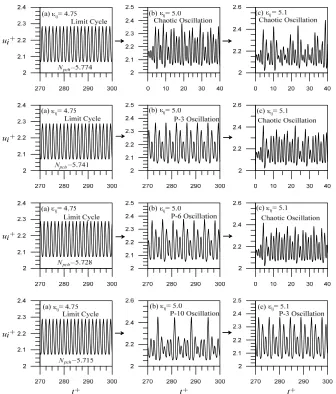
N , 5.728, 5.741 and 5.77 pectively, are considered in the presen or such four analyti-cal cases, Figure 3 displays the influences of neutron i the nonlinear dynamics of inlet velocity
4 res t analysis. F
nteraction on
ui
in one typical channel (channel 1) of this seven nuclear-coupled boiling channel system under different values of neutron interaction parameters
jm . If theof
value jm is more large, the corresponding neutron interaction is more weak and thus the system is more un-stable [9].
Considering the condition of jm 4.75, the results in Figure 3(a) indicate that the transient responses of all the four operat
tio
ing states present a type of limit cycle oscilla-riod-1 orb
Figure 3. The effects of different neutron interaction parameter values on the nonlinear phenomena of the seven nuclear- coupled boiling channel system with a heat flux ratio of 1.3:1.2:1.1:1.0:0.9:0.8:0.7 and fixed values of Nsub3.394 and
C 4 .
increasing unstable effect on the stability and distinct in-uence on the nonlinear dynamics of the system. As the fl
increase in the value of jm, the results in Figure 3 re-veal that the system with the operating state of
5.715 pch
N experience ifferent nonlinear oscillation types of complex P-1, complex P-10 and complex P-3, or another operating state of Npch 5.728
s d
respectively. F ,
the system exhibits the corresponding nonlinear oscilla-tion types of (complex P-1, complex P-6, co
in response to the change in
mplex chaos)
jm
as shown in Figure 3. In addition, the nonlinear oscillation types, with respect to the increasing jm, are of (c plex P-1, complex P-3, complex chaos) at the operating state of Npch 5.741
om
and (complex P-1, complex chaos, complex chaos) at the operating state of Npch5.774, respectively
Under the condition of strong void-reactivity feed-backs, i.e. 4C
.
, the preceding discussions demonstrate
that the effect of the neutron interaction on the nonlinear dynamics of the present system is more significant as the more large value of jm, i.e. more weaker neutron in-teraction. The multiple types of periodic and chaotic os-cillations are resting through the complex and coupling interaction among the channels and the subcores. The distinct racteristics of those nonlinear phenomena, i.e. periodic and chaotic attractors, will be further plotted on th space and analyzed by cha-otic measures as an example of
unique and inte s cha
e phase
5 jm
in Section 4.3.
4.3. Complex Periodic and Chaotic Attractors
Considering the system with the void-reactivity coeffi-cient quadrupled
4C
and neutron interaction pa-rameter of jm 5, some interesting nonlinear dynamicscoupled boiling channels. At the state of Nsub3.085 and Npch 5.48, a special oscillation type of complex P-2 (period-2 orbit) occurs in the system as illustrated in Figure 4 as a result of the channel-to-channel interactions and subcore-to-subcore neutron interactions. The results indicate that the corresponding phase diagram onto the
i
u
plane for each channel and the transient re- sponse of fuel cladding temperature
TF
for one select subcore (subcore 1). The figures on the phase plane in each channel reveal very interesting and peculiar shapes
to of complex P-2 attractor.
If the inlet subcooling is further increased 3.394
sub
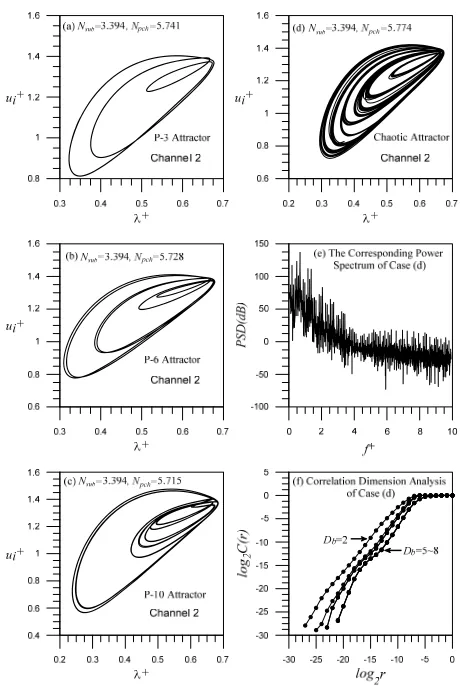
N , much more nonlinear oscillation types can take place depending on the operating conditions. Figure 5 illustrates that the phase diagrams onto the ui
plane for the transients of the representative channel (channel 2) at different operating conditions.
The results in Figures 5(a)-(d) display some distinc-tive periodic and chaotic attractors, i.e. complex P-3 at-tractor at Npch 5.741, complex P-6 attractor at
5.728 pch
N , complex P-10 attractor at Npch 5.715 and complex chaotic attractor at Npch 5.774, respec-
0.72 0.76 0.8 0.84 0.88 0.92 0.96 +
1.9 2 2.1 2.2
ui+ 2.3
0.4 0.45 0.5 0.55 0.6 0.65 +
1 1.1 1.2 1.3 1.4
ui+
0.36 0.4 0.44 0.48 0.52 0.56 +
0.92 0.96 1.08
1 1.04 1.12
ui+
0.36 0.4 0.44 0.48 0.52 +
0.84 0.86 0.88 0.9 0.92 0.94 0.96
ui+
0.38 0.4 0.42 0.44 0.46 0.48 +
0.76 0.78 0.8 0.82 0.84
ui+
0.74
480 484 488 492 496 500 t+
-0.1 0 0.1 0.2
TF+
0.4 0.42 0.44 0.46 +
0.62 0.64 0.66 0.68 0.7 0.72 0.74
ui+
0.4 0.41 0.42 0.43 0.44 0.45 +
0.54 0.56 0.58 0.6 0.62 0.64
ui+
Channel 1 Ch
Channel 2 Channel 6
Chann l 3e Channel 7
Channel 4
annel 5
Subcore 1
Figure 4. The phase trajectories of complex P-2 oscilla- tions and transient response of fuel cladding temperature
in subcore 1 occur in the state of and
with
) (TF
pch
N
sub
N 3.085 5.48
C4
e 5. The phase trajectories onto the ne of ntative ch nel for s c
Figur pla
the represe an variou om ic and
chaotic oscillations exist in the system i
u
plex period with 4C and jm5
, and the corresponding power sp
orre-n aorre-nalysis of case (d).
tively. Figure 5(e) illustrates the corresponding power spectrum of complex chaotic oscillation in Figure 5(d) through FFT analysis. The analytical result shows that the power spectrum has no well-defined peaks and falls off rapidly as the frequency increases. Furthermore, the correlation dimension of this complex strange attractor is estimated following the procedure in [14]. Using the di-mension as a parameter, the in a log–log plot is sh n Figure 5(f). The results exhibit the slope of th almost unchanged af . It implies an imbed dimension of 5 [1 pe of the leas tting straight line for in Figure 5(f) suggests a fractal dimension of . This furthe ms that a comple
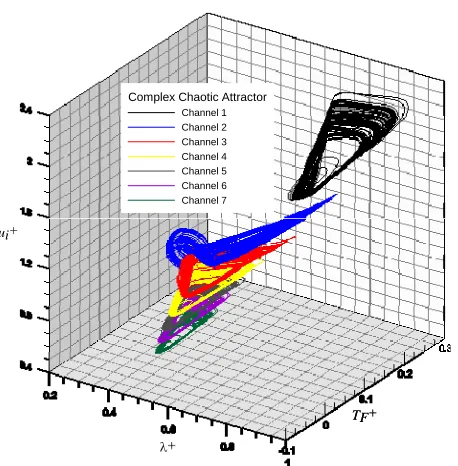
this system uch complex chaotic for the operatin of Figure 5(d) are onto a three dim nsional phase plan as shown in Figure 6. These 3D ph
channels demonstrate that such complex chaotic attrac-
ectrum and c lation dimensio
b
D
own i e curve is ding t-square fi
r confir . S g state e
C r
ter Db 5]. Th
b
D
1.64
furthe e of ase trajec
5
e slo 5
x chaotic attractor exist in oscillations
r projecte 0.01
d
u T
tories for all
i F
[image:7.595.61.285.360.675.2]TF+ ui+
TF+
Complex Chaotic Attractor
Channel 1 Channel 2 Channel 3 Channel 4 Channel 5 Channel 6 Channel 7
[image:8.595.60.289.79.312.2]results indicate that the effect of neutron interaction has a great influence on the nonlinear phenomena of the present system. For the system subject to a strong void-reactivity feedback
Figure 6. The 3D phase trajectories onto the plane for complex chaotic oscillations appear in the operat-ing state of Figure 5(d).
tors have distinctive phase shapes constrained by the boundary conditions of a constant total mass flow rate and the same dynamic pressure drop among channels.
5. Conclusions
ity back a
boiling channel sys-m with a constant total flow rate. The characteristic
cre
k subc
ction param
i F
u T
By considering multi-channel thermal hydraulics, fuel rod dynamics and multi-point neutron dynamics, this study investigates the effects of the void-reactiv
feed-nd the neutron interaction on the nonlinear phe-nomena of a seven-nuclear-coupled
te
feature of the multiple coupling feedback and nonlinear interaction among sub-models can induce complex and interesting nonlinear phenomena in this nuclear-coupled boiling system. The following conclusions may be drawn from the results:
1) The void-reactivity feedback has a significant effect on the nonlinear phenomena of the present system. The in ase in the value of the void-reactivity coeffi-cient can lead to an unstable effect on the system dy-namics. For the system with a wea ore-to-sub- core neutron interaction
jm 5
, it will result in a series of changes in nonlinear oscillation types from the steady oscillations, complex periodic oscillations, to complex chaotic oscillations depending on the sys-tem states with different void-reactivity coefficients of 2C, 3C and 4C, respectively.2) Increasing the value of neutron intera eter
jm will debilitate the neutron interaction among subcores and make the system more unstable. The
4C
, various complex periodic oscillations and com lex chaotic oscillations depending on the system evolve through the step increase in ofp states can
the parameter value jm from 4.75, 5.0 to 5.1.
3) Multiple types of periodic and chaotic oscillations are unique as a result of the c nd cou nter-actions among the channels and the subcores. Multi-ple comMulti-plex period d comp aotic attractors can simultaneously r in this n-nu-clear-coupled boiling chan stem under e spe-cific operating conditions.
REFERE
[1] Rizwan-uddin and J. J. Dorning, “A Chaoic Attr in Periodically Forced Tw e Flow Syste uclea 4 988, pp.
. Lahe “An Investigation of Pe-riodic and Strange Attrac ling Flo s Using
of led Boiling nel with Forced Flows,” ering and , Vol. 179
omplex a
ic attractors an appea nel sy
NCES
o Phas
y Jr., tors in Boi
Chan Design
pling i
lex ch seve som
actor m,” N
, 1
w
, No. 1, 1998, a r Science and Engineering, Vol. 100, No.
393-404.
[2] A. Clausse and R. T
Chaos Theory,” Proceedings of the Ninth International Heat Transfer Conference, Vol. 2, Jerusalem, 19-24 Au- gust 1990, pp. 3-8.
[3] Y. N. Lin, J. D. Lee and C. Pan, “Nonlinear Dynamics a Nuclear-Coup
Nuclear Engine pp. 31-49.
http://dx.doi.org/10.1016/S0029-5493(97)00242-2
[4] J. D. Lee and C. Pan, “Nonlinear Analysis for a Nu- clear-Coupled Two-Phase Natural Circulation Loop,” Nuclear Engineering and Design, Vol. 235, No. 5, 2005, pp. 613-626.
http://dx.doi.org/10.1016/j.nucengdes.2004.09.008
[5] G. V. Durga Prasad and M. Pandey, “Stability Analysis and Nonlinear Dynamics of Natural Circulation Boiling Water Reactors,” Nuclear Engineering and Design, Vol. 238, No. 1, 2008, pp. 229-240.
http://dx.doi.org/10.1016/j.nucengdes.2007.05.004
[6] C. Y. Wu, S. B. Wang and C. Pan, “Chaotic Oscillations in Low Pressure Two-Phase Natural Circulation Loop under Low Power and High Inlet Subcooling Condi- tions,” Nuclear Engineering and Design, Vol. 162, No. 2-3, 1996, pp. 223-232.
http://dx.doi.org/10.1016/0029-5493(95)01127-7
[7] M. Aritomi, S. Aoki and A. Inoue, “Instabilities in Paral- lel Channel of Forced-Convection Boiling Upflow Sys- tem (II) Experimental Results,” Journal of Nuclear Sci- ence and Technology, Vol. 14, No. 2, 1977, pp. 88-96. http://dx.doi.org/10.1080/18811248.1977.9730730
http://dx.doi.org/10.1016/S0960-0779(97)00117-3
[9] J. D. Lee and C. Pan, “Dynamic Analysis of Multiple Nuclear-Coupled Boiling Channels Based on a Multi- Point Reactor Model,” Nuclear Engineering and Design, Vol. 235, No. 22, 2005, pp. 2358-2374.
http://dx.doi.org/10.1016/j.nucengdes.2005.05.031
[10] J. D. Lee and C. Pan, “Periodic and Chaotic Oscillations in the Nuclear-Coupled Boiling Channel System Subject
Taipei, Taiwan, 1997.
[12] J. D. Lee and C. Pan, “Dynamics of Multiple Parallel Boiling Channel Systems with Forced Flows,” Nuclear Engineering and Design, Vol. 192, No. 1, 1999, pp. 31- 44. http://dx.doi.org/10.1016/S0029-5493(99)00085-0
9 [13] D. Kahaner, C. Moler and S. Nash, “Numerical Methods
and Software,” Prentice Hall, Upper Saddle River, 1989. [14] T. S. Parker and L. O. Chua, “Practical Numerical Algo-
rithms for Chaotic Systems,” Chapter 7, Springer, New York, 1989. http://dx.doi.org/10.1007/978-1-4612-3486-to Strong Void-Reactivity Feedbacks,” Annals of Nuclear
Energy, Vol. 36, No. 5, 2009, pp. 793-801. http://dx.doi.org/10.1016/j.anucene.2009.01.016
[11] Taiwan Power Company, “Preliminary Safety Analysis Report,” Lungmen Nuclear Power Station Units 1 & 2,
Nomenclature
[15] F. C. Moon, “Chaotic and Fractal Dynamics, an Introduc- tion for Applied Scientists and Engineers,” Wiley, New York, 1992, pp. 358-359.
sat
T saturation temperature
KT non-dimensional temperature
t non-dimensional time x s
A cross sectional area of the channel
m2 ,x s j
A non-dimensional cross sectional area of the j-th heated channel, Ax s j, Ax s,1
j
C non-dimensional precursor concentration in j-th subcore
P
C constant pressure specific heat
J kg 1K1
C void-reactivity coefficient
0 i
u steady state inlet velocity
m s 1
su velocity scale, ui0
u non-dimensional velocity f
specific volume of saturated liquid
m3kg1
fg difference in specific volume of saturated liquid and vapor
m3kg1
Greek symbols
$ %
H
D diameter of the channel
m 1f single-phase friction factor
C
h clad-to-coolant heat transfer coefficient
2 1
W m K
gap
h Pellet-to-clad gap conductance
W m 2K1
void fraction or thermal diffusivity
delayed neutron fraction
P
pressure drop
PaP
non-dimensional pressure drop f
i saturated liquid enthalpy
J kg 1
density
kg m 3
or reactivity (K K , whereK is multiplication factor ) fg
i latent heat of evaporation
J kg 1
i inlet liquid enthalpyi
J kg 1
k thermal conductivity
W m 1K1
or loss coefficient
non-dimensional density
f
density of saturated liquid
kg m 3
neutron generation time
s HL channel length m
L non-dimensional length
boiling boundary
m
non-dimensional boiling boundary
C
decay constant of delay
M non-dimensional mass s
N number of nodes in the single ,
1 s ed neutron precursor -phase regionpch j
N phase change number for j-th channel, Subscripts channel
exit of the channel inlet of the channel
ch
j fg
f x s s fg f
Q
e
Au i
i
j j-th channel or subcore
on 0
f i fg
fg f
i i i
Nsub subcooling number, n n-th node in the single-phase regi steady state
j
N P
non-dimensional neutron density in j-th s bcore u F fuel pellet system pressure
barj
Q heating
WC cladding power in
te
j-th channel
0
Q steady-state heating power
Wq heat flux
W m 2
steady state heat flux
W m 2 0q
q volumetric heat generation rate
W m 3r radius
![Table 1. The geometries and properties used in the present study [11].](https://thumb-us.123doks.com/thumbv2/123dok_us/7956877.752755/4.595.58.286.404.729/table-geometries-properties-used-present-study.webp)