Hi ■TOPfflM
UR
345
:,5i#«
r \ i
Mw
i;
g
« F » * ι ' ' -f'i
fcMH
Kir
is;iir**·'·.'
CUI
M
•■"Χ',Άm
ATOMIC ENERGY COMMUNITY - EURATOM
' Jïr*j3»iit!v^ 'iii
m
It V W Idi »(»l»J ii»!'1 ¡irH'Wif! Nbi
*ί"ί·Μ
•tilh
riff!
* a
w
' M ' f J
H?*
lállt
î «y-TC
BASIC RELATIONSHIPS IN n-COMPONENT
il
¿A"3lit)
:.?;::.·1ΐ»ίΐ
lì!
I»'»
M
im
DIABATIC FLOW
. WUNDT i t í
ktftisì ι · ·ï f } # } l « . «J f* I
û
m
w«'
if1)'
pi«
II!
>»*<^iHr'f
iwftà
i ' j t t ' f » · * . » *
ftM
aPLHnifP
H ·1
i®£
mt
tmû
M l i i W l
• ; Î / I ·
ili
lililííhjHw'Ét.i
^uDrøM
fe«
' il«.!
M Í y.'
«A
m
iv,i
'M i<vHr:iilS
f¡(il l<9
AãíS
Joint Nuclear Research Ce
affi
Research Reactors
m
»)';'%«Hig Éifffl
imi
acting on their behalf :
Make any warranty or representation,
either the EURATOM Commission, its contractors nor any person
any warranty or representation, express or implied, with respect to the accuracy, completeness, or usefulness of the information con-tained in this document, or that the use of any information, apparatus, method, or process disclosed in this document may not infringe privately owned rights; or
Liity with respect to the use of, or for damages resulting Assume any liability with respect
from the use of any information, appar; disclosed in this document.
EUR 3459.e
BASIC RELATIONSHIPS IN n-COMPONENT DIABATIC FLOW by H. WUNDT
European Atomic Energy Community - EURATOM
Joint Nuclear Research Center - Ispra Establishment (Italy) Reactor Physics Department - Research Reactors
Brussels, April 1967 - 80 Pages - 1 Figure - FB 125
Relationships between the extensive quantities mass, volume, total energy, and momentum, and their related specific quantities, their densities, as well as their density currents, are compiled. On the basis of the "complete-mixing model" (the constituents may have different velocities, but fill each one the whole volume) and the conception of partial quantities, equivalent relationships are derived also for η-component flowing mixtures. With the aid of these expressions the general balances for mass, partial masses, momentum and energy (subdivided into internal, displacement, kinetic and potential energies) are established in three-dimensional, time-dependent coordinate-free partial
EUR 3459.e
BASIC RELATIONSHIPS IN n-COMPONENT DIABATIC FLOW b> H. WUNDT
European Atomic Energy Community - EURATOM
Joint Nuclear Research Center - Ispra Establishment (Italy) Reactor Physics Department - Research Reactors
Brussels, April 19G7 - 80 Pages - 1 Figure - FB 125
the consideration of chaotically numerous and transient internal boundary conditions at bubbles and droplets during boiling. Its drawback is t h a t slip effects, inter-phase viscosity, pressure drop, heat conduction, and the magnitude of the heat transfer coefficient for various flow-patterns cannot properly be seized. I t is proposed to combine some simplified equations with the necessary empirical correlation knowledges. The momentum equation proves to be unable for inclusion in a computer programme because of insufficient determination of the stress tensor for two phase flow. Details of the energy equation suffer equally from this difficulty so that, up to now, only its roughest statements could be applied.
A handy set of two equations is given and repeated in the conclusions which may be useful for calculating transients in heat exchangers and around boiling water reactor fuel elements, stability problems being excluded.
differential equation notation. Specialization to one-dimensional two phase flow is made.
The "complete-mixing model" is the only field theory t h a t permits to avoid the consideration of chaotically numerous and transient internal boundary conditions at bubbles and droplets during boiling. Its drawback is t h a t slip effects, intcr-phasc viscosity, pressure drop, heat conduction, and the magnitude of the heat transfer coefficient for various flow-patterns cannot properly be seized. It is proposed to combine some simplified equations with the necessary empirical correlation knowledges. The momentum equation proves to be unable for inclusion in a computer programme because of insufficient determination of the stress tensor for two phase flow. Details of the energy equation suffer equally from this difficulty so that, up to now, only its roughest statements could be applied.
E U R 3 4 5 9 . e
EUROPEAN ATOMIC ENERGY COMMUNITY - EURATOM
BASIC RELATIONSHIPS IN n-COMPONENT
DIABATIC FLOW
by
H. WUNDT
1967
Joint Nuclear Research Center Ispra Establishment - Italy Reactor Physics Department
their density currents, are compiled. On the basis of the "complete-mixing model" (the constituents may have different velocities, but fill each one the whole volume) and the conception of partial quantities, equivalent relationships are derived also for η-component flowing mixtures. With the aid of these expressions the general balances for mass, partial masses, momentum and energy (subdivided into internal, displacement, kinetic and potential energies) are established in three-dimensional, time-dependent coordinate-free partial differential equation notation. Specialization to one-dimensional two phase flow is made.
The "complete-mixing model" is the only field theory t h a t permits to avoid the consideration of chaotically numerous and transient internal boundary conditions at bubbles and droplets during boiling. Its drawback is that slip effects, inter-phase viscosity, pressure drop, heat conduction, and the magnitude of the heat transfer coefficient for various flow-patterns cannot properly be seized. It is proposed to combine some simplified equations with the necessary empirical correlation knowledges. The momentum equation proves to be unable for inclusion in a computer programme because of insufficient determination of the stress tensor for two phase flow. Details of the energy equation suffer equally from this difficulty so that, up to now, only its roughest statements could be applied.
CONTENTS
Preface page
1 . General form of "balances
2. Introduction of thermohydrοdynamic variables, homogeneous case
3. Relationships between thermohydrodynamic
variables, heterogeneous case
3.1. Integral quantities
3.2. Specific quantities
3.3. Densities
3.4. Current densities
3.5. Flow 'rates
4. Relationships of onedimensional twophase
flow
¿.(..1. Integral quantities
4.2. Specific quantities
4.3. Densities
4.4. Current densities
4.5. Relationships between fractions
4.6. Flov/ rates
5. The balance equations
5.1. Mass balance
5.2. Volume balance
5.3. Momentum balance
5.4. Energy balance
5.4.1. Homogeneous flow
5.4.2. Heterogeneous flow
5.4.3. Specialization to onedimensional
twophase flow
6. Conclusions
List of symbols
their density currents, are compiled. On the basis of the "complete-mixing model" (the constituents may have different velocities, b u t fill each one the whole volume) and the conception of partial quantities, equivalent relationships are derived also for η-component flowing mixtures. With the aid of these expressions the general balances for mass, partial masses, momentum and energy (subdivided into internal, displacement, kinetic and potential energies) are established in three-dimensional, time-dependent coordinate-free partial differential equation notation. Specialization to one-dimensional two phase flow is made.
The "complete-mixing model" is the only field theory t h a t permits to avoid the consideration of chaotically numerous and transient internal boundary conditions at bubbles and droplets during boiling. Its drawback is that slip effects, inter-phasc viscosity, pressure drop, heat conduction, and the magnitude of the heat transfer coefficient for various flow-patterns cannot properly be seized. It is proposed to combine some simplified equations with the necessary empirical correlation knowledges. The momentum equation proves to be unable for inclusion in a computer programme because of insufficient determination of the stress tensor for two phase flow. Details of the energy equation suffer equally from this difficulty so that, up to now, only its roughest statements could be applied.
CONTENTS
Preface page
1. General form of balances
2. Introduction of thermo-hydrodynamic variables, homogeneous case
3. Relationships between thermo-hydrodynamic variables, heterogeneous case
3.1. Integral quantities 3.2. Specific quantities 3.3. Densities
3.4. Current densities 3.5. Flow 'rates
4. Relationships of one-dimensional two-phase flow
4.1. Integral quantities 4.2. Specific quantities 4.3. Densities
4 . 4 . Current d e n s i t i e s
4 . 5 . Relationships between f r a c t i o n s
4 . 6 . Flov/ r a t e s
5. The balance equations 5.1. Mass balance 5.2. Volume balance 5.3. Momentum balance 5.4. Energy balance
5.4.1. Homogeneous flow 5.4.2. Heterogeneous flow
5.^.3. Specialization to one-dimensional two-phase flow
Two phase flow has, in particular in connexion with boiling heat transfer, become a field of very intense en-gineering research during the recent past. The interest has been stimulated by its appearance in boiling water re-actors and rocket engines as well as in several types of heat exchangers.
Correlation attempts to interprete numerous experimen-tal results and to predict the behaviour of designed plants are dispersed over well some thousands of papers. A very deserving textbook synopsis has recently appeared [1].
•My impression is that, despite of an almost "bewilder-ing abundance of data, the common theoretical foundations are to a certain deal fragmentary or even misleading.
In order to fill this gap this paper shall provide re-search workers with a systematic classification of basic relationships from hydrodynamics and thermodynamics that may be suitable for two phase flow investigations.
As it is irrelevant for our purposes to distinguish between chemically different "components" and chemically
identical but physically different "phases" of the same substance in a moving fluid, we speak, for convenience, of components only.
Moreover, most of the used definitions and relations are applicable to more than two components so that the no-tation is simplified by using the summation symbol over all components and giving the latter ones a current index i. In the case of pure phases, the number of participants is normally restricted to 2 due to GIBBS' phase rule so that
5
-The rigorous relationships derived in this paper are partly in a striking contrast to what is sometimes taken as a hasis in the literature to describe some two phase flow phenomena. It is for this reason that papers which further establish on such relations are intentionally not quoted. References are but made to such papers which deal with the derivation of the fundamental equations and which were thus of utility to prepare this paper itself.
In this sense, the scope of the present paper is li-mited. It cannot provide any new correlations nor can it finally clarify two phase flow mechanisms. The equations which will be derived show characteristic differences bet-ween homogeneous and heterogeneous flow, but are in fact
scarcely treated further; it is rather discussed why they cannot "be solved reasonably without certain specific ex-perimental informations.
This is to restrain engineers from too a vigorous em-pirical advance in some ases. The purpose of this paper
1. General form of balances *)
There are two methods of treatment of two phase flow and boiling heat transfer problems which do not exclude but should complement one another. The one is an empiri cal approach to explain isolated phenomena such as pres sure drop through pipes e.g., by means of dimensional analysis. The other method is the analytical one. This means that first the physical equations governing the
system are established. Then, in principle, if also the initial and boundary conditions are given, the solution should supply the complete subsequent system behaviour in space and time. Of course, such a sanguine expectation is, as always, quite academic as sooner or later a point will be reached where the rigorous continuation must be stopped
for a serious lack of informations about details.
"Nevertheless, just this "rigorous" approach shows in a coherent manner where and possibly how the gaps diould be filled by empirical informations of the first kind. True uncorstanding in sciences has almost ever been achieved in
this way.
Thus, we try to establish a set of partial differential equations describing the behaviour of a η-component flow with heat addition. This is, at least for two phase flow, not new, but our treatment will be somewhat more general than usual derivations, leading to better understanding.
*) ' The "general" method of balances is followed also e.g.
in [2] and [3].
The equations in question are, as known, the balances or conservation equations of mass , energy, and momentum, The thermodynamics of irreversible processes deals also with an entropy balance - the second fundamental lav/ is
the central problem of non-equilibrium thermodynamics -, but, as can be seen so far, no practical applicability
exists yet for boiling heat transfer problems.
We consider a volume V to which pertain the three ex tensive quantities M (mass), E (total energy), and Ρ (mo mentum). The amounts of those quantities can simply be added when joining two or more volumes to give the total quantity.
Let Y be any extensive quantity, then the following quantities will also be needed:
- the related "specific" quantity (per mass unit) y = Y/M - the related "Y-density" (per volume unit) py (with ρ =
mass density),
- the related "Y-current density" Φγ,
- the Y-flow rate through the closed surface of the given volume Qy,
- the Y-production density inside the volume oy.
By definition, Y is given by
Y = /pydV . (1.1) V
*)
' We prefer the physical notation of mass, not the engi
by the production rate within, thus
dt dt v v
Qy is obtained by scalarly multiplying the Ycurrent den
sity çEy (positive outwards) with the oriented surface dA
and integrating:
0γ = JÆy.dA ,
(1.3)
A
or, by GAUSS' theorem:
0γ = /div ^ dV . (1.4)
V
Substituting (1.4) into (1.2) and cancelling the vo
lume integration yields
£ (py) = div 3y + Ογ. (1.5)
3t
This is the differential "local" formulation of the
balance of any specific quantity y. It shall in the
following be specified to each one of our interesting thermohydrodynamic quantities. If y is a scalar, then
ΦΥ is a vector; if y is a vector, then φψ is a tensor
of second order
*)
' We denote, for typing convenience, scalars with arrow
less characters, vectors with one arrow, and tensors with
Note that y, py, Φ*γ, and Cy are "locally" defined va
riables or "field variables", whereas the other ones are
"integral variables", no more depending on position co
ordinates.
We consider now the balance with respect to any velo
city field φ, and move the integration volume dV with it.
The new current density with respect to this velocity field
is Φγpycp.
If we choose φ = ν, the "center of mass velocity" which
will be defined exactly in chapter 3, the mass pdV* re
mains constant along the path. Instead of (1.2) we get
d = M d L nvv)dÃ** + /c
f^/pydV* = / ( V pyv*)cLÃ> + /cydV* , (1.6)
V* A* V
where the asterisk suggests the moved volume. As pdV*
remains unchanged in time, the time derivation acts on y
only.
When applying once more GAUSS' theorem and cancelling
the volume integration, one gets
P 5 t ,= d i v (% " pyv) + oy. (1.7)
One calls this the "substantial" formulation of the
*)
ybalance ' because the substance (mass) of the integra
tion volume is held constant. The total differential ope
rator d/dt changes to the "substantial differential ope
rator" D/Dt which refers just to the mass velocity v,
*)
' The denotation "flow" formulation is too vague and
a.': no other one. his subtle remark becomes important
] ·. ter on. D/Dt is, as usual,
2_
=|_
+ v\
g r„d ,
(1.8)
a. relationship .which can also be derived by eliminating
Cy f rem _ ( '■ . 3 ) ana (1.7). Due to the correction term v«grad, the independent position coordinate? remain the
11
2. Introduction of thermohydrodynsmie variables:
homogeneous case
After having the general recipe to establish balances,
the only task is to specify correctly what is Φγ and o\r
in each case.
As already mentioned, we will substitute mass, total
energy, and momentum, resp., for Y. We will treat all
these quantities simultaneously and take the volume V it
self as fourth extensive variable.
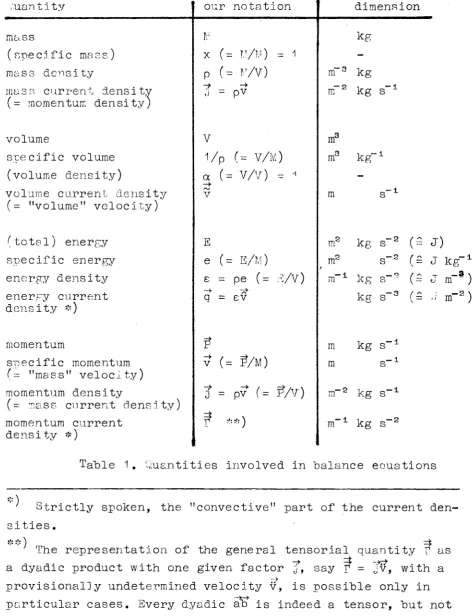
We first give a list of' the involved qua nti ties. The
nomenclature considers as much as nossible the recomman
dations of the International Union for Pure and Apnlied
Physics (IUPAP), document U.I.Ρ 11 (S.U.U. 653) from
1965. Unfortunately, not seldom quantities coïncide which
usually have equal characters (e.g. ν for specific volume
and for velocity) so that sidestep notations must be used.
The adopted units system is the "UiScystem where caloric "
units have already been transformed (e.g. Joules instead of
kilocalories). Conversion factors tire so avoided.
For each of the four blocks (see next page), the pro
cedure is the same. In order to go from the "basic integral
Quantity to the corresponding specific quantity, one has
to divide by the mass M. The ratios are to be understood
as differential quotients. The specific Quantities are thus
suitable as field variables, and so do also the various
densities and. current densities. The "specific mass" χ for
a homogeneous body is, of course, simply unity, but for
more than one component the definition becomes nontrivial
Quantity
mass
(specific mass)
mass density
mass current density (= momentum density)
volume
specific volume
(volume density)
volume current density (= "volume" velocity)
(total) energy
specific energy
energy density
energy current density *)
momentum
specific momentum (= "mass" velocity)
momentum density
(= mass current density)
momentum current density *)
Ol Γ χ
Ρ
V
ir ( = ( =Vp
α —» v E e ε > qf
> v ->f
( = ( = = ( = = . notation=
MA O
=
MA)
pv(= v/?
= v/v)
= E/M)
pe ( =
-¿
εν
=
f/U)
pv ( =
s« )
= ^
ï)
— 1
-Vv)
?/v)
m 3
m2 m3 m3 m ms m2 * m m m m"2 m dimension kg kg kg kg" kg kg kg kg kg kg s'1 1 s"1 s"2 s"2
S "
s"3 s1 s1 s1 s2 ( = ( =
(= J k g -1) 3;
■ )
S)
m
Table 1. Quantities involved in balance eQuations
* )
' Strictly spoken, the "convective" part of the current den
sities.
* * ) =*
The representation of the general tensorial quantity Γ as a dyadic product with one given factor j, say Γ = ¿ν, with a
>
provisionally undetermined velocity v, is possible only in particular cases. Every dyadic ab is indeed a tensor, but not every tensor is a dyadic.
[image:18.595.79.552.76.693.2]13
The respective third lines, the densities, are derived
from the integral quantities by division by the volume V.
Once more, the ratios should be consid.ered as differential
quotients. The direct way to obtain the densities is to
multiply the specific quantities with the mass density p.
Again, the "volume density" α assumes a nontrivial mean
ing only for more*component flow (see § 5,i>).
The various (convective) current densities are obtained
from the respective densities by multiplying the latter
ones with appropriate velocities. The right velocity is the
"mass velocity" ν in the case of mass, the "volume veloci
ty" ν for volumes, the "energy velocity" ν for energies,
whereas an averaged "momentum velocity" does not exist for
morecomponent flow, unless in the onedimensional (scalar)
case, as shall be shown in chapters 3 and 4. These notions
are unusual and shall thoroughly be explained in § 3.4.
All velocities are different for morecomponent flow. The
current densities are vectors for mass, volume, and energy,
but a tensorial quantity for momentum, which itself is al
ready a vector.
The integral quantities "flow rates" (depending on time
only) are obtained according to' (1.3) and (1.4) as
■•dA* = - / d i ·
Si
= /pvdA = / d i v (pv)dV
r
k gs i ]
A
V
% = v . d X = / d i v ν dV- > rm3 s "11
>
• dÃ* = /,
A V
•a?
= - I·
ν
ƒ dA·? = - { D i v Γ dV rm kg s "2]
Q = - /pev.dA = - / d i v (pev)dV fm2 kg s"3 1 ( = Γ.:νΊ)
A V
In the case of momentum, the differential operator
"Div" under the volume integral means the tensor diver
gence, leading to a vectorial quantity, defined by
9Γ k ι
Div
•f .
Sx t
V ^ sr
k 2V ^ sr
k39X;
· )
(2.2)
Concerning GAUSS' theorem for tensorial Quantities, one
finds in the literature (e.g. [5], p. 134)
/dA·? = /(DivrÒdV,
(2.3)A V
where the tensor Γ is the postfactor under the surface
integral, ^hen changing the factor sequence in this
This holds for rectilinear coordinates only. In the
case of curvilinear coordinates additional terms with
CHRISTOFFEL symbols occur (cf. e.g. r41, pr^. I65 and 177).
Our divergence has of course nothing to do v/ith the
sum at the main diagonal elements, which unfortunately is
also sometimes called the tensor divergence. The latter
quantity, a scalar invariant, should preferably be called
15
noncommutative " s c a l a r " oroduet, the o r i g i n a i t e n s o r Γ must be r e p l a c e d by the transposed tensor* Γ' so t h a t an a l t e r n a t i v e n o t a t i o n to ( 2 . 3 ) i s
¡f-äJt = / ( D i v . ? ' ) d V = /(?.Div)dV. ( 2 . 4 )
A V V
In general, the above defined momentum flow rate ÖU is not parallel to the surface vector dA. The dimension
of Γ is, superficially considered, that of an energy, but
has nothing to do with that (different tensor order!).
The various "production densities" oy, which are lo
cal auantities, represent in general the unhomogeneous
terms in the balances (see eq. (1.5) as well as eq.(l.7))
and do not follow from the already discussed quantities.
We denote them as follows:
mass production density σ,, ^m3 kg s 1]
(volume production density) o,, [s1 ]
energy production density ov, !"m1 kg s~3]( = [W m"~3l)
'ill
momentum production density Offrn 2 kg s 21 .
Relationships b e t w e e n thermohydrodynamic variables;
heterogeneous case
3.1 .Jrrtegral jquan_t,±ti_e_s_
The truly interesting case is that our considered v o
lume consists of n components with current index i, which,
however, in our m o d e l , fill each the whole volume (so a s ,
e.g., air as a mixture of nitrogen and o x y g e n ) .
Let us then defi.ne "partial" quantities according to
partial masses
partial volumes
partial energies
partial momenta
ML :
VL :
El ■
ï*
= xLM
= aLV
= r LE
= x
L« P
> (3.1.1)
where the nondimensional Quantities xL, a1, γ , and γ1 may be called "mass fractions","volume fractions",
"energy fractions", and "momentum fractions", resp. Of
course:
η
xL
L=i
= 1;
\ ,
a1
ί=ι = 1;
η
YL
L=i = 1;
η '. zi
Χ
I =1
= Γ (unit tensor). '
(3.1.2)
'*) f \
' In the two component case (n = 2) with liquid and vapor,
ν
17
-Strictly spoken, the denotation of the (generally
assym-metric) tensors %L as "fractions" is not good, but shall
be kept for the moment. At the end of § 3.4, we will
discuss the general suitability of such tensorial quantities
We will further make the agreement that "partial" quan tities shall be denoted by upper indices, i.e. those quan tities whose sum gives directly - without any statistical
weight - the total quantity '. Thus
n n n n
Vi!
1= M; V V
1= V; V Ε
1= Ε; Γ f
1= F* . (3.1.3)
L = 1 I = 1 L = i ί = i
3.2.Specific quantities
When proceeding'to specific quantities, we must dis tinguish between
- "true" specific quantities, where the starting integral quantities are divided by their own (partial) masses Μ*, to be denoted by lower indices,
- "partial" specific quantities, where the starting in tegral quantities are divided by the t otal mass M.
' Provided that a conservation law holds for this kind
T h i s g i v e s
s p e c i f i c m a s s e s
" t r u e " " p a r t i a l "
ML/M' 1
1 · 1 * ) s p e c i f i c v o l u m e s .(—)L= VL/ML = —
Ρ PI
specific energies e-L = EL/ML
specific momenta · v; = PL/ML
χι- = Ml/M
(-)l= VL/M
Ρ
eL = E't/M
v' = ΡΫΜ
(3.2.1 AS in chapter 2, all Quotients should be understood as differential quotients; the above quantities are thus "field" quantities.
For the partial specific quantities holds
xl
L = 1 L = 1
η
P' e" = e vl
L = 1 I = 1
(3.2.2)
They can a l s o be e x p r e s s e d by means o f t h e f r a c t i o n s :
1 NI ■1
χι· 1 ; ( p ) = a1«; eL = rLe ; v1 XL*v , ( 3 . 2 . 3 )
similarly to (3.1.1). It can easily be verified that the
occurring "fractions" for the specific quantities are
just the same ones as for the integral quantities.
•i. \ Ί Ι
' The relation (-5)9' L ; = Tjr is obtained by comparison with
19
Whereas the partial quantities are formal but suitable
quantities for computation purposes, the "true" quantities
have a physical meaning and numerical values independent
of the particular experimental situation. Apart from the
trivial quantity XL = 1, (0)1 means the specific volume
of each component or phase as it can be found in tables;
it is a state variable. For a given pressure e.g., it as
sumes a welldefined constant value at saturation. This is
important, as then, for isobaric processes, (75)^ should
not be differentiated in the balance equation whereas
(p)1 should be differentiated.
eL, the specific total energy which includes also the
kinetic energy and other part energies, cannot be read'from
tables, as it is the case for u(internal energy) or for h
(enthalpy), which are state variables. The relationships
between these energy forms are considered in § 5.4.
The true specific momentum vL is easily understood to
be the true mass velocity of the component i.
In order to compute the partial specific quantities
from the true ones, one has always to multiply with the
mass fractions x'L = ML/Mf thus
xL
el = xLe t ?
xt = x^xL(= x M ; ( ¿ )L = xL( ¿ )L = jL ;
vL = xLvL . (3.2.4)
By substituting these relations into (3.2.2), one has
(the first expression being trivial):
Π ΓΙ Π II
) χ1 = 1; ) . χ1(τ\)ϊ = h / . x l ei = ei / . X'L^L = ^ ·
(3.2.5)
/ ■ ~ ' L · vPyi
Here'we have found the recipe how to compute the quan
1 >
tities —, e, and v, resp., which we must consider to be
representative for the mixture, from the corresponding
"true" values of the components.
The second relation of (3.2.5) must, later on, be com
pared, with the averaging rule for the density p,to be de
rived in (3.3.6).
The third equation, applied tc two phases, is the ener
gy averaginr rule fcr flowing wet steam. An equivalent
rule holds for the entropy s. However, the wellknown rules
for the internal energy u and for the enthalny h (cf. Γ3],
p. 163) are restricted to mi\vterres with no relative motion
of' their components. This may be understood by considering
that each component carries a kinetic energy k¡_ which, in
irreversible processes, may be partly or completely de stroyed leading to supplementary internal energy of the
joined body. Thus, for quantities without conservation law,
such as for u, h, or k, 2 u'L = Σ x^u^ / u, etc. Obviously,
before establishing averaged Quantities, all components must be
thought to have already joined one another.
The last eauation (3.2.5) finally gives the instruction
how to compute the center of mass velocity ν we had al
ready spoken about in chapters 1 and 2.
By comparing formulas (3.2.3) and (3.2.4), the follow
ing relations between the "fractions" a'1, γ'1, and γ} with x'L are obtained:
a1· = xL. ( )L; Yle = xLeL; yL.v = xLvL .
21
lhe last relation indicates that the linear transfor
mât >
mation described by χυ turns the vector ν into the di
rection of vL .
The steam fraction x of wet steam is also (correctly)
called "quality" in thermodynamics, α is the "void frac
tion", γ has no proper name. It is cautioned not to call
χ a quality, not even for onedimensional flow where
it reduces to a scalar, though its value is particularly
easy to measure at the end of a test path. "Quality"
suggests a material property that χ is not because of the
involved velocity situation.
Further relationships between fractions, specialized
to two phase flow, will be given in chapter 4.
3.3. Dens ities
Let us now proceed to the various densities. Once more,
we have to distinguish between "true" and "partial" den
sities, according to whether we divide the integral quan
tities by the individual partial volumes V'L or by the
total volume V.
mass densities
volume densities
energy densities
momentum densities
. Pt
a t
ε ι
-*·
3l
" t r u e "
= M*L/Vl
= VL/ Vl = 1
= Et/Vi
= FVVL
" p a r t i a l "
pt = ML/V
at = VL/V
ε1 = EL/ V
ÎL =
P-/V
he sum of the partial densities is the total density
in each case:
n n n
"3>i 3>
(3.3.2) '( pL = p; / , CL1 = 1; ¿ , ε1 = ε; ' , D J
Γ=ι L=i t=i ί=ι
Like (3.1.3·), we find
pL = xLp; aL = αι·1; ε1 = τ1ε: îTL = v.L ·î . (3.3.3)
Once more, the seme fractions as for th,e integral and
the specific Quantities occur. This is obvious as the
partial densities can also be computed from the partial
specific Quantities by multiplying the latter ones by p:
pL = pxL; a1 = p(£)1: ε1 = pel ; j>L = pvL . (3.3.4)
The partial densities are commuted from the known true
densities by multiplying the latter ones with the volume
fractions a'L = V'L/V:
pL = aLpL; a.L = aLa¡,( = α1); ευ = α1 ει; tl = aLj\ .
(3.3.5)
T h i s can be summed t o y i e l d :
η η η η
> i \ ï Λ \ ï \ i -* ->
; , α PL = ρ; / , ocL = 1 ; /_ , aLe t = ε ; / ay 2χ. = d .
L =ι Γ=ΐ i. =ι L=i
23
-By comparing (3.3.5) with (3,5.5), one can relate xL, γ1 , and γ} to aL :
χςρ = aLpL ; - ; γιε = «le-L ; χ1· ?8 α17ί. (3.3.7)
The representation of the component densities by the specific quantities and the mass densities of the respec tive components is given by:
J ει = pteL ; J, = pLvt (3.3.8)
; al = oHhl ; et = p ^ ; f- = p<<v\ . ^ ' 5 ' ^
Comparison of the second relation of (3.2.5) with the f i r s t relation of (3.3.6) gives
ρ = ¿ , alp t = — . (3.3.10)
t = i
V ? !
l—i Pt
L = i
In the case of η = 2, this yields a coupling between
ocL and xl by means "of the known pj,. This shall be con
sidered in more generality in the following chapter. For
η > 2, similar equations are not obtainable. Notice that
3.4.Current densities
As in chapter 2, we multiply the various densities with appropriate velocities in order to get the nertaining
current densities. From the demand that once more the par tial quantities should sum up to the total quantity, those velocities can be computed.
In order to calculate first the "true" component current densities, we multiply the respective true densities with
the only available true velocities vL , namely
?t = Pivi ; vL = αιη = vL ; qL = ef.vL ; Γι = jftn .
(3.4.1)
Here, in the case of a homogeneous component, we may
in-deed represent r-L as a dyadic product .
The "true volumetric velocities" vL of components are
equal to the respective mass velocities v-L..
To convert true densities to partial densities, the
former ones are to be multiplied by aL. As a consequence,
the current densities behave equally:
DL = pLvt ; vL = aLvi ; qL = eLvL ; V1 = iLvL = pLvLvL.
(3.4.2)
The chosen factor sequence is arbitrary as j\v-L = pi.v\v\
25
-For the mass current density which is identical with
the momentum density j, this was airead?/ stated in ( 3...·.-.).
But for the first time it comes out that the partial
—>
"volumetric" velocities v1 of the components are not
eaual to the respective ΑΛ = x^vj,.
By summing up the partial quantities we get
η η η η
/ . ] = . ! ; / vL = ν : / q1 - q ; / Τ1 = Γ .
ί=ι Γ=ι 1=1 1=1
("Λ.3)
If we substitute the expressions (3.3.3') into (3.4.2) and add according to (3.4.3), w.e find
η η η
>/ ( xLv¡, = pv ; 1 · / auvL =
p / x"vL = pv ; i · / orvL = ν ; ε / Y"VL = εν ;
ί = ι t = 1 I =1
η
/ . (Χ. · 3 ) ν ι = Γ / any ¿ν , (3.4.4)
L = l
where the right hand sides are taken from table
*)
; As no associative law holds for this kind of multinli
=$·
cation, it is impossible to turn the linear operator γ1
-ï » >
The "mixture" velocities in question are thus found to be:
V
mass : ν = / _ xLv-L
Γ=ι
η
* V
t-volume: v = ,· α V[
ί =ι >
7?
V :
=
T.
r
l
ïi
1 = 1
energy:
momentum: "ν" not separately er is ting in general.
Cï.h.5)
The statistical weights to construct them are just the original ratios known from the integral quantities.
The following relations may also be useful (to deduce
from 3.4.5 with 3.2.3):
π π η
V
L ~»
*
V ,1,U
1 á
Vt"»·
/ xLvL = v ; / (p) vL = ρ v ; > eLvL =
ί=ι l=i L=i
η
but / vLvL / vv . (3.4.6)
27
It remains still to give relationships between partial
and total current densities, for which we write ad hoc
, ι. _ vL · j ; ν = β ·ν · Q = δ ·Ρ · Γ = ι!/ · Γ .
(3.4.7)
The f i r s t r e l a t i o n i s a l r e a d y known from ( 3 . 3 . 3 ) , l a s t e o u a t i o n ; χ1 c o u l d t h u s d i r e c t l y be i n t r o d u c e d .
Eor t h e o t h e r r e l a t i o n s , we s u b s t i t u t e (5.^.5) i n t o
(3.4.2), 1 e a d i n g t o
>: p v i = XL ,p v ; aLV{, = ßL' V ; YLev-L = ôL« e v ;
(χι·Ϊ)νι = ψ1· Γ , (3.¿+.8)
w i t h
η η η η
^
=*t
?
V &
3
V
Ä
?
V
/ XL = I : / ßL = I : / ôL = I
/ . x
L=
Γ; ζ , ß
L= ï
; Ζ . δ
1= Ι ;
¡_ . ψ
= ï
.
t = i L=i ί=ι ί=ι
( 3 . 4 . 9 )
The s i g n i f i c a n c e of ßL, oL, and . ψ1 i s p u r e l y a c a d e m i c , a s f a r a s t h e y cannot be computed unambiguously from t h e
-> ~
v a r i o u s g i v e n v e c t o r s v , v , e t c .
* ) =£}
This brinrs us to the problem of the utility of such
tensorial quantities in connection with ηcomponent flow,
as already mentioned in § 3.1. We do not speak here about
the tensors in the general balances treated in chapter 2,
such as the momentum current density Γ, or the dyadic
products occurring for rL. They all have a real physical
meaning.
The question is rather what is about the "fractions"
=*L ^L 3l %
X » ß » δ , and ψ . Let us discuss e.g. thelast equation
of (3.2.3), which may be considered as definition for γ}.
The vectors vu and. ν are all known. Assume for the mo
ment mdimensional vectors, then we have just m eouations
for a certain i, whereas the "unknown" tensor γ1 contains
m2 elements. Thus, equations of this kind are solvable
only for m = 1, i.e. for scalers. For m >_ 2, no unambiguous
solution exists. None of the tensors in question has there
fore a reasonable meaning except for onedimensional flow
where they reduce to scalars. In moredimensional formu
lations, they must completely be avoided..
3.5 o£'low_ra tes
Although integral quantities have nothing to do with
the differential formulation of balances, we bring them
here for completeness. This is in particular in order
- 29
Similarly to eqs. (2.1), we get partial flow rates
% = _ (
/rjt.dÃ* = -
- ( (jW'D'tâ
A
0, V - ; v
/ v
Ll.di? = ·- /(ft.^.dsr
«dAA'
JE
= - íq^.dÃ* = - /(c^-q)-dA
A-H.
/cLA«rL = - /< / ά Α · ( ψι· Γ ) ,
>
J
( 3 . 5 . 0
where the relations (3.4.7) have been used.
=* =* 4: 3·
In view of the unprofitableness of χ , β, δ1, and ψ1
4. Relationships for onedimensional two phase flow
'When considering two phase flow, in particular water
and steam, through a straight pipe, it is rather obvious
to simplify the balance equations by restriction to a
single axial coordinate. All vectors and tensors reduce
to scalar quantities, omitting the components pertaining
to the other coordinates. The objections arising from
such a neglect shall be treated only in chapter 5.
Here we will compute the formulas of the nreceding
chapters for n = 2 phases. The fractions of vapor shall
be denoted, as usual, by χ, a, etc., without index, those
of liquid by (1x), (1oc), etc. For the indices used, ν
means vapor, 1 means liquid. For upper indices we write *
instead of v, and ' instead of 1.
The elementary volume V is a disk with area A and any
(insignificant) thickness dz. ¿11 integral quantities
can equally be considered as quantities per unit length.
"e give formulas for the practical use without much
comment, referring simply to the relations of preceding
chapters where they have been taken from, in square brackets,
[3.1.1]:
M' = xM
V » = αν
E' = γΕ
Ρ' = XP
M' = (lx)M
V' = (la)V
E' = (ΐ-γ)Ε
Ρ' = (ΐ-χ)Ρ Ν
> (4.1.1)
31
4.2.Specific Quantities
"true" specific quantities [3.2.1 ]
(1)
=ï!
=i_
^p;v M' p„
E|
V ~ M'
ν ρ*
ν ~ M*
rl)
- Ii _ 1
vp;l " M' Pi
v.
M'
EL
M'
> (4.2.1)
"partial" specific quantities [3.2.1], [3.2.3], [3.2.4]:
X
Φ
e"
=
=
=
M' M
V M
E ' M
_ vi _ α _ / I N
. β _
M
= Ye = xe
= χν = xv.
( 1 - x ) = MJ M
Φ'
e'
ν '
V ' ' M
Ξ ' " M
Ρ ' ' M
M P K Χ ΑΡ;1
= ( ΐ - γ ) β = ( l - x ) e1
>
( 1 - Χ ) ν = ( ΐ - χ ) νχ
specific quantities of mixture Γ3.2.5]
χ 1-x
— +
ν Pi
= xe + (l-x)e, ν
v 1
ν = xvy + (1-X)V1
> (4.2.3)
relations between fractions [3.2.61
α χ Y χ X χ V V V V 1-α 1-x 1_y 1-x 1"X 1-x Ρ Pi
!i
e V > (4.2.4) 4.3.Densities"true" densities Γ3.3.1] , [3.3.8]
pv =
ε =
V
Κ
=
M" V '
E '
V ' =
Ρ '
V*
-- ρ e
κν ν
ρ ν *ν ν
Μ_ V'
Ε'
ν, κι η \ (4.3.1)
εΊ , - ρ e.
EL
"partial" densities [3.3.1], [3.3.31, [3.3.4], Γ3.3.5Ι
» ..
M_l
V
E'
= X p = OCR
V
e * = 7j—V = γε = αε = pe* = ρ "e
v v
V " = X3 = α ϋν = p v · = p ' vv
ρ'
=ψ-
=
(1-x)
=
0-α)
PiEJ
V = ( 1 - γ ) = ( ΐ - σ ) ε1 = pe' = p'e^ \ " ( 4 . 3 . 2 )
y = — = ( l - x ) j = ( l - a ) j1 = pv' =
p'v-mixture densities [3.3.6]:
GO
co
Ρ = ο.ρν + ( ΐ - α ) ρ1
pe = ε = «ε + (ΐ-α)ε1 = o:pvev + (l-a)p1e1
ρν = j = a jv + ( l - a ) jx = «pvvy + (l-a)p1v1
> (k.3.3)
relations between fractions Γ3.3.7Ι
N
χ
α
Y a.
y
a
v Pve V pe
Ρ v Hv v
pv
1-x P l
A-a " p
1-Y εχ
1-α " ε
1- X 3\
1-α j P lel
pe
P lvl
pv
> ( 4 . 3 . 4 )
4.4.Current densities (now scalars)
true" current densities [3.4.1]
J = ρ ν
uv * v ν
ν = ν
ν ν
h
= Pi
vi
vi = vi
> 0 = ε ν = ρ e ν q_ = ε , v., = ρ, e., v.,
'V v v Hv v v ^ 1 1 1 μ1 1 1
Γ = J v = ρ Ve
V V V V V Γ1 = Vi = Ρΐν1
J
(U.4.1)
"partial" current densities [3.4.2 ], [3.4.7] :
j ' = p ' vv = x j = a jv j ' . = p ^ = ( l - x ) j = ( l - a ) ^
v " = α νγ = βν = a vv v ' = ( ΐ - α ) νχ = ( ΐ - β ) ν = (l-oOvL
q ' = ε * νγ = ôq = a q ^ q ' = ε ' ν1 = ( l - ô ) q = ( l - a ) q -L
>
Y" = j ' v v = ψΓ = α Γν Γ ' = j , v1 = ( ΐ - ψ ) Γ = ( ΐ - α ) Γ2
J
mixture c u r r e n t d e n s i t i e s Γ3.4.4"':
j = a jv + ( l - a ) j1 = a pvvy + ( l - a ) p1v1 = ρΓχνγ + ( ΐ - χ ) νχ] = pv
ν = a vv + ( 1 - a ) ^
q = aqv + ( l - a ) a1 = a p ^ e ^ + ( l - a ) p1e1v1 = pe [ γ νγ + ( ΐ - γ ) ν1] = pev
Γ = αΓ„ + (1-α) ΓΊ = αρ„ν2 + Η - α ) ρ ν | = ρνΓχνγ + ( ΐ - χ ) ν . , ] = ρνν '
>
ν ν
( 4 . 4 . 3 )
definition of velocities Γ3.4.ΡΙ:
ν = xvv + ( ΐ - χ ) νχ
ν = a vy + ( ΐ - α ) νχ
ν = γ νγ + ( ΐ - γ ) ν1
>
ν = Χ% + (1- χ ) νχ
* )
J
n
Here, and only i n t h i s one-dimensional' c a s e , v g e t s a meaning: v = / xlvc
1=1
00
en
4.5.Relationships between fractions
In contrast to formulas (4.2.4) and (4.3.4), the re
lations can also be given without recourse to mixture
properties, but with the "true" phase properties only.
For this purpose, we define the following ratios bet
ween "true" specific Quantities
the specific volume ratio ξ
the specific energy ratio η
(Vp)y _ PjL
(Vp)
1p
vV
V V
the specific momentum ratio S =
(= velocity ratio or slip ratio) 1
> Í4.5.1)
For a given saturation pressure, ξ is numerically
known. The same is but not true for the slip ratio S, as
it is not built by state variables, nor for η, as e is
no state variable.
Let
ρ Ρ *)
= u + k = h (τ0„ + k ; en = u, + k, = h, (ñ). + k,
r ν ν ν vP'v v' 1 1 1 1 vP'l 1
(4.5.2)
where k and k. are the· specific kinetic
ν 2 1 · 2
energies and u , u, the specific internal energies of the
components. Then
u +k (un+k, ) u u..
ν ν 1 1 Λ ~ ν 1 Λ
η = : ι .
Ul+ kl U
(4.5.3)
Λ, \ "t-J
37
u υ... is the evaporation heat at constant volume (con
v 1 v
s tant ρ). In most cases, kL is negligible against uL ;
nevertheless, (4.5.3) is rigorous only for the components
at rest.
Similarly,
η
hv(p/p)v+kv[h1(p/p)1+k1]
^ ( ρ / ρ )χ+ ^
h h,
1 s 2 — ¿ 1, (k.5.k)
where h h, is the evaporation heat at constant pressure p,
and the socalled expansion energy p/p is omitted.
It is further to be noticed that both h, and u, are
known except for an additive constant. For saturated wa
ter of 0 C, h, is, by convention, equated to zero. The
enthalpy difference h, (and u, , too) is free from such
arbitrariness and thus by far more suitable than η for
theoretical purposes.
From (4.2.3), (4.2.4), (4.3.3), and (4.3.4), the fol lowing relationships are easily obtainable
χ =
α =
Y =
α
α + ξ(ΐ-α)
Υ
ΐ£.
ξχ + (1-χ)
ηχ ηχ + (1-χ)
Sx
Χ :: Sx + (1-χ)
Λ ξ γ ηα - Γ + +
η ( ΐ ·
η(ι·
ηα
ξ ( ι ·
Sa
- γ )
-Υ)
-α)
Χ
Χ + S(1-x)
1χ_
ξχ + S(1-X)
m
ηχ + s(i-x) sy
Sa + ξ(ΐ-α) Sy + η(ΐ-γ)
OC I
;
0,9
Ofl
0,7
0,6
0,5
0,4
0,3
0,2
0,1
ι ■
Ρ»
1
Iah ~ρΜ(
/?·
ΙΨ*Μ
1
"¡Γ^
5oJ>
)0«L(*
1
ρ « i o
1 »at
/pc.
rik—^ — ^ - i ' » ■
O I 0,1 0,2 0,3 0,4 0,5 0,6 0,7 0,6 0,9 7 X
Figure 1
» ))
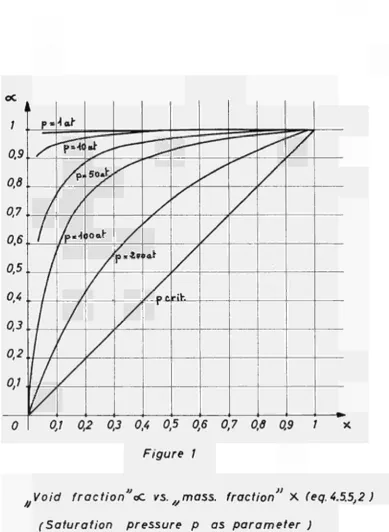
..Void fraction oC vs. mass, fraction X (eq. 4.5.5,2 )
[image:44.595.152.542.109.642.2] 39
4.6.Flow rates
"partial" flow rates [3.5.1]
M
- ( ■
XJ cLA
Qv =
°^ =
Qp =
/ßv dA A
/Ôq dA A
/ψΓ dA A
= /(lx)j dA A
Q¿ = /(lß)v dA
A
«έ
. . f
/(lô)q dAOp = /(l*)r dA . A
> (U.6.T)
The integrations must be extended over flow cross sec
tions A perpendicular to the flow direction. But as a
variability of the integrands normal to the flow axis can
not be considered in a consistent onedimensional theory
(unique position coordinate is z ) , the above expressions
degenerate to
« 4
-« ,
«i =
< *
- XdA
ßvA
-
mA
ψΓΑ
^ =
^v =
%
< *
- (1.
(1.
(1
(1
X)JA
β)νΑ
ô)qA
ψ) ΓΑ
If the left hand expressions are divided by the total
flow rates Q„, 5L·, Q„, Qp, resp., (see 2.1., specialized
to one dimension), the area A and the current densities
j, v, q, and Γ, cancel in all cases so that follows
Q"
II
X o
¿M
*
"V
v
o*
_E 0
%
\
mass flow rate ratio
β = — volumetric flow rate ratio
energy flow rate ratio
ψ = — momentum flow rate ratio.
>
J
(4.6.3)
All these quantities are integral quantities, thus
foreign to a differentially formulated theory. They are
results of the processes inside a test distance and have
a meaning only at its end.
In particular, the relatively easily measurable quan
tity χ, frequently called "quality" in the literature, is
not suitable to be used in our theory. Obviously, any cor
relation between integrai! and locally defined (field)
quantities is without meaning, e.g. between χ and a, or
similar ones, as it can be stated between two local quan
41
5. The balance equations
5.I.Mass balance
After the lengthy preparations of chapters 2, 3, and 4,
we will now use the general balances, either in "local"
form (1.5) or in substantial form (1.7), and specify the
general current densities iL and the production densi
ties Oy.
In the case of mass, y is the "specific mass", i.e.
unity (see table 1 ) . The current density ãL is ~$ = pv,
anõ., without mass sources, aM = 0.
This gives
■— = div pv. (5.1.1)
The substantial formulation (1.7) is not'directly
suitable in the mass case. But by applying (1.8) on the
density ρ and considering (5.1.1) one finds
=£ = ρ div ν ,
(5.1.2)
Dt
another wellknown formulation of the continuity equation.
We now proceed to the balance of partial masses, y is
here xL (partial mass per total mass, cf. 3.2.1), and
<£h = jL = pLv\ (cf. 3.4.2). This can all be chosen quite
■ Thus, according to (1.5):
a(pxL) ?PL L> ? / c , ,x
8 t ~ = 9t~ = G 1 V Ρ vt + °M » (5.1.3)
or substantially (1.7):
DxL
Dt = d i v (plV{, p'Lv) + oj, , ( 5 . 1 Λ )
n
τ —·
\
v/here ) σλ = 0 .
ί : M t =1
The expression pL(v{,-v) will also appear later on. It
is the excess of the partial current density over the correction due to the movement of observation point and may be called "(mass-) diffusion current density"
«Í1 = pl(vLv) (5.1.5)
of the component i.
η
Of course, ) J*1 = 0.
l=i
Eq. (5.1.3) may herewith also be written as
43
-When specializing the formulas to one-dimensional two phase flow, we have
at
+ V 9z + ΡΈ =°
3v (5.1.7)dp' dp' 9νη , - .
9t" + Vl θ ζ ~+ Ρ 9z~ = Va» * )
9t ν 9z 9z
9p' 9p' 9v^ „
+ ν — + ρ' τ-* = oM(z,t) .
?
(5.1.8)The equations are not independent one from the others, as the sum of eqs. (5.1.8) gives just ec. (5.1.7).
In the one-dimensional treatment, the overall suita bility of which for boilinr; rhenomena investigations is
not assured, the partial densities pL can be replaced by
the known true densities pt. At the same time the vapor velocity ν may be reduced to 'the liquid velocity v., by
introducing the slip ratio S(z,t). The suitability of this measure in view of a solution of the system is also doubtful.
Eqs. (5.1.8) transform to
9v-9t
O f V η
[Ρι(ΐ-α)] + νχ — ΓΡι(ΐ-α)] + Ρι(ΐ-α) — *
¿(z.t)
■ΓΤ ( ρ α) + S(z,t)vn -ζ- (ρ α) + ρ α r— rS(z,t)v,^
3t ν"ν ' ν ' ' 1 3ζ ν rv "ν 8ζ χ * ' \
ft
■
aL
(z'
(5.1
>
t)
or, if ρΊ and ρ are,constant for constant saturation
pressure,
3 a
3t Vl 3z"oa + (',-a)
9V. 3z
σ ^ ζ , ΐ )
, N 3a 3S , . Sv-, . o¿¡(z,t)
+ ^ + S t z . t ^ + α Γ νχ + S(z,t) g ^ ] = ^ ι a
ν
>
(5.1.10)
The state variable α acts as a dimensionless mass
s u r r o g a t e , mnhasis is to b e laid on the fact that S(z,t) enters into the equation as a foreign b o d y . The r e p l a c e m e n t of ν _ by 'h' reveals to be only a p s e u d o s i m p l i f i
cation as long as t h e slin ratio S is n o t known as f u n e st
tion of ζ and t '
The righthand inhomogeneous terms must b e otherwise
p r o c u r e d (from the energy equation, as w e shall s e e ) .
5.2 .Volu.me_ balance
Though resulting only in trivialities, the formal p r o
cedure shall also b e applied to our v o l u m e quantities, in
order to show the overall consistency.
The specific volume is y = 1/p, and the volume current
density is <&, = v, according to table 1 .
*)
45
Thus, the local formulation yields
§£ "1" = div ν + σν = 0 (5.2.1)
which means that no geometrical volume storage is
possible. The substantial formulation reads
Ρ Dt 'õ' = " d l V (v v) + Cy (5.2.2)
or
1 Dp _>
r κ? = + div ν, (5.2.3.)
Ρ Dt
when cancelling div ν due to (5.2.1). This is just eq. (5.1.2).
Notice the important difference between ν and the
special velocity v.
The partial volume balances may be omitted.
5.3. Momentum_balan.c e
As the energy balance requires some additional thermo
dynamic considerations, we will first investigate the momentum balance.
This balance is called NAVIERSTOKES' equation of move
ment in hydrodynamics. Thus, in the case of homogeneous
onecomponent flow, we should arrive at some wellknown
notation, but the heterogeneous flow will lead to a more
sophisticated formulation, as we shall see.
' Besides, the source can be evaluated to be cy = ) Oy = ) Ojy/Pi
According to our general procedure, we choose for y the specific momentum v, a vector; see table 1.
The momentum current density, to be read from eq. (3.4.4), is
V
(χ
1.Τ)ν\
V
Ρ vivi1=1 1=1
This is the pure convection part ano. is not complete. As well known, particles of real fluids interact mutually by pressure and viscous forces resulting in a momentum transfer. This additional (and preponderant) momentum current density is described by the stress' tensor
P+P xx
P
zx
Ό
xy
P P+P yx yy
ρ xz
yz
P P+P zy * - zz
*)
[kg m"1 s"2] (5.3.1)
The normal pressure ρ ' is superimposed by "viscous
pressures" pjt which, according to STOKES, are given by
/3V/.X 9ν/,Λ
pj l -μ
K-ér
31 1 +"ãj '
!- l^'
ôdiv νJi
dlj = x,y,ζ
ι = χ,y,ζ .
(5.3.2)
s¡0
' For the description in nonCartesian coordinates,
cf. [7].
"' This pressure p(t,r) is one of our system variables
47
The tensor Π is symmetric: ρjι = Ptj. μ is the usual
dynamic viscosity and μ' is the socalled "second visco 2
sity parameter" which is sometimes specified to μ' = =■ μ,
The latter relation is however rigorously valid only for
monoatomic gases (ENSKOG 1917). We shall make no use of
the definition (5.3.2). It is further convenient to use
the viscous part of Π separately by subtracting the sca
lar pressure ρ from the diagonal elements:
ff*= ff - p ?
Ρ ^xx *xy Ρ "O "xz
Ρ Ρ Ρ
yx yy yz
P P P
■^zx ^ z y *ζζ
It may be anticipated that Div ·? = 0 so ti that
(5.3.3)
Div
(P?) =
grad p.(5.3.4)
A momentum production σ=>· may be caused by external for
ces proportional to mass, such as gravity. Let ft [m/s2]
be this force (per unit mass) on the i· component, then
σ ^
u
>
i?
t [kg m"s s 2] (5.3.5)In the case of gravity which we will consider exclu
> »
sively, ft is equal to g, the freefall acceleration vec
tor, so that
Substitution of these expressions into eq. (1.5) gives
the local formulation
or
ft (pv) =
Div(r+n) + pg ,
(5.3.7)
•|t (pv) = Div Γ grad ρ Div Π* + pg. (5.3.8)
In order to reduce the current density to the given velocity field v, we must subtract pvv from ilU = Γ+Π
(see eq. ( 1 . 6 ) ) . Thus, the substantial formulation accord ing to eq. (1.7) is
T \ —> —»
Ρ Dt = ~ D i v ' r + Djv«(pvv) D i v π + pg, (5.3.9) o r
p ^ = Div(rpvv) grad ρ Divïï* + pg Κ (5.3.10)
Unless for homogeneous (onecomponent) flow, ψ is not
equal to pvv, as can be seen from the last expression
in (3.4.4).
' The term D i v ( r p w ) can also be written as D i v / v t J1
L = 1
with JL defined by (5.1.5). This illustrates the origin
49
The vector Div·(pvv) is parallel to v, as every ex
pression of this kind is parallel to the last vector in
the dyadic product:
...■rh " .-■',,,: -'· ι,"' ',, fr'ïpqioofîl o í
D i v (pat?) = (grad ρ·?)"? + (ρ div a)"t? +p (a«Grad)"b* .
(5.3.11)
In contrast to this, ß i v r is in general not parallel to v, because it cannot be expressed in the form Div.(pvv)
as we have seen. Thus, the additional term Div·(Γpvv)
changes both magnitude and direction of the time deri vative vector ^v/Dt against the case of homogeneous flow.
The above formulations 5.3.7 to 5.3.10 may be consi
dered as an extension of the usual NAVIERSTOKES' ecua
tion to heterogeneous flow.
The elements of the tensor Π* are, as shown in
eq. (5.3.2), themselves functions of the velocity compo
nents and a material property μ, the viscosity. This is
already true for the simpler case of laminar motion. For
a turbulent flow, the stress tensor is superimposed by
the tensor Π. ^ of turbulent "apparent" viscosity, the
element ajk of which is ρ vjvk. vj etc. are Cartesian
components of the turbulent oscillation velocity ν' , and
the bar means a time average '. Their computation as well
as their measurement are extremely difficult; the theore
tical statements (PRANDTL's mixing length etc.) are by
far unable to predict correct results in complex cases
like ours.
* i
' The method applies to quasistationary turbulence. For
macroscopically rapidly changing velocity fields, the
What is still more serious is the fact that the ele
ments of both tensors n* and Π, , refer of course to
11 turb.
a homogeneous fluid. The important open question is how
to incorporate two or more entirely different viscosi
ties μ5_ into the stress tensor, and which velocities
should reasonably be applied.
Here the completemixingmodel suggests some idea but
not yet a solution. It is obvious that only a unique pres
sure field p(t,r) is physically possible, and not a set
of different but completely overlapping (true) pressure
fields pL(t,r) . The same must be true for the tensor
n*(t,r) which is a unique one for the mixture. No dif
ferent tensor components ρ . can occur because the con
^xy,i
stituents are undistinguishible as concerns their po
sition.
Hence the "mixture" friction tensor Π* must entirely
refer to mixture velocity components and a "mixture vis
cosity" μ. If μ is a material property for homogeneous
fluids, the same can hardly be true for a mixture, as the
effect of fricción between really separated components i and k must be considered in any way. This latter cross
—» —>
effect however depends on both velocity fields vL and νκ,
strictly spoken on VLVK.
This reasoning reveals that the relatively simple
STOKES' statement (5.3.2) is insufficient for morecom
ponent flow and may not be used. The effective viscosity
for slipflow must be higher than that computed from mo
lecularstatistical theories for gas and liquid mixtures
at rest (see e.g.[8]).
' "Partial" pressures pL = aLp can of course be consi^