http://dx.doi.org/10.4236/wjet.2013.13008
Pressure-Driven Demand and Leakage Simulation for Pipe
Networks Using Differential Evolution
Naser Moosavian, Mohammad Reza Jaefarzadeh
Department of Civil Engineering, Ferdowsi University of Mashhad, Mashhad, Iran. Email: [email protected]
Received September 1st, 2013; revised October 2nd, 2013; accepted October 8th, 2013
Copyright © 2013 Naser Moosavian,Mohammad Reza Jaefarzadeh. This is an open access article distributed under the Creative Commons Attribution License, which permits unrestricted use, distribution, and reproduction in any medium, provided the original work is properly cited.
ABSTRACT
Traditional techniques for hydraulic analysis of water distribution networks, which are referred to as demand-driven simulation method (DDSM), are normally analyzed under the assumption that nodal demands are known and satisfied. In many cases, such as pump outage or pipe burst, the demands at nodes affected by low pressures will decrease. There-fore, hydraulic analysis of pipe networks under deficient pressure conditions using conventional DDSM may cause large deviation from actual situations. In this paper, an optimization model is introduced for hydraulic analysis of water distribution networks using a meta-heuristic method called Differential Evolution (DE) algorithm. In this methodology, there is no need to solve linear systems of equations, there is a simple way to handle pressure-driven demand and leak-age simulation, and it does not require an initial solution vector which is sometimes critical to the convergence. Also, the proposed model does not require any complicated mathematical expression and operation.
Keywords: Hydraulic Analysis; Differential Evolution; Optimization Model
1. Introduction
In the recent past, several packages originally developed for steady state analysis of looped water distribution sys-tems. For instance, EPANET2 has been extended to in-clude the possibility of “extended period simulations” (EPS), namely the possibility of simulating long periods of time by means of a succession of steady states, only accounting for the change in storage of reservoirs occur-ring from one time step to the next [1].
This model, which is used in current engineering prac-tice, is based on the conventional Demand Driven Simu-lation Method (DDSM). It assumes that nodal outflows are fixed and are satisfied regardless of network pres-sures. The assumption simplifies the mathematical solu-tion of the problem but is not always appropriate because it is clear that the amount of outflow at nodal outlets de-pends on network pressures. If the pressure falls below a minimum required level (due to some critical events such as mechanical and hydraulic failures or excess demand), the flow will be significantly reduced. Although some nodes may be able to satisfy their demands, others may meet the demand partially while the rest may fail and may not provide any water at all. The assumption of
water distribution networks using a meta-heuristic algo-rithm called Differential Evolution (DE). Analysis of hydraulic networks can be achieved by treating it as an optimization problem as shown by Arora [12], Hall [13], and Collins et al. [14]. Arora considered a simple two- piped loop while Collins et al. have based their approach on rigorous theoretical background and developed nonlinear optimization models, solutions of which yield the hydraulic network analysis [15]. Collins’s model can be minimized by application of differential evolution algorithm. In this methodology, there is no need to solve linear systems of equations, there is a simple way to han-dle pressure-driven demand and leakage simulation, and it does not require an initial solution vector which is sometimes critical to the convergence. Also, the pro-posed model does not require any complicated mathe-matical expression and operation. In the next part, Collins’s model is described.
2. Co-Content Model Approach
Arora [12] is the first researcher who suggested an ap-proach based on the principle of conservation of energy. This principle states: “Flow in the pipes of a hydraulic network adjust so that the expenditure of the system en-ergy is minimum.” Next, Collins et al. [14] proposed a model termed the co-content model, that is based on equations having the unknown nodal heads as the basic unknowns, i.e., based on H equations. The unknown pipe flows are expressed in terms of the nodal heads and the known pipe resistances, so that the energy loss in pipe
xx E is given by [15]
1 1 1 n i j x x x n x
H H
E Q h
R
(1)
In which Rx is the hydraulic resistance function, hx is
head loss in pipe x, Hi and are pressure heads in node i and node j. j
H
Now consider the network of Figure 1, with the known and unknown parameters as shown therein. Let the unknown nodal heads at nodes 3, 4, and 5 be H3, H4,
[1]
(1) (2)
[3]
[4]
(3)
(4)
[5]
[image:2.595.310.540.164.305.2](5) [2]
Figure 1. Schematic representation of the looped pipe net-work with 5 pipes.
and H5, respectively. Herein also consider a ground node G with fixed known level H0G, as shown in Figure 1.
The nodes 3, 4, and 5 are connected to the ground node G with pseudo pipes, carrying the known nodal outflows
q3, q4, and q5 as shown in Figure 1.
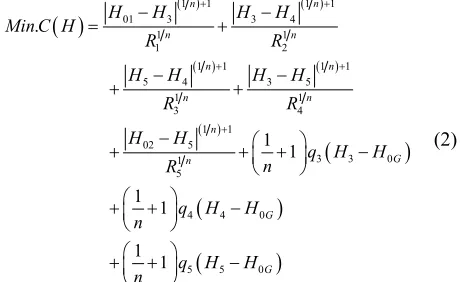
The co-content optimization model is expressed as
1 1 1 1
01 3 3 4
1 1
1 2
1 1 1 1
5 4 3 5
1 1
3 4
1 1 02 5
3 3 0
1 5
4 4 0
5 5 0
. 1 1 1 1 1 1 n n n n n n n n n G n G G
H H H H
Min C H
R R
H H H H
R R
H H
q H H n
R
q H H n
q H H n
(2)
01
H and H02 are known pressure heads for source nodes. The first five terms of the objective function rep-resent the energy loss in real pipes 1, of the net-work, respectively, and the last three terms show
,5
1 n1
times the energy loss in the pseudo pipes [15]. It should be noted that there are no constraints and there-fore an unconstrained model in three decision variables is made. For minimization of optimization model, which are partially differentiating in unknown heads, the node- flow continuity equations are created. Therefore, the so-lution of the co-content model gives the values of the unknown heads such that the node-flow continuity rela-tionships are satisfied [15]. For simplicity, HoG can betaken as zero, so that the General co-content model can be expressed as
1 1 1 1 Min. 1 ni j
j j n
x x j
H H
C H q H
n R
(3)Collins et al. [14] suggested the solution of the NLP optimization of the model. Their method were 1) the Frank-Wolfe method; 2) a piece-wise linear approxima-tion; and 3) the convex simplex method. These methods are highly depends on initial guesses and in some cases they converged to an incorrect solution [14].
3. Head Dependent Analysis
Wagner et al. [16] and Chandapillai [17] suggested a parabolic relationship between required nodal head and minimum head. Their relationships are
min
min
min min
0 j
1 p
j *
j j * j
*
j j
H H
H H
q q H H H
H H
q H H
0
(4)
H* is the required nodal head. This formulation is eas-ily handled to co-content model without any mathemati-cal complexity.
4. Leakage Simulation
Water losses via leakages constitute a major challenge to the effective operation of municipal WDN since they represent not only diminished revenue for utilities, but also undermined service quality [9] and wasted energy resources [10]. In order to conduct more accurate analy-sis of a WDN, such as a better estimate of flow through the network (with respect to both satisfied demand and losses through leakage), a hydraulic analysis based on capable of accounting for pressure-driven (also known as head-driven) demand and leakage flow at the pipe level should prove invaluable. To reach this goal, a leakage model is expressed as follows [3]
if 00 if
k
k k k k k -leak
k
β l P P
q
P
(5) Where Pk = average pressure in the pipe computed as
the mean of the pressure values at the end nodes I and j of the kth pipe; and lk= length of that pipe. Variables αk
and βk= two leakage model parameters [11]. The
alloca-tion of leakage to the two end nodes can be performed in a number of ways [18]. Here the nodal leakage flow
qj−leakis computed as the sum of qk−leakflows of all pipes connected to node j as follows:
-
-1
if 0
1
2
2 0 if
k
k k k k
j leak k leak
k k
k
l P P
q q
P
0
(6)where Pk
P Pi j
2. This formulation is also easily handled to co-content model without any mathematical complexity.5. Application of Differential Evolution
Algorithm for Minimizing Co-Content
Model
For the hydraulic analysis, this study introduces Differ-ential Evolution (DE) algorithm. Because the algorithm was originally developed for solving optimization
prob-lems, the hydraulic network analysis wasintroduced into an optimization problem (co-content model). One ad-vantage of the DE algorithm is the fact that it does not require an initial solution vector which is sometimes critical to the convergence. Also, application of DE algo-rithm in co-content model does not require any compli-cated mathematical expression and operation. In this mo- del, pressure-driven demand and leakage can be simu-lated.
5.1. Differential Evolution (DE)
Differential evolution (DE) is a simple powerful and population-based stochastic optimization algorithm that outperforms many meta-heuristic algorithms on numeri-cal single objective optimization problems. In DE each decision variable is represented in the chromosome by a real number. The DE algorithm requires only three con-trol parameters: weight factor (F), crossover rates (CR), and population size (NP). The initial population is ran-domly generated by uniformly distributed random num-bers using the maximum and minimum limitation of each decision variable. Then the fitness values of all the indi-viduals of population are calculated to find out the best individual xbest,G of current generation, where G is the index of generation. Three main steps of DE, mutation, crossover, and selection were performed sequentially and were repeated during the optimization cycle [19].
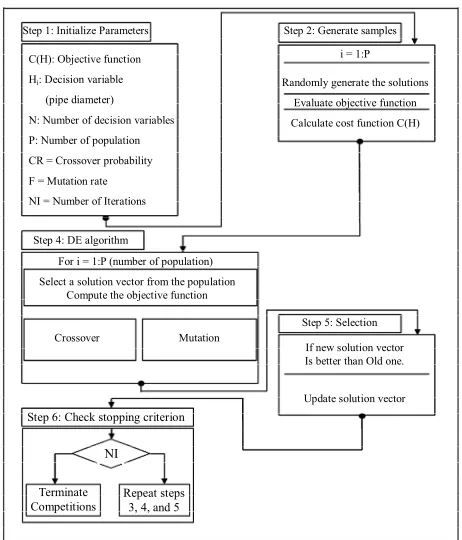
The steps in the procedure of DE are shown in Figure 2. They are as follows:
Terminate
Competitions Repeat steps 3, 4, and 5 NI Step 6: Check stopping criterion
Step 1: Initialize Parameters Step 2: Generate samples
C(H): Objective function Hi: Decision variable
(pipe diameter) N: Number of decision variables P: Number of population CR = Crossover probability F = Mutation rate NI = Number of Iterations
i = 1:P
Randomly generate the solutions Evaluate objective function Calculate cost function C(H)
Step 4: DE algorithm
For i = 1:P (number of population) Select a solution vector from the population
Compute the objective function
Crossover Mutation
Step 5: Selection
If new solution vector Is better than Old one.
[image:3.595.308.539.449.719.2]Update solution vector
Step 1. Initialize problem and algorithm parameters Step 2. Samples Generation
Step 3. Start Iterative Process Step 3.1. Mutation Operator Step 3.2. Cross-Over Operator Step 4. Selection
Step 5. Check The Stopping Criterion.
5.2. Step 1. Initialize the Problem and Algorithm Parameters
In Step 1, the optimization problem is specified as fol-lows:
1 1 1 1 Min. 1 ni j
j j n
x x
H H
C H q H
n R
j (7)Where C H
is an objective function; H is the set of each decision variable. In this paper, the objective func-tion is the co-content model; the unknown heads are the decision variables.5.3. Step 2. Samples Generation
The initial population, initial values of the mutation fac-tor, F and initial values of the crossover rate, CR for the DE is created arbitrarily by following formula:
min 1 max min
min 2 max min
min 3 max min
, , ,
,0
,
H i j H i j H i j H i j
F j F F F
CR CR CR CR
(8)
where 1 2 3= independently generated random num-bers in the range of
τ ,τ ,τ
0,1 . Hmin
i j, and Hmax(i, j) are maximum and minimum limits of variable j and node i.min
F and Fmax are maximum and minimum limits of mutation factor. min and max are maximum and minimum limits of crossover rate. Then, the fitness val-ues of all the individuals of population are cal-culated. The position matrix of the population of genera-tion G can be represented as:
CR CR
C H
1 1 1
1 1 2
2 2 2
2 1 2
1
N
G N
nPop nPop
nPop N
C H H H
C H H H
P
C H H
(9)
N is the number of unknown nodes.
5.4. Step 3. Start Iterative Process
In this step, two main steps of DE, mutation, and cross-over, are performed sequentially and new solution vec-tors are created.
5.4.1. Mutation Operator
In this step, mutation operator is used, for each solution
vector in the population, to create new solutions in DE according to the following formula:
new , , , ,
H i j H i C F H i A H i B (10)
A, B, and C are random solution vectors.
5.4.2. Cross-Over Operator
In the crossover operator, the new vector is generated by choosing some parts of mutation vector, and other parts come from the target vector. The crossover operator of DE is shown as follows:
new
new , , if rand
, otherwise
H i j CR
H i j
H i j
(11)
where CR represents the crossover probability. If ran- dom number rand is larger than CR value, the component of mutation vector will be chose to the trial vector. Oth-erwise, the component of target vector is selected to the trial vectors. The mutation and crossover operators are used to diversify the search area of optimization prob-lems [19].
5.5. Step 4. Selection
The trial vector is carried to the next generation only if it yields a reduction in the value of the objective function in the case of the minimization problem. Otherwise, the target vector will be selected for the next generation.
The population of the next generation is selected as follows:
new new new if otherwiseH j C H j C H j
H j H j (12)
where C H j
represents the cost of the jth individ-ual in the current generation. The F selections for the next generation is given by
, 1
min 2
max min
F j G F F F (13)
where G is the generation number. It should be noted that 0
G in the initial generation.
5.5. Step 5. Check the Stopping Criterion
In this section, Steps 3, 4 and 5 are repeated until the termination criterion is satisfied.
6. Numerical Examples
bal-ance in the network for demonstrating the effectiveness of DE in comparison with other methods.
The average of mass and energy balance is shown by δ
and is calculated by following formula:
1
1 connected to
through
mean ,
2, ,
n
i j
j n
i k
j k
H H
abs q
R
j N
(14)
In all numerical examples min max , min and max . To check the performance of the DE for the minimization of co-content model, ten optimization runs were performed using different random initial solutions in all examples.
0.2
CR CR
0.2
F F 0.8
6.1. Numerical Example 1
In order to demonstrate the advantages of the proposed model in pressure-driven demand condition, the simpli-fied water distribution network shown in Figure 3, was used. For the sake of simplicity, the same Hazen-Wil-liams roughness coefficient C = 130 was assumed for all the 14 pipes of identical length of 1000 m, while no mi-nor losses have been added. The following diameters have been used in the example: 500 mm (P-2); 400 mm (P-1); 300 mm (P-4, P-7); 250 mm (P-10); 200 mm (P-3, P-5, P-6, P-13); 150 mm (P-8, P-9, P-11, P-12, P-14). The nodal demands are q2 = 1, q3 = 1, q4 = 2, q5 = 15, q6 = 15, q7 = 10, q8 = 5 (m3/min). Without loss of general-
Reservoir
1 2
3 3
2
4
4 8
5 6 7
6 9
5
10 11 12 13
14
7 8
Figure 3. Schematic representation of the looped pipe net-work used in the numerical example 1.
ity, in this example, the minimum head requirement *
i
H
has been assumed equal to the ground elevation Zi [1]. So
the relationship between required nodal head and mini-mum head is:
0 j j
j
j j j
H Z
q
q Z H
(15)
Todini [1] proposed a three steps approach for solving this network and its solution is reported in the 4th col-umn of Table 1. In proposed methodology, pressure- driven model can be applied in hydraulic analysis with-out any mathematical formulation. In this situation, an if-then rule is added to co-content model and optimiza-tion process is conducted. The DE technique is applied to solve this problem in three cases. DE model parameters selected are as follows: number of decision variables = 7; number of population for case 1 = 10, case 2 = 20, case 3 = 20; number of iteration for case 1 = 1000, case 2 = 1000 and case 3 = 5000. The bound variables were set between 50 and 140. The best, worst and average solu-tions of DE algorithm in three cases are shown in Table 2. This table compares the average of mass and energy balance of the three cases with those obtained using To-dini algorithm. As it can be seen in Table 2, DE found the optimal solution more accurately than Todini method in all cases. Results of the best performance of DE and convergence history are reported in Table 1 and Figure 4, respectively.
As you can see in the Figure 4, after about 400 itera-tions the parameter δ becomes convergent and then it doesn’t change. The minimum value of δ calculated by DE algorithm is 2.07E-02, while the value obtained for this parameter, by the method introduced by Todini equals to 2.76E-02. Values of δ at each node are com-pared in the seventh and eighth columns of Table 1, us-ing the two proposed methods and the method of Todini.
0 100 200 300 400 500 600 700 800 900 1000 10-2
10-1 100
Number of Iteration
A
v
er
age o
f M
as
s
and
E
ner
gy
B
al
a
nc
e
Table 1. Head and parameter δ in numerical example 1.
DE 3 steps DE 3 steps DE 3 steps
Node Z(m)
H(m) H(m) [2] H-Z H-Z [1] δ δ [1]
1 140 140 140 0 0 0 0
2 80 129.304 130.07 49.304 50.07 7.93e-10 0.0003
3 90 132.288 132.76 42.288 42.76 7.24e-09 0.004
4 70 109.587 110.96 39.587 40.96 5.56e-10 0.0021
5 80 80.000 88.54 0.000 8.54 0.0576 0.034
6 90 90.000 91.45 0.000 1.45 0.0069 0.0173
7 90 90.000 90.00 0.000 0.00 0.0803 0.106
[image:6.595.281.535.306.657.2]8 100 88.922 90.43 −11.078 −9.57 2.54e-09 0.0439
Table 2. Average of mass and energy balance for numerical example 1.
Mass and Energy Balance (δ) DE
best worst mean std
Number of population 10
Number of iteration 1000 2.07E-02 9.01E-02 4.14E-02 2.37E-02
Number of population 20
Number of iteration 1000 2.07E-02 2.08E-02 2.07E-02 3.38E-05
Number of population 20
Number of iteration 5000 2.07E-02 2.07E-02 2.07E-02 6.20E-06
Three Steps Approach [1] Maximum Accuracy 2.76E-02
As you can see at all the nodes, in calculating the mini-mum value of δ, the proposed method works better than the Todini method.
6.2. Numerical Example 2
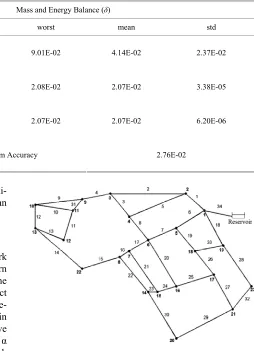
The second considered network is a real planned network designed for an industrial area in Apulian town (Southern Italy). The network layout is shown in Figure5 and the corresponding data are provided in Table 3. With respect to the leakages, they have been assumed as pressure- driven (see Equation (5)) since they are implemented in the pressure-driven network simulation model as above described [11]. The parameter β = 1.0632 × 10 − 7 and α
= 1.2, as reported in Giustolisi et al. [11] for this network. Giustolisi et al. [11] proposed a hydraulic simulation model, which fully integrates a classic hydraulic simula-tion algorithm, such as that of Todini and Pilati [20] found in EPANET 2, with a pressure-driven model that entails a more realistic representation of leakage. They applied their model in this network and results are dem-
Figure 5. Schematic representation of the looped pipe net-work used in the numerical example 4.
[image:6.595.59.532.307.472.2]Table 3. Hydraulic data relevant to the numerical example 2.
Pipe L (m) D (mm) Pipe L (m) D (mm) Pipe L (m) D (mm) 1 348.5 327 12 428.4 184 23 165.5 100 2 955.7 290 13 419 100 24 252.1 100 3 483 100 14 1023.1 100 25 331.5 100 4 400.7 290 15 455.1 164 26 500 204 5 791.9 100 16 182.6 290 27 579.9 164 6 404.4 368 17 221.3 290 28 842.8 100 7 390.6 327 18 583.9 164 29 792.6 100 8 482.3 100 19 452 229 30 846.3 184 9 934.4 100 20 794.7 100 31 164 258 10 431.3 184 21 717.7 100 32 427.9 100 11 513.1 100 22 655.6 258 33 379.2 100
34 158.2 368
case 4 = 20 and case 5 = 50; number of iteration for case 1 = 500, case 2 = 1000, case 3 = 10,000, case 4 = 5000 and case 4 = 2500. In proposed method, there is no need to change mathematical formulation for hydraulic analy-sis. An if-then rule is added to co-content model and op-timization process is done easily. In this example, the bound variables were set between 0 and 36.4.
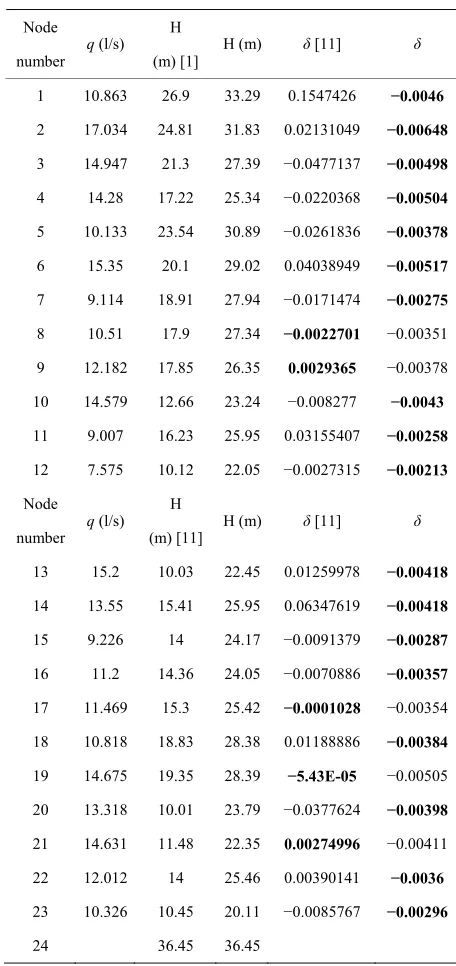
Table 5 compares different cases of algorithm DE for minimization of model. The best result is related to the case in which the number of population is equal to 50 and the number of iterations equal to 2500. After per-forming 10 different runs, the best value of δ is obtained equal to 0.0026, while the best result is obtained equal to 0.0181 in Giustolis method. The results of two men-tioned methods are compared in the fifth and sixth col-umns of Table 4. In this table, the best result is shown in bold, and it is considered the method DE has calculated the best value of δ at 17 nodes and Gistulishi method has calculated it at 5 nodes. The convergence process of al-gorithm DE has been shown in two forms in Figures 6
and 7. The absolute value of δ is calculated for each it-eration in Figure6 and the amount of objective function
C(H) is calculated for each iteration in Figure 7. The algorithm becomes convergent after 2500 iterations.
6.3. Numerical Example 3
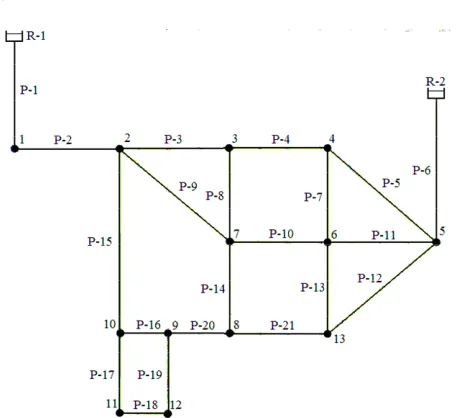
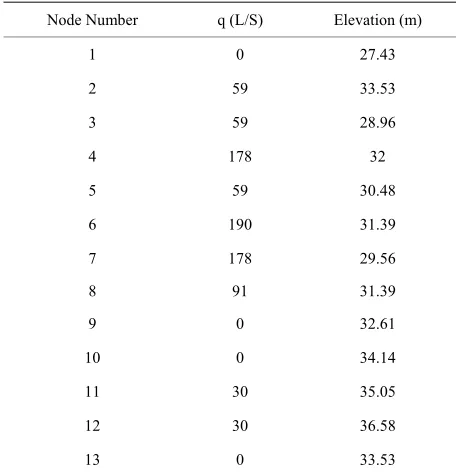
Figure 8 shows the network from Mallick et al. [21]. The network consists of 2 reservoirs, 13 nodes and 21 pipes. The detailed properties are shown in Tables 6 and
7. It is supposed that the desired pressure for each node (H*) is 30 m, and the minimum pressure (H
min) is 10 m [22]. The pipe leakage coefficients are β = 5 × 10 − 7 and
Table 4. Head and parameter δ in numerical example 2.
Node H
number q (l/s) (m) [1] H (m) δ [11] δ 1 10.863 26.9 33.29 0.1547426 −0.0046
2 17.034 24.81 31.83 0.02131049 −0.00648
3 14.947 21.3 27.39 −0.0477137 −0.00498
4 14.28 17.22 25.34 −0.0220368 −0.00504
5 10.133 23.54 30.89 −0.0261836 −0.00378
6 15.35 20.1 29.02 0.04038949 −0.00517
7 9.114 18.91 27.94 −0.0171474 −0.00275
8 10.51 17.9 27.34 −0.0022701 −0.00351 9 12.182 17.85 26.35 0.0029365 −0.00378 10 14.579 12.66 23.24 −0.008277 −0.0043
11 9.007 16.23 25.95 0.03155407 −0.00258
12 7.575 10.12 22.05 −0.0027315 −0.00213
Node H
number q (l/s) (m) [11] H (m) δ [11] δ 13 15.2 10.03 22.45 0.01259978 −0.00418
14 13.55 15.41 25.95 0.06347619 −0.00418
15 9.226 14 24.17 −0.0091379 −0.00287
16 11.2 14.36 24.05 −0.0070886 −0.00357
17 11.469 15.3 25.42 −0.0001028 −0.00354 18 10.818 18.83 28.38 0.01188886 −0.00384
19 14.675 19.35 28.39 −5.43E-05 −0.00505 20 13.318 10.01 23.79 −0.0377624 −0.00398
21 14.631 11.48 22.35 0.00274996 −0.00411 22 12.012 14 25.46 0.00390141 −0.0036
23 10.326 10.45 20.11 −0.0085767 −0.00296
24 36.45 36.45
α = 1.18, for this network. The DE technique is applied to solve this problem and DE model parameters selected are as follows: number of decision variables = 13; num-ber of population for all cases = 20; numnum-ber of iteration for case 1 = 1000, case 2 = 2500, case 3 = 5000 and case 4 = 10,000. The bound variables were set between 0 and 60.96.
[image:7.595.58.286.110.337.2]0 500 1000 1500 2000 2500 10-3
10-2 10-1 100
Number of Iteration
A
v
er
ag
e of
M
as
s
and
E
ner
gy
B
al
anc
[image:8.595.59.286.77.261.2]e
Figure 6. Convergence history of numerical example 2 (case 1).
0 500 1000 1500 2000 2500
101.2 101.3 101.4
Number of Iteration
Obj
e
c
ti
v
e F
unc
ti
on
C
(H
)
[image:8.595.310.538.109.372.2]Figure 7. Convergence history of numerical example 2 (case 2).
[image:8.595.57.288.300.472.2]Figure 8. Schematic representation of the looped pipe net-work used in the numerical example 3.
Table 5. Average of mass and energy balance for numerical example 2.
Mass and Energy Balance (δ) DE
best worst mean std
Number of population 50 Number of
iteration 500
6.00E-03 1.76E-02 1.14E-02 3.60E-03 Number of
population 50 Number of
iteration 1000
2.60E-03 1.01E-02 5.90E-03 2.20E-03 Number of
population 20 Number of
iteration 10,000
3.90E-03 4.00E-03 4.00E-03 4.08E-05 Number of
population 20 Number of
iteration 5000
3.20E-03 3.80E-03 3.60E-03 1.88E-04 Number of
population 50 Number of
iteration 2500
2.60E-03 5.50E-03 3.00E-03 5.88E-04
Giustolisi
[image:8.595.312.539.407.736.2]Algorithm [11] Maximum Accuracy 1.81E-02
Table 6. Pipe characteristics of Sample network from Mal-lick et al. [21].
Pipe Number L (m) D (mm) C
1 609.6 762 130
2 243.8 762 128
3 1524 609 126
4 1127.76 609 124
5 1188.72 406 122
6 640.08 406 120
7 762 254 118
8 944.88 254 116
9 1676.4 381 114
10 883.92 305 112
11 883.92 305 110
12 1371.6 381 108
13 762 254 106
14 822.96 254 104
15 944.88 305 102
16 579 305 100
17 487.68 203 98
18 457.2 152 96
19 502.92 203 94
20 883.92 203 92
[image:8.595.60.290.498.707.2]Table 7. Nodes properties of Sample network from Mallick et al. [21].
Node Number q (L/S) Elevation (m)
1 0 27.43
2 59 33.53
3 59 28.96
4 178 32
5 59 30.48
6 190 31.39
7 178 29.56
8 91 31.39
9 0 32.61
10 0 34.14
11 30 35.05
12 30 36.58
[image:9.595.57.285.111.349.2]13 0 33.53
Table 8. Average of mass and energy balance for numerical example 3.
Mass and Energy Balance (δ) DE
best worst mean std
Number of population 20 Number of
iteration 1000
1.90E-03 1.11E-02 5.30E-03 2.60E-03 Number of
population 20 Number of
iteration 2500
1.46E-04 7.03E-04 4.55E-04 1.72E-04 Number of
population 20 Number of
iteration 5000
1.06E-06 1.37E-06 5.00E-06 4.32E-06 Number of
population 20 Number of
iteration 10,000
1.18E-08 2.90E-08 1.75E-08 6.29E-09
how the accuracy of parameter δ depends on the iteration number of convergence in the first case. As it can be seen, the value of δ reaches the accuracy 1e-2 after 1000 itera-tions, the accuracy 1e-4 after 2500 iteraitera-tions, 1e-6 after 5000 iterations and 1e-8 after 10,000 iterations. Figure9
[image:9.595.309.534.295.471.2]compares the nodal pressures in the mentioned two cases. As it can be observed, if the dependence of pressure on the demand is not included, a negative pressure is made at the nodes 6, 8, 11 and 12, but all pressures in the sec-ond case are greater than 5 meters and the minimum pressure of 10 meters has been partly supplied in most of the nodes. Figure 10 shows the process of changing the
Figure 9. Simulation results with and without pressure- driven demand.
0 1000 2000 3000 4000 5000 6000 7000 8000 9000 10000 10-8
10-7 10-6 10-5 10-4 10-3 10-2 10-1 100
Number of Iteration
A
v
erage of
M
a
s
s
a
nd E
nergy
B
al
an
c
e
Figure 10. Convergence history of numerical example 3.
parameter δ towards the number of iterations.
7. Conclusions
The purpose of this paper has been to introduce a novel methodology for hydraulic analysis of water distribution systems under deficient pressure conditions considering the pressure-driven demand and leakage. The methodol-ogy is illustrated using three networks with different layouts.
[image:9.595.59.286.387.581.2]common users to undertake deficient pressure conditions.
REFERENCES
[1] E. Todini, “A More Realistic Approach to the “Extended Period Simulation” of Water Distribution Networks, Ad-vances in Water Supply Management,” Taylor & Francis, Chapter 19, 2003.
[2] F. Martinez, P. Conejos and J. Vercher, “Developing an Integrated Model for Water Distribution Systems Con-sidering Both Distributed Leakage and Pressure Depend-ent Demands,” Proceedings of the 26th Annual ASCE Water Resources Planning and Management Conference, Tempe, Arizona, June 1999, pp. 1-14.
[3] G. Germanopoulos, “A Technical Note on the Inclusion of Pressure Dependent Demand and Leakage Terms in Water Supply Network Models,” Civil Engineering and Environmental Systems, Vol. 2, No. 3, 1985, pp. 171-179. http://dx.doi.org/10.1080/02630258508970401
[4] G. Germanopoulos, P. W. Jowitt and J. P. Lumbers, “As-sessing the Reliability of Supply and Level of Service for Water Distribution Systems,” Proceedings of The Institu-tion of Civil Engineers, Vol. 80, No. 2, 1 April 1986, pp. 413-428.
http://dx.doi.org/10.1680/iicep.1986.741
[5] J. Lumbers, “Re-Thinking Network Analysis for Inter-mittent Supplies,” Water and Environment, Manager, Vol. 1, No. 3, 1996, p. 6.
[6] L. S. Reddy and K. Elango, “Analysis of Water Distribu-tion Networks with Head Dependent Outlets,” Civil En-gineering Systems, Vol. 3, No. 6, 1989, pp. 102-110. http://dx.doi.org/10.1080/02630258908970550
[7] M. Tabesh, “Implications of the Pressure Dependency of Outflows on Data Management, Mathematical Modeling and Reliability Assessment of Water Distribution Sys-tems,” PhD Thesis, University of Liverpool, Liverpool, UK, 1998.
[8] T. T. Tanyimboh and M. Tabesh, “Discussion of Com-parison of Methods for Predicting Deficient-Network Performance,” Journal of Water Resources Planning and Management, Vol. 123, No. 6, 1997, pp. 369-370. [9] J. Almandoz, E. M. Cabrera, F. Arregui, E. Jr. Cabrera
and R. Cobacho, “Leakage Assessment through Water Distribution Network Simulation,” Journal of Water Re-sources Planning and Management, Vol. 131, No. 6, 2005, pp. 458-466.
http://dx.doi.org/10.1061/(ASCE)0733-9496(2005)131:6( 458)
[10] A. F. Colombo and B. W. Karney, “Energy and Costs of Leaky Pipes: Toward a Comprehensive Picture,” Journal of Water Resources Planning and Management, Vol. 128, No. 6, 2002, pp. 441-450.
[11] O. Giustolisi, D. Savic and Z. Kapelan, “Pressure-Driven Demand and Leakage Simulation for Water Distribution networks,” Journal of Hydraulic Engineering, Vol. 134, No. 5, 2008, pp. 626-635.
http://dx.doi.org/10.1061/(ASCE)0733-9429(2008)134:5( 626)
[12] M. L. Arora, “Flow Split In Closed Loops Expending Least Energy,” Journal of the Hydraulics Division, Vol. 102, No. 3, 1976, pp. 455-458.
[13] M. A. Hall, “Hydraulic Network Analysis Using (Gener-alized) Geometric Programming,” Networks, Vol. 6, No. , 6, 1976, pp. 105-130.
http://dx.doi.org/10.1002/net.3230060204
[14] M. Collins, L. Cooper, R. Helgason, J. Kenningston and L. LeBlanc, “Solving the Pipe Network Analysis Problem Using Optimization Techniques,” Management Science, Vol. 24, No. 7, 1978, pp. 747-760.
http://dx.doi.org/10.1287/mnsc.24.7.747
[15] P. R. Bhave and R. Gupta, “Analysis of Water Distribu-tion Networks,” Alpha Science InternaDistribu-tional, Technology & Engineering, University of Michigan, Michigan, 2006. [16] J. Wagner, U. Shamir and D. Marks, “Water Distribution
Reliability: Analytical Methods,” Journal of the Water Resources Planning and Management, Vol. 114, No. 3, 1988, pp. 253-275.
http://dx.doi.org/10.1061/(ASCE)0733-9496(1988)114:3( 253)
[17] J. Chandapillai, “Realistic Simulation of Water Distribu-tion System,” Journal of Transportation Engineering, Vol. 117, No. 2, 1991, pp. 258-263.
http://dx.doi.org/10.1061/(ASCE)0733-947X(1991)117:2 (258)
[18] L. Ainola, T. Koppel, T. Tiiter and A. Vassiljev, “Water Network Model Calibration Based on Grouping Pipes with Similar Leakage and Roughness Estimates,” Pro-ceedings of the Joint Conference on Water Resource En-gineering and Water Resource Planning and Manage-ment, Minneapolis, 2000, pp. 104-197.
[19] W. Chun-Yin and T. Ko-Ying, “Topology Optimization of Structure Using Differential Evolution,” Journal of Systemics, Cybernetics and Informatics, Vol. 42, No. 6, 2008, pp. 46-51.
[20] E. Todini and S. Pilati, “A Gradient Algorithm for the Analysis of Pipe Networks. Computer Applications in Water Supply. 1 (System Analysis and Simulation),” John Wiley & Sons, London, 1988, pp. 1-20.
[21] K. N. Mallick, I. Ahmed, K. S. Tickle and K. E. Lansey, “Determining Pipe Groupings For Water Distribution Networks,” Journal of Water Resources Planning and Management, Vol. 128, No. 2, 2002, pp. 130-139. http://dx.doi.org/10.1061/(ASCE)0733-9496(2002)128:2( 130)
[22] L. Jun and Y. Guoping, “Iterative Methodology of sure-Dependent Demand Based on EPANET for Pres-sure-Deficient Water Distribution Analysis,” Journal of Water Resources Planning Management, Vol. 139, No. 1, 2013, pp. 34-44.