doi:10.4236/aces.2013.34B001 Published Online October 2013 (http://www.scirp.org/journal/aces)
Effect of Copper (II) Ions on Quality of Struvite Produced
in Continuous Reaction Crystallization Process at the
Magnesium Ions Excess
Nina Hutnik1, Boguslawa Wierzbowska1, Krzysztof Piotrowski2*, Andrzej Matynia1 1Wroclaw University of Technology, Faculty of Chemistry, Wybrzeze Wyspianskiego, Wroclaw, Poland 2Silesian University of Technology, Department of Chemical & Process Engineering, M. Strzody, Gliwice, Poland
Email: *[email protected]
Received May, 2013
ABSTRACT
The research results concerning continuous removal of phosphate (V) ions from solutions containing 1.0 or 0.20 mass % of phosphate (V) ions and 0.2 or 0.5 mg/kg of copper (II) ions using magnesium and ammonium ions addition are presented. Continuous reaction crystallization of struvite MgNH4PO4 × 6H2O ran both under stoichiometric conditions and at 20% excess of magnesium ions (pH 9, 900 s). It was concluded, that presence of copper (II) ions in a process system influenced product quality moderately advantageously. Mean size of struvite crystals enlarged by ca. 6% only. Lower concentration of phosphate (V) ions and excess of magnesium ions caused, that products of ca. 9% - 13% larger crystal mean size (up to ca. 40 m) were removed from the crystallizer. Presence of struvite crystals and copper (II) hydroxide were detected analytically in the products (Cu in a product varied from 6 to 90 mg/kg). Presence of copper (II) ions favored crystallization of struvite in the form of tubular crystals.
Keywords: Struvite; Phosphate(V) Ions; Copper Ions; Continuous Reaction Crystallization; DT MSMPR Crystallizer;
Crystal Size Distribution; Product Quality
1. Introduction
Recovery of phosphate(V) ions from wastewaters (called phosphorus recycling [1]) is based on precipitation fol- lowed by mass crystallization of sparingly soluble phos- phate salts, the most often magnesium ammonium phos- phate(V) hexahydrate, MgNH4PO4 × 6H2O, struvite (solubility product pKsp 9.0 - 13.26) [2]. The substrates used in this process are usually crystalline magnesium and ammonium salts or waste solutions containing mag- nesium or/and ammonium ions in sufficiently large con- centrations. Yield and quality of manufactured product depend mainly on chemical composition of wastewater, pH and the assumed technological and equipment solu- tions [2-7]. Essential factor influencing course and re- sults of struvite reaction crystallization process is com- position of impurities present in wastewater [2,8]. Even small amount of impurity can inhibit or catalyze struvite precipitation reaction, influence nucleation rate and crystal growth rate, crystals shape and their eventual ag- glomeration [9-12]. Some metal ions in alkaline envi- ronment of struvite reaction crystallization process can
form sparingly soluble hydroxides or phosphates, what essentially modifies chemical composition of the product and often limits the possibilities of its further application in agriculture [13].
One of impurities present e.g. in liquid manure or in wastewaters from mineral fertilizer industry are copper(II) ions [14]. The research results concerning influence of three process parameters: molar ratio of substrates (stoichiomet- ric conditions or 20% excess of magnesium ions in rela- tion to concentrations of phosphate(V) and ammonium ions), concentration of phosphate(V) ions (1.0 or 0.20 mass %) and concentration of copper(II) ions (0.2 or 0.5 mg/kg) in solution feeding the continuous DT MSMPR (Draft Tube, Mixed Suspension Mixed Product Removal
[15]) type crystallizer on struvite product quality are presented in this work. The research tests ran at pH 9 for constant mean residence time of struvite crystal suspend- sion in the crystallizer 900 s. Process yield defined as final concentration of PO43– ions in a postprocessed mother solution was determined. Product crystal size distributions and their statistical parameters (Lm, L50, Ld, CV) were calculated. Crystals shape (La/Lb) and their agglomeration effects were estimated. Copper content in a product was determined analytically.
2. Material and Methods
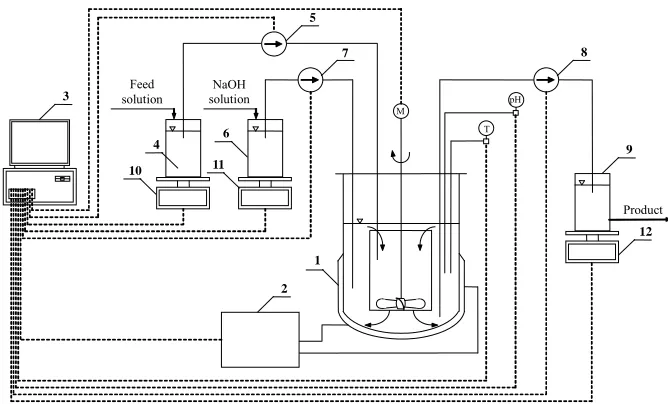
Scheme of laboratory plant for the tests of struvite con- tinuous reaction crystallization process in copper (II) ions presence is shown in Figure 1. Steering, control and ac-
quisition of measurement data streams were carried out with the use of PC computer. For precise control of ex- perimental plant operated in steady-state mode IKA lab- worldsoft program was used. Working volume of the crystallizer was 0.6 dm3. Crystallizer was a glass cylin- drical tank (D 120 mm, H 123 mm), in a bottom part
equipped with external heating/cooling coil (thermo- stated with water circulation system), providing isother- mal process conditions. In central axis of the apparatus cylindrical circulation profile (Draft Tube, DT, ddt 57 mm, hdt 53 mm) was placed, inside which three-paddle propeller mixer (dm 55 mm) operated. Inlet ports of re- acting substances, alkalising solution and removal port of product crystal suspension are indicated in Figure 1.
Crystallizer was continuously provided with feed solu- tion prepared earlier in a mixer device using chemically pure substances (magnesium chloride MgCl2 × 6H2O, ammonium dihydrogenphosphate(V) NH4H2PO4 and copper (II) chloride CuCl2×2H2O (p.a. POCh Gliwice, Poland) and deionised water (Barnstead – NANOpure DIamond). The solution was introduced into circulation profile (mixer speed: 6.6 ± 0.11/s; suspension movement – downward). Between crystallizer body and DT element (suspension movement – upward) aqueous solution of sodium hydroxide of concentration 20 mass % NaOH was dosed in proportions providing the assumed, con-
trolled value of pH. Temperature in a crystallizer was 298 ± 0.2 K. Research tests ran under stoichiometric con- ditions (molar proportions between the substrates [PO43–]RM : [Mg2+]
RM : [NH4+]RM = 1 : 1 : 1) and at 20% excess of magnesium ions ([PO43–]RM : [Mg2+]RM : [NH4+]RM = 1 : 1.2 : 1). Concentration of phosphate (V) ions in a feed was 1.0 or 0.20 mass %. Corresponding concentration of magnesium ions was thus: 0.256 or 0.0512 mass % – in stoichiometric conditions, and 0.307 or 0.061 mass % – at their 20% excess. Concentration of ammonium ions was: 0.190 or 0.0380 mass %, appropriately, while con- centration of copper ions was 0.2 or 0.5 mg/kg. Con- tinuous reaction crystallization of struvite ran at pH 9 (±0.1) for mean residence time of suspension in a crys- tallizer 900 s (± 20 s). After establishing in the crystal- lizer the required parameter values, process in steady state ran through the next 5. After this time whole crys- tallizer content was transferred to vacuum filter. Product crystals were not washed. Using adequate analytical methods for each test run there were determined: solid phase content in product crystal suspension (MT), chemical composition of mother liquor and solid phase (plasma emission spectrometer ICP–AES CPU 7000, spectrome- ter IR PU9712, atomic absorption spectrometer iCE 3000, spectrophotometer UV–Vis Evolution 300), product crystal size distribution (solid particle laser analyser Coulter LS–230) and crystals shape (scanning electron microscope JEOL JSM 5800LV). Accuracy of process data determination in the continuous laboratory plant was estimated to be ca. 10%.
M
T
Product NaOH
solution pH
3
11 6
5
7
1 2
9 8
10 4
12
[image:2.595.130.464.463.665.2]Feed solution
Figure 1. Laboratory test stand scheme of continuous crystallizer with a propeller stirrer for reaction crystallization of stru-vite, 1 – DT MSMPR type crystallizer with internal circulation of suspension, 2 – thermostat, 3 – computer, 4 – reservoir of feed mixture: aqueous solution of NH4H2PO4, MgCl2 and CuCl2, 5 – feed proportioner (pump), 6 – alkalinity agent tank:
3
3. Results and Discussion
[image:3.595.60.538.504.707.2]The research and analytical test results are presented in
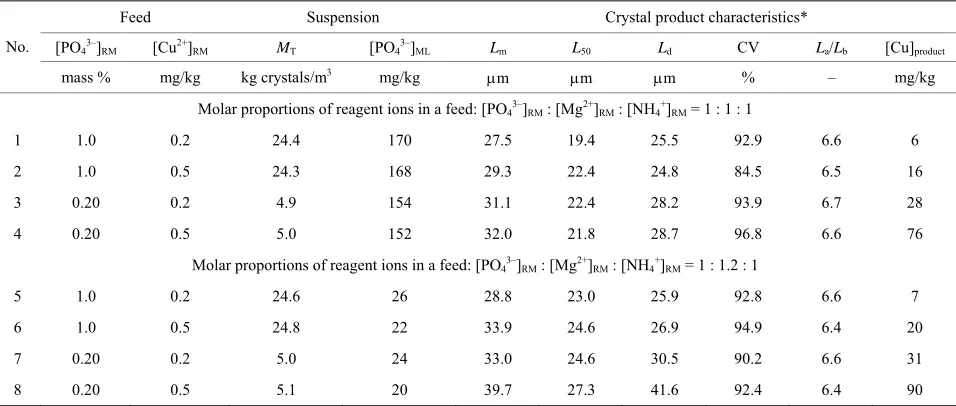
Table 1. From the table it results, that increase in con-
centration of copper(II) ions in a feed influenced product crystal size distribution moderately advantageously. For example, under stoichiometric conditions, for [PO43–]RM 1.0 mass %, mean product crystal size Lm increased from 27.5 to 29.3 m (by ca. 6%), while median crystal size
L50 from 19.4 to 22.4 m [14]. Growth Lm with the in- crease in copper(II) ions concentration in a process sys- tem is connected with general decrease of the smallest struvite crystals amount in a population of solid product. For [Cu2+]
RM 0.2 mg/kg crystal fraction of sizes below 5
m in a product was 15.7%, whereas for [Cu2+] RM 0.5 mg/kg this fraction decreased to 13.0%, thus shrank by ca. 17%. The largest struvite crystal size did not, how- ever, varied (ca. 140 m), whereas dominant crystal size (Ld, corresponding to maximum in differential distribu- tion), even slightly decreased (Ld 25.5 → 24.8 m). In
Figure 2(a) exemplary volumetric (mass) size distribution
of struvite crystals produced in presence of 0.5 mg/kg of copper(II) ions in a feed ([PO43–]RM 1.0 mass %, pH 9, 900 s) is presented. In Figure 3(a) there was presented
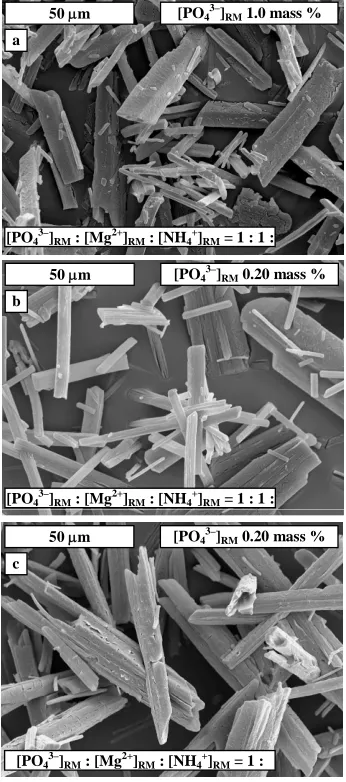
scanning electron microscope image of product sample, which crystal size distribution was presented in Figure 2(a). Detailed data concerning influence of copper(II)
ions concentration ((1–10)×10–5 mass %) and techno- logical parameters (pH 9–11, 900–3600 s) of struvite continuous reaction crystallization process from solutions containing 1.0 mass % of PO43– ions under stoichiometric conditions are presented in [14]. Influence of these pa-
rameters on mean size Lm (m) of product struvite crys- tals was elaborated in a form of empirical correlation [14]:
Lm = 6.748×10² [Cu2+]RM0.052 pH–1.956 0.243 (1) Five time decrease of phosphate(V) ions concentration in a crystallizer feed (from 1.0 to 0.20 mass %) resulted in increase in mean struvite crystal size Lm by 9-13% (No. 3 and 4 in Table 1). Solution supersaturation at the crys-
tallizer inlet decreased. Thus struvite nucleation rate, strongly dependent on supersaturation is decreased, as well. It resulted in decrease of nuclei amount, thus larger size of crystals removed from the crystallizer (compare
Figures 2(a) and (b),as well as Figures 3(a) and (b)).
From the comparison of Figures 2(a) and (b) it results,
that feeding the crystallizer with solution of concentra- tion 0.20 mass % phosphate(V) ions both number and size of the largest struvite crystals increased. The largest size of struvite particles produced at [PO43–]RM 0.20 mass % was 210 m (Figure 2(b)), whereas at [PO43–]RM 1.0 mass % it was 140 m only (Figure 2(a)). Fraction of
the smallest size particles in a product did not, however, decrease. In results mean size of product crystals in- creased by 2.7 m only: from 29.3 to 32.0 m (tests No. 2 and 4 in Table 1).
It can be assumed, that it is a net effect of smaller struvite nucleation rate corresponding to lower working supersaturation level in a crystallizer and smaller content of solid phase in a mixed and circulated suspension (MT 24.3 → 5.0 kg struvite/m3 of suspension), limiting thus excessive crystal attrition effects. From the analysis of presented experimental data it results, that influence of
Table 1. Effect of copper(II) ions on the results of continuous struvite reaction crystallization process in DT MSMPR crystal-lizer. Process parameters: temperature 298 K, pH 9, mean residence time of suspension in the crystallizer 900 s.
Feed Suspension Crystal product characteristics*
[PO43–]RM [Cu2+]RM MT [PO43–]ML Lm L50 Ld CV La/Lb [Cu]product
No.
mass % mg/kg kg crystals/m3 mg/kg m m m % – mg/kg
Molar proportions of reagent ions in a feed: [PO43–]RM : [Mg2+]RM : [NH4+]RM = 1 : 1 : 1
1 1.0 0.2 24.4 170 27.5 19.4 25.5 92.9 6.6 6
2 1.0 0.5 24.3 168 29.3 22.4 24.8 84.5 6.5 16
3 0.20 0.2 4.9 154 31.1 22.4 28.2 93.9 6.7 28
4 0.20 0.5 5.0 152 32.0 21.8 28.7 96.8 6.6 76
Molar proportions of reagent ions in a feed: [PO43–]RM : [Mg2+]RM : [NH4+]RM = 1 : 1.2 : 1
5 1.0 0.2 24.6 26 28.8 23.0 25.9 92.8 6.6 7
6 1.0 0.5 24.8 22 33.9 24.6 26.9 94.9 6.4 20
7 0.20 0.2 5.0 24 33.0 24.6 30.5 90.2 6.6 31
8 0.20 0.5 5.1 20 39.7 27.3 41.6 92.4 6.4 90
*Without product crystal washing; tests No. 1 – 2 see [14]; Average concentration of Cu2+ ions in mother solution: 0.05 – 0.10 mg/kg.
Lm = ΣxiLi, where: xi – mass
fraction of crystals of mean fraction size Li; L50 – median crystal size for 50 mass % undersize fraction; Ld – crystal mode size; CV = 100(L84 – L16)/(2L50), where:
these process parameters on the final crystal size distri- bution of struvite can be regarded only as a moderate.
Excess of magnesium ions in relation to phosphate(V) and ammonium ions concentrations in a crystallizer feed ([PO43–]RM : [Mg2+]RM : [NH4+]RM = 1 : 1.2 : 1) influenced the process results generally advantageously (tests No. 5-8 in Table 1). For example, mean struvite crystal size
Lm enlarged from 32.0 to 39.7 m (by ca. 24%) for [PO43–]RM 0.20 mass % in presence of copper ions of concentration 0.5 mg/kg (Figure 2(c)). Higher
super-saturation of magnesium ions in struvite precipitation environment influenced partial components of the con-tinuous reaction crystallization process generally advan-tageously. Their net effect (higher nucleation rate, how-ever also higher crystals growth rate) produced more favourable crystal size distribution of struvite. In Figure 3(c) there is presented scanning electron microscope
im-age of exemplary product crystals. From the comparison of crystal size distributions presented in Figures 2(b) and (c) it results, that at magnesium ions excess both number
and size of the largest struvite crystals increased (Lmax 210 → 220 m). Simultaneously number of the smallest struvite particles decreased. Crystal fraction of sizes smaller than 5 m represented 9.7% (Figure 2(c)). In
result the dominant crystal size Ld increased from 28.7 up to 41.6 m, and mean size Lm – from 32.0 to 39.7 m (tests No. 4 and 8 in Table 1).
a
b
c
Figure 2. Exemplary differential (left scale) and cumulative (right scale) volumetric (mass) size distributions of struvite crystals produced in continuous reaction crystallization process in presence of 0.5 mg/kg of copper(II) ions in a feed: a) [PO4
3–
]RM 1.0 mass % and b) [PO4 3–
]RM 0.20 mass %, for
[PO43–]RM : [Mg2+]RM: [NH4+]RM = 1 : 1 : 1, and c) [PO43–]RM
0.20 mass % for [PO4 3–
]RM : [Mg 2+
]RM: [NH4 +
]RM = 1 : 1.2 : 1
– corresponding to tests No. 2, 4 and 8 in Table 1.
From the data presented in Table 1 it also results, that
homogeneity within product crystal population was prac-tically constant. The CV coefficient value representing quantitatively inhomogeneity within crystal sizes varied within the 90.2%-96.8% range (excluding only one strongly deviated value: 84.5%) with the average value of 93.4%. It is relatively high CV value, suggesting large diversification within product crystal sizes (CV for ideal DT MSMPR crystallizer is 50% [15]).
From the analysis of scanning electron microscope images of exemplary products (Figure 3) it results, that
struvite crystal habit was practically constant. Based on planimetric measurement results involving 50 crystals randomly selected from three microscope images (from each product population) it was concluded, that average ratio of their length La to their width Lb varied within relatively narrow range from 6.4 to 6.7, depending on process parameter values (Table 1). These values were
close to geometrical proportions within struvite crystals produced in the same crystallizer unit from aqueous solu-tions of NH4+, Mg2+ and PO43- ions without impurities [12]. Less than moderate agglomeration within struvite crystals were reported in the products (Figure 3),
espe-cially within larger crystals. It can be thus regarded, that advantageous process conditions were established in the crystallizer, limiting excessive aggregation and agglom-eration between crystals of the main product component. From the presented product microscope images (Figure 3) it also results, that in struvite population characteristic
in shape tubular crystals are present. Most of them, espe-cially larger crystals, demonstrated, however, distinct ruptures and crashes along longitudinal axis, numerous surface cracks and deformed edges, being the proof of significant tensions in their structure (see Figure 4).
These crystals, shaped during unconstrained growth, are especially susceptible for the action of shear stresses generated by turbulent flow of mother solution, as well as on secondary contact nucleation [15].
In Table 1 there are presented the analytically
deter-mined concentration values of phosphate (V) ions in a postprocessed mother solution. It can be practically as-sumed, that this concentration stabilised on relatively constant and low level 161 ± 9 mg PO43–/kg under stoichiometric conditions and 23 ± 3 mg PO43–/kg at magnesium ions excess. Average efficiency of phosphate (V) ions removal from the feed was thus 91%-99%. Magnesium ions excess in relation to phosphate (V) and ammonium ions concentrations influenced process yield advantageously. Concentration of phosphate (V) ions in a postprocessed mother solution was ca. 7 time smaller compared to stoichiometric conditions. In Table 1 there
Con-5
centration of copper (II) ions in a feed was modified from 0.2 to 0.5 mg Cu2+/kg). It was concluded, that av-erage concentration of copper (II) ions in a postprocessed mother solution decreased to 0.05-0.10 mg Cu2+/kg. In a product copper (II) hydroxide appeared (pKsp 19.32) in amount from 6 to 90 mg/kg (copper based calculations), depending on copper (II) ions concentration in a feed and process parameters. Raise of [Cu2+]
RM from 0.2 to 0.5 mg/kg caused, that copper content in a product increased from 6 to 16 mg/kg ([PO43–]RM 1.0 mass %). Lower con-centration of phosphate (V) ions in a feed (0.20 mass %), thus smaller amount of product struvite (MT 4.95.0 kg crystals/m3 suspension) caused, that relative content of copper in a product increased ca. 5 time. Excess of mag-nesium ions in a process system caused, that copper con-tent in a product increased by ca. 15% in average.
50 m
a
[PO43–]RM 1.0 mass %
[PO43–]RM : [Mg2+]RM : [NH4+]RM = 1 : 1 :
50 m
b
[PO43–]RM 0.20 mass %
[PO43–]RM : [Mg2+]RM : [NH4+]RM = 1 : 1 :
50 m
c
[PO43–]RM 0.20 mass %
[image:5.595.327.519.86.228.2][PO43–]RM : [Mg2+]RM : [NH4+]RM = 1 :
Figure 3. Scanning electron microscope images of struvite crystals produced in a continuous DT MSMPR type crystal-lizer in presence of 0.5 mg/kg of copper(II) ions. Process parameters: a) test No. 2, b) test No. 4 and c) test No. 8 in Table 1 (corresponding to Figure 2).
[image:5.595.86.259.289.680.2]20 m
Figure 4. Habit and surface morphology of struvite crystals produced in presence of copper(II) ions (corresponding to Figure 3c).
4. Conclusions
In presence of copper (II) ions struvite crystal products of mean size from 27.5 to 39.7 m and large size diversifi-cation (average CV 93.4%) were manufactured. It was observed, that with the increase in concentration of cop-per(II) ions from 0.2 to 0.5 mg/kg in a feed mean size of product crystals Lm increased insignificantly, only by ca. 6%. Decrease of phosphate (V) ions concentration in a feed from 1.0 to 0.20 mass % resulted in raise of mean size of struvite crystals by 9-13%. Similarly, excess of magnesium ions in relation to phosphate (V) and ammo-nium ions concentrations influenced process results ad-vantageously. Mean size of product crystals increased by 13% in average. Excess of magnesium ions in a process system strongly, advantageously influenced the struvite continuous reaction crystallization process yield. Con-centration of phosphate (V) ions in a postprocessed mother solution decreased to 23 ± 3 mg/kg, what can be regarded as a very good result of their removal from the feed. Precipitation of phosphate (V) ions in presence of copper(II) ions results in production of not only struvite crystals, but also copper(II) hydroxide particles (copper based – from 6 to 90 mg/kg).
5. Acknowledgements
This work was supported by the National Science Centre of Poland under grant No. NN 209 0959 40 (2011–2014).
REFERENCES
[1] J. Doyle and S. A. Parsons, “Struvite Formation, Control and Recovery,” Water Research, Vol. 36, No. 16, 2002,
pp. 3925-3940. doi:10.1016/S0043-1354(02)00126-4 [2] K. S. Le Corre, E. Valsami–Jones, P. Hobbs and S. A.
Parsons, “Phosphorus Recovery from Wastewater by Struvite Crystallization: A Review,” Critical Reviews in Environmental. Science and Technology, Vol. 39, No. 6,
doi:10.1080/10643380701640573
[3] A. Matynia, J. Koralewska, K. Piotrowski and B. Wierz-bowska, “The Influence of the Process Parameters on the Struvite Continuous Crystallization Kinetics,” Chemical Engineering Communications, Vol. 193, No. 2, 2006, pp.
160-176. doi:10.1080/009864490949008
[4] A. Matynia, B. Wierzbowska, N. Hutnik, K. Piotrowski, R. Liszka, T. Ciesielski and A. Mazienczuk, “Method for Struvite Recovery from Wastewater of Mineral Fertilizer Industry,” Przem. Chem., Vol. 89, 2010, pp. 478-485. [5] A. Mazienczuk, N. Hutnik, K. Piotrowski, B.
Wierz-bowska and A. Matynia, “Continuous crystallizers with jet pump driven by recirculated mother solution in pro-duction of struvite”, Przem. Chem., Vol. 91, 2012, pp.
890-895.
[6] K. S. Le Corre, E. Valsami–Jones, P. Hobbs and S. A. Parsons, “Impact of Reactor Operation on Success of Struvite Precipitation from Synthetic Liquors,” Environ-metal Technology, Vol. 28, No. 11, 2007, pp. 1245-1256.
doi:10.1080/09593332808618885
[7] A. Kozik, A. Matynia, N. Hutnik and K. Piotrowski, “Ef-fect of Technological Input Parameters on Struvite Sepa-ration in a Continuous Laboratory Plant,” Przem. Chem.,
Vol. 92, 2013 (in press).
[8] N. Hutnik, A. Kozik, A. Mazienczuk, K. Piotrowski, B. Wierzbowska and A. Matynia, “Phosphates(V) recovery from phosphorus mineral fertilizers industry wastewater by continuous struvite reaction crystallization process”,
Wat. Res., Vol. 47, 2013 (in press). doi:10.1016/j.watres.2013.04.026
[9] K. S. Le Corre, E. Valsami–Jones, P. Hobbs and S. A.
Parsons, “Impact of Calcium on Struvite Crystal Size, Shape and Purity,” Journal of Crystal Growth, Vol. 283, 2005, doi:10.1016/j.jcrysgro.2005.06.012
[10] N. Hutnik, K. Piotrowski, B. Wierzbowska and A. Matynia, “Continuous Reaction Crystallization of Stru-vite from Phosphate(V) Solutions Containing Calcium ions”, Crystal Research and Technology, Vol. 46, No. 5,
2011, pp. 443-449. doi:10.1002/crat.201100049
[11] N. Hutnik, K. Piotrowski, J. Gluzinska and A. Matynia, “Effect of Selected Inorganic Impurities Present in Real Phosphate(V) Solutions on the Quality of Struvite Crys-tals Produced in Continuous Reaction Crystallization Process,” Progr. Environ. Sci. Technol., Vol. 3, 2011, pp.
559–566.
[12] N. Hutnik, B. Wierzbowska and A. Matynia, “Effect of Inorganic Impurities on Quality of Struvite in Continuous Reaction Crystallization in the Presence of Magnesium ions Excess,” Przem. Chem., Vol. 91, 2012, pp. 762-766.
[13] L. E. de–Bashan and Y. Bashan, “Recent Advances in Removing Phosphorus from Wastewater and Its Future Use as Fertilizer,” Water Research, Vol. 38, No. 19, 2004,
pp. 4222-4246. doi:10.1016/j.watres.2004.07.014
[14] N. Hutnik, A. Matynia, K. Piotrowski and A. Mazienczuk, “Influence of Copper Ions on the Qquality of Struvite Crystals Produced in Continuous Reaction Crystallization Process,” Proceedings of the 38th International Confer-ence of Slovak Society of Chemical Engineering SSCHE, Tatranské Matliare, 23-27 May 2011, pp. 318-324. [15] J. W. Mullin, “Crystallization”, Butterworth–Heinemann,