Munich Personal RePEc Archive
House Market in Chinese Cities:
Dynamic Modeling, In-Sampling Fitting
and Out-of-Sample Forecasting
Leung, Charles Ka Yui and Chow, Kenneth and Yiu,
Matthew and Tam, Dickson
City University of Hong Kong, Hong Kong Institute of Monetary
Research, Hong Kong Monetary Authority
2010
House Market in Chinese Cities: Dynamic Modeling,
In-Sampling Fitting and Out-of-Sample Forecasting
♣Charles Ka Yui Leung City University of Hong KongΩ
Kenneth K. Chow
Hong Kong Institute for Monetary Research
Matthew S. Yiu
Hong Kong Institute for Monetary Research Hong Kong Monetary Authority
Dickson C. Tam
China International Capital Corporation Limited
December 2010
♣
Acknowledgement: We are very grateful to the comments and suggestions by the referees and seminar participants of AsRES meeting and the HKMA. Leung is grateful to the financial support from the City University of Hong Kong, Chow and Yiu are grateful to the support from HKMA and HKIMR. The views expressed in this paper are solely those of the authors and do not necessarily reflect those of the CICC, HKIMR, HKMA, its Council of Advisors or Board of Directors.
Ω Correspondence: Leung, Department of Economics and Finance, City University of Hong Kong,
Abstract
This paper attempts to contribute in several ways. Theoretically, it proposes simple
models of house price dynamics and construction dynamics, all based on
forward-looking agents’ maximization problems, which may carry independent
interests. Simplified version of the model implications are estimated with the data
from four major cities in China. Both price and construction dynamics exhibit strong
persistence in al cities. Significant heterogeneity across cities is found. Our models
out-perform widely used alternatives in in-sample-fitting for all cities, although
similar success only limited to highly developed cities in out-of-sample forecasting.
Policy implications and future research directions are also discussed.
Keywords: pre-sale, production constraint, collateral constraint, cross-city heterogeneity, fundamental versus policy
1. Introduction
The China property market has experienced an unprecedented growth in the last few
years.1 From 1998 to 2007, the property price index increased by more than 50%.
Moreover, it has been related to the aggregate economy in many important
dimensions, in the manner similar to many developed economies. An obvious
example is the consumer price inflation. According to Peng, Tam and Yiu (2008), the
property price was the second largest contributor to the upsurge in China inflation in
the period from 2002 to 2004. And, as in the United States and many OECD countries,
the property market also contributes significantly to public finance.2 After the
abolition of the administrative housing allocation system in 1998 and the
implementation of the auction policy for land, the revenue from land sales became an
important source of income to both the local and central governments in China.3 The
property market also appears in the discussion of the development and stability of the
banking sector, as in the case of other countries.4 For instance, Deng and Fei (2008)
find that the ratio of mortgage loan balances to total bank loans increased from 0.5%
1
The rapid urbanization and high GDP growth have been pushing forces of this real estate market boom in China recently. The expansion of the mortgage business, which provides sufficient liquidity to the market, might also have played a significant role in boosting the property market. Moreover, the People’s Republic of China implemented a policy in 1998 to encourage the commercial banks to expand the mortgage business and provide financial support to housing consumption after the elimination of the welfare house distribution policy, which is entitled “Management Provisions on Residents Housing Loan” according to Leung and Wang (2007). Over 60% of the real estate investment is financed by bank loans (Liu and Huang, 2004). Peng, Tam and Yiu (2008) also find that the growth of rental price, land price, inflation and GDP are exerting a positive impact on the real estate market.
The focus of this paper, however, is not on the growth of the property market itself, but rather how well a market-based economics model can explain the property market in China.
2
Clearly, it is beyond the scope of this paper to review the literature on this topic. Among others, see Hanushek (2002, 2006), Ross and Yinger (1999) and the references therein.
3
This revenue is even more important for the local government since 40% of the revenue goes to the central government while the local government takes the rest (Chan, 1999). For the case of the United States, see Hanushek and Yilmaz (2007a, b), among others.
4
in 1998 to more than 10% in 2004. The housing wealth also constitutes a large share
and plays a very important role in the household portfolio in China, as many recent
works have recognized in other developed countries.5 For instance, Liu and Huang
(2004) report that home equity took about 47.9% of the Chinese household wealth in
2002 according to an urban survey of National Bureau of Statistics of China. In 2003,
the central government announced the real estate sector as one of the pillar industries
of the Chinese economy, which seems to be an unprecedented official statement both
in the economic history of China and among socialist countries. All these demonstrate
two facts. Apparently the importance of the property market in the Chinese Economy
is growing. In addition, the role of the property market in the aggregate economy in
China has become increasingly similar to the case of other developed countries. Thus, to complement the voluminous empirical literature on the China real estate
market,6 this paper attempts to contribute in several ways.
1. Most of the literature is purely empirical. For those containing theoretical
models, they are either static or at most two periods. In contrast, this paper
provides two infinite-horizon models in which agents are forward-looking and
the first order conditions that we derive naturally tied the choice variables
(such as how much housing to consume) to the market variables (such as the
prices and interest rate).
2. Most of the literature is in reduced form regression. In this paper, we first
derive first-order-conditions (FOC) from agents’ dynamic optimization
problems. We then estimate a linearized version of those first order conditions.
This is in line with the “structural estimation” literature promoted by Hansen
(1982), Hansen and Sinleton (1982), and recently, Piazzesi, Schneider and
Tuzel (2007). (Singleton (2006) provides a textbook treatment on such an
approach.) This approach provides us a “micro-foundation” for the empirical
work and a more explicit linkage between the theory and the empirics.
5
Once again, this literature is too large to be reviewed here. Among others, see Cocco (2004), Yao and Zhang (2005), Piazzesi, Schneider and Tuzel (2007).
6
3. The dynamic models we provide, including the one in the appendix, are
general in nature, and could be modified for other applications. Thus, it may
carry some independent interests.
4. This paper performs out-of-sample-forecasting (OSF) and finds that the simple
models proposed here match the data reasonably well. To our knowledge,
most empirical works on China do not perform OSF. (The importance of OSF
have been discussed by Meese and Rogoff, 1983; Cheung, Chinn and Pascual,
2005, among others).
5. Perhaps even more importantly, this research strategy will test empirically
whether real estate economics models developed in the tradition of the main
stream economics are capable to account for the dynamics of the China
property market. Given the fact that the Chinese real estate market is
constantly exposed to frequent and discretionary government intervention,7 and the well known micro-level differences,8 it is not clear why models that are developed to explain the advanced economies will also be applicable in the
Chinese economy, unless the market in China has indeed reached a certain
level of maturity. To put it in another way, the economic reforms in China are
now “significant enough to be detected” in the real estate market.
The house price and construction dynamics are chosen to be the focus of
this study for obvious reasons. First, the China housing price and construction data
series in China are more complete than other related series. Second, they are also
more “visible” for the general public and the media, and therefore often are chosen as
policy targets of the government. Limited by the data availability, we focus on the
data series from four major cities, we can afford to estimate them separately and be
able to present the results clearly. In particular, we would compare whether during a
fixed sampling period, the same set of variables would have similar impact on the
price and construction dynamics across different cities. In addition, we will conduct
out-of-sample forecasting and compare the performance of our models with some
7
See Leung and Wang (2007), Deng and Fei (2008), and the references therein, for more details.
8
widely used alternatives. To our knowledge, thus far there has been no attempt to
conduct empirical test which are directly derived from maximization modes, and to
conduct both in-sample-fitting and out-of-sample forecasting for China housing
market at the city level. This paper takes an initial step towards this direction.
The reasons to focus only on the quarterly data from four major Chinese
cities, namely, Beijing, Tianjin, Shanghai and Chongqing, from 1998 to 2008 are
clear. Their data series are relatively longer (which will enhance the study of market
dynamics) and they are also relatively more developed in China. Their housing
markets are expected to be more market-driven so that the model should be more
applicable to these cities. Our approach reflects our assumption that housing markets
in cities at different stages of economic development and different industrial
specialization may behave differently. To complement the previous literature, which
are either based on cross-sectional regressions, or the panel data approach with
city-fixed effects, this paper would rather study these cities separately, and thus
allowing the quantitative relationships among variables are indeed very different
across cities. In fact, our results seem to justify our “priors” and we will explain the
results in details in the following section.
The organization of this paper is as follows. Section 2 describes the
methodology. The details of the regression equations we use, different estimation
approaches and the estimation issues will be discussed in this section. Section 3
presents the empirical results and discussions. The final section will discuss the policy
implications and conclusions.
In this paper, we intend to build two simple dynamic models, one for the housing
price and one for the construction. And based on the theoretical results from those
models, we will propose two simple empirical models, which will in turn be estimated
with the China data. We will assess the performance of those empirical models based
on both in-sample fitting and out-of-sample forecasting. In this section, we will first
present the theoretical model of house price, followed by the empirical counterpart.
We then switch to a simple model of construction, which will also be followed by its
empirical counterpart.
2.1 A simple Model of House Price
This section proposes a simple model of city level house price, which would
provide some guidance for our empirical investigation. Following the
consumption-based house price model of Kan et al (2004), Leung (2003, 2007), we
assume that there is a forward-looking, representative consumer in a city, which
maximize the lifetime utility
(
)
0
max t t, t
t
U C H
β ∞ =
∑
, subject to the budget constraint ineach period, with β∈
( )
0,1 is the discount factor. For simplicity and followingGreenwood and Hercowitz (1991), we assume that the utility function is separable in
the non-durable consumption Ct and the housing stock Ht,
U C H
(
t, t)
=lnCt+ωlnHt,where ω>0is the parameter governs the relative importance of non-durable
consumption Ct and the housing stock Ht in the utility function. To ensure
“time-consistency,” we adopt the dynamic programming approach in solving the
model. The Bellman equation for the dynamic optimization can be written as
V H W P P
(
t; t, ,t t−1,Rt)
=maxU C H(
t, t)
+βV H(
t+1;Wt+1,Pt+1, ,P Rt t+1)
Wt+P Ht ts ≥Ct+γP Ht ts+1+ −
(
1 γ)
R P Ht t−1 ts+R Hth tr, (1)where Wtis the wage, Pt is the per unit house price, s t
H is the stock of housing
purchased in the previous period and owned in the current period, γis the
down-payment ratio, Rt is the interest factor imposed on the mortgage carried from
period (t-1) to period t, h t
R is the rent for rental housing, r t
H is the amount of rental
housing for the current period. For simplicity, we simply assume that the consumer
treats the owner-occupied housing s t
H and rental housing r t
H as perfect substitute.
s r
t t t
H =H +H
This formulation of budget constraint follows both Kan et al (2004) and Chen, Chen
and Chou (2010). It simply formulates the idea that the total revenue (the left hand
side of (1)), which is the sum of the wage and the re-sale value of the house, should
exceed the total expenditure (the right hand side of (1)), which is the sum of the total
value of consumption, the down-payment for the house purchase in the current period,
and the mortgage debt carried from the last period.
Following the method in Kan et al (2004), the first order conditions are easy to
derive,
λt =1 /Ct,
1
(
)
h s r
t t t
t
R H H
λ ω
+ = ,
{
( )
s1 1 1 1(
1)
1}
t Pt Ht t Pt R Pt t
λ γ =β ω + − +λ+ ⎡⎣ + − −γ + ⎤⎦ .
(
)
1 1 1
1 1
1
t t t
t s
t t t t
P C C
R P C P H
γ ω γ
β + + + + + ⎛ ⎞ ⎛ ⎞ ⎛ ⎞ =⎜ ⎟⎜ ⎟− ⎜ ⎟+ − ⎝ ⎠⎝ ⎠ ⎝ ⎠ ,
(
)
h s r
t t t
t
R H H C
ω
+ = .
Or, the two expressions can be combined as
(
)
1 1 1 1 1
1 1
1
h s r
t t t t t
t
h s r s
t t t t t t
P R H H C
R P R H H P H
γ ω γ
β + + + + + + + ⎛ ⎞⎛ ⎞ ⎛ ⎞ ⎛ ⎞ + =⎜ ⎟⎜ ⎟⎜ ⎟− ⎜ ⎟+ − +
⎝ ⎠⎝ ⎠⎝ ⎠ ⎝ ⎠ . (1’)
Notice that most variables in (1’) are available and hence in principle, we can directly
estimate (1’) with GMM or other nonlinear econometric technique. However, with
only 40 quarterly data points, it is difficult, if not impossible, to do so. Following the
log-linear approximation method of King, Plosser and Rebelo (2002), the equation
above can be roughly approximated as
1
1 0 1 1 2 1 3 4 1
1
h t
t t t s t
t t
C
GP a a GR a GH a a R P H + + + + + + ⎛ ⎞ = + + − ⎜ ⎟+
⎝ ⎠ . (2)
Thus, this simple model suggests that the growth rate of house price GPt+1 is related to the growth rate of the house rent GRth+1, the growth rate of the housing stock GHt+1, a change of the ratio between the expenditure on non-durable
consumption versus the value of the housing wealth
1 1 t s t t C P H + + ⎛ ⎞ ⎜ ⎟
⎝ ⎠ , and the mortgage
interest rate Rt+1. Clearly some of the variables such as GPt+1 and GRth+1, are much more accessible to the authors than the others. In the next section, we will discuss in
more details how the empirical work is implemented.
This section attempts to study the housing market dynamics of some major cities in
China. Our estimation is “linear in form” and “structural” by nature. Inspired by the
simple theoretical analysis of the previous section, we envision that the housing price
follows the following process,
1 2 4 1
[ ] (1 )
t t t t t
GP=ϕ γ GR +γ GWAGE +γ DU + −ϕ GP− (3) where GP is the growth rate of the overall property price index, GR is the annual growth rate of the real rental, GWAGE is the growth rate of household real disposal income, DU is the annual difference of the real lending rate for housing loans as a measure of user cost of homeownership. Roughly speaking, equation (3) is broadly
consistent with growth models with endogenous real estate price (among others, see
Tse and Leung, 2002; Leung, 2003).
The intuition behind this equation is very simple. First, the theoretical result in
the previous section suggests that the growth rate of property price is (intuitively)
related to the growth of the housing rental rate. There are additional reasons why we
would focus on the growth rate of the house price instead of the levels. During our
sampling period, the house price of China has a clear upward trend. Estimating these
potentially non-stationary data series directly may lead to spurious regressions. A
suitable de-trending9 of the level data is therefore appropriate. Moreover, the level
data of the China property price is not available in quarterly frequency. Only the growth rate of the property price at city level is accessible. Thus, focusing on the growth rate of property price is well-justified in all kinds of consideration. This also
helps us to differentiate from some of the earlier efforts which tend to focus on the
cross-sectional difference of the house prices across cities.
9
The other terms in equation (2) are difficult to find accurate quarterly measures
for all cities. Thus, we need to use proxies. First, on a quarterly basis, the total stock
of housing may not change as much as the other variables and we might therefore
switch the attention to the other variables, such as the change of the ratio between the
expenditure on non-durable consumption versus the value of the housing wealth
1
1
t s t t
C P H
+ +
⎛ ⎞ ⎜ ⎟
⎝ ⎠. In case of separable utility function, as we assume here, this term is
likely to be stationary over time. However, the utility function of a representative
agent may not be separable in non-durable consumption and housing in practice. In
fact, some empirical works suggest that the utility function is indeed non-separable.10
In the appendix, we solve for the non-separable case and find that it is even more
difficult to find an appropriate proxy in practice. On the other hand, as shown by the
work of Atkeson and Ogaki (1996), Ogaki and Atkeson (1997), the change in the
relative importance of non-durable consumption (such as food) versus housing is
related to the income. Since wage is a non-stationary variable during the sampling
period, we use the growth rate of wage instead.
Another term that appears in equation (2) is the interest rate. As mentioned by
Liu and Huang (2004), over 60% of the real estate investments are financed by bank
loans in China. Thus, the interest rate can be an important factor. Since the interest
rate is non-stationary, we use the annual difference of the real lending rate for housing
loans (DU) will serve as a measure of user cost of homeownership in the regression. The last term reflects that the growth rate of housing price may have some
persistence (and thus GPt may depend on GPt−1 ). This can be due to the
informational friction. In contrast to the United States, the information flow is slower
10
and the market transparency is lower.11 It may also be due to behavioral reason such
as momentum, or because of the persistence of technological shocks, or because of
habit formation in the preference.12 Moreover, all of the estimations will be based on
quarterly data. Thus, serial correlation of prices that may not appear in some previous literature (which employ only annual data) may nevertheless be found in quarterly
data.13
Clearly, some other variables may also be important, such as the housing stock
data, the construction data, the evolution of the demography of each city, the
age-dependent home ownership rate, etc. Unfortunately, those variables are not
available for the whole sampling period. By the same token, we are unable to identify
quarterly price data for each type of real estate in each city. Only the overall property
price index can be obtained. Fortunately, in these major cities, the residential property
constitutes more than 60% weight in the overall price index. Moreover, as these cities
are rapidly growing and resources are being intensively competed. As a result, the
prices of different types of property tend to move together. Equation (3) thus
represents a compromise of the “ideal model” we would like to estimate and the data
available for estimation. As it will become clear, despite all these limitations, our
simple model achieves moderate success, as it will be clear in later sections.
The expected signs are the other coefficients are straightforward. With regard to
the rental growth (GR), a positive coefficient is expected because housing can also be regarded as an investment asset. If the rental growth increases, the return on holding
real estate assets becomes higher, which will attract more capital to go into the real
11
For instance, during most of our sampling period, second hand market transaction data are not available from the government, but only through real estate agents, who have strong incentive to selectively report or even mis-report.
12
Among others, see Leung (2007), Leung and Chen (2006) for a discussion and explicit modeling of the equilibrium dynamics of real estate price.
13
estate market and lead to higher housing prices. Similarly, the household disposal
income growth (GWAGE) is expected to have a positive effect on price as faster household income growth will normally generate a greater demand for housing.
A higher growth rate of the interest factor, however, can have different impacts.
On the one hand, if the interest factor grows fast, it will increase the opportunity of
house purchase, and would suppress the growth rate of the house price. On the other
hand, the interest factor is indeed an endogenous variable. The increase in the interest
factor may simply reflect a strong demand in housing (and other assets) and the
central bank in China needs to “intervene” by increasing the opportunity cost of house
ownership. Thus, the net effect of the interest rate change on the house price growth
can go either way, leading to ambiguous prediction on the coefficient in the linear
regression.
2.3 A Simple Model of Construction
The theoretical literature on construction and real estate development is
voluminous and it is clearly beyond the scope of this paper to review it here. Wang
and Zhou (2006), among others, provide an excellent review of the literature. More
recently, the literature also embeds the pre-sale behavior of the developers into the
model, such as Lai, Wang and Zhou (2002), Chan, Fang and Yang (2008), Liu,
Edelstein and Wu (2009), among others. While the simple theoretical model builds on
their insights, it has a very different focus, which is to relate the construction activities
(developer side) to the land price and house price in a dynamic setting. To maintain
the tractability of the model, some simplifying assumptions are made. They can be
justified by the work mentioned above. To explicitly model those choices, however,
Following the work of Kan et al (2004), this section considers a
representative developers who takes the prices as given and maximizes an infinite
flow of profit,
∑
∞ =0
t t tπ
β , where πt is the profit at time t, which can be expressed in
the following way,
(
1)
1(
1)
1 1h h c l l
t P Ht t P Ht t It P Lt t P L Rt t t
π =α + −α + − −ξ − −ξ − − (4)
The idea behind this expression is simple. We assume that the developer sells a
fraction α, 0<α <1, of the housing units he produced at period t at the market
price h
t
P , i.e. Ht, and pre-sell a fraction (1−α) of the housing units he will
complete at period (t+1), i.e. Ht+1, also at the market price h t
P . Thus, we ignore the
potential “pre-sale discounting” or pricing-in issues, for simplicity. These are the
revenue of the developer. He has three sources of expenditure. On top of the
investment expenditureItc, the developer needs to pay for the land, which is necessary
for the construction.14 We assume that the developer receives some kind of short term
loan (“bridging loan”) so that he only needs to pay for a fraction ξ, 10<ξ < , of the
value of land purchased at time t, l t
t L
P , where Lt is the amount of land the
developer purchases at the market price of land at time t, Ptl. In addition, the
developer needs to pay for the residual amount of the value of land purchased in the
previous period (interest included). Since the developer has already paid for the
fraction ξ of it in the previous period, he only needs to pay the remaining fraction
) 1
( −ξ of it. This is the last term
(
1−ξ)
Ptl−1Lt−1Rt , where Rt is the interest factor imposed on the loan between period t and period (t+1).
14
Notice that we have used “C” to represent non-durable consumption in the previous section, and
The developer faces two constraints. The production constraint dictates the
amount of housing that can be produced given the investment and inputs,
( )
1( )
21 1
η η
−
+
≤
tc t
t
I
L
H
, (5)where 0<η1,η2 <1 are parameters governing the marginal product of each input in
the production function. Notice also that land needs to be purchased in period (t-1) while investment is made in period t for the housing to be delivered in period (t+1). This differential in timing captures the observation that some preparation works need
to be done first (including the management of underground water, etc.) before real
construction works are possible.
The second constraint concerns the collateral constraint of the developer.
Previous theoretical work such as Hart and Moore (1994), Chen (2001), and empirical
work such as Chen and Wang (2007, 2008), Wang and Chang (2008), among others,
all suggest that the collateral constraint is important for firms. Empirical finance
researches also suggest that the capital structure may be important in the investment
decisions of firms.15 In the current context, we assume that the value of debt due to
land purchase does not exceed the value of houses that will be completed in the next
period and have not been pre-sold. Formally, it means that
αP Ht+h1 t+1≥ −
(
1 ξ)
P L Rtl t t+1. (6)As in Kan et al (2004), we adopt the dynamic programming approach to
ensure “time consistency” of this maximization problem. The Bellman equation can
be written as
Ψ
(
Lt−1,Ht)
=maxπt+ Ψβ(
L Ht, t+1)
15
subject to the constraints (5) and (6), where πt is given by (4). The first order
conditions are easy to derive with the Kuhn-Tucker Theorem,16
( )
1 1( )
21 1 1
1 c c
t It Lt
η η
λ η − −
=
(
)
12 1
(.) 1
l c l t
t t t t
t
P P R
L
ξ ξ λ β +
+
⎛∂Ψ ⎞ + − = ⎜ ⎟
∂ ⎝ ⎠
( )
1(
)
1, 2, 1
1
.
1
c c h h
t
t t t t
t
P P
H
β + λ λ α α
+ +
∂Ψ
= − − −
∂
where λ1ct, λ2ct are the Lagrangian multipliers of (5) and (6) respectively, Ψ
( )
. t+1 is the shorthand for the value function at time period (t+1), Ψ(
L Ht, t+1)
. By envelope theorem, we have
( )
1(
)
( )
1( )
2 11 1, 1 2 1
.
1 l c c
t
t t t t t
t
P R I L L
η η
ξ λ η −
+
+ + +
∂Ψ
= − − +
∂ ,
( )
11 1 . h t t t P H α + + + ∂Ψ = ∂ .
At the equilibrium, the production constraint, i.e. equation (5), must be binding,
otherwise the profit is not maximized. The collateral constraint, i.e. equation (6),
may not be binding. Therefore we need to study the two cases separately.
Case (a): Collateral constraint is not binding.
In other words, αP Ht+h1 t+1> −
(
1 ξ)
P L Rtl t t+1 and 2c 0t
λ = . The dynamical system
can then be reduced to
16
c 1c 1 1
t t t
I =λ ηH+ ,
ξPtl+ −
(
1 ξ β)
P Rtl t+1=βη λ2 1,ct+1(
Ht+2/Lt)
,
(
1)
h(
h1)
1ct t t
P P
α α β + λ
− + = .
They imply that
(
)
(
)
(
)
(
)
22 1 1
1 1
1 2 2
1 1 1 1 1 1 c l t
t t t
c l
t t t t
h h
t t t
h h
t t t
R I P L
I P L R
P P H P P H
ξ ξ β ξ ξ β
α αβ α αβ + + + + + + + + + + + ⎛ + − ⎞ ⎛ ⎞⎛ ⎞ =⎜ ⎟⎜ ⎟⎜⎜ + − ⎟⎟ ⎝ ⎠⎝ ⎠⎝ ⎠ ⎛ − + ⎞⎛ ⎞ = ⎜⎜ − + ⎟⎜⎟ ⎟ ⎝ ⎠ ⎝ ⎠
(7)
which suggests that the growth rate of construction investment will depend on the
growth rate of land price, l1/ l
t t
P+ P , the growth rate of land purchase, Lt+1/Lt, and some adjusted ratio of the interest factor,
(
ξ + −(
1 ξ β)
Rt+2)
/(
ξ+ −(
1 ξ β)
Rt+1)
. Alternatively, it can also be expressed as the ratio of weighted average of house pricesin different periods,
(
(
1)
h1(
h2)
)
/ 1(
(
)
h(
h1)
)
t t t t
P P P P
α + α β + α α β +
− + − + . There is,
however, another case that we should also consider.
Case (b): Collateral constraint is binding.
In other words, h1 1
(
1)
l 1t t t t t
P H P L R
α + + = −ξ + and 2c 0
t
λ > . The dynamical system
will then become
c 1c 1 1
t t t
I =λ ηH+ ,
2,
1 1 1 1
1 c 1 h
c t t
t h h
t t t
I P
P H P
α
λ β
αη + + α +
⎛ ⎞
(
)
(
)
2 11 2,
1
1
c
l c t
t t t
t
I
P R
L
η β
ξ ξ λ β
η + +
⎛ ⎞ ⎡ + − + ⎤= ⎜ ⎟ ⎣ ⎦ ⎝ ⎠ .
The last two expressions together imply that
(
)
(
)
1 1
2
1 1 1 1
1 1 1 1 1 1 1 1 1 1 1 c l
t t t t
c h
t t t
l h
t t t
t
c h
t t
l h
t t t
t
c h
t t
I P L R I P H
P L P
R
I P
P L P
R
I P
η β ξ
η αη α ξ ξ α α ξ ξ η α + + + + + + + + ⎛ ⎞ ⎛ ⎞ ⎛ ⎞ = ⎛ − ⎞ ⎜ ⎟ ⎜ ⎟ ⎜ ⎟ ⎜ ⎟ ⎝ ⎠⎝ ⎠ ⎝ ⎠⎝ ⎠ ⎡ ⎤ ⎛ ⎞ ⎛ − ⎞ ⎛ ⎞ +⎜ ⎟⎢ + − ⎜ ⎟ ⎜ ⎟⎥ ⎝ ⎠ ⎝ ⎠⎣ ⎝ ⎠⎦ ⎡ ⎤ ⎛ ⎞ ⎛ ⎞ ⎛ ⎞ ⎛ − ⎞ =⎜ ⎟+⎜ ⎟⎢ + − ⎜ ⎟ ⎜ ⎟⎥ ⎝ ⎠ ⎝ ⎠ ⎝ ⎠⎣ ⎝ ⎠⎦ .
(8)
The last equality is due to the fact that h1 1
(
1)
l 1t t t t t
P H P L R
α + + = −ξ + . This expression (8)
suggests that the growth rate of construction investment will depend (in a nonlinear
manner) on the growth rate of the house price, Pth+1/Pth, the current level of residential investment, the value of land holding P Ltl t, the interest factor, etc.
2.4 An Empirical Construction Equation
The previous theoretical analysis suggests that the growth rate of the
construction could depend on several factors and whether the real estate developers
are being constrained or not. In a complete market, there is a one-to-one
corresponding between the “price side” and the “quantity side” by the duality
theory.17 In that case, it suffices to study the price dynamics and we can safely ignore
the construction dynamics. Unfortunately, markets are far from being complete in
practice, especially for the China real estate market. Therefore, it is necessary to
17
estimate another equation on the “quantity side” separately. Since our sampling period
is rather short (with less than 40 observations), we restrict our attention to the case of
a linear model.18 Inspired by the theoretical analysis in the above section, we consider
the following equation for estimation.
1 2 3 4 5 1
t t t t t
GC = +δ δ GP+δ DTREAL +δ GLPI +δ GC− , (9) where GC is the growth rate of residential commodity building construction started,
GP is the growth rate of the real housing price, DTREAL is the annual difference of the real lending rate. GLPI is the growth rate of the real land price. Clearly, the
corresponding coefficient δ5 measures the persistence of the growth of new
construction.
The rationale of this equation is straightforward. The theoretical analysis in
the previous section shows that the growth rate of the construction started GCt
could depend on the growth rate of the house price, the change in the interest factor,
the growth rate of the land price. Therefore, we include those variables in the equation
(9). Obviously, a higher growth rate of the house price will encourage more
construction work to start. A higher growth rate of the interest factor, however, can
have different impacts. On the one hand, if the interest factor grows fast, it will
discourage developers from building new houses. On the other hand, the interest
factor is somewhat endogenous. The central bank in China, just like central banks in
other countries, tends to increase the interest rate when the economy is “hot.” In other
words, there is likely to be a high demand for housing and the central bank attempts to
“stabilize” the market by increasing the interest rate. In other words, an increase in the
interest rate simply represents an underlying strong demand for housing. Thus, the net
18
effect of the interest rate change on the construction growth can go either way,
leading to ambiguous prediction on the coefficient in the linear regression.
The same intuition applies to the growth rate of the land price. Other things
being equal, an increase in the growth rate of land price will increase the construction
cost and hence discourage the construction work to increase. However, other things
are typically not equal. The land price increases because it reflects a strong economic
growth being foreseen or a significant demand increase being perceived. Thus, the
growth rate of construction started can also be positively associated with the growth
rate of the land price.
There are reasons to suspect that housing construction may indeed be
serially correlated. First, housing construction takes time and therefore a single
project may take several periods to be finished, creating a serial correlation in the data.
It is especially true in this quarterly frequency dataset. Also, if the productivity shock
is persistent over time, developers would increase their construction in consecutive
periods, as in Leung (2007).
Notice that the growth rate of price is included in the construction equation
(9), but construction does not enter the pricing equation (3). The reason is very simple.
Price can change instantly while construction may take time to adjust, perhaps due to
some ongoing projects. Thus, even though both house price and new construction are
both endogenous variables from a dynamic equilibrium point of view, the house price can adjust much faster and would capture information about future changes. In this sense, price is a “more forward-looking” variable than the construction level.
Therefore, it makes sense to include price in the construction equation (9) in order to
capture information that may not be available for the econometrican yet are known to
level in the price equation (3) as it may not capture much extra information about the
future.
Again, there are other variables such as the land holding, the amount of
housing stock on the market, etc. that could be included in the construction equation
(9). Unfortunately, data of those variables are not available for the regression.
3. Data and Estimation Results
Our empirical procedures contain two parts. The first part is to study the
housing price and housing construction dynamics in the four major cities in China,
based on equations (3), (9). For the house price equation (3), we estimate the model
with data from 2000Q3 to 2007Q4, the most accessible to the authors for all four
cities (Beijing, Tianjin, Shanghai and Chongqing). For the construction equation (9),
we estimate the model with data from 1998Q2 to 2007Q4. All data used in this paper
are from the CEIC Data Ltd, a data provider whose data are from official sources.
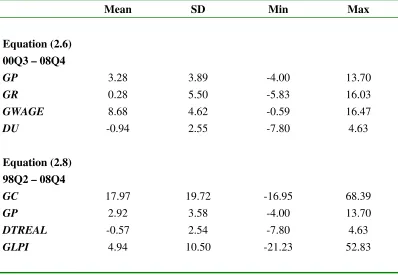
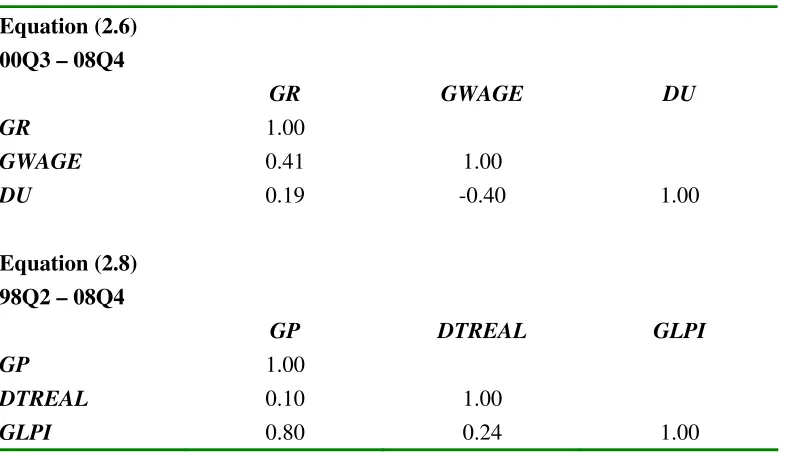
Table 1 and 2 provide some summary statistics. Constrained by the data, we simply
apply OLS on each city separately.19 As we have explained those linear regressions
can be regarded as the linearization of the first order conditions resulted from the two
dynamic models derived from above. Thus, the coefficients estimated from the
regression carries “structural interpretations.” We run the regressions separately for
each city because cities could differ in terms of culture, economic development, legal,
and other infrastructures, which would affect the estimated coefficients. This is our
in-sample-fitting part. The second part is out-of-sample forecasting. We use our
model to forecast the house prices and construction dynamics in 2008 in those four
major cities in China.
19
(Table 1 and 2 about here)
In the literature, there are discussions on whether in-sample-fitting (ISF) or
out-of-sample-forecasting (OSF) should be used as the criteria to measure the
performance of an econometric model (among others, see Meese and Rogoff, 1983;
Inoue and Kilian, 2004; Cheung, Chinn and Pascual, 2005). In this paper, we will
consider both ISF and OSF. And to more accurately assess the performance of our
model, we provide two widely used alternatives for comparison in both ISF and OSF.
We follow the literature to use both RMSE (Root Mean Squared Error) and
MAE (Mean Absolute Error) as the metric for the models’ ability to match with the
data. We will first present the results regarding the house price equation, followed by
those related to the construction equation.
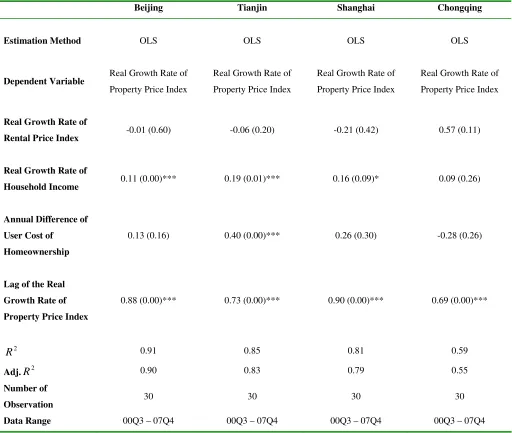
Table 3 presents the regression results regarding the house price equation in
individual cities. All models are adjusted for heteroskedasticity and autocorrelation
by the Newey-West HAC Standard Errors and Covariance.Overall, the model works
well in these four cities. In terms of the more conventional measure, the model applies
pretty well in Beijing, achieving a R2of 0.90. The case for Tianjin and Shanghai are also reasonable good, with a R2of 0.80 or above. The case of Chongqing is a little below the norm, with a R2slightly below 0.60. It may be due to its relatively less developed economy, or due to a very different sectoral focus, and hence our model
may not match that well. The diversity of the model performance also seems to justify
our city-by-city approach.
(Table 3 about here)
For individual variable, the real growth rate of household income has a
positive (and statistically significant) effect on the growth rate on house price change,
as expected. The effect of rental growth is however insignificant. The effect of the
the previous period growth rate of property price is always positively and statistically
significant effect on the house price growth. Such persistence in house price is
consistent with the equilibrium model where technological shocks are persistent and
agents rationally respond to shocks (such as Leung, 2007).
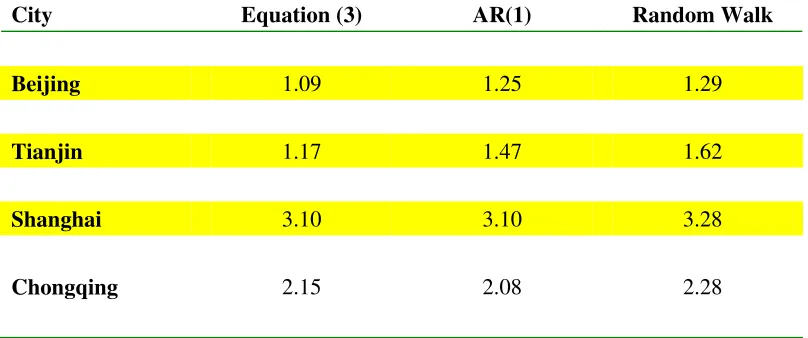
We now turn to the in-sample-fitting. We compare our model with the two
widely used alternatives, namely the 1st degree auto-regressive model (AR(1)) and the
random walk. In terms of RMSE, our model out-performs the alternatives in all four
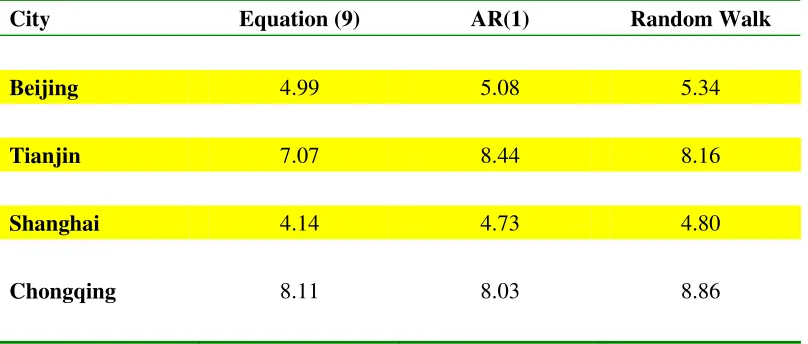
cities, as shown in table 4a. In terms of MAE, our model still out-performs the
alternatives in all except Chongqing, as shown in table 4b. Putting all these together,
despite the simplicity, our model has apparently captured some important
characteristics of the house price dynamics in these four cities during the sampling
period (2000Q3 – 2007Q4).
(Table 4 about here)
In terms of the out-of-sample forecasting, our model does not do as well. In
terms of RMSE, our model only out-performs the alternatives in Beijing, as shown in
table 4c. In terms of MAE, our model out-performs the alternatives in both Beijing
and Chongqing, as shown in table 4d. One possible explanation is that during the
period of OSF (i.e. the period 2008Q1 -2008Q4), some changes occur in the market of
Tianjin and Shanghai which are not captured by our model. We can only leave this to
future research for more in-depth investigation.
We now turn to the construction equation (9). Table 5 reports the regression
results. Overall, the results are even better than the counterpart of the house price
consistent with the previous literature that dynamic models typically match the
quantity dynamics better than the price dynamics.20
(Table 5 about here)
As we compare the effect of individual variable on the construction growth
rate, we again notice the very significant diversity across cities, even though we are
using the same econometric model. For instance, the growth rate of the property price
has a positive and statistically significant impact on the construction growth in Tianjin.
And the point estimate is 0.99. Thus, the effect from house price to construction is, in
a sense, one-to-one! The counterparts in the other cities, however, are all statistically
insignificant. In the case of the difference of lending rate, the coefficients are negative
and statistically significant in Beijing and Shanghai, which are arguably more
developed. The counterpart of Tianjin is positive and statistically significant. In Chongqing, the coefficient is also large in magnitude and is statistically significant at
10% level. This contrasting result between the relatively more developed cities and
the relatively less developed is also observed in the case of the land price. While they
are all statistically significant at 10% level, the coefficients of the growth rate of land
price are positive in both Tianjin and Chongqing yet negative in Shanghai. Thus, the
level of “market-ization” may affect how the housing started (or other real estate
market variables as well) respond to the changes of the market conditions. And had
we adopted the panel data approach which only uses a city-level fixed effect, we may
not be able to capture such city-level heterogeneity.
Persistence, measured by the coefficient of the lagged construction growth
rate on the current construction growth rate is always positive and statistically
significant. Interestingly, the coefficients for both Beijing and Shanghai are above
0.90, while the counterparts for both Tianjin and Chongqing are between 0.70 and
20
0.80. Thus, even if the effect of a variable is positive in all cities, the magnitude of
that effect can be different across cities.
In terms of the in-sample-fitting (ISF), our model again out-performs the
alternatives in all cities according to RMSE, and in all cities except Chongqing
according to MAE, as shown in table 6a and 6b. Just as the case of house price
dynamics, our construction model seems to capture some important dynamics during
the sampling period (1998Q2 -2007Q4).
(Table 6 about here)
Unfortunately, our out-of-sample forecasting (OSF) is not as successful as
the ISF. In terms of RMSE, our model only out-performs the alternatives in Shanghai,
as shown in table 6c. In terms of MAE, our model out-performs the alternatives in
both Beijing and Shanghai, but not in Tianjin or Chongqing, as shown in table 6d. The
results here are consistent with the previous conjecture that during the period of OSF
(i.e. the period 2008Q1 -2008Q4), some changes occur which are not captured by our
model. We again leave this to future research.
4. Concluding Remarks
Many have been written on the China housing market. This paper
complements the existing literature by providing two simple dynamic models, in
which households and developers are forward looking and respond to prices optimally.
In particular, the household are bounded by the budget constraint and the developer
pre-sells her housing units and is required to meet both the production constraint as
well as the collateral constraint. These models deliver two nonlinear equations
endogenously, one for price dynamics and one for construction dynamics. These
equations relate the house price and construction to other variables, such as the land
applied to different economies, we consider there may be an independent interest for
these two models. In fact, an on-going research project is to further extend and
develop them.
In the context of the major Chinese cities, with less than 40 observations in
each series, we are unable to conduct structural estimation. Instead, we confront the
linearized versions of them to the time series from four major cities in China (Beijing,
Tianjin, Shanghai and Chongqing). We conduct the regression separately and hence
allow the coefficients of the same variable taking different values across cities.
Several empirical results are obtained. Overall, our simple regression
models perform reasonably well. Heterogeneity across cities, on the other hand, is
very dramatic. For instance, in the case of house price equation, while Beijing
achieves a R2 of 0.91, Chongqing achieves 0.59. and while the growth rate of the real household income is positive and statistically significant for both Beijing and
Tianjin, it is marginally significant for Shanghai (10% level) and not significant at all
for Chongqing. Interest factor is important only for Tianjin but not other cities. In the
case of construction equation, growth rate of the property price is positive and
statistically significant for Tianjin, but not significant at all for other cities. The
interest factor will positively and significantly affect the growth rate of construction in
Tianjin and Chongqing, but negatively and significantly in Beijing and Shanghai. The
growth of land price will negatively affect the construction growth in Shanghai, but
positively in Tianjin and Chongqing. These results may suggest that cities in China
are indeed very different, especially in terms of the stage of economic development
and therefore their response to economic environment changes and policy changes
may be very different as well. It also cautious us in the application the Panel data
approach on Chinese city research which only differentiate cities by a city-level fixed
“decompose” the cross-city heterogeneity to differences in institutional factors,
differences in the economic development or sectoral specialization, among other
factors.
While measures such as R2 may give a sense of the “absolute
performance” of the model, we would also like to obtain some measures of “relative
performance” of the model. More specifically, we compare both the in-sample-fitting
(ISF) and out-of-sample forecast (OSF) of the model with two widely used
alternatives, namely, the AR(1) and the random walk. We use both RMSE and AME
to establish the robustness. Interestingly, both of our price dynamics equation and our
construction dynamics equation out-perform the alternatives in ISF in most cases. In
other words, despite their simplicity, both of our price dynamics and construction
dynamics capture some important feature of the data during the sampling period 1998
to 2007. For OSF, however, our price dynamics model consistently out-performs the
alternatives only in Beijing. Similarly, our construction dynamics model consistently
out-performs the alternatives on OSF only in Shanghai. One possibility is that there
are changes occur during the year 2008 that our model fails to capture. We will
continue to investigate this issue in the future research.
The third major empirical finding is that in both price dynamics and
construction dynamics models, the lagged variable are always positive and statistical
significant, although the magnitude varies slightly across cities. One interpretation
from the literature that this is due to the sluggish adjustment of housing stock, which
has been repeatedly documented (among others, see Hanushek and Quigley, 1979;
Leung, 2007). Needless to say, it can also be due to information diffusion (as
information flow in China is not as efficient as in some Western countries), or policy
persistence (as government policy still plays an important role in the housing market).
the causes of persistence in price and construction dynamics, and to identify the role
of policy in the dynamic propagation mechanism.
This paper also carries important policy implications. For instance, if the
housing market is believed to be “overheating,” our results suggest that increasing the
interest rate for mortgage loans may not have a significant direct effect on bringing down the house price growth in the short run. This is because the housing market of
the four cities in the sample period may have been subject to strong speculation or
constrained by credit rationing under macro control policy undertaken by the
government. In principle, the interest rate may have an indirect effect or some general equilibrium effect through its impact on the aggregate output or the stock market. To
address this concern, we will need a more elaborate econometric model for the joint
estimation of the real estate sector and the aggregate economy, which in turn demands
longer time series and more aggregate data.
For another policy application, this paper also shows that the interest rate
and the land price change can have very different impacts on the construction across
cities. Is it a result of differential local government policies? Or, it is a feature of cities
with different stages of economic development or different industrial specialization?
To address this question, future research may need to significantly extend the sample
size in terms of the number of cities involved. In any case, more investigations of this
are clearly needed and the results can be important for both academics and policy
References
Atkeson, A. and M. Ogaki, 1996, Wealth-Varying Intertemporal Elasticities of
Substitution: Evidence from Panel and Aggregate Data, Journal of Monetary Economics, 38, 507-34.
Bardhan, A. and R. Edelstein, 2008, Housing Finance in Emerging Economies:
Applying a Benchmark from Developed Countries, in D. Ben-Shahar, C. K. Y.
Leung and S. E. Ong, eds., Mortgage Markets Worldwide, Oxford: Blackwell Publishing: 231-52.
Baxter, M., 1991, Business Cycles, Stylized Facts, and the Exchange Rate Regime:
Evidence from the United States, Journal of International Money and Finance, 10(1): 71-88.
Chan, N., 1999, Land-use Rights in Mainland China: Problems and Recommendations
for Improvement, Journal of Real Estate Literature, 7: 53-63.
Chan, S. H.; F. Fang and J. Yang, 2008, Presales, Financing Constraints, and
Developers' Production Decisions, Journal of Real Estate Research, 30, 345-375.
Chen, N.-K., 2001, Bank Net Worth, Asset Prices and Economic Activity, Journal of Monetary Economics, 48: 415–36.
Chen, N.-K.; S.-S. Chen, Y.-H. Chou, 2010, House Prices, Collateral Constraint, and
the Asymmetric Effect on Consumption, Journal of Housing Economics, 19, 26-37.
Chen, N.-K. and H.-J. Wang, 2007, The Procyclical Leverage Effect of Collateral
Value on Bank Loans—Evidence from the Transaction Data of Taiwan,
Economic Inquiry, 45(2): 395-406.
Chen, N.-K. and H.-J. Wang, 2008, Procyclical Collateral Value and Business
Investment — An Empirical Investigation of Firm Level Data, Southern Economic Journal, 75, 26-49.
Cheung, Y. W.; M. D. Chinn and A. G. Pascual, 2005, Empirical exchange rate
models of the nineties: Are any fit to survive? Journal of International Money and Finance, 24, 1150-1175.
Christiano, L. and W. J. Den Haan, 1996, Small-sample properties of GMM for
business-cycle analysis, Journal of Business & Economic Statistics, 14, 309-327. Cocco, J. F., 2004, Portfolio Choice in the Presence of Housing, Review of Financial
Studies, 18: 535-67.
Deng, Y. and P. Fei, 2008, The Emerging Mortgage Markets in China, in D.
Deng, Y., D. Zheng and C. Ling, 2005, An Early Assessment of Residential Mortgage
Performance in China, Journal of Real Estate Finance and Economics, 31:
117–36.
Gerlach, S. and W. Peng, 2005, Bank Lending and Property Prices in Hong Kong,
Journal of Banking and Finance, 29: 461-81.
Greenwood, J. and Z. Hercowitz, 1991, The allocation of capital and time over the
business cycle, Journal of Political Economy, 99, 1188-1214.
Hamilton, J., 1994, Time Series Analysis, Princeton: Princeton University Press. Hansen, L. P., 1982, Large Sample Properties of Generalized Method of Moments
Estimators, Econometrica, 50(4), 1029-54.
Hansen, L. P. and J. Heckman, 1996, The Empirical Foundations of Calibration,
Journal of Economic Perspectives, 10, 87-104.
Hansen, L. P. and K. J. Singleton, 1982, Generalized Instrumental Variables
Estimation of Nonlinear Rational Expectations Models, Econometrica, 50(5),
1269-86.
Hanushek, E., 2002, Publicly Provided Education, in A. Auerbach and M. Feldstein,
eds., Handbook of Public Economics, Vol. 4, Amsterdam: North-Holland:
2045-141.
Hanushek, E., 2006, School Resources, in E. Hanushek and F. Welch, eds., Handbook of the Economics of Education, Vol. 2, Amsterdam: North-Holland, 865-908. Hanushek, E. and J. Quigley, 1979, The Dynamics of Housing Market: a Stock
Adjustment Model of Housing Consumption, Journal of Urban Economics, 6 (1): 90–111.
Hanushek, E. and K. Yilmaz, 2007a, The Complementarity of Tiebout and Alonso,
Journal of Housing Economics, 16: 243-61.
Hanushek, E. and K. Yilmaz, 2007b, Schools with Location: Tiebout, Alonso and
Governmental Policy, NBER Working Paper No.12960, Cambridge MA:
National Bureau of Economic Research.
Hart, O., Moore, J., 1994, A theory of debt based on the inalienability of human
capital, Quarterly Journal of Economics, 109, 841–879.
Hausman, J., 1978, Specification Tests in Econometrics, Econometrica, 46: 1251-72. Hayashi, F., 2000, Econometrics, Woodstock: Princeton University Press.
Hsiao, C., 2003, Analysis of Panel Data, Cambridge: Cambridge University Press. Hwang, M. and J. M. Quigley, 2006, Economic Fundamentals in Local Housing
Inoue, A. and L. Kilian, 2004, In-Sample or Out-of-Sample Tests of Predictability:
Which One Should We Use? Econometric Reviews, 23, 371-402.
Kan, K.; Kwong, S. K. S.; Leung, C. K.-Y., 2004, The dynamics and volatility of commercial and residential property prices: theory and evidence, Journal of Regional Science, 44(1), 95-123.
King, R., C. Plosser and S. Rebelo, 2002, Production, Growth and Business Cycles:
Technical Appendix, Computational Economics, 20(1-2): 87-116.
King, R. and S. Rebelo, 1993, Low Frequency Filtering and Real Business Cycles,
Journal of Economic Dynamics and Control, 17(1-2): 207-31.
Lai, R. N.; K. Wang, and Y. Zhou, 2002, Sale before Completion of Development:
Pricing and Strategy, Real Estate Economics, 32, 329-357.
Leung, C. K. Y., 2003, Economic growth and increasing house price, Pacific Economic Review, 8(2), 183-190.
Leung, C., 2004, Macroeconomics and Housing: a review of the literature, Journal of
Housing Economics, 13, 249-267.
Leung, C. K. Y., 2007, Equilibrium correlations of asset price and return, Journal of Real Estate Finance and Economics, 34, 233-256.
Leung, C. K. Y. and N.-K. Chen, 2006, Intrinsic cycles of land price: a simple model,
Journal of Real Estate Research, 28(3), 293-320.
Leung, C. K. Y. and W. Wang, 2007, An Examination of the Chinese Housing Market
through the Lens of the DiPasquale-Wheaton Model: a Graphical Attempt,
International Real Estate Review, 10(2): 131-65.
Leung, F., K. Chow and G. Han, 2008, Long-Term and Short-Term Determinants of
Property Prices in Hong Kong, HKMA Working Paper No.15/2008, Hong Kong
Monetary Authority.
Li, D., 1998, Changing Incentives of the Chinese Bureaucracy, American Economic
Review, Papers and Proceedings, 88, 393-397.
Liu, H. and Y. Huang, 2004, Prospects of Real Estate Markets in China – Challenges
and Opportunities, Institute of Real Estate Studies, Tsinghua University.
Liu, M., B. Song and R. Tao, 2006, Perspective on Local Governance Reform in
China, China & World Economy, 14, 16 – 31.
Liu, P.; Edelstein, R. H. and F. Wu, 2009, Forward Real Estate Markets and Hedging:
A Theoretical Approach. University of California, Berkeley, mimeo.
Mas-Colell, A.; M. Whinston and J. Green, 1995, Microeconomic Theory, Oxford: Oxford University Press.
Meese, R., Rogoff, K., 1983, Empirical exchange rate models of the seventies: do
Mera, K. and B. Renaud, eds., 2000, Asia’s Financial Crisis and the Role of Real Estate, New York: M.E. Sharpe.
Myers, S., 2003, Financing of corporations, in Handbook of the Economics of Finance, Volume 1A, ed. by G. M. Constantinides, M. Harris and R. Stulz, 215-253. Ogaki, M. and A. Atkeson, 1997, Rate of Time Preference, Intertemporal Elasticity of
Substitution, and Level of Wealth, Review of Economics and Statistics, 79, 564-72.
Pesaran, H. and R. Smith, 1994, A Generalized R2 Criterion for Regression Models Estimated by the Instrumental Variables Method, Econometrica, 62: 705-10. Peng, W., D. Tam and M. Yiu, 2008, The Property Market and the Macroeconomy of
the Mainland: A Cross Region Study, Pacific Economic Review, 13(2): 240-58. Piazzesi, M., M. Schneider and S. Tuzel, 2007, Housing, Consumption and Asset
Pricing, Journal of Financial Economics, 83: 531-69.
Ping, X. and M. Chen, 2004, Real estate financing, land price and the trend of housing
price, Peking University, mimeo (In Chinese).
Renaud, B., 2008, Mortgage Finance in Emerging Markets: Constraints and Feasible
Development Paths, in D. Ben-Shahar, C. K. Y. Leung and S. E. Ong, eds.,
Mortgage Markets Worldwide, Oxford: Blackwell Publishing: 253-88.
Ross, S. and J. Yinger, 1999, Sorting and Voting: a Review of the Literature on Urban
Public Finance, in P. Cheshire and E. Mills, eds., Handbook of Regional and Urban Economics, 3: 2001-60.
Shi, T., 1997, Political Participation in Beijing, Cambridge: Harvard University Press.
Singleton, K. J., 2006, Empirical Dynamic Asset Pricing: Model Specification and
Econometric Assessment , Princeton: Princeton University Press.
Sundaram, R., 1996, A First Course in Optimization Theory, Cambridge: Cambridge
University Press.
Tsai, L., 2007, Accountability Without Democracy: Solidary Groups and Public
Goods Provision in Rural China, Cambridge:Cambridge University Press.
Tse, C. Y.; Leung, C. K. Y., 2002, Increasing Wealth and Increasing Instability: The Role of Collateral, Review of International Economics, 10(1), 45-52.
Wang, C. A. and C. O. Chang, 2008, Is It a Heavy Log that Broke the Camel’s Back?
Evidence of the Credit Channel in Taiwan’s Construction Industry,
International Real Estate Review, 11, 38-64.
Wang, K. and Y. Zhou, 2006, Equilibrium Real Options Exercise Strategies with
Multiple Players: The Case of Real Estate Markets, Real Estate Economics, 34, 1-49.
Yao, R. and H. Zhang, 2005, Optimal Consumption and Portfolio Choices with Risky
Table 1a. Summary Statistics of the Variables of Beijing
Mean SD Min Max
Equation (2.6)
00Q3 – 08Q4
GP 3.10 4.39 -6.97 10.10
GR 9.95 24.83 -4.17 92.33
GWAGE 7.96 3.16 1.41 14.68
DU -0.45 3.32 -6.53 7.50
Equation (2.8) 98Q2 – 08Q4
GC 12.96 28.15 -15.10 86.07
GP 2.20 4.30 -6.97 10.10
DTREAL -0.25 2.94 -6.53 7.50
GLPI 1.49 3.80 -6.67 12.97
Table 1b. Summary Statistics of the Variables of Tianjin
Mean SD Min Max
Equation (2.6)
00Q3 – 08Q4
GP 3.28 3.89 -4.00 13.70
GR 0.28 5.50 -5.83 16.03
GWAGE 8.68 4.62 -0.59 16.47
DU -0.94 2.55 -7.80 4.63
Equation (2.8) 98Q2 – 08Q4
GC 17.97 19.72 -16.95 68.39
GP 2.92 3.58 -4.00 13.70
DTREAL -0.57 2.54 -7.80 4.63
[image:34.612.108.506.445.720.2]