Adaptive interactive expectations:
dynamically modelling profit
expectations
Bell, William Paul
University of Queensland
29 June 2009
Online at
https://mpra.ub.uni-muenchen.de/38260/
Adaptive Interactive Expectations:
Dynamically Modelling Profit Expectations
William Paul Bell
A thesis submitted for the degree of Doctor of Philosophy at
The University of Queensland in June 2009
Declaration by author
This thesis is composed of my original work, and contains no material previously published or written by another person except where due reference has been made in the text. I have clearly stated the contribution by others to jointly authored works that I have included in my thesis. I have clearly stated the contribution of others to my thesis as a whole, including statistical assistance, survey design, data analysis, significant technical procedures, professional editorial advice, and any other original research work used or reported in my thesis. The content of my thesis is the result of work I have carried out since the commencement of my research higher degree candidature and does not include a substantial part of work that has been submitted to qualify for the award of any other degree or diploma in any university or other tertiary institution. I have clearly stated which parts of my thesis, if any, have been submitted to qualify for another award.
I acknowledge that an electronic copy of my thesis must be lodged with the University Library and, subject to the General Award Rules of The University of Queensland, immediately made available for research and study in accordance with the Copyright Act 1968. I acknowledge that copyright of all material contained in my thesis resides with the copyright holder(s) of that material.
Statement of Contributions to Jointly Authored Works Contained in the Thesis
No jointly authored works.
Statement of Contributions by Others to the Thesis as a Whole
No contributions by others.
Statement of Parts of the Thesis Submitted to Qualify for the Award of another Degree
None
Published Works by the Author Incorporated into the Thesis
Bell, WP 2009, 'Network Averaging: a technique for determining a proxy for the dynamics of networks', paper presented to Complex ’09, the 9th Asia-Pacific Complex Systems Conference, Chuo University, Tokyo, Japan, 6 November 2009 – incorporated into Chapters 3 and 4.
Bell, WP 2008, 'Interactive Adaptive Profit Expectations and Small World Networks', paper presented to Business, Economics and Law Faculty Research Conference 2008, University of Queensland, Brisbane, Australia, 26 September 2008 – incorporated into Chapters 2 and 3.
Additional Published Works by the Author Relevant to the Thesis but not Forming Part of it
Acknowledgements
First of all, I wish to thank my supervisors, Professor John Foster, Dr Phil Wild and Dr Rodney Strachan, for their feedback and advice in preparing this thesis. Specifically, I wish to thank Professor John Foster for the continual source of valuable ideas and friendly meetings throughout my candidature. I wish to thank Dr Phil Wild for his detailed feedback on the thesis generally, and in agent-based modelling and input-output modelling, thus make the thesis more consistent with the literature and alert the reader to the unconventional use of input-output tables. I wish to thank Dr Rodney Strachan for introducing me to the literature on model-averaging and simulated-annealing
and the ensuing discussions, leading to a sharper presentation of the ‘runtime-weighted model-averaging’ and model-averaging generally and improving the formula notation throughout the thesis. Additionally, I wish to thank Dr Jason Potts for his feedback and advice as a supervisor in the first eighteen month of my candidature.
I wish to thank Dr David Green for introducing me to distributive computing and his prompt help with the high performance computing facility without which this thesis would have taken too many years to complete. I wish to thank Professor Duncan Ironmonger for providing the D&B (2008) National Business Expectations Survey in a readily useable format, thus saving me considerable time. Additionally, I would like to thank Dr Luis Izquierdo for introducing me to NetLogo programming. The simulation for testing the Adaptive Interactive Expectations (AIE) model is written in NetLogo and is used extensively in the thesis.
I wish to thank the Australian Research Council’s Centre for Complex Systems for providing additional funding.
I wish to thank my friend Thomas Ekholm for his enthusiasm, suggestions, and for proofreading. Specifically, he hammered weak arguments, which resulted in a stronger thesis and his play with words resulted in more accessible thesis.
Abstract
This thesis aims to develop an alternative expectations model to the Rational Expectations Hypothesis (REH) and adaptive-expectations models, which provides more accurate temporal predictive performance and more closely reflects recent advances in behavioural economics, the
‘science of complexity’ and network dynamics. The model the thesis develops is called Adaptive Interactive Expectations (AIE), a subjective dynamic model of the process of expectations formation. To REH, the AIE model provides both an alternative and a complement. AIE and REH complement one another in that they are diametrically opposite in the following five dimensions, agent intelligence, agent interaction, agent homogeneity, equilibrium assumptions and the rationalisation process. REH and AIE stress the importance of hyper-intelligent agents interacting only via a price signal and near zero-intelligent agents interacting via a network structure, respectively. The complementary nature of AIE and REH provide dual perspectives that enhance analysis.
The Dun & Bradstreet (D&B 2008) profit expectations survey is used in the thesis to calibrate AIE and make predictions. The predictive power of the AIE and REH models is compared. The thesis introduces the ‘pressure to change profit expectations index’,px. This index provides the ability to model unknowns within an adaptive dynamic process and combine the beliefs from interactive-expectations, adaptive-expectations and biases that include pessimism, optimism and ambivalence.
AIE uses networks to model the flow of interactive-expectations between firms. To overcome the uncertainty over the structure of the interactive network, the thesis uses model-averaging over 121 network topologies. These networks are defined by three variables regardless of their complexity. Unfortunately, the Bayesian technique’s use of the number of variables as a measure of complexity makes it unsuitable for model-averaging over the network topologies. To overcome this limitation in the Bayesian technique, the thesis introduces two model-averaging techniques, ‘runtime-weighted’ and ‘optimal-calibration’. These model-averaging techniques are benchmarked against
‘Bayes-factor model-averaging’ and ‘equal-weighted model-averaging’.
aggregated and disaggregated versions of AIE are benchmarked against adaptive-expectations to establish whether the interactive-expectations component of AIE add value to the model.
The thesis finds that AIE has more predictive power than REH. ‘Optimal-calibration model-averaging’ improves the predictive performance of the better-fitting versions of AIE, which are those versions that use the ‘input-output table’ and ‘matrix of ones’ link-intensity matrices. The
‘runtime-weighted model-averaging’ improves the predictive performance of only the ‘input-output table’ version of AIE. The interactive component of the AIE model improves the predictive performance of all versions of the AIE over adaptive-expectations. There is an ambiguous effect on prediction performance from introducing the ‘input-output table’. However, there is a clear reduction in the predictive performance from introducing its transpose.
AIE can inform the debate on government intervention by providing an Agent-Based Model (ABM) perspective on the conflicting mathematical and narrative views proposed by the Greenwald– Stiglitz Theorem and Austrian school, respectively. Additionally, AIE can provide a complementary role to REH, which is descriptive/predictive and normative, respectively. The AIE network calibration uses an ‘input-output table’ to determine the link-intensity; this method could provide Computable General Equilibrium (CGE) and Dynamic Stochastic General Equilibrium
(DSGE) with a way to improve their transmission mechanism. Furthermore, the AIE network calibration and prediction methodology may help overcome the validation concerns of practitioners when they implement ABM.
Keywords
Expectations, profits, networks, adaptive, interactive, model-averaging, agent-based, Australia
Australian and New Zealand Standard Research Classifications (ANZSRC)
Contents
Declaration by author...i
Acknowledgements...iii Abstract ...iv Contents ...vi Figures...viii Tables ...ix Abbreviations ...x
1. Introduction ...1
1.0 Introduction...1
1.1 Background to the research...2
1.1.1 Failures of the REH and adaptive-expectations models ...2
1.1.2 What caused the failure of REH and the neoclassical framework? ...5
1.1.3 The failure of REH informing the development of AIE ...7
1.2 Research problem...8
1.3 Justification for the research ...8
1.4 Methodology ...9
1.4.1 Justifying the Methodology ...9
1.4.2 Outlining the Methodology...10
1.5 Outline of the thesis ...13
1.6 Definitions...15
1.7 Delimitations of scope and key assumptions ...17
1.8 Conclusion ...17
2. Literature Review ...18
2.0 Introduction...18
2.1 Parent disciplines, fields and models ...19
2.1.1 Theoretical Frameworks: Neoclassical, Complexity and Behavioural Economics ...20
2.1.2 Rational Expectations Hypothesis and Behavioural Economics ...33
2.1.3 Efficient Market Hypothesis ...38
2.1.4 Microfoundations Projects: from General Equilibrium Theory to Emergence...50
2.1.5 Dynamic Stochastic General Equilibrium and Rational Expectations...61
2.1.6 Using Emergence in an Economic System to Link the AIE Model Components ...69
2.1.7 Profit Expectations Index and Expectations Phase Transitions ...73
2.1.8 Adaptive-expectations Model: an AIE Model Component and Benchmark ...75
2.1.9 Interactive-expectations Model: an AIE Model Component ...78
2.2 Immediate discipline and analytical models ...84
2.2.1 Modelling Complex Systems and Emergence ...85
2.2.2 Applying Network Theory to the AIE Model: A Proxy for Institutional Structure...91
2.2.3 Model Falsification and Verification Issues ...93
2.2.4 Optimisation Techniques for Functions of Many Variables...98
2.2.5 Model-selection & Model-averaging: Optimal-calibration & Runtime-weighted ...106
2.3 Research Questions ...113
2.4 Conclusion ...114
3. Methodology...115
3.0 Introduction...115
3.1 Justification for the Framework and Methodology...116
3.1.1 Probability and Decision Theory: Objective and Subjective ...116
3.1.2 Modelling Biological Cognitive Systems as Probability Calculators...117
3.2 Ingredients of the formal AIE model ...121
3.2.1 Decomposing the D&B Indices into the States of Firms and Initialising AIE ...122
3.3 The Pressure to Change Profit Expectations Index px...123
3.3.1 Calculating the Pressure to Change Profit Expectations Index...123
3.3.2 Comparing Interactive-expectations Approaches: Network versus Statistical ...125
3.3.3 Stochastically Determining the Pressure Level at which to Change Expectations...126
3.3.4 Ensuring the Pressure to Change Index does not exceed 100...128
3.4 Calibrating the AIE model’s 121 network topologies ...129
3.4.1 Visualisation of the Model Variance of the Network Topologies ...129
3.4.2 Combining the Search Techniques to Find the Global Minimum ...131
3.5 Model-averaging ...134
3.5.1 Runtime-weighted Model-averaging ...135
3.5.2 Optimal-calibration Model-averaging...139
3.5.3 Equal-weighted Model-averaging...142
3.5.4 Bayes-factor Model-averaging...143
3.6 The disaggregated AIE model...144
3.7 Rational Expectations Hypothesis Made Operational ...147
3.8 Research Questions Refined and Made Operational...148
3.9 Conclusion ...150
4. Results ...151
4.0 Introduction...151
4.1 Research Questions ...151
4.2 Conclusion ...156
5. Conclusion and Implications ...157
5.0 Introduction...157
5.1 Conclusions about each research question...158
5.2 Conclusions about the research problem ...160
5.3 Implications for theory...161
5.4 Implications for policy and practice...166
5.4.1 Using REH and AIE in a Complementary Approach to better inform Policy...166
5.4.2 Narrative, Mathematical and ABM Methodologies Together Informing Policy...167
5.4.3 Theory in Practice ...169
5.4.4 Contributions of the thesis to the literature...170
5.5 Limitations ...172
5.5.1 Computing Power ...172
5.5.2 Learning and other evolutionary processes...173
5.6 Further research...175
5.6.1 Integrating Unconstrained-nonlinear-optimisation and Simulated-annealing ...175
5.6.2 Linking Leaky Integration Neuronal Models and Ambiguity Belief Models...175
5.6.3 Improving AIE Networks using Input-Output tables and the Number of Firms ...175
5.6.4 Introducing Networks based on Input-Output tables into CGE and DSGE...176
5.6.5 Relationship between Structural Change in a Network and Volatility ...176
5.6.6 Multiple Levels of Patterns in Emergence...176
5.6.7 A Phase Change or Structural Change Causing a Change in Profit Expectations...176
5.6.8 Benchmark Runtime-weighted Model-averaging in a Controlled Experiment ...177
5.6.9 Impulse Propagation in Dynamics models for Policy Analysis...177
5.6.10 Adding Exogenous Inputs to AIE to supplement the Change in Actual Profits ...177
5.6.11 Using Random Seeds to Improve Adaptive-expectations as a Benchmark ...178
5.6.12 Using the Levenberg-Marquardt system for nonlinear parameter estimation ...178
5.6.13 Testing parallel processing on a graphics adaptor ...179
A Source code for the AIE Model, Model-averaging and Optimisation...180
Figures
Figure 2–1 Deductive and Inductive Theorising...24
Figure 2–2 Comparing Agent Interaction and Intelligence of REH and AIE...27
Figure 2–3 Three Cognitive Systems Framework ...30
Figure 2–4 A Hypothetical Value Function...45
Figure 2–5 Components of the Profit Expectations Index and Phase Change...73
Figure 2–6 All–firms Profit Expectations and Actual Profits Indices ...75
Figure 2–7 Wholesale, Retail, Durable and Non–durable Profit Expectations Indices...79
Figure 2–8 Divisional Profit Expectations Indices less the All–firms Profit Expectations Indices ...80
Figure 2–9 Regular, Small World and Random Networks. ...91
Figure 2–10 Medwar Zone...96
Figure 2–11 Simulated-annealing Algorithm ...100
Figure 2–12 Threshold-accepting Algorithm...103
Figure 3–1 The 200 runs with the lowest model variance from the limited gradient method ...129
Figure 3–2 SSE/T for various L and ρ for δ = 1.0 ...130
Figure 3–3 SSE/T for various L and ρ for δ = 1.2 ...130
Figure 3–4 SSE/T for various L and ρ for δ = 1.4 ...130
Figure 3–5 Finding the optimal ‘runtime-weighted constant’c...136
Figure 3–6 Comparing the Calibration of the AIE model against the D&B Index ...137
Figure 3–7 Prediction based upon the calibration ’runtime-weighted constant’ c = 5.2 ...138
Figure 3–8 Evaluating the prediction using ‘runtime-weighted model-averaging’...138
Figure 3–9 Minimising the model variance using ‘optimal-calibration’...139
Figure 3–10 Minimising the model variance using ‘optimal-calibration’...140
Figure 3–11 Prediction using ‘optimal-calibration model-averaging’...141
Figure 3–12 Prediction performance using ‘optimal-calibration model-averaging’...141
Figure 3–13 Calibration Period: Comparing Equal-weighted & Bayes-factor Model-averaging ...142
Tables
Table 2–1 Neoclassical Assumptions ...21
Table 2–2 Intuition–Reasoning Judgement Selection Model ...30
Table 2–3 Factors affecting emergence in an economic system and correspondence to AIE ...70
Table 2–4 Input-Output Table for the Durable, Non–durable, Wholesale and Retail Divisions...81
Table 3–1 Parameter values for the five runs with the lowest model variance (SSE/T) ...130
Table 3–2 Percentage Decrease in Model Variance using the Differing Optimisation Techniques 131 Table 4–1 The results of the AIE simulation for the aggregated and disaggregated versions...152
Abbreviations
ABM Agent-based Models
ABS Australian Bureau of Statistics
ACCS Australian Research Council Centre for Complex Systems ADM Arrow–Debreu–McKenzie model
AGE Applied General Equilibrium AIC Akaike Information Criteria
AIE Adaptive Interactive Profit Expectations AMH Adaptive Market Hypothesis
ANZSIC Australian New Zealand Standard Industrial Codes BIC Bayesian Information Criteria
CAPM Capital Asset Pricing Model CGE Computable General Equilibrium D&B Dun & Bradstreet
D&BSIC Dun & Bradstreet Standard Industrial Classification DVD Digital Video Disc
DSGE Dynamic Stochastic General Equilibrium EMH Efficient Market Hypothesis
fMRI Functional Magnetic Resonance Images GE General Equilibrium
GET General Equilibrium Theory GTAP Global Trade Analysis Project
px Pressure to change profits expectations index REH Rational Expectations Hypothesis
RBC Real Business Cycle
SMD Sonnenschein–Mantel–Debreu Theorem S&P Standard & Poor’s
1.
Introduction
1.0 Introduction
This chapter provides the foundations for the thesis. Sufficient background for the research is discussed to introduce the research problem and justify the research. The methodology is briefly described and justified and each chapter of the thesis is outlined. The definitions and delimitations of the research are presented.
This thesis develops an Agent-based Model (ABM), called Adaptive Interactive Expectations (AIE), to model the interactive formation of profit expectations. It statistically compares the accuracy of the AIE model to the Rational Expectations Hypothesis (REH) and the standard non-interactive adaptive-expectations model. The thesis models profit expectations because profit expectations determine future investment and whether one business extends credit to another. Noting that, the interactive formation of profit expectations is readily extended to other forms of interactive-expectations.
This thesis also compares the epistemology of the neoclassical and ‘science of complexity’
frameworks for three reasons. First, they are the frameworks that contain the REH and AIE models, respectively. REH is the main expectations model in neoclassical economics and forms a benchmark for the AIE. Second, the neoclassical framework is shown to be logically inconsistent, philosophically flawed and empirically questionable, thus it requires a replacement framework to model expectations. The ‘science of complexity’ is discussed as a remedy to many of the neoclassical frameworks ailments. Similarly, the REH has come under increasing criticism, which opens the way for a replacement. Third, discussing the failures in the neoclassical framework and its expectations model, REH, informs the development of the AIE model.
The structure of the chapter is as follows. Section 1.1 discusses the background to the research, which overviews the epistemology of economics. Section 1.2 presents the research problem. Section 1.3 justifies the research. Section 1.4 briefly justifies and outlines the methodology. Section 1.5 outlines the structure of the thesis and the contents of each chapter. Section 1.6 provides definitions. Section 1.7 presents the delimitations of scope of the thesis and key assumptions. Section 1.8 concludes the chapter.
1.1 Background to the research
This section discusses the background literature, which provides the motivation for the research problem, that is, to develop an alternative model for expectations formation to the REH and adaptive-expectations models. Not only does reviewing the failure of these models provide motivation to develop an alternative model but it informs also the development of an alternative model.
Section 1.1.1 discusses the failures of the REH and adaptive-expectations models. Section 1.1.2 discusses what caused the failure of REH and its neoclassical framework. Section 1.1.3 discusses what can be learned from the failure of the REH to inform the development of AIE.
1.1.1 Failures of the REH and adaptive-expectations models
The historical context for the REH and the adaptive-expectations models is discussed to show their failure to adequately model expectations.
Hick’s (1939) adaptive-expectations model was the dominant expectations model in economics until Muth (1960; 1961), who was dissatisfied with the performance of the adaptive-expectations model, introduced REH that builds on rational choice (Von Neumann & Morgenstern 1944). Billari (2006, p. 2) describes the rational expectations paradigm as that which assumes homogenous economic agents who know their preferences and have unlimited computing power to calculate optimal solutions, and have perfect knowledge of all data relevant to calculate the optimal solution. Sargent (2008, p. 1) asserts in rational expectations that outcomes do not differ systematically (that is, regularly or predictably) from what people expect them to be. REH embodies the three neoclassical assumptions discussed in section 2.1.1. REH grew in importance as it became embedded in many neoclassical economic theories such as the Efficient Market Hypothesis (EMH),
it are coming under increasing criticism because they have logical inconsistencies, poor predictive performance and contradict behavioural research but despite these anomalies, REH continues in extensive use and to inform policy. Section 2.1 further discusses this topic.
Lovell (1986, p. 122) states that there is sufficient empirical evidence to suspend belief in REH and calls for the empirical testing of REH against the alternatives. Prescott (1977, p. 30) claims, ‘Like utility, expectations are not observed, and surveys cannot be used to test the rational expectations
hypothesis. One can only test if some theory, whether it incorporates rational expectations or, for
that matter, irrational expectations, is or is not consistent with observations.’ However, the EMH, GET and DSGE provide examples of theories that incorporate REH and are inconsistent with observation. They are discussed in turn.
Fama (1965; 1970) introduces the EMH that builds upon Bachelier’s (1900) ‘Theory of speculation: the origins of modern finance’ and extends REH. The EMH contends that markets use information efficiently in that markets reflect available information in the prices. Mandelbrot (1963) finds that Bachelier’s (1900) random walk model of stock option prices based upon a Gaussian distribution fails to account for the clustered volatility of the price movement of cotton. Shiller (1981) observes that in contradiction to the EMH, the S&P stock prices move too much to be justified by the subsequent changes in the dividends. Furthermore, Farmer and Geanakoplos (2008) state that the market is essentially a dynamic process, hence the failure of EMH to model market dynamics is a serious shortcoming.
GET helps to prove that the neoclassical framework is logically inconsistent and degenerative. Walras (1874) introduces GET to find a price vector that would establish the balance between supply and demand across a number of markets. Arrow, Debreu and McKenzie (ADM) (Debreu 1959) extend Walras (1874) by incorporating elements of REH. The Arrow–Debreu Existence Theorem (Arrow & Debreu 1954) proves the existence of the price vector. However, the
Farmer and Geanakoplos (2008, p. 14) note that there are problems with defining utility, which makes the use of alternatives desirable. However, neoclassical economics found an alternative solution to the shapeless excess demand curve by assuming all goods have a neutral Engel curve (Keen 2001, pp. 38-42). In practice there are few, if any, goods with neutral Engel curves. This solution protects the hard-core of neoclassical economics, but sacrificed realism, as part of the
‘protective-belt’. Lakatos (1976) would consider this falsification avoidance a sign of a degenerative scientific research program.
CGE embodies REH assumptions. An example of the prevalence, credibility and perceived importance of CGE is the Global Trade Analysis Project (GTAP 2009) coordinated by the Centre for Global Trade Analysis, Department of Agricultural Economics, Purdue University. GTAP (2009) provides figures on its use in global quantitative economic analysis to support its claim as a common language for global trade analysis. Mitra-Kahn (2008) notes that the ‘general equilibrium’
in CGE models is an assumption and comes from balancing macro Keynesian simultaneous equations, where equilibrium is imposed from above, which makes CGE models ‘top–down’
models. In comparison, the ‘general equilibrium’ of GET and Applied General Equilibrium (AGE) models derive from finding a price vector that balances the supply and demand of the agents; equilibrium is calculated, with the simplex method in the AGE model, thus AGE and GET models are ‘bottom–up’ models and seek to prove that ‘general equilibrium’ exist. CGE and DSGE just assume that equilibrium exists even though the SMD Theorem proves the lack of general equilibrium in static models. Furthermore, Blatt (1983) discusses the dual (in)stability problem that proves that the imposition of equilibrium with these ‘top–down’ models is also of questionable veracity. Altogether, this makes any policy derived from CGE or DSGE potentially misleading.
DSGE are full multi-period dynamic models, which consider that the agents’ expectations depend on the future states of the economy. This requires the model to be solved simultaneously over the full multi-period. The DSGE method directly uses REH. Kydland and Prescott (1982) introduce the first DSGE, called the Real Business Cycle (RBC). Summers (1986) describes the RBC as a floating Walrasian equilibrium buffeted by productivity shocks, which assumes no monetary policy effects on real activity; in which fiscal policy only works via incentives and economic fluctuations are purely the result of supply rather than demand. Stadler (1994) discusses five criticisms of the RBC. One, there is a lack of evidence for sufficient large real shocks to drive the model. Two, testing the RBC is purely subjective. Three, RBC fails to capture the business cycle because it lacks suitable transmission mechanisms. Four, the RBC does not explain recession well. Five, the representative agent makes the model unsuitable for welfare or policy development. Aoki (2007) suggests using an agent-based modelling (ABM) approach that would resolve two of the RBC problems, the poor transmission mechanism and the representative agent. In agreement, Kirman (1992, p. 131) suggests that it is insufficient to introduce heterogeneity into general equilibrium models without expanding the role of interactions between agents from anonymous price-takers to include the passage of information, the building of regulations, organising into groups for the purpose of trading, and more. Prescott (1988, p. 84) acknowledges that the RBC models are
‘necessarily false and statistical hypothesis testing will reject them.’
1.1.2 What caused the failure of REH and the neoclassical framework?
This section discusses three reasons for the failure of the neoclassical framework and its REH, which are chosen for their relevance to the thesis. First, instrumentalism, the philosophy underpinning neoclassical economics, is flawed. Second, neoclassical economics approximates the dynamic economy with static models. Lastly, neoclassical economics has blurred the distinction between subjective and objective probabilities by using rational choice theory beyond the domain intended by Von Neumann and Morgenstern (1944). The second and third reasons are interrelated, if one assumes that the economy is static, it is feasible to approximate subjective probabilities with frequentist probabilities. However, the economy is not static.
notes that all theories make negligibility assumptions and these assumption are fine provided the theories can make falsifiable predictions. However, making domain assumptions means that theory is applied outside the scope of its assumptions and may well be misleading, such as, when static analysis is applied to a dynamic system. Musgrave (1981) notes that heuristic assumptions are fine too, provided that the theory can predict and the assumptions gradually become more realistic to allow more accurate prediction. However, neoclassical economics became less realistic after it introduces the neutral Engel curve assumption to maintain stability in GET. Section 5.3 further discusses the flaws in instrumentalism to establish the need for an alternative framework to the neoclassical theoretical framework for the AIE model.
Vercelli (2007, p. 21) discusses the two forms of decision theory, the objectivist theory introduced by Von Neumann and Morgenstern (1944) and the subjectivist theory, often called Bayesian, suggested by Savage (1954). Lucas (1986, p. S411) notes, ‘the economic theory of choice is ... a description of a ... stationary “point” ... [in a] dynamic adaptive process.’ At such a point, the optimal adaptation has already happened and the decision–maker knows the complete list of its possible states and options, and is also aware of the consequences of each choice for each possible state. Vercelli (2007, p. 21) notes that the objective and subjective decision-making theories may appear different. However, their implications are almost identical axiomatically and ontologically because both theories refer to a world that is familiar to the decision–maker. The term ‘subjective’ in the thesis refers to the much stronger form that Keynes (1937, pp. 213-4) uses when he discusses ‘uncertain’ knowledge to claim that probabilities are unmeasurable, rather than the weaker form suggested by Savage (1954).
1.1.3 The failure of REH informing the development of AIE
The background establishes not only the need for an alternative expectations model to REH but establishes also the need for an alternative framework to the neoclassical and the need for an alternative to the utility curve concept. Keynes (1937, pp. 213-4) provides a suitable structure to develop an alternative expectations model and the ‘science of complexity’ provides a suitable framework.
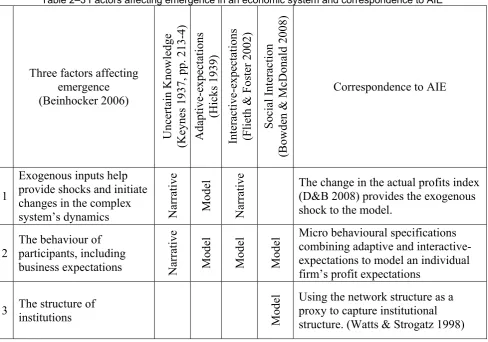
Keynes (1937, pp. 213-4) discusses ‘uncertain’ knowledge and claims that probabilities relating to the relatively distant future are not measurable, where he suggests that people adopt the following three strategies in the face of uncertainty, which are further addressed in other literature.
1. Assume the present is a much more servable guide to the future than the past and largely ignore the unknowns in the future. This strategy could be modelled with the exponential smoothing in adaptive-expectations (Hicks 1939).
2. Assume the existing state of opinion is reflected in the prices and the characteristic of the existing output is a correct summing up for future prospects, unless something new and relevant comes into the picture. This strategy could be modelled by combining adaptive-expectations (Hicks 1939) and interactive-expectations (Flieth & Foster 2002). 3. Knowing our own judgement to be worthless; we fall back on the judgement of the rest
of the world, in so doing, we conform to the behaviour of the majority or the average. This leads to a conventional judgement. This strategy could be modelled with interactive expectations (Flieth & Foster 2002).
1.2 Research problem The research problem of this thesis is.
Can a dynamic subjective expectations model be used to make more accurate temporal predictions than the REH and the adaptive-expectations models?
To address the research problem, the thesis develops AIE as a dynamic subjective expectations model. Section 2.3 breaks the problem into seven testable smaller research questions. These questions involve empirically testing AIE against REH and adaptive-expectations models. These questions are made operational in section 3.8 by using the methodology in Chapter 3. Chapter 4 addresses the questions by analysing the results from running the AIE model outlined in Chapter 3. Sections 5.1 and 5.2 provide context within the literature for the questions addressed in Chapter 4.
1.3 Justification for the research
Section 1.1 provides a background to REH, which includes stressing the importance of REH to the neoclassical framework, where REH is a hard-core theory in the framework, which underpins the following major theories, EMH, GET, and DSGE. Section 1.1 also provides reason to develop a dynamic subjective expectations model within an alternative framework to neoclassical economics to replace REH for the following reasons. EMH, GET and DGE all show anomalies attributable to REH at their core. The neoclassical framework shows signs of degenerating. Instrumentalism, the philosophical underpinning to neoclassical economics, is flawed. The static analysis central to neoclassical economics and REH may misinform policy development. Static analysis was only ever intended as a stop–gap measure until the techniques for dynamic analysis were developed.
1.4 Methodology
This section briefly justifies and outlines the methodology in section 1.4.1 and 1.4.2, respectively. Chapter 3 builds on this section to provide a fuller justification and description of the methodology.
1.4.1 Justifying the Methodology
The methodology chosen is ABM using falsifiable temporal prediction to compare the predictive power of the AIE model against the REH and adaptive-expectations models, hence there are two aspects to justify, which are using falsifiable temporal prediction and using an ABM. In addition, there is a need to justify introducing the ‘pressure to change profit expectations index’, px, to replace probabilities and utility curves.
1.4.1.1 Justification for using falsifiable temporal prediction rather than stylised facts
Falsifiable temporal prediction is not commonly used in ABM that more often uses stylised facts to produce falsifiable predictions. However, falsifiable temporal prediction was chosen for two reasons. First, it allows AIE direct comparison with the benchmark models, REH and adaptive-expectations. Second, it provides credibility for the techniques developed to support AIE because practitioners appear reluctant to adopt ABMs (Dawid & Fagiolo 2008, p. 352). This reluctance is due in part to using stylised facts to verify and validate the models. Section 2.2.3 further discusses verifications and validation issues for ABMs. Section 5.4.3 further discusses the reluctance of the practitioners to adopt ABM.
1.4.1.2 Justification for using network ABM
model economic situation well where the institutions are mature (Axtell & Epstein 1999, p. 177; Ormerod et al. 2007, pp. 208-9). Section 5.5.2 further discusses zero-intelligent agents.
1.4.1.3 Justification for introducing the ‘pressure to change profit expectations index’ px
The thesis introduces the px to replace probabilities. There is a need to justify replacing probabilities with an index, as probabilities are prevalent in economic decision theory. Section 1.1 discusses Keynes’ (1937, pp. 213-4) view on uncertain knowledge where he claims that probabilities are unmeasurable. Lucas (1986, p. S411) notes, ‘the economic theory of choice is ... a description of a ... stationary “point” ... [in a] dynamic adaptive process.’ AIE dynamically models uncertain knowledge to use the strong form of subjectivity as opposed to the weak form in Savage (1954) who suggested using a Bayesian approach, which is more suited to a stationary point. Section 3.1.4 further discusses probability in stationary decision theory and unknowables in dynamic adaptive processes. The index also provides a way to separate belief from outcome and probability. For example, Kahneman and Tversky (1979) introduce prospect theory that uses weights to model people’s expectations. Additionally, Eichberger, Kelsey and Schipper (2009) discuss ambiguity, when they note the difficulty in adding together different beliefs and state ‘... the separation of beliefs and outcome evaluation ... makes the theory easier to apply in economics and
social sciences.’ The px provides a method to add together pressures from threes sources, interactive, adaptive and biases, including optimism, pessimism and ambivalence. Section 3.1.3 discusses the need for alternative measures of belief to outcome or probability. Yu and Cohen (2009) find that the Bayesian approach is a slightly less accurate model of learning than an exponential discounting model, which has many features in common with the leaky integration neuronal models. This suggests a more fundamental basis for modelling because the human decision-making process is essentially a biological process and the Bayesian approach is a mathematical approximation. Section 3.1.2 further discusses Yu and Cohen’s (2009) findings.
1.4.2 Outlining the Methodology
Section 1.4.1 justifies using a network ABM and introducing px for AIE. This section outlines how AIE is developed to address the research problem in section 1.2 and research questions in section 2.3. Section 3.2 provides an overview of the ingredients to the formal AIE model; the core equations for the AIE model are equations (3-2), (3-3) and (3-4).
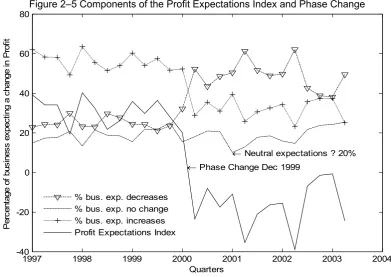
actual and expected profits, that is, either increasing, decreasing or no–change. These survey responses are aggregated to form the D&B (2008) profit expectations and actual profit indices.
The only exogenous input into AIE is the actual profits index series. The reason is to focus on endogenous processes and network structures. AIE simulates profit expectations by using the first two quarters from the D&B (2008) profit expectations index series to initialise the model and the D&B (2008) actual profit index series. AIE is calibrated using the D&B (2008) survey by minimising the model variance. Once calibrated, AIE is benchmarked against the following models, REH and adaptive-expectations. AIE is benchmarked against REH because REH is the main neoclassical expectations model, which shows many anomalies. AIE is benchmarked against adaptive-expectations to determine how effective the interactive component in AIE is in improving predictive performance.
In addition to the aggregate called all–firms, the D&B (2008) profit expectations survey comprises four divisions, non–durable manufacturing, durable manufacturing, wholesale and retail. Figure 2– 7 shows the D&B (2008) profit expectations indices for the four divisions. The all–firms and four divisions provide an opportunity to test an aggregate and disaggregated version of AIE, respectively. The AIE uses an ABM that has a network whose nodes represent firms and the links represent the flow of expectations between the firms. In the aggregated AIE version, the link intensities between firms are set to one. In the disaggregated AIE version, the ‘input-output table’
shown in Table 2–4 based on the four divisions allows calibration of the link-intensity between firms. The thesis introduces two ‘link-intensity matrices’ based on the ‘input-output table’ and its transpose, where a ‘matrix of ones’ provides the default and benchmark ‘link-intensity matrix’, when testing these ‘link-intensity matrices’ against the benchmark establishes whether the interactive-expectations network can be calibrated using an ‘input-output table’. This is a significant issue for practitioners who would like to validate ABM for use in policy development.
model-averaging techniques to circumvent this problem, which are called ‘runtime-weighted model-averaging’ and ‘optimal-calibration model-averaging’. ‘Bayes-factor model-averaging’ and ‘
equal-weighted model-averaging’ were used to benchmark ‘runtime-weighted model-averaging’
and ‘optimal-calibration model-averaging’.
The px for each firm for each period is the sum of the pressures from three sources, interactive, adaptive and bias, including optimism, pessimism or ambivalence. It is determined stochastically by using the px relative to fixed pressure levels that are determined experimentally as to whether a firm changes its profit expectations for the next period. A firm can be in one of three states, increase, decrease and ‘no change.’ The interactive pressure on a firm is calculated using the number of firms it is linked to, which are in each of the three states. The adaptive pressure for each firm for each quarter is calculated from the difference between its actual profit state and its expected profit state for the current quarter and previous quarter. The bias pressure represents the general mood of the economy. The profit expectations state of each firm for each period is summed to calculate the profit expectations index of the model. This index is compared to the D&B profit expectations index to calculate the model variance.
1.5 Outline of the thesis
The thesis addresses the issues raised above in the following chapters.
The literature review in Chapter 2 justifies the need to find a replacement or supplement to REH, thus the thesis develops AIE as a potential candidate. REH is the standard neoclassical model of expectations and forms the core of many other neoclassical theories such as GET, EMH, CGE and DSGE. The literature reveals that many behavioural, logical and econometric discrepancies in these theories are related to their use of REH. Modelling expectations in an interactive and dynamic way may remedy many of the discrepancies found. A comparison of the ‘science of complexity’ and neoclassical frameworks shows the former to be more suitable for the development of such a model. To supplement the behavioural literature already uncovered, the chapter surveys the literature in the interactive-expectations, network, ABM, input-output and adaptive-expectations fields to find components for AIE. The literature review finds that there is a gap in the literature for a dynamic subjective temporal predictive model of expectations and that constructing the model using an ABM methodology is the most appropriate. This combination of temporal prediction and ABM requires a discussion of multi-variable optimisation techniques. Furthermore, AIE uses a model-average across 121 different network topologies, where each network topology requires optimisation. The BIC proves unsuitable for model-averaging in this thesis because the network topologies in AIE have a fixed number of parameters regardless of complexity. Therefore, there is a requirement for the development of new model-averaging techniques. The research questions are developed from benchmarking different versions of the AIE model against REH and he adaptive-expectations model. Further questions are developed from benchmarking two new model-averaging techniques against existing techniques.
represents the flow of expectations for the current quarter from other connected firms. The adaptive pressure for a firm is determined from the difference between actual profits and expected profits for the current and last quarters. The biases are an indication of the general mood of the economy. Stochastic equations are introduced to determine whether px is sufficient for a firm to change expectations next quarter. The techniques for calibrating the 121 network topologies are discussed. The model-averaging techniques for the 121 network topologies are ‘optimal-calibration’,
‘runtime-weighted’, ‘Bayes-factor’ and ‘equal-weighted’. The thesis introduces the ‘ runtime-weighted model-averaging’ and ‘optimal-calibration model-averaging’ and benchmarks them against the ‘Bayes-factor model-averaging’ and ‘equal-weighted model-averaging’. The thesis also introduces the ‘link-intensity matrix’ based on the ‘input-output table’ to better calibrate the network structure in the disaggregated AIE model. The default ‘link-intensity matrix’ is a ‘matrix of ones’, which forms a benchmark. The ‘transpose of the input-output table’ forms a ‘link-intensity matrix’ and is also compared against the benchmark. Lastly, the research questions are made operational and refined to reflect the methodology.
Chapter 4 discusses the results from running the AIE model in Chapter 3 to answer the research questions. Different versions of the AIE model are calibrated using the D&B profit expectations survey and the predictive performances of the versions are compared against the benchmarks, REH and adaptive-expectations models. The aggregate AIE model is calibrated over a short and long period and their predictive performances are compared. The remainder of the results are derived from calibrating the AIE model over the short period only. Additionally, the predictive performance of the model-averaging techniques that the thesis introduces, called ‘optimal-calibration’ and ‘runtime-weighted’, are compared with the benchmark model-averaging techniques called ‘Bayes-factor’ and ‘equal-weighted’. Furthermore, the predictive performance of the aggregate AIE model that uses the ‘link-intensity matrix’ based on the ‘input-output table’ and its transpose, is compared with the predictive performance of the benchmark ‘link-intensity matrix’
that is a ‘matrix of ones’.
The conclusion and implications in Chapter 5 provide context within the literature for the results from Chapter 4. The theoretical implications of the comparison between REH and AIE beget comparison between instrumentalism and scientific realism and between neoclassical and the
implications are discussed, which includes using REH and AIE together in a complementary normative and descriptive/predictive role, respectively. Additionally, combining narrative, mathematics and ABM to inform policy and ameliorate each other’s weaknesses is also explored. The practical implications are discussed, including the AIE network topology and model-averaging techniques to overcome the lack of validation credibility for ABMs. The contributions of the thesis to the literature are presented. Additionally, improvements to the AIE network calibration by using an ‘input-output table’ and the number of firms to determine the ‘link-intensity matrix’ are discussed, as is its possible application to CGE and DSGE to improve their transmission mechanism. The thesis concludes with further research ensuing from the research in the thesis.
The source code for the AIE model, model-averaging and optimisation techniques cited in Appendix A are provided on DVD.
1.6 Definitions
Definitions adopted by researchers are often not uniform, hence key and controversial terms are defined to establish positions taken in this thesis.
All–firms This term is for the aggregate of the four divisions of the D&B (2008) profit expectations survey, including manufacturing durable, manufacturing non–durable, wholesale and retail.
‘input-output network’ A network whose parameter values are constrained using the number of firms and the ‘link-intensity matrix’ derived from an ‘input-output table’.
Input-output ratio ‘Input-output tables’ are used to form ratios in an unconventional way in this thesis. Traditionally input-output ratios are based upon divisions of the economy. The thesis uses ratios derived from the ‘input-output table’ for individual firms to form the interactive component of a ‘pressure to change profit expectations index’ px. The ‘input-output table’ in conjunction with the number of links to other firms within a network structure is used to calculate the index. Section 2.1.9.1 further discusses the interactive component of the px.
(Newman, Barabási & Watts 2006), whereas graph theory is the study of static networks, which is more a pursuit in pure mathematics.
Subjective The thesis uses Keynes’ (1937, pp. 213-4) ‘uncertain’ knowledge as the basis for a non-probabilistic treatment of decision-making and introduces an index to replace probabilities. Additionally, the term subjective becomes synonymous with dynamic processes that uses Lucas’ (1986, p. S411) observation that ‘the economic theory of choice is ... a description of a ... stationary “point” ... [in a] dynamic adaptive
process.’
Objective The thesis considers both probabilistic based decision theories as objective. These theories include Von Neumann and Morgenstern’s (1944) rational choice and Savage’s (1954) Bayesian approach. Additionally, the term objective becomes synonymous with static analysis that uses Lucas’ (1986, p. S411) observation. The need for this approach to defining subjective and object stems from people using Von Neumann and Morgenstern’s (1944) rational choice beyond its intended domain of frequentist probability.
Profit Profit is simply income less expenditure, as used in the D&B (2008) profit expectations survey.
Parameter See variable.
Run The software simulating AIE has a combination of parameter settings, which produce a model variance. The combination of the parameter settings and model variance form a single run. Three of the parameter settings describe the network topology of AIE. The AIE model uses the model-averaging of 121 different network topologies to improve its predictive performance, which is the model-average of 121 runs.
1.7 Delimitations of scope and key assumptions
AIE is tested with the Australian D&B (2008) profit expectations survey, which makes the calibrations and predictions applicable to Australia. However, the AIE technique could be applied to any similar expectations surveys.
The AIE model has only one exogenous input, that is, the ‘change in actual profits’. The reason to restrict AIE to a single exogenous input was to focus on the interactive-expectations in the model and in particular the network. There is ample literature to suggest that the predictive ability of the AIE may improve by introducing exogenous inputs such as the change in credit and interest rates. However, time spent perfecting the calibration of the network structure to capture endogenous effects may well produce considerable gains and is a preferable first step before more exogenous factors are introduced.
1.8 Conclusion
2.
Literature Review
2.0 Introduction
This literature review discusses how the neoclassical framework’s three core axioms are logically inconsistent. The framework’s chief expectations model is the Rational Expectations Hypothesis
(REH), which is built upon the neoclassical axioms and rational choice. REH is important because many major neoclassical theories use REH such as the Efficient Market Hypothesis (EMH), General Equilibrium Theory (GET) and Dynamic Stochastic General Equilibrium (DSGE). However, there is an extensive empirically based literature that falsifies REH, rational choice and these theories. The literature finds that REH is more a normative model than a descriptive/predictive model. This presents a gap in the literature for a descriptive/predictive model of expectations that can complement the normative role of REH. This thesis develops the Adaptive Interactive Expectations
(AIE) model to fill this gap in the literature. The literature that informs the development of AIE and that falsifies REH comes from numerous disciplines that include, neurology, psychology, physiology and the ‘science of complexity’.
Network theory is discussed to provide a proxy for institutional structure in AIE. Agent-based Models (ABM) are discussed because they can combine the behavioural rules within network structures used in AIE. Falsification and verification issues that relate to ABM are also discussed. AIE uses temporal prediction, thus it avoids many of the ABM verification issues. Optimisation techniques for functions of many variables are discussed because AIE has many variables and uses 121 network topologies to represent institutional structure, and consequently calibrating AIE is extremely time consuming. Model-averaging techniques are discussed because the 121 network topologies are structurally different and, therefore, are models in their own right. The thesis introduces two new model-averaging techniques called ‘optimal-calibration’ and ‘runtime-weighted’.
2.1 Parent disciplines, fields and models
This section of the literature review discusses the more conceptual literature to support the construction of AIE. The section compares the theoretical frameworks of neoclassical economics and ‘science of complexity’ to provide context for REH and AIE as complements. REH and its criticisms from behavioural economics and econometrics are discussed. The section finds that REH is considered an assumption unamenable to falsification by some researchers, which requires that REH to be falsified as part of a larger theory such as the EMH, GET or DSGE. Therefore, falsification of the three theories is discussed in detail.
The EMH has a number of pricing anomalies, which can be explained by behavioural economics that also provides behavioural rules for AIE. DSGE fails to match a number of stylised facts about the business cycle. GET is logically falsified using the Sonnenschein–Mantel–Debreu (SMD)
Theorem that proves that the three axioms for the neoclassical framework are inconsistent. GET and emergence form the microfoundations projects for neoclassical and complexity economics, respectively. Consequently, falsification of GET leads the thesis to adopt emergence for AIE to link together its micro level components. Profit expectations indices and phase changes are discussed because they are the macro level phenomenon that AIE is tested against. The adaptive-expectations model and interactive adaptive-expectations model are discussed because they provide the micro behavioural rules for AIE, which are supported by findings from behavioural economics and whose findings are contrasted with REH, EMH, GET and DSGE. The limitations identified within REH, EMH, GET and DSGE provide justification for the AIE methodology.
2.1.1 Theoretical Frameworks: Neoclassical, Complexity and Behavioural Economics
This section discusses the neoclassical and complexity economic frameworks to provide context for REH and AIE, respectively. REH and AIE are complements that provide advantages to analysing scenarios from two perspectives. The complexity economic framework uses a pattern recognition or inductive approach, which belongs to the philosophy of science. By contrast, the neoclassical framework uses a deductive or axiom-proof-theorem approach, which belongs to the philosophy of mathematics. However, neoclassical economics requires many simplifying assumptions in its axioms for the mathematics to remain tractable. The section introduces behavioural frameworks that aid the development of the AIE model, including ex-ante and ex-post rationalisation and the three systems cognitive framework.
The structure of this section is as follows. Section 2.1.1.1 defines the neoclassical framework. Section 2.1.1.2 defines the complexity framework. Section 2.1.1.3 compares the methodologies of the two frameworks and augments complexity with experimental and behavioural economics. Section 2.1.1.4 discusses the role of these frameworks in directing research. Section 2.1.1.5 discusses the role of AIE as a complement to REH, which enhances analysis by allowing a dual approach. Section 2.1.1.6 compares ex-ante and ex-post rationalisation to differentiate the rationalisation processes in AIE and REH at a neurological level. Section 2.1.1.7 discusses the three systems cognitive framework to provide context for AIE and REH at a psychological level. Section 2.1.1.8 compares objective and subjective expectations and their respective methodologies. Section 2.1.1.9 summarises the contents discussed in the previous sections.
2.1.1.1Neoclassical
Table 2–1 Neoclassical Assumptions
Arnsperger and Varoufakis (2006) Farmer and Geanakoplos (2008, p. 5) 1 Methodological instrumentalism Agent optimisation of utility
2 Methodological individualism Perfect competition (price taking) 3 Methodological equilibration Market Clearing
4 Rational Expectations
Instrumentalism
The philosophy underlying neoclassical economics is instrumentalism; ‘a system of pragmatic philosophy that considers idea to be instruments that should guide our actions and their value is
measured by their success’ (WordNet® 3.0 Princeton University 2009). Friedman (1953, p. 15), a major proponent of instrumentalism, states ‘..., the relevant question to ask about the “assumptions” of a theory is not whether they are descriptively “realistic”, for they never are, but
whether they are sufficiently good approximations for the purpose in hand. And this question can
be answered only by seeing whether the theory works, which means whether it yields sufficiently
accurate predictions.’ Section 5.3 discusses the flaws in instrumentalism.
1. Methodological instrumentalism
Methodological instrumentalism explains all behaviour as a desire to maximise preference-satisfaction. There is no room for philosophical question as to whether a person will act in such a way. Traditionally in neoclassical economics preference-satisfaction is constant and determined exogenously, whereas in complexity economics preferences depend on the structure and history of interaction. Behavioural economics provides substantial experimental evidences against the utility maximising model of an individual. Sections 2.1.2, 2.1.3, 2.1.4 and 2.1.8 discuss this evidence. Based upon this evidence, AIE uses a set of rules to replace the utility maximising model.
2. Methodological individualism
model of the economy is its failure to link microeconomic to macroeconomic phenomenon. Section 2.1.4 further discusses this linkage failure of GET.
In comparison, complexity economics studies the relationships among structure, interactions and individuals to explain macro socio-economic processes as an emergent process. AIE uses emergence to link the profit expectations of individual firms to the macro level profit expectations index. The network structure of AIE acts as a proxy for institutional structure and helps model emergence. Sections 2.1.4 and 2.2.1 further discuss emergence.
3. Methodological equilibration
Methodological equilibration is the imposition of equilibrium. Once the neoclassical agent’s utility function and constraints are postulated, to develop predictions at the macro level the aggregate behaviour of the individuals has to be sufficiently regular. Arnsperger and Varoufakis (2006) reduce the equilibration process to three steps:
1. Discover an equilibrium
2. Assume that agents or their behaviour will find themselves at equilibrium
3. Demonstrate that any small perturbations are incapable of dislodging self-interested behaviour from the discovered equilibrium.
This simple approach provides for prediction. However, the neoclassical microfoundations project, as discussed in Section 2.1.4, has failed to find a price vector for which there is a stable unique equilibrium. Complexity economics does not impose equilibration and treats the economy as an evolutionary system. However, relaxing the equilibrium assumption creates modelling problems. The predictive problems associated with evolutionary systems are discussed in Section 2.2.3.
All three neoclassical economics assumptions have major problems. Salzano and Colander (2007, p. X) comment, ‘The problem with [neoclassical] economics is twofold[:] the first is the simplicity of the model assumptions do not allow the complexity of the common sense interactions that one
would expect; the second is the failure of the models to fit the data in an acceptable way.’ The next section discusses complexity economics that addresses these issues.
2.1.1.2Complexity
Pryor (2000, p. 64) describes complexity economics as ‘involving positive feedback, lack of determinable equilibrium, and the importance of adaptive process of interaction between many
heterogeneous people, none of whom is completely aware of how such an interaction is turning out
evolutionists, specialists in dynamic processes and nonlinear mathematics, experimentalists, specialists in comparative economic systems, Austrian economists, game theorists, anti-Walrasians, economic historians, etc. Delre and Parisi (2007, p. 212) note all these approaches differ to neoclassical economics which uses its static explanation of equilibrium to predict macro-variables and assumes that entities are REH rational and have full information. However, Pryor (2000, p. 65) notes within complexity economics that there exists a tension between the focus on process and structure. Delre and Parisi (2007, p. 212) discuss two of the alternative approaches to modelling complexity, evolutionary economics (Arthur, Durlauf & Lane 1997; Dosi & Nelson 1994; Nelson & Winter 1982) and agent-based computational economics (Epstein & Axtell 1996; Tesfation 2002). Bounded rationality features in both approaches. Evolutionary economics focuses on the fitness of agents’ behaviours in the environment and how these behaviours adapt and evolve under the pressure of selection rules. Agent-based computational economics simulates the behaviours of economic agents by using computational models in order to show emergence. Emergence is the process whereby the interactions of economic agents that follow micro-level rules, leads to macroeconomic phenomenon. This is the modelling approach adopted by AIE and the micro-level rules of the agents are developed from behavioural economics discussed in Section 2.1.3. Other approaches to modelling complexity are discussed in Section 2.2.1. Sections 2.1.6 and 2.2.1 further discuss emergence.
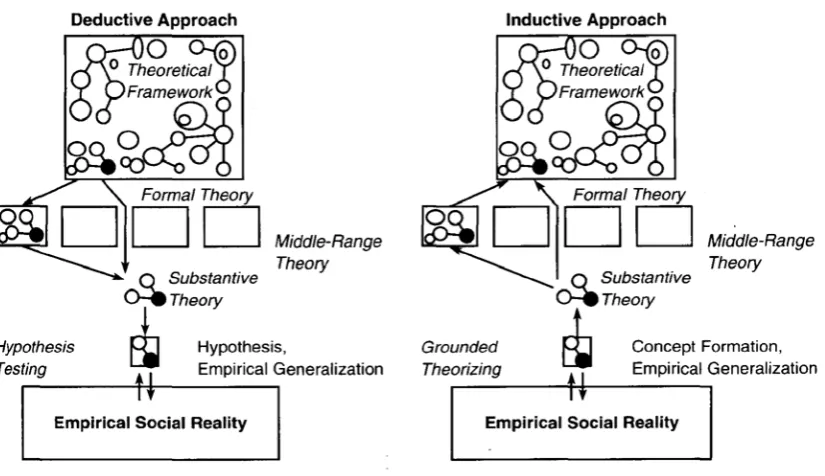
2.1.1.3Complexity and Neoclassical Methodologies: Inductive and Deductive, respectively
‘..., [neoclassical] theory is an elegant attempt to find a parsimonious model of human behaviour in
economic settings. It can be criticized, though, as a quick and dirty method, a heroic attempt to
simplify a complex problem. Now that we have begun to understand its limitations, we must begin
the hard work of laying new foundations that can potentially go beyond it.’
(Farmer & Geanakoplos 2008, p. 54)
Figure 2–1 Deductive and Inductive Theorising
(Source: Neuman 2003, p. 51)
Farmer and Geanakoplos (2008, p. 6) discuss the movement from qualitative narrative in political economy to highly mathematical theorem-proof format in neoclassical economics. However, both show continuity in that they are deductive approaches. In contrast, Brock (2000, p. 34) discusses the Santa Fe vision of complexity science as stressing pattern identification at macro levels and trying to reproduce these patterns by using micro rules, which is certainly an inductive approach. Blaug (1992, pp. 238-39) comments, ‘[The] central weakness of modern economics is, indeed, the reluctance to produce theories that yield unambiguous refutable implications, followed by a general
unwillingness to confront those implications with fact.’ Blaug (1992, p. 18) quotes the Duhem– Quine Thesis, ‘no conclusive disproof of a scientific theory can ever be made.’ The Duhem–Quine Thesis or the ‘under-determination problem’ can explain the ‘general unwillingness to confront these implications with fact’ because any observation contradicting a theory can be explained by adding an auxiliary hypothesis. This technique makes the neoclassical framework impervious to empirical falsification. For example, Blaug (1992, p. 168) cites Weintraub (1985) arguing at length that GE must be appraised as research in mathematics and not as a theory that can be falsified. Additionally, Blaug (1992, p. 168) cites Hahn (1984, pp. 4-5) who claims that falsifiability for GE is unnecessary and argues that GE [science] provides understanding without prediction, justifying GE with the symmetry thesis.
to a shapeless excess demand curve, which makes the equilibration assumption incongruent with the other GET assumptions. Therefore, one or more of the underpinning assumptions in the neoclassical framework is incorrect or the lack of dynamics is at fault. Section 2.1.4 discusses GET and SMD Theorem in more detail.
Experimental economics, an inductive approach, provides empirical falsification of the neoclassical framework and informs the results of the SMD Theorem. Smith (2007) discusses his motivation for developing experimental economics as his dissatisfaction with the gap between what market participants do and what is taught in the neoclassical theory of supply and demand. The explanation for market equilibrium in the neoclassical framework requires either that all market participants have perfect information or that there must be a large number of buyers and sellers who are all price takers. However, Smith (2007) uses experimental economics to show that interconnected markets do approximate market equilibrium dynamically and track a moving equilibrium even with few market participants and limited information. Smith’s results are consistent with SMH, showing that one or more of the underpinning assumptions of neoclassical economics are faulty.
Using a deductive approach, game theory models the strategic interactions between agents hence one would presume that it would inform the above impasse. However, Smith (1991, p. 879) notes that the axiomatic approach of game theory assumes individual rationality and complete information on payoffs (utilities) and other factors. Without this common knowledge, the models become insufficiently specified and the analysis incoherent. Thus it appears that game theory is incongruent with the findings of experimental economics and sheds little light on the above impasse. There appears a gap between strategic interactions and behavioural interactions required to model the double-sided auctions in Smith’s experimental economics.
2.1.1.4Frameworks Directing Research Programmes
Smith (1991) uses experimental economics to investigate specialisation and wealth creation within a free market. Beinhocker (2006) discusses complexity economics and evolutionary economics whose focus is also on wealth creation. This contrasts with the core focus of neoclassical economics on allocative efficiency, which can be attributed to its three underpinning assumptions. This focus on allocative efficiency is illustrated using CGE and neoclassical growth theory, as follows.
Blaug (1992, p. 168) notes that CGE is a highly prestigious area of economics and absorbs enormous intellectual resources. In a heuristic sense, CGE embodies rational choice and equilibrium economics, which puts equilibrium modelling and rational choice on the neoclassical
‘do’ list and puts disequilibrium economics and alternatives to rational choice on the ‘don’t’ list. Blaug (1992, p. 168) concludes that there lacks a comparable and viable alternative to CGE and economist cannot easily switch to another scientific research program. Section 2.1.5 further discusses CGE.
preoccupied with the perfectly competitive process. Blaug (1992, pp. 238-39) concludes that growth theory’s contribution to a truly causal explanation of growth in industrialised economies is nil. Slightly less critical, Nelson and Winter (1982, p. 233) note that neoclassical growth theory has been fruitful in providing information about certain patterns of growth. However, it has been strikingly unsuccessful in handling technological change and stands as an obstacle to thinking about macroeconomics and microeconomics within the same intellectual framework. Section 2.1.5 further discusses CGE and its descendant DSGE.
2.1.1.5REH and AIE are diametrically Opposed Complements Enhancing Analysis
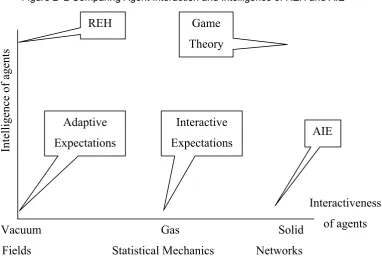
[image:40.595.114.497.370.633.2]This thesis introduces AIE as a complement to REH to allow complementary analysis. They complement one another in five dimensions, agent intelligence, agent interaction, agent homogeneity, equilibrium assumptions and rationalisation process. Figure 2–2 shows how the REH and AIE models map onto a two dimensional space, relating the intelligence of an agent and the level of interaction between agents.
Figure 2–2 Comparing Agent Interaction and Intelligence of REH and AIE
Game Theory
Adaptive Expectations
REH
Interactive Expectations
Interactiveness of agents AIE
Inte
llig
ence of agents
Vacuum Gas Solid Fields Statistical Mechanics Networks
The other three dimensions are excluded to enhance clarity. An analogy between physical states and methodologies is used to provide a qualitative scale for the ‘interactiveness of agents’