0095-1137/11/$12.00 doi:10.1128/JCM.05439-11
Copyright © 2011, American Society for Microbiology. All Rights Reserved.
Characterization of Genetic Diversity of
Bacillus anthracis
in France
by Using High-Resolution Melting Assays and Multilocus
Variable-Number Tandem-Repeat Analysis
䌤
†
S. Derzelle,
1* S. Laroche,
1P. Le Fle
`che,
2,3,4Y. Hauck,
2,3S. Thierry,
1G. Vergnaud,
2,3,5and N. Madani
1Anses, Animal Health Laboratory, Bacterial Zoonosis Unit, 94706 Maisons-Alfort, France1; University Paris-Sud, Institut de
Ge´ne´tique et Microbiologie, UMR 8621, Orsay F-91405, France2; CNRS, Orsay F-91405, France3; Division of Analytical
Microbiology, DGA CBRN Defence, BP3, 91710 Vert le Petit, France4; and DGA/MRIS—Mission pour la
Recherche et l’Innovation Scientifique, 92221 Bagneux, France5
Received 11 August 2011/Returned for modification 29 August 2011/Accepted 4 October 2011
Using high-resolution melting (HRM) analysis, we developed a cost-effective method to genotype a set of 13
phylogenetically informative single-nucleotide polymorphisms (SNPs) within the genome ofBacillus anthracis.
SNP discrimination assays were performed in monoplex or duplex and applied to 100B. anthracisisolates
collected in France from 1953 to 2009 and a few reference strains. HRM provided a reliable and cheap
alternative to subtypeB. anthracisinto one of the 12 major sublineages or subgroups. All strains could be
correctly positioned on the canonical SNP (canSNP) phylogenetic tree, except the divergent Pasteur vaccine strain ATCC 4229. We detected the cooccurrence of three canSNP subgroups in France. The dominant B.Br.CNEVA sublineage was found to be prevalent in the Alps, the Pyrenees, the Auvergne region, and the
Saoˆne-et-Loire department. Strains affiliated with the A.Br.008/009 subgroup were observed throughout most
of the country. The minor A.Br.001/002 subgroup was restricted to northeastern France. Multiple-locus variable-number tandem-repeat analysis using 24 markers further resolved French strains into 60 unique profiles and identified some regional patterns. Diversity found within the A.Br.008/009 and B.Br.CNEVA subgroups suggests that these represent old, ecologically established clades in France. Phylogenetic relation-ships with strains from other parts of the world are discussed.
Bacillus anthracis, the etiological agent of anthrax, is a
spore-forming, Gram-positive bacterium belonging to the Bacillus
cereusgroup. In the environment,B. anthracisprimarily exists
as quiescent spores that can persist for long periods of time in soil (35). Mammals—mainly wild and domesticated herbi-vores—are its natural hosts. Transmission to animals typically occurs through the gastrointestinal tract. Ruminants become infected by ingestion of soilborne spores while grazing. When inside the host, spores are phagocytized by macrophages and are carried to the lymph nodes, where they germinate and yield toxin-producing capsulated bacilli which rapidly multiply (21). The bacteria then enter the bloodstream and eventually cause septicemia. Septicemia and subsequent toxemia can rapidly lead to host death. The disease is acquired primarily through contact with infected animal products and can be transmitted to humans via the gastrointestinal, cutaneous, or respiratory routes (22).
B. anthracisis considered to be an evolutionarily young
spe-cies, as suggested by its extremely low genetic variability (11, 12, 25). It is one of the most monomorphic bacterial pathogen species known, and its evolution is strictly clonal. Molecular
typing techniques used to differentiate between B. anthracis strains therefore require high discriminatory power. Tandem-repeat polymorphisms, including minisatellites, microsatellites, single-nucleotide repeat (SNR), and single-nucleotide poly-morphism (SNP), identified via whole genome sequence anal-yses have proven most successful in discriminating amongB.
anthracisstrains (12–15, 17, 18, 24–26, 34).
Compared with the majority of polymorphic tandem-repeat markers, SNPs exhibit an extremely low mutation rate that makes them very valuable for broadly defining major phyloge-netic divisions (13, 25). Using a large number of SNPs scat-tered throughout the whole genome, the phylogenetic relation-ships among B. anthracis isolates (25, 30) have been established. Researchers have further demonstrated that a small number of canonical SNPs (canSNPs), representative of specific branches and nodes in theB. anthracis tree, can be used to accurately define the major clades (13, 36). This leads to a genotyping method that uses a set of 13 strategically placed canSNPs to subdivide B. anthracis isolates into three recognized major lineages (A, B, and C), with further subdivi-sion into 12 clonal sublineages or subgroups (36). This method had been applied to analyze several collections ofB. anthracis strains of worldwide origin (2, 7, 23, 26, 33, 36). However, as it is based on TaqMan minor groove binding allelic discrimina-tion assays, the current method incurs a high cost per studied marker. canSNP interrogation thus would greatly benefit from development of inexpensive alternative assays to increase ac-cess for research laboratories to these important phylogenetic markers.
* Corresponding author. Mailing address: Bacterial Zoonosis Unit, Maisons-Alfort Laboratory for Animal Health, ANSES, 23 Avenue du Ge´ne´ral de Gaulle, 94706 Maisons Alfort cedex, France. Phone: 33 1 49 77 38 84. Fax: 33 1 49 77 13 44. E-mail: [email protected]. † Supplemental material for this article may be found at http://jcm .asm.org/.
䌤Published ahead of print on 12 October 2011.
4286
on May 16, 2020 by guest
http://jcm.asm.org/
High-resolution melting (HRM) analysis is a recent post-PCR technique that can detect sequence variations without the need for sequence-specific probes. HRM techniques can de-termine with high precision the melt profile of PCR products using a new generation of double-stranded DNA binding dyes and accurate fluorescence data acquisition over small temper-ature increments (as low as 0.01°C). The information in HRM analysis is contained in the shape of the melting curve rather than just the calculated melting temperature (Tm), therefore
increasing the potential resolving power of this approach. Based on its ease of use, simplicity, flexibility, low cost, non-destructive nature, high sensitivity, and specificity, HRM anal-ysis is quickly becoming the tool of choice to screen patients for pathogenic variants (37). It has also been employed for iden-tification of various microorganisms, including bacteria (3, 10). We report the development of an HRM-based SNP inter-rogation method that enables cost-effective genotyping of B.
anthracisstrains. Thirteen monoplex and six duplex HRM
as-says were designed to score the 13 published canSNPs. This method was used to determine the current phylogenetic posi-tion of 100B. anthracisstrains collected in France. Relation-ships among French isolates were further resolved using mul-tiple-locus variable-number tandem-repeat (VNTR) analysis on 24 loci (MLVA24), and the congruence between the two methods was measured.
MATERIALS AND METHODS
Bacterial strains, growth, and biosafety procedures.TheB. anthracisstrains used as references for the HRM analysis were ATCC 4229, ATCC 14578, 17 JB, Sterne (CIP 77.2), strain Pasteur II (CIP 74.12), CIP A211, CIP A204, CIP 53.169, CNEVA 9066, and IEMVT 89 from the Institut d’Elevage et de Me ´de-cine Ve´te´rinaire des pays Tropicaux. All French isolates were initially confirmed asB. anthracisbased on bacteriology and PCR (29). These isolates included field strains collected from bovine, human, and environmental origin in France from 1953 to 2009. Strains were grown on horse blood agar petri dishes at 37°C.
Preparation of DNA samples.Bacterial colonies were taken from 24-h-old blood agar plates and mixed with 400l of water buffer. Suspensions were incubated at 100°C in boiling water for 20 min, cooled down for 10 min at 4°C, and centrifuged for 10 min at maximum speed. Viability testing was systemati-cally performed to assess the complete removal of live forms ofB. anthracisfrom DNA so that subsequent PCR testing could be carried out safely at lower levels of biocontainment. Briefly, 200-l aliquots of each DNA preparation, including the cell pellets, were spread on horse blood agar petri dishes and grown at 37°C for 18 to 24 h. DNA used for MLVA was further purified using the High Pure
PCR template preparation kit (Roche Diagnostics, Basel, Switzerland) according to the manufacturer’s recommendations, with final DNA elution in 200l.
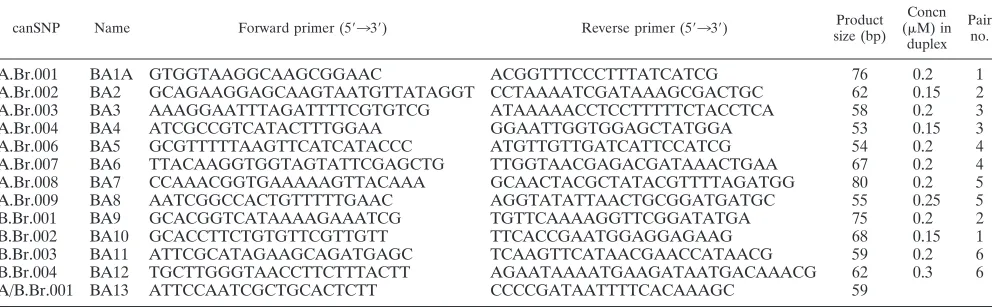
HRM assays. The genomic positions of the 13 canSNPs can be found in supplemental Tables 4 and 5 in Van Ert et al. (36). Using Primer 3 Software (31), HRM primers were designed to amplify small amplicons (Table 1). Amplification was performed on the LightCycler 480 system using the LightCycler 480 high-resolution melting master mix (Roche Diagnostics). The reaction mixture con-sisted of 0.2M each primer, 1⫻LightCycler 480 HRM master mix, and 3 mM MgCl2in a 10-l volume. Primer concentrations ranged from 0.15M to 0.3M in duplex reactions, as specified in Table 1. PCR amplifications were performed using about 5 ng of genomic DNA. The following parameters were used: 10 min at 95°C followed by 40 cycles consisting of 10 s at 95°C, 10 s at 58°C, and 10 s at 72°C. Samples were then heated to 95°C for 1 min, cooled to 50°C for 1 min, and heated from 65°C to 90°C at a rate of 1°C/s with 25 acquisitions/1°C. HRM data were analyzed with the LightCycler 480 gene scanning software (version 1.5.0) using non-temperature-shifted normalization curves (t⫽0). The sensitivity pa-rameter, which influences the stringency with which melting profiles are classified into different groups, was empirically adjusted so that all samples sharing the same allele were called “same” by the software and the remaining ones were denoted as different. TheTmof each amplicon was calculated using the
com-panionTmcalling software (Roche Diagnostics).
MLVA.Twenty-four loci identified in previous studies (17, 18) were used, and MLVA was performed as described previously (18). Briefly, all 24 VNTR mark-ers were amplified in four multiplex PCRs. Five to 10 ng DNA was used as the template in a final volume of 15l containing 1⫻PCR Roche reaction buffer, 0.2 mM deoxynucleoside triphosphates (dNTPs), the appropriate concentrations of each primer, and 1 UTaqpolymerase (Roche Diagnostics). The labeled PCR products were diluted and added to a mix containing 40l of sample loading solution (Beckmann Coulter) and 0.5l of size marker (Bioventures or Beck-man-Coulter). Samples were separated by electrophoresis in a CEQ separation gel (linear polyacrylamide [LPA I]) on a CEQ 8000 automatic DNA analysis system (Beckman-Coulter). The electropherograms were analyzed by the CEQ fragment analysis system software to determine the length of each fragment in reference to the size marker. All data produced were managed using BioNumer-ics software version 6.5 (Applied Maths, Sint-Martens-Latem, Belgium). Clus-tering was done using a graphing algorithm called a minimum spanning tree (MST). The priority rule for constructing MSTs was set so that the type that had the highest number of single-locus variants (SLVs) would be linked first. A cutoff value for a maximum difference of 2 out of 10 VNTRs was applied to define a cluster in the MST method.
[image:2.585.44.540.83.237.2]Sequencing.DNA sequences of some canSNP regions fromB. anthracisstrains ATCC 4229 and IEMVT 89 were determined. PCR fragments of about 200 bp centered on canSNPs were amplified using 1 U of the GoTaq DNA polymerase (Promega). PCRs were carried out with a GeneAmp PCR System 9700 thermo-cycler (Applied Biosystems). The reaction conditions were 94°C for 10 min followed by 45 cycles of 94°C for 30s, 55°C for 30 s, and 72°C for 30 s. A final extension step of 72°C for 10 min was performed. Each amplicon generated was purified on the QIAquick purification kit (Qiagen) according to the manufac-turer’s instructions and sequenced by Eurofins MWG Operon (Ebersberg, Ger-many).
TABLE 1. Primer sequences
canSNP Name Forward primer (5⬘33⬘) Reverse primer (5⬘33⬘) Product
size (bp) Concn (M) in
duplex Pair
no.
A.Br.001 BA1A GTGGTAAGGCAAGCGGAAC ACGGTTTCCCTTTATCATCG 76 0.2 1
A.Br.002 BA2 GCAGAAGGAGCAAGTAATGTTATAGGT CCTAAAATCGATAAAGCGACTGC 62 0.15 2
A.Br.003 BA3 AAAGGAATTTAGATTTTCGTGTCG ATAAAAACCTCCTTTTTCTACCTCA 58 0.2 3
A.Br.004 BA4 ATCGCCGTCATACTTTGGAA GGAATTGGTGGAGCTATGGA 53 0.15 3
A.Br.006 BA5 GCGTTTTTAAGTTCATCATACCC ATGTTGTTGATCATTCCATCG 54 0.2 4
A.Br.007 BA6 TTACAAGGTGGTAGTATTCGAGCTG TTGGTAACGAGACGATAAACTGAA 67 0.2 4
A.Br.008 BA7 CCAAACGGTGAAAAAGTTACAAA GCAACTACGCTATACGTTTTAGATGG 80 0.2 5
A.Br.009 BA8 AATCGGCCACTGTTTTTGAAC AGGTATATTAACTGCGGATGATGC 55 0.25 5
B.Br.001 BA9 GCACGGTCATAAAAGAAATCG TGTTCAAAAGGTTCGGATATGA 75 0.2 2
B.Br.002 BA10 GCACCTTCTGTGTTCGTTGTT TTCACCGAATGGAGGAGAAG 68 0.15 1
B.Br.003 BA11 ATTCGCATAGAAGCAGATGAGC TCAAGTTCATAACGAACCATAACG 59 0.2 6
B.Br.004 BA12 TGCTTGGGTAACCTTCTTTACTT AGAATAAAATGAAGATAATGACAAACG 62 0.3 6
A/B.Br.001 BA13 ATTCCAATCGCTGCACTCTT CCCCGATAATTTTCACAAAGC 59
on May 16, 2020 by guest
http://jcm.asm.org/
Nucleotide sequence accession numbers. EMBL accession numbers are HE598698 to HE598707 (strain ATCC 4229) and HE598697 (strain IEMVT89).
RESULTS
HRM assay design and validation.Thirteen SNP
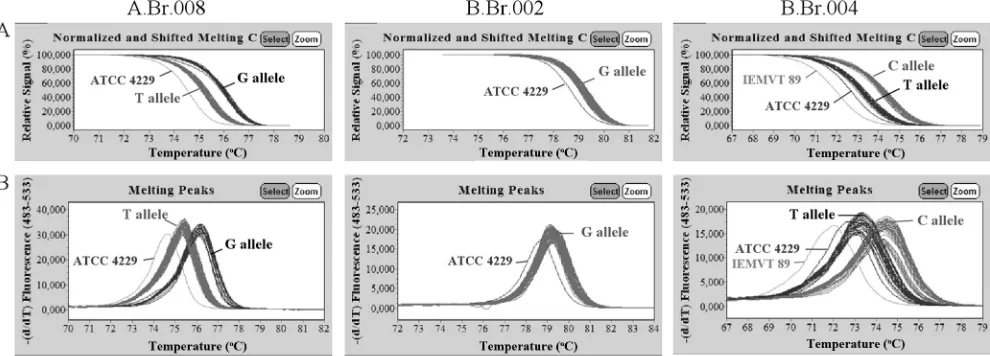
discrimi-nation assays were designed to screen by HRM the set of canSNPs identified and selected by Van Ert et al. (36). Primers matching sequences close to each canSNP were chosen to maximize the differences in melting temperatures that the SNP confers (Table 1). Assays were evaluated on a panel of 10 reference strains, including five known canSNP genotypes. All strains except the Pasteur vaccine strain ATCC 4229 gave amplicons producing a single melting peak for the 13 mono-plex assays. The two expected alternate alleles exhibited dis-tinct melting curves andTmvalues. On average, differences in Tmvalues of about 1°C were observed between the two allelic
states, with calculated Tm values ranging from 71.95°C to 79.3°C (Table 2 and Fig. 1). As illustrated in Fig. 1, differences in the shapes of the melting curves allowed clear separation and unambiguous grouping of each alternate allele by the
LightCycler 480 gene scanning software. HRM was found to be a robust and reproducible method to score canSNP genotypes. The HRM analysis also highlighted some discordant results that suggest unexpected sequence variability at several canSNP loci. Discrepancies between observed and expected HRM re-sults were demonstrated for the IEMVT 89 and ATCC 4229 strains (Fig. 1 and Table 2). These two strains were sequenced to identify new polymorphisms and ultimately classify both samples.
The IEMVT 89 strain, which was the only specimen isolated from Africa in theB. anthracisreference panel, was scored as a third distinct group by the B.Br.004 HRM assay. The ampli-con displayed aTmvalue of 71.95°C (compared to about 73°C and 74°C for the expected canSNP T and C alleles, respec-tively) and a modified melting curve shape. Sequencing re-vealed a second mutation contiguous to the canSNP position (T allele). This additional substitution of a C with a T can explain the observed discrepancy. Taken together, these results show that the IEMVT 89 strain shares the canSNP character-istics of the A.Br.005/006 canSNP subgroup but can be
distin-TABLE 2. Melting temperatures and SNP alleles determined for six reference strains using HRM
canSNP Name Tm(°C) (SNP allele)
a
CNEVA9066 ATCC14578 (Vollum) CIP 77.2 (Sterne) CIP 74.12 (Pasteur II) ATCC4229 IEMVT 89
A.Br.001 BA1A 75.92 (T) 76.09 (T) 76.02 (T) 76.10 (T) 78.18(T) 76.14 (T)
A.Br.002 BA2 79.19 (G) 79.22 (G) 78.32 (A) 79.31(G) –(G) 79.14 (G)
A.Br.003 BA3 72.62 (A) 73.03 (A) 73.84 (G) 73.01 (A) 72.66 (A) 72.86 (A)
A.Br.004 BA4 77.55 (T) 77.45 (T) 78.34 (C) 77.52 (T) 76.93(T) 76.94 (T)
A.Br.006 BA5 78.19 (C) 77.41 (A) 77.24 (A) 77.38 (A) 77.48(A) 77.23 (A)
A.Br.007 BA6 74.67 (T) 75.66 (C) 74.65 (T) 74.84 (T) 77.02 74.56 (T)
A.Br.008 BA7 75.20 (T) 75.40 (T) 75.11 (T) 76.14 (G) 74.56(T) 75.11 (T)
A.Br.009 BA8 78.17 (A) 78.23 (A) 78.14 (A) 78.25 (A) 78.09 (A) 78.05 (A)
B.Br.001 BA9 74.95 (T) 75.08 (T) 75.03 (T) 75.00 (T) 75.96 (A) 74.85 (T)
B.Br.002 BA10 79.17 (G) 79.41 (G) 79.17 (G) 79.22 (G) 78.69(G) 79.10 (G)
B.Br.003 BA11 75.91 (A) 76.74 (G) 76.80 (G) 76.73 (G) –(G) 76.53 (G)
B.Br.004 BA12 74.07(C) 73.41 (T) 73.16 (T) 72.97 (T) 72.50(T) 71.95(tT)
A/B.Br.001 BA13 75.58 (A) 75.74 (A) 75.69 (A) 75.66 (A) 76.26 (G) 75.55 (A)
Subgroup B.Br.CNEVA A.Br.Vollum A.Br.001/002 A.Br.008/009 new A.Br. A.Br.005/006
a–, no HRM amplification; CIP, collection number of Pasteur Institute. UnexpectedT
[image:3.585.42.543.81.243.2]mvalues and nucleotide polymorphisms are indicated in bold.
FIG. 1. HRM analysis of three canSNPs using monoplex assays on 90B. anthracisstrains. (A) Normalized melting curve; (B) negative derivative of fluorescence with respect to temperature. Data and plots were produced by the LightCycler 480 system using gene scanning software.
on May 16, 2020 by guest
http://jcm.asm.org/
[image:3.585.45.540.527.705.2]guished from the other strains in this subgroup by its unique sequence at the B.Br.004 canSNP locus.
In contrast, the ATCC 4229 Pasteur strain, a heat-attenu-ated, toxin-negative strain, could not be placed into any of the 12 subgroups previously defined by theB. anthracis canSNP-derived phylogenetic tree. The strain failed to amplify at two canSNP loci (A.BR.002 and B.Br.003) and was denoted as a distinct genotype at eight other canSNPs. In addition, ampli-fication was of lower efficiency than that of the other strains. Sequencing revealed numerous mutations within the corre-sponding PCR products (including primer annealing sites) that were consistent with the discrepancies observed in PCR effi-ciency, melting curve shape, or Tm values. Interestingly, the ATCC 4229 strain was also PCR negative when screening for
anotherB. anthracis-specific SNP used to confirmB. anthracis identity, i.e., the nonsense mutation at nucleotide position 640 of theplcRgene (4, 16). Sequencing indicated a 12-nucleotide deletion at this position (data not shown), further highlighting the unique character of this particular strain.
canSNP typing of French isolates. HRM assays were then
used to examine the phylogenetic position and genetic diversity of FrenchB. anthracisisolates. One hundred field strains rep-resentative of anthrax activity in France since 1953 were se-lected for this study. Most of them were colse-lected during ani-mal anthrax outbreaks that have occurred over the past 20 years (19, 20). The CNEVA9066 and Sterne 77.2 strains were used as internal controls for run-to-run normalization. Melting profiles denoted as “same” or “different” by the software were scored into one of the two expected allelic states. No discrep-ancies were observed. All strains were unambiguously classi-fied into three of the 12 phylogenetic subgroups identiclassi-fied worldwide, A.Br.001/002, A.Br.008/009, and B.Br.CNEVA.
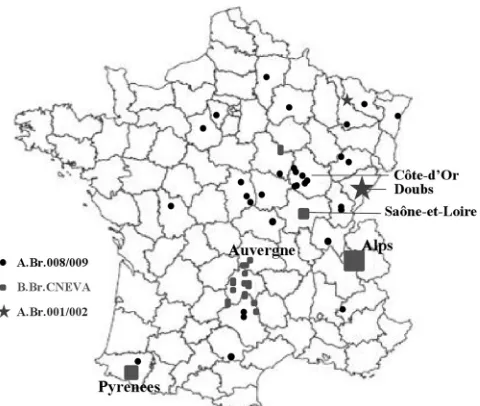
[image:4.585.44.284.68.271.2]Localization of these three subgroups in France is shown in Fig. 2. The majority of strains (54%) were part of the B.Br.C-NEVA sublineage. This sublineage was prevalent in four areas, i.e., the Alps, the Pyrenees, the Auvergne region, and the Saoˆne-et-Loire department. About one-third of French strains (30%) belong to the A.Br.008/009 subgroup. Strains affiliated with A.Br.008/009 were isolated throughout the country. The remaining strains (16%) were from the A.Br.001/002 sub-group. Most of these strains (13 out of 16) were collected during 17 clustered animal outbreaks occurring in the summer of 2008 in the Doubs department, near Switzerland (19). The other strains are older isolates from human cases.
Multiplexing assays. To increase the analysis throughput,
the overall HRM genotyping assay was converted into six du-plex PCRs (Table 1) and applied to 40 strains representative of the diversity (genetic and geographic) found in France. Primer concentrations were adjusted so as to amplify two canSNPs with similar efficiency and to yield melting peaks of equivalent height for both amplicons. As illustrated in Fig. 3, the HRM method was still able to successfully resolve the different vari-ants in duplex reactions. Although correct grouping by the
[image:4.585.45.541.530.706.2]FIG. 2. Location ofB. anthraciscanSNP genotypes in France. Map shows actual collection sites where isolates of known origin were ob-tained for this study. Strains affiliated with the B.Br.CNEVA, A.Br.001/002, and A.Br.008/009 subgroups are indicated, respectively, by dark circles, stars, or gray squares. Size is proportional to the number of isolates.
FIG. 3. HRM analysis of six canSNPs using duplex assays on sixB. anthracisstrains. (A) Normalized melting curve; (B) negative derivative of fluorescence with respect to temperature. Data and plots were produced by the LightCycler 480 system using gene scanning software.
on May 16, 2020 by guest
http://jcm.asm.org/
gene scanning software may need empirical adjustments of the sensitivity parameter to compensate for variability in PCR efficiency, HRM results were reproducible and data were con-sistent with the 13 monoplex assays. All samples were unam-biguously subtyped into one of the 12 canSNP genotypes.
MLVA of French isolates.Twenty-four VNTR markers from
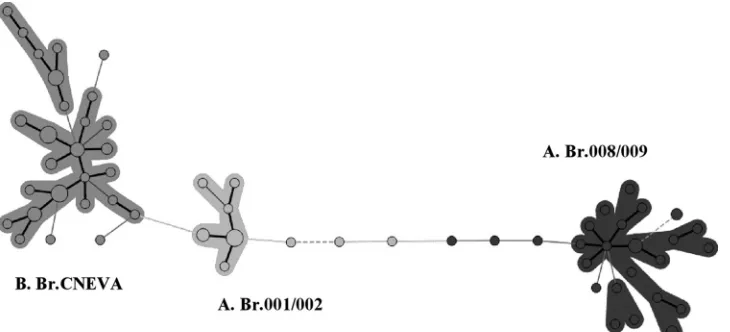
the MLVA25 system developed by Lista et al. (18) were used to further subtype most of the French strains. The whole MLVA data set revealed at least 60 different genotypes. Within canSNP subgroups, strains were, respectively, resolved into nine (A.Br.001/002 subgroup, n ⫽ 16 strains), 24 (A.Br.008/009,n⫽30 strains), and 27 (B.Br.CNEVA,n⫽50 strains) unique genotypes (see the supplemental material). Ge-netic relationships among French B. anthracis isolates are graphically presented in Fig. 4 using a minimum spanning tree. As expected, canSNP subgroups were quite dissimilar and loosely connected to each other. More specifically, they dif-fered in the number of repeat copies at the Bams01 marker, with a unique allele size of 16 repeats for A.Br.001/002, 13 repeats for A.Br.008/009, and 14 repeats for B.Br.CNEVA. In contrast, close genetic relationships were detected between most genotypes of a given canSNP subgroup, and regional strain patterns were observed within the B.Br.CNEVA sublin-eage using the Bams34, Bams22, or Bams51 markers. For instance, isolates from the Pyrenees and Aube departments were characterized by 8 repeat copies (versus 6 repeats for the other strains) for marker Bams51 and by 9 repeat copies for marker Bams34 (versus 11 for strains collected in Sa ˆone-et-Loire or 13 repeats for strains from Auvergne and the Alps). Isolates from the Alps had 13 repeat copies (versus 15 repeats for the other strains) for marker Bams22.
DISCUSSION
The analysis of a small set of canonical SNPs is a fast way to determine the major clonal sublineages ofB. anthracis. Cost is an important issue for all diagnostic and phylogenetic assays. The setup described by Van Ert et al. (36) requires the use of
26 sequence-specific TaqMan minor groove binder (MGB) probes. This setup incurs high costs in laboratories where only a few strains have to be typed per year. The development of cheaper alternatives for interrogating canSNPs would increase access to these important markers for a larger number of laboratories. HRM is an attractive method, as it is faster, simpler, and less expensive than alternative approaches requir-ing separations or labeled probes (28, 39). HRM is a srequir-ingle- single-step, closed-tube assay that has high discriminatory power. The HRM assay requires approximately 1 h for a run, including the follow-up data analysis, on the LightCycler 480 instrument and can be performed in reaction volumes of less than 10 l, reducingde factothe cost per analysis.
Although it is highly recommended to standardize the qual-ity and amount of DNA templates to minimize reaction-to-reaction variability in HRM assays, these parameters were not found to be extraordinarily critical for distinguishing homozy-gotic variants unless insufficient amplification had occurred. Any sample showing late amplification (threshold cycle [CT]
value over 36) was discarded to avoid misidentified classifica-tion of samples. Two reference strains with distinct allelic states (CNEVA9066 and Sterne 77.2) were also included for run-to-run normalization to ensure that the correct allele is called. Indeed, although the relative temperature calibration is extremely accurate, absolute temperature calibration can vary between runs (by up to 0.5°C). The developed assay success-fully differentiated between the differentB. anthracis sublin-eages in our panel of strains. We thus conclude that HRM is a fast and reliable diagnostic technique for bacterial genotyping. Finally, the method was demonstrated to be amenable to some multiplexing. The monoplex assays were converted into a du-plex format without compromising efficiency or accuracy. Both formats provided reproducible melting curves and consistent SNP genotyping data.
Besides capacity for SNP discrimination, the HRM tech-nique can also be used for gene scanning and detection of new polymorphisms. Any amplicon containing one or more
unex-FIG. 4. Minimum spanning tree of 95B. anthracisisolates based on categorical analysis of 24 VNTRs. Each circle represents a unique genotype. The diameter of each circle varies according to the number of isolates having the same genotype. Genotypes connected by a shaded background differ by a maximum of two VNTR markers. Thick and regular connecting lines represent a difference of one and two markers, respectively; thin interrupted lines represent a difference of three markers; thin dashed lines represent four or more differences. The length of each branch is also proportional to the number of differences.
on May 16, 2020 by guest
http://jcm.asm.org/
[image:5.585.112.477.70.236.2]pected sequence variations would have a different HRM pro-file compared to those of controls, although SNPs involving C-to-G or A-to-T substitutions are difficult to distinguish. As a result, any sample with aberrant curve shapes requires further analysis by sequencing to confirm and identify the new muta-tion(s). We reported conflicting data in two strains. The Pas-teur vaccine strain ATCC 4229 gave discordant results for 10 canSNP loci and could not be placed into any sublineages of the original canSNP tree defined by Van Ert et al. (36). The strain did not carry the nonsense mutation inplcR, a charac-teristic that differentiates theB. anthracislineage from the rest of theB. cereusgroup (16). Shotgun sequencing and compar-ison to other genomes had recently positioned this strain into the major A lineage of B. anthracis but on its own, specific branch point (32). Taken together, these data suggest that this peculiar strain may represent a borderline strain that should be classified as a new, additional subgroup in the current canSNP scheme (36). In contrast, the IEMVT 89 strain, which exhib-ited a single deviant melt profile, did share the expected canSNP characteristics of the A.Br.005/006 subgroup. One se-quence variation adjacent to the B.Br.004 canSNP could ex-plain the aberrant curve shape andTmobserved. Considering
that the IEMVT 89 strain was the sole Central and West Africa isolate of our collection, we could not conclude whether this additional SNP represents a new informative canSNP marker (specific to strains from these regions) or just a single point mutation in a particular strain. Interestingly, it has been re-cently reported thatB. anthracisstrains isolated in Cameroon and Chad carry the same additional base difference just down-stream of the canSNP B.Br.004 (27), suggesting that this par-ticular substitution of a C with a T could be a new informative canSNP marker specific to strains from this part of the world. Examination of more African specimens is needed to confirm this hypothesis.
The present work establishes the first overall picture of the genetic diversity ofB. anthracis in France and provides valu-able data sets for future epidemiological or forensic studies. Three greatly differing canSNP genotypes cooccur in France. The majority of strains (54%) are affiliated with the B.Br.C-NEVA sublineage. This lineage is found exclusively in Western and Central Europe (12, 36). Primarily reported from southern France (6), strains belonging to B.Br.CNEVA have also been recovered from northern Italy, Croatia, Slovakia, Switzerland, Germany, and Poland (7–9, 26, 36), where it represents au-tochthonous cases from cattle that died from anthrax. While previous MLVA8 analysis resolved only two different geno-types among 27 French isolates affiliated with the B2 cluster (6), MLVA24 resolved 27 distinct genotypes in this study. Spatial differences seen between MLVA profiles suggest a successful establishment andin situ differentiation of B.
an-thraciswithin regions. The sublineage is prevalent in four
geo-graphical areas: the Alps, the Pyrenees, Auvergne, and the Saoˆne-et-Loire department. It may be of interest to note that these zones, close to the mountainous massifs of France, share similar land topologies, made of pastoral valleys. Our data, consistent with other MLVA studies reporting new additional genotypes among Italian, Polish, and Swiss isolates (7–9, 26), indicate that the B.Br.CNEVA sublineage may be relatively genetically diverse.
The second group (30% of strains) observed in France is
A.Br.008/009, a widely dispersed subgroup spread across most of Europe and Asia. A.Br.008/009 is the most common type observed in Italy (5), some Eastern European countries (2, 36), and Central Asia (1, 23, 33). French isolates affiliated with the A.Br.008/009 subgroup were collected in various areas and times throughout the country and a particular spot in Bour-gogne (in the Cotes-d’Or department) where recurrent out-breaks have occurred. Cooccurrence of this subgroup with the B.Br.CNEVA sublineage was observed in a single area, the Pyrenees. A complex pattern of 24 distinct genotypes was re-solved by MLVA, suggesting that the A.Br.008/009 subgroup also has an extensive history in France.
We reported for the first time the presence of the A.Br.001/ 002 canSNP subgroup in France. A.Br.001/002 is found com-monly in Eastern Asia and China, where it represents an old established clade (33). The strains found in Europe (36, 38) may represent old imported infections from Asia via animals or human activities, such as trading (33). A.Br.001/002 is a minor group (16%) in France that seems to be geographically re-stricted to the northeast. Most specimens were isolated in 2008 during an episode involving 17 clustered outbreaks, with many cases in Doubs (19). These strains were resolved in six MLVA24 profiles showing minor variations. They were only loosely connected to three older strains from the Pasteur In-stitute Collection that formed a separate cluster.
ACKNOWLEDGMENT
We thank Christiane Mendy for excellent technical support.
REFERENCES
1.Aikembayev, A. M., et al.2010. Historical distribution and molecular diver-sity ofBacillus anthracis, Kazakhstan. Emerg. Infect. Dis.16:789–796. 2.Antwerpen, M., et al.2011. MLVA and SNP analysis identified a unique
genetic cluster in BulgarianBacillus anthracisstrains. Eur. J. Clin. Microbiol. Infect. Dis.30:923–930.
3.Cheng, J. C., et al.2006. Rapid detection and identification of clinically important bacteria by high-resolution melting analysis after broad-range ribosomal RNA real-time PCR. Clin. Chem.52:1997–2004.
4.Easterday, W. R., et al.2005. Use of single nucleotide polymorphisms in the plcRgene for specific identification ofBacillus anthracis. J. Clin. Microbiol. 43:1995–1997.
5.Fasanella, A., et al.2005. Molecular diversity ofBacillus anthracisin Italy. J. Clin. Microbiol.43:3398–3401.
6.Fouet, A., et al.2002. Diversity among FrenchBacillus anthracisisolates. J. Clin. Microbiol.40:4732–4734.
7.Garofolo, G., L. Serrecchia, M. Corro, and A. Fasanella.2011. Anthrax phylogenetic structure in Northern Italy. BMC Res. Notes4:273. 8.Gierczynski, R., A. Jakubczak, and M. Jagielski.2009. Extended
multiple-locus variable-number tandem-repeat analysis ofBacillus anthracisstrains isolated in Poland. Pol. J. Microbiol.58:3–7.
9.Gierczynski, R., et al.2004. Intriguing diversity of Bacillus anthracisin eastern Poland—the molecular echoes of the past outbreaks. FEMS Micro-biol. Lett.239:235–240.
10.Jeffery, N., R. B. Gasser, P. A. Steer, and A. H. Noormohammadi.2007. Classification ofMycoplasma synoviaestrains using single-strand conforma-tion polymorphism and high-resoluconforma-tion melting-curve analysis of thevlhA gene single-copy region. Microbiology153:2679–2688.
11.Keim, P., et al.2009. The genome and variation ofBacillus anthracis. Mol. Aspects Med.30:397–405.
12.Keim, P., et al.2000. Multiple-locus variable-number tandem repeat analysis reveals genetic relationships withinBacillus anthracis. J. Bacteriol.182:2928– 2936.
13.Keim, P., et al.2004. Anthrax molecular epidemiology and forensics: using the appropriate marker for different evolutionary scales. Infect. Genet. Evol. 4:205–213.
14.Kenefic, L. J., et al.2008. High resolution genotyping ofBacillus anthracis outbreak strains using four highly mutable single nucleotide repeat markers. Lett. Appl. Microbiol.46:600–603.
15.Kenefic, L. J., et al.2009. Pre-Columbian origins for North American an-thrax. PLoS One4:e4813.
16.Kolsto, A. B., N. J. Tourasse, and O. A. Okstad.2009. What setsBacillus
on May 16, 2020 by guest
http://jcm.asm.org/
anthracisapart from otherBacillusspecies? Annu. Rev. Microbiol.63:451– 476.
17.Le Fle`che, P., et al.2001. A tandem repeats database for bacterial genomes: application to the genotyping ofYersinia pestisandBacillus anthracis. BMC Microbiol.1:2.
18.Lista, F., et al.2006. Genotyping of Bacillus anthracisstrains based on automated capillary 25-loci multiple locus variable-number tandem repeats analysis. BMC Microbiol.6:33.
19.Madani, N., C. Mendy, F. Moutou, and B. Garin-Bastuji.2010. La fie`vre charbonneuse en France. Episodes de l’e´te´ 2009 et foyers enregistre´s sur la dernie`re de´cennie (1999-2009). Bull. Epidemiol.38:17–19.
20.Mailles, A., C. Alauzet, M. Mock, B. Garin-Bastuji, and Y. Veran.2010. Cas groupe´s de charbon cutane´ humain en Moselle—De´cembre 2008, Fe´vrier 2010, p. 4. Institut de Veille Sanitaire, Saint-Maurice, France. www.invs .sante.fr.
21.Mock, M., and A. Fouet.2001. Anthrax. Annu. Rev. Microbiol.55:647–671. 22.Mock, M., and T. Mignot.2003. Anthrax toxins and the host: a story of
intimacy. Cell. Microbiol.5:15–23.
23.Okinaka, R. T., et al.2008. Single nucleotide polymorphism typing of Ba-cillus anthracisfrom Sverdlovsk tissue. Emerg. Infect. Dis.14:653–656. 24.Okutani, A., et al.2010. Phylogenetic typing ofBacillus anthracisisolated in
Japan by multiple locus variable-number tandem repeats and the compre-hensive single nucleotide polymorphism. J. Vet. Med. Sci.72:93–97. 25.Pearson, T., et al.2004. Phylogenetic discovery bias inBacillus anthracis
using single-nucleotide polymorphisms from whole-genome sequencing. Proc. Natl. Acad. Sci. U. S. A.101:13536–13541.
26.Pilo, P., V. Perreten, and J. Frey.2008. Molecular epidemiology ofBacillus anthracis: determining the correct origin. Appl. Environ. Microbiol.74:2928– 2931.
27.Pilo, P., et al.2011. BovineBacillus anthracisin Cameroon. Appl. Environ. Microbiol.77:5818–5821.
28.Price, E. P., et al.2010. Cost-effective interrogation of single nucleotide polymorphisms using the mismatch amplification mutation assay and capil-lary electrophoresis. Electrophoresis31:3881–3888.
29.Ramisse, V., G. Patra, H. Garrigue, J. L. Guesdon, and M. Mock.1996. Identification and characterization ofBacillus anthracisby multiplex PCR analysis of sequences on plasmids pXO1 and pXO2 and chromosomal DNA. FEMS Microbiol. Lett.145:9–16.
30.Read, T. D., et al.2002. Comparative genome sequencing for discovery of novel polymorphisms inBacillus anthracis. Science296:2028–2033. 31.Rozen, S., and H. J. Skaletsky.2000. Primer3 on the WWW for general users
and for biologist programmers, p. 365–386.InM. S. Krawetz (ed.), Bioin-formatics methods and protocols: methods in molecular biology. Humana Press, Totowa, NJ.
32.Segerman, B., et al. 2011. Bioinformatic tools for using whole genome sequencing as a rapid high resolution diagnostic typing tool when tracing bioterror organisms in the food and feed chain. Int. J. Food Microbiol. 145(Suppl. 1):S167–S176.
33.Simonson, T. S., et al.2009.Bacillus anthracisin China and its relationship to worldwide lineages. BMC Microbiol.9:71.
34.Stratilo, C. W., C. T. Lewis, L. Bryden, M. R. Mulvey, and D. Bader.2006. Single-nucleotide repeat analysis for subtypingBacillus anthracisisolates. J. Clin. Microbiol.44:777–782.
35.Turnbull, P. C.2002. Anthrax history, disease and ecology, p. 1–19.InT. M. Koehler (ed.), Anthrax, 2002/09/13 ed., vol. 271. Springer-Verlag, Berlin, Germany.
36.Van Ert, M. N., et al.2007. Global genetic population structure ofBacillus anthracis. PLoS One2:e461.
37.Vossen, R. H., E. Aten, A. Roos, and J. T. den Dunnen.2009. High-resolution melting analysis (HRMA): more than just sequence variant screening. Hum. Mutat.30:860–866.
38.Wattiau, P., et al.2008. Occurrence and genetic diversity ofBacillus anthracis strains isolated in an active wool-cleaning factory. Appl. Environ. Microbiol. 74:4005–4011.
39.Wittwer, C. T.2009. High-resolution DNA melting analysis: advancements and limitations. Hum. Mutat.30:857–859.