Assisted Laser Desorption Ionization–Time of Flight Mass
Spectrometry-Based Yeast Identification Using a Fast Protein
Extraction Procedure
Elena De Carolis,aAntonietta Vella,aLuisa Vaccaro,aRiccardo Torelli,aPatrizia Posteraro,bWalter Ricciardi,cMaurizio Sanguinetti,a Brunella Posteraroc
Institute of Microbiology, Università Cattolica del Sacro Cuore, Rome, Italya
; Clinical Laboratory, Ospedale San Carlo, Rome, Italyb
; Institute of Public Health, Section of Hygiene, Università Cattolica del Sacro Cuore, Rome, Italyc
In recent studies evaluating the usefulness of the matrix-assisted laser desorption ionization–time of flight mass spectrometry (MALDI-TOF MS)-based identification of yeasts for the routine diagnosis of fungal infections, preanalytical sample processing has emerged as a critical step for reliable MALDI-TOF MS outcomes, especially when the Bruker Daltonics Biotyper software was used. In addition, inadequate results often occurred due to discrepancies between the methods used for clinical testing and database construction. Therefore, we created an in-house MALDI-TOF MS library using the spectra from 156 reference and clin-ical yeast isolates (48 species in 11 genera), which were generated with a fast sample preparation procedure. After a retrospective validation study, our database was evaluated on 4,232 yeasts routinely isolated during a 6-month period and fast prepared for MALDI-TOF MS analysis. Thus, 4,209 (99.5%) of the isolates were successfully identified to the species level (with scores of >2.0), with 1,676 (39.6%) having scores of>2.3. For the remaining 23 (0.5%) isolates, no reliable identification (with scores of <1.7) was obtained. Interestingly, these isolates were almost always from species uniquely represented or not included in the database. As the MALDI-TOF MS results were, except for 23 isolates, validated without additional phenotypic or molecular tests, our proposed strategy can enhance the rapidity and accuracy of MALDI-TOF MS in identifying medically important yeast spe-cies. However, while continuous updating of our database will be necessary to enrich it with more strains/species of new and emerging yeasts, the present in-house MALDI-TOF MS library can be made publicly available for future multicenter studies.
T
o date, literature-based evidence has accumulated with respect to the reliability of matrix-assisted laser desorption ioniza-tion–time of flight mass spectrometry (MALDI-TOF MS) for the identification of yeast isolates in diagnostic clinical microbiology laboratories (1–10). As already shown with bacteria, MALDI-TOF MS identifies yeasts with rapidity, accuracy, and superiority over conventional phenotypic methods (for review, see references11–15).
As an alternative to the ethanol/formic acid-based procedure, also referred to as complete tube extraction, recommended for use only with the Bruker MALDI Biotyper system (Bruker Daltonics, Bremen, Germany), the on-plate extraction or fast formic acid method (4,16,17), which consists of covering the smeared yeast colony with a formic acid solution, was proposed. Using the Bruker Biotyper 3.0 database and spectral scores ofⱖ1.7 as cutoffs for species-level identification, Theel et al. found that the formic acid-based direct on-plate method yielded identification percent-ages that were similar to those obtained with the more complex tube-based extraction method (18). Nonetheless, Van Herendael et al. showed that MALDI-TOF MS analysis using the short ex-traction method is suitable for the rapid identification of yeast isolates but that its use necessitates the identification threshold to be lower (⬍1.7) to account for the lower scores originating from the method (19). Therefore, it was speculated that the highest concordance between acquired spectra and those included in the reference library—in terms of high-confidence (percentage or score) identification—is achievable only if the sample preparation procedure employed for the MALDI-TOF MS system at hand does
not differ from that employed to construct the system’s reference library (11,12).
To address this issue, we used a previously established protocol for fast fungal protein extraction (20)—a slight modification from the formic acid-based method—to develop a spectral database for the rapid and unambiguous identification of medically important yeasts by MALDI-TOF MS. First, we retrospectively evaluated the performance of this database by comparing it with the Bruker Biotyper library (V3.2.1.1) and using a clinical collection of well-characterized yeast isolates (n ⫽ 100) that underwent the fast preparation method. Second, we evaluated our database prospec-tively by testing freshly collected yeast isolates which were recov-ered during 6 months of routine laboratory workflow (n⫽4,232) and prepared with the above method. Results for the isolates suc-cessfully identified (with scores ofⱖ2.0) were validated without
Received1 December 2013 Returned for modification27 January 2014 Accepted13 February 2014
Published ahead of print19 February 2014
Editor:D. W. Warnock
Address correspondence to Maurizio Sanguinetti, [email protected].
E.D.C. and A.V. contributed equally to this work.
Supplemental material for this article may be found athttp://dx.doi.org/10.1128 /JCM.03355-13.
Copyright © 2014, American Society for Microbiology. All Rights Reserved.
doi:10.1128/JCM.03355-13
on May 16, 2020 by guest
http://jcm.asm.org/
additional phenotypic tests; for only a minority of them (with scores of⬍1.7) was further molecular analysis undertaken.
MATERIALS AND METHODS
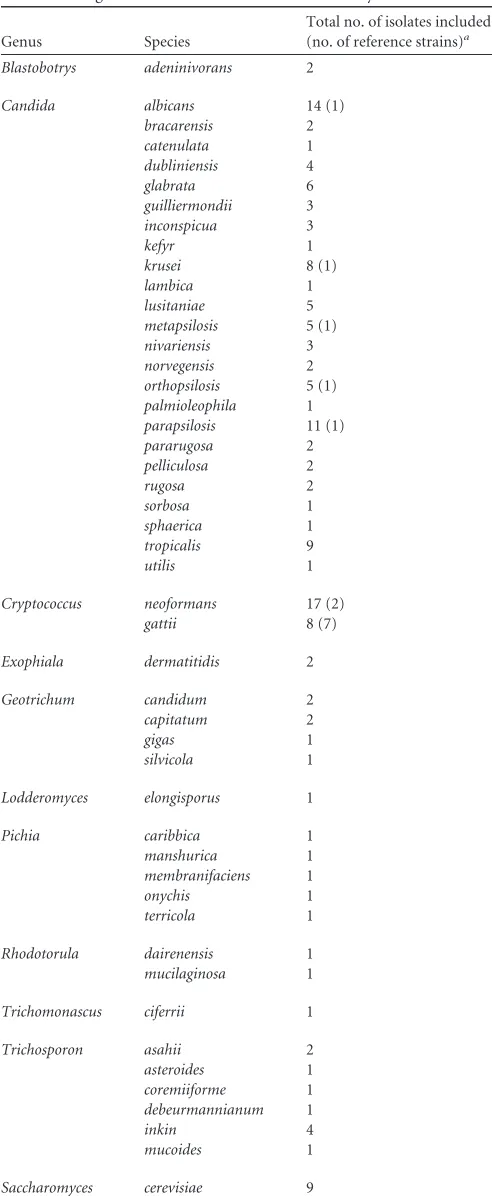
Yeasts used in this study.A total of 156 yeast isolates (representing 48 species of 11 genera) comprising 14 reference strains obtained from the American Type Culture Collection (ATCC) and the National Institutes of Health (NIH) and 142 clinical strains mostly obtained from the stock collections of the Università Cattolica del Sacro Cuore (UCSC) (Rome, Italy), the Università degli Studi di Milano (Milan, Italy), and the New Jersey Medical School (Newark, NJ) were used to construct the UCSC yeast database (Table 1; see also Table S1 in the supplemental material). Except for the reference strains, the isolates included in the library were selected, randomly whenever possible, to cover the diversity of the yeast species routinely encountered in many hospital settings and were identi-fied as described below. For the retrospective part of the study, a collection of 100 medically important yeast and yeast-like isolates obtained from UCSC patients was established to include 14Candidaspecies,
Cryptococ-cus neoformans, and 4 species in the generaGeotrichum,Rhodotorula, and
Saccharomyces(Table 2). For the second part of the study, a set of 4,232
yeasts isolated in a 6-month period (March 2012 to August 2012) from UCSC patients were prospectively analyzed, as described below. All pa-tients’ isolates were recovered from clinical specimens obtained from deep sites (blood, cerebrospinal fluid, and peritonea), from the respiratory, gastrointestinal, and genitourinary tracts, and from the skin or superficial lesions. Except for 4,232 isolates that were tested fresh from clinical cul-tures, all other isolates were retrieved from frozen (⫺70°C) storage. In both cases, isolates were subcultured on Sabouraud dextrose agar (SDA) (Kima, Padua, Italy) to ensure viability, purity, or sufficient growth before testing; if a pure culture was obtained from the primary SDA plate, it was analyzed directly. All isolates were processed for mass spectrometric anal-ysis within 24 to 48 after visible growth at 35°C.
MALDI-TOF MS sample preparation, spectral analysis, and data-base generation.For MALDI-TOF MS identification, isolates were pre-pared using a short extraction method as previously described (20). Briefly, cells from a single colony on an SDA plate were suspended in 50l of 10% formic acid and vortexed, and 1l of the lysate was used for the analysis. Alternatively, the complete formic acid/acetonitrile extraction procedure was performed as described by the manufacturer. Following preparation, each sample was analyzed, in duplicate, with the MALDI Biotyper software package (version 3.0) on a Microflex LT mass spec-trometer (Bruker Daltonics) as previously described (20).
To create the UCSC yeast database, spectra were generated from the 156 reference isolates processed with the short extraction method, and for each isolate, 10 replicate spectra were required for the entry of that isolate into the database and for the creation of a mass spectral profile (MSP). The relationships between the replicates of each set of spectra were estimated by the composite correlation index analysis, where values of around 1 represent a high conformance of the spectra and values near 0 indicate clear diversity of the spectra (21). Indeed, each database entry was gener-ated as a composite of 10 spectra, which were imported into the MALDI Biotyper software to produce a list of the most significant peaks in terms of average masses, average intensities, and relative frequencies (1). As ap-proximately 10 min per each database entry was needed, the entire library construction process was completed within 3 working days.
[image:2.585.298.544.74.672.2]By means of the pattern-matching process resulting in logarithmic scores of 0 to 3, the spectra of 100 challenge isolates were analyzed against the Bruker Biotyper V3.2.1.1 database alone (4,110 entries), the UCSC yeast database alone, and the UCSC and Bruker databases combined (4,266 entries). The supplemented database was challenged against the spectra of 4,232 isolates from the prospective study. According to the manufacturer, a score ofⱖ2.0 was recorded as identification to the species level, and a score ofⱖ1.7 was recorded as identification to the genus level. However, in our final evaluation, only species identifications with scores
TABLE 1Fungal isolates used to construct the UCSC yeast database
Genus Species
Total no. of isolates included (no. of reference strains)a
Blastobotrys adeninivorans 2
Candida albicans 14 (1)
bracarensis 2
catenulata 1
dubliniensis 4
glabrata 6
guilliermondii 3
inconspicua 3
kefyr 1
krusei 8 (1)
lambica 1
lusitaniae 5
metapsilosis 5 (1)
nivariensis 3
norvegensis 2
orthopsilosis 5 (1)
palmioleophila 1
parapsilosis 11 (1)
pararugosa 2
pelliculosa 2
rugosa 2
sorbosa 1
sphaerica 1
tropicalis 9
utilis 1
Cryptococcus neoformans 17 (2)
gattii 8 (7)
Exophiala dermatitidis 2
Geotrichum candidum 2
capitatum 2
gigas 1
silvicola 1
Lodderomyces elongisporus 1
Pichia caribbica 1
manshurica 1
membranifaciens 1
onychis 1
terricola 1
Rhodotorula dairenensis 1
mucilaginosa 1
Trichomonascus ciferrii 1
Trichosporon asahii 2
asteroides 1
coremiiforme 1
debeurmannianum 1
inkin 4
mucoides 1
Saccharomyces cerevisiae 9
aA total of 156 isolates were represented in the database. Details about the isolates,
including the reference strains, are listed in Table S1 in the supplemental material.
on May 16, 2020 by guest
http://jcm.asm.org/
of⬎2.0 were regarded as correct, whereas the proposed genus-level iden-tifications were refused.
Molecular identification.All 156 isolates included in the UCSC yeast database, the 100 isolates from the retrospective study, and any other study isolates for which a definitive species identification needed to be achieved or randomly confirmed were characterized molecularly by se-quencing the ITS1-5.8S-ITS2 ribosomal DNA (rDNA) region and, when necessary, the 28S ribosomal subunit gene region, as previously described (22).
RESULTS
Construction of in-house database for fast MALDI-TOF MS yeast identification.First, we evaluated the reliability of a short extraction formic acid-based method for MALDI-TOF MS sam-ple preparation that was previously employed to identify Crypto-coccusisolates to the species and subspecies levels (20). By ensur-ing the removal of extracellular and other potentially inhibitensur-ing compounds (11), this method generated a good number of spec-tral peaks for fungal species discrimination and, in the meantime, decreased the time for MALDI-TOF MS identification compared to that for the complete extraction method (data not shown).
Then, samples from 156 yeast isolates of reference and clinical strain collections were similarly processed to create an in-house MALDI-TOF MS “fast” yeast library, namely, the UCSC yeast da-tabase (Table 1). For each isolate, an MSP was generated through the accumulation ofⱖ5,000 laser shots from 10 technical repli-cates of the same spectrum, and each MSP was checked for spec-ificity before entry into the database. Thus, while composite cor-relation index analysis provided high similarity values (ⱖ0.9) (data not shown) between the spectra composing each isolate’s MSP, the specificities of individual MSPs were assessed by match-ing all spectra from the 156 isolates against those in our
user-modified Bruker-UCSC database, i.e., the Biotyper database V3.2.1.1 supplemented with in-house reference spectra generated in this study (for a total of 4,266 MSPs). The 156 spectra matched to an excellent degree (with scores ofⱖ2.5) with their own corre-sponding MSPs, whereas no cross-identifications were observed at a score ofⱖ2, and scores between 1.7 and 1.9 resulted from the matching of newly created MSPs with those from the unmodified (original) Bruker database with respect to the same isolates (data not shown).
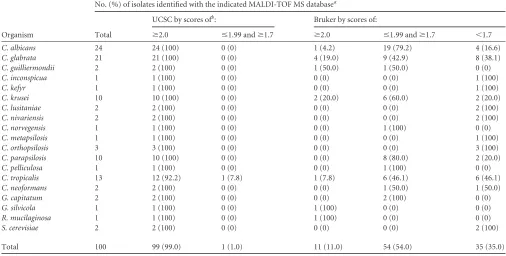
Validation of the fast yeast database.To validate the UCSC yeast database, 100 isolates from the clinical strain collection of the UCSC Microbiology Institute (Table 2) were prepared for MALDI-TOF MS analysis using the short (fast) and the complete extraction methods, as detailed above. Overall, two series of sam-ples from 14Candidaspecies (26%Candida albicansand 74% non-albicans Candida species) and eight non-Candida species (from the generaCryptococcus,Geotrichum,Rhodotorula, and Sac-charomyces) were analyzed by MALDI-TOF MS. When isolates were used to challenge the UCSC yeast database (Table 2), the fast method yielded correct identifications to the species level (with scores ofⱖ2.0) for 99 (99%) of the isolates; while one isolate (Candida tropicalis) was acceptably identified to the genus level (with a score ofⱖ1.7 but⬍2.0), 50 (50%) of these isolates had scores of⬎2.3, and 49 (49%) of them had scores ranging from 2.0 to 2.3 (data not shown). In contrast, when the same 100 spectra were analyzed against the Bruker database alone (Table 2), only 11 isolates (11%) were identified to the species level (with scores of
ⱖ2.0), and another 54 isolates (54%) were identified to the genus level; the remaining 35 isolates (35%) failed to provide reliable identification (with scores of⬍1.7), despite having representative spectra in the Bruker library. As expected, using the Bruker
data-TABLE 2MALDI-TOF MS identification scores for 100 clinicalCandidaand non-Candidaisolates challenged against the UCSC yeast and the Bruker Biotyper databases
Organism
No. (%) of isolates identified with the indicated MALDI-TOF MS databasea
Total
UCSC by scores ofb: Bruker by scores of:
ⱖ2.0 ⱕ1.99 andⱖ1.7 ⱖ2.0 ⱕ1.99 andⱖ1.7 ⬍1.7
C. albicans 24 24 (100) 0 (0) 1 (4.2) 19 (79.2) 4 (16.6)
C. glabrata 21 21 (100) 0 (0) 4 (19.0) 9 (42.9) 8 (38.1)
C. guilliermondii 2 2 (100) 0 (0) 1 (50.0) 1 (50.0) 0 (0)
C. inconspicua 1 1 (100) 0 (0) 0 (0) 0 (0) 1 (100)
C. kefyr 1 1 (100) 0 (0) 0 (0) 0 (0) 1 (100)
C. krusei 10 10 (100) 0 (0) 2 (20.0) 6 (60.0) 2 (20.0)
C. lusitaniae 2 2 (100) 0 (0) 0 (0) 0 (0) 2 (100)
C. nivariensis 2 2 (100) 0 (0) 0 (0) 0 (0) 2 (100)
C. norvegensis 1 1 (100) 0 (0) 0 (0) 1 (100) 0 (0)
C. metapsilosis 1 1 (100) 0 (0) 0 (0) 0 (0) 1 (100)
C. orthopsilosis 3 3 (100) 0 (0) 0 (0) 0 (0) 3 (100)
C. parapsilosis 10 10 (100) 0 (0) 0 (0) 8 (80.0) 2 (20.0)
C. pelliculosa 1 1 (100) 0 (0) 0 (0) 1 (100) 0 (0)
C. tropicalis 13 12 (92.2) 1 (7.8) 1 (7.8) 6 (46.1) 6 (46.1)
C. neoformans 2 2 (100) 0 (0) 0 (0) 1 (50.0) 1 (50.0)
G. capitatum 2 2 (100) 0 (0) 0 (0) 2 (100) 0 (0)
G. silvicola 1 1 (100) 0 (0) 1 (100) 0 (0) 0 (0)
R. mucilaginosa 1 1 (100) 0 (0) 1 (100) 0 (0) 0 (0)
S. cerevisiae 2 2 (100) 0 (0) 0 (0) 0 (0) 2 (100)
Total 100 99 (99.0) 1 (1.0) 11 (11.0) 54 (54.0) 35 (35.0) a
For identification, isolates were all treated with the fast extraction protocol prior to MALDI-TOF MS analysis.
bNo isolates yielded spectral scores of⬍1.7 with the UCSC yeast database.
on May 16, 2020 by guest
http://jcm.asm.org/
[image:3.585.39.545.90.346.2]base, the complete extraction applied to the 100 isolates increased the average score by 0.502 (from 1.745 to 2.247) score units com-pared to the fast method, and this resulted in 90% correct identi-fications to the species level, with 43% of 90 isolates having scores of⬎2.3 and 47% scores between 2.0 and 2.3, whereas 10% of the isolates were identified to the genus level (data not shown).
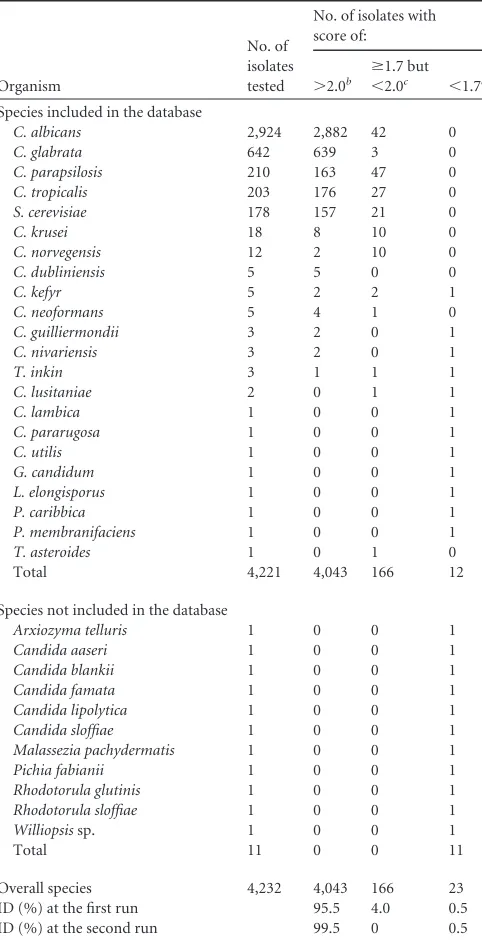
Prospective evaluation of the fast yeast database for routine MALDI-TOF MS analysis.During the 6 months of this prospec-tive study, 4,232 clinical isolates of yeasts were routinely identified by MALDI-TOF MS using the fast method and the UCSC yeast database. By applying a species-level identification cutoff score of 2.0, we obtained 4,043 (95.5%) correct identifications and 189 (4.5%) nonidentifications (Table 3). Among the isolates identified correctly, 39.6% had scores of⬎2.3. Spectra that did not yield a score ofⱖ2.0 were reanalyzed after they were manually acquired, or a second acquisition of spectra was performed with the same isolates allowed to grow for another 24 h prior to being retested. In particular, the spectra yielding scores in the range ofⱖ1.7 to⬍2.0 were from isolates that, in the first run, were mostly identified as Candida parapsilosis (47 isolates), C. albicans (42 isolates), C. tropicalis(27 isolates),Saccharomyces cerevisiae(21 isolates), Can-dida krusei(10 isolates), orCandida norvegensis(10 isolates) (
Ta-ble 3). After the second run, 166 out of 189 correct identifications
were obtained, leaving only 23 (0.5%) cases with no reliable iden-tification (with scores of ⬍1.7) (Table 3). When identified by rDNA sequencing, these isolates were almost shown to belong to species having unique representative spectra in the UCSC yeast database (Table 1) or to species not included in the database (11 isolates) (Table 3). After the spectra from the 11 isolates were subsequently added to the UCSC yeast database, they were found to match, as expected, with their own corresponding spectra con-tained in the database. Overall, 99.5% of the yeasts were identified (4,209/4,232) (Table 3), and this percentage increased to 99.7% (4,209/4,221) when the species included only in the UCSC yeast database were considered.
DISCUSSION
AlthoughCandida albicansremains the leading cause of invasive fungal infections from yeasts (23), infections due to non-albicans Candidaspecies or other unusual opportunistic pathogens have been increasingly reported (24,25) as a result of growing popula-tions of immunocompromised and otherwise compromised pa-tients (26,27). Such a diversified landscape of emerging fungi poses a diagnostic challenge when traditional methods are used, since they often fail to identify uncommon fungal species (28). Over the past few years, MALDI-TOF MS appeared to modify this scenario (15), leading to substantial improvement of fungal diag-nostics (29) and patient treatment (30).
In the present study, we sought to further enhance the rapidity and accuracy of the Bruker MALDI-TOF MS system in identifying common and uncommon yeast species. First, to decrease the time needed for the preanalytical sample processing (in part shared by other investigators [18,19,31]) but to also preserve the quality of the mass spectra for subsequent MALDI-TOF MS analysis, we adopted a preparation method that is a just compromise between two extreme procedures, complete protein extraction and direct colony transfer. Then, the same method was utilized during the in-house database construction process.
After a validation step using 100 well-characterized relevant fungal organisms, we found that 4,209 of 4,232 (99.5%) yeasts,
[image:4.585.300.541.96.566.2]consecutively isolated under routine clinical conditions, were successfully identified by MALDI-TOF MS, with 1,676 isolates yielding scores much higher than the reliability cutoff score rec-ommended by Bruker Daltonics for species-level identification
TABLE 3Performance of the UCSC yeast database forCandidaand non-Candidaclinical isolates prospectively tested by MALDI-TOF MS analysisa
Organism
No. of isolates tested
No. of isolates with score of:
⬎2.0b ⱖ
1.7 but ⬍2.0c ⬍1.7d
Species included in the database
C. albicans 2,924 2,882 42 0
C. glabrata 642 639 3 0
C. parapsilosis 210 163 47 0
C. tropicalis 203 176 27 0
S. cerevisiae 178 157 21 0
C. krusei 18 8 10 0
C. norvegensis 12 2 10 0
C. dubliniensis 5 5 0 0
C. kefyr 5 2 2 1
C. neoformans 5 4 1 0
C. guilliermondii 3 2 0 1
C. nivariensis 3 2 0 1
T. inkin 3 1 1 1
C. lusitaniae 2 0 1 1
C. lambica 1 0 0 1
C. pararugosa 1 0 0 1
C. utilis 1 0 0 1
G. candidum 1 0 0 1
L. elongisporus 1 0 0 1
P. caribbica 1 0 0 1
P. membranifaciens 1 0 0 1
T. asteroides 1 0 1 0
Total 4,221 4,043 166 12
Species not included in the database
Arxiozyma telluris 1 0 0 1
Candida aaseri 1 0 0 1
Candida blankii 1 0 0 1
Candida famata 1 0 0 1
Candida lipolytica 1 0 0 1
Candida sloffiae 1 0 0 1
Malassezia pachydermatis 1 0 0 1
Pichia fabianii 1 0 0 1
Rhodotorula glutinis 1 0 0 1
Rhodotorula sloffiae 1 0 0 1
Williopsissp. 1 0 0 1
Total 11 0 0 11
Overall species 4,232 4,043 166 23 ID (%) at the first run 95.5 4.0 0.5 ID (%) at the second run 99.5 0 0.5 a
Isolates were treated with the fast extraction protocol prior to MALDI-TOF MS analysis for identification.
b
A total of 1,676 (39.6%) isolates with scores ofⱖ2.3 (high-probable species identification by Bruker Daltonics) were fromC. albicans(1,046 isolates),C. glabrata
(491 isolates),C. parapsilosis(35 isolates),C. tropicalis(46 isolates),S. cerevisiae(32 isolates),C. krusei(8 isolates),C. norvegensis(2 isolates),C. dubliniensis(5 isolates),C. kefyr(2 isolates),C. neoformans(4 isolates),C. guilliermondii(2 isolates), andC. nivariensis(2 isolates).
c
Isolates were all identified to the species level after the second run of MALDI-TOF MS analysis.
d
Isolates were all identified by the rDNA sequence-based method.
on May 16, 2020 by guest
http://jcm.asm.org/
(⬎2.0). To prove the correctness of these identifications, selected isolates were subjected to rDNA sequencing, and in all cases, se-quence-based analyses confirmed the MALDI-TOF MS results (data not shown). Thus, our MALDI success rate was superior to that reported by Theel et al. on 90 clinical yeast isolates studied (18). In that study, using the on-target formic acid extraction method and their own laboratory-validated MALDI-TOF cutoff scores (ⱖ1.5 andⱖ1.7, respectively), 86 (95.6%) isolates were correctly identified to the genus level, and 73 (81.1%) isolates were identified to the species level (18). Although these percentages were comparable to those found by Dhiman et al. when the same isolates were previously processed by the complete extraction method (3), it is intriguing that only 82.2% and 41.1% correct genus or species identifications were achieved, in that study, when Theel et al. applied the manufacturer’s recommended MALDI-TOF cutoff scores (ⱖ1.7 andⱖ2.0, respectively) (18).
In line with our data, in a very recent evaluation of the Bruker Biotyper and Andromas (the latest MALDI-TOF MS system com-mercially available together with the Vitek MS system [11,12]), both systems accurately identified 98.3% of 1,383Candidaisolates routinely collected in French hospital laboratories (7). However, since the fungal cell is lysed directly on a MALDI plate in the Andromas system, the necessity of performing a time-consuming extraction step by the Biotyper protocol might disadvantage the Bruker system in routine laboratory practice (7). To this regard, we showed that the time required for the analysis of a batch of 96 samples (48 yeast colonies tested in duplicate)—i.e., the time cal-culated from scraping single colonies grown on the SDA plates to species identification results—was⬍1 h, compared to the⬃2 h needed with the Bruker method.
As the UCSC yeast database might not be exhaustive, we plan to continuously update this reference library with more represen-tative isolates by exploiting the intrinsic expandability of the Bruker Biotyper software. This property has been experimented satisfactorily in our previous studies (20,32,33), including a very recent study that evaluated comparatively the Bruker Biotyper and the Vitek MS systems (10). Besides the high accuracy shared by these two systems in identifying the most common yeasts iso-lated in clinical settings, we showed that the Vitek MS system yielded a higher rate of major errors (i.e., false classifications) for rarerCandidaand non-Candidaspecies due to its nonexpandable database (10). Thus, failing to identify or misidentifying new and emerging strains/species due to the lack of corresponding spectra in the database may be resolved without difficulty using the Bruker Biotyper software, provided that an incautious enrich-ment of databases (e.g., performed in small but not centralized laboratories) does not generate erroneous microbial identifica-tions (34). In addition, utilizing an expanded library would allow laboratories to drastically abate the number of cases for which no spectra are present in the database at the time of analysis. Herein, only 23 isolates (11 from species not included in the database) remained unresolved by MALDI-TOF MS analysis, which made it necessary to resort to more laborious molecular-based identifica-tions.
Lastly, our findings parallel those recently reported by Lau et al. (35) and, unlike those from other studies (4,36), suggest that a strategy that uses modified cutoff scores should be avoided, given that this also implies the manual validation of the identification outputs after the application of additional criteria, i.e., a certain number of database hits on a single species at the top or a certain
difference in the score to the next species (11). In contrast, using the original cutoff scores might ensure that the time saved during sample preparation is not spent later in the analyses manually validating and might prevent the use of interpretative algorithms (36), which require at least three consecutive database hits and then do not work for fungal species (especially rare species) with fewer spectra archived in the database (11).
In summary, our data suggest that the use of a simplified pre-treatment protocol coupled with the fast yeast database developed ad hocmay represent a powerful strategy for making more accu-rate and rapid the MALDI-TOF MS-based identification of yeast species of medical importance. Once our database is made pub-licly available for future multicenter studies to allow its wide-scale adoption, we feel that laboratories with limited mycological ex-pertise will benefit from this database, thereby bolstering the role of the clinical mycology laboratory in assisting clinicians in the diagnosis of fungal diseases.
ACKNOWLEDGMENTS
This work was supported by a UCSC-Linea D1 grant to M.S. and B.P. We thank Emanuela Paniccia and Rocco Borraccio for their excellent technical assistance.
REFERENCES
1.Stevenson LG, Drake SK, Shea YR, Zelazny AM, Murray PR.2010. Eval-uation of matrix-assisted laser desorption ionization–time of flight mass spec-trometry for identification of clinically important yeast species. J. Clin. Micro-biol.48:3482–3486.http://dx.doi.org/10.1128/JCM.00687-09.
2.Bader O, Weig M, Taverne-Ghadwal L, Lugert R, Gross U, Kuhns M.
2011. Improved clinical laboratory identification of human pathogenic yeasts by matrix-assisted laser desorption ionization time-of-flight mass spectrometry. Clin. Microbiol. Infect.17:1359 –1365.http://dx.doi.org/10 .1111/j.1469-0691.2010.03398.x.
3.Dhiman N, Hall L, Wohlfiel SL, Buckwalter SP, Wengenack NL.2011. Performance and cost analysis of matrix-assisted laser desorption ionization– time of flight mass spectrometry for routine identification of yeast. J. Clin. Microbiol.49:1614 –1616.http://dx.doi.org/10.1128/JCM.02381-10. 4.Pinto A, Halliday C, Zahra M, van Hal S, Olma T, Maszewska K, Iredell
JR, Meyer W, Chen SC.2011. Matrix-assisted laser desorption ioniza-tion–time of flight mass spectrometry identification of yeasts is contingent on robust reference spectra. PLoS One6:e25712.http://dx.doi.org/10 .1371/journal.pone.0025712.
5.Iriart X, Lavergne RA, Fillaux J, Valentin A, Magnaval JF, Berry A, Cassaing S.2012. Routine identification of medical fungi by the new Vitek MS matrix-assisted laser desorption ionization–time of flight system with a new time-effective strategy. J. Clin. Microbiol.50:2107–2110.http://dx .doi.org/10.1128/JCM.06713-11.
6.Sendid B, Ducoroy P, François N, Lucchi G, Spinali S, Vagner O, Damiens S, Bonnin A, Poulain D, Dalle F.2013. Evaluation of MALDI-TOF mass spectrometry for the identification of medically-important yeasts in the clinical laboratories of Dijon and Lille hospitals. Med. Mycol.
51:25–32.http://dx.doi.org/10.3109/13693786.2012.693631.
7.Lacroix C, Gicquel A, Sendid B, Meyer J, Accoceberry I, François N, Morio F, Desoubeaux G, Chandenier J, Kauffmann-Lacroix C, Henne-quin C, Guitard J, Nassif X, Bougnoux ME.2014. Evaluation of two matrix-assisted laser desorption ionization–time of flight mass spectrom-etry (MALDI-TOF MS) systems for the identification ofCandidaspecies. Clin. Microbiol. Infect.20:153–158.http://dx.doi.org/10.1111/1469-0691 .12210.
8.Rosenvinge FS, Dzajic E, Knudsen E, Malig S, Andersen LB, Løvig A, Arendrup MC, Jensen TG, Gahrn-Hansen B, Kemp M.2013. Perfor-mance of matrix-assisted laser desorption-time of flight mass spectrome-try for identification of clinical yeast isolates. Mycoses.56:229 –235.http: //dx.doi.org/10.1111/myc.12000.
9.Westblade LF, Jennemann R, Branda JA, Bythrow M, Ferraro MJ, Garner OB, Ginocchio CC, Lewinski MA, Manji R, Mochon AB, Procop GW, Richter SS, Rychert JA, Sercia L, Burnham CA.2013. Multicenter study evaluating the Vitek MS system for identification of medically
on May 16, 2020 by guest
http://jcm.asm.org/
portant yeasts. J. Clin. Microbiol. 51:2267–2272. http://dx.doi.org/10 .1128/JCM.00680-13.
10. Mancini N, De Carolis E, Infurnari L, Vella A, Clementi N, Vaccaro L, Ruggeri A, Posteraro B, Burioni R, Clementi M, Sanguinetti M.2013. Comparative evaluation of the Bruker Biotyper and Vitek MS matrix-assisted laser desorption ionization–time of flight (MALDI-TOF) mass spectrometry systems for identification of yeasts of medical importance. J. Clin. Microbiol.51:2453–2457.http://dx.doi.org/10.1128/JCM.00841-13. 11. Bader O.2013. MALDI-TOF-MS-based species identification and typing approaches in medical mycology. Proteomics13:788 –799.http://dx.doi .org/10.1002/pmic.201200468.
12. Posteraro B, De Carolis E, Vella A, Sanguinetti M.2013. MALDI-TOF mass spectrometry in the clinical mycology laboratory: identification of fungi and beyond. Expert Rev. Proteomics10:151–164.http://dx.doi.org /10.1586/epr.13.8.
13. Borman AM, Johnson EM.2013. Genomics and proteomics as compared to conventional phenotypic approaches for the identification of the agents of invasive fungal infections. Curr. Fungal Infect. Rep.7:235–243.http: //dx.doi.org/10.1007/s12281-013-0149-7.
14. Clark AE, Kaleta EJ, Arora A, Wolk DM. 2013. Matrix-assisted laser desorption ionization–time of flight mass spectrometry: a fundamental shift in the routine practice of clinical microbiology. Clin. Microbiol. Rev.
26:547– 603.http://dx.doi.org/10.1128/CMR.00072-12.
15. Patel R.2013. Matrix-assisted laser desorption ionization–time of flight mass spectrometry in clinical microbiology. Clin. Infect. Dis.57:564 –572. http://dx.doi.org/10.1093/cid/cit247.
16. Cassagne C, Cella AL, Suchon P, Normand AC, Ranque S, Piarroux R.
2013. Evaluation of four pretreatment procedures for MALDI-TOF MS yeast identification in the routine clinical laboratory. Med. Mycol.51:371– 377.http://dx.doi.org/10.3109/13693786.2012.720720.
17. Bille E, Dauphin B, Leto J, Bougnoux ME, Beretti JL, Lotz A, Suarez S, Meyer J, Join-Lambert O, Descamps P, Grall N, Mory F, Dubreuil L, Berche P, Nassif X, Ferroni A.2012. MALDI-TOF MS Andromas strat-egy for the routine identification of bacteria, mycobacteria, yeasts,
Asper-gillusspp. and positive blood cultures. Clin. Microbiol. Infect.18:1117–
1125.http://dx.doi.org/10.1111/j.1469-0691.2011.03688.x.
18. Theel ES, Schmitt BH, Hall L, Cunningham SA, Walchak RC, Patel R, Wengenack NL.2012. Formic acid-based direct, on-plate testing of yeast
andCorynebacteriumspecies by Bruker Biotyper matrix-assisted laser
de-sorption ionization–time of flight mass spectrometry. J. Clin. Microbiol.
50:3093–3095.http://dx.doi.org/10.1128/JCM.01045-12.
19. Van Herendael BH, Bruynseels P, Bensaid M, Boekhout T, De Baere T, Surmont I, Mertens AH.2012. Validation of a modified algorithm for the iden-tification of yeast isolates using matrix-assisted laser desorption/ionisation time-of-flight mass spectrometry (MALDI-TOF MS). Eur. J. Clin. Microbiol. Infect. Dis.31:841–848.http://dx.doi.org/10.1007/s10096-011-1383-y.
20. Posteraro B, Vella A, Cogliati M, De Carolis E, Florio AR, Posteraro P, Sanguinetti M, Tortorano AM.2012. Matrix-assisted laser desorption ionization–time of flight mass spectrometry-based method for discrimi-nation between molecular types ofCryptococcus neoformansand
Crypto-coccus gattii. J. Clin. Microbiol.50:2472–2476.http://dx.doi.org/10.1128
/JCM.00737-12.
21. Vella A, De Carolis E, Vaccaro L, Posteraro P, Perlin DS, Kostrzewa M, Posteraro B, Sanguinetti M.2013. Rapid antifungal susceptibility testing by matrix-assisted laser desorption ionization–time of flight mass spec-trometry analysis. J. Clin. Microbiol.51:2964 –2969.http://dx.doi.org/10 .1128/JCM.00903-13.
22. Sanguinetti M, Porta R, Sali M, La Sorda M, Pecorini G, Fadda G, Posteraro B.2007. Evaluation of VITEK 2 and RapID yeast plus systems for yeast species identification: experience at a large clinical microbiology laboratory. J. Clin. Microbiol.45:1343–1346.http://dx.doi.org/10.1128 /JCM.02469-06.
23. Falagas ME, Roussos N, Vardakas KZ.2010. Relative frequency of albi-cansand the various non-albicans Candidaspp among candidemia isolates from inpatients in various parts of the world: a systematic review. Int. J. Infect. Dis.14:e954 – e966.http://dx.doi.org/10.1016/j.ijid.2010.04.006. 24. Pfaller M, Neofytos D, Diekema D, Azie N, Meier-Kriesche HU, Quan
SP, Horn D.2012. Epidemiology and outcomes of candidemia in 3648 patients: data from the Prospective Antifungal Therapy (PATH Alliance) registry, 2004-2008. Diagn. Microbiol. Infect. Dis.74:323–331.http://dx .doi.org/10.1016/j.diagmicrobio.2012.10.003.
25. Miceli MH, Díaz JA, Lee SA.2011. Emerging opportunistic yeast infec-tions. Lancet Infect. Dis. 11:142–151. http://dx.doi.org/10.1016/S1473 -3099(10)70218-8.
26. Pfaller MA, Diekema DJ.2010. Epidemiology of invasive mycoses in North America. Crit. Rev. Microbiol.36:1–53.http://dx.doi.org/10.3109 /10408410903241444.
27. Arendrup MC.2010. Epidemiology of invasive candidiasis. Curr. Opin. Crit. Care16:445– 452.http://dx.doi.org/10.1097/MCC.0b013e32833e84d2. 28. Ostrosky-Zeichner L.2012. Invasive mycoses: diagnostic challenges. Am.
J. Med.125:S14 –S24.http://dx.doi.org/10.1016/j.amjmed.2011.10.008. 29. Tan KE, Ellis BC, Lee R, Stamper PD, Zhang SX, Carroll KC.2012.
Prospective evaluation of a matrix-assisted laser desorption ionization– time of flight mass spectrometry system in a hospital clinical microbiology laboratory for identification of bacteria and yeasts: a bench-by-bench study for assessing the impact on time to identification and cost-effectiveness. J. Clin. Microbiol.50:3301–3308.http://dx.doi.org/10.1128 /JCM.01405-12.
30. Huang AM, Newton D, Kunapuli A, Gandhi TN, Washer LL, Isip J, Collins CD, Nagel JL.2013. Impact of rapid organism identification via matrix-assisted laser desorption/ionization time-of-flight combined with antimicrobial stewardship team intervention in adult patients with bacte-remia and candidemia. Clin. Infect. Dis.57:1237–1245.http://dx.doi.org /10.1093/cid/cit498.
31. Goyer M, Lucchi G, Ducoroy P, Vagner O, Bonnin A, Dalle F.2012. Optimization of the preanalytical steps of matrix-assisted laser desorption ionization–time of flight mass spectrometry identification provides a flex-ible and efficient tool for identification of clinical yeast isolates in medical laboratories. J. Clin. Microbiol.50:3066 –3068.http://dx.doi.org/10.1128 /JCM.06381-11.
32. De Carolis E, Posteraro B, Lass-Flörl C, Vella A, Florio AR, Torelli R, Girmenia C, Colozza C, Tortorano AM, Sanguinetti M, Fadda G.2012. Species identification ofAspergillus,FusariumandMucoraleswith direct surface analysis by matrix-assisted laser desorption ionization time-of-flight mass spectrometry. Clin. Microbiol. Infect.18:475– 484.http://dx .doi.org/10.1111/j.1469-0691.2011.03599.x.
33. Mancini N, Burioni R, Sanguinetti M, Clementi M. 2013. Risks of “blind” automated identification systems in medical microbiology. J. Clin. Microbiol.51:3911.http://dx.doi.org/10.1128/JCM.02032-13.
34. Westblade LF, Jennemann R, Branda JA, Bythrow M, Ferraro MJ, Garner OB, Ginocchio CC, Lewinski MA, Manji R, Mochon AB, Procop GW, Richter SS, Rychert JA, Sercia L, Burnham CA.2013. Reply to “risks of ‘blind’ automated identification systems in medical microbiology.” J. Clin. Microbiol.51:3912.http://dx.doi.org/10.1128/JCM.02349-13.
35. Lau AF, Drake SK, Calhoun LB, Henderson CM, Zelazny AM.2013. Development of a clinically comprehensive database and a simple proce-dure for identification of molds from solid media by matrix-assisted laser desorption ionization–time of flight mass spectrometry. J. Clin. Micro-biol.51:828 – 834.http://dx.doi.org/10.1128/JCM.02852-12.
36. Steensels D, Verhaegen J, Lagrou K.2011. Matrix-assisted laser desorp-tion ionizadesorp-tion–time of flight mass spectrometry for the identificadesorp-tion of bacteria and yeasts in a clinical microbiological laboratory: a review. Acta Clin. Belg.66:267–273.http://dx.doi.org/10.1179/ACB.66.4.2062567.