http://dx.doi.org/10.4236/ojmh.2014.43008
Short Report: Identifying Sources of
Subsurface Flow—A Theoretical Framework
Assessing Hydrological Implications of
Lithological Discontinuities
Martin Reiss, Peter Chifflard
University of Marburg, Faculty of Geography, Marburg, Germany Email: [email protected]
Received 2 May 2014; revised 3 June 2014; accepted 2 July 2014 Copyright © 2014 by authors and Scientific Research Publishing Inc.
This work is licensed under the Creative Commons Attribution International License (CC BY).
http://creativecommons.org/licenses/by/4.0/
Abstract
An integrative theoretical concept—combining scientific approaches from soil science and slope hydrology—is given as a framework to study the influence of depth functions of geochemical con-centrations for trace elements, dissolved organic carbon and stable isotopes in the soil pore water of stratified soils on the chemical composition of the hillslope runoff. Combining investigations at the point and hillslope scale opens the opportunity to identify sources of subsurface runoff com-ponents using geochemical depth functions as proxies.
Keywords
Subsurface Runoff, Soil Solution, Hillslope Hydrology, Cover Beds, Geochemical Barriers
1. Motivation
M. Reiss, P. Chifflard
92
in stratified soils [7]. These uncertainties are an essential reason why in hydrological research the stratification of soils and hereby especially cover beds is not really taken into account as a major trigger of slope water paths. By contrast in soil science the Substrate-Oriented-Soil-Evolution-Model [6] underlines the importance of stra-tified soils and lithological discontinuities (LD) as a key element controlling ecological processes and depth functions of soil properties like acidification parameters or trace elements [8]. LD act as geochemical barriers [9] or migration barriers [10] since the LD are not a result of pedological processes consequently in this case the depth distribution of chemical soil properties is not a result of soil formation. Whereas [8] have assessed the depth distribution of e.g. trace elements in the soil matrix at the point scale, [11] showed a typical depth distri-bution for Mn and Fe in the soil pore water depending on lithological discontinuities in stratified soils along a hillslope catena (SW-Germany) and underline that these depth functions indicate zones of preferential transport. Nevertheless, there is still a missing link of investigations at different scales regarding the impacts of the geo-chemical barriers and the pronounced depth distributions on the geo-chemical composition of the subsurface runoff and consequently the hillslope runoff. Furthermore it is frequently unclear how these sources of the subsurface runoff are hydrological connected to the stream [12] and how the contribution of these sources varies over time (e.g. event, seasonal) [13].
2. Approach
In consequence of these research gaps we will basically combine an allochthonistic approach of soil formation [8] with a (pedo-)hydrology approach [12] to identify sources of lateral subsurface flow at the hill slope scale based on geochemical depth distributions in stratified soils at the point scale (Figure 1). We assume that in cov-er beds which typically consist of lithological discontinuities the soil watcov-er in diffcov-erent depths can be characte-rized by different concentrations of trace elements, dissolved organic carbon (DOC) and stable isotopes. These geochemical depth functions will push the boundaries to detect different sources of subsurface runoff more de-tailed as it used to be by the application of the natural tracer dissolved silica which just allows separating surface and subsurface runoff [14].
3. Methods
Figure 1. The Pedon-Hillslope-Catchment-Approach as a theoretical frame- work assessing hydrological implications of lithological discontinuities. LD: Lithological Discontinuity/p: Percolation/i: Interflow.
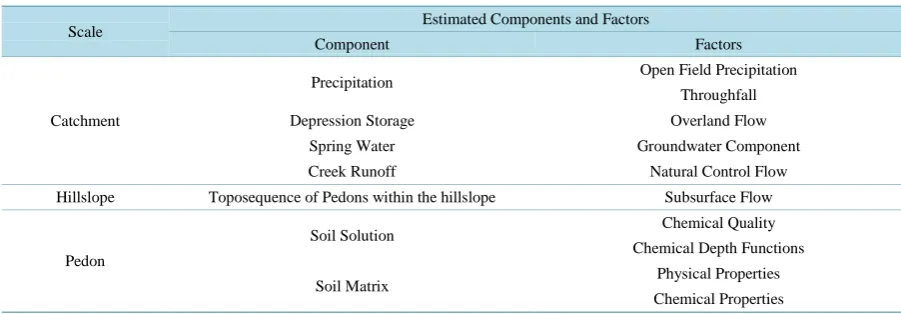
Table 1. Spatial-Functional Investigation Program within the Pedon-Hillslope-Catchment-Approach.
Scale Estimated Components and Factors
Component Factors
Catchment
Precipitation Open Field Precipitation
Throughfall
Depression Storage Overland Flow
Spring Water Groundwater Component
Creek Runoff Natural Control Flow
Hillslope Toposequence of Pedons within the hillslope Subsurface Flow
Pedon
Soil Solution Chemical Quality
Chemical Depth Functions
Soil Matrix Physical Properties
Chemical Properties
lyser and a LGR DLT-100 Liquid-Water Isotope Analyser.
References
[1] Chifflard, P., Kirnbauer, R., Zepp, H., Tilch, N., Didszun, J., Zillgens, B., Schumann, A. and Uhlenbrook, S. (2010) Tracing Runoff Generation Processes through Different Spatial Scales in Low and High Mountain Ranges. IAHS Pub-lication, 336, 90-95.
[2] Gurtz, J., Zappa, M., Jasper, K., Lang, L., Verbunt, M., Badoux, A. and Vitvar, T. (2003) A Comparative Study in Modelling Runoff and Its Components in Two Mountainous Catchments. Hydrological Processes, 17, 297-311. http://dx.doi.org/10.1002/hyp.1125
[3] Moldenhauer, K.-M., Heller, K., Chifflard, P., Hübner, R. and Kleber, A. (2013) Influence of Cover Beds on Slope Hydrology. In: Kleber, A. and Terhorst, B., Ed., Mid-Latitude Slope Deposits (Cover Beds), Elsevier, Amsterdam, 127- 152. http://dx.doi.org/10.1016/B978-0-444-53118-6.00004-0
[4] Kleber, A. and Terhorst, B. (2013) Introduction. In: Kleber, A. and Terhorst, B., Ed., Mid-Latitude Slope Deposits
(Cover Beds), Elsevier, Amsterdam, 1-8.
Re-M. Reiss, P. Chifflard
94
view. Quaternary International, 222, 120-128. http://dx.doi.org/10.1016/j.quaint.2010.03.010
[6] Lorz, C., Heller, K. and Kleber, A. (2011) Stratification of the Regolith Continuum—A Key Property for Processes and Functions of Landscapes.Zeitschrift für Geomorphologie, 55, 277-292.
http://dx.doi.org/10.1127/0372-8854/2011/0055S3-0062
[7] Weiler, M. and McDonnell, J.J. (2006) Testing Nutrient Flushing Hypotheses at the Hillslope Scale: A Virtual Expe-riment Approach. Journal of Hydrology, 319, 339-356. http://dx.doi.org/10.1016/j.jhydrol.2005.06.040
[8] Lorz, C. and Phillips, J.D. (2006) Pedo-Ecological Consequences of Lithological Discontinuities in Soils—Examples from Central Europe. Journal of Plant Nutrition and Soil Science, 169, 573-581.
[9] Perelman, A.I. (1977) Geochemistry of Elements in the Supergene Zone. Keter Publishing House, Jerusalem.
[10] Ostaszewska, K. (2010) The Geochemical Landscape Concept and Its Usefulness in Physical Geography. Miscellanea Geographica, 14, 5-12.
[11] Fiedler, S., Jungkunst, H.P.F., Jahn, R., Kleber, M., Sommer, M. and Stahr, K. (2002) Linking Soil Classification and Soil Dynamics—Pedological and Ecological Perspectives. Journal of Plant Nutrition and Soil Science, 165, 517-529.
[12] van Verseveld, W.J., McDonnell, J.J. and Lajtha, K. (2009) The Role of Hillslope Hydrology in Controlling Nutrient Loss. Journal of Hydrology, 367, 177-187. http://dx.doi.org/10.1016/j.jhydrol.2008.11.002
[13] Penna, D., Borga, M., Sangati, M. and Gobbi, A. (2010) Dynamics of Soil Moisture, Subsurface Flow and Runoff in a Small Alpine Basin. IAHS Publications, Red Book Series, 336, 96-102
[14] Scanlon, T.M., Raffensperger, J.P. and Hornberger, G.M. (2001) Modeling Transport of Dissolved Silica in a Forested Headwater Catchment: Implications for Defining the Hydrochemical Response of Observed Flow Pathways. Water Resources Research, 37, 1071-1082. http://dx.doi.org/10.1029/2000WR900278
[15] Zakosek, H., Romschinski, A. and Sedlatschek, A. (1971) Die Böden der Teilgebiete A und B des Forschungsgebiets Krofdorf. Unveröffentlichter Kurzbericht an die Projektgruppe Krofdorf, Hessisches Landesamt für Bodenforschung, Wiesbaden.
[16] Schumann, S., Schmalz, B., Meesenburg, H. and Schröder, U. (2010) Status and Perspectives of Hydrology in Small Basins. German National Commitee for the International Hydrological Programme (IHP) of UNESCO and the Hy-drology and Water Resource Programme (HWRP) of WMO, Koblenz.
[17] Grossmann, J. and Udluft, P. (1991) The Extraction of Soil Water by the Suction-Cup Method: A Review. Journal of Soil Science, 42, 83-93. http://dx.doi.org/10.1111/j.1365-2389.1991.tb00093.x
currently publishing more than 200 open access, online, peer-reviewed journals covering a wide range of academic disciplines. SCIRP serves the worldwide academic communities and contributes to the progress and application of science with its publication.
Other selected journals from SCIRP are listed as below. Submit your manuscript to us via either