Volume 79
Issue 4
Winter
Article 2
Winter 1989
The Structure of the Fourth Amendment: The
Scope of the Protection
John M. Junker
Follow this and additional works at:
https://scholarlycommons.law.northwestern.edu/jclc
Part of the
Criminal Law Commons,
Criminology Commons, and the
Criminology and Criminal
Justice Commons
This Criminal Law is brought to you for free and open access by Northwestern University School of Law Scholarly Commons. It has been accepted for inclusion in Journal of Criminal Law and Criminology by an authorized editor of Northwestern University School of Law Scholarly Commons.
Recommended Citation
009 1-4169/89/7904-1105
THEJOURNAL OF CRIMINAL LAW & CRIMINOLOGY Vol. 79, No. 4 Copyright 0 1989 by Northwestern University, School of Law Printed in US..
THE STRUCTURE OF THE FOURTH
AMENDMENT: THE SCOPE OF THE
PROTECTION*
JOHN M. JUNKER**
Fourth amendment doctrine consists of three foundational ele-ments: scope, content, and remedy. This essay examines the first of these elements: the scope of the protection against unreasonable searches and seizures under the fourth amendment. Its purpose is to describe and assess the doctrine that determines whether that amendment governs the conduct sought to be remedied.
In its most elementary form, the scope inquiry asks whether the challenged governmental conduct amounted to a "search" or "seizure," but these textual referents are only the starting point for our journey into the doctrinal-political' labyrinth of fourth amend-ment analytics. The textual version of the "content" inquiry is even more cryptic: whether the search or seizure was "reasonable." The "remedy" issue is, in criminal cases (the dominant but not exclusive source of fourth amendment doctrine) whether the product of an unreasonable search or seizure is subject to the exclusionary rule. As many have noted, there is no explicit textual referent to a remedy for such violations.2
Each of these elementary descriptions of the three basic struc-tural components of fourth amendment doctrine undergoes two levels of elaboration. Each may be described in terms of a relatively concise set of analytic categories, and those categories themselves
* Copyright 1988 by John M. Junker. All rights reserved.
** Professor of Law, University of Washington School of Law. B.A. 1959,
Washing-ton State University; J.D. 1962, University of Chicago. The author gratefully
acknowl-edges the helpful suggestions by his colleagues, Professors Arval A. Morris and Louis E. Wolcher, and by Professors Francis A. Allen and Yale Kamisar, all of whom reviewed and commented upon an earlier draft. The Article was supported in part by research
grants from the University of Washington School of Law during the summers of
1985-87.
1 "Political" refers to the process of determining the official dominance of one value over a competing value.
2 Kamisar, Does (Did) (Should) the Exclusionary Rule Rest on a Principled Basis Rather than
an Empirical Proposition?, 16 CREIGHTON L. REV. 565, 581-597 (1983).
branch into sets of rules that apply to given circumstances or factual settings. For example, whether a particular observation by the po-lice, say from an airplane, is a "search"-that is, within the scope of the fourth amendment-depends on whether that conduct is deemed to have affected the legitimate expectation of privacy of the person who seeks to exclude evidence derived from such an obser-vation. In the case of aerial surveillance, the "legitimacy" of such an expectation turns on whether the observed premises are deemed to be within the officer's "plain view," and that question, in turn, will depend upon the circumstances of the officer's location (whether or not in "public airspace") and the means by which the observation was made (whether by naked eye, enhanced vision or more sophisti-cated surveillance devices). In short, at the analytic level, "plain view" negates "search;" at the circumstantial level, a legal vantage point and conventional techniques yield a "plain view.' 3
This Article proceeds from a general description of the entire structure and a wide-angle view of fourth amendment doctrine since
Mapp v. Ohio,4 to a detailed analysis of the United States Supreme Court's decisions affecting the scope of the fourth amendment.5
The structural components of fourth amendment doctrine ap-pear, in a tactical setting, as a series of obstacles to exclusion of the challenged evidence, because each must in turn be hurdled or exclu-sion will be denied. Only if the conduct by which the police ac-quired the evidence is within the scope of the fourth amendment does it make sense to ask whether that conduct was "unreasonable." Further, only if one of the rules that comprise the content of the amendment was violated does it make sense to ask whether the product of the violation is subject to exclusion. Logically, therefore, the assessment of fourth amendment issues should be addressed in that order: scope, content, remedy. Because of the vulnerability of the exclusionary rule, however, there are more than a few examples in which the order has been reversed.6 Analytic confusion between
3 This is the official resolution of the aerial surveillance controversy. As we shall see, an alternate analytic route would yield the opposite result.
4 367 U.S. 643 (1961).
5 For historical overviews of the fourth amendment prior to AMapp v. Ohio see J.
LANDYNSKI, SEARCH AND SEIZURE AND THE SUPREME COURT (1966) and N. LASSON, THE HISTORY AND DEVELOPMENT OF THE FOURTH AMENDMENT TO THE UNITED STATES CONSTI-TUTION (1937).
6 See, e.g., Illinois v. Gates, 462 U.S. 213 (1983); Payton v. New York, 445 U.S. 573,
620 (1980)(Rehnquist, J., dissenting); Robbins v. California, 453 U.S. 420, 437
Coo-FOURTH AMENDMENT SCOPE
scope and content issues, though less apparent, is even more com-mon in the Court's decisions, and often occurs, one suspects, in the quest for a particular result.7
These same structural components may be viewed as pawns in a political controversy that inheres in organized society: the tension between the individual claim to privacy and autonomy and the col-lective demand for crime control and security.8 Every fourth amendment decision chooses, at the margin, which of these oppos-ing values to prefer, and the doctrine reflects and accommodates that choice. The immediate task is to explicate the analytic catego-ries through which that accommodation is expressed.
I. THE ANALYTIC FRAMEWORK OF PRIVACY
This Article makes two claims for the analytic structure it de-scribes. First, that the analysis applies to any attempt to give legal protection to privacy, regardless of the particular text by which that protection is expressed. State constitutions, such as those of Ari-zona9 and Washington,1 0 that mention neither searches, seizures, warrants nor probable cause, nonetheless generate doctrines that fit comfortably within the analytic categories.
Second, the components of the analytic framework presented here are comprehensive (although not exclusive). Every fourth amendment issue falls within a particular analytic category, and although the categories overlap, they do so in instructive ways. Of course, these are empty claims unless the analysis also facilitates one's ability to understand, assess and use privacy doctrine. The proof of that is in the analytic scheme.
lidge v. New Hampshire, 403 U.S. 443, 492, 510 (1971)(Burger, C.J., dissenting, Black-mun, J., dissenting); Spinelli v. United States, 393 U.S. 410, 429 (1969)(Black, J., dissenting); Terry v. Ohio, 392 U.S. 1 (1968).
7 See, e.g., New Jersey v. T.L.O., 469 U.S. 325, 353 (1985)(Brennan, J., dissenting); Hudson v. Palmer, 468 U.S. 517, 537 (1984)(O'Connor, J., concurring); United States v. ViIlamonte-Marquez, 462 U.S. 579 (1983); United States v. Edwards, 415 U.S. 800, 809
(1974) (Stewart, J., dissenting); Cardwell v. Lewis, 417 U.S. 583 (1974); United States v. Biswell, 406 U.S. 311 (1972); Wyman v. James, 400 U.S. 309 (1971); United States v. Van Leeuwen, 397 U.S. 249 (1970). See generally La Fave, Being Frank About the Fourth: On
Allen's " 'Process of Factualization'in the Search and Seizure Cases", 85 MICH. L. REV. 427, 440
n.77 (1985)(In discussing several "content" issues, the author notes that "[m]any of the activities deemed outside the fourth amendment entirely... would be better viewed as inside the amendment but subject to lesser limitations .. .
8 Amsterdam, Perspectives on the Fourth Amendment, 58 MINN. L. REV. 349, 438 (1973); Saltzburg, Another Victim of Illegal Narcotics: The Fourth Amendment (As Illustrated by the Open Fields Doctrine), 48 U. Prrr. L. REV. 1, 3 (1986).
9 Ariz. Const. art. II, § 8. 10 Wash. Const. art. I, § 7.
Issues concerning the scope of the protection consist only of the following:
1. whether government conducted, instigated or participated in the challenged activity;1'
2. whether the challenged activity amounted to a "search" or ''seizure;"12
3. whether such a search or seizure affected the "reasonable expectation of privacy" of the party challenging the intrusion;13
4. whether such a search or seizure affected that party's "per-son, house, papers or effects;' 14
5. whether the challenging party's fourth amendment protec-tion has been defeased by abandonment,' 5 consent'6 or incarceration; 17
Thus, to be within the scope of the fourth amendment, the moving party must establish that government agents have engaged in a search or seizure that affected such party's undefeased legiti-mate expectation of privacy in his or her person, house, papers or effects. If successful, the party is entitled to a hearing on whether the intrusion was "reasonable" under the rules that provide the con-tent of the protection.
The content rules are of two general types, concerning either the predicate for, or the manner of executing, a given search or seizure. Because the Court has, in the past twenty years, been in-creasingly willing to tailor the predicate required for a search or seizure according to its judgment of the magnitude of the intrusion, the "predicate" requirement has grown increasingly complex.'8
De-lI See, e.g., United States v. Jacobsen, 466 U.S. 109 (1984); Walter v. United States,
447 U.S. 649 (1980).
12 See, e.g., Arizona v. Hicks, 107 S. Ct. 1149 (1987); United States v. Dunn, 107 S. Ct. 1134 (1987); Dow Chemical Co. v. United States, 476 U.S. 227 (1986); Maryland v. Ma-con, 472 U.S. 463 (1985); United States v. Karo, 468 U.S. 705 (1984).
13 Katz v. United States, 389 U.S. 347, 361 (Harlan, J., concurring). Because an in-trusion that invades a "reasonable expectation of privacy" is therefore a "search" or "seizure," and vice versa, these rubrics are logically redundant. Whether they are also analytically redundant will be determined after further examination of the criteria by which the Court assigns one or the other as its premise or its conclusion.
14 Oliver v. United States, 466 U.S. 170, 176 (1984).
15 California v. Greenwood, 108 S. Ct. 1625 (1988); see also Walter v. United States, 447 U.S. 649, 662 (1980)(Blackmun, J., dissenting)(where defendants did not seek re-turn of misdelivered films re-turned over to the FBI until after their indictment on obscen-ity charges. Justice Blackmun argued that their expectation of privacy "was abandoned
by their shunning the property ... for over 20 months." Id. at 665).
16 Schneckloth v. Bustamonte, 412 U.S. 218 (1973).
FOURTH AMENDMENT SCOPE
spite the occasional emphasis on "bright line" criteria to facilitate enforcement,'9 the Court prefers dim lines where they serve the ma-jority's purpose.20 Moreover, using the device of a "diminished"
expectation of privacy, the Court has on occasion reduced the predi-cate requirement almost to the vanishing point.2' Conversely, the Court recently required a predicate more rigorous than probable cause and a warrant for a surgical search,22 reflecting the "aug-mented" expectation of privacy in the integrity of one's body.23 Governmental conduct within the scope of the protection violates the prohibition against unreasonable searches and seizures only if: 1. the government does not possess the predicate required for the kind of activity undertaken, including, for example, probable cause to search or to "associate . . . seized material with criminal activity,"24 reasonable suspicion to detain persons or things,25 aju-dicial warrant or exigent circumstances,2 6 administrative or statu-tory authorization of inspections,2 7 and every other pre-intrusion
325 (1985); Michigan v. Clifford, 464 U.S. 287 (1984); United States v. Villamonte-Mar-quez, 462 U.S. 579 (1983); Michigan v. Summers, 452 U.S. 692 (1981); Delaware v. Prouse, 440 U.S. 648 (1979); Terry v. Ohio, 392 U.S. 1 (1968); Camara v. Mun. Court, 387 U.S. 523 (1967). See also LaFave, "Seizures" Typology: Classifying Detentions of the Person
to Resolve Warrant, Grounds, and Search Issues, 17 U. MICH. J.L. REF. 417, 417-19
(1984) (describing the elaboration of categories of seizures of the person).
19 See, e.g., New York v. Belton, 453 U.S. 454 (1981).
20 See, e.g., Michigan v. Chesternut, 108 S. Ct. 1975, 1979 (1988); United States v.
Sharpe, 470 U.S. 675 (1985); New Jersey v. T.L.O., 469 U.S. 325 (1985); Illinois v. Gates, 462 U.S. 213 (1983). See also Bradley, Two Models of the Fourth Amendment, 83 MICH. L. REv. 1468, 1471 (1985)(The author compares what he terms the "no lines" and the "bright line" approaches to search and seizure decisions, concluding that the former approach "in most cases . .. reflects the result, though not the reasoning, of current Supreme Courts cases.").
21 See, e.g., Bell v. Wolfish, 441 U.S. 520 (1979); United States v. Martinez-Fuerte,
428 U.S. 543 (1976); United States v. Biswell, 406 U.S. 311 (1972). 22 Winston v. Lee, 470 U.S. 753 (1985).
23 Notwithstanding this proliferation of individualized predicates for particular intru-sions-a phenomenon captured with the term "variable content"--and despite the Court's continued invocation of the old regime-that warrantless searches "are per se unreasonable under the Fourth Amendment, subject only to a few specifically estab-lished and well delineated exceptions," Thompson v. Louisiana, 469 U.S. 17, 20 (1984)(per curiam), the dichotomy between the predicate for and the execution of searches and seizures expresses the only fundamental difference to be found in the con-tent rules.
24 Texas v. Brown, 460 U.S. 730, 738 (1985).
25 See, e.g., United States v. Montoya de Hernandez, 473 U.S. 531 (1985); United States v. Hensley, 469 U.S. 221 (1985); United States v. Place, 462 U.S. 696 (1983).
26 See, e.g., Thompson v. Louisiana, 469 U.S. 17 (1984)(per curiam); Welsh v.
Wis-consin, 466 U.S. 740 (1984); Steagald v. United States, 451 U.S. 204 (1981); Payton v. New York, 445 U.S. 573 (1980).
27 See, e.g., New York v. Burger, 107 S. Ct. 2636, (1987); United States v.
Villamonte-Marquez, 462 U.S. 579 (1983); Donovan v. Dewey, 452 U.S. 594 (1981); United States v.
requisite to the legality of the conduct;28 or
2. the officers executing the intrusion (a) exceed the zone within which the intrusion is permitted, for example the Chimel2 9 -Belton 3 0 zone limiting searches incident to arrest to the person of the
arrestee and the area from which he or she might grab a weapon or evidence, including the passenger compartment of a vehicle, or (b) search more intensely31 or seize more onerously32 or for a longer duration33 than their predicate permits.
Although these latter rules governing the execution of intru-sions could also be viewed as cases in which the police lacked the predicate for the action taken, there are analytic advantages to treat-ing such cases as beyond the authority possessed, rather than as a variety of an insufficient predicate. Useful, not maximal, reduction is the analytic objective. Because courts use the predicate-execution dichotomy to describe fourth amendment doctrine,34 understanding will be better served by assessing rather than by submerging the distinction.
The final component, remedy, is restricted in this essay to the rule excluding the product of an unreasonable search as evidence in a criminal, delinquency, or forfeiture proceeding. Except for the rule in Stone v. Powell,35 precluding federal habeas corpus review of fourth amendment issues following a "full and fair" opportunity to litigate that issue on direct review, the limits on exclusion are not unique to search and seizure cases. Limiting exclusion to evidence derived from the violation-the "fruit of the poisonous tree" limita-tion3 6
-is
a logical feature of any exclusionary rule.37 Similarly, the use of illegally obtained evidence acquired in "good faith,"3 8 or to impeach,3 9 are exceptions to the exclusionary rule, not to the fourth amendment.Biswell, 406 U.S. 311 (1972); Colonnade Catering Corp. v. United States, 397 U.S. 72 (1970); Camara v. Mun. Court, 387 U.S. 523 (1967).
28 E.g., Ker v. California, 374 U.S. 23 (1963)(knock-and-announce requirement).
29 Chimel v. California, 395 U.S. 752 (1969). 30 New York v. Belton, 453 U.S. 454 (1981).
31 See, e.g., Arizona v. Hicks, 107 S. Ct. 1149 (1987); Ybarra v. Illinois, 444 U.S. 85 (1979); Arkansas v. Sanders, 442 U.S. 753 (1979), modified, United States v. Ross, 456 U.S. 798 (1982).
32 E.g., Dunaway v. New York, 442 U.S. 200 (1979).
33 E.g., United States v. Place, 462 U.S. 696 (1983).
34 E.g., Dunaway, 442 U.S. at 200.
35 428 U.S. 465 (1976).
36 Nardone v. United States, 308 U.S. 338, 341 (1939). 37 See, e.g., Nix v. Williams, 467 U.S. 431, 442-44 (1984).
38 United States v. Leon, 468 U.S. 897 (1984).
FOURTH AMENDMENT SCOPE
Issues concerning the remedy of exclusion consist only of the following:
1. whether the evidence sought to be excluded was the prod-uct of the violation of the moving party's fourth amendment right.40 2. whether such evidence is used to establish the elements of the government's case against such party or to impeach his or her credibility as a witness.4'
3. whether the party challenging admission seeks relief on di-rect or collateral review.4 2
4. whether the challenged evidence was "obtained by officers
acting in reasonable reliance on a search warrant . . .ultimately
found to be unsupported by probable cause,"43 or pursuant to a statute, later found unconstitutional, authorizing a warrantless search.44
II. A NOTE ON REMEDY
It is one of the curiosities of fourth amendment law that its rem-edy, the exclusionary rule, has consistently upstaged the substantive rules governing the scope and content of constitutionally protected privacy.4 5 In part, the prominence of the exclusionary rule derives from the fact that its use always dramatically subordinates the search for truth in favor of the protection of individual privacy and oper-ates to the immediate benefit of an otherwise inculpated criminal defendant.4 6 Less obviously, the exclusionary rule and its vessel,
Mapp v. Ohio,4 7 not only generated an explosion of fourth amend-ment privacy doctrine, but also ushered in a new constitutional era of incorporated Bill of Rights protections for persons charged with a crime in state criminal proceedings.48
Although Gideon v. Wainwright4 9 came two years after Mapp, all but a few states had already provided counsel for indigent criminal defendants. When Mapp provided a forum-the pretrial motion to
40 Segura v. United States, 468 U.S. 796 (1984); United States v. Crews, 445 U.S. 463 (1980); Wong Sun v. United States, 371 U.S. 471 (1963).
41 United States v. Havens, 446 U.S. 620 (1980).
42 Stone v. Powell, 428 U.S. 465 (1976).
43 United States v. Leon, 468 U.S. 897, 900 (1984). 44 Illinois v. Krull, 107 S. Ct 1160 (1987).
45 See generally Loewenthal, Evaluating the Exclusionary Rule in Search and Seizure, 49
UMKC L. REV. 24 (1980).
46 For a review of this conflict see Kamisar, "Comparative Reprehensibility" and the Fourth
Amendment Exclusionary Rule, 86 MICH. L. REv. 1 (1987).
47 367 U.S. 643 (1961).
48 See Israel, Selective Incorporation: Revisited, 71 GEO. LJ. 253 (1982).
49 372 U.S. 335 (1963).
suppress-and a potentially conviction-barring remedy, it was pre-dictable that defense counsel would not be slow to assert their cli-ents' right to exclude evidence acquired by unreasonable search or seizure. From this perspective the exclusionary rule emerges as the driving force behind the remarkable elaboration of privacy doctrine following the Mapp decision.
Finally, Mapp's place in the history of the "incorporation" bate is not without significance. Although the rights of criminal de-fendants guaranteed by the fourth, fifth, sixth and eighth amendments could have been selectively incorporated in any order, the dam was in fact broken when the Court in Mapp declared the fourth amendment's exclusionary rule binding upon the states. Thus, although Mapp had its antecedents, it is accurate to say that the modern era of constitutional protection of the rights of the ac-cused began with the Court's five-four decision in the Mapp case.
Because Wolf v. Colorado5 0 had, twelve years before Mapp,
ex-pressly declined to "incorporate" the exclusionary rule within the due process "core of the fourth amendment.., the security of one's privacy against arbitrary intrusion by the police,"5' the task con-fronting the Mapp majority was to provide a convincing doctrinal and political basis for repudiating Wolf. If the most formidable ob-stacles to exclusion-a natural reluctance to bar reliable evidence of guilt from a criminal trial and a structural reluctance to impose na-tional standards on unwilling states-could be persuasively over-come, the Wolf precedent would easily collapse. A durable case for the exclusionary rule, therefore, could only be built upon regard for privacy itself. A society that prized individual privacy enough would willingly sacrifice both the convictions that exclusion might bar and the state autonomy that a uniform rule would compromise. At bot-tom, no remedy is stronger than the values it protects. To the ex-tent that privacy is deemed appropriately subordinated to crime control, the exclusionary rule cannot, and should not, endure.
Mr. Justice Clark's opinion for the Court in Mapp fails so utterly to make the case for individual privacy that one is forced to question the depth of his commitment to the value of that right. Further in-vestigation seems to confirm the suspicion that his true sentiments lay with its natural opponent-the power of law enforcement of-ficers to search and seize at the margin of their constitutional au-thority. In the six years he remained on the Court following the
Mapp decision, only in the last fourth amendment criminal case in
50 338 U.S. 25 (1949).
FOURTH AMENDMENT SCOPE
which he participated did Justice Clark vote in favor of the right of privacy.52 Even that decision, Berger v. New York,5 3 may be viewed as a primer addressed to Congress on the essential elements of a con-stitutional statute authorizing warranted electronic eavesdropping-instructions that Congress was soon to follow in Title II of the Om-nibus Crime Control and Safe Streets Act of 1968.5 4 Between Mapp
and Berger, Mr. Justice Clark consistently sided with the opponents of privacy and, out of fourteen non-unanimous privacy decisions,5 5 four times made a majority to limit privacy over the dissent of his
colleagues from the Mapp majority.5 6
It is fair to conclude that despite its unequaled significance in the history of fourth amendment doctrine, the values expressed in the opinion in Mapp v. Ohio 57 found no home in the heart or mind of its author.
A subtler and more profound change in constitutional doctrine accompanied the shift from Wolf to Mapp, a change not in the reme-dies available to criminal defendants but in the nature of the sub-stantive constitutional limitations on state criminal prosecutions. Before Wolf, a state criminal defendant was entitled under the due process clause of the fourteenth amendment to a trial that was "fun-damentally fair."5 8 A conviction that failed to meet that minimal standard plainly could not stand; the remedy, reversal, entailed no additional judgment.59 Wofposed two questions about the relation-ship between constitutionally protected privacy and state prosecu-tions. Logically anterior to the question of remedy was the question of content: what rules should govern searches and seizures by state
52 Justice Clark voted with the majority in Griswold v. Connecticut, 381 U.S. 479
(1965), a substantive right of privacy decision.
53 388 U.S. 41 (1967).
54 18 U.S.C. §§ 2510-2521 (1968).
55 Osborn v. United States, 385 U.S. 323 (1966); Hoffa v. United States, 385 U.S. 293, 321 (1966)(Clark, J., dissenting); Lewis v. United States, 385 U.S. 206 (1966); Schmerber v. California, 384 U.S. 757 (1966); Linkletter v. Walker, 381 U.S. 618 (1965); United States v. Ventresca, 380 U.S. 102 (1965); Beck v. Ohio, 379 U.S. 89, 92 (1964)(Clark, J., dissenting); Aguilar v. Texas, 378 U.S. 108 (1964); Rugendorfv. United States, 376 U.S. 528 (1964); Fahy v. Connecticut, 375 U.S. 85, 92 (1963)(Clark, J., dis-senting); Ker v. California, 374 U.S. 23 (1963); Lopez v. United States, 373 U.S. 427 (1963); Wong Sun v. United States, 371 U.S. 471 (1963); Lanza v. New York, 370 U.S. 139 (1962).
56 Schmerber, 384 U.S. 757; Rugendorf, 376 U.S. 528; Ker, 374 U.S. 23; and Lanza, 370 U.S. 139 (4-3 decision).
57 367 U.S. 643 (1961).
58 E.g., Palko v. Connecticut, 302 U.S. 319 (1937).
59 Thus, it was only after Mapp and Ker that the Court began to consider whether the denial of a constitutional right could be deemed "harmless." Fahy v. Connecticut, 375 U.S. 85 (1963); see Chambers v. Maroney, 399 U.S. 42 (1979).
enforcement agents-fundamental fairness" or the rules applicable to a "prosecution for violation of a federal law in a court of the United States"?60
It is fitting thatJustice Frankfurter should express for the Court the judgment of post-World War II America in favor of the right of the individual.
The knock at the door, whether by day or night, as a prelude to a search, without authority of law but solely on the authority of the po-lice, did not need the commentary of recent history to be condemned as inconsistent with the conception of human rights enshrined in the history and basic constitutional documents of English-speaking peoples.6 l
It did not follow, however, as Mr. Justice Murphy's dissent dis-ingenuously asserted, that "the Fourteenth Amendment prohibits activities which are proscribed by the search and seizure clause of the fourth amendment."6 2 Instead, Wolf incorporated only "the core of the fourth amendment": "the security of one's privacy against arbitrary intrusion by the police . . .is . . . 'implicit in the concept of ordered liberty' and as such enforceable against the States through the Due Process Clause."6 3 Had Wolf not rejected the exclusionary rule, the Court would soon have been called upon to specify the scope and content of this new "core of privacy" right. Instead, the right sought first to complete itself by evolving its miss-ing remedy. Thus, the standard view of the doctrine between Wolf and Mapp defines the uncertain right in terms of the remedy of ex-clusion.r4 The morphine capsules pumped from Mr. Rochin's stom-ach were excluded to deny "brutality the cloak of law,"6 5 but the bedroom conversations electronically seized from Mr. Irvine66 and the blood sample drawn from Mr. Breithaupt's unconscious per-son6 7 remained admissible. As Professor Francis Allen put it at the time, "the discrepancy between right and remedy bedeviled the ca-reer of Wolf and left this area of due-process doctrine in a state of unstable equilibrium." 68
The obstacle to equilibrium was not the exclusionary rule; as suggested, exclusion and reversal are natural judicial responses to
60 Wolf v. Colorado, 338 U.S. 26 (1949). 61 Id. at 28.
62 Id. at 41. 63 Id. at 27-28.
64 1 W. LAFAVE, SEARCH AND SEIZURE 11-12 (2d ed. 1987).
65 Rochin v. California, 342 U.S. 165, 173 (1952). 66 Irvine v. California, 347 U.S. 128 (1954). 67 Breithaupt v. Abram, 352 U.S. 432 (1957).
FOURTH AMENDMENT SCOPE
prosecutions procured by means that are not "fundamentally fair."6 9 Contrary to the standard view of the Woif-Rochin-Irvine epi-sode, it was the right itself, not the remedy, that "due process" doc-trine could not easily absorb. Due process rights, then and now, are always "complete" rights, in that such rights invariably consist of both a "violation" and an intolerable degree of "harm" to the ac-cused. For example, to exclude testimony by an eyewitness on due process grounds requires showing both that the confrontation with the accused was "unnecessarily suggestive" (the violation) and that there was a consequent "substantial likelihood of misidentification" (the harm).70 Similarly, the prosecution's failure to disclose excul-patory evidence to the defense (the violation) does not offend due process "unless the omission deprived the defendant of a fair trial" (the harm).7 1 Privacy rights are wholly different. Even the violation of a right of privacy at the due process "core" of the fourth amend-ment does not entail the sort of "harm" that makes a conviction
"fundamentally unfair."
Yet it is unarguably true that "the security of one's privacy against arbitrary intrusion by the police .... is basic to a free
soci-ety."'7 2 Escape from Wolf's dilemma thus lay only in two possible directions: either, (1) the Court could define the privacy right to include only such egregious intrusions that "harm" could be sensed if not demonstrated; or, (2) it could abandon "harm" and rest exclu-sion solely on the violation of the defendant's right of privacy.
"The Irvine case is of critical importance in the history of the
Wolf doctrine," as Professor Allen early observed,73 because it sig-naled rejection of the first option by refusing to extend Rochin v.
California 74 to non-violent "police measures .. .that ... flagrantly, deliberately, and persistently violated the fundamental principle de-clared by the Fourth Amendment."75
A constitutional basis for the exclusion of illegally seized evi-dence in state prosecutions could not be found in "due process"
69 Rochin, 342 U.S. at 173.
70 Neil v. Biggers, 409 U.S. 188 (1972)
71 United States v. Agurs, 427 U.S. 97 (1976). Thus, in United States v. Bagley, 473 U.S. 667 (1985), the Court acknowledged that "the standard of review applicable to the knowing use of perjured testimony is equivalent to the Chapman harmless error stan-dard." Id. at 680 n.9. See also United States v. Lovasco, 431 U.S. 783 (1977)(pre-indict-ment delay violates due process only where delay unnecessary and prejudicial to defendant).
72 Wolf v. Colorado, 338 U.S. 25, 27-28 (1949)(emphasis added). 73 Allen, supra note 68, at 7.
74 342 U.S. 165 (1952).
75 Irvine v. California, 347 U.S. 128, 132 (1954).
alone because, as the Court later stated, "the protections of the fourth amendment . ..have nothing whatever to do with the fair ascertainment of truth at a criminal trial."' 76 Only by "incorporat-ing" the fourth amendment could exclusion be based, as it was in federal prosecutions, upon the bare violation of the defendant's "right . . . to be secure against unreasonable searches and
seizures. "77
Severing the violation from the harm was a momentous step. It was both the cause and the effect of the extension of the fourth, fifth,78 sixth79 and eighth8 0 amendments as limitations on state crim-inal processes. Thus augmented, "due process" was able to em-brace respect for individual dignity, equality and privacy in addition to the "fair ascertainment of truth." The exclusionary remedy, how-ever, meant that these values could be assured only by sacrificing reliable evidence of guilt and thus affronting, in the view of its
crit-ics, the demand for effective crime control.
Mapp thus thrust to the political foreground the tensions
inher-ent in the protection of privacy and exposed the contradiction that
Wolf had avoided: the enforcement of a right "basic to a free
soci-ety"8' that had "nothing whatever to do with the fair ascertainment of truth .... "82 Fashioning a rationale that could harmonize these
opposing values, override state autonomy and placate law enforce-ment interests was a task that even a committed spokesman for a Court united behind a single constitutional theory would find chal-lenging. That it was undertaken by a divided Court on a theory that commanded only four votes in an opinion by a Justice whose com-mitment to privacy was at best halfhearted would seem to have
ren-dered the task impossible had it not been accomplished.
The fragility of Mapp was soon apparent. In his remaining ten years on the Court, Justice Black voted in favor of individual privacy in only six83 of forty-four fourth amendment cases decided by a di-vided Court. Thus, by the 1964 term, Justices Clark and Black had abandoned the Mapp majority and thereafter became increasingly
76 Schneckloth v. Bustamonte, 412 U.S. 218, 242 (1973). 77 Irvine, 347 U.S. at 132.
78 Malloy v. Hogan, 378 U.S. 1 (1964). 79 Gideon v. Wainwright, 372 U.S. 335 (1963). 80 Robinson v. California, 370 U.S. 660 (1962). 81 Mapp, 367 U.S. at 656.
82 Schneckloth v. Bustamonte, 412 U.S. 218, 242 (1973).
FOURTH AMENDMENT SCOPE
critical of decisions enforcing or enhancing fourth amendment pro-tection.8 4 In Berger v. New York,85 Justice Black justified his literalist interpretation of the fourth amendment that words are not things that can be "seized" by arguing that "eavesdroppers are not merely useful, they are frequently a necessity [in dealing] with such speci-mens of our society [as] bribers, thieves, burglars, robbers, rapists, kidnappers and murderers,"8 6 and announced that:
I continue to believe that the exclusionary rule formulated... in the
Weeks case is not rooted in the Fourth Amendment but rests on the
supervisory power of this court. [I]n Mapp... the close interrelation-ship between the Fourth and Fifth Amendments ... as they applied to the facts of that case required the exclusion there of the unconstitu-tionally seized evidence.8 7
In Davis v. Mississippi,8 8 Justice Black accused the majority of"so widely blowing up the Fourth Amendment's scope that its original authors would be hard put to recognize their creation."8 9 Reflect-ing the same attitudes that had the previous year produced the Om-nibus Crime Control and Safe Streets Act of 1968,90 he announced that:
[I]t is high time this Court, in the interest of the administration of criminal justice made a new appraisal of the language and history of the Fourth Amendment and cut it down to its intended size. Such a judicial action would make our cities a safer place for men, women and
children to live.9'
Thus, on the eve of the Burger Court, amid a rising tide of fear of "crime in the streets," the counter-attack on the exclusionary rule began. Predictably, it focused on Mapp's vulnerable doctrinal foun-dation and on the price exacted by the exclusion of reliable evidence of guilt. Earlier in the Term, Justice Black had insisted that the rule had "one primary and overriding purpose, the deterrence of uncon-stitutional searches and seizures by the police."9 2 Thereafter, oppo-nents of exclusion would argue, with increasing success, that the rule should not apply when its use could not be shown to yield a significant marginal deterrent effect. "The application of the rule,"
84 Aquilar v. Texas, 378 U.S. 108 (1964); Beck v. Ohio, 379 U.S. 89 (1964).
85 388 U.S. 41 (1967).
86 Id. at 73. 87 Id. at 76, n.3.
88 394 U.S. 721 (1969). 89 Id. at 729.
90 Schwartz, The Legitimation of Electronic Eavesdropping: The Politics of "Law and Order", 67 MIcH. L. Rev. 455 (1969).
91 Id. at 730.
92 Kaufman v. United States, 394 U.S. 217, 238 (1969)(Black,J., dissenting).
the Court said in United States v. Calandra93 "has been restricted to those areas where its remedial objectives are thought most effica-ciously served."
In 1971, Chief Justice Burger, joined by Justices Black and Blackmun, chose the unlikely vehicle of Bivens v. Six Unknown Named
Agents of Federal Bureau of Narcotics,94 in which the majority held that a violation of the fourth amendment gave rise to a federal cause of action for damages, to argue in dissent that the "suppression doc-trine" should be supplanted by federal and state statutory damage actions.9 5 The dissent in Bivens marked a new, open phase in the campaign against the exclusionary rule. Thereafter, every remedy case that came before the Court became an occasion to restrict the application of the exclusionary rule,9 6 culminating in the "good faith" exception for searches conducted pursuant to a defective war-rant or a statute later found to be unconstitutional.97
III. THE TRANSFORMATION AND RETRANSFORMATION OF THE
FOURTH AMENDMENT
The liberal vision of the fourth amendment was enacted by three Court decisions during that remarkable era known as The Six-ties. Mapp began the process of transformation by "incorporating" the exclusionary rule as a due process-mandated remedy for viola-tions of the amendment.98 In 1963, Ker v. California99 confirmed what Mapp had suggested but could not hold: the content of the incorporated right was identical to the rules applicable in a federal prosecution, a result reached with no more judicial finesse than its author, Mr. Justice Clark, had displayed in his opinion in Mapp. Completing the structure was the Court's decision, in 1967, in Katz
v. United States,'0 0 which supplied the analytic framework for deter-mining the scope of the amendment. The finished vision thus
en-93 414 U.S. 338, 348 (1974). 94 403 U.S. 388 (1971).
95 Id. at 411, 427, 430 (Burger, C.J., dissenting) (Black, J., dissenting)(Blackmun, J.,
dissenting).
96 E.g. I.N.S. v. Lopez-Mendoza, 468 U.S. 1032 (1984); United States v. Leon, 468 U.S. 897 (1984); Cardwell v. Taylor, 461 U.S. 571 (1983); Allen v. McCurry, 449 U.S. 90 (1980); United States v. Payner, 447 U.S. 727 (1980); United States v. Havens, 446 U.S. 620 (1980); United States v. Caceres, 440 U.S. 741 (1979); Stone v. Powell, 428 U.S. 465 (1976); United States v. Janis, 428 U.S. 433 (1976); United States v. Calandra, 414 U.S. 338 (1974).
97 Massachusetts v. Sheppard, 468 U.S. 981 (1984); Illinois v. Krull, 107 S. Ct. 1160 (1987).
98 Mapp v. Ohio, 367 U.S. 643, 655 (1961). 99 374 U.S. 23 (1963).
FOURTH AMENDMENT SCOPE
compassed any intrusion upon an individual's "reasonable" expectation of privacy, judged such intrusions against the rigorous content rules developed in federal proceedings, and punished any violation by exclusion of the ill-gotten product, both to deter future violations and to assure the integrity of the judicial process. The Court generously bestowed access to the protection by the "stand-ing" rules it announced in Jones v. United States 10 1 in 1960.
The retransformation of the amendment began almost immedi-ately.102 Opposition to the Court's "liberal" decisions enlarging the rights of persons suspected or accused of crime was a major plank in the 1968 presidential campaign of Richard Nixon. In 1969, Nixon appointed Warren Burger to replace retiring ChiefJustice Earl War-ren, and Justice Fortas' resignation the following year made room for the appointment ofJustice Blackmun. In January, 1972, Justices Powell and Rehnquistjoined the Court, replacingJustices Black and Harlan, who had retired following the end of the previous Term.
The Warren Court decisions of the Sixties provided the doctri-nal chrysalis for the retransformation of the fourth amendment in the Seventies and Eighties. Katz had abandoned "constitutionally protected areas" and embraced "expectation of privacy" as the touchstone for determining whether an act or intrusion by govern-ment agents constituted a "search" or "seizure" within the meaning of the fourth amendment. Further, the strength and weakness of that new standard-its ability to accommodate but not to resolve the clash between opposing interests in crime control and privacy-had been eloquently described only a year earlier, in Justice Harlan's dissenting opinion in United States v. White.10 3 There, responding to the majority's assertion that the defendant had assumed the risk that an undercover agent might secretly transmit their conversation, he said:
Our expectations, and the risks we assume, are in large part reflections of laws that translate into rules the customs and values of the past and present. Since it is the task of the law to form and project, as well as mirror and reflect, we should not, as judges, merely recite the expecta-tions and risks without examining the desirability of saddling them upon society. The critical question, therefore, is whether under our system of government, as reflected in the Constitution, we should im-pose on our citizens the risks of the electronic listener or observer without at least the protection of a warrant requirement.10 4
Moreover, the implications of Katz for the "standing" doctrine,
101 362 U.S. 257 (1960).
102 Amsterdam, supra note 8, at 360-62. 103 401 U.S. 745 (1971).
104 Id. at 786 (Harlan, J., dissenting).
although not fully articulated until 1978 in Rakas v. Illinois,105 had begun to affect the formulation of the "standing" inquiry: standing depended on whether, as the Court said in Mancusi v. DeForte,10 6 the
defendant had "a reasonable expectation of freedom from govern-mental intrusion"'0 7 in the union office from which the records sought to be suppressed were seized.
The doctrine was similarly prepared for the retransformation of the content of the fourth amendment-the rules for determining whether action within its scope was or was not "reasonable"-from a "monolithic" requirement of probable cause and a warrant to a scheme in which the predicate for any particular intrusion varied ac-cording to the severity of the intrusion and the relative strength of the opposing law enforcement and privacy interests. After Camara v.
Mun. Court 108 and Terry v. Ohio, 10 9 neither warrants nor searches and seizures invariably entailed probable cause or even individualized suspicion.
Finally, Chief Justice Burger had, in the October 1971 Term, initiated the attack on the exclusionary rule that would culminate thirteen years later in the so-called "good faith" exception to the exclusionary rule established in United States v. Leon 1"0 and
Massachu-setts v. Sheppard. "'
The mysterious aspect of judicial doctrine-making is the pro-cess by which national values are mediated by the incumbent jus-tices of the Supreme Court. President Nixon undoubtedly expected his appointees to render the Constitution more favorable to the col-lective interest in crime control and thus to subordinate the privacy and autonomy of the individual where those interests were in con-flict. If the Burger Court were so minded, as it convened for the first time in full strength in the winter of 1972, it had the doctrinal
tools at hand.
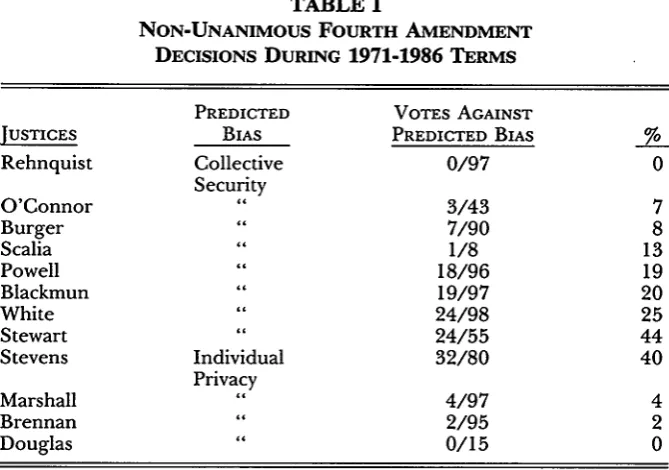
That the Court has increasingly restricted the breadth of the fourth amendment's protection is indisputably evident from the doctrinal record. With a few exceptions,1 12 in every decision
con-105 439 U.S. 128 (1978). 106 392 U.S. 364, 368 (1968).
107 See Allen, The Wolf Case: Search and Seizure, Federalism and the Civil Liberties, 45 U. ILL.
L. REV. 1, 22-23 (1950).
108 387 U.S. 523 (1967). 109 392 U.S. 1 (1968).
110 468 U.S. 897 (1984).
111 468 U.S. 981. See also Bivens v. Six Unknown Agents of the Fed. Bureau of Narcot-ics, 403 U.S. at 411 (Burger, C.J., dissenting).
FOURTH AMENDMENT SCOPE
cerning the scope of the amendment since Katz v. United States 1"3 the Court has found the challenged "intrusion" to be outside the pro-tection because the government activity did not amount to a "search" or "seizure" that "violated" a "protected," "reasonable" or "legitimate" "expectation of privacy" in the "persons, houses, places or effects" of a person with "standing."'"14
The Court's preference for crime control values is less apparent in its decisions affecting the content of the fourth amendment. Of the one hundred and ten such cases decided since Mapp, the split is roughly three to two in favor of the power to search and seize. Be-neath the raw numbers, however, a powerful and undeniable prefer-ence for collective security over individual privacy may be discerned. A number of the content decisions that opt for privacy at the
margin have since been abandoned 15 or drastically limited.11 6
537 (1982)(applying Payton v. New York, 445 U.S. 573 (1980), to cases pending on direct appeal on the date Payton was decided, and generally adopting Mr. Justice Harlan's views on the "retroactivity" of the Court's decisions; (3) Torres v. Puerto Rico, 442 U.S. 465 (1979)(affirming that the fourth amendment applies to Puerto Rico); (4) Davis v. Mississippi, 394 U.S. 721 (1969)(rejecting the doctrinally bizarre notions, apparently unique to Mississippi, that the fourth amendment does not apply to the "in-vestigatory stage" or to "trustworthy" evidence such as fingerprints); (5) Mancusi v.
De-Forte, 392 U.S. 364 (1968)(union official had "standing" to object to the seizure of records in his custody that were seized from an office he shared with other officials); (6) Bumper v. North Carolina, 391 U.S. 543 (1968)(acquiescence to a claim of authority to search pursuant to a warrant not sufficient to show voluntary consent).
As this list indicates, questions of retroactivity and consent are treated here as af-fecting the scope of the fourth amendment, although both exert far less influence on the reach of the amendment than do the more typical "definitional" scope elements of "search," "seizure," and "expectation of privacy." Valid consent to a search or seizure affects the scope of privacy at two levels. It operates to defease the protection the amendment would otherwise provide in the absence of such consent. More generally, the doctrinal criteria for a valid consent operate to contract or expand the scope of the amendment by easing or retarding such defeasance. As Schneckloth v. Bustamonte, 412 U.S. 218, 242 (1973), illustrates, those criteria are important to the de facto scope of privacy, and they respond to the same political considerations that actuate the Court's definitional scope decisions.
Retroactivity decisions, although the least significant of the doctrines that restrict the scope of the right, have played an important symbolic role in post-Mapp fourth amendment jurisprudence. The device was created (or at least reincarnated), one will recall, to deny application of the exclusionary rule to cases already "final" on the date
Mapp was decided. Linkletter v. Walker, 381 U.S. 618 (1965).
113 389 U.S. 347 (1967).
114 These developments are examined in detail in section IV.
115 Preston v. United States, 376 U.S. 364 (1964) and Dyke v. Taylor Implement Mfg. Co., 391 U.S. 216 (1968)(distinguished and abandoned in Chambers v. Maroney, 399 U.S. 42 (1970)); Aquilar v. Texas, 378 U.S. 108 (1964) and Spinelli v. United States, 393 U.S. 410 (1969)(explicitly abandoned in Illinois v. Gates, 462 U.S. 213 (1983)); Robbins v. California, 453 U.S. 420 (1981)(abandoned in United States v. Ross, 456 U.S. 798
(1982)).
116 United States v. Chadwick, 433 U.S. 1 (1977) and Arkansas v. Sanders, 442 U.S.
Others simply reaffirm established principles, applying them to rela-tively uncontroversial fact situations. 17 Several of the Court's con-tent decisions side with privacy values on the merits of the particular dispute, but introduce doctrine that, generally applied, increases the government's power to search and seize legitimately. 1 8 Although
753 (1979)(limited by United States v. Ross, 456 U.S. 798 (1982) and United States v. Johns, 469 U.S. 478 (1985)); Whiteley v. Warden, 401 U.S. 560 (1971)(potentially lim-ited by the "good faith" exception of Leon-Sheppard); Sibron v. New York, 392 U.S. 40 (1968)(limited by Adams v. Williams, 407 U.S. 143 (1972)).
117 Stanford v. Texas, 379 U.S. 476 (1965)(general search warrant which does not describe with particularity things to be seized an unconstitutional "general warrant"); James v. Louisiana, 382 U.S. 36 (1965)(per curiam)(search of arrestee's home two blocks from scene of arrest beyond the zone lawfully searched incident to arrest); Sabbath v. United States, 391 U.S. 585 (1968)(applying knock-and-announce statute to arrest); Recznik v. City of Lorain, 393 U.S. 166 (1968)(per curiam) (defendant's home not ren-dered a "public place" by presence of a large number of persons on the premises); Connally v. Georgia, 429 U.S. 245 (1977)(per curiam) (magistrate with financial incentive to grant search warrants not "neutral and detached"); Lo-Ji Sales Inc. v. New York, 442 U.S. 319 (1979) (magistrate who participated in execution of general search warrant not neutral and detached; warrant to seize two films and "similarly obscene materials" an unconstitutional general warrant); Brown v. Texas, 443 U.S. 47 (1979)(groundless stop violates fourth amendment); Florida v. Royer, 460 U.S. 491 (1983)(arrest without prob-able cause occurred when police seized airline passenger's luggage and passenger was not free to leave interrogation room).
118 Although Camara v. Mun. Court of San Francisco, 387 U.S. 523 (1967), and See v. Seattle, 387 U.S. 541 (1967), brought administrative inspections within the scope of the fourth amendment (overruling Frank v. Maryland, 359 U.S. 360 (1959), which had deemed non-criminal searches "peripheral" to the concerns of the amendment), the de-cisions in these cases, together with the stop-and-frisk dede-cisions the following Term, introduce into fourth amendment doctrine the idea of "variable content"-the notion that the predicate for a search or seizure may vary according to the Court's assessment of the degree of intrusiveness it entails. Camara and See, for example, permit fire, health and housing code inspections pursuant to a warrant issued solely on a showing that the particular inspection falls within a reasonable legislative or administrative program for the periodic inspection of similar premises. Despite Justice Stevens' insistence, in Mar-shall v. Barlow's Inc., 436 U.S. 307, 325 (1978)(Stevens, J., dissenting), and the "fire scene" cases, Michigan v. Tyler, 436 U.S. 499, 512 (1978)(Stevens, J., concurring) and Michigan v. Clifford, 464 U.S. 287, 299 (1984)(Stevens, J., concurring), that warrants may only be issued on probable cause, those cases permit occupational safety inspec-tions and fire scene investigainspec-tions under warrants issued without "individualized suspi-cion" but solely on a showing of compliance with reasonable legislative or administrative standards.
Similarly, although Delaware v. Prouse, 440 U.S. 648 (1979) held that an automo-bile could not be stopped without "reasonable suspicion" (the Terny predicate), its dic-tum approving roadblock stops of all motorists pursuant to administrative regulations has proved to be the more influential feature of the decision. See, e.g, Texas v. Brown, 460 U.S. 730 (1983).
See also Walter v. United States, 447 U.S. 649 (1980), in which the Court found the
min-FOURTH AMENDMENT SCOPE
some of the remaining twenty cases establish or confirm important limitations on governmental power to invade privacy,'1 9 they are plainly eddies in a gathering current that flows strongly in the oppo-site direction.
As the most politically vulnerable component of the protection, the exclusionary remedy has been both directly limited120 and shamelessly exploited as a basis for limiting the scope, 21 and con-tent1 22 of the amendment. Recently, however, the indirect assault
utes exceeded the authority derived from investigative detention, but reaching out to say that exposing the luggage to a narcotics detection dog was not a "search" within the meaning of the fourth amendment); and Hayes v. Florida, 470 U.S. 811 (1985) (re-af-firming Davis v. Mississippi, 394 U.S. 721 (1969), but suggesting that a warrant to detain for fingerprinting might be based on less than probable cause to arrest and that field detention for fingerprinting on "reasonable suspicion" was supported by case law).
119 Cases limiting the zone of a search incident to arrest include: Coolidge v. New Hampshire, 403 U.S. 443 (1971); Vale v. Louisiana, 399 U.S. 30 (1970); and Chimel v. California, 395 U.S. 752 (1969). Cases limiting searches and stops near international borders include: United States v. Brignoni-Ponce, 422 U.S. 873 (1975); United States v. Oritz, 422 U.S. 891 (1975); and Almeida-Sanchez v. United States, 413 U.S. 266 (1973). Cases limiting the power to enter a residence to effect an arrest include: Welsh v. Wis-consin, 466 U.S. 740 (1984); Steagald v. United States, 451 U.S. 204 (1981); and Payton v. New York, 445 U.S. 573 (1980). Cases limiting entry and search of fire and homicide scene include: Michigan v. Clifford, 464 U.S. 287 (1984); Thompson v. Louisiana, 469 U.S. 17 (1984)(per curiam); Michigan v. Tyler, 436 U.S. 499 (1978); and Mincey v. Ari-zona, 437 U.S. 385 (1978).
See also Winston v. Lee, 470 U.S. 753 (1985) (predicate beyond probable cause and a
warrant required for surgical search of accused); Tennessee v. Garner, 471 U.S. I (1985)(deadly force may not be used to seize fleeing felon unless probable cause exists to believe that suspect poses threat of great bodily harm to arresting officer or others); Dunaway v. New York, 442 U.S. 200 (1979)(probable cause required for detention for custodial interrogation indistinguishable from traditional arrest); Ybarra v. Illinois, 444 U.S. 85 (1979)(presence in tavern subject to search warrant not a sufficient predicate for search or frisk of patron); Franks v. Delaware, 438 U.S. 154 (1978)(permitting challenge to a facially valid affidavit on a substantial preliminary showing of probable cause based on knowing or reckless false statement); Gerstein v. Pugh, 420 U.S. 103 (1975)(requir-ing an ex parte judicial determination of probable cause as a predicate for post-arrest detention); United States v. United States Dist. Court for the E. Dist. of Mich., 407 U.S. 297 (1972)(declining to exempt from the warrant requirement electronic surveillance of domestic organizations ordered by the President on national security grounds).
120 Illinois v. Krull, 107 S. Ct. 1160 (1987); I.N.S. v. Lopez-Mendoza, 468 U.S. 1032 (1984); Massachusets v. Sheppard, 468 U.S. 981 (1984); United States v. Leon, 468 U.S. 897 (1984); Cardwell v. Taylor, 461 U.S. 571 (1983)(per curiam); Allen v. McCurry, 449 U.S. 90 (1980); United States v. Payner, 447 U.S. 727 (1980); United States v. Havens, 446 U.S. 620 (1980); United States v. Caceres, 440 U.S. 741 (1979); United States v. Ceccolini, 435 U.S. 268 (1978); Stone v. Powell, 428 U.S. 465 (1976); United States v. Janis, 428 U.S. 433 (1976); United States v. Calandra, 414 U.S. 338 (1974).
121 E.g., Rakas v. Illinois, 439 U.S. 128, 137-38 (1978); United States v. Peltier, 422
U.S. 531 (1975), especially Justice Brennan's dissent, Peltier, 422 U.S. at 561-62 (Bren-nan, J., dissenting); Schneckloth v. Bustamonte, 412 U.S. 218, 250 (1973)(Powell, J., concurring).
122 Ybarra v. Illinois, 444 U.S. 85, 97 (1979)(Burger, CJ., dissenting); Illinois v.
on the exclusionary rule appears to have been deflated by the suc-cess of the direct attack.
Fourth amendment doctrine sometimes appears to be an elabo-rate structure ofjury-rigged accommodations between collective se-curity and individual privacy in which each doctrinal component is constantly in danger of collapsing into an undifferentiated inquiry as to whether the official conduct was "reasonable." The "good faith" exception is an obvious and dramatic example of this tendency of the fourth amendment to slump toward the textual minimum as it absorbs the stresses imposed by the clash between collective and individual "rights."
Whether the Court's decisions in Gates, Leon, and the "scope" cases examined in this essay simply relieve the stress that actuates this inclination toward more flexible limits on law enforcement or whether, on the other hand, they signal a further and perhaps com-plete deterioration of the categorical structure of fourth amendment
doctrine, will depend on society's commitment to the value of indi-vidual privacy. Heightened fear of crime or terrorism or drug use will inevitably reduce the zone of privacy that individuals allow each other, and the fourth amendment cannot protect us from ourselves. Thus, pursuing the question, for example, of whether Leon will remain an "exception" or be so broadly applied that it supplants the "rule" soon transforms the technical assessment of the exclusionary rule into a speculative inquiry that is more political than doctrinal. The legal analyst walks a narrow path in this realm. To fail to recog-nize the political foundations of the doctrinal choices would give one the distorted view of a pre-Galilean astronomer; but even the right perspective does not entitle one to render cosmic judgments
about phenomena beyond one's powers of observation.
My solution is to acknowledge that the doctrine follows a politi-cally centered orbit and to assert that for the past fifteen years the Court's fourth amendment decisions have consistently, though not invariably, favored the state's power to intrude, at the margin of its authority, over the individual's assertion of a right to freedom from
such intrusion.
IV. THE SCOPE OF THE FOURTH AMENDMENT
The challenge to one who would understand the scope of the fourth amendment lies in solving the puzzle of its analytic redun-dancy. All of the major concepts from which its scope is
FOURTH AMENDMENT SCOPE
search, seizure, legitimate expectation of privacy, consent, and standing-beg the ultimate question of what sorts of official acts are limited by the amendment's "reasonableness" stricture. There are several possible interpretations. First, each of these rubrics may ex-press separate aspects of the inquiry, reflecting the complexity and significance of the Amendment's role in American society. Second, the redundancy may reflect only circumstantial-not political-vari-ations in the scope inquiry. Third, the redundancy may expose the central core of the scope inquiry, yielding a more encompassing and numinous quality from which these rubrics all derive. Finally, the redundant categories may simply reflect a general antipathy toward the protection of individual privacy, because each has been used by the Court as yet another device for constricting the scope of the fourth amendment.
This Article has dwelt long enough on the generalities of the subject. Fourth amendment doctrine is generated to explain orjus-tify the resolution of the endless variety of conflicts between individ-ual privacy and collective security. It is from the study of those practical accommodations that the nature of the fourth amendment will emerge. Because a doctrinal system is built up from successive layers, all of which must be rendered consistent with each additional
tier, the present task is best approached by the same route.
By the time of Katz, the conceptual apparatus it replaced had already been stretched to the point of transparency. Silverman v. United States 123 and Clinton v. Virginia 12 4 had reduced the
require-ment of "physical penetration" to little more than a metaphor. In these cases and Wong Sun125 the Court had applied the fourth
amendment to the seizure of a person's words or statement. What is remarkable, however, is how little was changed by
Katz's abandonment of the "trespass" standard of Olmstead v. United States 126 and Goldman v. United States 127. True, it changed the result
in the electronic surveillance cases. However, it did not bring the use of sense enhancing devices within the scope of the amendment as a general proposition. 28 Moreover, Katz had no effect on the scope-narrowing doctrines of "plain view," "consensual encoun-ter," "voluntary transfer," consent or abandonment. Indeed, the
123 365 U.S. 505 (1961).
124 377 U.S. 158 (1964)(per curiam). 125 371 U.S. 471 (1963).
126 277 U.S. 438 (1928).
127 316 U.S. 129 (1942)(These cases held wiretapping and electronic eavesdropping to be outside the fourth amendment when accomplished without trespassing on the surveilled premises.).
128 See, e.g., United States v. Knotts, 460 U.S. 276 (1983).
main function of the expectation of privacy rubric minted in Katz seems to have been to provide an additional ground for denying fourth amendment protection by refusing "legitimacy" to assertions of privacy in, for example, one's voice and handwriting, 2 9 bank records, 3 0 open fields'3
1 or any "private enclave" visible from
pub-lic airspace. 132
"Plain view," although sometimes misperceived as a content is-sue,13 3 in fact serves the extremely significant function of delineat-ing the kinds of observations that are not "searches" and thus are not within the protection of the amendment. When government agents are in an area where they have a right to be, doing what they have a right to do, the acquisition of information in "plain view" does not constitute a "search."' 34 Moreover, if that information provides a predicate for a seizure that can be accomplished without engaging in conduct itself subject to protection-such as entering private premises-the content rules allow the immediate seizure of such material.13 5
The "plain view" rule works without complication when the of-ficer is in a public place using his or her unaided senses. When the officer's vantage point is from a private place, a predicate for his or her presence is required. When sense enhancing equipment is used to acquire a "plain view," the analysis shifts to the other side of the equation. Instead of asking whether the official conduct was a search, the question becomes whether that conduct violated a "le-gitimate expectation of privacy." However this question is an-swered, the conclusion completes the circle: that there was or was not a "search."
It is invulnerably established by Berger and Katz that electronic surveillance of conversations, without the consent of any party thereto, constitutes a "search and seizure." It was to bring such conduct within the reach of the fourth amendment that the "expec-tation of privacy" rubric was coined. Although the Court has not yet faced such a case, surely the same would be true of video
129 United States v. Dionisio, 410 U.S. 1 (1973); United States v. Mara, 410 U.S. 19 (1973).
130 United States v. Miller, 425 U.S. 435 (1976).
131 Oliver v. United States, 466 U.S. 170 (1984). 132 California v. Ciraolo, 476 U.S. 207 (1986).
133 See, e.g., Illinois v. Andreas, 463 U.S. 765, 778 (1983)(Brennan, J., dissenting). 134 y. KAMISAR, W. LAFAVE &J. ISRAEL, MODERN CRIMINAL PROCEDURE 244 (6th ed. 1986).