Thesis by
Ragavendran Gopalakrishnan
In Partial Fulfillment of the Requirements for the Degree of
Doctor of Philosophy
California Institute of Technology Pasadena, California
2013
c 2013
This thesis is dedicated to my parents,
Acknowledgements
First and foremost, I would like to extend my heartfelt gratitude to my advisor, Prof. Adam Wierman. In all of the nearly five years I have spent at Caltech, nobody has been a greater source of inspiration and motivation to me than he. I have marveled at how efficiently he converts (an unimaginable amount of) hard work and dedication into career success and excellence. I feel honored to have learnt from and spent these founding years of my academic career under the mentorship of someone who sets the highest standards for the quality of work that they contribute to the research community. A great person to be around with so much positive energy around him, he has constantly been ever-understanding of the deeper personal issues I have been struggling with, which often took a toll on my mental and emotional health, slowing progress. His encouragement and support during such times kept me going and helped me overcome some of the obstacles while increasing my productivity. The broad exposure to research (and researchers) in algorithmic game theory, performance modeling, and related fields that he made sure I obtained has been extremely helpful for me in making my career choices. My skills of critical thinking and effective presentation have grown leaps and bounds under his guidance.
Next, I would like to thank Prof. Jason Marden, whom I was introduced to by Adam when he was still a post-doc at Caltech. None of the contributions of this thesis would have been possible, were it not for his passionate involvement in our collaborative work. Since Jason wrapped up his work here and joined CU-Boulder as an assistant professor, I have had the privilege of taking several week-long trips to visit him and interact closely with him on solving this beast of a research problem that posed an incredible number of challenges. One of the challenges of working on a tough theoretical problem is the inherent uncertainty of how it will pan out, and the longer the time spent on it, the riskier it feels. But Jason, with his surprisingly (and sometimes annoyingly!) accurate grasp of the underlying intuition of the problem, was that source of faith and confidence which kept me going. I might well have given up working on this problem at some stage, had it not been for his introspective guidance, and perhaps, more importantly, his resolute confidence in my abilities as a researcher. I hope to have a wonderful upcoming year as a post-doc at CU working with Jason and his first batch of graduate students.
I could not possibly forget to mention my good friends Ninja, Bhargavi, Ramya, Sushree, JK, KJ, SV, Push, Vikas, Nisha, and Sujeet, whom I have had great fun getting to know during my time here. They have always stood alongside me with their loving support, and they never fail to cheer me up whenever I become too sad or serious. Having had a very restricted (nearly nonexistent) social life before and during my first couple of years at Caltech, I have learnt a lot about life from some of them, perhaps more than they realize.
Even though I have known them only since last Fall, in such a short period, Caltech PRISM and the Center for Diversity, along with its assistant director Portia Harris, have made a strong impression on me. I could not have had a warmer welcome from them during the first few Friday lunches I started attending. I am indebted to them for helping me feel normal and accepted, as well as giving me the courage to move ahead and face the many challenges that life throws at me.
I would also like to thank all the members of the Rigorous Systems Research Group (RSRG) for providing a charged research environment that I turned to many times for renewed motivation. Many thanks to the staff of Annenberg—most notably Sydney, Maria, and Jeri—who were quick with any administrative processing that I often had to get done.
And last, but not the least, I can think of no words to express my gratitude to my family (mom, dad, and bro) for providing their support and encouragement from afar. I hope to make you all proud one day.
Abstract
Cost sharing games, traditionally studied in economics in the context of cooperative game theory, have gar-nered recent interest in the computer science community in the noncooperative setting, where individually strategic agents choose resources based on how the welfare (cost or revenue) generated at each resource (which depends on the set of agents that choose the resource) is distributed. The focus is on finding distribu-tion rules that lead to stable allocadistribu-tions, which is formalized by the concept ofNash equilibrium.
There are many known distribution rules that guarantee the existence of a (pure Nash) equilibrium in the noncooperative setting, e.g., the Shapley value and its weighted variants (budget-balanced), and the marginal contribution (not budget-balanced). To better understand the limitations on the design of distribution rules, researchers have recently sought to provide characterizations of the class of distribution rules that guarantee equilibrium existence. Recent work has shown that the onlybudget-balanceddistribution rules that guar-antee equilibrium existence in all welfare sharing games are generalized weighted Shapley value (GWSV) distribution rules. Though this characterization seems general, its proof consists of exhibiting a specific ‘worst-case’ welfare function which requires that GWSV distribution rules be used. Thus, characterizing the space of distribution rules (not necessarily budget-balanced) for any specific local welfare functions remains an important open problem. Our work provides an exact characterization of this space for a general class of scalable and separable games, which includes a variety of applications such as facility location, routing, network formation, and coverage games as special cases.
Our main result states that all games conditioned on any fixed local welfare functions possess an equilib-rium if and only if the distribution rules are equivalent to GWSV distribution rules on some ‘ground’ welfare functions. This shows that it is neither the existence of some worst-case welfare function, nor the restriction of budget-balance, which limits the design to GWSV distribution rules.
Contents
Acknowledgements v
Abstract vii
1 Introduction 1
1.1 Contributions of the Thesis . . . 6
1.1.1 Background and Preliminaries . . . 6
1.1.2 Noncooperative Cost Sharing Games . . . 6
1.1.3 Characterization Results . . . 7
1.1.4 Proof of Theorem 2. . . 8
1.1.5 Conclusion and Future Work . . . 9
2 Background and Preliminaries 11 2.1 Background . . . 11
2.1.1 Algorithmic Game Theory . . . 13
2.1.2 Game-Theoretic Control . . . 14
2.2 Set Theoretic Concepts . . . 16
2.2.1 Relations . . . 16
2.2.2 Set Functions . . . 17
2.3 Cooperative Games . . . 18
2.3.1 Unanimity Games . . . 21
2.4 Noncooperative Games . . . 21
2.4.1 Potential Games . . . 22
2.4.2 Inefficiency of Nash Equilibrium. . . 24
3 Noncooperative Cost Sharing Games 27 3.1 Model . . . 27
3.2 Examples of Distribution Rules. . . 28
3.2.2 The Shapley Value Family of Distribution Rules . . . 29
3.2.3 The Marginal Contribution Family of Distribution Rules . . . 30
3.3 Important Families of Cost/Revenue Sharing Games. . . 31
3.4 A Basis for Distribution Rules . . . 32
3.5 Connecting Shapley Values and Marginal Contributions. . . 33
3.6 Generalized Weighted Potential Games . . . 35
4 Designing Distribution Rules for Pure Nash Equilibria 39 4.1 Characterization in Terms of Generalized Weighted Shapley Values . . . 40
4.2 Characterization in Terms of Generalized Weighted Marginal Contributions . . . 42
4.3 Proof Sketch of Theorem 2 . . . 43
4.3.1 Reduction to Budget-Balanced Distribution Rules. . . 44
4.3.2 Three Necessary Conditions . . . 46
4.3.3 Decomposition of the Distribution Rule . . . 46
4.3.4 Consistency of Basis Distribution Rules . . . 47
4.3.5 Existence of a Universal Weight System . . . 48
5 Proof of Theorem 2 49 5.1 Notation . . . 50
5.2 Proof Outline . . . 51
5.3 Reduction to Budget-Balanced Distribution Rules . . . 52
5.4 Constraints on Individual Distribution Rules . . . 52
5.4.1 Three Necessary Conditions . . . 53
5.4.2 Decomposition of the Distribution Rule . . . 58
5.5 Consistency of Basis Distribution Rules . . . 72
5.5.1 Two Consistency Conditions . . . 73
5.5.2 Existence of a Universal Weight System . . . 96
6 Conclusion 101 6.1 Limitations of Our Result . . . 101
6.2 Implications for Efficiency/Budget-Balance Tradeoff . . . 102
6.3 Implications for Tractability/Budget-Balance Tradeoff . . . 103
6.4 Implications for Privacy. . . 104
6.5 Cost Sharing Mechanisms . . . 104
List of Figures
5.1 Counterexample 1 . . . 54
5.2 Counterexample 2 . . . 57
5.3 Counterexample 3 . . . 67
5.4 Counterexample 4 . . . 71
5.5 Counterexample 5(a) . . . 74
5.6 Counterexample 5(b) . . . 77
5.7 Counterexample 6 . . . 83
5.8 Action sets of the players in Example 15. . . 86
5.9 Possible (anonymous) configurations for valid action profiles . . . 88
5.10 Possible configurations for valid action profiles . . . 90
5.11 Possible configurations forM3,Z4,P2segments within an invalid action profile for Example 16 . . . . 92
List of Tables
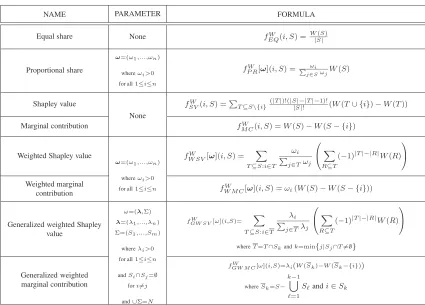
3.1 Example distribution rules . . . 29
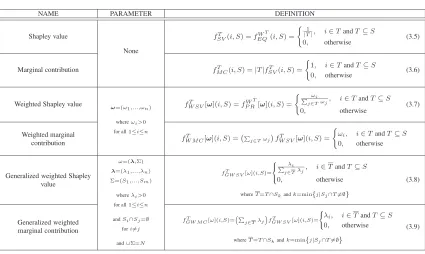
3.2 Definition of basis distribution rules . . . 33
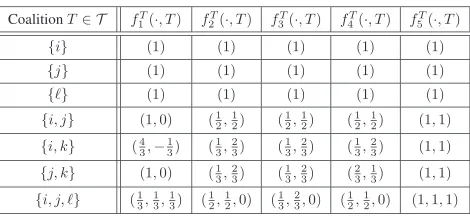
4.1 Tables for Examples 1-6 . . . 45
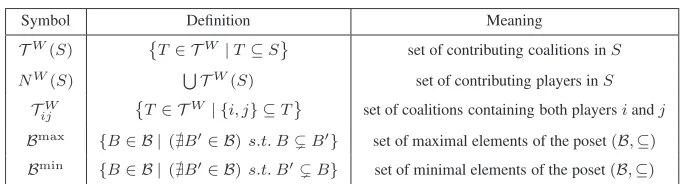
5.1 Summary of notation . . . 50
5.2 Tables for Example 7 . . . 51
Chapter 1
Introduction
Fair division is an issue that is at the heart of social science. An important constituent of this broad concept is the problem of cost sharing—how should the cost incurred (or revenue generated) by a group of self-interested agents be shared among them? This central question has led to a large literature in economics over the last several decades.
While a few central ideas behind cost sharing can be traced back to the late nineteenth century in the context of trading between two agents (Edgeworth [23]), a formal and sustained study of cost sharing his-torically emerged in 1944 as the central theme of the theory ofcooperative games with transferable utility (von Neumann and Morgenstern [86]), which provided valuable tools for a structured study on the subject. Moulin [58] traces the research advances in axiomatic cost sharing that was initiated in 1953 by the sem-inal work of Shapley [78], and credits this line of research with generating some of the deepest axiomatic results of modern microeconomic theory. Young [93] provides a discussion of equitable division of costs and benefits in cooperative enterprises, one of the earliest applications of a formal study of cost sharing. Young [92] further lists several diverse applications where the cost sharing problem emerges—involuntary settings such as allocation of infrastructure costs among different calls by a telephone company, allocating computing costs among different departments by a university, setting landing fees for aircraft of varying sizes by aviation authorities, determining road taxes for vehicles causing different levels of wear and tear to the roadways by highway departments, etc., as well as voluntary settings such as roommates sharing living costs, municipalities sharing setup and operating costs of a common water supply system, etc.
A standard framework that we adopt in this thesis is that ofcost sharing games, where a set of agents makes strategic choices of which resources to utilize. Each resource generates a welfare (cost or revenue)1
depending on the set of agents that choose the resource, and the total welfare across all the resources is then shared among the agents. A wide variety of applications fit this broad description—the terms ‘resource’, ‘utilize’, ‘welfare’ are abstract, and could mean different things depending on the specific situation that is being modeled. For example, consider a setting where graduate students (agents) in a research group choose which projects (resources) they should work on. Not all students might be able to choose all projects—there will be constraints on what combinations of projects a student can work on, depending on factors such as research background and ability to multitask. These constraints determine the ‘action sets’ of the students. Once the students make their decisions, each project generates a certain reward (welfare) depending on the progress made by the students working on that project, and the total reward across all projects is distributed among the students according to some rule. Compatibility between students (whether two students can get along well with each other or not) can be taken into account while specifying the reward function of each project (since it affects progress).
This framework can also model resource allocation problems that arise in computer systems, such as net-work formation (Jackson [40]) and facility location (Goemans and Skutella [32]), as observed in recent years by researchers in computer science. This observation was one of many convergent factors that contributed to the genesis of the field of algorithmic game theory in the late 1990s. Jain and Mahdian [41] provide an introduction to cost sharing and cooperative game theory from this perspective. Moulin [60] surveys recent research in network cost sharing and lists several open problems in the area. In such cooperative cost sharing games, the problems studied typically involve a cost valuev(S)for each subset of agentsS, which usually stems from the optimal solution to an underlying combinatorial optimization problem.2A canonical example
for illustrating network cost sharing is the multicast network formation game (Granot and Huberman [36]), where a set of consumers (agents)N wishes to connect to a common source (a broadcaster)sby utilizing links (resources) of an underlying graph. Each link has a cost associated with its usage, and the total cost of all the links used needs to be split among the agents. In such a situation, any subsetS of agents, if they cooperate, can form a coalition, and the best they can do is to choose the links of the minimum cost spanning tree for the set of verticesS∪ {s}, and incur its cost—denote it byv(S).
A cooperative framework, in effect, models a ‘binary choice’ for the agents—opt out, or opt in and cooperate. An important solution concept in cooperative game theory, called thecore, is defined as the set of all possible ways of distributingv(N)to the agents inNin such a way that it is in their best interest to fully
1The term ‘cost sharing games’ has come to refer to both cost and revenue sharing games. Our convention is to interpret positive
welfare as revenue and negative welfare as cost. Hence, the objective of the agents is alwayswelfare maximization.
2Note that our focus in this thesis is on cost sharinggames and not cost sharingmechanisms(Feigenbaum et al. [27]), which
cooperate (and hence form the grand coalition). In other words, a distribution rulefv:N→Ris in the core, ifPi∈Nfv(i) = v(N), and for every subsetS ⊆ N,P
i∈Sf
v(i) ≤v(S). This solution concept carries with it a very strong notion of stability—for distribution rules in the core, the grand coalition is immune to arbitrarycoalitional deviationsby the agents. In a way, such a severe stability requirement is justified in the cooperative setting, where, to begin with, agents are assumed to be open to cooperating with each other, and cooperation is feasible in, if not facilitated by, the environment. In general, the core can be empty, though for multicast games it is not.
In contrast, in large distributed (and often unregulated) systems such as the Internet, agents’ options are more complex as they have the opportunity to strategically choose the best action from multiple available options. Cooperation is rarely desired, and even then, rarely feasible in such settings; therefore, a noncooper-ative cost sharing gameis a better model, where agents are concerned only with minimizing their individual share of the total cost across all the resources. Moreover, for the same reason, it is more appropriate for the distribution rule to be decentralized, i.e., composed oflocalresource-specific distribution rules that spec-ify how the local cost generated at a resource is shared (only) among the agents who choose that resource. Accordingly, there has been an emerging focus recently on weaker notions of stability that suit the noncoop-erative model, such as the Nash equilibrium, which is an allocation that is immune tounilateral deviationsby any single agent. This focus is driven by network cost sharing applications where, more recently, individually strategic behavior is a more suitable assumption. The first such models of noncooperative cost sharing ap-peared just a decade ago, in the context of facility location (Vetta et al. [84]) and network formation (Fabrikant et al. [24]).
Our previous example of multicast games also provides a useful illustration of the noncooperative cost sharing framework. Multicast games were first modeled as noncooperative games in Chekuri et al. [14], whose model also generalized facility location games. As explained above, the principal difference from the cooperative model is that here, the global cost share of an agent stems from local distribution rules which specify how the local cost (cost of each link) is split between the agents using that link. Accordingly, an agent’s total cost share is simply the sum of her cost shares across all the links she uses. In addition, each agent can choose between potentially several link combinations that connect to the source. A pure Nash equilibrium corresponds to a choice of links by each agent such that each agent incurs the least possible cost given the links chosen by the other agents. Similarly to the fact that the core might be empty in the cooperative model, a pure Nash equilibrium may not exist in general, but for multicast games it does.
The primary objective for researchers is in identifying (possibly budget-balanced3) distribution rules that
result in stable and/or fair outcomes. In the cooperative model, this could mean investigating global distri-bution rules that are in thecoreand hence guarantee a stable grand coalition. In the noncooperative model,
3A distribution rule is said to bebudget-balancedif it exactly distributes the welfare to the agents. In other words, there is no surplus
it could mean investigating local distribution rules that guarantee the existence of a Nash equilibrium. An additional concern that arises in the noncooperative model is regarding the ‘efficiency’ of the outcome—for example, how close is the total welfare generated by the Nash equilibrium to the maximum total welfare that could be achieved, had there been a central authority who could control the agents’ actions? (For example, in the noncooperative multicast game, a Nash equilibrium choice of links by the agents may not collectively result in the minimum spanning tree forN∪ {s}; so how inefficient could it be?) Hence, a secondary objec-tive for researchers in the noncooperaobjec-tive model is to investigate for local distribution rules that guarantee the most efficient Nash equilibria. It is important to note that the existence of such desirable distribution rules is not a priori guaranteed.There are cooperative games that have empty cores, and there are noncooperative games that possess no Nash equilibria. Further, if the most efficient Nash equilibrium that could be guaran-teed is not ‘efficient enough’ for the application at hand, then it could mean a bad modeling choice or a bad choice of a solution concept.A principal contribution of this thesis lies in characterizing the space of local distribution rules for which interesting classes of scalable noncooperative games are guaranteed to possess Nash equilibria. We also initiate the study of efficiency analysis in these classes.
Most of the previous literature in noncooperative cost sharing games (Anshelevich et al. [7], Corbo and Parkes [18], Fiat et al. [29], Chekuri et al. [14], Christodoulou et al. [16]) considered a fixed distribution rule that guarantees equilibrium existence, namely equal share (dubbed the ‘fair cost allocation rule’, equivalent to the Shapley value in these settings), and the focus was directed towards characterizing the efficiency of equilibria. Only recently is there an emerging focus on designing local distribution rules that guarantee equilibrium existence and studying the efficiency of the resulting equilibria. Perhaps, the most famous such distribution rule is the Shapley value (Shapley [78]), which is budget-balanced, guarantees the existence of a Nash equilibrium when used in a noncooperative setting, and for certain classes of cooperative games such as convex games, is always in the core. Generalizations of the Shapley value, e.g., weighted and generalized weighted Shapley values (Shapley [77]), exhibit many of the same properties.
this issue that is important: when designing a distribution rule, oneknowsthe specific local welfare functions for the situation, wherein there may be distribution rules other than generalized weighted Shapley values that also guarantee the existence of an equilibrium.
Another recent example of work in this direction is by von Falkenhausen and Harks [85], who consider games where the action sets (strategy spaces) of the agents are either singletons or bases of a matroid defined on the ground set of resources. For such games, they focus on designing (possibly separable, non-scalable) distribution rules that result in efficient equilibria. They tackle the question of equilibrium existence with a novel characterization of the set of possible equilibria independent of the distribution rule, and then exhibit a family of distribution rules that result in any given equilibrium in this set. Our goal is fundamentally different from theirs, in that we seek to characterize distribution rules that guarantee equilibrium existence for aclass of games, whereas they directly characterize the best/worst achievable equilibria of agiven game.
An alternative approach towards noncooperative cost sharing is studied by Anshelevich et al. [8], Hoefer and Krysta [38]. They consider a fundamentally different model of a cost sharing game where agents not only choose resources, but also indicate their demands for the shares of the resulting welfare at these resources. Their model essentially defers the choice of the distribution rule to the agents. In such settings, they prove that an equilibrium may not exist in general.
1.1
Contributions of the Thesis
The goal of this thesis is to study the design of stable, scalable, efficient distribution rules for a broad class of noncooperative cost sharing games. In so doing, importantly, we expose the fundamental scope and lim-itations of such a design. As surveyed above, our work has far reaching implications across various fields such as microeconomic theory, operations research, algorithmic game theory and mechanism design, and distributed control, where cost sharing has found important applications. We now outline the structure of this thesis, while highlighting our technical contributions.
1.1.1
Background and Preliminaries
InChapter2, we provide a historic overview of game theory, algorithmic game theory, and game-theoretic
control, highlighting the connections to cost sharing. Then, the relevant mathematical preliminaries, including both set theoretic and game-theoretic concepts, are introduced. This chapter can be safely skipped by the expert reader, without significant loss in continuity.
1.1.2
Noncooperative Cost Sharing Games
While most of Chapter3 is concerned with the specifics of our model and a review of relevant existing
literature on distribution rules, towards the end, we present two auxiliary contributions of this thesis which have fundamental implications beyond just our goals of characterizing distribution rules for noncooperative cost sharing games.
We begin the chapter with a formal description of our model for a noncooperative cost sharing game. We then discuss existing distribution rules for cost sharing games, such as the Shapley value and marginal contribution distribution rules, and their extensions. Thereafter, we introduce an importantbasis represen-tation framework for distribution rulesbased on ‘unanimity games’, that greatly simplifies their specifica-tion, and provides a deeper understanding of the intuitive interpretation of these rules. We demonstrate the power of this basis framework by exposing a fundamental relationship between Shapley values and marginal contributions—these families of distribution rules are equivalent, given a transformation connecting the wel-fare functions they are defined on. To be precise, in Proposition1, we show thatgiven any welfare function
1.1.3
Characterization Results
Chapter4details the core results of this thesis,4where we provide a complete characterization of the space of
distribution rules (not necessarily budget-balanced) that guarantee the existence of a pure Nash equilibrium (which we will henceforth refer to as just an equilibrium)for any specific local welfare functions:
(a) Our main result (Theorem2) states that all games conditioned on any fixed local welfare functions pos-sess an equilibrium if and only if the distribution rules are equivalent to generalized weighted Shapley value distribution rules on some ‘ground’ welfare functions. This shows, perhaps surprisingly, that the results of Chen et al. [15], Marden and Wierman [54] hold much more generally. In particular, it is neither the existence of some worst-case welfare function, nor the restriction of budget-balance, which limits the design of distribution rules to generalized weighted Shapley values.
(b) Our second result (Theorem3) provides an alternative characterization of the set of distribution rules that guarantee equilibrium existence. In particular, it states that all games conditioned on any fixed local welfare functions possess an equilibrium if and only if the distribution rules are equivalent to generalized weighted marginal contribution distribution rules on some ‘ground’ welfare functions. This result is actually a consequence of the connection between Shapley values and marginal contributions, namely that they can be viewed as equivalent given a transformation connecting their ground welfare functions (Proposition1in Chapter3).
These characterizations provide two alternative approaches for the problem of designing distribution rules, with different design tradeoffs, e.g., between budget-balance and tractability. More specifically, a design through generalized weighted Shapley values provides direct control over how close to budget-balanced the distribution rule will be; however, computing these distribution rules often requires computing exponentially many marginal contributions (Matsui and Matsui [55], Conitzer and Sandholm [17]). On the other hand, a design through generalized weighted marginal contributions requires computing only one marginal contribu-tion; however, it is more difficult to provide bounds on the degree of budget-balance.
Another important consequence of our characterizations is thatpotential games are necessary to guaran-tee the existence of an equilibriumin all games with fixed local welfare functions, since generalized weighted Shapley value and generalized weighted marginal contribution distribution rules result in (‘weighted’) poten-tial games (Theorem1, Hart and Mas-Colell [37], Ui [83]). This is particularly surprising, since the class of potential games is a relatively small subset of the class of games that possess an equilibrium (Sandholm [74]), and our characterizations imply that such a relaxation in game structure would offer no advantage in guaran-teeing equilibria.
The final section of this chapter is devoted to an outline of the proof of Theorem2, highlighting the key steps involved with illustrations. The complete proof is deferred to the following chapter.
1.1.4
Proof of Theorem
2
Chapter5is the meat of this thesis, spanning more than 50 pages in detailing the proof of our main result,
Theorem2. The first phase of the proof consists of a quick reduction of the problem of characterizingall distribution rules to the problem of characterizing onlybudget-balancedrules. Though straightforward, this is a powerful reduction, because the rest of the proof uses the budget-balance property copiously. The second phase of the proof consists of a sequence of counterexamples that establish novel necessary conditions for budget-balanced distribution rules to guarantee the existence of an equilibrium. These necessary conditions are established by exhibiting one or more counterexample games with carefully chosen parameters, such that failure to satisfy a necessary condition would lead to these games having no equilibria. Every successive necessary condition eliminates a bunch of distribution rules, until finally, only generalized weighted Shapley values remain.
Within this analysis, new tools for studying distribution rules using their basis representation (see Section 3.4) are developed, including an inclusion-exclusion framework that is crucial for our proof. Specifically, they aid in constructing clever counterexamples that help establish necessary conditions. For example, our inclusion-exclusion techniqueis a generic procedure that enables ‘singling out’ the effect (on the incentives of an agent) of any desired unanimity game without affecting the incentives of other agents. The ability to elicit such an isolation for an arbitrary welfare function (which is a linear combination of unanimity games) is at the crux of several lemmas whose proofs involve induction on the size of the unanimity game, requiring a counterexample for every induction step. Due to their generic nature, such tools could also be useful for related models, such as cost sharing mechanisms.
Another example of a powerful proof technique is the basis framework for distribution rules, without which the current modular structure of the proof would not be possible—once we establish the necessary condition that every budget-balanced distribution rule that guarantees equilibrium existence must have a basis representation, it is the basis framework that enables the separation of the easier task of just focusing on the 2n−1 basis distribution rules(the distribution rules corresponding to unanimity games), which are
independent of the welfare function, from the much more difficult task of establishing the ‘consistency’ of these basis distribution rules, which requires specifying counterexample games for distribution rules that are arbitrary linear combinations of these basis rules—we tackle this latter task by grouping all possible linear combinations into32n−1
cases, and providing a counterexample ‘template’ for each case.
1.1.5
Conclusion and Future Work
Chapter6begins by taking a step back to place our core contributions in characterizing a class of stable
Chapter 2
Background and Preliminaries
In this chapter, we first provide, in Section2.1, a historical introduction to game theory, followed by introduc-tions to two major fields where the cost sharing framework has found applicaintroduc-tions—algorithmic game theory and game-theoretic control. These introductions, though self-contained, are by no means comprehensive—at all times, we focus on material that is either directly related to, or is a prerequisite for understanding our research on cost sharing games. We then introduce set theoretic preliminaries that will be required for an un-derstanding of the rest of this thesis, in Section2.2. Finally, in Sections2.3and2.4, we establish the notation as well as formal definitions and discussions of relevant concepts in game theory and cost sharing games that are introduced in a semiformal, pedagogical setting in Section2.1.
2.1
Background
Game theory is the study of decision making by strategic entities. It was initiated in 1944 by mathematician John von Neumann and economist Oskar Morgenstern [86]. Roger Myerson [62] defines game theory as the study of mathematical models of conflict and cooperation between intelligent rational decision-makers. The ‘entities’ and ‘decision-makers’ in these definitions are aptly termed ‘players’ in a ‘game’. Specifying a game consists of specifying its ‘rules’. Broadly, this involves specifying the players, what they can do, and how the outcome of their actions affects each other. Game theory consists of two major sub-theories—cooperative game theory (models of cooperation) and noncooperative game theory (models of conflict).
When players are unwilling to cooperate, or when cooperation fails, anoncooperativegame can better model the problem. This is not to say that cooperation is ruled out, rather, any resulting ‘cooperation’ must be self-enforcing, as opposed to relying on a third party (such as a court of law) for enforcement. Simple noncooperative games are often specified innormal form1, which involves specifying the set of players, the set of actions that each player can independently choose from, and a utility function for each player, which encodes the preferences of that player over all possible outcomes (i.e., all possible combinations of actions the players can collectively choose). The focus is on studying what actions the players will individually choose in order to maximize their own utility function, assuming, in the simplest of models, complete information, i.e., every player knows the specification of the entire game, and not just her own action set and utility function.
Specifying the game (either in the cooperative or noncooperative setting) is a relatively easy task in comparison to the challenge of predicting its outcome. The difficulty of this task stems from the fact that researchers have varying views on which outcome should be expected. Asolution conceptis a formal rule for predicting how a game will be played. These predictions constitute ‘solutions’ which specify what actions will be chosen by the players, and therefore, the outcome of the game. Cooperative and noncooperative games have different solution concepts, since they place different behavioral assumptions on the players:
(a) Cooperative games.In most cooperative games, the characteristic function is superadditive, that is, the value of the grand coalition (where all players cooperate) is at least as large as the total value of any disjoint set of coalitions that could be formed. Therefore, a reasonable assumption is that ‘rational’ players will agree to form the grand coalition.2 The problem is then for the players to agree on how
the resulting value of the grand coalition should be split among themselves. Several solution concepts have been proposed, that correspond to different notions of ‘stability’ and/or ‘fairness’. Some solution concepts arerefinementsof others, meaning that the sets of outcomes satisfying them are contained within the set of outcomes of a less restrictive solution concept. Such refinements become necessary when a solution concept cannot predict a unique outcome. The two solution concepts of interest to us are thecore, which consists of the set of outcomes that guarantee a stable grand coalition, and the Shapley value, which is the unique outcome that satisfies a certain set of fairness axioms. We discuss them in more detail in Section2.3.
(b) Noncooperative games.In noncooperative games, a solution concept is any function that maps a game to a subset of its possible outcomes. Most solution concepts are equilibrium concepts, which select outcomes that satisfy varying notions of ‘stability’. Perhaps the most famous of such concepts is theNash equilibrium, which consists of the set of outcomes in which no player can strictly gain by unilaterally deviating from her current action. We discuss it in more detail in Section2.4.
1The normal form representation is used to specify simple games where the timing/sequence of the players’ actions is not modeled.
In effect, the players could be thought of as making their moves simultaneously. In contrast, games where timing issues are important, e.g., when a player’s next action could depend on the previous actions (history of the game), are specified inextensive form. For the purposes of our study in this thesis, normal form representations suffice, as we deal with distributed (and often large) environments where the players are typically unaware of the actions of other players.
2Even if the characteristic function is not superadditive and/or the grand coalition is not formed, these solution concepts can still be
Different solution concepts have different characteristics, and no single solution concept is universally better than another. It is worth mentioning at this point that considerable efforts have been made to bridge the gap between cooperative and noncooperative game theory, and therefore, their solution concepts; for details on one such initiative called the Nash program, refer to Serrano [76]. Indeed, this thesis highlights the value of using cooperative solution concepts to incentivize players in a noncooperative game to choose some desired outcome, e.g., a Nash equilibrium. For a more inclusive treatment of solution concepts in both cooperative and noncooperative games, refer to a standard textbook on game theory, such as Osborne and Rubinstein [68].
Of independent interest is the question of how exactly players reach a desired outcome, and when ap-plicable, how they could be aided in that process. For example, in cooperative games, how does a coalition actually form? How do the players communicate, bargain, etc.? In noncooperative games, how do players arrive at an equilibrium? What outcomes are observed when players play these games in the real world, and how do they arrive that these outcomes? The fields of experimental game theory, and behavioral economics at large, deal with such questions about game dynamics. There is also a large literature on ‘learning in games’ which studies distributed algorithms (sometimes intuitive and natural) that players could carry out to attain a desired outcome, often in the presence of limited information. A general discussion of this literature is be-yond the scope of this thesis, but at times, we do cite some useful results from this body of work that support our results.
2.1.1
Algorithmic Game Theory
Primarily developed by economists during its early years, game theory has since found applications in a variety of areas such as political science, psychology, biology, logic, and computer science. Within computer science, the first connection to game theory was perhaps observed in 1977 by Andrew Yao [91], in the final paragraph of his seminal paper on (what is today known as) Yao’s principle, an important proof technique for establishing lower bounds on the computational complexity of randomized algorithms, especially of online algorithms. It took several more years, however, before a compelling case was made, by Noam Nisan and Amir Ronen [66] in 1999, for incorporating strategic concerns and the resulting need for game-theoretic analysis while designing (distributed) algorithms. Since then, the study of game theory within the context of computer algorithms has quickly grown into a field of its own, known as algorithmic game theory or computational game theory.
efficient equilibrium outcome, as well as good algorithmic properties like efficient running time. This last area is called algorithmic mechanism design. For a comprehensive introduction to algorithmic game theory, refer to Nisan et al. [67].
Our topic of study in this thesis, namely cost sharing, is most closely associated with mechanism design— they both share the underlying goal of designing a game with good static and dynamic properties. However, most often, mechanism design problems additionally involve soliciting someprivateinformation from the players, such as how much they value a scarce good or service. This information is then used to allocate these scare resources in an optimal way, e.g., in a single-item auction, ‘social welfare’ is maximized when the person who values the item the most gets it. Since the players cannot be trusted to reveal their true valuations, mechanism designers worry about designing a game in which players cannot benefit from lying about their private values. In this thesis, we only concern ourselves withcost sharing games, where private values are not part of the model. Towards the end, in Chapter6, we do briefly discuss a parallel model ofcost sharing mechanismsand how such a problem could be approached.
2.1.2
Game-Theoretic Control
Historically, game theory has been shaped largely by economists—indeed, today, game theory is regarded primarily as a branch of economics—and therefore, from their point of view, the strategic players were hu-man beings, who come with fixed incentives (utility functions), perhaps unknown to begin with. Economists primarily concern themselves with learning these preferences, which would help model them better, lead-ing to a better prediction of their collective behavior as a group or society, in response to a public policy or mechanism. However, as game theory found more applications outside of economics, the concept of a ‘player’ grew more abstract, and could broadly refer to any decision-making entity, not necessarily human. One such application is in the area of multiagent systems (Shoham and Leyton-Brown [80]), a branch of study that emerged from the artificial intelligence (AI) community in the late 1980s, when researchers realized the limitations of a single agent handling complex, large-scale tasks (Alonso [5]). The principal mathematical tool used by AI researchers until this point was statistical decision theory (also a fundamental tool used in econometrics), which was developed independently of game theory in the 1950s.3 Briefly, decision theory
deals with a single agent interacting with its environment. While this theory does, in principle, extend to
3Perhaps surprisingly, the discovery of the fundamental ideas of decision theory is rife with controversy. Blaise Pascal, in the 17th
multiple agents (by treating, for each agent, all other agents collectively as the ‘environment’), it becomes exceedingly difficult to do so as the number of agents increases—it simply does not scale. Game theory, in contrast, provides a framework that is meant to model multiple interacting decision-makers. In fact, most of the situations modeled by classical decision theory can be thought of as one-player games.
Game theory saw increased adoption in the modeling and analysis of various problems in the field of multiagent systems since the late 1990s, so much so that today, the terms ‘agent’ and ‘player’ are used almost interchangeably. Modern texts on multiagent systems do not just deal with intelligent agents from the AI perspective, but treat the subject broadly, by including such diverse disciplines as distributed systems, economics (mostly microeconomic theory), operations research, analytic philosophy, and linguistics. Game-theoretic control is one such interdisciplinary area that emerged within the field of multiagent systems, in the context of a game-theoretic approach to distributed resource allocation.
Resource allocation is a fundamental problem that arises in nearly all computer systems. Traditional approaches to determine efficient allocations involved mostly centralized algorithms (Ageev and Sviridenko [3], Ahuja et al. [4], Feige and Vondrak [26]). However, in many modern applications, these centralized algorithms are not applicable and/or desirable, due to their poor reliability, efficiency and scalability. As a result, increasingly, resource allocation in a multiagent system is a problem that needs to be solved in a distributed, decentralized manner, e.g., power control and frequency selection problems in wireless networks (Altman and Altman [6], Campos-Náñez et al. [12], Falomari et al. [25], Kauffmann et al. [44]) and coverage problems in sensor networks (Cassandras and Li [13], Marden and Wierman [53]).
Game-theoretic control involves modeling the interactions of agents within a noncooperative cost sharing game where the agents are ‘self-interested’; the resulting equilibria are viewed as stable operating points for the system. This is motivated by the fact that the underlying decision-making architecture in noncooperative cost sharing is identical to the desired decision-making architecture in distributed engineering systems, i.e., local decisions based on local information where the global behavior emerges from a compilation of these local decisions. This parallel makes it possible to utilize a broad set of game-theoretic tools in distributed control. A key distinction between game theory for economic systems and game theory for engineering systems is that decision-makers are inherited in economic systems while decision-makers are designed in engineering systems. There are wide-ranging advantages to the game-theoretic approach including robustness to failures and environmental disturbances, minimal communication requirements, and improved scalability.
These two major modules of game-theoretic control are referred to asutility designandlearning design, respectively. Most of the existing literature on game-theoretic control (e.g., most of the work cited above) provides application-specific co-designs of the utility functions and learning rules. Recently, Gopalakrishnan et al. [33] provided an architectural framework for game-theoretic control, proposing the notion of an added design constraint that facilitates decoupling utility design and learning design from one another. This allows for an independent development of a rich set of utility and learning designs, from which designs can be chosen ‘off the shelf’ according to the requirements of the resource allocation problem being considered. This work provides fresh motivation for unifying distribution rule design for cost sharing games with application-independent utility design for distributed agents. While the set of cost sharing design tools are developed from a broader, more abstract standpoint, the specific restrictions/constraints imposed by the application (e.g., economic versus engineering) dictate the appropriate design choice to be ultimately used/deployed.
2.2
Set Theoretic Concepts
In this section, we define a few concepts from set theory. LetN be a finite set. A partition of a setNis a set of nonempty subsets ofNsuch that every element ofNis in exactly one of these subsets.
Definition 1. A collectionPof subsets ofNis a partition ofNif and only if:
(a) ∅∈ P/
(b) SP =N
(c) (∀A, B∈ P) A∩B6=∅ ⇔A=B
The partition{N}is called the trivial partition ofN.
2.2.1
Relations
Definition 2. A (binary) relationRon a setNis a subset ofN×N.
For any two elementsx, y∈N, if(x, y)∈R, then we writexRy. Sometimes, a relation is better denoted directly by the operator that defines it. For example, the operator⊆defines a relation on2N for a finite set
N. For any two subsetsA, B ⊆N, we sayA⊆B if and only if(A, B)∈⊆. (Here, instead of a letterR, we have used the operator⊆to denote the relation itself.) Some basic properties that a relationRon a setN
could satisfy are:
(a) Reflexive:∀x∈N,xRx.
(d) Antisymmetric:∀x6=y∈N,xRy⇒ ¬yRx.
(e) Transitive:∀x, y, z∈N,xRy∧yRz⇒xRz. (f) Total:∀x, y∈N,xRy∨yRx.
Any relationRhas a correspondingtransitive closure,R+, which is a transitive relation obtained fromR
by iteratively adding pairs(x, z)toR whenever there existsy such that(x, y) ∈ Rand(y, z) ∈ R. IfR
is transitive to begin with, then it is its own transitive closure. Any reflexive relationhas a corresponding irreflexive or strict relation that is obtained by removing all pairs of the form(x, x)from. This relation is aptly denoted by≺. (Sometimes,and≻are used.) We now define a few important kinds of relations on a setN:
Definition 3. A partial order onNis a binary relationonNthat is reflexive, antisymmetric, and transitive.
A setN along with a partial orderonN, is called apartially ordered setorposet, and is denoted by the tuple(N,). For example,(2N,⊆)is a poset. An elementx∈N is amaximal(respectively,minimal) element of the poset(N,)if there is no elementy∈N\{x}such thatxy(respectively,yx). The set of all maximal (respectively, minimal) elements of a poset(N,)is denoted byNmax(respectively,Nmin).
Definition 4. A total order onNis a binary relationonN that is total, antisymmetric, and transitive.
A setNalong with a total orderonN, is called atotally ordered set, denoted by(N,). For example,
(2N,⊆)is not a totally ordered set, whereas(Z,≤)is.
Definition 5. An equivalence relation onN is a binary relation∼onN that is reflexive, symmetric, and transitive.
Theequivalence classof an elementx∈N under∼, denoted[x], is defined as[x] ={y∈X|x∼y}. For example, =is an equivalence relation on Z, where the equivalence class of any integer is simply the singleton set containing that integer. As another example, ‘is parallel to’ is an equivalence relation on a set of linesLon a plane, where the equivalence class of any given line is the set of all lines inLthat are parallel to it, including itself. The set of all equivalence classes defined by an equivalence relation on a setN is a partition ofN.
2.2.2
Set Functions
LetN be a finite set. Then, any functionW : 2N →Ris called a set function. For example, the function that assigns to every subset ofN, its cardinality, is a set function. A set functionW : 2N →Ris said to be:
(c) supermodularorconvex, if for every pair of setsA, B ∈2N,W(A∪B)+W(A∩B)≥W(A)+W(B). (d) subadditive, if for every pair of disjoint setsA, B∈2N,W(A∪B)≤W(A) +W(B).
(e) submodularorconcave, if for every pair of setsA, B∈2N,W(A∪B)+W(A∩B)≤W(A)+W(B). (f) monotone, if for every pair of setsA, B ∈2N withA⊆B,W(A)≤W(B).
LetF(N)denote the space of all set functionsW : 2N → RwithW(∅) = 0. It is a vector space with the standard operations of addition and multiplication. Instead of working with set functionsW ∈ F(N)
directly, it is often easier to representW as a linear combination of simple basis functions. A natural basis, first defined in Shapley [77], is the set ofinclusion functions:
Definition 6. An inclusion function of a nonempty setT ∈2N, denoted byWT, is given by:
WT(S) =
1, T ⊆S
0, otherwise
It is well known (Shapley [77]) that the set of all2n−1inclusion functions constitutes a basis forF(N), i.e., given any functionW ∈ F(N), there exists a unique support setTW ⊆ 2N, and a unique sequence
QW =qW
T T∈TW of nonzero coefficients indexed byT
W, such that:4
W = X
T∈TW
qW
T W T
We sometimes denote the functionW by the tuple TW, QW. Inclusion functions are of great importance in the context of cooperative game theory, where they are identified withunanimity games. We explore this in more detail in the next section.
2.3
Cooperative Games
LetN={1,2, . . . , n}denote a finite set of players. We begin by defining a cooperative game.5
Definition 7. A cooperative game, or a game in coalitional form, denoted by the tuple(N, v), consists of a finite set of playersN, and a characteristic functionv : 2N → Rsatisfyingv(∅) = 0. A subgame of a co-operative game(N, v)induced by a subsetS⊆Nis the cooperative game(S, vS), where the characteristic functionvS : 2S−→RsatisfiesvS(T) =v(T)for all subsetsT ⊆S.
4Notice thatWandWTarefunctions. Two functions are said to be equal to each other if they have the same domain, and agree on
every element of their common domain.
5We only concern ourselves withtransferable utility- orTU- games, where it is assumed that, for a coalition that is formed, the
Since specifying a function requires specifying its domain, we sometimes denote the game simply by
v. The characteristic function describes how much collective payoff a set of players can gain by forming a coalition. The players then choose which coalitions to form, according to their beliefs about how the payoff from a coalition will be divided among coalition members, often agreed upon through a binding commitment/contract. Traditionally, in most applications, the characteristic functionvis superadditive, and therefore, v(N), the payoff of the grand coalition, is at least as much as the total payoff of any disjoint set of coalitions that could be formed. Therefore, a standard assumption in cooperative game theory is that ‘rational’ players will agree to form the grand coalition, and need only agree upon howv(N)is shared among them. Thus, solution concepts for cooperative games are traditionally proposed only for such a distribution rulefv:N →Rn.6 LetΓbe the space of all cooperative games(N, v).
Definition 8. A solution concept for cooperative games is a mapping that assigns/recommends, to each game
(N, v)∈Γ, a distribution rulefv:N →Rnthat specifies how the payoff of the grand coalitionv(N)could be split among the players inN.
Different solution concepts have been proposed, based on different notions of fairness. Some of the important properties to expect from distribution rulesfv recommended by a solution concept, sometimes calledaxioms of fairness, are:
(a) Efficiency. The payoff from the grand coalition is completely divided among its players, i.e., for all
v∈Γ,Pi∈Nf
v(i) =v(N).
(b) Dummy. A playeriis called adummyplayer ornullplayer in gamev, if her marginal contribution to any coalition that does not contain her is zero, i.e.,v(S∪ {i}) =v(S)for allS⊆N\{i}. This axiom
states that, for allv∈Γ, ifiis a dummy player inv, thenfv(i) = 0.
(c) Symmetry. Two playersi, j aresymmetricin gamev, if swapping one for the other in any coalition containing only one of these two players does not change the coalition’s payoff, i.e., v(S ∪ {i}) =
v(S∪ {j})for allS ⊆N\{i, j}. In other words, swapping their identities does not change the game
v. This axiom states that, for allv ∈ Γ, ifi, jare symmetric players inv, thenfv(i) =fv(j). This property is sometimes referred to asanonymity.
(d) Additivity. Let(N, v),(N, w)∈Γbe two games. Then, the share of playerifrom the gamev+wis the sum of her shares from gamesvandw. That is, for allv, w∈Γ,fv+w=fv+fw.
(e) Individual Rationality. The share of each playeriis at least as much as the payoff she could have obtained on her own, i.e., for allv∈Γ, for alli∈N,fv(i)≥v({i}).
6However, our forthcoming model of cost sharing games in Chapter3requires a broader application of this concept, because we
In addition to these axioms,7it is also desirable that a solution concept recommends a nonempty (preferably
singleton) set of distribution rules for all games.
An efficient distribution rule is called apre-imputation, and an individually rational pre-imputation is called an imputation. Next, we define the core and the Shapley value, two important solution concepts proposed for cooperative games:
Definition 9. The core of a gamev, denoted byC(v), is defined as the set of all imputations ofvunder which no coalition has a payoff that is greater than the sum of its members’ shares, i.e.,
C(v) =
(
fv:N →R| X
i∈N
fv(i) =v(N)andX
i∈S
fv(i)≥v(S), ∀S⊆N
)
The concept of the core was first conceived by Francis Edgeworth [23], and later defined in game-theoretic terms in Donald Gillies [31]. By definition, the core guarantees that the grand coalition will be stable, in the sense that it is immune to coalitional deviations, i.e., no group of players, by breaking out of the grand coalition and forming a separate coalition, can collectively obtain a higher payoff. The core of a game could be empty, although for convex games, it is not.8 Even if the core is nonempty, it could contain more than
one imputation. Therefore, while this solution concept brings with it a strong sense of stability and is indeed a refinement of the set of all imputations, for some games it turns out to be too strong that it eliminates all imputations, and for some, too weak that it still retains many.
Definition 10. The Shapley value of a gamevis the distribution rulefv
SV, given for alli∈Nby:
fv SV(i) =
X
S⊆N\{i}
|S|!(n− |S| −1)!
n! (v(S∪ {i})−v(S))
The Shapley value has the following intuitive interpretation—imagine that the grand coalition is being formed as players arrive into a room, one at a time. When a playeriarrives into the room, and sees the set of players
S who are already present in the room, she demands her marginal contributionv(S∪ {i})−v(S). The Shapley value assigns to each playeri, heraverageorexpected marginal contribution in joining the set of players who arrived before her, assuming that alln!possible orders of arrival are equally likely. This elegant solution concept was proposed in his PhD dissertation by Lloyd Shapley [77], and it turns out to be the unique distribution rule that satisfies the first four of the five fairness axioms9 (and is therefore a pre-imputation).
For superadditive games, the Shapley value additionally satisfies the individual rationality axiom and is hence an imputation. Moreover, for convex games, the Shapley value is guaranteed to be in the core, and hence a meritorious refinement. We discuss the Shapley value much more extensively in Chapter3.
7Technically, the name of the first axiom should be different. Traditionally, when superadditivity of the game was a common
assumption, this axiom implies efficiency, but in general, it is not always efficient to form the grand coalition. As we shall see in Chapter
3, an analogous property in the context of noncooperative cost sharing is better termed as ‘budget-balance’.
8A necessary and sufficient condition for a nonempty core is calledbalancedness, which was independently discovered by Olga
Bondareva [11] and Lloyd Shapley [79]. It can be shown that convex games are balanced, and balanced games are superadditive.
9There have been many other axiomatic characterizations of the Shapley value since Shapley’s original one, notable among which
2.3.1
Unanimity Games
The set of inclusion functions (introduced in the previous section) forms a basis for the space of all cooperative games with a fixed set of players. The games with an inclusion function as their characteristic function are calledunanimity games, for the following reason. Consider the inclusion functionWT for some nonempty
T ⊆N. Then, for the game(N, WT), no coalition can receive a nonzero payoff unless all the players inT unanimously agree to participate in that coalition.
Unanimity games hold special significance, because most solution concepts for cooperative games (the ones that are additive) need only be defined for unanimity games, since every game can be expressed as a linear combination of unanimity games; therefore, these solution concepts would automatically extend to arbitrary games by linearity. In addition, it turns out that many solution concepts are vastly simpler to state for unanimity games. For example, the Shapley value of a unanimity game(N, WT)distributes the payoff equally among all players inT:
fWT
SV (i) =
1
|T|, i∈T
0, otherwise
Therefore, because it is an additive solution concept, the Shapley value of any game (N, v) ∈ Γ can be
written as:
fv SV(i) =
X
T∈Tv
qv Tf
WT SV (i),
wherev = X T∈Tv
qv TW
T. The proof of our core result in this thesis (Chapter5) relies critically on a basis framework that is based on unanimity games.
2.4
Noncooperative Games
As before, we letN ={1,2, . . . , n}denote a finite set of players. For each playeri∈N, we letAidenote a finite set of actions for her to choose from. We call the tuplea= (a1, a2, . . . , an)an outcome or (joint) action profile, whereai∈ Ai. Then, the space of all possible action profiles is denoted byA=A1× A2× · · ·× An. In order to emphasize a playeri’s particular action, we sometimes denote an action profilea∈ Aas(ai, a−i), wherea−idenotes the actions of all players butiin the action profilea. Each playeri ∈ N has a utility functionUi :A →Rthat assigns, to each outcomea∈ A, her payoffUi(a). Utility functions can be thought of as encoding players’ preferences over outcomes. We are now ready to define a noncooperative game. Definition 11. A finite noncooperative game (in normal form), denoted by the tuple(N,{Ai}i∈N,{Ui}i∈N), consists of a finite set of playersN, and for each playeri∈ N, a finite action setAiand a utility function
We assume the simplest of settings, where there is complete information, that is, each player knows the entire game, not just her action set and utility function. We also assume that all players choose their actions simultaneously, or, equivalently, they are not aware of the actions chosen by the other players while choosing their own action. The task is then to predict which of the outcomes inAwould occur. Solution concepts for noncooperative games attempt to answer this question. LetΓbe the space of all noncooperative games.
Definition 12. A solution concept for noncooperative games is a mapping that assigns/recommends, to each game(N,{Ai},{Ui})∈Γ, a set of action profilesa∈ Athat indicates the possible outcomes of the game.
Most solution concepts for noncooperative games areequilibrium concepts, i.e., they are based on some notion of stability. Perhaps, the most famous one is the Nash equilibrium:10
Definition 13. A Nash equilibrium of a game(N,{Ai},{Ui})∈Γis defined as any action profilea∗ ∈ A such that
(∀i∈N) Ui(a∗i, a ∗
−i) = max ai∈Ai
Ui(ai, a∗−i).
In other words, a Nash equilibrium denotes a stable outcome of a game, where no player has an incentive to unilaterally deviate, as she cannot strictly improve her payoff. The above definition also motivates the common usage of the termbest responsein this context. An action profile is a Nash equilibrium if and only if every player’s action is a best response to the other players’ actions. A game might have no Nash equilibrium, or multiple Nash equilibria; both of these possibilities are frequent criticisms against the Nash equilibrium as a solution concept.11 The basic idea behind this concept can be traced back to Antoine Cournot [19],
who used a version of the Nash equilibrium concept in his theory of oligopoly. The modern game-theoretic concept of Nash equilibrium was first introduced for zero-sum games by von Neumann and Morgenstern [86], and subsequently significantly extended to general games by John Nash [64].
2.4.1
Potential Games
Of interest to us are classes of games for which a Nash equilibrium is guaranteed to exist. Indeed, this thesis investigates this principal question in the context of cost sharing games. Potential games is one such class.
Definition 14. A finite game(N,{Ai},{Ui}) ∈ Γ is an (exact) potential game if there exists a function Φ :A →Rsuch that, for alli∈N, alla−i∈ A−i, alla′i, a′′i ∈ Ai,
Ui(a′i, a−i)−Ui(a′′i, a−i) = Φ(a′i, a−i)−Φ(a′′i, a−i).
10Note that in this thesis, we only considerpureNash equilibrium, i.e., players make deterministic choices of which action to play.
More general equilibrium concepts such as mixed Nash equilibrium and correlated equilibrium allow players to choose probabilistically.
11Other criticisms involve theepistemic conditionsto be assumed in order for a Nash equilibrium to be realized. Some of these
The functionΦis called thepotential functionof the game. The existence of such a potential function for a game is nontrivial, because of the fact thatΦis a single, player-independent function that encodes the differences in every player’s utility function due to unilateral deviations. Finite potential games are guar-anteed to possess at least one Nash equilibrium, becauseΦmust attain a maximum inA, saya∗, and by definition ofΦ, this means that ata∗, no player can unilaterally deviate and increase their utility, rendering it a Nash equilibrium. The set of local maxima ofΦ(both interior and boundary) exactly determines the set of Nash equilibria.12 In addition to these useful static properties, potential games also possess good
dy-namic properties—for example, simple best-response dydy-namics (where players keep taking turns to iteratively switch to their best response to the other players’ actions) is guaranteed to converge to a Nash equilibrium. For all these reasons, potential games are a very special class of games indeed. The underlying idea of a po-tential was proposed in 1973 by Robert Rosenthal [70] for a special class of games calledcongestion games, and he showed that every congestion game had a potential function. Two decades later, in 1996, Dov Mon-derer and Lloyd Shapley generalized the concept for any noncooperative game, and showed that for every potential game, there is a congestion game with the same potential function [57].
The type of potential games defined above is sometimes explicitly called anexact potential game, since the difference in the potential function is exactly equal to the difference in the utility function, see (15). However, it can be seen that this definition can be relaxed further, while still maintaining the existence of a Nash equilibrium:
Definition 15. A finite game(N,{Ai},{Ui}) ∈ Γis a weighted potential game if there exists a vector of strictly positive player weightsω = (ω1, . . . , ωn), and a functionΦ : A →Rsuch that, for alli∈N, all
a−i∈ A−i, alla′i, a′′i ∈ Ai,
Ui(a′i, a−i)−Ui(a′′i, a−i) =ωi(Φ(a′i, a−i)−Φ(a′′i, a−i)).
Weighted potential games exhibit the same static properties of potential games. The slight difference in dynamic properties is that the convergence rates to Nash equilibria will depend on the weights.
A further generalization that is quite popular is the concept ofordinal potential games:
Definition 16. A finite game(N,{Ai},{Ui})∈Γis an ordinal potential game if there exists a totally ordered set(R,), and a functionΦ :A → Rsuch that, for alli∈N, alla−i∈ A−i, alla′i, a′′i ∈ Ai,
Ui(a′i, a−i)> Ui(a′′i, a−i)⇐⇒Φ(a′i, a−i)≻Φ(a′′i, a−i).
It is easy to see that ordinal potential games also possess the same static properties like guaranteeing the existence of a Nash equilibrium. While best-response dynamics still converges to a Nash equilibrium, the convergence rate analysis is more complex.