Proceedings of the NAACL HLT 2010 First International Workshop on Formalisms and Methodology for Learning by Reading, pages 34–42,
Mining Script-Like Structures from the Web
Niels Kasch
Department of Computer Science and Electrical Engineering
University of Maryland, Baltimore County Baltimore, MD 21250, USA
Tim Oates
Department of Computer Science and Electrical Engineering
University of Maryland, Baltimore County Baltimore, MD 21250, USA
Abstract
This paper presents preliminary work to ex-tract script-like structures, called events and event sets, from collections of web docu-ments. Our approach, contrary to existing methods, is topic-driven in the sense that event sets are extracted for a specified topic. We introduce an iterative system architecture and present methods to reduce noise problems with web corpora. Preliminary results show that LSA-based event relatedness yields bet-ter event sets from web corpora than previous methods.
1 Introduction
In this paper, we present a preliminary system to ex-tract script-like structures in a goal-directed fashion from the web. For language processing purposes, humans appear to have knowledge of many stylized situations, such as what typically happens when go-ing to a restaurant or ridgo-ing a bus. This knowledge is shared among a large part of the population and lets us predict the next step in a sequence in a fa-miliar situation, allows us to act appropriately, and enables us to omit details when communicating with others while ensuring common ground is maintained between communication partners. It seems we have such knowledge for a vast variety of situations and scenarios, and thus natural language processing sys-tems need access to equivalent information if they are to understand, converse, or reason about these situations.
These knowledge structures, comparable to scripts (Schank and Abelson, 1977) or narrative
chains (Chambers and Jurafsky, 2008), describe typ-ical sequences of events in a particular context. Given the number of potential scripts, their develop-ment by hand becomes a resource intensive process. In the past, some work has been devoted to automat-ically construct script-like structures from compiled corpora (Fujiki et al., 2003) (Chambers and Juraf-sky, 2008). Such approaches, however, only produce scripts that are directly related to the topics repre-sented in such corpora. Therefore, newspaper cor-pora (e.g., the Reuters Corpus) are likely to contain scripts relating to government, crime and financials, but neglect other subject areas. We present a system that extracts scripts from the web and removes the constraints of specialized corpora and domain lim-itations. We hope our iterative technique will pro-duce scripts for a vast variety of topics, and has the potential to produce more complete scripts.
Another drawback of existing approaches lies with their passive extraction mechanisms. A user/system does not have the ability to obtain scripts for a specific topic, but rather is bound to obtain the most prevalent scripts for the underlying corpus. Furthermore, scripts derived in this fashion lack an absolute labeling or description of their top-ics. This can be problematic when a user/system is looking for specific scripts to apply to a given sce-nario. In contrast, our system facilitates the search for scripts given a topic. This goal oriented approach is superior in that (1) scripts are labeled by a de-scriptive topic and can be organized, accessed and searched by topic, (2) scripts can be constructed by topic and are not reliant on existing and potentially limiting corpora and (3) script coarseness and
tail can be be controlled through iterative script im-provement and augmentation based on additional in-formation retrieved from the web.
2 Related Work
Lin and Pantel describe an unsupervised algorithm for discovering inference rules from text (DIRT) (Lin and Pantel, 2001a) (Lin and Pantel, 2001b). In-ference rules are derived from paths in dependency trees. If two paths occur in similar contexts (i.e., the words/fillers of their slots are distributionally simi-lar) then the meaning of the paths is similar. Ver-bOcean (Chklovski and Pantel, 2004) is a resource of strongly associated verb pairs and their semantic relationship. Verbs are considered strongly associ-ated if DIRT deems dependency paths, which con-tain the verbs, as being similar. A form of mutual information between verb pairs and lexico-syntactic patterns indicative of semantic relationship types is used to categorize the verb pairs according to sim-ilarity, strength, antonymy, happens-before and en-ablement.
(Fujiki et al., 2003) describe a method to ex-tract script knowledge from the first paragraph of Japanese newspaper articles. The first paragraph of such articles is assumed to narrate its contents in temporal order. This circumvents the need to order events as they can be extracted in presumed order. Events are defined in terms of actions, where an ac-tion consists of a tuple composed of a transitive verb and its subject and object. The method’s goal is to find sequences of pairs of actions by (1) using co-occurrence of subjects and objects in neighboring sentences, (2) locating sentences where two verbs share the same subject and (3) identifying sentences where two verbs share the same object. Once pairs of events are extracted, their subject and objects are generalized into semantic entities similar to seman-tic roles.
(Chambers and Jurafsky, 2008) attempt to identify narrative chains in newspaper corpora. They utilize the notion of protagonist overlap or verbs sharing co-referring arguments to establish semantic coher-ence in a story. Co-referring arguments are taken as indicators of a common discourse structure. This assumption is used to find pairwise events in an un-supervised fashion. Point wise mutual information (PMI) is used to indicate the relatedness between
event pairs. A global narrative score, aiming to max-imize the PMI of a set of events is utilized to gener-ate a ranked list of events most likely to participgener-ate in the narrative chain. Temporal order is established by labeling events with temporal attributes and us-ing those labels, along with other lus-inguistic features, to classify the relationship (before or other) between two events.
For the purposes of our work, finding documents related to a term and identifying similar terms is an important step in the script creation process. (Deer-wester et al., 1990) describe Latent Semantic Anal-ysis/Indexing (LSA) as a technique superior to term matching document retrieval. LSA aims to facili-tate document retrieval based on the conceptual con-tent of documents, thereby avoiding problems with synonomy and polysemy of individual search terms (or in documents). LSA employs singular-value-decomposition (SVD) of a term-by-document ma-trix to construct a “semantic space” in which related documents and terms are clustered together.
3 Approach
In this work we aim to extract scripts from the web. We define a script as a collection of typi-cally related events that participate in temporal re-lationships amongst each other. For example, e1
happens-beforee2denotes a relationship such
that evente1occurs prior to evente2. An event is
de-fined as a tuple consisting of a verb, a grammatical function and a set of arguments (i.e., words) which act out the grammatical function in relation to the verb. Figure 1 shows the structure of events.
e[verb, grammatical function,{set of arguments}]
Figure 1: The structure of an event. An event is a tuple consisting of a verb, a grammatical function and a set of arguments (i.e., instances of words filling the grammati-cal function).
The set of arguments represents actual instances found during the script extraction process. Figure 2 illustrates an incomplete script for the topiceating at a restaurant.
3.1 The Task
doc-e1[ enter, nsubj,{customer, John}) ] e2[ enter, dobj,{restaurant}] e3[ order, nsubj,{customer}] e4[ order, dobj,{food}] e5[ eat, nsubj,{customer}] e6[ eat, dobj,{food}] e7[ pay, nsubj,{customer}] e8[ pay, dobj,{bill}]
e9[ leave, nsubj,{customer}] e10[ leave, dobj,{restaurant}]
Temporal Ordering =e1 < e2< e3 < e4 e4 < e5< e6 < e7< e8 < e9< e10
Figure 2: An excerpt of a script for the topiceating at a restaurant. The script denotes the stylized actions of a customer dining at a restaurant. The<relation denotes eventeihappens beforeeventej.
uments from a subset of documents on the web, (2) extract events relevant for the topic, (3) (optional) refine the topic and restart at 1, and (4) establish a temporal ordering for the events.
We currently impose restrictions on the form of acceptable topics. For our purposes, a topic is a short description of a script, and contains at least a verb and a noun from the script’s intended domain. For example, the topic for a passenger’s typical actions while using public transportation (i.e. a bus) can be described by the topicriding on a bus.
3.2 System Architecture
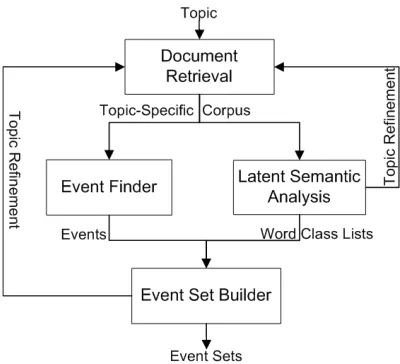
The script extraction system consists of a variety of modules where each module is responsible for a cer-tain task. Modules are combined in a mixed fash-ion such that sequential processing is combined with an iterative improvement procedure. Figure 3 illus-trates the system architecture and flow of informa-tion between modules. The following secinforma-tions de-scribe each module in detail.
3.2.1 Document Retrieval
[image:3.612.326.526.71.253.2]Our system utilizes the web as its underlying in-formation source to circumvent domain limitations of fixed corpora. However, using the entire web to extract a script for a specific topic is, on one hand, infeasible due to the size of the web and, on the other hand, impractical in term of document rele-vancy. Since only a subset of pages is potentially
Figure 3: System Architecture and flow of information.
relevant to a given topic, the web needs to be filtered such that mostly relevant web pages are retrieved. The document retrieval module makes use of exist-ing search engines for this purpose.1
The document retrieval module is presented with the topic for a script and issues this topic as a query to the search engines. The search engines produce a relevancy ranked list of documents/URLs (Brin and Page, 1998) which, in turn, are downloaded. The number of downloaded pages depends on the cur-rent iteration number of the system (i.e., how often theretrieval-analysiscycle has been executed for a given topic2).
The document retrieval module is also responsi-ble for cleaning the documents. The cleaning pro-cess aims to remove “boilerplate” elements such as navigational menus and advertising from web pages while preserving content elements.3 The collection of cleaned documents for a given topic is considered to be atopic-specific corpus.
3.2.2 Latent Semantic Analysis (LSA)
The aim of the LSA module is to identify words (verbs, nouns and adjectives) that are closely related
1
The Google and Yahoo API’s are used to establish commu-nication with these search engines.
2
At the first iteration, we have arbitrarily choosesn to re-trieve the first 1000 unduplicated documents.
3
to the topic presented to the document retrieval mod-ule. To find such words, the topic-specific corpus is (1) part-of-speech tagged and (2) transformed into a term-document matrix. Each cell represents the log-entropy for its respective term in a document. Note that we consider a term to be a tuple consist-ing of a word and its POS. The advantage of us-ing word-POS tag combinations over words only is the ability to query LSA’s concept space for words by their word class. A concept space is created by applying SVD to the term-document matrix, reduc-ing the dimensionality of the scalreduc-ing matrix and constructing the term-document matrix using the re-duced scaling matrix.
Once the concept space is constructed, the space is searched for all terms having a high correlation with the original topic. Terms from the original topic are located in the concept space (i.e., term vectors are located) and other term vectors with high co-sine similarity are retrieved from the space. A list of n = 50terms4 for each word class∈ {verb, noun, adjective} is obtained and filtered using a stop list. The stop list currently contains the 100 most com-mon words in the English language. The idea behind the stop list is to remove low content words from the list. The resulting set of words is deemed to have high information content with respect to the topic. This set is used for two purposes: (1) to augment the original topic and to restart the document col-lection process using the augmented topic and (2) identify event pairs constructed by the event finding module which contain these highly correlated terms (either as events or event arguments). The first pur-pose aims to use an iterative process to construct a higher quality topic-specific corpus. A new corpus created in this fashion presumably represents docu-ments that are richer and more relevant to the aug-mented topic. The second purpose steers the extrac-tion of events towards events containing those con-stituents judged most relevant. This fact can be in-corporated into a maximization calculation based on pointwise mutual information to find highly corre-lated events.
4The number was chosen experimentally and is based on the correlation score (cosine similarity) between word vectors. After about 50 words, the correlation score begins to drop sig-nificantly indicating weaker relatedness.
3.2.3 Event Finding
The collection of documents (or topic-specific corpus) is then processed to facilitate finding event pairs. Finding event pairs involves the notion of verb argument overlap using the assumption that two events in a story are related if they share at least one semantic argument across grammatical func-tions. This virtue of discourse structure of coherent stories has been described in (Trabasso et al., 1984) and applied by (Fujiki et al., 2003) as subject and ob-ject overlap and by (Chambers and Jurafsky, 2008) as following a common protagonist in a story. For example, in the sentences “John ordered a drink. He enjoyed it very much.” we can establish that events
orderandenjoyare part of a common theme because the arguments (or loosely semantic roles) oforder
[image:4.612.313.542.327.662.2]andenjoy refer to the same entities, that isJohn = Heanda drink = it.
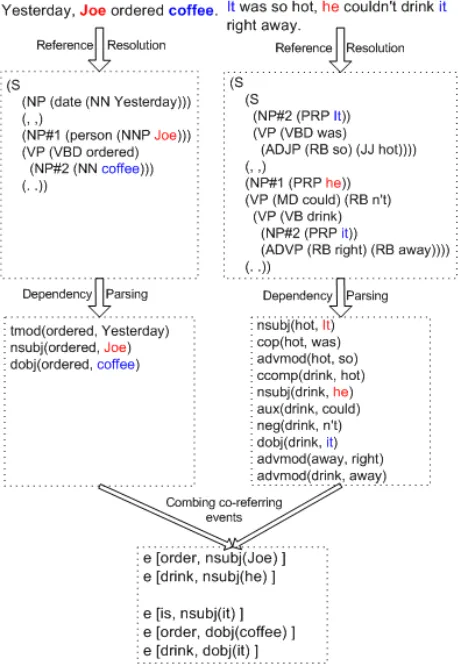
To identify such pairs, the topic specific corpus is (1) co-reference resolved5 and (2) dependency parsed6. Sentences containing elements referring to the same mention of an element are inspected for verb argument overlap. Figure 4 illustrates this procedure for the sentences “Yesterday, Joe ordered coffee. It was so hot, he couldn’t drink it right away”.
Co-reference resolution tells us that mention he
refers to Joe and mention(s) it refer to coffee. By our previous assumption of discourse coherence, it is possible to deduce that events wasanddrinkare associated with event order. In a similar fashion, event drink is associated with event was. This is due to the fact that all events share at least one ar-gument (in the case of eventsorder anddrink two arguments are shared). For each pair of events shar-ing arguments in a particular grammatic function, an event pair is generated indicating where the overlap occurred.
3.2.4 Constructing Event Sets
Sets of events representing script-like structures are constructed through the use of pointwise mutual information in combination with the lists of related words found by Latent Semantic Analysis. We uti-lize the definition of PMI described in (Chambers and Jurafsky, 2008). For two eventse1ande2
pmi(e1, e2) =log P(e1, e2) P(e1)P(e2)
(1)
where
P(e1, e2) =
C(e1, e2)
P
i,jC(ei, ej)
(2)
andC(e1, e2)is the number of times eventse1 and e2had coreferring arguments.
We extend the definition of PMI between events to assign more weight to events whose constituents are contained in the list of words (verbs, nouns and ad-jectives) judged by Latent Semantic Analysis to be most relevant to the topic. For notational purposes, these lists are denotedL. Thus, we can calculate the weighted LSA PMILP(e1, e2)as follows:
LP(e1, e2) =P(e1, e2) +LSA(e1, e2) (3)
5
OpenNLP’s Co-Reference Engine is utilized http:// opennlp.sourceforge.net/.
6The Stanford Parser is utilized http://nlp. stanford.edu/software/lex-parser.shtml
where
LSA(e1, e2) =α∗(E(e1) +E(e2)) (4)
α=
(
2 ife1verb ∈Lande2verb ∈L
1 otherwise (5)
E(e) = (||everb∩L||+ 1) ∗ (||eArgs∩L||
||eArgs|| + 1)
(6)
To construct the set of n events related to the topic, the LP scores are first calculated for each event pair in the corpus. The set can then be con-structed by maximizing:
max i<k≤n
k−1
X
i=0
LP(ei, ek) (7)
Therefore, events that share a larger number of constituents with the LSA relevancy list are pre-ferred for inclusion in the event set. This prac-tice distributes the relatedness weight among the fre-quency of events and LSA. The noisy nature of our proposed corpus generation method makes such a technique essential as we will see in section 4.3.
3.2.5 Ordering Events
At this time, we only establish a naive temporal ordering on the events. The ordering process simply assumes that an event appearing in the corpus prior to another event also occurs earlier in time. We re-alize that this assumption does not always hold, but delay a more sophisticated ordering process as fu-ture work.
4 Experiments
This section describes experimental results, obsta-cles we have encountered, various approaches to overcome these obstacles and lessons learned from our work. Unless mentioned otherwise, the results pertain to the topiceating at a restaurant. This topic has been chosen for our investigation since previ-ous work (Schank and Abelson, 1977) establishes a comprehensive reference as to what a script for this domain may entail.
4.1 Domain Richness
The overall goal was to investigate whether a topic-specific corpus contains sufficiently useful informa-tion which is conducive to the script extracinforma-tion task. Latent Semantic Analysis was performed on the Part-of-Speech tagged topic specific corpus. The semantic space was queried using the main con-stituents of the original topic. Hence, this resulted in two queries, namelyeatingandrestaurant. For each query, we identified the most related verbs, nouns and adjectives/adverbs and placed them in respec-tive lists. Lists are then combined according to word class, lemmatized, and pruned. Auxiliary verbs such asbe, do andhave consistently rank in the top 10 most similar words in the un-pruned lists. This re-sult is expected due to the frequency distribution of auxiliaries in the English language. It is a nat-ural conclusion to exclude auxiliaries from further consideration since their information content is rela-tively low. Furthermore, we extend this notion to ex-clude the 100 most frequent words in English from these lists using the same justification. By the in-verse reasoning, it is desirable to include words in further processing that occur infrequently in natural language. We can hypothesize that such words are significant to a given script because their frequency appears to be elevated in the corpus. Table 1 (left) shows the resulting word class lists for both queries. Duplicates (i.e., words with identical lemma) have been removed.
The table reveals that some words also appear in the restaurant script as suggested by (Schank and Abelson, 1977). In particular, bold verbs re-semble Schank’s scenes and bold nouns resemble his props. We can also see that the list of ad-verbs/adjectives appear to not contribute any signif-icant information. Note that any bold words have been hand selected using a human selector’s subjec-tive experience about theeating at a restaurant do-main. Furthermore, while some script information appears to be encoded in these lists, there is a signif-icant amount of noise, i.e., normal font words that are seemingly unimportant to the script at hand.
For our purposes, we aim to model this noise so that it can be reduced or removed to some degree. Such a model is based on the notion of overlap of noisy terms in the LSA lists derived from indepen-dent topic related corpora for the main constituents of the original topic. For example, for the topic
eat-eating at a restaurant Overlap removed
Verbs Nouns A&A Verbs Nouns A&A
keep home own order home fry
need place still set hand amaze
help table last expect bowl green
dine lot open share plate grill
love part full drink cook chain
order hand off try fish diet
feel reason long cut soup clean
avoid course fat decide service smart
add side right watch break total
let number down process drink relate stay experience busy save cheese worst
include water fast offer rice black
tend point single provide serve fit
set dish low hear chance light
tell bowl free fill portion exist
found plate white forget body empty
bring bite wrong write party live
locate cook ready follow rest
eat fish true travel cream
leave soup close taste
Table 1: (Left) 20 most relevant terms (after pruning) for LSA querieseating andrestaurant on theeating at a restaurantcorpus. (Right) Terms remaining after noise modeling and overlap removal. Boldterms in the table were manually judged by a human to be relevant.
ing at a restaurant, we obtain two additional corpora using the method described in Section 3.2.1, i.e., one corpus for constituenteatingand another for the sec-ond main constituent of the original topic, restau-rant. Both corpora are subjected to LSA analysis from which two (one for each corpus) LSA word lists are obtained. Each list was created using the respective corpus query as the LSA query. The as-sumption is made that words which are shared (pair-wise) between all three lists (i.e., the two new LSA lists and the LSA list for topiceating at a restaurant) are noisy due to the fact that they occur independent of the original topic.
Table 1 (right) illustrates the LSA list for topic
eating at a restaurant after removing overlapping terms with the two other LSA lists. Bold words were judged by a human selector to be relevant to the in-tended script. From the table we can observe that:
≈57%
2. More words (bold) were judged to be related to the script (e.g., 6 vs. 5 relevant verbs, 12 vs. 9 nouns, and 3 vs. 0 adjectives/adverbs)
3. More relevant words appear in the top part of the list (words in the list are ordered by rele-vancy)
4. Some words judged to be relevant were re-moved (e.g., dine, bring, eat).
Using the information from the table (left and right) and personal knowledge about eating at a restaurant, ahumancould re-arrange the verbs and nouns into a partial script-like format of the form7:
e1[ offer, nsubj,{waiter}) ]
e2[ offer, dobj,{drink}) ] Example: waiter offers a drink
e2[ order, nsubj,{customer}]
e3[ order, dobj,{fish, soup, rice}] Example: customer orders fish
e4[ serve/bring, nsubj,{waiter}]
e5[ serve/bring, nsubj,{bowl, plate}] Example: waiter serves/bings the bowl, plate
e6[ eat, nsubj,{customer}]
e7[ eat, dobj,{portion, cheese}]
Example: customer eats the portion, cheese
e8[ leave, nsubj,{customer}]
e9[ leave, dobj,{table}]
Example: customer leaves the table
Note that this script-like information was not ob-tained by direct derivation from the information in the table. It is merely an illustration that some script information is revealed by LSA. Table 1 neither im-plies any ordering nor suggest semantic arguments for a verb. However, the analysis confirms that the web contains information that can be used in the script extraction process.
4.2 Processing Errors
As mentioned in section 3.2.3, events with co-referring arguments are extracted in a pairwise fash-ion. In the following section we describe observa-tions about the characteristics of events extracted 7Bold terms do not appear in the LSA lists, but were added for readability.
this way. However, we note that each step in our system architecture is imperfect, meaning that er-rors are introduced in each module as the result of processing. We have already seen such errors in the form of words with incorrect word class in the LSA lists as the result of incorrect POS tagging. Such errors are amplified through imprecise pars-ing (syntactic and dependency parspars-ing). Other er-rors, such as omissions, false positives and incor-rect class detection, are introduced by the named en-tity recognizer and the co-reference module. With this in mind, it comes as no surprise that some ex-tracted events, as seen later, are malformed. For example, human analysis reveals that the verb slot of these events are sometimes “littered” with words from other word classes, or that the arguments of a verb were incorrectly detected. A majority of these errors can be attributed to ungrammatical sentences and phrases in the topic-specific corpus, the remain-der is due to the current state of the art of the parsers and reference resolution engine.
4.3 Observations about events
To compare relations between events, we looked at three different metrics. The first metricM1simply observes the frequency counts of pairwise events in the corpus. The second metric M2 utilizes point wise mutual information as defined in (Chambers and Jurafsky, 2008). The third metric M3 is our LSA based PMI calculation as defined in section 3.2.4.
M1 reveals that uninformative event pairs tend to have a high number of occurrences. These pairs are composed of low content, frequently occurring events. For example, event pair [e[ have, nsubj,{}], e[ say, nsubj,{}]] occurred 123 times in our topic-specific corpus. More sophisticated metrics, such as M2, consider the frequency distributions of individ-ual events and allocate more weight to co-occurring events with lower frequency counts of their individ-ual events.
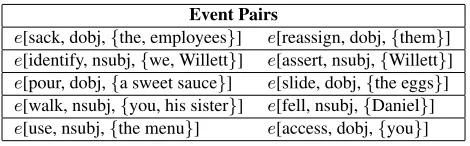
In this fashion, M2 is capable of identifying strongly related events. For example, Table 2 lists the five pairwise events with highest PMI for our topic-specific corpus.
Event Pairs
[image:8.612.71.306.70.143.2]e[sack, dobj,{the, employees}] e[reassign, dobj,{them}] e[identify, nsubj,{we, Willett}] e[assert, nsubj,{Willett}] e[pour, dobj,{a sweet sauce}] e[slide, dobj,{the eggs}] e[walk, nsubj,{you, his sister}] e[fell, nsubj,{Daniel}] e[use, nsubj,{the menu}] e[access, dobj,{you}]
Table 2: Pairwise events with highest PMI according to Equation 1.
not require a leap of faith to connect that sacking employees is related toreassigning them in the con-text of a corporate environment.
e(eat, nsubj), e(gobble, nsubj), e(give, nsubj), e(live, nsubj), e(know, nsubj), e(go, nsubj), e(need, nsubj), e(buy, nsubj), e(have, nsubj), e(make, nsubj), e(say, nsubj), e(work, nsubj), e(try, nsubj), e(like, nsubj), e(tell, dobj), e(begin, nsubj), e(think, nsubj), e(tailor, nsubj), e(take, nsubj),e(open, nsubj),e(be, nsubj)
Figure 5: An event set obtained through metricM2 (us-ing the PMI between events). Temporal order(us-ing is not implied. Event arguments are omitted. Bold events indi-cate subjectively judged strong relatedness to theeating at a restauranttopic.
Figure 5 shows a set of events for our topic. The set was created by greedily adding event en such that for all events e1, e2, ...en−1 already in the set
∀ni−1pmi(ei, en) is largest (see (Chambers and Ju-rafsky, 2008)). The topic constituent eating (i.e.,
eat) was used as the initial event in the set. If this set is intended to approximate a script for theeating at a restaurantdomain, then it is easy to see that vir-tually no information from Schank’srestaurant ref-erence script is represented. Furthermore, by human standards, the presented set appears to be incoherent. From this observation, we can conclude thatM2is unsuitable for topic-specific script extraction.
Figure 6 illustrates an event set constructed using metric M3. Note that the sets in Figures 5 and 6 do not imply any ordering on the events. The bold events indicate events that appear in our reference script or were judged by a human evaluator to be logically coherent with theeating at a restaurant do-main. The evaluation was conducted using the eval-uators personal experience of the domain. In the fu-ture, we intend to formalize this evaluation process. Figure 6 signifies an improvement of the results of
e(eat, nsubj),e(wait, dobj), e(total, nsubj) e(write, dobj), e(place, dobj), e(complete, dobj) e(exist, nsubj), e(include, dobj), e(top, nsubj) e(found, dobj), e(keep, dobj), e(open, dobj) e(offer, dobj), e(average, nsubj),e(fill, dobj) e(taste, nsubj),e(drink, dobj),e(cook, dobj) e(read, dobj),e(enjoy, dobj),e(buy, dobj)
Figure 6: An event set obtained through metric M3 (weighing PMI and LSA between events). Temporal or-dering is not implied. Event arguments are omitted. Bold events indicate subjectively judged strong relatedness to theeating at a restauranttopic.
Figure 5 in terms of the number of events judged to belong to the restaurant script. This leads us to the conclusion that a metric based on scaled PMI and LSA appears more suitable for the web based topic driven script extraction task. Once a temporal order is imposed on the events in Figure 6, these events could, by themselves, serve as a partial event set for their domain.
5 Discussion and Future Work
We have presented preliminary work on extracting script-like information in a topic driven fashion from the web. Our work shows promise to identify script knowledge in a topic-specific corpus derived from an unordered collection of web pages. We have shown that while web documents contain signifi-cant amounts of noise (both boilerplate elements and topic unrelated content), a subset of content can be identified as script-like knowledge.
Latent Semantic Analysis allows for the filter-ing and prunfilter-ing of lists of related words by word classes. LSA furthermore facilitates noise removal through overlap detection of word class list elements between independent corpora of topic constituents. Our method of weighted LSA and PMI for event re-latedness produces more promising partial event sets than existing metrics.
References
Sergey Brin and Lawrence Page. 1998. The anatomy of a large-scale hypertextual web search engine. Comput. Netw. ISDN Syst., 30(1-7):107–117.
Nathanael Chambers and Dan Jurafsky. 2008. Unsu-pervised learning of narrative event chains. In Pro-ceedings of ACL-08: HLT, pages 789–797, Columbus, Ohio, June. Association for Computational Linguis-tics.
Timothy Chklovski and Patrick Pantel. 2004. VerbO-cean: Mining the Web for Fine-Grained Semantic Verb Relations. InProceedings of Conference on Empirical Methods in Natural Language Processing, pages 33– 40, Barcelona, Spain, July. Association for Computa-tional Linguistics.
Scott Deerwester, T. Susan Dumais, W. George Furnas, K. Thomas Landauer, and Richard Harshman. 1990. Indexing by Latent Semantic Analysis. Journal of the American Society for Information Science, 41:391– 407.
Toshiaki Fujiki, Hidetsugu Nanba, and Manabu Oku-mura. 2003. Automatic acquisition of script knowl-edge from a text collection. InEACL ’03: Proceedings of the tenth conference on European chapter of the As-sociation for Computational Linguistics, pages 91–94, Morristown, NJ, USA. Association for Computational Linguistics.
Dekang Lin and Patrick Pantel. 2001a. DIRT - Discov-ery of Inference Rules from Text. InKDD ’01: Pro-ceedings of the seventh ACM SIGKDD international conference on Knowledge discovery and data mining, pages 323–328, New York, NY, USA. ACM.
Dekang Lin and Patrick Pantel. 2001b. Discovery of Inference Rules for Question-Answering. Nat. Lang. Eng., 7(4):343–360.
Roger C. Schank and Robert P. Abelson. 1977. Scripts, Plans, Goals and Understanding. Lawrence Erlbaum Associates, Hillsdale, NJ.