Journal of Criminal Law and Criminology
Volume 65 | Issue 4
Article 14
1975
Parameters of Criminal Prosecution: An
Application of Path Analysis to a Problem of
Criminal Justice
John Hagan
Northwestern University School of Law
Follow this and additional works at:
https://scholarlycommons.law.northwestern.edu/jclc
Part of the
Criminal Law Commons
,
Criminology Commons
, and the
Criminology and Criminal
Justice Commons
This Criminology is brought to you for free and open access by Northwestern University School of Law Scholarly Commons. It has been accepted for inclusion in Journal of Criminal Law and Criminology by an authorized editor of Northwestern University School of Law Scholarly Commons.
Recommended Citation
THE JOURNAL OF CRIMINAL LAW & CRIMINOLOGY
Copyright () 1975 by Northwestern University School of Law
Vol. 65, No. 4 Printed in U.S.A.
PARAMETERS OF CRIMINAL PROSECUTION: AN APPLICATION OF
PATH ANALYSIS TO A PROBLEM OF CRIMINAL JUSTICE
JOHN HAGAN*
A sociological concern with the process of
criminal sentencing is well-established.' Simi-larly well-demonstrated is a sociological inter-est in the process of criminal prosecution.2 Surprisingly, however, the two concerns have not been linked systematically in empirical re-search. The tendency, instead, has been to treat sentencing and prosecution as separate depend-ent variables, to be linked individually to other variables in the legal process. The current study combines consideration of prosecution and sentencing, using the techniques of path analysis.3 Before turning to the analysis itself, however, we will review several approaches taken to the study of criminal prosecution.4
THE LirRnA:upm
The process of criminal prosecution is a
sub-*Assistant Professor of Sociology, University of Toronto, Canada.
I
E. GREEN, JUDICIAL ArTITDES INSENTENc-ING (1961) ; S. NAGEL, THE LEGAL PROCESS FROM A BEHAVIORIAL PERSPECTIVE (1969); Lemert and
Rosberg, The Administration of Justice to
Minor-ity Groups in Los Angeles County, 11 UNIv.
CALIF. PUBLICATIONS CULTURE AND SOCIETY
(1948) ; Sellin, Race Prejudice in the
Administra-tion of Justice, 41 Am.
J.
SOCIOLOGY 212 (1935).2 F. MILLER, PROSECUTION: THE DECISION To CHARGE A SUSPECT WITH A CRIME (1970); D.
J.
NEWMAN, CONVICTION: THE DETERMINATION OF GUILT OR INNOCENCE WITHOUT TRIAL (1966); Newman, Pleading Guilty for Considerations: AStudy of Bargain Justice, 46 J. CRiM. L.C. & P.S.
780 (1956).
3 For basic discussions of the techniques of path
analysis, see Heise, Problems in Path Analysis
and Causal Inference, 1969 SOCIOLOGICAL
METHO-DOLOGY 38 (E. Borgatta ed. 1969); Land,
Princi-ples
of PathAnalysis,
1969 SOCIOLOGICALMETHO-DOLOGY 3 (E. Borgatta ed. 1969).
4 A review of the sentencing literature has
previously been provided in Hagan, Extra-Legal
Attributes and Criminal Sentencing: An Assess-ment of a Sociological Viewpoint, 8 L. & Soc'Y
REv. 357 (1974).
Discussions of criminal sentencing are largely atheoretical, focusing on the role of legal and extra-legal variables in the judicial process. Discus-sions of criminal prosecution are similarly atten-tive to these variables, while additionally concerned with linking such variables into theoret-ical perspectives on the prosecutorial process. For
ject of international concern5, an issue of con-stitutional debate6, a forum for social theoreti-cal speculation7
, and a focus of empirical research.8 For current purposes, we will re-strict our attention to several theoretical and empirical discussions of criminal prosecution.
Two dominant theoretical approaches can be discerned. Although the approaches are not mutually exclusive, they differ in emphasis, fo-cusing on two distinct concepts: bureaucrati-zation and class conflict.
Blumberg focuses on the role of bureaucrati-zation in Anglo-American systems of criminal justice.9 Drawing on Weber's discussions of the process of rationalization in modern legal systems, it is argued that the proper focus for study lies in the organization of the criminal court: "Sociologists and others have focused their attention on the deprivations and social disabilities of such variables as race, ethnicity, and social class as being the source of an ac-cused person's defeat in a criminal court. Largely overlooked is the variable of the court organization itself, which possesses a thrust, purpose, and direction of its own." '0 Blumberg argues that bureaucratic demands for efficiency exert an exogenous influence on the prosecu-tion process. These organizaprosecu-tional pressures are operationalized procedurally through the
ac-these reasons, the current review is confined to discussions of criminal prosecution.
5 See 8 Am. J. COMPARATIVE L. (1970) (entire volume).
6 Chambliss, The Unconstitutionality of Plea
Bargaining, 83 H.atv. L. REV. 1387 (1970).
7A.
BLUMBERG, CRIMINAL JUSTICE (1967) ; W.CHAMBLISS & P_ SEIDMAN, LAw, ORDER, AND
POWER (1971); Blumberg, The Practice of Law
as a Confidence Game, 1 L. & Soc'Y REV. 15 (1967); Sudnow, Normal Crimes: Sociological Features of the Penal Code in a Public Defender's
Offlce,
12 SoCIAL PROBLEMS 255 (1965).8 Newman, Pleading Guilty for Considerations:
A
Study of BargainJustice,
46J.
CRIM. L.C. & P.S. 780 (1956) ; Note, Compromises byProsecu-tors to Secure Guilty Pleas, 112 U. Pa. L. REv.
865 (1964).
9
A. BLUMBERG, CRIMINAL JUSTICE (1967).PARAMETERS OF CRIMINAL PROSECUTION
tions of defense counsel, client and prosecutor in the process of plea negotiation.:"
Chambliss and Seidman differ from Blum-berg in assigning an intervening role to proce-dural variables in the causal sequence.'2 Argu-ing from a Marxian view of class conflict, negotiation between defense counsel and prose-cutor is conceptualized as a mediating mecha-nism that facilitates protection of the powerful and exploitation of the powerless. Procedural variables thus assume an endogenous position, subject to the direct effects of the social class position of the defendants involved: "How fa-vorable a 'bargain' one can strike with the prosecutor in the pretrial confrontations is a direct function of how politically and economi-cally powerful the defendant is. In terms of day-to-day prosecutorial activities, what this comes down to is that the lower class, indi-gent, and minority group member is most likely to be prosecuted for his offenses. . . ." Is
Moving from theory to research, two empiri-cal studies are available for review. Vetri has published results of a survey questionaire com-pleted by prosecutors in forty-three states.14 It is important to note that the response rate to the questionnaire was low (40 per cent), and also that the accuracy of the responses ob-tained is dependent on the honesty and percep-tual acuity of the respondents involved. None-theless, the findings are of interest. Among findings relevant to our discussion, it is re-ported that prosecutors consider prior convic-tions, type of offense, and multiple charges as important factors in the decision to alter charges. Newman's study of the prosecution process used as its data source the recollections of ninety-seven felons under active sentence.'5 Although this study is also limited by the accu-racy of the respondents' reports, it is again of importance in terms of the insights offered for further research. Data reported by Newman cast doubt on the class based hypotheses of Chambliss and Seidman. For example, when
11 Blumberg, The Practice of Law as a
Confi-dence Game, 1 L & Soc'y REv. 15 (1967).
12 W. CHAMBLISS AND R. SEIDMAN, supra note
7, ch. 19.
13 Id. at 412.
'4 Note, Guilty Plea Bargaining: Compromises
by Prosecutors to Secure Guilty Pleas, 112 U. PA.
L. REv. 865 (1964). 15 Newman, supra note 8.
defendants are compared in terms of their ini-tial pleas, no significant differences are found
by education, occupation, and residence.
Simi-larly, "[a] analysis of the sample of offenders showed no clear-cut categories separating bar-gained and non-barbar-gained convictions." '6
Nev-ertheless, Newman reports that among those cases where negotiation was perceived to have occurred, approximately 33 per cent involved communication regarding alteration of charges, while 67 per cent involved discussion of sen-tencing considerations. A concluding hypothe-sis suggests that "[t]he way bargaining now works, the more experienced criminals can ma-nipulate legal processes to obtain light sen-tences and better official records .... '7
This discussion of the literature relating to criminal prosecution suggests several different themes. Chambliss and Seidman clearly hy-pothesize that class conflict, operationalized through the extra-legal attributes of the de-fendants, is a dominant disadvantaging factor in the process of criminal prosecution. Just as clearly, Blumberg argues that the prosecution process is guided by a set of bargaining proce-dures whose thrust is constrained more by or-ganizational priorities than class interests. Newman, in contrast, argues that it is the "conviction-wise" offender who benefits from the prosecutorial process. Finally, Vetri indi-cates that a number of more conventional legal variables must be considered in discussions of criminal prosecution.
Unfortunately, although the literature sur-rounding the prosecution process is helpful in isolating potentially important variables, it does not suggest a set of propositions suffi-ciently precise to allow a deductive model-test-ing approach to the research problem.'8 In re-sponse to this situation, techniques of path analysis are explored as a means of inductively determining causal linkages between the varia-bles concerned. At the same time, an assess-ment is attempted of the overall impact of fac-tors involved in the prosecutorial process. The intent is to provide an empirical grounding for additional theory construction and research.'9
16 Id. at 789.
17 Id. at 790.
IsSee
H.
BLALocx, CAUSAL INFERENcES IN NONEXPmUmENTAL RESEARcH(1964).
19 Heise, supra note 3, at 64.
JOHN HAGAN
THE SAMPLE AND METHODOLOGY
The sample consists of 1018 cases, involving over 1500 charges, drawn at random from files covering a six month period of prosecutions in
a medium-sized western Canadian city.20 Our
20 For a discussion of criminal prosecution in Canada, see Grossman, The Role of the
Prosecu-tor in Canada, 18 AM. J. ComPARAvE L. 498
(1970). Grossman generally concludes that crimi-nal prosecution in Canada is much like that in the United States.
primary interest was in the offender as the unit of analysis. Thus, it was necessary to se-lect the salient charge facing each offender. This was accomplished by choosing the offense assigned the most severe sentence. If none of the charges received sentence (i.e., if all charges were dismissed), or if the sentent.es were of equal severity, the offense providing the most severe sentencing option by statute, was chosen. Three groups of independent variables, presented in Table I, are considered in the
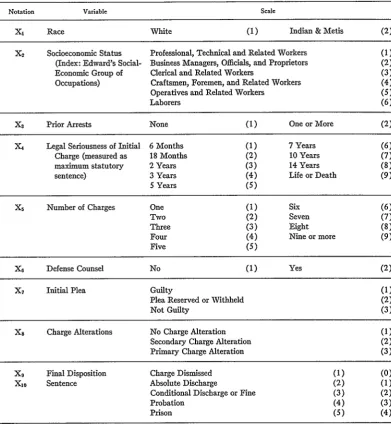
TABLE I: VARIABLES
Notation Variable Scale
X1 Race White (1) Indian & Metis (2)
X2 Socioeconomic Status Professional, Technical and Related Workers (1)
(Index: Edward's Social- Business Managers, Officials, and Proprietors (2)
Economic Group of Clerical and Related Workers (3)
Occupations) Craftsmen, Foremen, and Related Workers (4)
Operatives and Related Workers (5)
Laborers (6)
X3 Prior Arrests None (1) One or More (2)
X4 Legal Seriousness of Initial 6 Months (1) 7 Years (6)
Charge (measured as 18 Months (2) 10 Years (7)
maximum statutory 2 Years (3) 14 Years (8)
sentence) 3 Years (4) Life or Death (9)
5 Years (5)
X5 Number of Charges One (1) Six (6)
Two (2) Seven (7)
Three (3) Eight (8)
Four (4) Nine or more (9)
Five (5)
X6 Defense Counsel No (1) Yes (2)
X7 Initial Plea Guilty (1)
Plea Reserved or Withheld (2)
Not Guilty (3)
X8 Charge Alterations No Charge Alteration (1)
Secondary Charge Alteration (2)
Primary Charge Alteration (3)
X9 Final Disposition Charge Dismissed (1) (0)
X10 Sentence Absolute Discharge (2) (1)
Conditional Discharge or Fine (3) (2)
Probation (4) (3)
Prison (5) (4)
[image:4.454.35.427.196.621.2]PARAMETERS OF CRIMINAL PROSECUTION
analysis. A brief discussion of each set of vari-ables follows, with the order of presentation representing an assumed sequence of causal priority.
The first group of variables consists of ex-tra-legal offender characteristics: race (X1) and socio-economic status (X2). The minority group represented in the sample is of Indian and Metis descent.2' In several respects, the presence of Native persons in the sample can be considered an asset of this research. In comparison with other North American groups, it can plausibly be argued that Indian and Metis defendants understand less and re-sist least their fate in the hands of the law. Thus, if race in itself is a disadvantaging fac-tor in criminal prosecution, it would seem likely that Native persons would be among those experiencing the undesired effects.
The racial background of the defendant was indicated as (1) white or (2) Indian or Metis on the basis of designation as such in the case file.22 Additional information on the current or customary occupation of the defendant was gathered from the files, and socio-economic status was then indicated on the basis of Ed-ward's Social-Economic Grouping of Occupa-tions.2 3
The second group of variables includes le-gally defined offender and offense characteris-tics: prior arrest (X3), legal seriousness of the initial charge (X4), and the number of
charges (X,). Information regarding the pres-ence or abspres-ence of prior arrests and the num-ber of charges facing the offender was indi-cated directly from the files. The seriousness of the initial charge selected for analysis was operationally defined in terms of the maximum sentence provided for the offense in the Crimi-nal Code of Canada.
The third group of variables involves proce-dural factors: presence of defense counsel
21 The term "Metis" refers to persons of mixed,
in this case white and Indian, ancestry.
22 Persons of Indian and Metis backgrounds are
combined in one category in the same sense that persons of mixed white and Negro background are usually treated synonymously with Negroes, for the purpose of study. The concern is not with the biological accuracy of these designations, but rather with the presumed consequences of the
at-tribution of racial status.
23 For a discussion of this scale see F. MILLER,
supra Note Z.
(X6), initial plea (X7), and charge alteration
(Xs). The presence or absence of defense counsel and the nature of the initial plea were recorded from the files. The type of initial plea-was then ranked according to the intensity of the denial of guilt indicated: (1) plea of guilty, (2) plea reserved or withheld, (3) plea-of not guilty.
Measurement of charge alteration presented a more difficult problem. Discussions of charge alteration have typically focused on the distinc-tion between situadistinc-tionally and necessarily in-cluded offenses,2 4
the nature of the interaction between the negotiating parties,2 5 and the dis-junction between the expected and effected sentencing "considerations." 26 However, in the
jurisdiction under study, judges customarily sentence offenses concurrently. Thus, more im-portant than any of the previously mentioned concerns, for the purpose of predicting final disposition, is an indication of the particular charge being altered. In short, the most impor-tant consideration for the defendant is whether or not the most serious charge facing him is changed. Thus, charge alterations are ranked in our analysis as follows: (1) no charge al-teration, (2) secondary charge alal-teration, (3). primary charge alteration.2 7
The dependent variable for this analysis is-the outcome of is-the defendant's case. To pro-vide a comprehensive assessment of the prose-cution and sentencing process, it was necessary to consider not only those persons who were actually sentenced, but also persons whose cases were dismissed. To demonstrate the im-plications of considering the latter group, the dependent variable was coded first with, and second without, the inclusion of this set of fendants. The ranking of the variable was de-termined by the decision of guilt and/or re-striction of civil liberties imposed; the two codings are presented in Table 1.28 For
pur-24 Sudnow, supra note 7. 25 Blumberg, supra note 11. 26 Newman, supra note 8.
27 The frequency distribution of charge
altera-tions is as follows: (1) no charge alteration:
N = 594; (2) secondary charge alteration:
N = 326; (3) primary charge alteration: N = 98. 28 The distinction between charge dismissal and
JOHN HAGAN
poses of clarity, the first ranking is designated as "final disposition," and the second as "sen-tence."
The data are examined using techniques of path analysis and multiple regression proce-dures. Dichotomized measures included in the analysis are treated as "dummy variables," 29 while the remaining ordinal variables are
treated as interval measures. This strategy is in agreement with arguments presented by Bohrnstedt and Carter,3 0 Labovitz,31 Boyle,3 2 and Land.3 3 Within the field of the sociology of law, a precedent for this approach is avail-able in the work of Cartwright and Schwartz.3 4
successive increase in the curtailment of the civil liberties of the offender. The frequency distribution of final dispositions is as follows: (1) charge dis-missal: N = 142; (2) absolute discharge:
N = 25; (3) conditional discharge or fine:
N =678; (4) probation: N =74; (5) prison: N = 99.
29 For a discussion of the use of "dummy varia-bles" in regression analysis, see Boyle, Path
Anal-ysis and Ordinal Data, 75 Am. J. SOCIOLOGY 461
(1970).
30 Bohrnstedt and Carter, Robustness in
Regres-sion, Analysis. 1971 SOCIOLOGICAL METHODOLOGY 118 (H. L. Costner ed. 1971).
31 Labovitz, The Assignment of Numbers to Rank Order Categories, 35 Am. SOCIOLOGICAL REV. 515 (1970); Labovitz, Some Observations on
Measurement and Statistics, 46 SOCIAL FORCES 151 (1967).
32 Boyle, supra note 29. 33 Land, su¢pra note 3.
34 Cartwright and Schwartz, The Invocation of
Legal Norms: An Empirical Investigation of
THE ANALYSIS
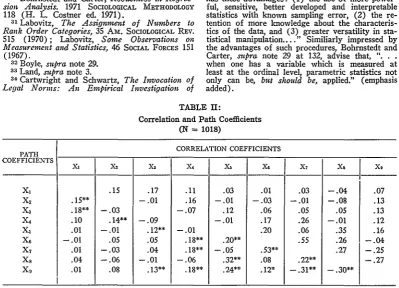
The analysis is carried out in two stages, corresponding to the two codings of the de-pendent variable. The first stage of the analysis involves the eight independent variables and final disposition (Xg). Correlation and path coefficients relating the nine variables involved in this stage of the analysis are presented in Table II. Correlation coefficients (rj) are pre-sented in the upper right-hand section of the Table, while path coefficients (pij) are pre-sented in the lower left-hand section of the Table. Following the inductive strategy de-scribed earlier, a causal model was developed and presented in Figure I. Path coefficients were selected for the model (from Table II) on the basis of two criteria: (1) attainment of statistical significance at the .01 level, and (2)
Durkheim and Weber, 38 Am. SOCIOLOGICAL REv.
340 (1973).
Labovitz, supra note 30 at 523, argues that, ... treating ordinal variables as if they are interval has these advantages: (1) the use of more power-ful, sensitive, better developed and interpretable statistics with known sampling error, (2) the re-tention of more knowledge about the characteris-tics of the data, and (3) greater versatility in sta-tistical manipulation...." Similiarly impressed by the advantages of such procedures, Bohrnstedt and Carter, supra note 29 at 132, advise that, "...
when one has a variable which is measured at least at the ordinal level, parametric statistics not only can be, but should be, applied." (emphasis added).
TABLE II:
Correlation and Path Coefficients
(N = 1018)
CORRELATION COEFFICIENTS
PATH ______________________ ____
COEFFICIENTS
M
N, X4 M Xa X7 X I X,
X, .15 .17 .11 .03 .01 .03 -. 04 .07
X2 .15"* -. 01 .16 -. 01 -. 03 -. 01 -. 08 .13
X3 .18** -. 03 -. 07 .12 .06 .05 .05 .13
X4 .10 .14** -. 09 -. 01 .17 .26 -. 01 .12
Xe .01 -. 01 .12** -. 01 .20 .06 .35 .16
X6 -. 01 .05 .05 .18** .20** .55 .26 -. 04
X7 .01 -. 03 .04 .18** -. 05 .53** .27 -. 25
X8 .04 - .06 - .01 - .06 .32** .08 .22** - .27
X9 .01 .08 .13** .18** .24** .12* -. 31* -. 30**
* Statistically significant at the .01 level.
** Statistically significant at the .01 level and explains more than one per cent of the variation in the endogenous variable.
[image:6.454.33.433.301.589.2]PARAMETERS OF CRIMINAL PROSECUTION
e= .99 e=.98
e=.87
/
explanation of more than one per cent of the variation in the endogenous variable.3 5 The resulting model can be discussed in terms of the three groupings of variables originally de-scribed.
Our attention is directed first to the three procedural variables: defense counsel, initial plea, and charge alteration. Charge alteration has an inverse direct effect on final disposition
(P9s) of -. 30, indicating that as the primacy
of charge alteration increases, the severity of final disposition diminishes. It is significant to note that there is an element of conceptual over-lap involved in this relationship. In those cases of primary charge alteration where the prose-cutor withdraws all charges against the defend-ant, the final disposition is predetermined: the case is dismissed. Thus, in these cases, the prosecutor effectively imposes the final judg-ment. The relationship between charge altera-tion and final disposialtera-tion reflects this aspect of the prosecutor's role in the decision-making process.
The defendant's initial plea has an inverse direct effect on final disposition (p97) of -. 31.
35 The F-test is used as the test of significance.
For a discussion of this test, see H. BLALocK,
So-CiAL STAIsiics (1960). For a discussion of the
liabilities of using significance tests alone as the criterion for selecting causal paths, see Heise,
supra note 3 at 61, and Hagan, supra note 4.
Assertion of innocence, in short, is linked to favorability of disposition. The nature of this causal sequence is elaborated with consideration of the role of defense counsel. Presence of defense counsel operates indirectly through plea and charge alteration to again effect inversely the severity of final disposition. With initial plea alone as the mediating variable, the indirect effect of defense counsel on final disposition
(P7sP97) is -. 16. Added to this is the indirect
influence of defense counsel operating through initial plea and charge alteration (P76PrPs9s
--. 03). The resulting estimate of the indirect
effect of defense counsel on final disposition is -. 19.
Our focus shifts next to the legal variables included in the model. Each legal variable rectly affects final disposition, as well as di-rectly or indidi-rectly affecting a procedural vari-able. Final disposition is linked: (1) with the initial charge, by a path coefficient (p94) of
.18; (2) with a number of charges, by a
path coefficient (p95) of .24; and (3) with prior alone is equal in importance to that of charge arrests, by a path coefficient (p93) of .13. Thus the seriousness of the initial charge, the number of immediate charges, and the number of prior arrests are all substantively and causally related to final disposition. It is appropriate to note, however, that none of the legal variables taken
JOHN HAGAN
alteration in its direct effect on final dispo-sition.
Seriousness of the initial charge and the number of charges are also related directly to the presence of defense counsel by respective path coefficients (p64p65) of .18 and .20. Further, the number of charges operates through presence of defense counsel to produce
an indirect effect on the initial plea (P,,Po) of .11. Finally, the number of charges facing an offender has a direct effect on charge alteration (p5s) of .32. As one might expect, then, the number of offenses available for negotiation is related causally to the probability of alteration in charges.
Our attention turns finally to the role of extra-legal offender characteristics in the prose-cution and sentencing process. Links between these and remaining variables in the model are as conspicuous in their absence as they are in their presence. Thus, there are no direct links between extra-legal offender characteristics and the procedural variables or final disposition. Percentage comparisons, by race, for the three procedural variables, are provided in Table III. Thus, while 33.4 per cent of the white defend-ants retained counsel, 35.1 per cent of the Native defendants were also represented by counsel; while 26.2 per cent of the white de-fendants entered pleas of not guilty, 30.8 per cent of the Native defendants also denied their guilt; and while 9.6 per cent of the whites re-ceived primary charge alterations, 9.1 per cent of the Native persons similarly benefited from alterations in -primary charges. These findings
TABLE III:
Proportion of White and Native Offenders Retaining Counsel, Pleading Guilty, and
Receiving Charge Alterations
Procedural Variables
Race
Defense Initial Primary Counsel Plea of Charge Retained Not Guilty Alteration
White 33.4% 26.2% 9.6%
(291) (226) (86)
Indian & 35.1% 30.8% 9.1%
Meis (40) (36) (11)
suggest that Indian and Metis defendants are involved at a rate similar to whites in the pro-cedural maneuvers that characterize the prose-cutorial process.
It is of interest to note that the connection of extra-legal offender characteristics to the remainder of the model is through the mediat-ing influence of legal variables. Thus, race is linked directly to prior arrests by a path coeffi-cient (p31) of .18, while socio-economic status has a direct effect on initial charge of .14. Finally, the direct effect of race on socio-economic status is indicated by a path coefficient
(p21) of .15. Summarizing, the effect of race
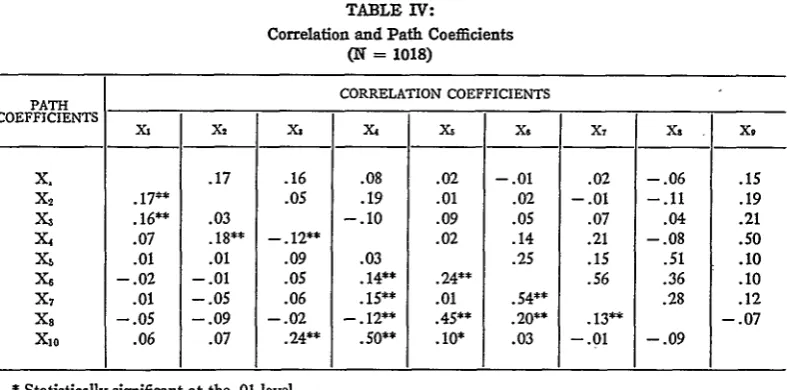
and socio-economic status on final disposition is indirect, and mediated by legal categorizations. In the second stage of our analysis, our atten-tion is directed to only those offenders who actually receive sentence; those offenders whose cases are dismissed are eliminated from the sample. Correlation and path coefficients relating to this phase of the analysis are pre-sented in Table IV, and the resulting path dia-gram is -pictured in Figure II. Criteria used in selecting path coefficients for the diagram are identical to those used in the first phase of the analysis.
The salient differences between the first and second path diagrams involve the legal and pro-cedural variables. In Figure II, the seriousness
of the initial charge (p10,4-=.50) and prior record (p10,3 = .24) are both increased in their
importance as predictors of the sentence im-posed. In contrast, the number of charges
(pio,s), defense counsel (p10,6), initial plea (p.0,7), and charge alteration (plo,s) each
account for 'less than one per cent of the varia-tion in sentencing. In brief, the procedural variables are decreased in importance, while the legal variables are increased in their influence. There are two immediate implications of these findings. First, the procedural variables (i.e., defense counsel, initial plea, and charge altera-tion) are clearly of less consequence for sen-tencing than for the dispositional process con-sidered in broader terms (i.e., with cases of charge dismissals included). Second, the in-creased importance of initial charge seriousness in sentencing heightens somewhat the indirect effect of socio-economic status. Thus, as a result of lower socio-economic status and defendants being charged with more serious offenses, the
PARAMETERS OF CRIMINAL PROSECUTION
TABLE IV:
Correlation and Path Coefficients (N = 1018)
CORRELATION COEFFICIENTS
PATH-COEFFICIENTS
X, Xi X X, X X6 XT X8 X9
X, .17 .16 .08 .02 -. 01 .02 -. 06 .15
X2 .17"* .05 .19 .01 .02 -. 01 -. 11 .19
XS .16* .03 -. 10 .09 .05 .07 .04 .21
Y- .07 .18** -.12** .02 .14 .21 -. 08 .50
X5 .01 .01 .09 .03 .25 .15 .51 .10
X6 -. 02 -. 01 .05 .14** .24** .56 .36 .10
X1 .01 -. 05 .06 .15** .01 .54** .28 .12
X8 -. 05 -. 09 -. 02 -. 12** .45** .20** .13** -. 07
X10 .06 .07 .24** .50** .10* .03 -. 01 -. 09 * Statistically significant at the .01 level.
** Statistically significant at the .01 level and explains more than one per cent of the variation in the endogenous variable.
indirect effect of socio-economic status on sen-tence (p1o,4p4,2) is
.09.
The direct effect of socio-economic status on sentence (P10,2) is.07.
The result is a combined total effect (pIo,4p4,2 +
P10,2) of
.16.
DIscussIoN AND CONCLUSIONS
The first stage of our analysis revealed that
the presence of defense counsel, the initial plea,
and charge alteration played a major role in
[ACE (X1 ) 1 8
OIoo
-ECONO mi
18
ST T
S
X
) "
<
determining final disposition. Race and
socio-economic status were not significant influences
in this process. Thus, the first phase of our
analysis replicates several of Newman's
find-ings; support is also provided for Blumberg's
argument that organizationally constrained procedures exert an influence in the court process that is independent
of extra-legal
of-fender characteristics. These data are not sup-portive of the conflict perspective, as presentede=.99
II.1
-12 e=.9724J
e=.81.50
E=C
1 2,,
=.8
[image:9.454.22.416.46.241.2]JOHN HAGAN
by Chambliss and Seidman. Several comments may help to place this conclusion in proper context.
A literal translation of the conflict perspec-tive into the study of criminal prosecution overlooks the extensive social sifting that oc-curs in the earliest phases of the legal process. It should be noted that although variation in the socio-economic status of offenders in our sample was statistically sufficient for analysis, it was at the same time limited in theoretically relevant terms. Assignment of the numbers one through six to each of Edward's Social Eco-nomic Groupings of Occupations (see Table I) resulted in a mean offender status of 4.97, and a standard deviation of 1.31. In short, the so-cio-economic status of offenders prosecuted was persistently low. Thus, the salience of class-linked factors at points preceding actual prosecution may have muted the potential im-portance of such factors in later stages of the dispositional process.
Second, it is important to note that in the charges initially filed against offenders, there is some indication of the process of social sift-ing. Lower socio-economic status offenders are charged with more serious offenses, while Na-tive offenders more often have prior records. The importance of such class-linked factors be-came apparent in the second stage of our anal-ysis. The seriousness of the offense charged against lower socio-economic status defendants
was revealed as a mediating variable in the more severe sentences received by this group of offenders.
Findings reported in both phases of the analysis have implications for issues posed in Newman's research. In neither of the causal
models presented is prior record prominantly linked to the process of charge alteration. However, confirmation is provided for the ex-pectation that offenders with more extensive cases (i.e., involving multiple offenses) are more likely to experience alterations in charges. This finding supports a hypothesis that offenders often may be systematically "over-charged" in anticipation of "rewards" to be distributed later in the bargaining process. At the same time, it is significant that the number of charges is related both to prior rec-ord and charge alteration, while prior recrec-ord has a negligible direct effect on charge altera-tion. This finding serves to question the initial causal importance assigned in Newman's data to a prior conviction history.
The benefits of charge alteration become ob-scure in the second phase of our analysis. Here it is revealed that presence of defense counsel, initial plea, and charge alteration are relatively unimportant for those offenders who are ac-tually sentenced. This finding suggests that "considerations" won in early stages of the legal process may ultimately prove illusionary, a finding that fits well with Blumberg's charac-terization of the bargaining process as a "con-fidence game." Notwithstanding the signifi-cance of this finding, this phase of the analysis also suggests the importance of considering those offenders who are able to avoid convic-tion and sentencing through the help of de-fense counsel and protestations of innocence. If the full effects of the prosecution process are to be realized, it will be important for future research to attend to those defendants whose cases are dismissed, as well as to those who are actually sentenced.