DEVELOPMENT
OF
THREE PHASE LOAD
FLOW BY REUSING
OBJECT ORIENTED SINGLE PHASE LOAD FLOW
Mamdouh Abdel-Akher, Khalid Mohamed Nor, Hazlie Mokhlis and Abdul Halim Abdul Rashid University of Malaya, Malaysia
ABSTRACT
This paper presents the development of three phase load flow software by reusing an existing single phase load flow software component. The single phase load flow component was developed using Object Oriented and Component Based Development methodologies. The object oriented power system model of the single phase load flow component was established separately from the mathematical solution. The proposed three phase load flow is formulated based on symmetrical components theory, which involves a positive sequence load flow solution. Based on this relation, the single phase load flow component and its power system model can be reused in the development of the three phase load flow software. The single phase load flow power system model is extended
for
tnodeling three phase devices such a5 untransposed lines, three phase loads...
etc. Reuse o f the single phase component is achieved through composition relationship, where the positive sequence load flow is modeled as an object inside the three phase load flow component. The three phase load flow is solved by incorporating the solution of both positive sequence load flow and the nodal voltage equations for zero and negative sequence networks.Keywords: load flow, Software Reusc, Object oriented, Symmetrical components, Newton-Raphson, Fast-Decoupled.
INTRODUCTION
Three phase load flow analysis is very important in electrical power system that considering three phase unbalanced condition.
Power
system planning, operation, control and optimization are few examples of it wide application. The three-phase load flow study can be achieved in phase coordinates or in symmetrical components frame of reference. Most of studies are established in a-b-c frame of reference. This is because the mutual inductancesbetween
different phasesof an
unsymmetrical transmission lines is not equal to each other.Recently
thedecoupled
modelsof
the untransposed transmission lines were presented [ 11. These models are used for solving three phase load flow basedon
symmetrical components theory[I]. These
techniques are implemented in this research for developing new integrated load flow simulation using component object model(COM)
and object oriented programming methodology (OOP).Before the introduction of OOP, software were built using structural programming approach. However, this approach has a lot of drawbacks such as has high development cost, low productivity, unmanageable software quality, and high risk to move to new technology [2]. The OOP is then came to resolve this problems. OOP is a natural extension of structured programming. It provides a good programing practices and makes it very easy to do so. The result is clean code that it is easy to extend and simple to maintain, Once an object is created for an application, the same object can then be used in other applications. Reusing objects can
greatly cut the software development time and increase productivity [3]. An object represents an individual, identifiable item, unit, or entity, either real or abstract, with a well-defined role in the problem domain. It has state, behavior, and identity; the structure and behavior of similar objects are defined in their base class; the term5 instance and object are interchangeable. The objects are
classified into three types. Firstly, Entity Objects that represent objects in our real world. Secondly, Interface Objects that handle data exchanged with users or other
systems.
Finally,
Control Objects thatare
created to handle complex operations that do not fit naturally in any one object or class[4]..
Although OOP provides reusability features, this is only at the source codes level since the codes still have to be recompiled whenever their functionalities need to be extended. In order to overcome this limitation, a newest software development approach that
is
Component Based Development (CBD) can be used. This approach is very different from traditional approach in which software systemscan
be
implemented fromscratch.
The components can be developed by different sofrware developers in different times and at different places. Components give us a head start for developing our software by maximizing mechanisms such as components reusability. There is no existing standard definition of the key item “component”. In general a component has three main features 151:It is an independent and replaceable part of a system
It works in the context of a well-defined architecture.
a It communicates by its interfaces.
In this paper, the power system models that present power system devices as well as solution algorithms are encapsulated inside objects. The power system devices are modeled as entity objects. These entity objects present the object-oriented power system model (00-
PSM). On the other hand, the solution algorithms such as Newton Raphson, Fast Decoupled, and Linear Solver are modeled as control objects. These control objects contain complex solution algorithm that can not he fit in a single class. The control objects are developed as independent components. Thesc control objects present the power system component object model (PS-COM).
SINGLE PHASE OBJECT ORIENTED POWER SYSTEM MODEL
The real power systeni devices, such as generators, transformers, transmission lines, and loads are modeled as objects and classified by the same way as in the real
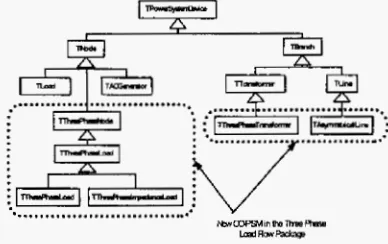
world. Fig. 1 shows the class hierarchy of the power system models. These inodcls are designed to he mcmher data of the components that are developed to solve the load flow. So, these models are reused through out the different power system studies because they became data type for the power system.
[image:2.616.91.285.402.524.2]'
...
...Y...
;,
*
,;v
:-
-
...*..
w-,nlblbm*Figure 1 The Object Oriented Power System Model
In Fig. 1 , the electncal network is described by two
essential elements. These elements are nodes and branches. They are modeled as classes m o d e and TBranch. The elements that are connected to nodes such as generators and loads are inherited from the class m o d e . On the other hand, the elements that are connected between two busbars such as transmission lines and transformers are inherited from the class TBranch.
DESCRIPTION OF THE SINGLE PHASE LOAD FLOW COMPONENTS
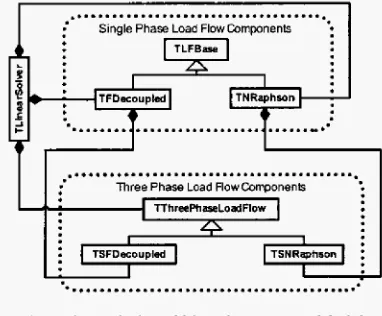
The single phase load flow contains four components; each component has a clear function in the single phase
load flow simulation. There are three components appears in Fig. 2, TFDecoupled, TNRaphson, and TLinearSolvcr. The fourth component IS an interface component for reading the IEEE data format, this component is used in CBD apphcations and does not appear in Fig 2 .
,
Figure 2 Single Phase Load Flow Component Software
Single Phase Load Flow Base Class
This class is designed to be base class for any single phase load flow algorithm. The class contains the common data, methods, and interface methods based on the single phase 00-PSM. Any algorithm for solving single phase load flow can be encapsulated inside a component inherited from the base class. The protected part of the class contains the 00-PSM. The 0 0 - P S M is visibk for all the class descendants. An interface for the 00-PSM is established to enable the user form accessing the 00-PSM. To make the components reusable, two
important flag interfaces are included in the class. These interfaces control the behavior of the inherited components from the class. The first flag interface enables the user to perform the solution process for one iteration and at the same time the refactorization is avoided in the next iteration. The second flag interface checks the convergence inside the component.
The Linear Solver Component
The solution of the load flow requires a mathematical solver for handling the matrix operation involved in the solution process. The solver component uses SuperLU library routines [6]. The solver can solves matrix equation in the form ofAz-b in order to get the x values. Although it is a public domain code, it
still
has the same capability compared to other in solving sparse linear equation. It uses many latest techniques, such as graph reduction technique in matrix factorization. Furthermore,it can also solve very unsymmetrical matrices.
Single Phase Load Flow Components
out different CBD applications for different power system studies.
EXTENDING 0 0 - P S M FOR MODELING THREE PHASE DEVICES
The three phase load flow components require three
phase 00-PSM to represent the real three phase elements such as three phase busbars, three phase loads, three phase transformers ... etc. In order to have the required model, the 00-PSM of the single phase in Fig. 1 can be extended for three phase 0 0 - P S M by inheriting the single phase 00-PSM.
DESCRIPTION OF THE
THREE
PHASE LOAD FLOW COMPONENTSThe three-phase load flow solution algorithm (Positive Sequence Load flow and Nodal Voltage Equations) is
encapsulated inside components independent on the algorithms used in the single phase load flow components. The single phase load flow coinponents are reused based on composition only. This reduces the dependency between the codes of both single phase and thrce phase load flow components.
Three Phase Load Flow Base Class
The class is designed to be the base class for any three phase load flow algorithm uses the symmetrical components theory and the decoupled models of the untransposed transmission lines. The class is developed ' based on object oriented approach; it handles the single phase load flow as an object. This object behaves as black box, only communicates with its surroundings with its interface. The flag interface in single phase load flow base class, is used for controlling the behavior of the component. The first one is adjusted such the positive load flow object performs one iteration while the second checks the mismatch tolerance is acceptable or not. The object returns the positive sequence load flow solution at each iteration during the overall solution process.
The three phase load flow is solved by incorporating the positive load flow solution with both the solution of the zero- and negative- sequence nodal voltage equations. The linear solver component is aggregated in the three phase load flow base class for solving the both zero and negative sequence voltage equations as exhibited in Fig. 2. The positive sequence load flow object can be declared as any type of the single phase load flow algorithms. It may be TNRaphson
or
TFDecoupled. According to its declaration, the positive sequence object will behave in three phase load flow base class. The declaration of the positive sequence load flow is done inside independent.
components inherited form the three phase load flow base as exhibited in Fig 3.
Three Phase Load Flow Components
[image:3.612.341.532.272.430.2]There are two components for solving three phase load flow as given in Fig. 2. The two components are inherited from the base class TThreePhaseLoadFlow. The first component TSNRaphson declares the positive sequence load flow object as TNRaphson. The second component, TSFDecoupled, declares the positive sequence load flow object as TFDecoupled. Fig. 2 presents the component object model for the load flow analysis software.
...
Single Phase Load FlDWCompanents':
L
...
Three Phase Load HowComponenkTThreePhaseLoadFlow
...
Figure 3 Load Flow Object Components Model
The most important point that makes these components flexible, reusable, and can be replaceable that the interface o f the load flow components are based on the 0 0 - P S M model itself, this model is persistent, i.e. long life cycle object. Normally these objects
are
not related toalgorithms that are encapsulated inside load flow components. The 0 0 - P S M is only reused as data type for developing the load flow components.
Interface Component For Unbalanced Three Phase Data
This component i s developed as interface component; the components collects all the unbalanced power system data inside one interface object, these data include the unbalanced loads, untransposed transmission lines, the sequence data for transformers, generators
...
etc. The component is not shown in Fig. 3. It is reused only in CBD application for supplying the power system data for the components that request these data.PACKAGING COMPONENTS
one or more than one package. Then, the package is compiled to generate the package libraries. The libraries are stored in files that have extension with the bpl (Borland package library). The library then can be reused for developing many functioning application for both single and three phase load flow or can be extended for
developing new software components that could perfom another power system study.
COMPONENT BASED DEVELOPMEKT APPLICATIONS
The sourcc code of the developed components and classes are not required, since the library files plus the header files only required for developing functioning applications. Two CBD applications are given bclow to explain the usage o f the object load flow components.
Component Based Development Single Phase Load Flow Application
Table 1 gives the code for the single phase load flow
application. Firstly, an interface object called TEEEData is declared, this object has a job that is to read the power system data in the standard IEEE data format. Then control object, LoadFlow is defined as instant from the class TLFBase. There are two possibilities for declaring the object LoadFlow. The first choice is as the TNRaphson component while the second as the TFDecoupled component. The power system data is tmnsfemed form the interface object IEEEData to the object LoadFlow by its interface.
Table 1 SingIe Phase Load Flow CBD Application
#include NRaphson.h #include FDeioup1e.h #include ReadAsciiDahh
TReadAxiiDats *IEEEData =new TReadAsciiData(NUU)
' IEEEData -rFileName(IEEE3OD.txt)
TLFBase *LoadFlow;
if (YourChoices=Newmn~phson)
LoadFlow=new TNRaphson(NUL1); if(YourChoice= =FastDecoupled) LwdFlow=naW TFDecoupte(NUU);
LoadFlow-zAddBus( IEEEData -rNBus, I E E D a t a ->Type...)
The load flow is solved by dispatching the interface method Calculate(). The method is defined inside the class TLFBase as virtual method. The method will be invoked at the runtime according to the declaration o f the object LoadFlow. If the object is declared as TNRaphson, the method Calculate() inside the component TNRaphson will override the virtual method inside the base class TLFBase. The same situation if the control object LoadFlow is declared as TFDecoupled. The solution is
printed in text file by dispatching the interface method PrintResultO,
Component-Based Development Three Phase Load Flow Application
The three phase load flow components are used the same way as in the case of the single phase load flow application. Addition data should be supplied to the object LoadFlow in Table 2 . This data is encapsulated inside the interface object ThreePhaseData. Three phase load flow in the application can be solved by dispatching the interface method Calculate() in the object LoadFlow in similar manner to the case of the single phase load flow application.
Table 2 Three Phase Load Flow CBD Application
#include SNRaphson.h #include SFDecwp1e.h #include ReadAsciiDahh #include Unba1ncedData.h
TReadAsKiiData *IEEEOata= new TReadAxiiData(NULL) TUnbalancedDala *ThreePhaseData=new
TUnbalancedData(NULL); IEEEData ->FileName(lEEEl4.t)
ThreePhaseData->LoadFileName(.. .);
ThreePhaseData->LineFileName( ...) ;
TAsymmetricalloadFIowLPBase *LoadFlow; if (YourChoice==SequenceNewtonRaphson)
LoadFlow=new TSNRaphson(NULL); if(YourChoice= =SequenceFastDecoupled) LoadFlow= new TSFDecouple(NULL);
LoadFlow->PositiveloadFlow->AddEus( IEEEData ->NSus,...)
LwdFlow- >Calculate(); LaodFlow->PrintThreeRerult(l;
REUSABILITY
IN
THE
DEVELOPMENT OF THE THREE PHASE LOAD FLOWThe reusability is measured in software industry for economic reasons especially in developing large software projects. In this paper component technology is used for developing reusable load flow objects. These objects model complex problems that may take along time to be developed from scratch. The single phase load flow
object components are reused for developing other components for thee phase load flow. And at the same time the OO-PSM is extended to new models.
single phase 0 0 - P S M . The rest 45% is reused as it in the development of the three phase load flow based on composition. In view of the solution algorithms, 60% of
three phase components are reused based on composition
of single phase load flow components and the rest 40% are developed from scratch.
It is important to be iiientioned here in that to produce reusable component, this requires understanding for the problcm that the object component represents. This nieans that developing reusable component for power system study is not only programming practice but also power engineering practice.
RESULTS
The 24 bus data in reference [7] was tested with both the
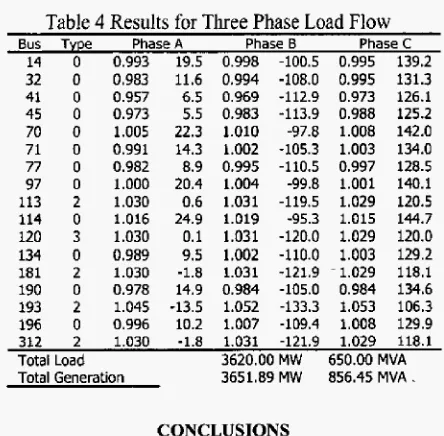
two CBD application in section 7. In the case of both power system and load are balanced, the results differs only in the phase shift introduced by Y-A transformers. For unbalanced power system, Case B in [7] was tested for sake of comparison, the sample results in Table 4 agree well with those given in Table 5 in [7].
Table
4
Results for Three Phase Load
Flow
Bus Type PhaseA Phase B Phase C14 0 0.993 19.5 0.998 -100.5 0.995 139.2
32 41 45 70 71 77 97 113 114 120 134 181 190 193 196
0 0.983 11.6
0 0.957 6.5
0 0.973 5.5
0 1.005 22.3
0 0.991 14.3
0 1.000 20.4
2 1.030 0.6
0 1.016 24.9
3 1.030 0.1
0 0.989 9.5
2 1.030 -1.8
0 0.978 14.9
2 1.045 -13.5
0 0.996 10.2
o
0.982 8.90.994
0.969 0.983 1.010
1.002
0.995 1.004
1.03 1 1.019 1.031 1.002 1.031 0.984 1.052
1.007
-108.0 -112.9 -113.9 -97.8 -105.3 -110.5 -99.8 -119.5 -95.3 -120.0
-110.0
-121.9 -105.0 -133.3 -109.4
0.995 131.3 0.973 126.1 0.988 125.2
1.008 142.0 1.003 134.0 0.997 128.5 1.001 140.1
1.029 120.5 1.015 144.7 1.029 120.0 1.003 129.2 1.029 118.1
0.984 134.6 1.053 106.3 1.008 129.9
.. .
312 2 1.030 -1.8 1.031 -121.9 1.029 118.1
Total Load 3620.00 MW 650.00 MVA
Total Generation 3651.89 MW 856.45 MVA CONCLUSIONS
The paper has presented the development of three phase load flow reusing single phase load flow based on
symmetrical components theory. There are two object- models were presented in this paper. The first one models the power system devices, 00-PSM. In this model, the single phase model is extended for modeling the three phase devices. The second one is the load flow component object model that models the load flow
solution algorithms single phase or three-phases. In this model, the single phase load flow objects are reused for
developing the three phase load flow components. Both
of single phase and three phase load flow objects are reused for developing CBD application. These applications were tested, only sample results for three phase load flow were presented.
ACKNOWLEDGMENT
The authors gratefully acknowledge University of Malaya in the work reported in this paper
REFERENCES
1.Xiao-Ping Zhang
,
“Fast three phase load flow methods” Power Systems, IEEE Trans. on Power System, Vol. 11, No. 3, Aug 19962. Developer’s Guide, Borland CttBuilder 6 for windows.
3, Xia Cai, Maichel R.
Lyu,
Kam-Fai Wong, and Roy KO,“Componen t-Based Software Engineering: Technologies. ..” Proc. APSEC2000, 2000.
4.
Ivar Jacobson, “Object-Oriented Software Engineering” Addison-Wesley Publishing Company.1992.
5.Luiz Fernando Capretz, Miriam A, M Capertz, and Dahai Li, “Component-Based Software Development”,
Proc. Of IEEE IECON’OI ,200 1.
6. J. W Demmel et. al, “A Supernodal Approach to Sparse Partial Pivoting”, SIAM Journal on Matrix Analysis and Applications Vol 20
,
No 3, pp.720 -755,1999.
7.Chen, B.-K. Chen, M . 4 . Shoults, R.R. Liang, C.-
C., “Hybrid three phase load flow”, IEE, Generation, Transmission and Distribution, Vol 137, No 3, May
1990, pp 177 -185.
AUTHORS ADDRESS The second author can be contacted at:
Department of Electrical Engineering, University of Malaya 50603 Kuala Lumpur, Malaysia
[image:5.613.90.312.464.682.2]