The Language Application Grid and Galaxy
Nancy Ide
∗, James Pustejovsky
∗∗, Keith Suderman
∗Marc Verhagen
∗∗, Chris Cieri
†
, Eric Nyberg
‡
∗Vassar College,∗∗Brandeis University,†Linguistic Data Consortium,‡Carnegie-Mellon University ∗Poughkeepsie, NY USA,∗∗Waltham, Mass. USA,†Philadelphia, PA USA,‡Pittsburgh, PA USA
{ide,suderman}@cs.vassar.edu,{jamesp,marc}@cs.brandeis.edu, [email protected], [email protected]
Abstract
The NSF-SI2-funded LAPPS Grid project is a collaborative effort among Brandeis University, Vassar College, Carnegie-Mellon University (CMU), and the Linguistic Data Consortium (LDC), which has developed an open, web-based infrastructure through which resources can be easily accessed and within which tailored language services can be efficiently composed, evaluated, disseminated and consumed by researchers, developers, and students across a wide variety of disciplines. The LAPPS Grid project recently adopted Galaxy (Giardine et al., 2005), a robust, well-developed, and well-supported front end for workflow configuration, management, and persistence. Galaxy allows data inputs and processing steps to be selected from graphical menus, and results are displayed in intuitive plots and summaries that encourage interactive workflows and the exploration of hypotheses. The Galaxy workflow engine provides significant advantages for deploying pipelines of LAPPS Grid web services, including not only means to create and deploy locally-run and even customized versions of the LAPPS Grid as well as running the LAPPS Grid in the cloud, but also access to a huge array of statistical and visualization tools that have been developed for use in genomics research.
Keywords:Web services, Interoperability, Workflow management
1.
Overview
The NSF-SI2-funded LAPPS Grid project1 is a
collabo-rative effort among Brandeis University, Vassar College, Carnegie-Mellon University (CMU), and the Linguistic Data Consortium (LDC) at the University of Pennsylva-nia, which has developed an open, web-based infrastruc-ture through which massive and distributed resources can be easily accessed, in whole or in part, and within which tai-lored language services can be efficiently composed, evalu-ated, disseminated and consumed by researchers, develop-ers, and students across a wide variety of disciplines (Ide et al., 2014). The LAPPS Grid is part of a larger multi-way international collaboration including key individuals and projects from the U.S., Europe, Australia, and Asia involved with language resource development and distri-bution and standards-making, who are creating the “The Federated Grid of Language Services” (FGLS) federation (Ishida et al., 2014), a multi-lingual, international network of web service grids and providers. We have also recently entered into a formal partnership with WebLicht/T¨ubingen and LINDAT/CLARIN (Prague) to create a “trust network” among our sites in order to provide mutual access to all from any one of the three portals. The key to the success of these partnerships is theinteroperabilityamong tools and services that is accomplished via the service-oriented archi-tecture and the development of common vocabularies and multi-way mappings that has involved key researchers from around the world for over a decade2.
1http://www.lappsgrid.org 2
E.g., the NSF-funded Sustainable Interoperability for Lan-guage Technology (SILT) project (NSF-INTEROP 0753069) (Ide et al., 2009), the EU-funded Fostering Language Resources Net-work (FLaReNet) project (Calzolari et al., 2009), the International Standards Organization (ISO) committee for Language Resource Management (ISO TC37 SC4), and parallel efforts in Asia and Australia, together with the LAPPS project and international
col-The LAPPS Grid currently includes a wide range of NLP component web services and provides facilities for service discovery, service composition (including automatic format conversion between tools where necessary), performance evaluation (via provision of component-level measures for standard evaluation metrics for component-level and end-to-end measurement), and resource delivery for a range of language resources, including holdings of the Linguistic Data Consortium (LDC).3
The LAPPS Grid project recently adopted Galaxy (Gia-rdine et al., 2005), a robust, developed, and well-supported front end for workflow configuration, manage-ment, and persistence.4 Galaxy allows data inputs and pro-cessing steps to be selected from graphical menus, and re-sults are displayed in intuitive plots and summaries that en-courage interactive workflows and the exploration of hy-potheses. Galaxy provides significant advantages for de-ploying pipelines of LAPPS Grid web services, including not only means to create and deploy locally-run and even customized versions of the LAPPS Grid as well as running the LAPPS Grid in the cloud, but also access to a huge ar-ray of statistical and visualization tools that have been de-veloped for use in genomics research.
2.
Galaxy
The Galaxy project5started in 2005 to create a system
en-abling biologists without informatics expertise to perform computational analysis through the web (Giardine et al., 2005). It has since been widely adopted within the life sci-ences community.
laborators.
3
http://www.ldc.upenn.edu
4
http://galaxy.lappsgrid.org
5
Figure 1: Model composition of the Hodgkin-Huxley Model.
Galaxy is an open-source application6 that includes tool integration and history capabilities together with a work-flow system for building automated multi-step analyses, a visualization framework including visual analysis capa-bilities, and facilities for sharing and publishing analyses (Goecks et al., 2012). It is accessed through a graphical interface where data inputs and computational steps are se-lected from dynamic menus, and results are displayed in plots and summaries that encourage interactive workflows and the exploration of hypotheses.
The main Galaxy site at http://usegalaxy.org is an installa-tion of the Galaxy software combined with many common tools and visualizations that is available to anyone to ana-lyze their data free of charge. The Galaxy ToolShed pro-vides a central location where tool developers can upload both their tool configurations and“recipes” describing how to install necessary dependencies.
As an example of the capabilities and versatility of Galaxy, Figure 1 illustrates how a model composition of the Hodgkin-Huxley squid giant axon model can be built using Galaxy workflows. This workflow interface shows nodes for sodium, potassium, and leak currents (left), which are then combined into a cell model for simulation of current injection (middle). The final node (right) plots the mem-brane potential.
Recognizing that capabilities of this type are applicable for developing workflows for NLP, and rather than duplicate the extensive work of the Galaxy project, the LAPPS Grid has adopted it as its primary workflow management sys-tem.7 We have worked with the Galaxy development team in order to adapt the system to our domain, and continue this collaboration to both enhance the capabilities we re-quire as well as contribute to the expansion of Galaxy to domains outside the life sciences, which is a current goal of the Galaxy project.
We provide Galaxy wrappers to call all LAPPS web ser-vices to the Galaxy ToolShed8. This enables the creation
6
Distributed under the terms of permissive Academic Free Li-cense: http://getgalaxy.org
7
http://galaxy.lappsgrid.org
8
https://toolshed.g2.bx.psu.edu
of complex workflows involving standard NLP components and composite services from a wide range of sources from within an easy-to-use, intuitive workflow engine with capa-bilities to persist experiments and results. In addition to ac-cess to LAPPS Grid tools and data, we have developed and contributed the following capabilities of the LAPPS Grid for use in Galaxy in order to support NLP research and de-velopment within that platform, including:
1. exploitation of our web service metadata to allow for automatic detection of input/output formats and re-quirements for modules in a workflow and subsequent automatic invocation of converters to make interoper-ability seamless and invisible to the user;
2. incorporation of authentication procedures for pro-tected data using the open standard OAuth9, which
specifies a process for resource owners to authorize third-party access to their server resources without sharing their credentials; and
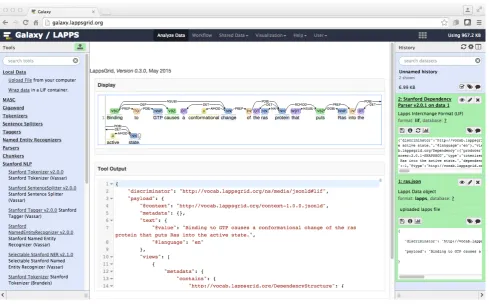
3. addition of a visualization plugin that recognizes the kind of input (coreference, phrase structure) and then uses appropriate off-the-shelf components like BRAT and Graphviz to generate a visualization. Figure 2 shows a visualization of named entity annotation over a document using BRAT.
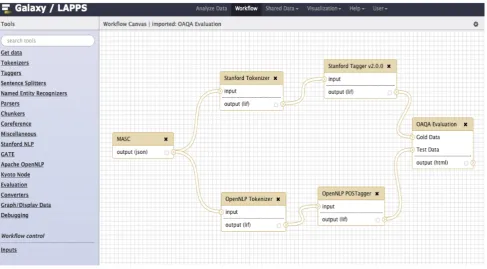
Figure 3 shows a simple workflow configuration in LAPPS/Galaxy that invokes a chain of processors from different sources (in this example, GATE, Stanford NLP tools, and OpenNLP tools) to perform named entity recog-nition. The ability to combine processing modules from different sources becomes especially valuable when used in combination with the Open Advancement (OA) evalu-ation services in the LAPPS Grid, which provides perfor-mance statistics for each component in the pipeline as well as statistics reflecting the cumulative performance. This fa-cility enables users to explore parallel workflows and eval-uate module-by-module results in order to ultimately iden-tify the optimal workflow configuration. Figure 4 shows
9
Figure 2: Visualization of a named entity annotation using LAPPS/Galaxy
a screenshot of the use of the OA evaluation service in a (simplified) workflow.
We have adopted and, as necessary, adapted Galaxy strate-gies for the following:
1. Replication of experiments, pervasive sharing of
methods and results. Reproducing experimental results is an essential part of scientific inquiry, providing the foun-dation for understanding, integrating, and extending results toward new discoveries. However, the field of NLP re-search and development has been plagued by a chronic lack of potential for replicability of results, as discussed in sev-eral recent publications (Pedersen, 2008; Fokkens et al., 2013), blogs10, and workshops11. As a result, there is not
only a great deal of re-inventing of the wheel and wasted effort, but also serious inhibition to progress that can be made possible by tapping into the collective intelligence of the community. Evaluation of results is also seriously ham-pered when details of an experiment (including versions and parameters for data, software) are not included in pa-pers, which is all too often the case. Our adaptation of the Galaxy workflow system enables us to foster replicability and reuse for NLP by providing the following capabilities (see (Goecks et al., 2010) for a comprehensive overview of Galaxy’s sharing and publication capabilities):
• automatic recording of inputs, tools, parameters and settings used for each step in an analysis in a publicly
10
E.g., http://nlpers.blogspot.com/2006/11/reproducible-results.html
11E.g., Replicability and Reusability in Natural Language
Pro-cessing: from Data to Software Sharing: http://nl.ijs.si/rrnlp2015/
viewable history, thereby ensuring that each result can be exactly reproduced and reviewed later;
• provisions for sharing datasets, histories, and work-flows via web links, with progressive levels of sharing including the ability to publish in a public repository;
• ability to create custom web-based documents to com-municate about an entire experiment, which represent a step towards the next generation of online publica-tion or publicapublica-tion supplement.
In addition to enabling other users to replicate an experi-ment, the individual user can develop a rich, organized cat-alog of reusable workflows rather than starting from scratch each time or trying to navigate a collection ofad hoc anal-ysis scripts. Similarly, it is possible to repeatedly apply a command history on different data. Once an analysis is done, the record eliminates ambiguity as to which result used which settings provide critical information for follow-up analysis.
2. Transparency. Research publications involving com-putationally intensive analysis can be difficult to understand (Nekrutenko and Taylor, 2012; Sandve et al., 2013). Galaxy provides means for researchers to make their analyses avail-able to others in ways that are easy to understand, primar-ily via Galaxy histories that can be shared or pointed to in papers to demonstrate exactly what has been done. In addi-tion, Galaxy Pages and free-form annotations provide ways to add context to analysis to describe the reasoning behind an analysis and parameter settings.
Figure 3: The LAPPS/Galaxy Interface: Workflow configuration
Figure 4: The LAPPS/Galaxy Interface: OA Evaluation on two pipelines
in community building and outreach, comparable to what we hope to achieve for the LAPPS Grid. Inspired by their success, we are adopting the Galaxy project’s outreach strategies in order to most effectively reach, teach, and in-volve the community in the LAPPS Grid, as well as pro-mote community engagement in LAPPS development via
[image:4.595.54.542.401.670.2]contributors to the LAPPS Grid development itself, whom we support through reviewing and merging pull requests (additions and modifications to the source code submitted to us through the version control system). We have also set up direct support for both of these constituencies by pro-viding a question/answer environment on the LAPPS wiki and dedicated mailing lists, which are routinely monitored by the LAPPS Grid development team.
We are working with the Galaxy team to develop and con-tribute existing capabilities in LAPPS Grid that can be of benefit to Galaxy users as well, including: (1) exploitation of our web service metadata to allow for automatic detec-tion of input/output formats and requirements for modules in a workflow and subsequent automatic invocation of con-verters to make interoperability seamless and invisible to the user; and (2) incorporation of authentication procedures for protected data using the open standard OAuth12, which
specifies a process for resource owners to authorize third-party access to their server resources without sharing their credentials. We also will contribute facilities that are under development within the LAPPS Grid project, including (1) provisions for including a “human-in-the-loop” in iterative development workflows, and (2) capabilities within the OA evaluation service for automatically providing “best path” analysis to determine an optimal workflow for a given task.
2.1.
NLP Galaxy “Flavor”
Galaxy recently added support for running tools from the Galaxy ToolShed within Docker containers. Docker13
al-lows users to package an application with all of its depen-dencies into a standardized unit into a Docker image, which is an easily distributable full-fledged installation that can be used for testing, teaching, and presenting new tools and fea-tures. Within Galaxy, Docker support can be used to create aGalaxy Flavor, which is a Galaxy image configured with a tool suite for a particular task or application.
We have contributed a “Galaxy Flavor” including all LAPPS Grid services and resources, which is effectively a pre-configured virtual machine (VM) that can be run in any of several VMs (e.g., VirtualBox, AmazonEC2, Google, Microsoft Azure, VMWare, OpenStack, etc.). This enables users to access only the NLP subset of tools if desired, as well as to download a Galaxy-stable image and run it lo-cally. This capability is ideal for class work, workshops, and presentations as it allows full-blown installations to be easily shared and run. This also provides the capability to run the LAPPS Grid in environments where there is no in-ternet access, or where security requires a completely local environment.
2.2.
LAPPS/Galaxy Synergy
An additional, and potentially hugely significant, outcome of the LAPPS/Galaxy collaboration is that it enables the use of LAPPS Grid NLP services to extract information from repositories of biomedical publications such as PubMed14
and pass it on to biomedical analysis and visualization tools
12 http://oauth.net 13 https://www.docker.com 14 http://www.ncbi.nlm.nih.gov/pubmed
available in Galaxy. The synergistic development of capa-bilities supporting both NLP and genomic analysis within the Galaxy framework can have a significant impact on work in both fields, providing each with access to meth-ods for exploration and analysis of data that were previ-ously unfamiliar. For example, NLP researchers will ben-efit enormously from access to sophisticated visualization software for display and analysis of results common to re-search in the life sciences, but rarely used in NLP rere-search. Similarly, biologists will be able to take advantage of bio-oriented NLP web services for text mining of bio-entities and relations from textual sources, and via capabilities al-ready present in Galaxy, integrate them into existing bio-data resources and analysis tools. Provenance indexing to the article would enable researchers to both verify and con-textualize the results. Researchers in biology could also exploit human-in-the-loop capabilities to enhance iterative analysis of genomics and other data.
3.
LAPPS/Galaxy Development
The LAPPS Grid project is not developing new analysis tools, but is instead building the infrastructure to make ex-isting tools and resources easily discoverable, enable their rapid and easy configuration into pipelines and composite services, and most importantly, make them transparently in-teroperable. The Grid currently provides a large suite of commonly used NLP modules including the Stanford NLP modules, OpenNLP tools, GATE’s ANNIE tools, NLTK, BRAT annotation tool, etc., which can now be arbitrarily interchanged as needed by a given task or application.15 We are continually expanding the range of services available to Grid users by wrapping freely available tools and resources, including tools and resources that are already widely used in the field together with others that will be immediately useful. Perhaps more importantly, our collaborations with other grids and frameworks in Asia and Europe will signifi-cantly expand the resources available to LAPPS Grid users, including a vast array of multi-lingual tools and language resources.
In addition to adding services ourselves, we anticipate that some service users will be providers as well, since they will want to incorporate their own modules into composite ser-vices of their own or others’ design. To enable this we have developed facilities for wrapping uprovided ser-vices that are as user-friendly and transparent as possible, and provide corresponding tutorials and other support ma-terials. The goal is to make the LAPPS Grid (and the larger network of grids and frameworks under development) a fully community-based project.
4.
Conclusion
The LAPPS Grid project is collaborating with several other projects around the world to achieve interoperability among platforms and frameworks that serve NLP research and development, with the aim of establishing a globally and openly accessible, fully interoperable network of tools and services. Adoption of Galaxy, a fully developed and
15See http://www.lappsgrid.org/language-services for a full list
well-supported workflow engine, is now being pursued or considered by several other projects in the field of Lan-guage Technology, including the LanLan-guage Grid, the ELRA Grid16, and it has already been adopted by projects such as
the University of Melbourne’s Alveo17 and the University
of Oslo’s Language Analysis Portal project18. Widespread
adoption of Galaxy among NLP-related projects can con-tribute significantly to increased interoperability and the de-velopment of a open global network for NLP research and development.
The LAPPS Grid / Galaxy collaboration also provides an ideal bridge between the NLP and life science domains. The integration of data, tools, as well as workflows and methods from previously distinct scientific communities can provide unprecedented capabilities for both the emerg-ing field of BioNLP and biomedical and genomic science. We also see benefit for scholars and researchers in the Digital Humanities, who can benefit from the availability of pre-composed workflows for specific language-analytic tasks as well as the ability to access and combine tools and resources available from different sources, to which the new collaboration between the LAPPS Grid and We-bLicht/T¨ubingen and LINDAT/CLARIN directly speaks.
Acknowledgments
This work was supported by National Science Foundation grants NSF-ACI 1147944 and NSF-ACI 1147912.
Nicoletta Calzolari, et al., editors. (2009). Proceedings of ”The European Language Resources and Technologies Forum: Shaping the Future of the Multilingual Digital Europe”. ILC-CNR.
Fokkens, A., van Erp, M., Postma, M., Pedersen, T., Vossen, P., and Freire, N. (2013). Offspring from repro-duction problems: What replication failure teaches us. InProceedings of the Conference of The Association for Computational Linguistics, pages 1691–1701. The Asso-ciation for Computational Linguistics.
Giardine, B., Riemer, C., Hardison, R. C., Burhans, R., El-nitski, L., Shah, P., Zhang, Y., Blankenberg, D., Albert, I., Taylor, J., Miller, W., Kent, W. J., and Nekrutenko, A. (2005). Galaxy: a platform for interactive large-scale genome analysis.Genome Research, 15(10):1451–55. Goecks, J., Nekrutenko, A., and Taylor, J. (2010). Galaxy:
a comprehensive approach for supporting accessible, re-producible, and transparent computational research in the life sciences. Genome biology, 11:R86.
Goecks, J., Coraor, N., The Galaxy Team, Nekrutenko, A., and Taylor, J. (2012). NGS Analyses by Visualization with Trackster. Nature Biotechnology, 30(11):10361039.
Ide, N., Pustejovsky, J., Calzolari, N., and Soria, C. (2009). The SILT and FlaReNet international collaboration for interoperability. InProceedings of the Third Linguistic Annotation Workshop, ACL-IJCNLP, August.
16
In development
17http://alveo.edu.au
18
https://www.clarin.eu/sites/default/files/20151016-CAC-02-lap slides-LAP-The CLARINO Language Analysis Portal.pdf
Ide, N., Pustejovsky, J., Cieri, C., Nyberg, E., Wang, D., Suderman, K., Verhagen, M., and Wright, J. (2014). The Language Application Grid. InProceedings of the Ninth International Conference on Language Resources and Evaluation (LREC’14), Reykjavik, Iceland, May. Euro-pean Language Resources Association (ELRA).
Ishida, T., Murakami, Y., Lin, D., Nakaguchi, T., and Otani, M. (2014). Open Language Grid–Towards a Global Language Service Infrastructure. InThe Third ASE In-ternational Conference on Social Informatics (SocialIn-formatics 2014), Cambridge, Massachusetts, USA. Nekrutenko, A. and Taylor, J. (2012). Next-generation
se-quencing data interpretation: enhancing reproducibility and accessibility. Nature Reviews Genetics, 13(9):667– 672, September.
Pedersen, T. (2008). Empiricism is not a matter of faith.
Computational Linguistics, 34(3), September.