Wellbeing Policy Statement
and Framework for Practice
2018–2023
Revised October 2019
The promotion of wellbeing is central to the Department’s mission to enable children and young people to achieve their full potential and contribute to Ireland’s social, cultural and economic development. As a society, we face a wide range of challenges that impact on our wellbeing. Promoting the wellbeing of our children and young people is a shared community responsibility and is everybody’s business.
Schools play a key role in developing and enhancing young people’s wellbeing. Consequently, I have placed a high priority on wellbeing promotion and a target that all schools and centres for education will have embedded a School Self-Evaluation Wellbeing Promotion Process by 2023. Implementation of this process will help our children and young people to realise their potential, to be resilient in dealing with the normal stresses of their lives, to take care of their physical wellbeing and to have a sense of purpose, connection and belonging to their wider community, including their school community.
Current research indicates that what is most beneficial in the promotion of wellbeing in education is to adopt a preventative, whole school approach that is multi-component, and evidence-informed. There is overwhelming evidence that children and young people learn more effectively if they are happy in their work, believe in themselves, and feel supported.
We continue to be fortunate to have schools and centres for education already doing so much to equip children and young people with the knowledge, skills and competencies to enhance their wellbeing and deal with challenges including the implementation of the existing curricula. Schools and centres for education have a significant positive influence on the lives of our children and young people and it is a key part of the role of my Department to support them in their endeavours.
The Wellbeing Policy Statement and Framework for Practice was first published in 2018. It provided a definition of wellbeing, and an overarching structure encompassing the existing, ongoing and developing work in the area of wellbeing in education. It was informed by international research and practice and the many relevant policies and guidelines already available to schools and centres for education.
Since it was published, significant work has taken place to realise the vision set out in the Department’s Wellbeing Policy. Through the collaboration of the Department’s support services and other stakeholders and partners, the Wellbeing Framework for Practice has been finalised. This comprises the key areas of wellbeing in education on which schools are advised to focus, the indicators of success in each of these key areas and statements of effective practice to guide schools. In addition, a suite of resources to support schools in this important work has been developed.
Schools and centres for education are asked to include wellbeing promotion as a focus for their School Self-Evaluation (SSE). This should involve the development, implementation and review of wellbeing promotion in their schools, which includes tracking impact.
I would like to thank everyone involved in the development of this work. I believe that the promotion of the wellbeing of our children and young people is central to my mission to enable individuals to achieve their full potential by empowering them through learning.
Joe McHugh, T.D.
Table of Contents
Section 1 5
Key Messages 5
1. Why we Need a Wellbeing Policy Statement and Framework for Practice 8
2. What do we Mean by Wellbeing? 10
3. The Role of Schools and Centres for Education in Wellbeing Promotion 12 4. The Role of Government in Wellbeing Promotion in the Education System 17 5. The Department’s Ambition and Vision for Wellbeing Promotion 20 6. Wellbeing Policy Statement and Framework for Practice: Implementation 25
Section 2 33
Wellbeing in Education – Framework for Practice 33
Figures
Figure 1: Bronfenbrenner’s Ecological Model of Human Development 11 Figure 2: Whole School Approach - Four Key Areas Wellbeing Promotion. 16 Figure 3: Whole School Approach: Four Key Areas of Wellbeing Promotion 35 Figure 4: Linking Looking at our Schools and the Wellbeing Framework for Practice 37 Figure 5: Example of alignment of Looking at our Schools and the Wellbeing 38 Framework for Practice
Figure 6: Figure 6: Using the SSE process with the Wellbeing Framework for Practice 39
Tables
Table 1: Continuum of Support 14
Table 2 Wellbeing Promotion Indicators of Success 21
Table 3: Suggested Measures for Success 23
Table 4: High-level Actions 24
Table 5: Wellbeing Implementation Plan 28
Table 6: Continuum of Support 34
Table 7: Wellbeing Promotion Indicators of Success 36
Table 8: Additional agencies and bodies relevant to Wellbeing Promotion 55
References 48
Acronyms 52
Appendices
Appendix 1 Government Strategies and Cross-Departmental Collaboration 53 Appendix 2 Department Policy Documents and Reports Linked to Wellbeing Promotion 56
Schools and centres for education in Ireland play a vital role in the promotion of wellbeing through a range of activities and approaches to support the academic, physical, mental, emotional, social and spiritual development of all children and young people.
Many schools and centres for education have already developed innovative approaches to wellbeing promotion supported by strong leadership and quality teaching and learning.
Our education system is key to equipping children and young people with the knowledge, skills and competencies to deal with challenges that impact on their wellbeing.
This policy statement provides an overarching structure encompassing existing, ongoing and developing work in this area including the Aistear: the Early Childhood Curriculum Framework and Social Personal and Health Education (SPHE) curriculum at the primary level, and the Junior Cycle Wellbeing Programme at the post primary level.
This policy is for schools, centres for education, children and young people, parents/carers, support services, government departments, non-government organisations and all those with an interest in wellbeing promotion in education.
The Department of Education and Skills aims to ensure that the experience of children and young people from the early years and throughout their primary and post primary education will be one that enhances, promotes, values and nurtures their wellbeing.
The vision and ambition of the Department of Education and Skills in relation to Wellbeing Promotion sets out to ensure that by 2023:
• the promotion of wellbeing will be at the core of the ethos of every school and centre for education • all schools and centres for education will provide evidence-informed approaches and support,
appropriate to need, to promote the wellbeing of all their children and young people • Ireland will be recognised as a leader in this area
To implement this policy every school and centre for education is required by 2023, to use the School Self-Evaluation (SSE) process to initiate a wellbeing promotion review and development cycle.
Section 1
1. Why we Need a Wellbeing Policy Statement
and Framework for Practice
The Department of Education and Skills has a key role to play in promoting the wellbeing of children and young people in Ireland, in collaboration with the Departments of Health and Children and Youth Affairs, and with other Government Departments and Agencies. The promotion of wellbeing in the education community is a priority for the Department of Education and Skills.
This statement sets out the policy of the Department of Education and Skills in relation to its role in the promotion of the wellbeing of our children and young people in schools and centres for education. Schools play a vital role, in the promotion of children and young people’s academic, physical, mental, emotional, social and spiritual development. Our education system is key to equipping children and young people with the knowledge, skills and competencies to deal with challenges that may impact on their wellbeing.
The Wellbeing Policy Statement and Framework for Practice sets out the Department’s ambition and vision for wellbeing promotion, building on the many guidelines and frameworks that are already available to support and promote the wellbeing of children and young people. This document has been informed by extensive consultation with stakeholders and international research and practice. They include:
• Aistear: The Early Childhood Curriculum Framework (NCCA, 2009)
• Get Active Physical Education: Physical Activity and Sport for Children and Young People – A Guideline Framework (DES, 2012)
• Well-Being in Post Primary Schools Guidelines for Mental Health Promotion (DES, DOH & HSE, 2013) • Well-Being in Primary Schools Guidelines for Mental Health Promotion (DES, DOH & HSE, 2015) • Framework for Junior Cycle (DES & NCAA, 2015)
• Looking at Our School: A Quality Framework for Primary Schools (DES, Inspectorate, 2016) • Looking at Our School: A Quality Framework for Post Primary Schools DES, Inspectorate, 2016) • Junior Cycle Wellbeing Guidelines (DES & NCCA, 2017)
• A Whole School Guidance Framework (NCGE, 2017)
• Youthreach Soft Skills Framework (Gordon & County Meath ETB, 2015).
Children and young people learn more effectively and have better academic outcomes if they are happy in their work, believe in themselves and feel acknowledged and supported in their schools. National and international research highlights that the wellbeing of our children and young people is critical to their success in education and in life. It is clear from the research, which includes feedback provided by young people, that there are areas where improvements can be made. This Wellbeing Policy Statement and Framework for Practice draws from that research and acknowledges the considerable strengths already in the system and in current practice.
longer term. Evaluation and measurement of success is a challenge internationally and the Department is actively collaborating with international partners in developing a framework for evaluation. Schools and centres for education are supported in this document to identify their own targets for development and track their own success in implementation through use of statements of effective practice set out in the Wellbeing Framework for Practice in Section 2. This approach is aligned to the already familiar School Self-Evaluation process.
Key Principles
The development of this policy has been guided by key principles, which in turn will guide its implementation and monitoring:
• Child/Young person-centred: The wellbeing needs and the best interests of our children and young people are a central focus of this policy. This requires us to respect and value the voice of children and young people and foster their belonging and connectedness to the school community. This ensures a sound developmental base for present and future wellbeing, as well as academic achievement. • Equitable, fair and inclusive: All children and young people need access to equitable, fair and inclusive
opportunities to develop their wellbeing in ways that are responsive and suitable to their particular needs and contexts. Practices need to be tailored, responsive and relevant, building on the existing strengths of children and young people, school staff, families and school communities. This means that practices will vary across schools and centres for education and from student to student. • Evidence-informed: This policy promotes the use of evidence-informed practice, which brings together
local experience and expertise with the best available evidence from research. It acknowledges that what works in one context may not be appropriate or feasible in another.
• Outcomes focused: This policy promotes continuous improvement practices and the use of data relating to outcomes to guide practice in our schools in relation to the promotion of wellbeing for all children and young people. This policy and framework for practice will ensure the use of a self-reflection process for the identification, monitoring and review of outcomes.
• Partnership/Collaboration: The wellbeing of our children and young people is a shared responsibility. Working in partnership with other departments and agencies is key to ensuring this policy is implemented.
This Wellbeing Policy Statement and Framework for Practice outlines:
• What do we mean by wellbeing?
• The role of schools and centres for education in promoting wellbeing • What is already happening in the system and in schools?
• What needs to happen next?
2. What do we Mean by Wellbeing?
There are many definitions of wellbeing. It is important that any definition of wellbeing communicates its multi-dimensional nature and draws on the insights of psychology, philosophy and sociology (O’Brien & O’Shea, 2016). Wellbeing does not necessarily mean the absence of stress or negative emotions in life or the absence of mental health difficulties. It is important that all members of the education community understand that everyone experiences vulnerability and a need for care at some stages in their journey through life. All children and young people may be vulnerable at different stages of their development, and their sense of wellbeing may vary from time to time. Developing, nurturing and sustaining our wellbeing is a lifelong process.
Wellbeing is comprised of many interrelated aspects including being active, responsible, connected, resilient, appreciated, respected and aware (DES & NCCA, 2017).
The following definition of Wellbeing aims to take account of its multi-dimensional nature (World Health Organisation (WHO), 2001).
Wellbeing is present when a person realises their potential, is resilient in dealing with the normal stresses of their life, takes care of their physical wellbeing and has a sense of purpose, connection and belonging to a wider community. It is a fluid way of being and needs nurturing throughout life.
Wellbeing is experienced at a personal level but is associated with and connected to a broad range of risk and protective factors that exist at the individual, relational, community, cultural and societal levels. Our personal wellbeing and that of our local community is connected to the wider world. At a societal level, poverty, inequality, discrimination and oppression have been identified as significant risk factors associated with an increase in the vulnerability of the person and a decrease in their wellbeing (WHO, 2014). Conversely, a society which is built upon values of justice, equality, fairness, solidarity and respect for differences in an interconnected world is a significant protective factor in the development of wellbeing. At other levels, protective factors such as the individual’s personal skills and competencies, the affectional ties they have with family, the existence of supportive relationships, safe communities and support systems provide positive contexts and multiple opportunities to support the development of wellbeing and enhance the capacity to cope in the face of adversity (DES, HSE & DOH, 2013, 2015).
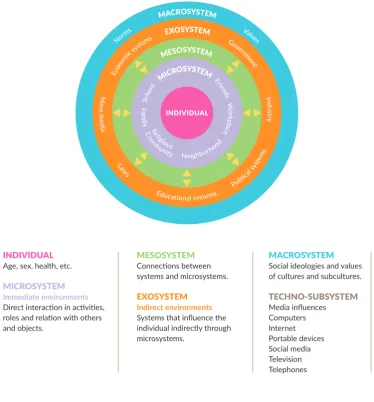
Figure 1: Bronfenbrenner’s Ecological Model of Human Development (Adapted from Bronfenbrenner (1979) and Junior Cycle Wellbeing Guidelines (2017).
INDIVIDUAL Age, sex, health, etc.
MICROSYSTEM Immediate environments Direct interaction in activities, roles and relation with others and objects.
MESOSYSTEM Connections between systems and microsystems.
EXOSYSTEM Indirect environments Systems that influence the individual indirectly through microsystems.
MACROSYSTEM Social ideologies and values of cultures and subcultures.
TECHNO-SUBSYSTEM Media influences Computers Internet Portable devices Social media Television Telephones M as s m ed ia L aw s
Educational systems Politi
cal s
yste
ms Econ
omic
system
s EXOSYSTEM G overnm ent In du str y Com munity Re ligious Fa m ily
Neighborhood Scho
ol MI
CROSYSTEM Frie
nd
s W
ork pla ce MESOSYSTEM Norm s MACROSYSTEM V alues INDIVIDUAL INDIVIDUAL
Age, sex, health, etc.
MICROSYSTEM
Immediate environments
Direct interaction in activities, roles and relation with others and objects.
MESOSYSTEM
Connections between systems and microsystems.
EXOSYSTEM Indirect environments
Systems that influence the individual indirectly through microsystems.
MACROSYSTEM Social ideologies and values of cultures and subcultures.
TECHNO-SUBSYSTEM Media influences Computers Internet Portable devices Social media Television Telephones M as s m ed ia L aw s
Educational systems Politi cal s
yste ms Econ
omic
system
s EXOSYSTEM G
overnm ent Indu str y Com munity Re ligious Fa m ily
Neighborhood Scho
ol
MICROSYSTEM Frie nd
s W
3. The Role of Schools and Centres for
Education in Wellbeing Promotion
Why Schools Have a Role in Wellbeing Promotion
Wellbeing education occurs throughout life and in a variety of settings. Promoting the wellbeing of our children and young people is a shared community responsibility and is everybody’s business. While many factors which influence wellbeing are located in the home, the school, situated within the community can be a powerful context for healthy development in enhancing protective factors and minimising risks. Schools play a key role in developing and enhancing young people’s wellbeing as they spend a large proportion of their time in school during their formative years. Many schools and centres for education have already developed innovative approaches to wellbeing promotion supported by strong leadership and quality teaching and learning. Schools and centres for education are also well placed to further support children and young people by optimising opportunities to learn about wellbeing. As well as being a place of academic learning, schools and centres for education provide opportunities to develop friendships and social networks, to respectfully encounter diversity and access support structures.
There is a recognised connection between the cognitive and the emotional world of children and young people. In the school environment social and emotional skills do not exist in isolation but interact with cognitive skills development. The role of the school is now understood as a place which develops the ‘whole child’, who should leave school with a balanced set of cognitive, social and emotional skills to face the challenges of the 21st century (OECD 2014). Hargreaves, Shirley, Wangia, Bacon & D’Angelo (2018) identify the mutually supportive relationships between wellbeing and achievement and emphasise the importance of the reciprocal relationship between wellbeing and the accomplishments of children and young people. Schools are important settings for preparing children and young people to develop wellbeing and positive mental health, where emotional wellbeing may be understood as an educational end in and of itself.
Risk and protective factors relating to wellbeing promotion that are specific to the school/educational setting have been identified. In the school/educational setting wellbeing protective factors include:
• positive relationships with peers and teachers - including positive teacher classroom management strategies and a sharing of positive behaviour management practices with parents
• a sense of belonging, security and connectedness to school through a positive school climate and participation in school and community activities
• opportunities for social and emotional learning including the development of attention and planning, self-awareness, self-management, relationship and responsible decision-making skills (CASEL 2015) • opportunities for the development of knowledge and skills providing a sense of mastery and
self-efficacy (Shonkoff et al, 2015)
• fostering expectations, recognising contributions, effort and achievement and providing opportunities for success
• wellbeing of school personnel
• protocols and support systems that proactively support children and their families should difficulties arise • opportunities to develop the necessary skills to cope with using online technology in a safe and
appropriate way
In the school setting wellbeing risk factors include:
• disengagement, absenteeism, isolation and alienation • violence/aggression, bullying and relationship difficulties
• low achievement/learning difficulties/special educational needs including social, emotional and behavioural needs
• cultural differences • school transitions
• poor connection between family and school • harsh and inconsistent discipline
• lack of opportunity to develop social and emotional learning, including problem solving and coping skills
Protective factors have been found to promote positive outcomes for children and young people, even when they have been exposed to risk factors (Cooper, Jacobs, 2011). Within the school context, therefore, implementing a preventative wellbeing promotion process that has a focus on strengthening school-based protective factors and minimising school-based risk factors is recommended.
How Can Schools Best Promote the Wellbeing of their Children and Young People?
Research indicates that a multi-component, preventative, whole school approach to the promotion of wellbeing, with interventions at both universal and targeted levels, is the most beneficial and evidence-informed approach for schools and centres of education.
A whole school approach involves all members of the school community engaging in a collaborative process of change to improve specific areas of school life that impact on wellbeing. Adopting a whole school approach has been found internationally to produce a wide range of educational and social benefits for individual children and young people, including improved behaviour, increased inclusion, improved learning, greater social cohesion, increased social capital and improvements to mental health (Weare & Gray, 2003).
Research indicates that the whole school approach adopted should have specific components that promote school based protective factors and reduce school-based risk factors in the promotion of wellbeing:
• The nature of the school environment and connectedness has been found to be a key determinant of success in terms of wellbeing promotion in schools and centres for education (Viner et. al, 2012). An environment that enhances competence and wellbeing is one that consciously fosters warm relationships, encourages participation, develops pupil and teacher autonomy and cultivates clarity about boundaries, rules and positive expectations.
• Wellbeing promotion should carry through to all aspects of teaching and learning. Children and young people spend most of their day in classrooms and, consequently, their daily experience of teaching and learning contributes greatly to their wellbeing. The teaching and learning must be democratic, inclusive, engaging, differentiated, fostering expectations of high achievement and providing opportunity for success. The importance of having a deliberate focus on the development of emotional and social competencies is also highlighted by research. The World Health Organisation (WHO), for example, recognises the need to promote wellbeing through interventions that promote competence and psychological strengths (WHO, 2005). Furthermore, social emotional learning programmes have been shown to significantly improve children and young people’s social and emotional skills, attitudes, behaviour and learning performance (Durlack, Weissbert, Dymnicki, Taylor & Schellinger, 2011). Such programmes can be delivered universally, to all children and young people as part of the SPHE curriculum.
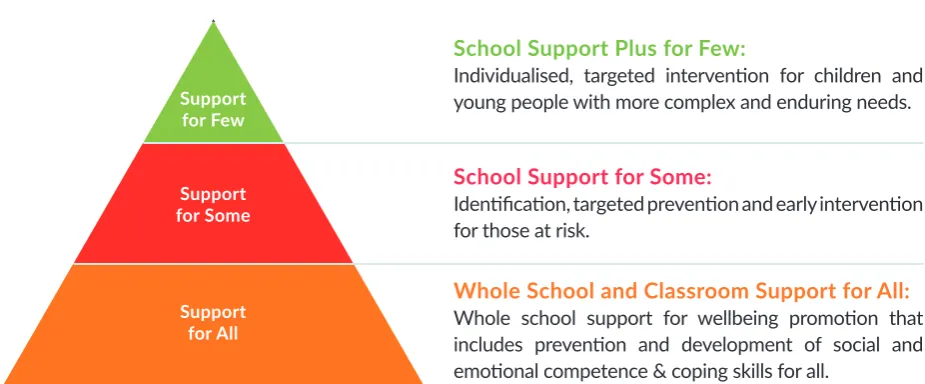
[image:16.595.82.545.529.721.2]• In line with best practice, the Continuum of Support offers a flexible framework within which schools can address all educational needs, including wellbeing needs (DES & NEPS, 2007, 2010a, 2010b). This involves three levels set out in Table 1 below:
Table 1: Continuum of Support
School Support Plus for Few:
Individualised, targeted intervention for children and young people with more complex and enduring needs.
School Support for Some:
Identification, targeted prevention and early intervention for those at risk.
Whole School and Classroom Support for All:
Whole school support for wellbeing promotion that includes prevention and development of social and emotional competence & coping skills for all.
Support for Few
Support for Some
The Continuum of Support recognises that individual children and young people can have different needs at different times. Those at greater risk and with greater needs may require more specific and targeted support, in addition to the support provided to all children and young people in their class-based groups (Weare & Nind, 2011; Werner-Seidler, Perry, Calear, Newby & Christensen, 2017). Research advocates for the inclusion of both universal and targeted approaches and there is evidence that both universal (support for all) and targeted group support (support for some & few) in schools can effectively prevent and address anxiety and low mood for many children and young people (Werner-Seidler, Perry, Calear, Newby & Christensen, 2017; Das et al, 2016; Ahlen, Lenhard & Ghadri, 2015). Some children and young people will still require additional support from specialist support services external to the school. Effective implementation is assisted by having:
◆ a sound theoretical base and rationale
◆ specific, well-defined goals
◆ a direct and explicit focus on outcomes for each component of a whole-school approach (Weare & Nind, 2011)
• Coherent policy and planning at a whole school level is needed to ensure the successful delivery of a wellbeing promotion process in schools. School leaders play a critical role in implementation, including in the review and development of school structures to support that implementation. Collaborative cultures emerge when schools engage in reflective practices including appreciative inquiry (Cooperider, 2016, n.d.) to consider the implications of policy from the perspective of their own school systems and the systems in their communities. Such models are noted to enhance professional development through shared learning, to give voice to creativity and to build shared ownership by creating internal and external networks. The development of structures within our schools such as student support teams, supportive consultation models and the use of reflective practices will help schools to engage in collaborative practice and to consider their own systems from within. Organisational and management factors are as essential to a successful whole school approach to wellbeing promotion as are curricular and extra-curricular factors (NICE, 2009).
• The role of the teacher has also been found to be paramount to children and young people’s wellbeing (OECD, 2017), and reaches beyond teaching and learning. The relationship that teachers develop with the young person is a key influence on wellbeing development. Access to ‘one good adult’ who can guide and support a young person at a vulnerable time is an identified protective factor. Furthermore, support for the wellbeing of staff is also an essential element, and crucial to sustaining teacher/resource staff engagement, enthusiasm and ability to model resilience. It builds staff capacity to cope with challenges and adapt to change, and creates conditions to support and motivate staff to be effective.
This Wellbeing Policy Statement and Framework for Practice helps to ensure effective implementation of a multi-component, whole school approach that positively impacts all children and young people in line with best international practice. There are many examples of wellbeing promotion already in place in schools and centres for education which are in keeping with this policy. In line with the Junior Cycle Wellbeing Guidelines (DES, NCCA, 2017), the Department considers that the following four areas of wellbeing promotion are key:
• culture and environment
• curriculum (teaching and learning) • policy and planning
This is further outlined in Figure 2, adapted from the Junior Cycle Wellbeing Guidelines (DES, NCCA, 2017) and informed by the HSE, Schools for Health Process (DES, DOH, HSE, 2013 & 2015).
Figure 2: Whole School Approach - Four Key Areas Wellbeing Promotion
Relationships & Partnerships
•
Student & staff relationships•
Peer relationships•
Student voice•
Partnership – staff, children and young people, parents/carers•
Partnerships with other schools•
Community partnerships•
External supportsCurriculum
(Teaching & Learning)
•
Extra-curricular learning•
Co-curricular learning•
Planning supports•
MonitoringKEY AREAS OF WELLBEING
Policy & Planning
•
All policies relevant to wellbeing•
All plans relevant to wellbeing•
School & centre self-evaluation•
Continuing professional development Culture & Environment•
Mission and ethos•
School & classroomclimate & culture
•
Quality & use of schoolbuildings & grounds
POLIC Y
& PLAN NING R
EL ATIO
NS HIPS
CUR RIC
ULU M CULTU
4. The Role of Government in Wellbeing
Promotion in the Education System
Whole of Government Strategies for Wellbeing
The Government is committed to the vision outlined in Better Outcomes Brighter Futures (Department of Children and Youth Affairs, 2014), “for Ireland to be one of the best small countries in the world in which to grow up and raise a family, and where the rights of all children and young people are respected, protected and fulfilled; where their voices are heard and where they are supported to realise their maximum potential now and in the future”.
Wellbeing promotion is a government priority as set out in A Programme for a Partnership Government (Department of the Taoiseach, 2017) and this is reflected through a range of strategies and cross-departmental groups. As one of the departments with a key role to play in this area, the Department of Education and Skills has a long history of supporting schools in promoting wellbeing through a range of policies, initiatives, frameworks, curricula and programmes. The Department has contributed to strategies that directly or indirectly promote wellbeing. These are set out in Appendix 1.
Initiatives of the Department of Education and Skills Impacting Wellbeing Promotion
The Department provides a holistic approach of care and education for children and young people from birth to six years. This is informed by Aistear: The Early Childhood Curriculum Framework (NCCA, 2009) which encompasses four themes, Wellbeing, Identity and Belonging, Communication, Exploring and Thinking. Pre-school children with special educational needs are further supported through the access and inclusion model (AIM).
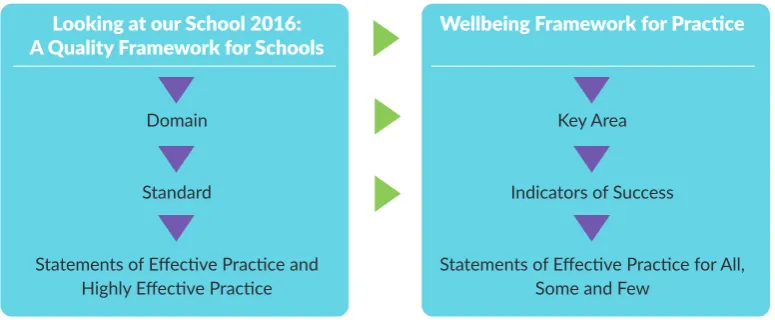
The quality framework Looking at Our School (DES & Inspectorate, 2016a, 2016b) articulates the Department’s holistic view of learning in schools. The framework sees wellbeing as both an enabler of learning and an outcome of learning. It emphasises the need for children and young people to develop a broad range of skills, competencies and values that enable active citizenship, lifelong learning and personal wellbeing. The framework asserts that in providing good quality learning experiences, teachers need to also consider children and young people’s wellbeing and that effective school leadership and management involves creating and maintaining a positive, secure and healthy culture where the holistic development of all children and young people is enabled.
Looking at Our School also provides a coherent whole-of-system approach to improving outcomes and experiences for all children and young people. It is used to assist schools in embedding self-evaluation processes and reflective practices and it provides a structure for implementing new initiatives. The domains and standards of Looking at Our School can therefore support schools in promoting and enhancing the wellbeing of all members of the school community.
Recent Departmental initiatives which also directly address the wellbeing of children and young people from a range of perspectives include:
• Reform of Junior Cycle including the introduction of Wellbeing as an area of learning
• Continued support for guidance counselling provision in post primary schools with the phased reinstatement of hours lost during the economic downturn
• Implementation of the Model for Allocating Special Education Teachers to Mainstream Schools and the establishment of the National Council for Special Education Support Service
• Continued focus on building capacity to support the implementation of the Action Plan on Bullying (2013)
• Revision of child protection procedures, in accordance with the Children First National Guidance for the Protection and Welfare of Children (DCYA, 2017)
• Publication of Cosán: The National Framework for Teachers’ Learning (Teaching Council, 2016) • Expansion of the Employee Assistance Scheme to include a teacher and special needs assistant
wellbeing programme
• Development and roll-out of a Physical Literacy Framework through the Professional Development Service for Teachers’ (PDST) Fundamental Movement Skills Programme
• Introduction of Physical Education as an optional Leaving Certificate examination subject
• Introduction of a Framework for Senior Cycle Physical Education for students who do not take Physical Education as a Leaving Certificate subject
• Review of Senior Cycle Programme underway • Review of the Primary Curriculum underway
Other Departments, their bodies and agencies, also have a role in wellbeing promotion, and cross-departmental collaboration is essential for success. This is well established with regard to wellbeing. There are many examples of inter-department and inter-agency working as indicated by the publications and initiatives outlined in Appendix 1. A list of additional agencies, organisations and bodies with a role in wellbeing promotion is included in Table 6 (Appendix 1).
Building Capacity in the System
Alternative education provision is available to particular groups of young people through special schools, hospital schools, secure units and centres for education for children and young people at risk of early school leaving.
The National Educational Psychological Service (NEPS) supports schools to promote the wellbeing and mental health of all children and young people. While supporting all, NEPS prioritises support for those at risk of educational disadvantage and those with special educational needs. In line with best practice, NEPS encourages schools to adopt a whole school, continuum of support approach to provide for children and young people’s wellbeing needs (DES & NEPS, 2007, 2010a, 2010b). This involves three levels: Support for All, Support for Some and Support for Few. NEPS achieves its objective through the provision of a tiered service delivery model encompassing casework and systemic work, to build overall school capacity.
A programme of continuing professional development and other supports in accordance with agreed work plans are provided by the Department which enrich the capacity of teachers to meet the needs of their children and young people. The Department’s support services for teachers are as follows:
• Professional Development Service for Teachers (PDST) • Junior Cycle for Teachers (JCT)
• The National Induction Programme for Teachers (NIPT) • The National Educational Psychological Service (NEPS) • Centre for School Leadership (CSL)
• The National Council for Special Education Support Service
• Supervision for guidance counsellors in relation to their guidance counselling role (funded by Teacher Education Section)
5. The Department’s Ambition &
Vision for Wellbeing Promotion
This policy statement sets out the vision and ambition of this Department to ensure that the experience of our children and young people from the early years throughout their primary and post primary education will be one that enhances, promotes, values and nurtures their wellbeing. While good practices are already established in wellbeing promotion, realising the Department’s ambition and vision for success will require focused attention. Supporting schools in this process of wellbeing promotion requires commitment across the education system and with the relevant partners of the education system.
The Department of Education and Skills, in reviewing its policy and approach to promoting the wellbeing of all children and young people in schools and centres for education, is setting out to ensure, that by 2023:
• the promotion of wellbeing will be at the core of the ethos of every school and centre for education • all schools and centres for education will provide evidence-informed approaches and support,
appropriate to need, to enhance the wellbeing of all
• Ireland will be recognised as a leader in wellbeing promotion in schools and centres for education Key to this ambition is building on the good practice already in place and the capacity of every school and centre for education to assess, understand, evaluate and promote the key factors that will lead to optimal promotion of student wellbeing in their own school setting.
The Department will endeavour to support appropriate, high quality, approaches to the ongoing review and development of school culture and environment, teaching and learning, policy and planning, and relationships and partnerships. The Department promotes a continuum of support approach and the provision of both universal and targeted interventions that promote school-based protective factors and reduce school-based risk factors. This multi-component, whole school approach will be key to ensuring that schools are places that augment the wellbeing of all children and young people by teaching and encouraging them to be active, responsible, connected, resilient, respected and aware (DES & NCAA, 2017).
What are the Indicators of Success?
Table 2: Wellbeing Promotion Indicators of Success
These Indicators of Success in the four key areas of Wellbeing are further expanded upon as statements of effective practice in the Wellbeing Framework for Practice (Section 2) which will form the basis of the school’s self-reflective Wellbeing Promotion Process.
Statements of Effective Practice in each of the four key areas of Wellbeing Promotion describe practices operating competently and efficiently at the whole school preventative level (Support for All) and also at the more specialised and individual intervention levels (Support for Some and Few). This is a key reference tool which helps to standardise the approach to reviewing wellbeing promotion in schools and centres for education. It is envisaged that schools and centres for education will engage with the statements and adapt and develop the best practice items as they meet the needs in their own school community.
Key Areas Indicators of Success
Culture & Environment • Children, young people and staff experience a sense of belonging and feel safe, connected and supported.
• Systems are in place so that the voice of the child/young person, teacher and parent are heard and lead to improvements in school culture and ethos.
Curriculum (Teaching & Learning)
• Children and young people experience positive, high-quality teaching, learning and assessment, which provides opportunities for success for all.
• Children and young people access curricular activities to promote their physical, social and emotional competence to enhance their overall wellbeing.
Policy & Planning • Schools and centres for education use a Self-Evaluation Wellbeing Promotion Process to develop, implement and review wellbeing promotion.
• Schools and centres for education incorporate wellbeing promotion into whole school policies and practices.
Relationships & Partnerships • Children and young people, their parents and other external partners are actively involved in wellbeing promotion within the school community.
The statements of effective practice should enable school leaders and staff involved in internal and external evaluation to arrive at evidence-based evaluative judgements about the quality of aspects of provision. They will enable school leaders and staff to identify strengths and areas to target within the school system and therefore plan the next stage in the improvement journey.
A corresponding catalogue of supports and programmes offered by the Department and other agencies will be available for use. This will provide practical support and information in an online, easily navigable format and act as a key reference tool in selecting programmes and interventions when reviewing practice in relation to wellbeing promotion.
What is a Self-Evaluation Wellbeing Promotion Process?
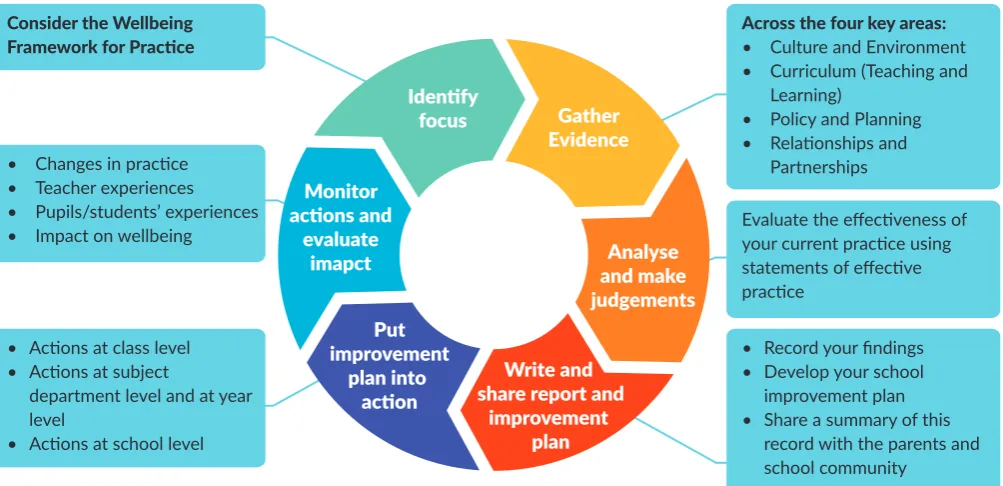
To implement this policy every school and centre for education is required, by 2023, to use the School Self-Evaluation (SSE) process to initiate a wellbeing promotion review and development cycle. Schools and centres for education will be supported in this process through using the Wellbeing Framework for Practice and Wellbeing Resources.
Schools firstly will select wellbeing promotion as a topic for SSE. At an information-gathering stage, schools will consult with and collect information from key stakeholders, including staff, children and young people, and parents/carers, relating to current practice in the key areas of wellbeing promotion. This information is essential in order to highlight positive aspects and strengths in their practice and identify areas for development – an analysis and judgement stage. This analysis will inform actions for wellbeing in a selected area. At an intervention stage, appropriate school interventions and strategies will be generated and agreed. Schools will incorporate these actions into their School Improvement Plan (SIP). Steps will be put in place to implement the agreed actions. At the monitoring stage actions will be reviewed on an ongoing basis which will assist schools in evaluating impact and tracking their progress in this process of continuous improvement.
How is Success Measured?
International research proposes that measuring progress has proven to be a challenge, as wellbeing outcomes for children and young people are difficult to measure. Caution is advised in aiming to measure the wellbeing of individuals. Personal wellbeing is not like literacy and numeracy skills, it is not something that can be definitively achieved and tested. Wellbeing is a process of well-becoming. It is not static and it fluctuates over time and within different contexts. It can vary from day to day and from time to time.
We know, however, that using measurement to evaluate provision for wellbeing in a system gives an indication of its effectiveness, signposts the need for improvement, and shows the ability of the school or centre for education to reflect on its systems. Outcomes and accountability matter. Schools and centres for education need to be ambitious in establishing an understanding of what can be achieved in contributing to the wellbeing of children and young people.
Table 3: Suggested Measures for Success
The DES Lifeskills Survey provides data on a number of school wellbeing promotion related issues, including physical activity, healthy eating, the implementation in schools of social, personal and health education (SPHE) and relationships and sexuality education (RSE), anti-bullying and substance use. In the longer term OECD data should also reflect the impact of implementation of the Wellbeing Promotion Process in Ireland.
The impact of the work of schools and centres for education combined with the impact of the work of other sectors will also be captured in the national data sets, such as the indicators for children and young people developed for and aligned with Better Outcomes, Brighter Futures: The National Policy Framework for Children and Young People 2014–2020. Furthermore, at present, an Outcomes Framework is in development as part of Healthy Ireland to provide evidence to support an objective assessment of its impact.
Overall Goal & High Level Actions
It is the goal of this Department that by 2023 all schools and centres for education will have embedded a dynamic Wellbeing Promotion Process encompassing a whole school approach and reflecting the four key areas and indicators of successful wellbeing promotion. While good practices are already established in wellbeing promotion, realising the Department’s ambition and vision for success will require focused attention. Supporting schools in this process of wellbeing promotion requires commitment across the education system. The following seven high level actions will support the realisation of this vision.
Schools should consider what measures of success are appropriate for them. A list of possible measures to monitor for change are set out below.
• Student attendance
• Successful school completion • Successful transitions of students
• Data gathered in school and centre for education (e.g. via survey, interview, checklists)
• Data gathered through consultation with children and young people, parents, teachers and other staff members
• Information from Inspection Reports
Table 4: High Level Actions
1. Strengthen and align current structures within the Department and between the Department and other relevant Departments to ensure the coordinated implementation of this Wellbeing Policy Statement and Framework for Practice
2. Plan and provide for the national roll-out of a professional development process to facilitate all schools and centres for education to engage with and embed a Self-Evaluation Wellbeing Promotion Process which builds professional capacity and collaborative cultures, from 2018-2023.
3. Provide for an aligned, comprehensive and easily-accessible programme of support for all schools and centres for education to address school-identified wellbeing promotion needs.
4. Consider how the system is meeting current and future teachers’ learning needs relating to wellbeing promotion.
5. Develop a research based framework for the evaluation of wellbeing promotion in schools.
6. Improve use of supports for children and young people at key points of transition within and between education settings.
7. Promote the wellbeing of school and centre for education personnel.
6. Wellbeing Policy Statement & Framework
for Practice: Implementation
The Department will work to ensure that implementation of this policy is supported from national to local level. It provides challenges and opportunities to build on existing good practice and will require commitment to achieve the stated ambition and vision for success.
Department agencies, state funded bodies and other stakeholders are key to ensuring the policy is implemented across the educational system. Commitment to collaborative actions and shared responsibility with other Government Departments including the Department of Health (DOH) and the Department of Children and Youth Affairs (DCYA) and their agencies is required.
Schools and centres for education are asked to commit to a process of self-reflection to identify existing strengths, opportunities and challenges in their practice and incorporate a Wellbeing Promotion Process into their existing planning and self-evaluation processes. Achievement of the vision will require change and improvement in how schools organise their approach to wellbeing promotion. Increased attention to implementing a multi-component whole school approach is an important element.
This Wellbeing Policy Statement and Framework for Practice heralds more aligned services and supports from the Department in the area of Wellbeing Promotion for all schools and centres for education. It is the overarching context in which the implementation of the Junior Cycle Wellbeing Programme is situated in post primary schools. Within this policy and framework implementation, it is expected that the Junior Cycle Wellbeing Guidelines will be the focus for implementation with the Junior Cycle cohort initially.
The Student Support Team and school leaders, will be responsible for implementation in post primary schools. At primary level school leaders will have responsibility for implementation, and in centres for education responsibility will lie with the centre coordinator.
Wellbeing Policy Statement Implementation Plan
An Implementation Plan for 2018-2023 is set out below with details and timelines in respect of the high level actions. Effective realisation of this policy will require allocation of resources to ensure actions are carried out.
The initial programme of work will include:
• Trialling, evaluating and refining the use of the online Wellbeing Resources to support the Wellbeing Promotion Process
• Enhancing existing structures that support wellbeing implementation
• Engaging in consultation with the partners in education including children and young people • Coordinating the work of support services and clarifying roles and responsibilities
• Building capacity in schools and centres for education in wellbeing promotion and promoting communities of practice and collaborative culture
• Improving collaborative practice across three government departments and their agencies
• Publication of a circular to advise schools on the use of external programmes and facilitators to promote a whole school, multi-component approach to wellbeing promotion.
Supporting the Implementation of the Wellbeing Promotion Process
Wellbeing Resources (available online), to support the Wellbeing Promotion Process will provide practical tools and information to support schools and centres for education. These Wellbeing Resources will include:
• Statements of Effective Practice for Wellbeing Promotion
• Evaluation Tools: Parent/Carer, Child/Young Person and Staff Questionnaires • Focus Group Guidelines to facilitate access to the voice of key stakeholders • Exemplars of good practice
• A Wellbeing Practice Recording Template
• List of current supports and resources relevant to wellbeing promotion for each of the four key areas • Revised circular for schools to provide strengthened guidance on the use of programmes/external
facilitators in school wellbeing promotion.
Using the Wellbeing Resources, schools and centres for education will monitor their work to improve wellbeing promotion. Progress on addressing the Statements of Effective Practice are specific and tailored to the wellbeing needs identified by stakeholders. They are evaluated by each individual school using the Wellbeing Promotion Process.
Supporting Schools and Centres for Education
Existing support services will focus initially on co-ordination and clarification of roles and responsibilities. This will be overseen by the Wellbeing Implementation Group.
A plan for supporting schools in the roll-out of the implementation of this Wellbeing Policy Statement and Framework for Practice will be developed by existing Departmental support services including:
• Professional Development Service for Teachers (PDST) • Junior Cycle for Teachers (JCT)
• The National Induction Programme for Teachers (NIPT) • The National Educational Psychological Service (NEPS) • Centre for School Leadership (CSL)
The Department of Education support services will collaborate with the HSE’s Schools’ Health Promotion Service to further support the roll-out of this Wellbeing Promotion Process.
How will the Policy Implementation be Monitored by the Department?
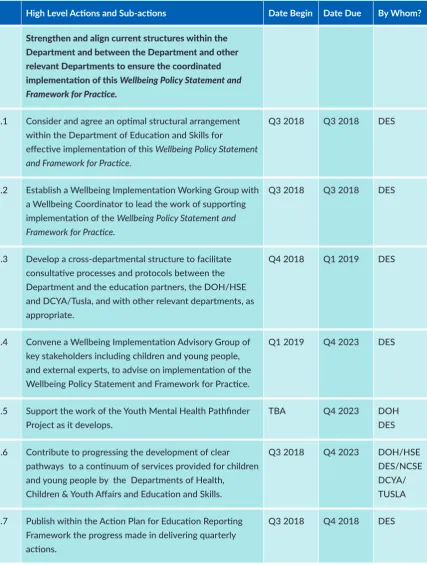
The Department of Education and Skills’ Wellbeing Steering Committee has responsibility for the oversight of the implementation, coordination and review of this Wellbeing Policy and Framework for Practice. The committee is comprised of representatives from the Curriculum and Assessment Policy (CAP) Unit, Teacher Education Section (TES), the Inspectorate and the National Educational Psychological Service (NEPS). The work of the Steering Committee is coordinated by NEPS. The implementation of this Wellbeing Policy Statement and Framework for Practice will be supported by a Wellbeing Advisory Group, which will include external membership. A Wellbeing Implementation Working Group will lead this work and provide regular progress reports to the Steering Committee and to the Minister. The Wellbeing Implementation Working Group will focus on the high-level actions and sub-actions set out in Table 5 which are designed to address the opportunities and challenges identified in this Wellbeing Policy Statement and Framework for Practice.
The Wellbeing Implementation Working Group will also set out a plan for facilitating quality engagement and communication with relevant stakeholders. It will convene a consultative group of key stakeholders and partners to devise an engagement strategy with regard to implementation of the Wellbeing Policy Statement and Framework for Practice. Coordinated activity with other Departments will be facilitated as appropriate, through Implementation and Steering Group mechanisms and the Youth Mental Health Pathfinder Project1 (CES, 2018) structures which are in development.
Wellbeing Policy Implementation Plan 2018-2023
The following Wellbeing Policy Implementation Plan will guide the work of implementation. Sub-actions, outlined in a sequential way in Table 5, will progress the work of achieving the high level actions.
Table 5: Wellbeing Implementation Plan 2018–2023
High Level Actions and Sub-actions Date Begin Date Due By Whom?
1 Strengthen and align current structures within the Department and between the Department and other relevant Departments to ensure the coordinated implementation of this Wellbeing Policy Statement and Framework for Practice.
1.1 Consider and agree an optimal structural arrangement within the Department of Education and Skills for
effective implementation of this Wellbeing Policy Statement and Framework for Practice.
Q3 2018 Q3 2018 DES
1.2 Establish a Wellbeing Implementation Working Group with a Wellbeing Coordinator to lead the work of supporting implementation of the Wellbeing Policy Statement and Framework for Practice.
Q3 2018 Q3 2018 DES
1.3 Develop a cross-departmental structure to facilitate consultative processes and protocols between the Department and the education partners, the DOH/HSE and DCYA/Tusla, and with other relevant departments, as appropriate.
Q4 2018 Q1 2019 DES
1.4 Convene a Wellbeing Implementation Advisory Group of key stakeholders including children and young people, and external experts, to advise on implementation of the Wellbeing Policy Statement and Framework for Practice.
Q1 2019 Q4 2023 DES
1.5 Support the work of the Youth Mental Health Pathfinder Project as it develops.
TBA Q4 2023 DOH
DES
1.6 Contribute to progressing the development of clear pathways to a continuum of services provided for children and young people by the Departments of Health,
Children & Youth Affairs and Education and Skills.
Q3 2018 Q4 2023 DOH/HSE
DES/NCSE DCYA/ TUSLA
1.7 Publish within the Action Plan for Education Reporting Framework the progress made in delivering quarterly actions.
High Level Actions and Sub-actions Date Begin Date Due By Whom?
2. Plan and provide for the national roll-out of a
professional development process to facilitate all schools and centres for education to engage with and embed a Self-Evaluation Wellbeing Promotion Process which builds professional capacity and collaborative cultures from 2018-2023.
2.1 In consultation with relevant partners, develop a CPD work plan for the introduction of the Wellbeing Promotion Process that promotes communities of practice,
collaborative cultures across clusters of schools and the promotion of innovation and creativity.
Q1 2019 Q3 2019 DES
2.2 Trial the Wellbeing Resource across clusters of schools and centres for education, for refinement and finalisation.
Q3 2018 Q4 2019 DES
2.3 Implement a national roll-out of supports for the introduction of the Wellbeing Promotion Process to all schools and centres for education between 2019 and 2023, which promotes communities of practice, collaborative cultures and the promotion of innovation and creativity.
Q1 2020 Q4 2023 DES
3. Provide for an aligned, comprehensive and easily-accessible programme of support for all schools and centres for education to address school-identified wellbeing promotion needs.
3.1 Map existing resources and supports available for continuing professional development in the area of Wellbeing, currently provided by DES support services and HSE Schools’ Health Promotion Service.
Q3 2018 Q2 2019 DES
3.2 Conduct a gap analysis of this map, and make
recommendations and provision for the implementation of priority actions to ensure clear pathways to support and resources are made available to all schools and centres for education for the promotion of Wellbeing.
Q2 2019 Q4 2019 DES
3.3 Based on the mapping exercise and gap analysis provide clear information to schools and centres for education regarding roles and responsibilities of support services in relation to wellbeing promotion together with details of
High Level Actions and Sub-actions Date Begin Date Due By Whom?
3.4 Initiate inter-departmental collaboration in developing a web portal to facilitate schools’ access to all supports for the implementation of the Wellbeing Policy Statement and Framework for Practice in schools and centres for education in an easily navigable and accessible format.
Q3 2018 Q4 2023 DES
3.5 Consider the need for the development of evidence-based social and emotional learning programmes with a sound theoretical and psychologically-informed rationale and specific, well-defined goals. Make recommendations and plan for their implementation.
Q3 2018 Q4 2023 DES
3.6 Provide more comprehensive and strengthened guidance to schools on the effective use of external programmes and facilitators relating to Wellbeing.
Q2 2018 Q3 2018 DES
3.7 Extend focused support for 20 DEIS post-primary schools in supporting the development of Student Support Teams.
Q2 2018 Q3 2019 DES
3.8 Extend focused support for all post-primary schools in supporting the development of Student Support Teams.
Q3 2019 Q4 2023 DES
3.9 Finalise the development of resource materials to support schools in development and review of Student Support Teams.
Q3 2018 Q4 2019 DES
3.10 Identify and implement actions to enhance the voice of children and young people in schools.
Q3 2018 Q4 2023 DES
3.11 Identify and implement actions to enhance engagement of parents/carers in the Wellbeing Promotion Process in schools.
Q3 2018 Q4 2023 DES
3.12 In the context of the Youth Mental Health Pathfinder Project, examine the need for the provision of therapeutic interventions for children and young people.
Q3 2018 Q4 2023 Pathfinder
Project (DES/ DCYA/ DOH)
3.13 Collect and review data on the use of Guidance
Counselling resources in post primary schools and identify potential recommendations for improvement.
High Level Actions and Sub-actions Date Begin Date Due By Whom?
3.4 Initiate inter-departmental collaboration in developing a web portal to facilitate schools’ access to all supports for the implementation of the Wellbeing Policy Statement and Framework for Practice in schools and centres for education in an easily navigable and accessible format.
Q3 2018 Q4 2023 DES
3.5 Consider the need for the development of evidence-based social and emotional learning programmes with a sound theoretical and psychologically-informed rationale and specific, well-defined goals. Make recommendations and plan for their implementation.
Q3 2018 Q4 2023 DES
3.6 Provide more comprehensive and strengthened guidance to schools on the effective use of external programmes and facilitators relating to Wellbeing.
Q2 2018 Q3 2018 DES
3.7 Extend focused support for 20 DEIS post-primary schools in supporting the development of Student Support Teams.
Q2 2018 Q3 2019 DES
3.8 Extend focused support for all post-primary schools in supporting the development of Student Support Teams.
Q3 2019 Q4 2023 DES
3.9 Finalise the development of resource materials to support schools in development and review of Student Support Teams.
Q3 2018 Q4 2019 DES
3.10 Identify and implement actions to enhance the voice of children and young people in schools.
Q3 2018 Q4 2023 DES
3.11 Identify and implement actions to enhance engagement of parents/carers in the Wellbeing Promotion Process in schools.
Q3 2018 Q4 2023 DES
3.12 In the context of the Youth Mental Health Pathfinder Project, examine the need for the provision of therapeutic interventions for children and young people.
Q3 2018 Q4 2023 Pathfinder
Project (DES/ DCYA/ DOH)
3.13 Collect and review data on the use of Guidance
Counselling resources in post primary schools and identify potential recommendations for improvement.
Q2 2018 Q4 2018 DES
3.14 Review the content and delivery of relationship and sexuality curriculum with a view to recommending areas
Q3 2018 Q4 2023 DES
NCCA
High Level Actions and Sub-actions Date Begin Date Due By Whom?
3.15 Continue to support DEIS schools in promoting the wellbeing of vulnerable children and young people through the DEIS Action Plan.
Q2 2018 Q4 2023 DES
4 Consider how the system is meeting current and future teachers’ learning needs relating to wellbeing promotion.
4.1 Within the context of emerging plans for CPD in the Department, develop a research based framework for the evaluation of continuing professional development.
Q3 2018 Q4 2023 DES
4.2 Consider the impact of the reconceptualised Initial Teacher Education (ITE) programmes on wellbeing, in the context of the Teaching Council’s review of the criteria and guidelines for ITE providers.
Q4 2018 Q4 2020 DES
5 Develop a research based framework for the evaluation of wellbeing promotion in schools.
5.1 A framework for evaluation of wellbeing promotion in schools and centres for education will be finalised.
Q3 2018 Q4 2020 DES
6 Improve use of supports for children and young people at key points of transition within and between education settings.
6.1 Consider, agree and implement actions needed to ensure the retention of vulnerable children and young people in the system, and particularly at critical transition stages in the education and training system, building on existing resources.
Q2 2018 Q4 2023 DES
6.2 Consider actions needed to support schools and centres for education in effective management of confidential information.
Q1 2019 Q4 2023 DES
6.3 Review and strengthen supports particularly for vulnerable children and young people, at key points of transition.
Q2 2019 Q4 2023 DES
7 Promote the wellbeing of school and centre for education personnel.
7.1 Review the current range of wellbeing supports available to staff with a view to ensuring best practice in early intervention and prevention for supporting positive
Section 2
Wellbeing in Education
Framework for Practice
The Statements of Effective Practice comprise actions for primary and post primary schools, and centres for education.
Background – The Policy
The Wellbeing Policy Statement & Framework for Practice – Revised (2019) builds on the good work already happening in schools to equip children and young people with the knowledge, skills and competencies to enhance their wellbeing and deal with life’s challenges.
The policy recognises that wellbeing education occurs throughout life and in a variety of settings. While many factors which influence wellbeing are located in the home and the community, the school can be a powerful context for healthy development in enhancing protective factors and minimising risks.
The policy provides schools with a whole school, multicomponent and preventative approach to wellbeing promotion, based on international research and best practice.
A whole school approach involves all members of the school community engaging in a collaborative process of change to improve specific areas of school life that impact on wellbeing. Adopting this approach has been found internationally to produce a wide range of educational and social benefits for children and young people. A whole school approach supports the integration of systems within the school community and creates capacity to be reflective and responsive to the needs of the school and members of the school community.
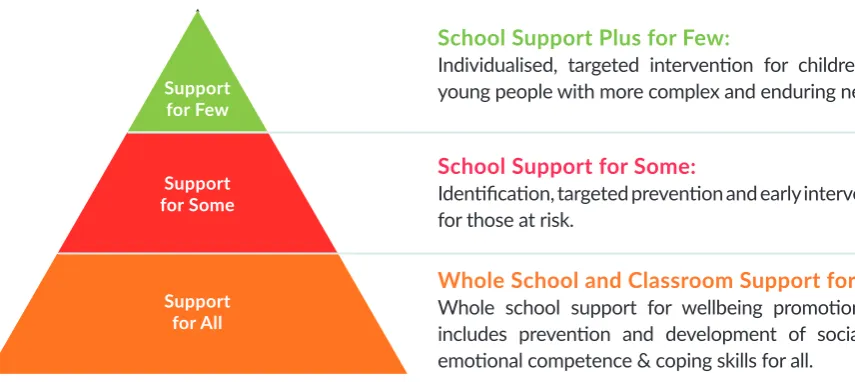
[image:36.595.108.536.546.737.2]A whole school approach focuses on promoting wellbeing for all members of the school community and includes preventative approaches. Embedded in the whole school approach and in line with the Department’s Continuum of Support (Table 6) is the recognition that members of the school community can have different needs at different times. Those at greater risk and with greater needs may require more specific and targeted support, in addition to the support provided to all members at the universal level.
Table 6: Continuum of Support
School Support Plus for Few:
Individualised, targeted intervention for children and young people with more complex and enduring needs.
School Support for Some:
Identification, targeted prevention and early intervention for those at risk.
Whole School and Classroom Support for All:
Whole school support for wellbeing promotion that includes prevention and development of social and emotional competence & coping skills for all.
Support for Few
Support for Some
The Department advocates a multicomponent approach to wellbeing promotion to ensure that all of the key areas that contribute to wellbeing promotion in schools are given a focus. The four key areas for action are outlined in Figure 3.
Figure 3: Whole School Approach: Four Key Areas of Wellbeing Promotion
Relationships & Partnerships
•
Student & staff relationships•
Peer relationships•
Student voice•
Partnership – staff, children and young people, parents/carers•
Partnerships with other schools•
Community partnerships•
External supportsCurriculum
(Teaching & Learning)
•
Extra-curricular learning•
Co-curricular learning•
Planning supports•
MonitoringKEY AREAS OF WELLBEING
Policy & Planning
•
All policies relevant to wellbeing•
All plans relevant to wellbeing•
School & centre self-evaluation•
Continuing professional development Culture & Environment•
Mission and ethos•
School & classroomclimate & culture
•
Quality & use of schoolbuildings & grounds
POLIC Y
& PLAN NING R
EL ATIO
NS HIPS
CUR RIC
ULU M CULTU