Scientific Journal Impact Factor: 1.205
International Journal of Applied And Pure Science and
Agriculture
www.ijapsa.com
TO STUDY THE CONSUMER DECISION
MAKING BEHAVIOR TO PURCHASE OF DURABLE GOODS
(WITH SPECIAL REFERENCE TO FEMALE IN LONI TOWN)Seema Johar
Research Scholar, MVGU
ABSTRACT
A decision is the selection of a action from two or more alternative choices. Constantly consumers make decision regarding the choice, purchase, use of products and services. They face a lot of dilemma at the time of taking a purchase decision. Thus it is a process by which the consumers identify their needs, collect information, evaluate alternatives and make purchase decision. Females play a significant role in the domestic and socio-economic life in the society. In India over the years, both female and male roles have been changing. Now a day’s female are playing different role of chief purchasing officer and controlling 85% of buying decisions. Certainly in male dominated societies many goods and services are actually decided and purchased by female. This is due to increasing literacy, independent income and role in the family. The consumer behaviour in relating to consumer durables is strongly affected by some economic, social, cultural and psychological factors; the present research has been selected for an intensive empirical survey of the various factors influencing the buyer’s behaviour on consumer durables in LONI town (Ghaziabad).
Keywords: Female Consumer, Consumer behaviour, Durable goods, Purchase behaviour, Decision making.
I. INTRODUCTION
subject to research often, only recently. This study is an attempt to explore the purchase decision process within a family with special reference in female’s purchasing behaviour and their role in purchase decision. ‘Family’ influence in the purchase decision process is to be considered more seriously than the influence of any other factor, for the simple and the most importance reason, that, it is the family that decides the consumption pattern, choice of products, brands, stores and other product related aspects.
II. REVIEW OF LITERATURE
Large numbers of research studies have been conducted on consumer behaviour both in India and abroad. The studies have covered both durables and non durables goods. The available literature on selected topic reveals that research studies on consumer behaviour date back to early fifties up to the present period. An attempt is made here review some selected works on consumer behaviours on consumer durables.
Dr.G.Sudharasan Reddy and Ms. Rajarashmi. P.S (2004) undertook a study entitled “Buyer Behaviour of Home Appliances with special reference to Microwave Products in Bangalore City” the objective of this study are to study the brand awareness of the buyers, to know the income level of microwave buyer, to extract the source of information through which buyers came to know about microwave, to know buyers preference of branded product, to determine the decision maker, to identify the factors influencing the buyers while purchasing microwave product, to identify the most favourable choice of microwave, to provide suggestions to microwave companies. Based on the objectives the findings are: the income levels of the buyer are above 15,000.The print media is the important source of information for the purchaser. Almost all the respondent prefers the branded product. The study reveals that the wives are the decision maker’s followed by the husband and wife discussion. Factor influencing the purchase of microwave are Quality of the product rather than the any attribute followed by brand name, price, and features and after sales service. Among all other brands LG stands first. Thus the buyer behaves positively when Quality and branded product is purchased by them.
Aradhana Krishna (2003) viewed that buyers’ purchase behaviours can be influenced not only by the current prices of a product but also by those prices expect in the future.
Bhawaniprasad and Kumari (1987) have analyzed “Impact of advertising on consumer durables markets: A study of Refrigerator consumer”, in this study a ranking/importance of refrigerator among other consumer durables is studied. Study of 200 owners of Allwyn refrigerator in the twin cities of Hyderabad and Secunderabad and Districts of Nizamabad and Karimnagar in Andhra Pradesh indicates that a very positive impact of advertising is found on the consumer durables market.
Bayus (1991) studied “The consumer durable replacement buyer”, and found that replacements account for a substantial portion of the sale of consumer durables in the U S. Results of replacement of automobiles indicate that “early” replacement buyers are more concerned with styling and image and less concerned with costs than “late” replacement buyers.
schemes: installment purchase (4.370), off-season discount (4.346) free gift (08).The suggestion is all the promotional measures has to be enforced to capitalize the opportunities in this highly growing Indian market.
Mujahid-Mukhtar E, Mukhtar H (1991) has studied role of decision making for household durables: good measure of female's power within a household in Pakistan. It is their influence in the purchase of new home improvement technology good (cars, appliances, etc.), who’s expense and life-long nature makes their purchase
an important decision. The study identified various cultural and economic factors that affect female's decision making power
STATEMENT OF THE PROBLEM
An understanding of purchase behaviour of female towards durable goods is an essential as it reflects the influence of brands, price, quality, quantity, mode of purchase, etc. The success of the market or the failure depends on the purchase behaviour of consumers. female are taking the lead roles as of today than the yester years. This is due to the outcome of education, employment, etc. Present, female are taking the lead in purchase decisions too. Hence, the present study.
OBJECTIVES OF THE STUDY
After the national and international literature review, the researcher downsizes the appropriate two objectives namely:
1. To study female’s purchasing behaviour.
2. To know the role of female in purchase decision making process.
III. RESEARCH METHODOLOGY
Area of the study:
The study was undertaken in LONI town(Ghaziabad).
Sample size:
A total of 125 respondents residing in the LONI town form the sample.
Research Tool Sampling Technique:
A structured questionnaire was given to the consumers who have visited the Durable Market in LONI town. Convenience sampling method was followed for collecting response from the respondents.
Sources of data:
The study is based on both primary and secondary data. Primary data was collected by using questionnaire and the secondary data has been collected from books, manuals and Internet.
Tools for analysis:
Weighted Average technique was used to find out the weighted average for each category of respondents, over several study factors to know their level of satisfaction towards the quality, price, availability, service, size & design of the products. For this purpose the qualitative information was converted into numerical one using five point scaling technique. In using five point scales, score 5 was given to Highly satisfied. 4 was given to Satisfied 3 was given to Moderate 2 was given to Dissatisfied 1 was given to Highly Dissatisfied.
It is inferred that irrespective of the age, education, employment, marital status, nature of family and family size, majority of the respondents are highly satisfied with product quality.
Factor Analysis: Factors considered by the respondents were analysed by ranking method. For which respondents were asked to assign the rank of the factors which given in the schedule. As per this technique, the number of respondents multiples the rank assigned by the respondents. The preference is taken as total score assigned to a factor. The factor scoring the least value is the most important rank was determined with ascending order. By using this technique, it was decided to analyse the factors by ranking for some preference.
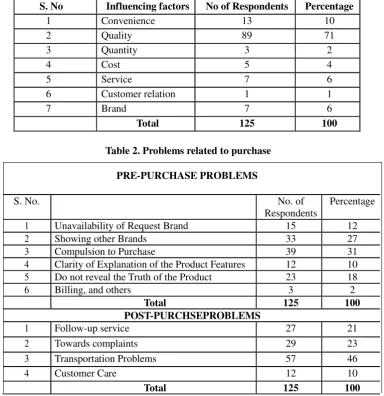
Table 1. Factors Influencing Purchase Behaviour
S. No Influencing factors No of Respondents Percentage
1 Convenience 13 10
2 Quality 89 71
3 Quantity 3 2
4 Cost 5 4
5 Service 7 6
6 Customer relation 1 1
7 Brand 7 6
Total 125 100
Table 2. Problems related to purchase
PRE-PURCHASE PROBLEMS
S. No. No. of Percentage
Respondents
1 Unavailability of Request Brand 15 12
2 Showing other Brands 33 27
3 Compulsion to Purchase 39 31
4 Clarity of Explanation of the Product Features 12 10
5 Do not reveal the Truth of the Product 23 18
6 Billing, and others 3 2
Total 125 100
POST-PURCHSEPROBLEMS
1 Follow-up service 27 21
2 Towards complaints 29 23
3 Transportation Problems 57 46
4 Customer Care 12 10
Table 3. Age & Factors Considered For Product Satisfaction
Sl. No AGE 18-30 years 31-40 years 41-50 years Above 50 years
1 Quality 4.45 4.37 3.94 5.00
2 Price 3.90 3.79 3.61 4.00
3 Availability 3.87 4.00 3.78 4.00
4 Service 3.91 3.84 3.83 4.00
5 Size 3.73 3.21 3.28 4.00
6 Design 3.97 3.95 3.94 4.00
Table 4. Educational Qualification & Factors Considered For Product Satisfaction
Sl.No Educational School Graduate PG Diploma Professionals
Qualification Level
1 Quality 4.19 4.46 4.18 4.75 4.00
2 Price 3.57 3.92 3.45 3.75 4.17
3 Availability 3.90 3.92 3.55 4.00 3.83
4 Service Rendered 3.57 3.93 3.73 4.75 4.17
5 Size 3.43 3.69 4.27 3.75 3.17
6 Design 3.86 4.00 4.00 3.75 4.17
Table 5. Income & Factors Considered For Product Satisfaction
Sl.No. Income Below Rs. Rs.15000 – Rs. 20,000 – Above
15,000 Rs. 20,000 Rs. 25,000 Rs.25,000
1 Quality 4.38 4.38 4.17 4.71
2 Price 3.90 3.87 3.50 3.71
3 Availability 3.90 3.80 3.92 4.14
4 Service Rendered 3.69 4.38 3.83 4.43
5 Size 3.61 3.64 3.92 4.00
6 Design 3.92 3.84 3.83 4.43
Table 6. Nature of Family & Factors Considered For Product Satisfaction
Sl.No Nature of family Nuclear Joint
1 Quality 4.40 4.32
2 Price 3.79 3.95
3 Availability 3.88 3.88
4 Service Rendered 4.08 3.49
5 Size 3.61 3.80
6 Design 3.98 3.98
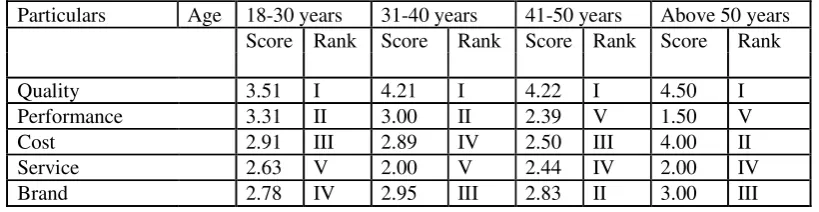
Table 7. Ranking Analysis For Age Group With Order Of Preference For Purchase
Particulars Age 18-30 years 31-40 years 41-50 years Above 50 years
Score Rank Score Rank Score Rank Score Rank
Quality 3.51 I 4.21 I 4.22 I 4.50 I
Performance 3.31 II 3.00 II 2.39 V 1.50 V
Cost 2.91 III 2.89 IV 2.50 III 4.00 II
Service 2.63 V 2.00 V 2.44 IV 2.00 IV
Most of the respondents under various educational levels are giving highest preference to product quality and least preference to the service rendered.
Table 8. Ranking Analysis for Occupation with Order of Preference for Purchase
Particu- Occupa- Professionals Business Service Agriculture Others
lars tion Score Rank Score Rank Score Rank Score Rank Score Rank
Quality 3.67 I 3.83 I 3.89 I 4.00 I 3.57 I
Performance 2.67 IV 3.17 II 3.15 III 2.58 IV 3.22 II
Cost 2.50 V 2.58 IV 3.37 II 2.42 V 2.88 IV
Service 2.83 III 2.42 V 2.52 IV 3.17 II 2.31 V
Brand 3.00 II 3.04 III 2.33 V 2.83 III 2.93 III
Table 9. Ranking Analysis for Marital Status with Order of Preference for Purchase
Particulars Marital Status Married Unmarried
Score Rank Score Rank
Quality 4.17 I 3.47 I
Performance 2.98 II 3.18 II
Cost 2.83 III 2.88 III
Service 2.23 V 2.64 V
Brand 2.81 IV 2.83 IV
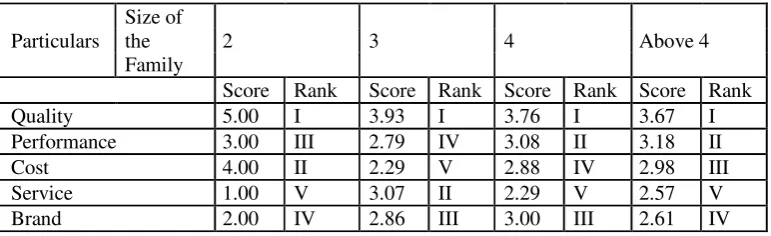
Table 10. Ranking Analysis for Family Size with Order of Preference for Purchase
Size of
Particulars the 2 3 4 Above 4
Family
Score Rank Score Rank Score Rank Score Rank
Quality 5.00 I 3.93 I 3.76 I 3.67 I
Performance 3.00 III 2.79 IV 3.08 II 3.18 II
Cost 4.00 II 2.29 V 2.88 IV 2.98 III
Service 1.00 V 3.07 II 2.29 V 2.57 V
Brand 2.00 IV 2.86 III 3.00 III 2.61 IV
FINDINGS AND SUGGESTIONS
1. The distinctive feature of the higher income group respondents is that, they shop as and
when they like. Similarly, the housewives shop almost weekly but the career going female do shop; only when need arises.
2. Education also plays a key role in shopping behaviour, in the sense that, compared to the
respondents with no formal education, respondents having a good educational background shop more of ten.
3. Majority of the respondents are students belonging to the age group of 18 to 30 years and
4. In majority of the respondents family, female plays a major role in purchase decision and they prefer to prepare item list before purchasing. The involvement each one has on the family matters influences their behaviour to a greater extent. The main aim of the study being to understand the behaviour of individuals in the process of decision making, information gathering and need identification.
5. In the selected sample, respondents gather information from both internal and external
sources. Majority of the sample respondents give importance to their friends and relatives opinions and suggestions and thus adhere to the advice given by them as per their earlier purchase behaviour of course advertisements do have a better say with lower and middle income respondents.
6. Majority of the respondents prefer to purchase products from departmental stores rather
than other types of shops, as they feel it is economical and products are of good quality.
7. The sample respondents adopt bargaining method of purchase; some do not follow this
method because of their confidence in buying.
8. Some respondents are ready to purchase new products offered in order to make a test
purchase and some respondents are not ready for test purchase.
9. The respondents are not conforming to the purchase list for the reason that they have
forgotten to add some items in purchase list.
10.Most of the respondents are aware of the quality marks and they carry the products in their
own vehicle or by bus and some avail the benefit of door delivery. The sample respondents prefer cash payment rather than credit payment. The result from the respondents says that most of them are facing various problems like harassment, adulteration, no follow up service, poor quality, etc during and after purchase. The post purchase behaviour of the sample respondents reveal the fact that, the decision process is not a satisfactory affair. The pressure of negative attitudes mounts up in certain families and is overcome by convincing, compromising, augmenting, etc. To overcome such an attitude, either they get convinced or as observed in the study, the way for getting rid of the product and not to buy it again is a better option. Most of the respondents are interested in recommending the product purchased by them to others and are satisfied with salesmen service. This clearly indicates that in family purchase decisions, in spite of an individual’s age, income, level of education, status, family size, etc, the interactive they have with each other leads the way for best ‘buy’. Ultimately greater the interaction, better the involvement and may be a satisfactory purchase. Most of the respondents under various personal factors have given highest preference to product quality. Most of the respondents were satisfied with all the factors like price, quality, availability, service, size and design and no one is dissatisfied with the above mentioned facts.
III. CONCLUSION
BIBLIOGRAPHY
Books
[1] AMARCHAND AND VARADRAJAN B (1977). An Introduction to Marketing: Vikas Publications house
Pvt Ltd. New Delhi
[2] BENETT P.D. AND HORNALD K. KASSARAJAN. (1976). Consumer Behaviour: Prentice hall of India,
New Delhi
[3] BLOCK CARL E. AND ROERING KENNETH J. (1978). Essentials of consumer Behaviour:The Dryen
Press illions,
[4] CLAES FORNELL. (1976). Consumer Input for Marketing Decisions: A study of corporate dept. for
consumer affairs: Praeger publisher Inc U.S.A.
[5] CLARK L.H. (1958). Consumer Behaviour: Research and Consumer Reactions: Harper and Brother
Publications Newyork,
[6] FRANCESCO M. NICOSIA. (1966). Consumer Decision: Marketing and Advertising Implications:
England cliffs N.J. Prentice Hall,
[7] Dr. Sudar asan Reddy G.& Ms. Rajarashmi P. S. “Buyer Behaviour of Home Appliances with special
reference to Microwave Products in Bangalore City” January 2004 Indian Journal of Marketing Vol. 34, No. 5, Pg.no.19-24, 2004.
[8] Anand and Hundal B. S. “Perceptions of consumers towards Promotional schemes for durables” in Punjab.
The ICFAI Journal of Marketing Management, Vol.VII, No.2, 2008.
[9] Foxall, G. R. (2010). Interpreting Consumer Choice: The Behavioural Perspective Model. New York:
Routledge.
[10] Ferber, Robert and L. C. Lee (1974), "The Role of Life Style in Studying Family Behavior," Faculty
Working Paper no. 226, University of Illinois at Urbana.
[11] Kenson, K. M. (1999). A Profile of Apparel Shopping Orientation Segments among Male Consumers.
Unpublished MA thesis, California State University Long Beach, USA.
[12] Lysonski, S., Durvasula, S. and Zotos, Y. (1996). Consumer Decision-Making Styles: A Multi-Country
Investigation. European Journal of Marketing 30 (12): 10-21
[13] Ownbey, S. F. and Horridge, P.E., (1997), .Acculturation Levels and Shopping Orientations of
Asian-American Consumers,. Psychology and Marketing, Vol. 14, No. 1, pp.1-18.
[14] Sproles G. B. and Kendall, E. L. (1986). A Methodology for Profiling Consumers’ Decision-Making Styles.
Journal of Consumer Affairs 20 (2): 267-279
[15] Rajesh Matai, Anil.K.Bhat (2013),”Underlying dimensions of purchase decision process for consumer
durables: A confirmation of the customer value hierarchy model”, Indian journal of marketing,May, pp 16 – 23.
[16] Suja R. Nair: Consumer Behaviour in Indian Perspective, Published by Himalaya Publishing House. Pg.