http://www.sciencepublishinggroup.com/j/ogce doi: 10.11648/j.ogce.20180606.14
ISSN: 2376-7669 (Print); ISSN: 2376-7677(Online)
Analysis of Factors Affecting Residual Moveout Picking
and Solutions
Hui Zhang
Geophysical Research Institute, Zhong Yuan Oil Field, Zhengzhou, China
Email address:
To cite this article:
Hui Zhang. Analysis of Factors Affecting Residual Moveout Picking and Solutions. International Journal of Oil, Gas and Coal Engineering. Vol. 6, No. 6, 2018, pp. 150-158. doi: 10.11648/j.ogce.20180606.14
Received: September 10, 2018; Accepted: September 21, 2018; Published: October 23, 2018
Abstract:
Reflection tomography on the base of common image gathers (CIGs) in offset domain or angle domain is the powerful and mostly used tool for velocity inversion. There are many factors that affect the accuracy and resolution of reflection tomography, in which RMO picking is a quite important one that can’t be ignored. Residual moveout Auto Picking on common image gathers is the most important step in tomography velocity inversion, the reliability of residual moveout picking decides the accuracy of tomography velocity inversion. Based on a case study of field data, the paper give a full discussions and experiences analysis of factors such as grid step, input data quality, geological structure, picking parameter, which affect residual moveout picking greatly. Furthermore, the paper also put forward corresponding suggestions and solutions to reduce or eliminate the impact of these factors on residual moveout picking. At last we implement a structure controlled residual moveout picking method with horizon constraint to a field data residual moveout picking. The proposed picking method refines the global picking though utilizing horizon constraint in vertical orientation and structure subdividing in lateral orientation. It effectively improves residual moveout quality and enhances inversion reliability, and also helps tomography inversion to update a velocity model with high resolution. The final prestack depth migration shows a good imaging of complex structures and faults, which demonstrates how important of the role that the fine residual moveout picking method plays in tomography inversion.Keywords:
Residual Moveout, Horizon Constraint, Prestack Depth Migration, Tomography, Velocity Inversion1. Introduction
Velocity is the key factor which affects imaging quality of pre-stack depth migration (PSDM). A good depth interval velocity helps pre-stack depth migration (PSDM) obtain good quality image than pre-stack time migration in complex structures. When internal velocity is inaccurate or incorrect, PSDM will cause big deviation with drilling well and mislead well placement. Therefore, building an accurate interval velocity is quite important for pre-stack depth migration.
Reflection tomography on the base of common image gathers (CIGs) in offset domain [1-6] or angle domain [7-10] is the powerful and mostly used tool for velocity inversion. Stoke (1992) [1] first proposed reflection tomography velocity inversion method on post-migrated domain by picking residual moveout (RMO) automatically. The main approaches of velocity inversion by reflection tomography involve iteration [11-13]. During this process, many factors affect reflection tomography, in which RMO picking is a quite
important one that can’t be ignored [14-17]. Many papers researched inversion problems and methods for addressing them [18-23].
2. Principle of Tomography Velocity
Inversion
The theoretical basis of reflection tomography is Radon transform, in reflection tomography formulation, the travel time derivation of an arrival between observed data and reference model can be written by the linear integration of slow residual along the ray path [2], which is
∆t ∆s dr (1)
Where, ∆t is the travel deviation, dr is the length of ray segment along the ray path, ∆s is the slowness deviation between the true model and reference model along the ray path.
By discretizing the slowness field ∆s using rectangular grids, the matrix equation of the collection of all the ray paths can be written as equation 2
L∆s ∆t (2) Where, L is the sensitivity matrix of the segment lengths of a given ray in a given grid, ∆s is the slowness derivations, ∆t is travel time derivations. The tomographic inverse problem is always ill-posed, thus other restrain information is required to regularize inverse problem. Since pure mathematics regularization constraints may cause a false target judgment in inversion. Here the paper use a geological structural conformed regularization, which is stable in inversion and velocity variety is natural, reasonable and consistent with the change of geological structure.
L
λD ∆s ∆t0 (3)
Where, D is regularization matrix to stabilize the tomographic inversion, λ is regularization weight.
3. Quality Analysis of Global Automatic
Picked RMO
The key part in the theory of tomography velocity inversion is to obtain accurate travel time derivations form picking the RMO on CIGs. Therefore, the picking quality of RMO on CIGs directly affects inversion accuracy. Next, we will demonstrate studies on effects of factors affect RMO picking on CIGs.
3.1. Effect of Grid Step on RMO Picking
Autopicking residual moveouts on CIGs is a huge workload. So chose an appropriate grid step along inline and crossline orientation between consecutive autopicked seed points helps it to be more economic, as well as less migration areas of the PSDM which offers CIGs for RMO picking. Small values result in more seed points, which mean an increase in accuracy, but a substantial increase in computation time and memory requirements. Large values result in less seed points, which reduce computation time but also reduce accuracy for both
PSDM and tomography inversion.
(a)
(b)
(c)
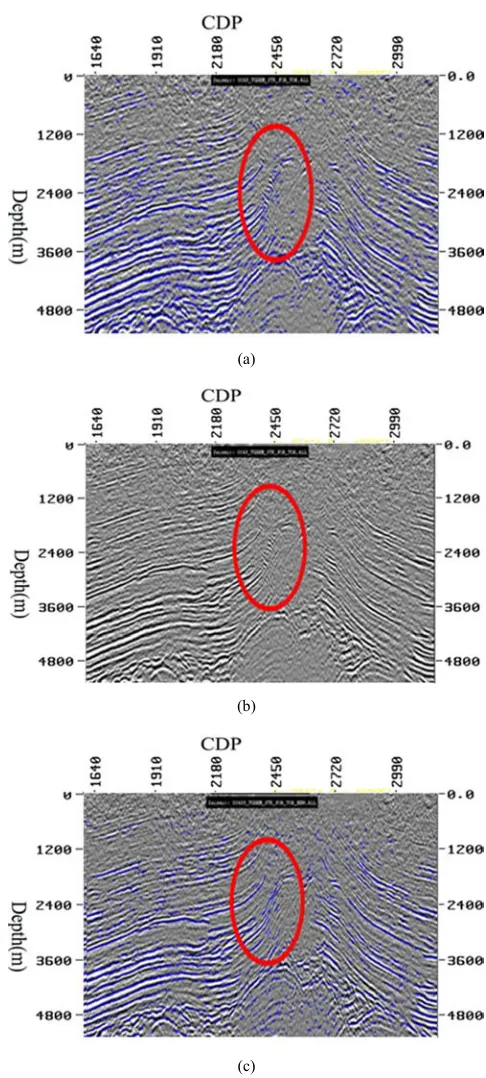
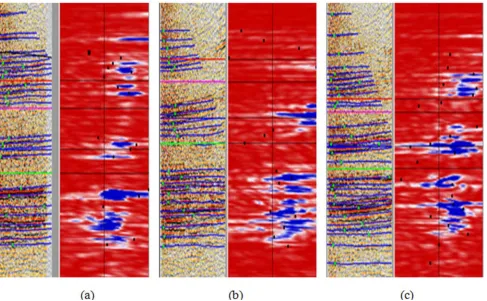
Figure 1. PSDM sections with different grid steps. (a) PSDM section with 4 times grid steps of surface survey. (b) PSDM section with 2 times grid steps of surface survey interpolated by PSDM data shown in 1a. (c) PSDM section with 2 times grid steps of surface survey.
high and steep structure areas. The dispersion shown in image caused an incorrect autopicked RMO values.
We interpolate the PSDM image into 2 times grid step of surface survey, as shown in Figure 1b, the dispersion still exists. This shows that grid step of surface survey selection is very important for initial migration. Distortions of final image
would bring artifact, it’s hard to be addressed by normal technique measures because of insufficient sampling.
We do migration of the same data using 2 times grid step of surface survey. The result shown in Figure 1c has no dispersion and artifacts, so we can ensure that the result is real and RMO picks is reliable.
3.2. Effect of Noise on RMO Picking
(a) (b) (c)
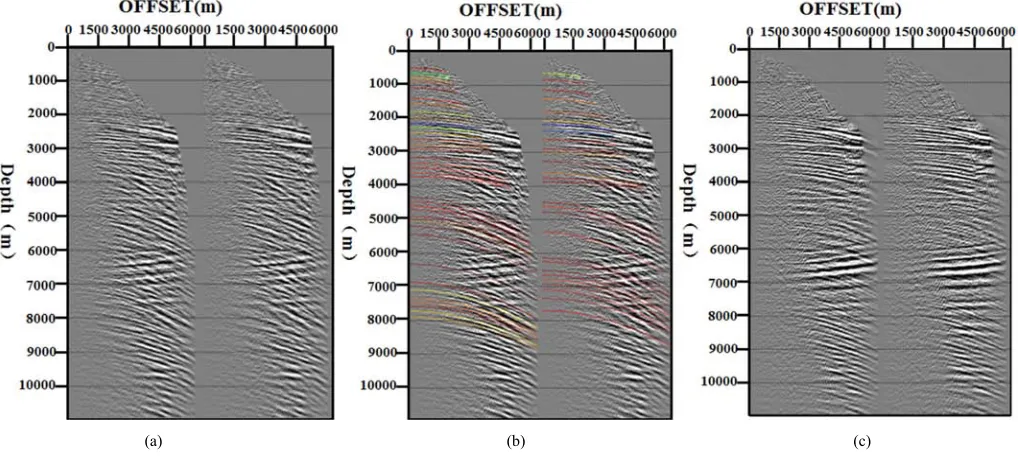
Figure 2. (a) Raw CIGs with multiples. (b) RMO picking of raw CIGs. (c) The CIGs after multiple suppression.
(a) (b) (c) (d)
Figure 3. (a) Semblance of raw CIGs with multiple waves. (b) RMO picking of raw CIGs. (c) Edited semblance of raw CIGs (d) RMO picking of raw CIGs based on edited semblance.
Residual noises after prestack data preconditioning degrades the quality of CIGs and further affect RMO picking. Figure 2a displays CIGs with multiple which mess up and distorted reflection events, and lead to wrong picking of residual curvature (Figure 2b). Some kinds of multiple suppress methods are indispensable, however the current multiple suppression methods can’t completely clear CIGs (Figure 2c). In particular, in the shown field data, it is difficult to identify multiples from either shot gathers or offset gathers in the pre-migrated domain.
CIGs based on edited semblance, compared with RMO picking of raw CIGs without any edit (Figure 3b), we can see that figure 3d perfectly avoid the effects of multiples and obtain reliable RMOs.
3.3. Effect of Single-to-Noise Level on RMO Picking
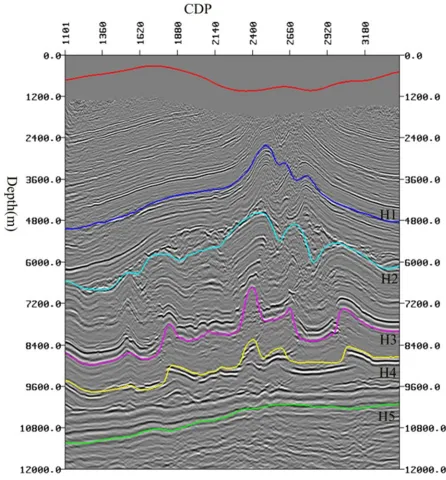
Picking RMO on CIGs deemed needs PSDM results are not low single-to-noise level, in which reflection evens are difficult to be described in an automated manner. On the depth migration section (Figure 4), the global section has different single-to-noise levels of different strata, which associates with
depositional environment. H1, H2, H3, H4, H5 define base horizons of several layers. From shallow to H1 are continued terrestrial deposition strata, which have relatively continues beds and PSDM data has a high single-to-noise level. H1 to H2 are transition strata of terrestrial deposition to marine deposition, and the bottom layer of H2 contains a large amount of gypsum sediment, so the interval velocity is higher than surrounding layers. PSDM data has a low single-to-noise level and bad depth imaging quality because of the change of sediment source and physical processes.
Figure 4. Interpret Horizons.
H2 to H3 are the continued marine deposition strata, with a relatively high single-to-noise level of PSDM data. However, strata at the top half of H2 to H3 have different sediment rock
bottom half part have strong amplitude energy but discontinuous layers.
H3 to H4 are transition strata of marine terrestrial deposition to terrestrial deposition, which also have low single-to-noise level of PSDM data as H1 to H2 do. Below H4 the layers are deep than 8000m, they have low single-to-noise level of PSDM data and low resolution.
The change of single-to-noise level greatly influences the global RMO auto picking on CIGs when using the same picking parameters from shallow to deep. In practice, this phenomenon always exists because single-to-noise level is a serious problem affecting seismic data quality on land acquisition. We perform a layer-by-layer RMO picking with
horizon constraint to give different picking parameters for CIGs with different single-to-noise levels from shallow to deep.
RMO picking with horizon constraint consists of three steps: first, interpret several horizons as constraint which can divide velocity model into different parts by taking single-to-noise levels on associate PSDM sections as a reference. Second, use different picking parameters at divided model parts according to amplitude energy and event continuity (as shown as figure 5). At this step, ∆t in equation 2 can be seen as ∆t , ∆t , ∆t , ∆t , ⋯ . Finally, we can perform global inversion though merging CIG picks all together.
Figure 5. Residual moveout picking with horizon constraints.
3.4. Effect of Subsurface Structure on RMO Picking
Usually we can’t clearly distinguish the extent of each factor as they are associated with each other, and RMO picking problem possibly caused by cooperation of several reasons. For the example data we discussed in the paper, deformation of subsurface structure has significant impact on RMO picking.
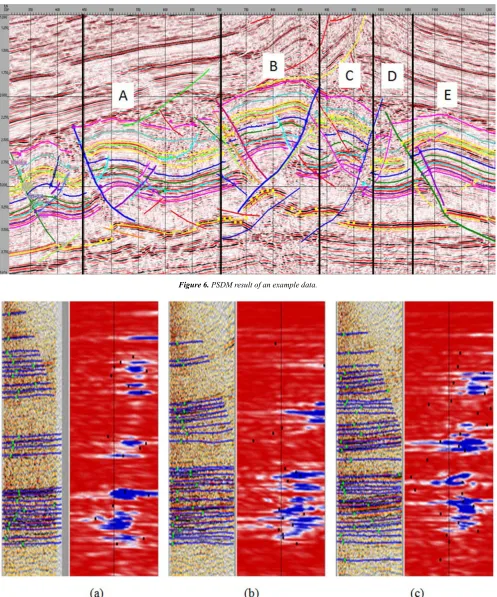
Strata between H2 to H3 in 3.3, not only have different single-to-noise levels in vertical orientation, but also have different complex structures. We divided strata between H2 to H3 into 5 parts laterally. Figure 6 shows that A has mild anticline and small scale wave-like fold and faults. B, C and D have sharp folds with pairs of anticlines and synclines, and overthrust faults. E has flat layers.
The developed multiple lateral structures produce amount
of diffractions, scattered waves, crossing arrivals and interference. A to D parts are especially complex, wavefields distorted and interfered mutually. These brought difficulties to PSDM and velocity inversion. PSDM based on ray-tracing or one way wave equation can’t handle multi-wavefiled imaging, and velocity inversion using ray-tracing in the tomography can’t deal with multipath problems. Poor behavior of PSDM makes reflection events on CIGs and hard to track. Figure 7 shows picks on three CIGs located at A, B and E, respectively.
Figure 6. PSDM result of an example data.
Figure 8. RMO pick of gathers at different structures using horizon constraint. (a) CIG gather locating at A. (b) CIG gather locating at B. (c) CIG gather locating at E.
(b)
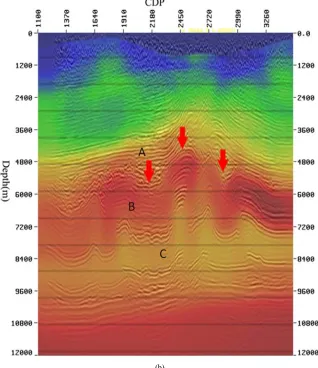
Figure 9. Comparison of velocity models before and after tomography inversion. (a) Initial velocity used for tomography inversion. (b) Final velocity after three times iteration.
4. The Application to the Field Data
We used the proposed ideas for RMO picking on the field data that we analyzed in the paper. Figure 9a is the overlay display of initial velocity model and associate PSDM image. After three times iterate of velocity inversion, we obtained final velocity and associate PSDM image (Figure 9b).
Initial velocity is simple and smooth which obtained though time migration velocity. Compared with initial velocity, the final velocity matches geological knowledge very well. First, the bottom of gypsum layer is clear and easy to interpret as shown by red arrows in figure 9b. Second, the rapid increases in velocity at depth A indicates the interface of terrestrial deposition to marine deposition, high velocity layer at depth B corresponds a stable marine deposition process. Third, it appears velocity reversal at depth C, which reflects the change of marine deposition to terrestrial deposition as we analyzed before.
PSDM result using final velocity shows a good imaging of complex structures, faults imaging is clear-cut, the bottom of gypsum layer is clearly portrayed and easy to interpret. The weak reflection layers which have low single-to-noise levels
below gypsum layer have been improved.
5. Conclusions
The paper analyzed aspects of input data quality, geological structure, single-to-noise level and quality control which affect RMO picking. Through field data implementation we proposed a structure-controlled RMO picking method with horizon constraint to improve residual move out picking quality hence to raise inversion reliability.
(1)There are many factors influence automatic RMO picking, such as single-to-noise level of input data, quality of common-image gathers, subsurface structure, depth migration method, picking parameters. Processors should pay attention to quality control of RMO picking in field data process and under the guidance of geological knowledge using geological constraint to improve the quality of RMO picking. (2)After picking up accurate and reliable RMO,
Acknowledgements
This research is supported by the National Science and Technology Major Projects of China (“Oil and Gas Accumulation regularity and Increasing Reserves Area in Dongpu Depression”, Grant No. 2016ZX05006-004).
References
[1] Stork C. Reflection tomography in the postmigrated domain. Geophysics, 1992, vol. 57, pp. 680-692.
[2] Adler F, Baina R, Soudani M A, Cardon P, Richard J B. Nonlinear 3D tomographic least-squares inversion of residual moveout in Kirchhoff prestack depth-migration common-image gathers. Geophysics, 2008, vol. 73, pp. 13-23. [3] Lafond C F, Levander A R. Migration moveout analysis and
depth focusing. Geophysics, 1993, vol. 58, pp 91-100. [4] Wang B, Pann K. Model-based interpretation of focusing
panels for depth focusing analysis. SEG Technical Program Expanded Abstracts, 1998, pp. 596-599.
[5] Wang B, Dirks V, Guillaume P, Audebert F, Epili D. A 3D subsalt tomography based on wave equation migration perturbation scans. Geophysics, 2006, vol. 71, pp. 1-6. [6] Woodward M, Farmer P, Nichols D, Charles S. Automated 3D
tomographic velocity analysis of residual moveout in prestack migrated common image point gathers. SEG Technical Program Expanded Abstracts, 1998, pp. 1218-1221.
[7] Dahl S B, Maarten V. Hoop D, Ursin B. Velocity analysis in the common scattering-angle/Azimuth domain. SEG Technical Program Expanded Abstracts, 1999, pp. 1715-1718.
[8] Xia F, Ren Y Q, Jin S W. Tomographic migration‐velocity
analysis using common angle image gathers. SEG Technical Program Expanded Abstracts, 2008, pp. 3103-3107
[9] Zhang K, Li Z C, Zeng T F, 2010. Residual curvature migration velocity analysis for angle domain common imaging gathers Applied Geophysics 7 49-56.
[10] Wang T F, Kang W, Cheng J B 2014 Migration velocity model building using local angle domain nonlinear tomography CPS/SEG Beijing 2014 International Geophysical Conference 739-742.
[11] Liu Z Y and Bleistein N. Migration velocity analysis: Theory and an iterative algorithm. Geophysics, 1995, vol. 60, pp. 142-153.
[12] Kosloff D, Sherwood J, Koren Z, Machet E, Falkovitz Y. Velocity and interface depth determination by tomography of depth migrated gathers. Geophysics, 1996, vol.61, pp. 1511-1523.
[13] Glinsky M E, Clark G A, Cheng P K Z, Devi K R S, Robinson J H, Ford G E. Automatic event picking in prestack migrated gathers using a probabilistic neural network. Geophysics, 2001, vol. 66, pp. 1488-1496.
[14] Etgen J T, Billette F J, Sandschaper R, Rietveld W E. The key practical aspects of 3D tomography: Data picking and model representation. SEG Technical Program Expanded Abstracts, 2002, pp. 826-829.
[15] Zhang Q and Du B. Multiscale and iterative refinement optical flow (MSIROF) for seismic image registration and gather flattening using multidimensional shifts. SEG Technical Program Expanded Abstracts, 2016, pp. 5468-5472.
[16] Smith K. Machine learning assisted velocity autopicking. SEG Technical Program Expanded Abstracts, 2017, pp. 5686-5690. [17] Hu J, Ahmed L, Jonhston R, Asimakopoulos C. Reliable
picking of residual moveouts for reflection tomography. SEG Technical Program Expanded Abstracts, 2017, pp. 5681-5685. [18] Liu Z Y and Bleistein N. Velocity analysis by residual moveout.
SEG Technical Program Expanded Abstracts, 1992, pp. 1034-1037.
[19] Li Z W, Yang K, Ni Y, Yang X C, Wang Y X, Wang X J. Migration velocity analysis with stereo-tomography inversion. Geophysical Prospecting for Petroleum, 2014, vol. 53, pp. 444-452.
[20] Mandelli S, Lipari V, Tubaro S. An investigation of uncertainty in velocity model building problems. SEG Technical Program Expanded Abstracts, 2017, pp. 5711-5715.
[21] Sun X Y, Hilburn G, He Y, Singh V. Horizon-based semblance picking tomography – a case study for velocity model building for Yucatan platform depth imaging. SEG Technical Program Expanded Abstracts, 2017, pp. 5721-5724.
[22] Yu Y, Nichols D, Bloor R. Tomographic earth model building with prior information. SEG Technical Program Expanded Abstracts, 2017, pp. 5696-5700.
[23] Zhang K, Li Z C, Zeng T F. Residual curvature migration velocity analysis for angle domain common imaging gathers. Applied Geophysics, 2010, vol. 7, pp. 49-56.