ISSN 2286-4822 www.euacademic.org
Impact Factor: 3.1 (UIF)
DRJI Value: 5.9 (B+)
Text Encryption Based on Singular Value
Decomposition
NIDHAL K. EL ABBADI
Computer Science Department University of Kufa, Najaf Iraq
ADIL MOHAMAD AL RAMMAHI MOHAMMED ABDUL-HAMEED
DHEIAA SHAKIR
Mathematical Department University of Kufa, Najaf Iraq
Abstract:
Nowadays, text encryption is recommendable when it is transmitted or stored on insecure channels as Internet. In this paper we introduced novel method to encrypt text based on SVD. Up to our knowledge this is the first paper encrypted text by using SVD.
The message is the composition of some character. Every character of the message can be represented as an ASCII value, and then we can build numeric matrix for each text. We suggested using other text as key and using with plaintext to scramble the plaintext prior to use the SVD process which makes cryptanalyst’s job difficult. There are many difficulties in using the SVD to encrypt text. The decrypted text was the same as the plaintext without loss any character. Encryption and decryption time were reasonable. One of the important features of this work is the ability to produce encrypted text with language differ from the plaintext language which make add more complixity of decrypt the encrypted text from third party.
1. Introduction
Information security is one of the most important issues to be considered when describing computer networks. The existence of many applications on the Internet, for example e-commerce (selling and buying through the Internet) is based on network security. In addition, the success of sending and receiving sensitive data using wireless networks depends on the existence of a secure communication (the Virtual Private Network, VPN). One of the methods which are used to provide secure communication is Cryptography (Ahmad Abusukhon et al. 2012).
Cryptography is the art of achieving security by encoding messages to make them non-readable. Cryptography is the practice and study of hiding information. In modern times cryptography is considered a branch of both mathematics and computer science and is affiliated closely with information theory, computer security and engineering. Cryptography is used in applications present in technologically advanced societies; examples include the security of ATM cards, computer passwords and electronic commerce, which all depend on cryptography.
There are two basic types of cryptography: Symmetric Key and Asymmetric Key. Symmetric key algorithms are the quickest and most commonly used type of encryption. There are few well-known symmetric key algorithms i.e. DES, RC2, RC4, IDEA etc.
Traditional encryption algorithms are private key encryption standards (DES and AES), public key standards such as Rivest Shamir Adleman (RSA), and the family of elliptic-curve-based encryption (ECC), as well as the international data encryption algorithm (IDEA).
There are other algorithms for encrypting text. Some of them use the corresponding decimal ASCII code, convert it to binary numbers and apply a process for changing the order of the bits. Another proposal is a technique on matrix scrambling which is based on random function, shifting and reversing techniques of circular queue (Elena Acevedo et al. 2013).
(Akanksha Mathur, 2012) presented an algorithm for data encryption and decryption based on ASCII values of characters in the plaintext. This algorithm is used to encrypt data by using ASCII values of the data to be encrypted. The secret used will be modifying of another string and that string is used as a key to encrypt or decrypt the data. So, it can be said that it is a kind of symmetric encryption algorithm because it uses same key for encryption and decryption but by slightly modifying it. This algorithm operates when the length of input and the length of key are same.
(Anupam Kumar Bairagi, 2011) describes how such an even-odd encryption based on ASCII value is applied and how encrypted message converting by using Gray code and embedding with picture can secured the message and thus makes cryptanalyst’s job difficult.
2. Singular Value Decomposition (SVD)
Let A be a real matrix. Then there exist orthogonal
matrices U of size and V of size such that
Where S is a matrix with non-diagonal entries all zero
and:
The diagonal entries of S are called the singular values of A. The columns of U are called the left singular vectors of A. The columns of V are called the right singular vectors of A.
D is diagonal matrix whose diagonal entries are the
eigenvalues of . Denote column j of V.
Note: each eigenvalue of is nonnegative. Let the eigenvalues of is
Define
Is orthonormal matrix each of its columns is a unit vector.
Thus the singular values of A are the square roots of the
eigenvalues of .
The matrix U is to be orthogonal, its columns must be an orthonormal set. Hence they are linearly independent vectors.
3. Methodology
3.1 Encryption
In this paper we introduced new way to encrypt text based on SVD.
The first step in encryption process is to converting the plain text to the corresponding ASCII code, and then arranges these numbers as square matrix called (A).
The key is any text suggested to use as a key regardless the length of the key. The suggested key also converts to corresponding ASCII numbers and then resize and rearrange as a square matrix with the same dimension of matrix A called matrix (B).
The elements of both matrices A and B will be scrambling to create another two matrices different from the origin matrix. This can be achieved by the following steps:
1. First matrix (C1) created by multiplication the key
matrix by the plaintext matrix.
It is clear that (Key and B) are matrices have the same dimensions and this is the multiplication between each element in the matrix (Key) with the corresponding element in the matrix B.
2. While the second matrix (C2) created by flipping the matrix C1 horizontally (so the first column of the input becomes the last column of the output).
SVD will be applied for the resulting matrices (C1 and C2)
The text matrix cipher will be (F) which is
Note the resulted matrix F is a real numbers matrix, these numbers will be rearranged by using specific process to represent it’s with group of integer values, and then each integer number displayed as a character according to the ASCII representation, or we can suggest specific character for each number.
3.2 Decryption
The decryption algorithm is the inverse of encryption algorithm. Start with converting each character in the cipher text to the corresponding ASCII number, and then reproduce the real numbers from each group of integer numbers, the result is the matrix F.
From the matrix F we reconstruct the matrices
( ). SVD will be applied for both matrices
( to get:
[U , S , V ]= SVD ( )
[U , S , V ]= SVD ( )
So the C1 and C2 will be reconstructed as follow:
Now the (Key and ) are matrices have the same
dimensions and this is the division between each element in the matrix (Key) with the corresponding element in the
matrix .
From the last matrix we recover the letters and
4 The Results
We test proposed algorithm with the text in the Fig. 1 which is written in English language.
Figure 1: English plaintext
We test the encryption algorithm by using short key to encrypt the plaintext showed in Fig. 1. The short Key used to encryption showed in Fig. 2.
Figure 2: the key used for encryption text in Fig. 1.
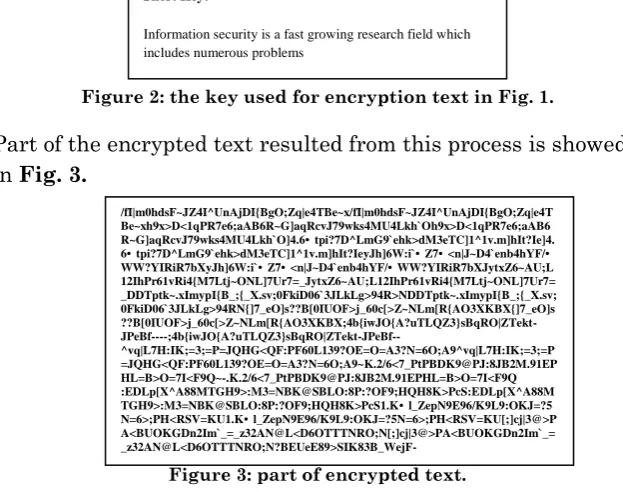
Part of the encrypted text resulted from this process is showed in Fig. 3.
Figure 3: part of encrypted text. Plaintext in English language:
Image encryption is one of the most methods of information hiding. A novel secure encryption method
for image encryption is presented in this paper. The proposed algorithm based on using singular value decomposition SVD. In this Paper we start to scramble the image data according to suggest keys (two sequence scrambling process with two different keys) to finally create two different matrices.
Short Key:
Information security is a fast growing research field which includes numerous problems
_z32AN@L<D6OTTTNRO;N?BEUeE89>SIK83B_WejF-The decrypted text is the same as original plaintext.
Also we test the algorithm with long key almost equal to the size of plaintext; in this case we used text written in Arabic language to prove the possibility of using this algorithm with any language, plaintext showed in Fig. 4.
Figure 4: Arabic plaintext
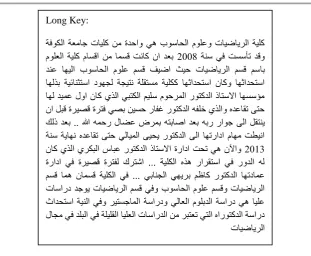
The key used to encrypt the plaintext showed in Fig. 4 is also in Arabic language showed in Fig. 5.
Plaintext in Arabic Language:
ءانبلا عيرست لجا نم ةيقيقح تاوطخ ىلا ةجاحب قارعلا لاز لاو ناك يناسنلاا ءانبلا ىتحو لب ينارمعلاو يرادلااو يملعلا فورعملا نمف
يتلا ثادحلأا نا يفيظولا ّوجلا شاع نم لك اهب رم يتلا ةبرجتلا مكحبو اضقانتلاب ةئيلم نوكت ةيفيظولا هتمدخ للاخ درفلا اهب رمي تآجافملاو ت
نم فقوم ىلع ليوعتلا مدع ىلا يدؤت ةيئاهنلا اهتلصحمبو يتلاو اهتلاخدمب ةنوهرم ةيرادلاا تاجرخملا لكف جئاتنلا نم ةجيتن وا فقاوملا لا دلب يف نحنف اباجيا ما تناك ابلس اهب ةطيحملا ءاوجلأاو اهتايطعمو ف ىلا ةجاحبو ةيرشبلا دراوملا ةرادا لاجم يف حواري لازي نمزلا نم ةرت
ءيش لك يف تتشتلا نم ةليوطلا دوقعلا تافلخم نم ىفاعتيل ةليلقلاب تسيل يتلا بوعشلا نم نيرخلآا براجت نم ةدافتسلاا ىلا هتجاح ىلا ةفاضا ةيفيظولا تاقلاعلاو تاقايسلا ريوطتو ةيرادلاا ةيمنتلا لاجم يف انتقبس انيلع امازلو اهاحضو ةيشع نيب لصحي نل رملأا اذهو لمحتن نا
Figure 5: encryption key.
Part of the result from this process is showed in Fig. 6.
Figure 6: part of the encrypted text.
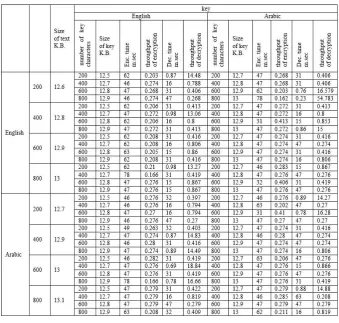
Encryption and decryption times checked, also the throughput determined. The results showed in Table 1.
Where,
5. Discussions
The encryption algorithm can use short or long text as a key efficiently, and the decrypted text retrieved the plaintext without any change in spite of using SVD algorithm which converts integer numbers to real numbers.
Also the encryption and decryption time was reasonable.
6. Conclusions
In this paper we suggest new text encryption algorithm based on using the SVD combined with other idea to scramble the text prior to encryption.
The key used in this algorithm is text with variable length or size up to the size of plain text without affecting the performance of encryption.
One of the important features of this proposed is the ability to convert the encrypted text to other language differs from the plaintext language as showed in Fig. 5, which is English text for Arabic plaintext.
Table 1: showed encryption and decryption time, and throughput.
REFERENCES
Abusukhon, Ahmad, Mohamad Talib, and Issa Ottoum. 2012. “Secure Network Communication Based on Text-to-Image Encryption.” International Journal of
Cyber-Security and Digital Forensics (IJCSDF) 1(4): 263-271.
Journal on Computer Science and Engineering (IJCSE)
4(9).
Bairagi, Anupam Kumar. 2011. “ASCII based Even-Odd
Cryptography with Gray code and Image
Steganography: A dimension in Data Security.” IJCIT
1(2).
Ayushi. 2010. “A Symmetric Key Cryptographic Algorithm.”
International Journal of Computer Applications 1(15).
Acevedo, Elena, Ángel Martínez, Marco Acevedo, and Fabiola Martínez. 2013. “A Novel Text Encryption Algorithm.”