Efficient Learning and Planning with Compressed Predictive
States
William Hamilton [email protected]
Mahdi Milani Fard [email protected]
Joelle Pineau [email protected]
School of Computer Science McGill University
Montreal, QC, Canada
Editor:Jan Peters
Abstract
Predictive state representations (PSRs) offer an expressive framework for modelling par-tially observable systems. By compactly representing systems as functions of observ-able quantities, the PSR learning approach avoids using local-minima prone expectation-maximization and instead employs a globally optimal moment-based algorithm. Moreover, since PSRs do not require a predetermined latent state structure as an input, they offer an attractive framework for model-based reinforcement learning when agents must plan with-out a priori access to a system model. Unfortunately, the expressiveness of PSRs comes with significant computational cost, and this cost is a major factor inhibiting the use of PSRs in applications. In order to alleviate this shortcoming, we introduce the notion of compressed PSRs (CPSRs). The CPSR learning approach combines recent advancements in dimensionality reduction, incremental matrix decomposition, and compressed sensing. We show how this approach provides a principled avenue for learning accurate approx-imations of PSRs, drastically reducing the computational costs associated with learning while also providing effective regularization. Going further, we propose a planning frame-work which exploits these learned models. And we show that this approach facilitates model-learning and planning in large complex partially observable domains, a task that is infeasible without the principled use of compression.1
Keywords: predictive state representation, reinforcement learning, dimensionality re-duction, random projections
1. Introduction
In the reinforcement learning (RL) paradigm, an agent in a system acts, observes, and receives feedback in the form of numerical signals (Sutton and Barto, 1998). Given this experience, the agent determines an optimal policy (i.e., a guide for its future actions) via value-function based dynamic programming or parameterized policy search. This is conceptually analogous to the ‘operant conditioning’ postulated to underlie certain forms of
animal (and human) learning. Organisms learn to repeat actions that give positive feedback and avoid those with negative results.
1.1 Fully to Partially Observable Domains
In the standard formulation, an RL agent is given prior knowledge of a domain in the form of a state-space, transition probabilities, and an observation (i.e., sensor) model. Formally, the system is described by a Markov decision process (MDP), and given the MDP description, a variety of optimization algorithms may then be used to solve the problem of determining an optimal action policy (Sutton and Barto, 1998). In general, approximate solutions are determined for domains exhibiting large, or even moderate, dimensionality (Gordon, 1999).
The situation is further complicated in domains exhibiting partial observability, where observations are aliased and do not fully determine an agent’s state in a system. For ex-ample, an agent’s sensors may indicate the presence of nearby objects but not the agent’s global position within an environment. To accommodate this uncertainty, the MDP frame-work is extended as partially observable Markov decision processes (POMDPs) (Kaelbling et al., 1998). Here, the true state is not known with certainty, and optimization algorithms must act upon belief states (i.e., probability distributions over the state-space).
1.2 Model-Learning Before Planning
The POMDP extension introduces a measure of uncertainty in the reinforcement learning paradigm. Nevertheless, an agent learning a policy via the POMDP framework has access to considerable a priori knowledge: Most centrally, the agent (which necessarily and implicitly contains the POMDP solver) has access to a description of the system in the form of an explicit state-space representation. Moreover, in a majority of instances, the agent knows the probabilities governing the transitions between states, the observation functions governing the emission of observable quantities from these states, and the reward function specifying some empirical measure of “goodness” for each state (Kaelbling et al., 1998).
Access to such knowledge allows for the construction of optimal (or near-optimal) plans and is useful for real-world applications where considerable domain-specific knowledge is available. However, the converse situation, where a (near)-complete system model is not known a priori, is both important and lags behind in terms of research results. In such a setting, an agent must learn a system model prior to (or while simultaneously) learning an action policy.
1.3 Learning a Model-based Predictive Agent
In this work we outline an algorithm for constructing a learning and planning agent for sequential decision-making under partial state observability. At a high-level, the algorithm is model-based, specifying an agent that builds a model of its environment through experience and then plans using this learned model. Such a model-based approach is necessary in complicated partially observable domains, where single observations are far from sufficient statistics for the state of the system (Kaelbling et al., 1998). At its core, the algorithm relies on the powerful and expressive model class of predictive state representations (PSRs) (Littman et al., 2002). PSRs (described in detail in Section 2) are an ideal candidate for the construction of an agent that both learns a system model and plans using this model, as they do not require a predetermined state-space as an input.
PSRs have been used as the basis of model-based reinforcement learning agents in a number of recent works (Boots et al., 2010; Rosencrantz et al., 2004; Ong et al., 2012; Izadi and Precup, 2008; James and Singh, 2004). However, for these previous approaches, the time and space complexities of learning scale super-linearly in the maximum length of the trajectories used (see Section 3). In this work we use an approach that simultaneously ameliorates the efficiency concerns related to constructing PSRs and alleviates the need for domain-specific feature construction. The model-learning algorithm, termed compressed predictive state representation (CPSR), uses random projections in order to efficiently learn accurate approximations of PSRs in sparse systems. In addition, the approach makes use of recent advancements in incrementally learning transformed PSRs (TPSRs), providing further optimization (Boots and Gordon, 2011). The details of the model-learning algorithm are provided in Section 3.2. Section 4 presents theoretical results pertaining to the accuracy of the approximate learned model and elucidates how our approach regularizes the learned model, trading off reduced variance for controlled bias.
The planning algorithm used is an extension of the fitted-Q function approximation-based planning algorithm for fully observable systems (Ernst et al., 2005). This approach has been applied to PSRs previously with some success (Ong et al., 2012) and provides a strong alternative to point-based value iteration methods (Izadi and Precup, 2008). The algorithm simply substitutes a predictive state for the observable MDP state in a fitted-Q learning algorithm, and a function approximator is used to learn an approximation of the Q-function for the system (i.e., the function mapping predictive states and actions to expected rewards). The details of the planning approach are outlined in Section 5. The main empirical contribution of this work is the application of this approach to domains and sample-sizes of complexity not previously feasible for PSRs. Section 6 will highlight empirical results demonstrating the performance of the algorithm on some synthetic robot navigation domains and a difficult real-world application task based upon the ecological management of migratory bird species.
manner, and (6) provides extensive empirical results pertaining to both model-learning and planning, including results on a difficult real-world problem.
2. Predictive State Representations
Predictive state representations (PSRs) offer an expressive and powerful framework for modelling dynamical systems and thus provide a suitable foundation for a model-based reinforcement learning agent. In the PSR framework, a predictive model is constructed di-rectly from execution traces, utilizing minimal prior information about the domain (Littman et al., 2002; Singh et al., 2004). Unlike latent state based approaches, such as hidden Markov models or POMDPs, PSR states are defined only via observable quantities. This not only makes PSRs more general, as they do not require a predetermined state-space, but it also increases their expressive power relative to latent state based approaches (Littman et al., 2002). In fact, the PSR paradigm subsumes POMDPs as a special case (Littman et al., 2002). In addition, PSRs facilitate model-learning without the use of local-minima prone expectation-maximization (EM) and allow for the efficient construction of globally optimal models via a method-of-moments based algorithm (James and Singh, 2004). The following section outlines the foundations of the PSR approach and sets the stage for the presenta-tion of compressed predictive state representapresenta-tions in Secpresenta-tion 3 and our efficient learning algorithm in Section 3.2. Much of the PSR background material (e.g., the derivation of the PSR model in Sections 2.2 and 2.3) expands upon the presentation in Boots et al. (2010) and uses important results from that work.
2.1 Notation
This section outlines the notation that will be used throughout the paper.
2.1.1 Matrix Algebra Notation
Bold letters denote vectors v ∈ Rd and matrices M ∈
Rd1×d2. Given a matrix M, kMk
denotes its Frobenius norm. M† is used to denote the Moore–Penrose pseudoinverse ofM. Sometimes names are given to the columns and rows of a matrix using ordered index sets
I and J. In this case, M∈RI×J denotes a matrix of size|I| × |J |with rows indexed by
I and columns indexed by J. We then specify entries in a matrix (or tensor) using these indices and the bracket notation; e.g., [M]i,j corresponds to the entry in the row indexed
by i∈ I and the column indexed j ∈ J. Rows or columns of a matrix are specified using this index notation and the∗ symbol; e.g., [M]i,∗, denotes the ithrow ofM. Finally, given
I0 ⊂ I and J0 ⊂ J we define [M]I0,J0 as the submatrix of M with rows and columns
specified by the indices in I0 and J0, respectively.
2.1.2 Probability Notation
We denote the probability of an event by P(·) and use | to denote the usual probabilistic
conditioning. To avoid excessive notation, when the P(·) operator is applied to a vector
For clarity, we use || to denote conditioning upon an agents policy (i.e., plan). That is,
|| denotes that we are conditioning upon the knowledge that the agent will “intervene” in a system by executing the specified actions.
2.2 Technical Foundations
A PSR model represents a partially observable system’s state as a probability distribution over future events. More formally, we maintain a probability distribution over different sequences of possible future action-observation pairs. Such sequences of possible future action-observations are termedtests and denotedτ. For example, we could construct a test τi = [okt+11 , o
k2
t+2, ..., o
kn t+n||a
l1
t+1, a
l2
t+2, ..., a
ln
t+n], where notationally subscripts refer to time,
superscripts identify particular actions or observations, and actions following the||symbol denote that we are conditioning upon the agent “intervening” by performing those specified actions at the specified times. We can then say that such a test is executed if the agent intervenes and takes the specified actions, and we say the testsucceeded if the observations received by the agent match those specified by the test. Going further, we can define the probability of success for testτi as
P(τi) =P(okt+11 , o
k2
t+2, ..., o
kn
t+n||alt1+1, a
l2
t+2, ..., a
ln t+n).
Of course, we want to know more than just the unconditioned probabilities of success for each test. A complete model of a dynamical system also requires knowing the success probabilities for each test conditioned on the agent’s previous experience, or history. We denote such a history hj = [al00ok00, a1l1ok11...alttoktt], where again subscripts denote time and
superscripts identify particular actions or observations. Importantly, the || symbol for intervention is absent from the definition of history, as the sequence of actions specified in a history are assumed to have already been executed.
Finally, given that an agent has performed some actions and received some observations, defining some historyhj, we compute
P(τiO|hj||τiA),
the probability ofτi succeeding conditioned upon the agent’s current history in the system,
whereτiA and τiO denote the ordered lists of actions and observations, respectively, defined inτi.
It is not difficult to see that a partially observable system is completely described by the conditional success probabilities of all tests given all histories. That is, if we have
P(τiO|hj||τiA)∀i∀j then we trivially have all necessary information to characterize the
dy-namics of a system. Of course, maintaining all such probabilities directly is infeasible, as there is a potentially infinite number of tests and histories (and at the very least an exorbitant number for any system of even moderate complexity) (Littman et al., 2002).
Fortunately, it has been shown that it suffices to remember only the conditional prob-abilities for a (potentially) small core set of tests, and the conditional probabilities for all other tests may be defined as linear functions of the conditional probabilities for the tests in this core set (Littman et al., 2002).2 More formally, we define the system dynamics ma-2. In this work, the shortened phrasecore setis always to be interpreted ascore set of tests; that is, such
trix,H, as the (potentially infinite size) matrix, where each row corresponds to a particular test (under some lexicographic ordering), each column to a particular history (under some lexicographic ordering), and a particular [H]i,j entry toP(τiO|hj||τiA). H simply organizes
P(τiO|hj||τiA),∀i∀jin a matrix structure. In Littman et al. (2002) and Singh et al. (2004) it
is shown that ifHhas rankkthen (1)kcorresponds to the rank of the partially observable system, as defined by Jaeger (2000) and (2) there exists a minimal core set of sizek (i.e., the smallest core set of tests is of sizek, though there may be larger core sets). Thus, ifH
has rankk, it suffices to remember conditional probabilities for onlyktests (those that are a part of the minimal core set), and the conditional probabilities for all other tests may be defined aslinear functions of the conditional probabilities for these tests.
The rank of H thus describes the complexity of a system. For example, a system with rank(H) = k can not be modelled by a POMDP with less than k states; though it may require more than k POMDP states (Singh et al., 2004). In contrast, a PSR can always (exactly) model a system with rank(H) =kusing a minimal core set of exactly sizek(Singh et al., 2004). This demonstrates how PSRs can be more compact than POMDPS.
Thus, for a PSR, given a minimal core set Q(i.e., |Q|= rank(H)), we can compute the conditional probability of some test τi ∈ Q/ as
P(τiO|hj||τiA) =r
>
τiP(Q
O|
hj||QA),
where rτi is a vector of weights and P(Q
O|h
j||QA) an ordered vector of conditional
prob-abilities for each test in the minimal core set qi ∈ Q. Integral to this approach is the
fact that restricting the model to linear functions of tests in the minimal core set does not preclude the modelling of non-linear systems, as the dynamics implicit in the probabilities may specify non-linear behaviours (Littman et al., 2002).
Thus, given the functions mapping tests in the core set to all other tests, it suffices to maintain, at time t, only the vector mt = P(QO|ht||QA), where ht is the history of the
system at timet. That is, it suffices to maintain only the vector of conditional probabilities for the tests in a core set (which is usually assumed to be minimal) .
2.3 The PSR Model
Formally, a PSR model of a system is defined by hO,A,Q,F,m0i, where O and A define the possible observations and actions respectively, Q is a minimal core set of tests, F
defines a set of linear functions mapping success probabilities for tests in the minimal core set to the probabilities for all tests, and m0 defines the initial state of the system (i.e.,
m0=P(QO||QA)). SinceF contains only linear functions, its elements can be specified as
vectors of weights. These vectors, in turn, are specified using a finite set of linear operators (i.e., matrices). Specifically, we define a linear operator Malok for each action-observation
pair such that
P(okt+1|ht||alt+1) =m >
∞MalokP(QO|ht||QA)
=m>∞Malokmt,
These operators map probabilities of tests in the specified minimal core set to the prob-abilities for single action-observation pairs and may be recursively combined to generate the full set of linear functions inF. For instance, for the test
τi = [okt+11 , o
k2
t+2, ..., o
kn t+n||a
l1
t+1, a
l2
t+2, ..., a
ln
t+n], we compute
P(τiO|ht||τiA) =r>τiP(Q
O|h
t||QA)
=m>∞Malnokn· · ·Mal2ok2Mal1ok1mt. (1)
These operators can also be used to produce n-step predictions (i.e., the probability
P(okt+n|ht||alt+n) of seeing an observation, ok, after taking action, al,n-steps in the future)
by
P(okt+n|ht||alt+n) =m>∞Malok(M?)n−1mt,
where M? = Palok∈A×OMalok is a matrix that can be computed once and stored as a
parameter for quick computation (Wiewiora, 2007).
Lastly, the operators provide a convenient method for updating the predictive state, defined by the prediction vector mt, as an agent tracks through a system and receives
observations. The prediction vector mt is updated to mt+1 after an agent takes an action al and receives observation ok using
mt+1 =P(QO|ht+1||QA) =P(QO|htalok||QA)
= Malokmt
m>
∞Malokmt
. (2)
Together, the elements ofhO,A,Q,F,m0i(whereF is understood to contain the linear operators described above and the normalizer) thus provide a succinct model of a system, which allows for the efficient computation of event probabilities and also facilitates condi-tioning upon observed histories.
2.4 Learning PSRs
There is a considerable amount of literature describing different approaches to learning PSRs. We provide an overview of the standard approaches, as Section 3.2 describes, in detail, the efficient compressed learning approach we propose.3
In general, PSR learning approaches may be divided into two distinct classes: discovery-based and subspace-discovery-based. In the discovery-discovery-based approach, a form of combinatorial search is used to discover the (minimal) core set of tests, and the PSR model is then computed in a straightforward manner given the explicit knowledge ofQ(James and Singh, 2004; James et al., 2005). This method generates an exact PSR model. However, the combinatorial search required to find Q precludes the use of this approach in domains of even moderate cardinality.
Unlike the discovery-based approaches, subspace-based approaches obviate the need for determining Q exactly (Hsu et al., 2008; Boots et al., 2010; Rosencrantz et al., 2004).
Instead, subspace-identification techniques (e.g., spectral methods) are used in order to find a subspace that is a linear transformation of the subspace defined byQ(Rosencrantz et al., 2004). The linear nature of the PSR model allows the use of this transformed PSR model in place of the exact PSR model without detriment. Specifically, it can be shown that the probabilities obtained via such a transformed model are consistent with those obtained via the true model (Boots et al., 2010).
Formally, one first specifies a large (non-minimal) core set of testsT and a set of histories
H. Next, one defines twoobservable matrices PT,H,PH, and|A| × |O|observable matrices PT,ao,H (one for each action-observation pair). PT,H is a|T | × |H| matrix which contains the joint probabilities of all specified tests and histories. PH is a |H| ×1 vector containing the marginal probabilities of each possible history. And eachPT,ao,His a |T | × |H|matrix containing the the joint probabilities of all specified tests and histories where a particular action-observation pair (indicated by the subscript) is appended to the history (Boots et al., 2010). These observable matrices can be viewed as submatrices ofH, the system dynamics matrix (e.g., PT,H = [H]T,H). We also define matrices PQ,H and PQ,ao,H∀ao ∈ A × O analogously but withQ replacingT (e.g., PQ,H= [PT,H]Q,∗).
Under the assumption that the empty history occurs first in the lexicographic ordering of H, the discovery-based approach builds a PSR model by
m0 = [PQ,H]∗,1 (3)
m>∞=P>H(PQ,H)†, (4)
Mao=PQ,ao,H(PQ,H)†, (5)
while the subspace-based approach builds a model by
β0= [ZPT,H]∗,1 (6)
β>∞=P>H(ZPT,H)†, (7)
Bao=ZPT,ao,H(ZPT,H)†, (8)
where Z is the projection matrix defining the subspace used for learning, which satisfies certain conditions. The conditions uponZand the standard selection criterion for choosing it are elucidated in Section 2.5 below.
From these equations we see that PSR learning, in both the subspace and discovery paradigms, corresponds to a set of regression problems. The pseudoinverses in (3)-(8) corresponding to solutions to a set regression problems. For example, in the learning of
m∞ the columns of PQ,H correspond to samples in the regression (i.e., each history is a sample), the rows to features (i.e., each test is a feature), and the regression targets are the entries ofPH (i.e., the marginal history vector).
In general, the complexity of the discovery-based learning approach is dominated by the combinatorial search for the set of core tests. In the worst case this search has time-complexity O((|A||O|)L), where L is the max-length of a trajectory (i.e., execution trace) used to learn the model. If the minimal core set of tests is provided as input, the discovery-based method has complexity O(|H||Q|2); however, the assumption that the minimal core set of tests is known is not realistic in practice. In contrast, the subspace-based approach has time-complexity O(|H|||T |dZ), where dZ is the column-dimension of Z. If the size of
2.5 Transformed Representations
PSR models learned via the subspace method are often referred to as transformed PSRs (TPSRs), since they learn a model that is an invertible transform of a standard PSR model. More formally, given the set of linear parameters defining a PSR model and an invertible matrixJ, we can construct a TPSR by applying Jas a linear operator to each parameter. That is, we set β0 =Jm0,β>∞ =m>∞J−1, and Bao = JMaoJ−1 ∀ao∈ A × O, and these
new transformed matrices constitute the TPSR model (Boots and Gordon, 2011). It is easy to see that theJ’s cancel out in the prediction equation (1) and update equation (2). Intuitively, TPSRs can be thought of as maintaining a predictive state upon an invertible linear transform of the state defined by the tests in the minimal core set.
In practice, the matrix J is determined by the projection matrix Z, which is used during learning in the subspace-based paradigm. To make the relationship between J and
Z explicit, we define the following matrices: R = (rτi,rτ2, ...,rτ|T |)
> ∈
RT ×Q , with each
rowicorresponding to the linear function mapping the probabilities of tests in the minimal core set to the probability of testτi (i.e., therτi as defined in Equation 1);N= diag(PH)∈
RH×H, with the marginal history probabilities along the diagonal; and, Q ∈RQ×H, with
each columnj equal to the expected probability vector for the tests in the minimal core set given that historyhj has been observed (i.e., [Q]∗,j =Mhjm0). These matrices can then be
used to define a factorization of the observable matrices. In particular, Boots et al. (2010) show that
PT,H=RQN (9)
and that
PT,ao,H =RMaoQN (10)
holds for all ao∈ A × O.
Examining the equations for the different learning methods (i.e., Equations 3 and 6) and using the factorizations given in (9) and (10), we see first that for the discovery-based method, which learns a true untransformed PSR, we have that
PQ,H=IQN,
where I is the identity. In this case the set of tests in PQ,H is the minimal core set, and thus the core set mapping operator Ris replaced by the identity. Similarly, we have
PQ,ao,H=IMaoQN.
Thus for the discovery method
PQ,ao,H(PQ,H)†=MaoQN(QN)†
=Mao,
where we used the fact that QN is full column-rank by definition. By contrast, for the subspace learning algorithm we have, assuming that ZRhas full row-rank,
Bao=ZPT,ao,H(ZPT,H)†
=ZRMaoQN(ZRQN)†
=ZRMaoQN(QN)†(ZR)†
where we again used the fact thatQNhas full column-rank. If we further assume thatZR
is invertible (i.e., is square in addition to being full row rank) then (11) simplifies to
ZRMao(ZR)†=ZRMao(ZR)−1.
Similar results hold forβ∞andβ0, showing that the subspace learning method does, in fact, return TPSRs in the case where ZRis invertible, and in this case we have a transformed representation withJ:=ZR.
The final piece of a TPSR is the specification of Z, the projection matrix defining the subspace used during learning (and implicitly defining the transformation matrix J). We know from the above derivations that Z must be chosen such that ZR is invertible. The standard method for guaranteeing this is by choosing Zvia spectral techniques; that is,Z
is set to be U>, the transpose of the matrix of right singular vectors (from the thin-SVD of PT,H) (Boots et al., 2010).
The TPSR approach can also be extended to work with features of tests and histories (Boots et al., 2010; Boots and Gordon, 2011) and/or kernelized to work in continuous domains (Boots and Gordon, 2013). This is useful in cases where the observation space is too complex for standard tests to be used (i.e., when the observation space is structured or continuous). When features of tests and histories are used, however, they are usually specified in a domain-specific manner (Boots et al., 2010). Some authors have also used randomized Fourier methods to efficiently approximate kernel-based feature selection (Boots and Gordon, 2011). These methods are quite successful in continuous domains (Boots et al., 2010; Boots and Gordon, 2011, 2013).
In contrast, the benefit of the algorithm presented in Section 3.2 is that it implicitly performs general purpose feature selection (for discrete-domains) using random compres-sion. And this is especially useful in cases where it is difficult to know a sufficient set of features prior to training (e.g., in the case where the model is being learned incremen-tally). Moreover, the motivation between the compression performed in this work and the above-mentioned feature-based techniques are disjoint in that the goal of this work is to provide compression for efficient learning whereas the above-mentioned feature-based learn-ing strategies are motivated by the need to cope with continuous or structured observation spaces. See Section 7.2 for further discussion on the relationship between this work and these alternative feature-based approaches.
3. Compressed Predictive State Representations
3.1 Foundations: Compressed Estimation
Despite the fact that non-compressed subspace-based algorithms, such as TPSR, can specify a small dimension for a transformed space (e.g., by removing the least important singular vectors ofU as in done in Rosencrantz et al. (2004) and analyzed in Kulesza et al. (2014)), there are still a number of computational limitations. To begin, TPSRs require that the
|T | × |H| matrix, PT,H, be estimated in its entirety, and that the PT,ao,H matrices be partially estimated as well. Moreover, since the naive TPSR approach must compute a spectral decomposition of PT,H it has computational complexity O(|H||T |2), in the batch (and incremental mini-batch) setting, assuming the observable matrices are given as input. Thus in domains that require many (possibly long) trajectories for learning or that have large observation spaces, such as those described in Section 6, the naive TPSR approach becomes intractable, since|H|and |T |both scale asO(L|Z|), whereLis the max length of a trajectory in a training set Z of size |Z|.45 In order to circumvent these computational constraints (and provide a form of regularization), the CPSR learning algorithm we propose (in the next section) performs compressed estimation.
This method is borrowed from the field of compressed sensing and works by projecting matrices down to low-dimensional spaces determined via randomly generated bases. More formally, am×nmatrixY is compressed to a d×nmatrixX (whered < m) by
X=ΦY, (12)
where Φ is a d×m Johnson-Lindenstrauss matrix (i.e., a matrix satisfying the Johnson-Lindenstrauss lemma) (Baraniuk and Wakin, 2009). Intuitively, a Johnson-Johnson-Lindenstrauss matrix is a random matrix defining a low-dimensional embedding which approximately preserves Euclidean distances between projected points (i.e., the projection preserves the dot-product between vectors). Different choices forΦare discussed in Section 6. It is worth noting that in our case, the matrix multiplication in (12) is in fact performed “online”, and the matrices corresponding to X and Φ are never explicitly held in memory (details in Section 3.2).
The fidelity of this technique depends what is called the sparsity of the matrix Y. Sparsity in this context refers to the maximum number of non-zero entries which occur in any column ofY. Formally, if we denote a column vector ofY byyi, we say that a matrix
isk-sparse if
k≥ ||yi||0 ∀yi∈Y,
where || · ||0 denotes Donoho’s zero “norm” (which simply counts the number of non-zero entries in a vector).
The technique is very well suited for application to PSRs. Informally, the sparsity condition is the requirement that for every history hj, only a subset of all tests have
non-zero probabilities (a more formal definition appears in the theory section below). This
4. Note that|H| and|T |scale linearly with the number ofobserved test/histories. TheO(L|Z|) bound is thus pessimistic in that it assumes each training instance is unique.
seems realistic in many domains. For example, in the PocMan domain described below, we empirically found the average column sparsity of the matrices to be roughly 0.018% (i.e., approximately 0.018% of entries in a column were non-zero). Moreover, as we will demonstrate empirically in Section 6, certain noisy observation models induce sparsity that can be exploited by this approach.
3.2 Efficiently Learning CPSRs
In this section, we present our novel compressed predictive state representation (CPSR) learning algorithm. The algorithm builds upon the work of Hamilton et al. (2013), extend-ing their algorithm in a number of important ways. Specifically, the algorithm presented here (1) permits a broad class of compression matrices (any full-rank projection matrix satisfying the JL lemma), (2) includes optional compression of both histories and tests, and (3) combines compressed sensing with spectral methods in order to provide numerical sta-bility and facilitate incremental (and even online) model-learning. Section 3.2.1 describes the foundational batch-learning algorithm. Section 3.2.2 describes how to incrementally update a learned model with new data efficiently for deployment in online settings.
3.2.1 Batch Learning of CPSRs
To begin, we define two injective functions: φT : T → RdT and φH : H → RdH. These
functions are independent mappings from tests and histories, respectively, to columns of independent random full-rank Johnson-Lindenstrauss (JL) projection matricesΦT ∈RdT×T
and ΦH ∈ RdH×H, respectively. The matrices are defined via these functions since the
full sets T and H may not be known a priori, and we can get away with this “lazy” specification since the columns of JL projection matrices are determined by independent random variables.
Next, given a training trajectory z of action-observation pairs of any length, let Ihj(z)
be an indicator function taking a value of 1 if the action-observations pairs inzcorrespond to hj. Similarly define | · | as the length of a sequence (e.g., of action-observation pairs)
and let Ihj,τi(z) be an indicator function taking a value of 1 if z can be partitioned such
that, starting from some indexkwithin the sequence, there are|hj|action-observation pairs
corresponding to those inhj ∈ H and the next|τi|pairs correspond to those in τi∈ T.6
Given a batch of of training trajectories Z we compute compressed estimates
ˆ
ΣH=ΦHPˆH
=X
z∈Z
X
hj∈H
Ihj(z)φH(hj) (13)
and
ˆ
ΣT,H=ΦTPˆT,HΦ>H
=X
z∈Z
X
ti,hj∈T ×H
Ihj,ti(z) [φT(ti)⊕φH(hj)] (14)
of the observable matricesPH and PT,H, respectively, where ⊕denotes the tensor (outer) product of two vectors.7
Next, we compute the ˆUSˆVˆ> rank-d0 thin SVD of ˆΣT,H:
( ˆU,Sˆ,Vˆ) = SVD( ˆΣT,H). (15)
Given these matrices we can construct
c1= ˆSVˆ>e (16)
and
c>∞= ˆΣ>HVˆSˆ−1, (17)
the compressed and transformed estimates ofm1 andm∞, respectively, whereeis a vector such thatΦHe= (1,0,0, ...,0)>. In practice this can be guaranteed by defining a modified history map φ0H : H →Rd+1 such that that for the null history,∅,φ0
H(∅) = (1,0,0, ...,0)> and that φ0H(hj) = [0 φH(hj)] for all hj 6= ∅. This specification of e assumes that all
z ∈ Z are starting from a unique start state. If this is not the case, then we set e such thatΦHe= (1,1,1, ...,1)>, which again can be guaranteed without cost but in this case by simply adding a constant “dummy” column to the front of ΦH. In this latter scenario, we would, in fact, not be learning c1 exactly and instead would learn c∗, an arbitrary feasible state as our start state. The uncertainty in our state estimate should decrease, however, as we update and track through our system and the process mixes (Boots et al., 2010). And indeed, the majority of domains without well-defined start-states are those for which there is significant mixing over time, so this technique should introduce only a small amount of error in practice.
Given the SVD of ˆΣT,H, we can also estimate the Cao matrices, the compressed and
transformed versions of the Mao matrices, directly via a second pass over the data. First,
however, we must define a third class of indicator functions onz∈Z: Ihj,ao,τi(z) takes value
1 if and only if the training sequence z can be partitioned such that, starting from some indexkwithin the sequence, there are|hj|+ 1 action-observation pairs corresponding tohj
appended with a particularao∈ A × Oand the next|τi|correspond to those inτi. In other
words, Ihj,ao,τi(z) is equivalent to Ih0j,τi(z), where a particular ao∈ A × O is appended to
the historyh0j. Using these indicators and the SVD matrices of ˆΣT,H, we compute, for each ao∈ A × O,
Cao=
X
z∈Z
X
ti,hj∈T ×H
Ihj,ao,ti(z)
h
ˆ
U>φT(ti)
⊕Sˆ−1Vˆ>φH(hj)
i
. (18)
Thus, in two passes over the data, we are able to efficiently construct our CPSR model parameters. The primary computational savings engendered by this approach is in the computation of the pseudoinverse of ˆΣT,H, which we implicitly compute via an SVD. Since we are performing pseudoinversion (i.e., SVD) on a compressed matrix, the computational
complexity is uncoupled from the number of tests and histories in the set of observed trajectories Z. Recalling that L denotes the max length of a trajectory in Z and letting
|Z| denote the number of trajectories in the set Z, this approach has a computational complexity of
O L|Z|dHdT +d2TdH
=O(L|Z|) (19)
sincedHand dT are a user-specified constants (assuming the standard cubic computational cost for the SVD).8 Without compression (i.e., with naive TPSR), a computational cost of
O L|Z|+|H||T |2
=O L3|Z|3
(20)
is incurred.
In addition to these computational savings, the above approach has the added benefit of not requiring that T and H be known in entirety prior to learning. This is especially important in the case where we want to alternate model-learning and planning/exploration phases using incremental updates (described below), as it is very unlikely that all possible tests and histories are observed in the first round of exploration. Performing SVD on the compressed matrices also induces a form of regularization (similar toL2 regularization) on the learned model, where variance is reduced at the cost of a controlled bias (details in Section 4).
3.2.2 Incremental Updates to the Model
In addition to straightforward batch learning, it is also possible to incrementally update a learned model, given new training data, Z0 (Boots and Gordon, 2011). This is especially useful in that it facilitates alternating exploration and exploitation phases. Of course, if such a non-blind alternating approach is used then the distribution of the training data changes (i.e., it becomes non-stationary), and the sampled trajectories can no longer be assumed to be i.i.d.. Despite this theoretical drawback, Ong et al. (2012) show that non-blind sampling approaches can lead to better planning results in a small sample setting.9
Briefly, we obtain a new ˆΣT,H estimate and update our ˆΣH estimate using using (14) and (13) with Z0. Next, we update our SVD matrices, given our additive update to ˆΣT,H, using the methods of (Brand, 2002). The c1 and c∞ vectors are then re-computed exactly as in equations (16) and (17).
To obtain our Cnewao matrices, we compute
Cnewao = X
z∈Z0
X
ti,hj∈T ×H
Ihj,ao,ti(z)
h
ˆ
U>newφT(ti)
⊕Sˆ−new1 Vˆ>newφH(hj)
i
+ ˆU>newUˆoldColdaoSˆoldVˆ>oldVˆnewSˆ−new1 . (21) The first term in (21) corresponds to estimating the contribution to the new Cao matrix
from the new data, and the second term is the projection of the old Cao matrix onto the
new basis. Using the results of Brand (2002), the complexity of this update is
O(L0|Z0|(dTdH+ (d0)3+d0dT) +dTd0dH), (22) 8. Section 4 describes how the choice of these constants affects the accuracy of the learned model. 9. In this work, where larger sample sizes were used, we did not find a significant benefit to goal-directed
whereL0 denotes the maximum length of a trajectory in Z0.
4. Theoretical Analysis of the Learning Algorithm
In the following section, we describe theoretical properties of the CPSR learning approach. Our analysis proceeds in two stages. First, we show that the learned model is consistent in the case wheredT ≥ |Q| and dH ≥ |Q| (i.e., when no real compression occurs). Following this, we outline results bounding the induced approximation error (bias) and decrease in estimation error (variance) due to learning a compressed model.
The analysis included in this section is intended as a means to justify the compression technique and study the overall consistency of our algorithm. It also provides guidance for the choosing of a theoretically sound range of values for the projection size used in the algorithm.
4.1 Consistency of the Learning Approach
The following adapts the results of Boots et al. (2010) and shows the consistency of our learning approach when the random projection dimension is greater than or equal to the true underling dimension of the system (i.e., the size of the minimal core set of tests, |Q|). We then describe the implications of this result for the case where we are in fact projecting down to a dimension smaller than |Q|.
4.1.1 Consistency in the Non-Compressed Setting
We begin by noting a fundamental result from the TPSR literature. Recall the matrix
R= (rτ1,rτ2, ...,rτ|T |)
>∈
RT ×Q where each row,ri, specifies the linear map
r>τiP(QO|ht||QA) =P(τiO|ht||τiA).
Supposing thatdT ≥ |Q|anddH≥ |Q|and withUcoming from the SVD ofΣT,H, we have
c0= (U>ΦTR)m0, (23)
c>∞=m>∞(U>ΦTR)−1, (24)
Cao= (U>ΦTR)Mao(U>ΦTR)−1. (25) That is, we simply recover a TPSR whereJ= (U>ΦTR), and it has been shown that the above implies aconsistent learning algorithm (Boots et al., 2010; Boots and Gordon, 2011). We note thatΦT appears in these consistency equations, while ΦH does not, emphasizing the different roles these two matrices occupy. This difference will play an important role in the theoretical analysis below.
4.1.2 Extension to the Compressed Case
analysis is the effect of this fact, i.e. (U>ΦTR) not being invertible. We show how we can viewΦT as inducing a form of compressed linear regression, and we provide bounds on the excess risk of learning within a compressed space.
There is, however, the additional complication ofΦH whendH<|Q|, as in that setting it is no longer possible to remove ΦH from the consistency equations (23)-(25). From the perspective of regression, ΦH can be viewed as compressing the number of samples, while
ΦT can be viewed as compressing the features. In this work, we focus on the effect of compressing tests and provide detailed analysis of how compressing tests (i.e., features) affects the implicit linear regression performed. Zhou et al. (2007) discuss the effect of compressing samples during regression, a result that follows naturally from the Johnson-Lindenstrauss lemma, and in Section 7, we discuss these results and their relationship to this work. For completeness, Section 6 also provides an empirical analysis of the effects of compressing histories and tests versus compressing tests alone.
4.2 Effects of Compression
In what follows, we analyse the effects of compression by viewingΦT as inducing a form of compressed linear regression, where both the input data and targets are compressed.
4.2.1 Preliminaries
This approach is justified by noting that, as discussed in Section 2.4, in equations (17) and (18) of our learning algorithm we are in fact performing implicit linear regression. That is, for ( ˆU,Sˆ,Vˆ) = SVD( ˆΣT,H),
ˆ
VSˆ−1= ( ˆU>ΣˆT,H)†
= ( ˆU>ΦTPˆT,HΦ>H)†. (26)
In other words, ˆVSˆ−1 is the Moore-Penrose pseudoinverse of ˆU>ΦTPˆHΦ>H, and multipli-cation by ˆVSˆ−1 is thus equivalent to performing least-squares linear regression.
Following the discussion in the previous section and to avoid unnecessary complication, we assumeΦHhas orthonormal columns (i.e., is not compressive) while analyzing the effects of compressing the tests. In the case whereΦHhas orthonormal columns, we defineΣT,ao,H as the compressed analogue of PT,ao,H, and see that (18) can be rewritten as
Cao= ( ˆU>ΣˆT,ao,H)( ˆU>ΣˆT,H)†
= ( ˆU>ΦTPˆT,ao,HΦ>H)( ˆU>ΦTPˆT,HΦ>H)†
= ( ˆU>ΦTPˆT,ao,H)Φ>H(Φ>H)†( ˆU>ΦTPˆT,H)† (27)
= ( ˆU>ΦTPˆT,ao,H)( ˆU>ΦTPˆT,H)†, (28)
where (27)-(28) holds since ΦH is assumed to have orthonormal columns. An analogous result holds for c∞ and thus, ΦH can, indeed, be omitted in our analysis (under the as-sumption thatΦ>HΦH=I).
primarily motivated by the need to efficiently compute pseudoinverses, which facilitates the efficient batch and incremental model-learning algorithms. That is, the SVD is not used as a dimensionality reduction technique, as random projections are used in that role.10 Thus, under the assumption that d0 =dT, we have that
Ax=b⇒Uˆ>Ax= ˆU>b
holds, since ˆU>is orthonormal ford0 =dT. Thus, the appearance of ˆUin the pseudoinverse is inconsequential in an analysis of the effect of compressing prior to regression.
To simplify the analysis one step further, we assume that our test set is a minimal core set Q. Therefore, random projections are applied on ˆPQ,H and PˆQ,ao,H matrices. The projections from over-complete test sets with rank bigger than |Q| down todT dimensions can be achieved by first projecting to size |Q| and then projecting from |Q| to dT. By the results of Section 4.1, this first projection leads to a consistent model, i.e. a model that is a linear transform of the model learned directly from ˆPQ,H and PˆQ,ao,H matrices, since ˆU>ΦTRis invertible with probability 1 when the projected dimension is equal to |Q| (Boots et al., 2010). The assumption that we work with the ˆPQ,H and PˆQ,ao,H matrices directly (as apposed to invertible transforms of them) simplifies the analysis below in that we can elucidate our sparsity assumptions etc. directly in terms of the minimal core set of tests instead of random linear functions of tests in the minimal core set. This assumption is mild in that we could work with these random invertible linear transforms and discuss the discrepancy between a “random” TPSR (i.e., a TPSR defined via a random linear transform) and a compressed version of this “random” TPSR, and this discussion would be analogous to that which is provided below, albeit with more cumbersome and unnecessarily complex derivations. The assumption that we work with the minimal core set of tests simply allows for a more interpretable and less cluttered analysis.
Now, we define
Bao=PQ,ao,H(PQ,H)†, β∞= (PQ,H)†PˆH.
Since Q is a minimal core set of tests, the above is a TPSR representation (Boots et al., 2010; Rosencrantz et al., 2004). Assume we have enough histories in Hsuch that matrices are full rank. DefiningPQ,handPQ,ao,h to be the vectors containing the joint probabilities
of all tests in the minimal core set and a fixed historyh, we have that (by the linearity of PSRs)
∀h:PQ,ao,h=BaoPQ,h, Ph=β>∞PQ,h.
One can thus think of finding the Bao and β∞ parameters as regression problems, having the estimates of PQ,hs as noisy input features. We also have noisy observations of the
outputs PQ,ao,h and Ph. Since the sample set suffers from the error in variables problem
(i.e., is noisy both on the input and output values) direct regression in the original space might result in large estimation error. Therefore, we apply random projections, reducing the
estimation error (variance) at the cost of a controlled approximation error (bias). And we get the added benefit that working in the compressed space also helps with the computation complexity of the algorithm.
Note that there is an inherent difference between our work and the TPSR framework. In TPSR, one seeks to find concise linear transformations of the observation matrices, whereas CPSR seeks to find good approximations in a compressed space (which cannot be linearly transformed to the original model). That said, approximate variants of the TPSR learning algorithm have been analyzed from the perspective of compressed regression (albeit without appealing to the compressed sensing framework we employ) (Kulesza et al., 2014; Boots and Gordon, 2010). For example, Kulesza et al. (2014) analyze low-rank TPSR models where the rank of the learned model is made less than|Q|by removing the least significant singular vectors of PT,H. We reiterate, however, that these analyses are distinct from the analysis presented in this work, as we analyze low-rank models where the rank is reduced via random projection-based compression (not by removing least-significant singular vectors). The following sections provide an analysis of the error induced by this compression and how the error propagates through the application of several compressed operators.
4.2.2 Error of One Step Regression
When the size of the projections is smaller than the size of the minimal core set, we have the implicit regression performed on a compressed representation. The update operators are thus the result of compressed ordinary least-squares regression (COLS). There are several bounds on the excess risk of regression in compressed spaces (Maillard and Munos, 2009, 2012; Fard et al., 2012, 2013). In this section, we assume the existence of a generic upper bound for the error of COLS.
Assume we have a target function f(x) = x>w+b(x) where x is in a k-sparse D-dimensional space, and b(·) is the bias of the linear fit. We observe an i.i.d. sample set {(xi, f(xi) +ηi)}ni=1, where ηi’s are independent zero-mean noise terms for which the
maximum variance is bounded byσ2η, andxi’s are sampled from a distributionρ. Let ˆfd(x)
be the compressed least-squares solution on this sample with a random projection of sized. That is, ˆfd(x) =x>Φ>wˆd with
ˆ
wd= (ΦX>XΦ>)−1(ΦX>)y∈Rd,
whereX∈Rn×D is a design matrix, y∈Rn is a vector of training targets, andΦ∈Rd×D
is a random projection matrix. Define kg(x)kρ(x) =pEx∼ρ(g(x))2 to be the weighted L2
norm under the sampling distribution. We assume the existence of a generic upper bound function, such that with probability no less than 1−δ
kf(x)−fˆd(x)kρ(x) ≤(n, D, d,kwk2,kxk2ρ(x),kb(x)k 2
ρ(x), σ 2
η, δ). (29)
The effectiveness of the compressed regression is largely dependent on how thekwkkxkρ(x)
term behaves compared to the norm of the target values. We refer the reader to the dis-cussions in Maillard and Munos (2009) and Maillard and Munos (2012) on the kwkkxkρ(x)
In order to use these bounds, we need to consider the sparsity assumptions in our compressed PSR framework. We formalize the inherent sparsity, discussed in previous sections, as follows: For all h, PQ,h and PQ,ao,h are k-sparse. Given that the empirical
estimates of zero elements in these vectors are not noisy, for ∆x = ˆPQ,h−PQ,h we have
that ∆x is k-sparse (with a similar argument for ∆y = ˆPQ,ao,h−PQ,ao,h).
To simplify the analysis, in this section we define ourCaomatrices to be slightly different
from the ones used in the described algorithm. By forcing the diagonal entries to be 0, we avoid using the ith feature for the ith regression. This removes any dependence between the projection and the target weights and simplifies the discussion. Since we are working with random compressed features as input, all of the features have similar correlation with the output, and thus removing one of them changes the error of the regression by a factor of O(1/d). We can nevertheless change the algorithm to use this modified version of the regression so that the analysis stays sound.
The following theorem bounds the error of a one step update using the compressed operators. We use i.i.d. normal random projection for simplicity. The error bounds for other types of random projections should be similar.11 Let [A]−i,∗ be matrix A with the ith row removed. We have the following:
Theorem 1 LetH be a large collection of sampled histories according to ρ, and let Φd×|Q|
be an i.i.d. normal random projection: Φij ∼ N(0,1/d). We observe noisy estimatePˆQ,h=
PQ,h+ ∆x of input andPˆQ,ao,h=PQ,ao,h+ ∆y of the output, where elements of∆x and∆y
are independent zero-mean random variables with maximum varianceσx2andσy2respectively.
Let σ21. . . σ|Q|2 be the decreasing eigenvalues of Eρ(h)[PQ,ao,hP>Q,ao,h]. Choose 1≤m ≤ |Q|
such that σm2 ≤1 and defineν =P|Q|
i=m+1σi2. For 1≤i≤d, define
ui =ΦiPˆQ,ao,H(Φ−iPˆQ,H)†.
Define Cao to be a d×d matrix such that
(Cao)i = [ui,1,ui,2, . . . ,ui,i−1,0,ui,i,ui,i+1, . . . ,ui,d−1].
Then with probability no less than 1−δ we have
kCao(ΦPQ,h)−ΦPQ,ao,hkρ(h)≤ √
d(|H|,|Q|, d, w2, x2, b2, ση2, δ/4d), (30)
where
w2 = kBaok2(m+ 4 √
mln(4d/δ)), (31)
x2 = kPQ,hk2ρ(h), (32)
b2 = ν+ 4√νln(4d/δ), (33)
ση2 = 4kln(4|Q|/δ) d σ
2
y +w2σ2x. (34)
The proof is included in the appendix. The main idea of the theorem is to use the dependence and sparsity of the features to tighten the bound on the error of compressed regression. When most of the variation in the PSR state can be explained using m linear observations, we can substitute the ΦiBao target weights having norm O(
p
|Q|), with a linear approximation having much smaller norm O(√m), at the expense of a small bias b. The theorem also describes the overall noise combining the effects of ∆x and ∆y.
Theorem 1 has three main implications. One is that the complexity of the compressed regression depends on how fast the eigenvalues drop for the minimal core set covariance matrix. If the eigenvalues drop exponentially fast, as is observed empirically in our experi-ments, we can guarantee a smaller regression error. Second, if the projection size is of order O(kln|Q|) we can control the variance of the combined noise term. Third, if we use the sparse COLS bound of Fard et al. (2012, 2013), we can can show that regression of size O(kln|Q|) should be enough to decrease the overall estimation error at the expense of a controlled bias.
The following corollary follows immediately from Theorem 1 by union bounding over all action-observation pairs.
Corollary 2 Using the assumptions of Theorem 1, with probability no less than 1−δ we
have, for all a∈ A and o∈ O,
kCao(ΦPQ,h)−ΦPQ,ao,hkρ(h)≤ √
d(|H|,|Q|, d, w2, x2, b2, σ2η, δ/(4d|A||O|)),
where w2 = maxaokBaok2(m+ 4
√
mln(4d/δ)), and other factors are as defined in Theo-rem 1.
4.2.3 Error of the Compressed Normalizer
The c∞ operator is the normalization operator for the compressed space. Therefore, for any history h, cT∞ΦPQ,h should equal Ph. The following theorem provides a bound over
the error of such a prediction:
Theorem 3 Let H be a large collection of sampled histories according to ρ. We observe
noisy estimate PˆQ,H = PQ,H+ ∆x of input and PH = ˆPH+ ∆z of the output, where
elements of∆xand∆zare independent zero-mean random variables with maximum variance
σx2 and σ2z respectively. Define c∞ = (ΦiPˆQ,H)†PH. Then with probability no less than
1−δ we have
c
>
∞(ΦPQ,h)−Ph
ρ(h)≤(|H|,|Q|, d,kβ∞k 2,kP
Q,hk2ρ(h),0, σ 2 ∞, δ),
where we define effective noise varianceσ2∞=σz2+σx2kβ∞k2. The proof is included in the appendix.
4.2.4 Error Propagation
and [ao]1:n). We would like to bound the error between P(o1:n||a1:n) and our prediction
c∞CanonCan−1on−1. . .Ca1o1c1.
Since the theorems in the previous sections were in terms of a fixed measure ρ, we have to make distributional assumptions to simplify the derivations. Assume that we fit our model using samples h ∼ ρ, imposing a distribution PQ,h ∼ µ. Note that as we increase
the size of a historyh, the norm of PQ,h becomes smaller. We make the assumption that
for all 1≤t ≤n, for a history [ao]1:t ∼ρt, the implied PQ,[ao]1:t is sampled from a scaled
version ofµ (i.e., s1
tPQ,[ao]1:t ∼µ). Thereforekf(PQ,h)kρt(h) =kf(stPQ,h)kρ(h).
Theorem 4 Let and ∞ be the bounds of Corollary 2 and Theorem 3 respectively, for a
sample H according to ρ and failure probability δ/2. Let ρn and its marginals ρn−1. . . ρ1,
be distributions over histories of size n, n−1, . . .1 respectively, such that kf(PQ,h)kρt(h)= kf(stPQ,h)kρ(h) for all measurable f. With probability1−δ
c∞CanonCan−1on−1. . .Ca1o1c1−P(o1:n||a1:n)
ρn ≤ ∞sn+kc∞k n−1
X
t=1
stcn−t−1,
where c= maxa,okCaok.
The proof is included in the appendix. Note that st is exponentially decreasing in t
(because longer tests are less probable). The norm of the update operators are expected to be less than 1 (as they shrink the vector of test probabilities). Combining these two, we expect the summation in the bound of Theorem 4 to be over a small exponential function of n.
5. Planning with CPSRs
The learning algorithm presented in Section 3.2 facilitates the construction of accurate predictive models in large complex partially observable domains. In this section, we outline how to plan (near)-optimal sequences of actions using such a learned model. The planning approach we employ was first proposed by Ong et al. (2012). In essence, the approach substitutes a predictive state in place of an observable state in the standard fitted-Qlearning algorithm of Ernst et al. (2005).
Unlike point-based value-iteration PSR (PBVI-PSR) planning algorithms, the theoret-ical convergence of the fitted-Q algorithm does not require that the PSR correspond to a finite-dimensional POMDP. That is, existing error-bounds for PBVI-PSR require that the PSRs used in planning correspond to some finite-dimensional POMDP (Izadi and Precup, 2008), whereas in general PSRs may have no corresponding finite-dimensional POMDP (Denis and Esposito, 2008).12 In contrast, the fitted-Q approach only requires that the input state-space be sufficient to describe the system, and PSRs satisfy this requirement, meaning that the convergence results for fitted-Q carry over to the PSR setting (when an
exact PSR model is used) (Ernst et al., 2005).13 Moreover, the fitted-Q approach does not explicitly require learning a model of rewards prior to the application of the planning algorithm (i.e., the reward model is captured only through theQ-function). We found this to be preferable to explicitly modelling the immediate rewards as a function of the CPSR states prior to planning, as such an explicit model introduces an extra (and unnecessary) level of approximation. In what follows, we briefly review the fitted-Qapproach and provide a high-level description of our planning algorithm.
5.1 Fitted-Q with CPSRs
Algorithm 1: Fitted-Q with CPSR
Inputs: A setD of tuples of the form (ct, at, rt,ct+1) constructed using a CPSR model, where rt is a numerical reward;R, a regression algorithm;γ, a discount factor; andT, a
stopping condition
Outputs: A policy π
1: k←0
2: Set ˆQk(ct, a) = 0 ∀a∈ Aand all possible ct
3: repeat
4: k←k+ 1
5: Build training set, T = {(yl, il), l = 1, ...,|D|} where: il = (clt, alt) and yl = rtl+
γmaxaQˆk−1(clt+1, a)
6: ApplyR to approximate ˆQk from T
7: untilT is met
output π, whereπ(ct) = argmaxa{Qˆk(ct, a)}
As stated above, fitted-Q with PSRs is analogous to the MDP case, with the predictive state taking the place of the MDP state in Algorithm 1. The algorithm iteratively builds more and more accurate approximations of theQ-function, which in our case maps predictive states and actions to expected returns. In this work, theExtra-Treesalgorithm is used as the base regression algorithm (Geurts et al., 2006), as it is a non-linear function approximator for which the fitted-Qconvergence results hold (Ernst et al., 2005). ForT, the termination condition, we use an iteration limit (instead of an convergence condition), as this allows for more accurate predictions of runtimes.
Letting Ψ(T) be the expected number of iterations under stopping condition T and assuming that the splitting procedure for nodes in the Extra-Trees algorithm takes constant time, the computational complexity of this fitted-Qapproach is (recalling the definitions of Section 3.2)
O(Ψ(T)×L|Z|log(L|Z|)), (35)
which is a factor Ψ(T)×log(L|Z|) greater than the complexity for the model-learning algorithm of Section 3.2. In practice, we found Algorithm 1 to be several orders of magnitude slower than the CPSR learning algorithm.
5.2 Combined Learning and Planning
Algorithm 2 specifies how CPSR model-learning and the fitted-Q planning algorithm are combined at a high level. This general specification permits a variety of sampling and Q-function approximation strategies. Specifically, it permits pure unbiased random sampling, interleaving exploration and exploitation phases, or even the drawing of samples from some arbitrary (e.g., expert) policy. Of course, if non-blind policies are used then the sample distribution becomes biased (i.e., the samples are no longer i.i.d.), and the analysis of Section 4 no longer holds.
Also note that the number of iterations used by the learner and planner need not be identical. More specifically, more samples may be used to learn the CPSR model than are used in planning. This is a pragmatic specification, as the CPSR learning algorithm can efficiently accommodate orders of magnitude larger sample sets than the fitted-Q planner (by Equations 19 and 35).
Algorithm 2: Combined learning and planning
Inputs: πs, a sampling policy; N, the number of sampling iterations; Im, the number
of trajectories to use in learning; and Ip, the number of trajectories to use in planning
(Im≥Ip)
Outputs: A CPSR model, Cand policyπ
1: D0 ← ∅
2: Initialize the CPSR model,C
3: fori=1 to N do
4: SampleIm trajectories, Zi, using πs
5: UpdateCusing Zi
6: Sub-sample Ip trajectories from Zi and useCto construct a tuple-set Di
7: Di← Di∪ Di−1
8: Apply Algorithm 1 with Di to learn a policy, πi
9: [Optional] Update πs (e.g., using πi)
10: end for output C andπN
6. Empirical Results
histo-ries are compressed versus uncompressed, showing that history compression has a negligible effect empirically (and justifying the simplifying assumption thatΦ>HΦH=Iin Section 4).
In the planning setting, we again seek to elucidate the empirical impact of performing compression, and we do so using three different partially observable domains. First, we use a simple synthetic robot navigation domain (identical to that used in the model-quality exper-iments) to compare the planning performance of agents trained with CPSR models, agents trained with uncompressed TPSR models, and memoryless (model-free) agents, which serve as a baseline. Next, we examine a massive partially observable domain that is intractable for classic POMDP-based approaches, demonstrating how the use of compression facilitates learning and planning in settings where it would be otherwise intractable. We also pro-vide a qualitative comparison to the Monte-Carlo AIXI algorithm (Veness et al., 2011), a related model-based reinforcement learning approach, using this domain. Lastly, we apply CPSR based learning and planning to the difficult real-world task of adaptive migratory management (Nicol et al., 2013). In this adaptive migratory management problem, a se-quential decision-making agent must learn a model of how a certain bird species migrates and how their migration patterns are adversely affected by rising sea-levels (and must do so without prior domain-specific knowledge). Using this learned model the agent must determine an optimal policy for protecting different locations along the birds’ migratory route so as to minimize population decline (Martin et al., 2007; Nicol et al., 2013). This difficult real-world domain, which builds upon hand-crafted simulators and ecological data sets (Iwamura, 2011; Nicol et al., 2013), demonstrates both the benefits of compression (in that it is computationally intractable for uncompressed TPSR) and the stark benefits of model-based planning over memoryless (model-free) planning.
6.1 Projection Matrices
In this analysis, we examine three different classes of random projection matrices: spherical, Rademacher, and hashed. The spherical projection matrices contain random Gaussian dis-tributed entries and are identical to those used in Hamilton et al. (2013). The Rademacher are a related class of random matrices where each entry is an independent Rademacher variable; these matrices also satisfy the JL lemma (Baraniuk and Wakin, 2009) and can afford additional efficiencies with low level implementations that exploit the fact that only additions and subtractions are used in the matrix multiplications (this optimization is not used here) (Achlioptas, 2001). The hashed random projection matrices induce a feature-mapping analogous to random hashing; each column of the random projection matrix has a 1 in a random position and the other entries are zero. These random hashing matri-ces do not directly satisfy the JL lemma, but they have been shown to preserve certain kernel-functions and perform extremely well in practice (Weinberger et al., 2009; Shi et al., 2009).
6.2 Domains
Figure 1: Graphical depiction ofColoredGridWorld. The S denotes the start position and the target denotes the goal.
6.2.1 ColoredGridWorld
The first domain, ColoredGridWorld, is conceptually similar to the simulated robot nav-igation domains commonly used in the PSR literature and is a direct extension of the
GridWorld domain used in Hamilton et al. (2013) and Ong et al. (2012). The environment
is a 47-state maze with coloured walls. The agent must navigate from a fixed start state to a fixed goal state using only aliased local observations. The action space consists of moves anywhere in the four cardinal directions (moving into walls produces no effect). To simulate noise in the agent’s actuators, actions fail with probability 0.2, and if this occurs, the agent moves randomly in a direction orthogonal to that which was specified. The observation space consists of whether or not the agent can see coloured walls in any of the 4 cardinal directions (one observation per wall). There are three possible colors, so there are 3 possible observations per wall and thus 81 possible observations in total. A reward of 1 is returned at the goal state (resetting the environment), and no other states emit rewards.
Though simple, this domain is quintessentially partially observable in that it is impos-sible to learn how to reach the goal without incorporating memory. Moreover, the added complication of coloured walls exponentially increases the cardinality of the observation space, leading to many possible tests and histories. In essence, the agent cannot know a priori whether the colouring is pertinent to the problem, so it vastly complicates the learning problem.
6.2.2 Partially Observable PacMan
The second domain used is based upon the partially observable PacMan domain, denoted
PocMan, first proposed by Silver and Veness (2010). It is an extremely large partially
observable domain with on the order of 1056states (Veness et al., 2011). The basic dynamics follow that of the video-game PacMan: an agent must navigate a maze-like environment starting from a fixed start-point, collecting food and avoiding coming in contact with any of four ghosts.
In this work, we examine two versions of the domain. The first version is a replica of
Figure 2: Graphical depiction of S-PocMan. The white dots denote food and the white annuli denote power-pills. The yellow PacMan figure denotes the fixed starting position
approximation. In the second version, which we call S-PocMan, we further complicate the environment by dropping the parts of the observation vector that allow the agent to sense in what direction food lies, and we sparsify the amount of food in the environment. In the original domain food was placed in each position with probability 12; in S-PocMan there are only 7 pieces of food in total, each in a fixed position. The reason for examining this more difficult version of the domain is that, as summarized in Section 6.4, we found that a memoryless controller was able to perform extremely well on the originalPocMan, achieving results approaching that of the AIXI algorithm. In other words, simply treating the original
PocMan domain as if it were fully observable led to very good results. This seems to be
due to the fact that the food rewards were plentiful and fully observable. In S-PocMan
we make the problem more partially observable in order to demonstrate the usefulness of a model-based approach.
6.2.3 Adaptive Migratory Management
The last domain we examine is based upon the ecological task ofadaptive migratory
man-agement (AMM). The specific goal ofAMM is to use intervention to protect certain regions
By phrasing the task of protecting these intertidal areas as a sequential decision-making problem, the hope is to learn an optimal strategy for intervention.
In Nicol et al. (2013) the AMM problem is formalized, and a simulator based data-set is provided (for a number of species including the Lesser Sand Plover). At its core the simulator uses a network-flow model for the migratory routes augmented with hand-crafted models for sea-level rises, population declines, and other relevant elements. See Nicol et al. (2013) for a complete description. In this work, we use data generated from the simulator, and we attempt to both learn a succinct model of the domain and optimize decisions using this learned model (i.e., we do not assume access to information contained within the internal simulator state).14
Formally, at each time point (which roughly corresponds to a year) the decision-making agent receives a vector of observations, where the first entry corresponds to the population level at the breeding site/node and the next three entries correspond to the protection levels at the three intertidal sites/nodes on the Lesser Sand Plover’s migratory route. There are four discretized population levels and three protection levels, corresponding to protection against three increasing states of sea-level rise. There are thus 108 unique possible obser-vations. At each time-step the decision-making agent must increase the protection level at one of the non-breeding nodes, and thus there are three possible actions at each time-step. (If the agent opts to protect a node which is already maximally protected then the action has no effect). Internal dynamics of the underlying system-model determine how protec-tion levels decline over time, but none of this informaprotec-tion is available to the agent. At the beginning of a simulation (i.e., in the fixed start-state) the protection and population levels are set to their minimal discretized values.
6.3 Model Quality Results
We examined the model quality of different CPSRs and an uncompressed TPSR on the
ColoredGridWorld domain. Sample trajectories were generated using a simple -greedy
exploration policy, where the non-random actions were determined by a policy learned via a memoryless controller. All models were set withd0 = 5, whered0 is final model dimension (from Section 3.2) set after performing SVD; however, singular values below a tolerance of 10−6 were also discarded. All tests,τi, with|τi| ≤7 were included in the estimation process
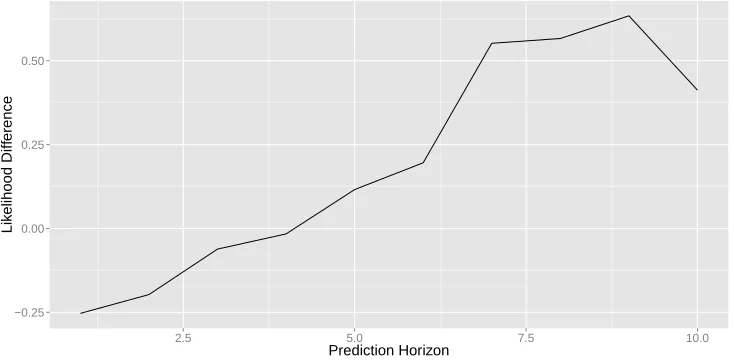
(including longer length tests did not improve performance).15 For the CPSR models, we set dT =dH, as preliminary experiments did not reveal any significant benefits to usingdT 6=dH and examined projection dimensions in the range [25,75]. Only the best performing size (determined through cross-validation) is reported. All models used 10000 train trajectories (of max length 13) and were evaluated with 10000 trajectories. The PacMan-style domains and the AMM domain were not examined in this model-quality context as naive TPSRs
14. Note that for the benchmark results presented in Nicol et al. (2013), they use knowledge of the underlying simulator state and cast the planning problem in the POMDP framework, while in this work we solve both the learning and planning problems (rather than just the planning problem).