S. Mahipal et al, International Journal of Computer Science and Mobile Applications,
Vol.1 Issue. 6, December- 2013, pg. 34-43 ISSN: 2321-8363
© 2013, IJCSMA All Rights Reserved, www.ijcsma.com 34
Density-Based Multi Feature Background
Subtraction with Support Vector Machine
S. Mahipal
1, P. Sreenivasa Moorthy
21
M.Tech. Student, CSE Department, CMR Institute of Technology, Hyderabad, A.P
Email-id: [email protected]
2
Associate Professor, CSE Department, CMR Institute of Technology, Hyderabad, A.P
Email-id: [email protected]
Abstract
Video surveillance systems have long been in use to monitor security sensitive areas. The making
of video surveillance systems “smart” requires fast, reliable and robust algorithms for moving object
detection, classification, tracking and activity analysis. Moving object detection is the basic step for
further analysis of video. It handles segmentation of moving objects from stationary background objects.
Object classification step categorizes detected objects into predefined classes such as human, vehicle,
animal, clutter, etc. It is necessary to distinguish objects from each other in order to track and analyse
their actions reliably.
S. Mahipal et al, International Journal of Computer Science and Mobile Applications,
Vol.1 Issue. 6, December- 2013, pg. 34-43 ISSN: 2321-8363
© 2013, IJCSMA All Rights Reserved, www.ijcsma.com 35
1 INTRODUCTION
The motion of background objects once the coaching amount and foreground objects
inactive during the coaching amount would be thought-about as permanent foreground objects.
Additionally the approach cannot address gradual illumination changes within the scene. These
issues cause the need that any answer should perpetually re estimate the background model.
Several adaptative background-modelling methods are planned to affect these slowly-changing
stationary signals. Milton Friedman and Russell modelled every picture element Associate in
Nursing exceedingly in a very camera scene by an adaptative constant quantity mixture model of
three Mathematic distributions. They additionally give some temporary discussion on the web
update equations supported comfortable statistics. Koller at all used a Kalman filter to trace the
changes in background illumination for each picture element. They applied a selective update
theme to incorporate solely the probable background values into the estimate of the background.
The strategies will cope well with the illumination changes but cannot handle the matter of
objects being introduced or faraway from the scene. One answer is to use a multiple-colour
background model per picture element. Grimson at all utilized Associate in Nursing adaptative
statistic mathematician mixture model to resolve these issues. Their model also can reduce the
result of little repetitive motions for instance, moving vegetation like trees and bushes
furthermore as little camera displacement. Elgammal at all used a kernel computer for every
picture element. Kernel exemplars were taken room a moving window. They additionally
introduced a technique to scale back the results of little motions by using a abstraction
coherence. This was done by examination merely connected elements to the background model
of its circular neighbourhood. Though the authors conferred variety of speed-up routines, the
approach was still of high machine quality. different techniques victimisation high level process
to help the background modelling are proposed for example, the Wallflower huntsman that
circumvents some of these issues victimisation high level process instead of endeavour the
inadequacies of the background model. Our technique relies on Grimson at all is framework, the
variations be the update equations, formatting technique and also the introduction of a shadow
S. Mahipal et al, International Journal of Computer Science and Mobile Applications,
Vol.1 Issue. 6, December- 2013, pg. 34-43 ISSN: 2321-8363
© 2013, IJCSMA All Rights Reserved, www.ijcsma.com 36
mathematician mixture model is that the Expectation Maximisation SVM algorithmic program.
The SVM algorithmic program is Associate in Nursing unvaried technique that guarantees to
converge to a local most in a very search house. Owing to the frame of reference needs in
modelling every picture element for the background image, an internet SVM algorithmic
program is needed. Several on-line SVM algorithms are introduced. They can be classified into
two teams. The primary cluster was within the realm of constant quantity estimation of
probability density functions pdfs. In different words, to use new knowledge in change the
previous estimate without modifying the structure of the previous model. The procedure was
introduced by Nowlan and explained in terms of the results by Neal and Hinton . Traven derived
Associate in Nursing N most up-to-date window version of the procedure. McKenna at all
extended the results of Traven to Associate in Nursing L most up-to-date window of the results
from L batch SVM runs and used it for chase a multi-colour foreground object. This parametric
estimation approach cannot run effectively while not a decent initial estimate normally found by
running the batch SVM algorithm. The second cluster is that of non-parametric approaches.
Priebe at all introduced Associate in nursing adaptative mixture model with random thresholding
for generating new mathematician kernels to the existing mixture model. Grimson and Stauffer,
however, applied a similar theme with deterministic thresholding. In Our Approach System
collecting foreground images and comparing that with background image. If any object is
detected means we will get an alert message to our mobile number. This comparison is
performed by using svm classifier.
2 BACKGROUND MODELING
We have a tendency to discuss the work of Grimson and Stauffer and its shortcomings.
The authors introduces a technique to model every background picture element by a combination
of K Gaussian distributions K is a small variety from three to completely different completely
different Gaussians are assumed to represent different colours. The weight parameters of the
S. Mahipal et al, International Journal of Computer Science and Mobile Applications,
Vol.1 Issue. 6, December- 2013, pg. 34-43 ISSN: 2321-8363
© 2013, IJCSMA All Rights Reserved, www.ijcsma.com 37
at all is work, the background parts are determined by presumptuous that the background
contains B highest probable colours. The probable background colours are those that keep longer
and more static. Static single-colour objects trend to make tight clusters within the colour area
whereas moving ones form widen clusters owing to totally different reflective surfaces
throughout the movement. The live of this was called the fitness worth in their papers. To permit
the model to adapt to changes in illumination and run in real-time, associate degree update theme
was applied. It is based mostly upon selective change. each new picture element worth is
checked against existing model parts so as of fitness. the primary matched model part are going
to be updated. If it finds no match, a brand new Gaussian part are going to be additional with the
mean at that time and a large variance matrix and a little worth of weight parameter.
3 RELATED WORKS
Each classifier uses k rectangular areas (Haar features) to make decision if the region of
the image looks like the predefined image or not. Figure “Types of Haar Features” shows
different types of Haar features.
S. Mahipal et al, International Journal of Computer Science and Mobile Applications,
Vol.1 Issue. 6, December- 2013, pg. 34-43 ISSN: 2321-8363
© 2013, IJCSMA All Rights Reserved, www.ijcsma.com 38
4 SYSTEM IMPLEMENTATION
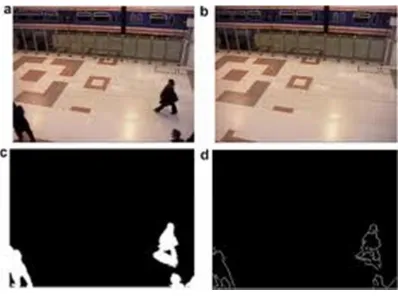
Although different, most bachelor's degree techniques share a typical denominator: they create the assumption that the discovered video sequence It is formed of a static background B a
head of that moving objects area unit discovered. With the idea that each moving object of a
colour or a colour distribution different from the one discovered in B, various bachelor's degree methods will be summarized by the subsequent formula.
Fig 2: Background Subtraction
5 FEATURE ANALYSES
We describe the characteristics of individual features and the performance of multiple feature integration. The correlation between every pair of features. RGB colours and three Harr-like
features are significantly correlated. We propose a pixel wise background modelling and
subtraction technique using k-mean clustering algorithm. Where generative and discriminative
techniques are combined for classification. The features improve background or foreground
classification performance. In pattern recognition and in image processing, feature extraction is a
special form of dimensionality reduction. When the input data to an algorithm is too large to be
processed and it is suspected to be notoriously redundant (much data, but not much information)
S. Mahipal et al, International Journal of Computer Science and Mobile Applications,
Vol.1 Issue. 6, December- 2013, pg. 34-43 ISSN: 2321-8363
© 2013, IJCSMA All Rights Reserved, www.ijcsma.com 39
features vector). Transforming the input data into the set of features is called feature extraction.
If the features extracted are carefully chosen it is expected that the features set will extract the
relevant information from the input data in order to perform the desired task using this reduced
representation instead of the full size input. Template matchingis a technique in digital image
processing for finding small parts of an image which match a template image. If the template
image has strong features, a feature-based approach may be considered; the approach may prove
further useful if the match in the search image might be transformed in some fashion. Since this
approach does not consider the entirety of the template image, it can be more computationally
efficient when working with source images of larger resolution, as the alternative approach,
template-based, may require searching potentially large amounts of points in order to determine
the best matching location.
6 CLASSIFICATIONS
After background modelling, each pixel is associated with k 1DGaussian mixtures,
where k is the number of features integrated. Background/foreground classification for a new
frame is performed using these distributions. The background probability of a feature value is
computed, and k probability values are obtained from each pixel, which are represented by a
k-dimensional vector. Such k-k-dimensional vectors are collected from annotated foreground and
background pixels, and we denote them by yj (j ¼ 1; . . .;N), where N is the number of data
points. In most density-based background subtraction algorithms, the probabilities associated
with each pixel are combined in a straight forward way, either by computing the average
probability or by voting for the classification. The objective of colour clustering is to divide a
colour set into c homogeneous colour clusters. Colour clustering is used in a variety of
applications, such as colour image segmentation and recognition. This algorithm classifies a set
of data points X into c .Homogeneous groups represented as fuzzy sets F1, F2, ..., Fc. The
objective is to obtain the fuzzy c-partition F = {F1, F2, .., Fc} for both an unlabeled data setX =
S. Mahipal et al, International Journal of Computer Science and Mobile Applications,
Vol.1 Issue. 6, December- 2013, pg. 34-43 ISSN: 2321-8363
© 2013, IJCSMA All Rights Reserved, www.ijcsma.com 40
The initial cluster centroids are selected based on the notion that dominant colours in a given
colour set are unlikely to belong to the same cluster
7 ALERTING SYSTEM
After detecting the changes in video frames, we are alerting the central control unit or
the user through SMS using the GSM Modem. A GSM modem is a wireless modem that works
with a GSM wireless network. A wireless modem behaves like a dial-up modem. The main
difference between them is that a dial-up modem sends and receives data through a fixed
telephone line while a wireless modem sends and receives data through radio waves. Typically,
an external GSM modem is connected to a computer through a serial cable or a USB cable. Like
a GSM mobile phone, a GSM modem requires a SIM card from a wireless carrier in order to
operate.
8 SVM IMPLEMENTATION Definition:
A support vector machine (SVM) is a concept in statistics and computer science for a set of related supervised learning methods that analyze data and recognize patterns, used for
classification and regression analysis. The standard SVM takes a set of input data and predicts,
for each given input, which of two possible classes comprises the input, making the SVM a
non-probabilistic binary linear classifier. Given a set of training examples, each marked as belonging
to one of two categories, an SVM training algorithm builds a model that assigns new examples
into one category or the other. An SVM model is a representation of the examples as points in
space, mapped so that the examples of the separate categories are divided by a clear gap that is as
wide as possible. New examples are then mapped into that same space and predicted to belong to
S. Mahipal et al, International Journal of Computer Science and Mobile Applications,
Vol.1 Issue. 6, December- 2013, pg. 34-43 ISSN: 2321-8363
© 2013, IJCSMA All Rights Reserved, www.ijcsma.com 41
Description:
More formally, a support vector machine constructs a hyper plane or set of hyper planes in a high- or infinite- dimensional space, which can be used for classification, regression, or
other tasks. Intuitively, a good separation is achieved by the hyper plane that has the largest
distance to the nearest training data points of any class (so-called functional margin), since in
general the larger the margin the lower the generalization error of the classifier.
Whereas the original problem may be stated in a finite dimensional space, it often
happens that the sets to discriminate are not linearly separable in that space. For this reason, it
was proposed that the original finite-dimensional space be mapped into a much
higher-dimensional space, presumably making the separation easier in that space. To keep the
computational load reasonable, the mapping used by SVM schemes are designed to ensure that
dot products may be computed easily in terms of the variables in the original space, by defining
them in terms of a kernel function K(x,y) selected to suit the problem.[1] The hyper planes in the higher dimensional space are defined as the set of points whose inner product with a vector in
that space is constant. The vectors defining the hyper planes can be chosen to be linear
combinations with parameters αi of images of feature vectors that occur in the data base. With
this choice of a hyper plane, the points x in the feature space that are mapped into the hyper
plane are defined by the relation:
Note that if K(x,y) becomes small as y grows further from x, each element in the sum
measures the degree of closeness of the test point x to the corresponding data base point xi. In
this way, the sum of kernels above can be used to measure the relative nearness of each test point
S. Mahipal et al, International Journal of Computer Science and Mobile Applications,
Vol.1 Issue. 6, December- 2013, pg. 34-43 ISSN: 2321-8363
© 2013, IJCSMA All Rights Reserved, www.ijcsma.com 42
the set of points x mapped into any hyper plane can be quite convoluted as a result allowing
much more complex discrimination between sets which are not convex at all in the original
space.
H3 (green) doesn't separate the two classes. H1 (blue) does, with a small margin and H2 (red)
with the maximum margin. Classifying data is a common task in machine learning. Suppose
some given data points each belong to one of two classes, and the goal is to decide which class a
new data point will be in. In the case of support vector machines, a data point is viewed as a
p-dimensional vector (a list of p numbers), and we want to know whether we can separate such
points with a (p − 1)-dimensional hyper plane. This is called a linear classifier. There are many
hyper planes that might classify the data. One reasonable choice as the best hyper plane is the
one that represents the largest separation, or margin, between the two classes. So we choose the
hyper plane so that the distance from it to the nearest data point on each side is maximized. If
such a hyper plane exists, it is known as the maximum-margin hyper plane and the linear
classifier it defines is known as a maximum margin classifier; or equivalently, the perceptron of
optimal stability.
9 CONCLUSIONS
In this application we are performing background subtraction by using SVM classifier.
This application is used in security places where it is needed. It is less expensive. In this
application we are using GSM modem to get the alert message when any object is found.
S. Mahipal et al, International Journal of Computer Science and Mobile Applications,
Vol.1 Issue. 6, December- 2013, pg. 34-43 ISSN: 2321-8363
© 2013, IJCSMA All Rights Reserved, www.ijcsma.com 43
REFERENCES
[1] C. Stauffer and W.E.L. Grimson, “Learning Patterns of Activity Using Real-Time Tracking,”
IEEE Trans. Pattern Analysis and Machine Intelligence, vol. 22, no. 8, pp. 747-757, Aug. 2000.
[2] B. Han, D. Comaniciu, and L. Davis, “Sequential Kernel Density Approximation through
Mode Propagation: Applications to Background Modeling,” Proc. Asian Conf. Computer Vision,
2004.
[3] D.S. Lee, “Effective Gaussian Mixture Learning for Video Background Subtraction,” IEEE
Trans. Pattern Analysis and Machine Intelligence, vol. 27, no. 5, pp. 827-832, May 2005.
[4] Z. Zivkovic and F. van der Heijden, “Efficient Adaptive Density Estimation Per Image Pixel
for Task of Background Subtraction,” Pattern Recognition Letters, vol. 27, no. 7, pp. 773-780,
2006.
[5] P. Viola and M. Jones, “Rapid Object Detection Using a Boosted Cascade of Simple
Features,” Proc. IEEE Conf. Computer Vision and Pattern Recognition, pp. 511-518, 2001.
[6] B. Han, D. Comaniciu, Y. Zhu, and L.S. Davis, “Sequential Kernel Density Approximation
and Its Application to Real-Time Visual Tracking,” IEEE Trans. Pattern Analysis and Machine
Intelligence, vol. 30, no. 7, pp. 1186-1197,July 2008.
AUTHORS’ BIOGRAPHY
S. Mahpal had B.Tech from Sree Chaitanya College of Engineering Karimnagar. He is an M.Tech. Student in CSE Department of CMR Institute of Technology, Hyderabad. He is currently working for his M.Tech. research project work under the guidance of Mr.P.S.Murthy. His areas of interest include Network Security, Computer Networks, and Programming languages.