ENGINNEERING AND GINNING
The Effect of Modest Moisture Addition to Seed Cotton
before the Gin Stand on Fiber Length
Richard K. Byler
R. Byler, P.O. Box 256, Stoneville, MS 38776 [email protected]
ABSTRACT
The objective of this study was to add a modest amount of moisture to seed cotton during ginning and determine the impact on fiber properties measured by the Advanced Fiber Information System (AFIS). In this study, half of the bales were ginned with modest drying and half had humid air applied in what would normally be the second tower drier. As determined by the oven method, the moisture content (wet basis) of the lint treated with drying averaged 4.8%, and the lint with moisture restoration averaged 5.6%. The AFIS fiber length properties were significantly better for the lint with moisture restoration before ginning. Most of the AFIS foreign matter measurements were slightly higher (less desirable) for the lint following moisture restoration. A measurement to indicate fiber damage was sought. The various AFIS fiber length measurements were highly correlated with each other, and the fiber length averaged by weight was considered to be the basic length measurement. This analysis showed that the length exceeded by 2.5% of the longest fibers calculated by number responded significantly to the treatment indepen-dently of the basic fiber length and could be used to indicate in-gin fiber damage. Based on AFIS, the fiber length after the lint cleaners increased 0.5 mm per 1.0% increase in fiber moisture content due to moisture addition.
T
he moisture content of fiber from upland cotton (Gossypium hirsutum L.) affects many of its physical properties and its response to processing in the gin. The moisture content of cotton fiber changes because of its exposure to moisture levels in the air. Excessive moisture content of cotton in the gin has been a problem, especially in the more humid areas of the USA. The first successful mechanical seed cotton driers were introduced in the late 1920s(Gerdes et al., 1941). By 1951, 81% of the gins were equipped with driers (Griffin and Merkel, 1953).
The driers helped solve the problem with high moisture content seed cotton that plagued farmers in some years, especially in the Mississippi River Valley. Artificial drying of seed cotton resulted in smoother gin operation and facilitated removal of foreign matter. The resulting ginned lint also had a “smoother” look and had less grade penalty due to rough preparation (Griffin and Merkel, 1953). If the lint was dried below 5%, the cotton grade was not improved further, but the upper half mean length and the resulting yarn strength was decreased. Nearly 80% of the ginned lint from the Mississippi Delta in 1952 had moisture content below 6% and about 45% had moisture content below 5% (Griffin and Merkel, 1953). Moisture was added before seed cotton cleaning and at the lint slide after ginning and cleaning, and fiber length and yarn strength were measured by the Fibrograph and Suter-Webb. The data showed the advantage to using moisture restoration before ginning. This data supported adding moisture to seed cotton to maintain fiber length when the moisture content was below 5%. Adding moisture after ginning did not help maintain fiber length or yarn strength.
Moore and Griffin (1964) presented data show-ing that sshow-ingle fiber breakshow-ing force increased with in-creased moisture content in the range 3 to 15%, while fiber-seed attachment forces remained constant from 3 to 11% and then decreased up to 15% moisture content. These data explained why ginning at higher moisture content improved fiber length. Staple length was not affected by the moisture content changes, but upper quartile length and short fiber measurements were affected. The yarn break factor and single strand strength were adversely affected by ginning at low moisture content. A moisture restoration test that used humid air or water spray before ginning was described, and the data collected supported the idea of restoring moisture by either method, but no statistical interpretation was offered.
146
some treatments, and measured the fiber length with the Suter-Webb array and the Fibrograph. No statisti-cal difference in staple length was recorded, but most of the other fiber length properties were significantly different among the treatments. The higher moisture content cottons tended to have higher trash content and resulted in significantly higher fiber strength. Data were also presented linking lower moisture content fiber at ginning to lower yarn strength. When moisture was added to the seed cotton after drying and pre-cleaning, the fiber and yarn properties improved. For example, one drying treatment in 1962 resulted in fiber moisture content of 2.7% and Fibrograph up-per half mean length of 26.7 mm (1.05 in). The same drying followed by moisture restoration with a spray resulted in fiber moisture content of 8.1% and upper half mean length of 27.7 mm (1.09 in).
Leonard et al. (1970) applied several moisture treatments, including moisture restoration by vapor and water spray before ginning. The vapor phase mois-ture restoration treatment was done in the extractor-feeder and normal seed cotton flow was maintained. The spray method involved spraying liquid water onto the seed cotton after seed cotton cleaning and storing the cotton for about 30 min before ginning. Fiber moisture contents entering the first lint cleaner were in the range 2.4 to 8.8% and were significantly different among moisture treatments. Improved fiber length, as measured by the Suter-Webb and Fibrograph, were correlated with higher moisture content. The Suter-Webb array upper quartile length varied from 29.0 to 30.0 mm (1.14 to 1.18 in). The method of moisture addition did not affect the results. They also included data from spinning, which showed significantly higher break factor for seed cotton ginned at higher moisture content, which was achieved by less drying or by moisture restoration before the gin stand.
Childers and Baker (1977) used five moisture treatments involving drying and moisture restoration before the gin stand on stripper-harvested cotton that arrived at the gin with moisture content suit-able for ginning. The treatments with no moisture restoration had lint moisture contents of 3 to 5%, and the treatments with moisture restoration had a lint moisture content of 5 to 6%. The treatments did not result in significantly different staple length or mean fiber length. There were significant differences in the yarn average break factor with lower fiber moisture content that corresponded to lower break factor. They concluded that “moisture restoration before ginning tended to offset most of the
harm-ful effects of drying on fiber quality” (Childers and Baker, 1977, p. 383).
Mangialardi and Griffin (1977) reviewed weather patterns for the months of September and October for the humid Midsouth. They concluded that in order to preserve fiber length, moisture restoration was needed ahead of the gin stand between 1000 and 1900 h (10:00 AM and 7:00 PM) when cotton lint contained less than 6.5% moisture content during normal weather. The need for moisture addition was particularly acute late in the season when it was not unusual for the relative humidity to reach 20%. They ginned eight replications each consisting of a control with no moisture restoration and an experimental with moisture restoration by water spray. The aver-age moisture content was 5.5% for the control and 7.1% for the experimental with moisture restoration. For the lint with moisture restoration, the 2.5% span length was significantly improved from 28.3 mm (1.11 in) for the control to 28.7 mm (1.13 in), and the 50% span length was improved from 13.3 to 13.6 mm (0.52 to 0.54 in).
Anthony and Griffin (2001) presented data from a test performed in a gin using drying temperatures in the range 20 °C to 250 °C (68 °F to 171 °F) with batch moisture restoration using four relative humid-ity levels. The fiber length was measured with the Digital Fibrograph with 6 samples per treatment. Moisture restoration before ginning with higher relative humidity resulted in better fiber length. They reported a slope of 0.11 mm (0.0043 in) per 1.0% moisture content for the relationship between fiber span length (both the 2.5 and 50% span lengths) and fiber moisture content.
Byler (2003) reported on a study in which 15 bales were ginned with three moisture treatments of seed cotton before the gin stand. The AFIS fiber length-related properties were significantly improved with moisture restoration before the gin stand. Mean fiber length increased 0.8 mm (0.03 in) per 1.0% increase in fiber moisture content.
Anthony (2004) analyzed samples obtained from 20 gins in Mississippi and Arkansas during the 2003 ginning season and found that the lint mois-ture content after the lint cleaners was in the range 3.0% to 5.8%. These data show that the problems of ginning at lower lint moisture content have not been solved.
Suter-Webb and Fibrograph length measurements and yarn strength measurements made in different studies were improved after adding moisture to the seed cotton relative to ginning at lower moisture con-tent. The price of ginned lint per kilogram increased by 0.5% as the length increased by 1.0% based on written contracts in the 2000/01 and 2001/02 crop periods (Lyford et al., 2003). The average fiber length in 2003 was 27.6 mm (34.8 thirty-seconds) (Seals, 2004) and the CCC (Commodity Credit Corporation) base loan price was $1.154 per kg ($0.5235 per lb.); therefore, an increase in length of 1% or 0.28 mm (0.01 in) would result in an average increase of $1.31 per 227 kg (500 lb) bale.
Interest exists in including an additional mea-sure of fiber length that predicts fiber-processing at the mill in official USDA Agricultural Marketing Service (AMS) classing (Bradow and Davidonis, 2000; Knowlton, 2004). Perhaps some insight into these measurements can be gained from AFIS data of controlled ginning tests. Ginning affects the fiber length, and it is important for ginning researchers to better understand this problem, especially how gins can improve the resulting fiber length, before such a measurement is adopted. Additions to the moisture content of the lint before the gin stand greater than 1.0% may be difficult to achieve under commercial ginning conditions, and moisture addition techniques which require storage of the seed cotton would dis-rupt normal ginning operations and would not likely be adopted.
The objective of this study was to examine the effects of moisture content restoration of less than 1.0% before the gin stand with commercially avail-able, continuous flow gin processing on AFIS fiber length properties.
MATERIALS AND METHODS
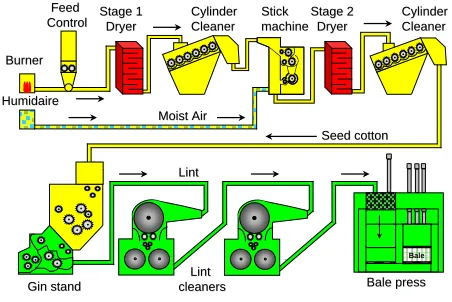
A commercially available humidaire (Samuel Jackson Inc.; Lubbock, TX), was reconfigured so that it would produce either warm dry air for drying, or warm moist air for moisture restoration. The air from the humidaire was used to pick-up the cotton after the stick machine. The cotton then went through a tower drier and was separated from the seed cotton in a cylinder cleaner (Fig. 1). Adding moisture to the seed cotton at this location would be expected to reduce the seed cotton cleaning efficiency, but the system design would not require much remodeling in most gins.
The cotton was harvested during the fall of 1999 and stored dry on trailers until ginned. Tests were run at two periods in 2000; Part I on 13 and 18 April and Part II on 27 and 28 July. Twelve bales were ginned in Part I, and 14 bales were ginned in Part II. The cotton cultivar Stoneville BXN 47 (Stoneville Pedigreed Seed Company; Memphis, TN) was ginned in Part I, and DPL 5409 (Delta and Pine Land Co.; Scott, MS) was ginned in Part II.
Tests were run on two separate days for each part with two moisture treatments each day. The treatments were applied to full bale units based on approximately 640 kg (1400 lb) of seed cotton. Each day half of the bales were ginned while con-ditioning the seed cotton in the second tower dryer with warm dry air, and the other half were ginned while conditioning the cotton in the second tower dryer with moist warm air. On one day, one bale was ginned with drying then two bales were ginned with each treatment alternatively. On the next day, one bale was ginned with moisture addition then two bales were ginned with each treatment alter-natively. This was a randomized complete block design repeated for 4 days with a pair of bales, one with drying only and the other with moisture addition, as the block. Sub-samples were collected for each bale by treatment combination. The seed cotton ginned during each day was considered to be uniform, because it had been all planted on the same day, grown on uniform soil at Stoneville, MS, harvested on the same day, and stored under similar conditions until ginned.
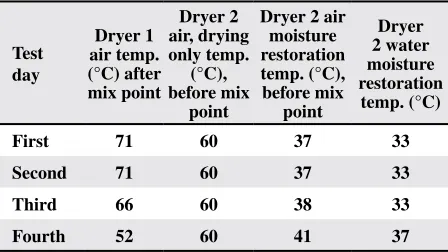
The temperature settings used for the treatments are shown in Table 1. The two treatments used either heated air or humidified, heated air in the stage two
Figure 1. Schematic of the cotton ginning system. Adapted from: Anthony, W. S. 1989. Online assessment of foreign matter in cotton during ginning. Applied Eng. in Agric. 5(3):330.
Bale
Seed cotton
Seed cotton
Burner
Burner
Feed
Feed
Control
Control
Humidaire
Humidaire
Stage 1
Stage 1
Dryer
Dryer
Cylinder
Cylinder
Cleaner
Cleaner
Stick
Stick
machine
machine
Stage 2
Stage 2
Dryer
Dryer
Cylinder
Cylinder
Cleaner
Cleaner
Moist Air
Moist Air
Lint
Lint
Gin stand
Gin stand
Lint
Lint
cleaners
148
drying system. The stage 1 drying air temperature was controlled by a temperature sensor located at the entrance of the tower dryer and kept constant each day but varied among the days. Data from the first two days were examined and lower temperatures in the first stage dryer were chosen for the third and fourth days to better simulate good drying practices in commercial gins. The humidaire had one setting for the water temperature, which was kept constant each day but varied among days to apply moisture differently. The humidaire air temperature was sensed in the duct before the mix point with the seed cotton and was kept constant during each day. It was set higher for the drying only treatment than for the moisture restoration treatment. The humidaire set-tings were lower than normally used in conditioning lint and the resulting air carried much less moisture than could be carried with higher settings, because excessive moisture addition to seed cotton may cause blockage of the ginning system.
calculated based on 5 observations per bale. This procedure resulted in 130 observations from 26 bales of the first dryer temperature, which was the same for all treatments. There were 65 observations from 13 bales of each of the other temperatures, with half of the bales receiving each humidification treat-ment. The means of the seed cotton moisture content were calculated for each treatment each day, with 5 samples per bale.
The SAS procedure MIXED was used to analyze the lint moisture data. A model was constructed to test for the main effects (treatment, day of the test, and sampling location), and two-way and three-way interactions. The random effect was the treatment by location by bale within a test day. The least squares means and the statistical significance of the mean comparisons using the LSMEANS statement of the SAS procedure MIXED of the lint moisture content were calculated for each treatment, day, and sam-pling location. For the first two days, there were 8 samples per bale for each lint sampling location and for the third and fourth days there were 5 samples per bale.
The AFIS data were analyzed using the SAS procedure MIXED. A model was constructed to test for main effects (treatment, day of the test, the bale order in the day, and sampling location), and two-way and three-two-way interactions. The random effects were the repeat samples within the bale at a location. The least squares means and significance of the dif-ferences between the means were calculated using the LSMEANS statement of the SAS procedure MIXED. The AFIS length-related data were further analyzed by adding the fiber length mean calculated by weight to the model to look at the possibility of finding a measurement that correlated with the treat-ment after the adjusttreat-ment for fiber length. After these analyses were completed the continuous variable representing the average observed moisture content for the bale measured before the lint cleaner was used in the model in place of the classification vari-able representing the treatment. The significance of each parameter in the model was noted. The means related to each parameter and the significance of the differences in the means of each of the AFIS variables was examined using the LSMEANS statement in the SAS procedure MIXED.
One sample was taken from each bale at the lint slide, resulting in 13 samples per treatment, and sent to the Dumas, AR, Agricultural Marketing Service
Table 1. Temperature settings used for the treatments
Test day
Dryer 1 air temp. (°C) after mix point
Dryer 2 air, drying only temp.
(°C), before mix
point
Dryer 2 air moisture restoration temp. (°C), before mix
point
Dryer 2 water moisture restoration
temp. (°C)
First 71 60 37 33
Second 71 60 37 33
Third 66 60 38 33
Fourth 52 60 41 37
Separate lint samples were taken between the gin stand and the lint cleaner and at the lint slide for determination of moisture content and analysis of fi-ber properties by the AFIS. The lint moisture content determined by the samples taken from between the gin stand and lint cleaner provided the best estimate of the lint moisture content at ginning. The moisture content of the samples was determined by the oven method (Shepherd, 1972), and all moisture content data in this study were calculated as described by the ASTM (2001). The ambient temperature, relative humidity, drying air, and humidaire temperatures were recorded for each bale ginned.
(AMS) classing office for hVI measurements. The same number of samples by treatment per day and per cultivar were in the data set. The same analysis using the procedure MIXED that was performed for the AFIS data was used for these data, except there was no factor for sampling location.
RESULTS
The mean air temperature, relative humidity, and test date of the four days of the test are shown in Table 2. The third and fourth days represented different ambient temperatures than the first two days, and the relative humidity on the first day was different than on the second day. Ginning used air for trans-portation of the material, and the lint was exposed to considerable ambient air in the gin stand and in the lint cleaners. These conditions were expected to affect the moisture content of the fiber.
The overall mean moisture content was 4.9% for the lint with no moisture added and 5.6% for lint with moisture restoration. The difference was significant (P < 0.0001). The moisture content for each day between treatments was significantly different. The lint moisture content with no moisture restoration was lower on day three than on day one, but lint moisture content was not significantly different for any other combinations of days. The lint moisture content with moisture restoration for the first day was not significantly different from day two, but it was higher than the days three and four. The lint moisture content with moisture restoration was not different among the second, third, and fourth days.
Table 2. Date, air temperature, and relative humidity for the four test days
Test
day Date temperature (°C)Air humidity (%)Relative
First 13 April 16 77
Second 18 April 17 62
Third 27 July 25 62
Fourth 28 July 27 56
The mean temperatures in the ginning system taken during the operation of the tests for each day of the test and treatment are shown in Table 3. The stage one temperature averages were within 1 °C of the set point. The stage two average air temperatures were within 1 °C of the set point and the average water temperature was the same as the set point. The means of the seed cotton moisture content for the samples taken from the feed control before dry-ing and moisture restoration are shown in Table 4. The standard deviation of the seed cotton moisture content means was 0.4, so the differences in the moisture content between treatments for a given day were not significant.
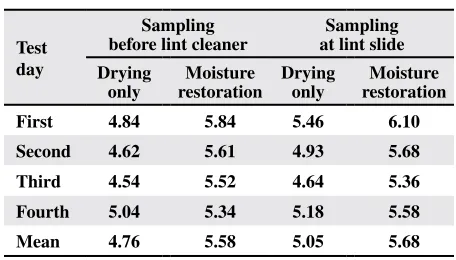
The means of the lint moisture content data for sampling location and treatment for each day are shown in Table 5. On the fourth day, less moisture was added to the fiber than on previous days. The data from samples taken before the first lint cleaner are the best available data on the moisture content of the fiber in the gin stand, and the samples from the lint slide represent the lint in the bale.
Table 3. Mean temperatures of the treatments for each day of the test
Test day
Dryer 1 air temp. (°C), after
mix point
Dryer 2 air, drying only temp.
(°C), after mix
point
Dryer 2 air, moisture restoration temp. (°C), before mix
point
Dryer 2 water, moisture restoration
temp. (°C)
First 71 61 37 33
Second 71 61 37 33
Third 65 61 38 33
Fourth 52 60 41 37
Table 4. Seed cotton moisture contents (%) determined by the oven method as it entered the gin for both treatments on each day of the test
Test day Drying only Moisture restoration
First 9.6 9.2
Second 10.0 9.7
Third 8.3 8.3
Fourth 8.1 8.5
Table 5. Lint moisture content (%) determined by the oven method for each sampling location and moisture treatment for each day of the testz
Test day
Sampling
before lint cleaner at lint slideSampling Drying
only restorationMoisture Drying only restorationMoisture First 4.84 5.84 5.46 6.10 Second 4.62 5.61 4.93 5.68 Third 4.54 5.52 4.64 5.36 Fourth 5.04 5.34 5.18 5.58 Mean 4.76 5.58 5.05 5.68
z Differences between treatments within a test day and
150
The change of lint moisture content from before the lint cleaner to after the lint cleaner could be affected by exposure to the ambient air in the lint cleaners. The lint moisture content mean increased by 0.1% between the sampling locations with mois-ture restoration, but that was the only difference in mean moisture content by treatment and by location that was not significant. For the lint with no moisture restoration, the average lint moisture content in-creased by 0.8% across the lint cleaner. The moisture restoration increased lint moisture content by 0.8% over the drying only treatment before the lint clean-ers, but the difference was reduced to 0.6% after the lint cleaners, which was likely due to natural drying during pneumatic conveying.
There were 316 observations for each of the AFIS variables. These were each modeled by the two treatments, two sampling locations, four days, and the bale order per day. Because the cultivar was uniform each day and the effects of cultivar were not of interest, the day of the test included differences in cotton cultivar and other differences associated with the day of the test, including possible weather and dryer setting effects. In general, all of the fixed effects but few of the interactions were significant. In some cases, the treatment was not significant.
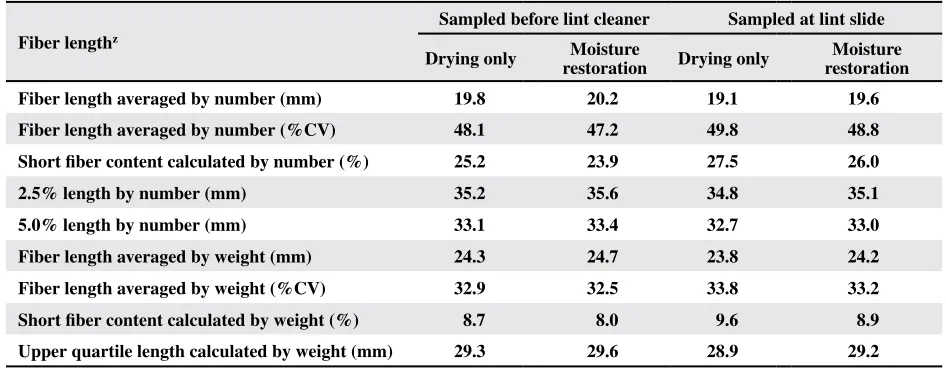
The means of the fiber length-related AFIS data are shown in Table 6. The location from which the samples were taken, i.e. before the lint cleaners or after them, was significant (P < 0.0001) for all AFIS fiber length data. The lint cleaners significantly re-duced the fiber length, as measured by the AFIS. All AFIS length factors were affected by the moisture
treatments (P < 0.05). The data for the moisture treatments were similar at the two sampling loca-tions. The sampling location by treatment interac-tion was not significant for any of the factors, so the conclusion that the lint cleaners caused fiber damage disproportionate to the treatment effect was not sup-ported by the data.
On the first three days, the difference in lint moisture content before the lint cleaners and at the lint slide was about 1.0%, but on the fourth day the difference was only about 0.3%. The fiber length-related data from the fourth day were examined to see if smaller moisture addition resulted in improved AFIS fiber properties. The treatment effect was sig-nificant (P < 0.05) for all of the length-related AFIS measurements, except for the coefficient of variation of length mean by weight. Moisture treatment had its most significant effect on fiber length averaged by number or by weight. The magnitude of the im-provement in length was smaller with the addition of less moisture. These data show that even for small moisture additions the fiber length was improved, which means that gin operators could obtain some benefit from this approach even if large amounts of moisture cannot be added.
Moisture restoration significantly improved every fiber length measurement at both locations. Fiber length mean by weight (P < 0.0001) and the fiber length mean by number (P < 0.0001) were most affected by treatment. The AFIS factors which varied the least due to treatment were the coef-ficient of variation of the fiber length averaged by weight or number (P = 0.0002) and the short fiber
Table 6. Means of fiber length-related AFIS data for each sampling location and treatment
Fiber lengthz
Sampled before lint cleaner Sampled at lint slide
Drying only restorationMoisture Drying only restorationMoisture
Fiber length averaged by number (mm) 19.8 20.2 19.1 19.6 Fiber length averaged by number (%CV) 48.1 47.2 49.8 48.8 Short fiber content calculated by number (%) 25.2 23.9 27.5 26.0
2.5% length by number (mm) 35.2 35.6 34.8 35.1
5.0% length by number (mm) 33.1 33.4 32.7 33.0
Fiber length averaged by weight (mm) 24.3 24.7 23.8 24.2 Fiber length averaged by weight (%CV) 32.9 32.5 33.8 33.2 Short fiber content calculated by weight (%) 8.7 8.0 9.6 8.9 Upper quartile length calculated by weight (mm) 29.3 29.6 28.9 29.2
z Means between treatments within a sampling location were significantly different at P≤ 0.01, except for fiber length
content measurements based on weight or number (P = 0.0003). For this data set, trying to detect post-harvest reductions in fiber length by measuring the coefficient of variation of fiber length calculated by either basis or by measuring the short fiber content would be less sensitive than measurements of the average fiber length.
If one length measurement could be used for fiber length, a second independent measurement might be used to detect fiber length degradation. For a measurement to provide useful information, it must measure something not already known. A model was constructed for the procedure MIXED with the length averaged by weight as a fixed ef-fect in the model along with the other fixed efef-fects identified previously. All of the fiber length-related AFIS measurements were correlated. The factor which provided the most significant response to the treatment was the length of the 2.5% longest fibers calculated by number (P = 0.002). The short fiber content calculated by weight was also significant (P
= 0.03). The coefficient of variation of fiber length calculated by weight (P = 0.11) and the short fiber content calculated by number (P = 0.5) were not significant. When studying the effects of carding, Krifa (2004) found that AFIS short fiber measure-ments did not indicate fiber length degradation, and he supported a new parametric model for cotton fiber length distribution.
These data suggest that if an AFIS length-related measurement were to be added to the fiber length measurements to detect post-harvest fiber length reduction, then a measure of the longest fibers would be more sensitive than a measurement of short fibers or fiber length uniformity. This conclusion has impli-cations for process control for gin managers who are concerned with detecting and reducing post-harvest fiber length degradation, as well as in valuing cot-ton samples.
The AFIS data relating to trash are shown in Table 7. The moisture restoration was performed before the second cylinder cleaner and before the extractor-feeder on the gin stand. Seed cotton clean-ing is less efficient at higher moisture content, so it was not surprising that restoring moisture resulted in significantly more trash in the lint. The lint cleaners reduced the overall trash level. The significant dif-ference in visible foreign matter for the samples at the lint slide could affect the AMS trash classifica-tion, depending on how close the reading was to the
classer’s leaf boundary. This problem would not be expected, except in rare cases, because the difference was so small.
Table 7. Means of trash-related AFIS data for each sampling location and treatment
Trash data
Sampled
before lint cleanerz at lint slideSampled z
Drying
only restorationMoisture Drying only restorationMoisture Total trash
count (per g) 700 780 ** 350 410 ** Trash mean
size (μm) 327 324 ns 450 352 ns Dust count
(per g) 580 650 ** 290 335 ** Trash count
(per g) 117 128 * 62 74 ** Visible foreign
matter (%) 2.25 2.47 * 1.26 1.45 *
z ns, *, and ** indicate means between treatments within
a sampling location are not significantly different (P > 0.05), and significantly different at P≤ 0.05 and P≤ 0.01, respectively.
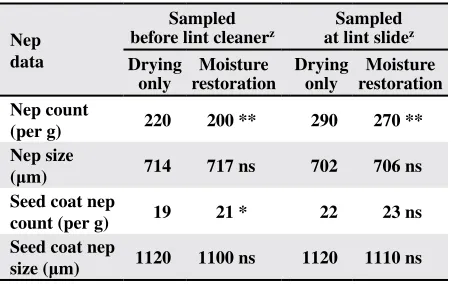
Table 8. Means of nep-related AFIS data for each sampling location and treatment
Nep data
Sampled
before lint cleanerz at lint slideSampled z
Drying
only restorationMoisture Drying only restorationMoisture Nep count
(per g) 220 200 ** 290 270 ** Nep size
(μm) 714 717 ns 702 706 ns Seed coat nep
count (per g) 19 21 * 22 23 ns Seed coat nep
size (μm) 1120 1100 ns 1120 1110 ns
z ns, *, and ** indicate means between treatments within
a sampling location are not significantly different (P > 0.05), and significantly different at P≤ 0.05 and P≤ 0.01, respectively.
The results from analysis of the nep-related AFIS data are shown in Table 8. The differences in nep count (P < 0.0001) and the seed coat nep count (P = 0.02) between treatments before the lint cleaners were statistically significant; however, the magnitudes of the differences were small. The nep count was reduced and the seed coat nep count was higher (worse) after moisture restoration.
152
restoration and the percentage of immature fibers was reduced. These differences, although statistically sig-nificant, were so small they were not considered to be important and probably resulted in slight uncontrolled differences in the seed cotton. The samples had all been uniformly conditioned with constant relative hu-midity and temperature before testing with the AFIS, and no differences were expected due to differences in fiber moisture content during testing.
Table 9. Means of fiber thickness-related AFIS data for each sampling location and treatment
Fiber thickness data
Sampled
before lint cleanerz at lint slideSampled z
Drying
only restorationMoisture Drying only restorationMoisture Maturity ratio 0.922 0.929 ** 0.915 0.920 ** Immature fiber
content (%) 5.1 4.9 ** 5.2 5.1 * Fineness
(mTex) 181 182 * 181 181 ns
z ns, *, and ** indicate means between treatments within
a sampling location are not significantly different (P > 0.05), and significantly different at P≤ 0.05 and P≤ 0.01, respectively.
The treatment was removed from the model and the measured lint moisture content before the lint cleaner was added to a model for the fiber length-re-lated AFIS measurements. The coefficients of mois-ture content for the fiber-related AFIS measurements are shown in Table 10. These slopes show significant differences in the AFIS measurements related to lint moisture content even with the average difference in moisture content of only 0.8%. The moisture content by sampling location interaction was significant, and the slopes of the fiber length measurements were significantly lower before the lint cleaners than after. The slope of the fiber length measurements after the lint cleaners was about 0.5 mm per 1.0% of moisture content added, including the fiber length averaged by number and weight, the length exceeded by 2.5% and 5% of the fibers by number, and the upper quartile length calculated by weight. This slope was greater than the slope of 0.11 mm (0.0043 in.) per 1.0% moisture content for both the 2.5 and 50% fiber span lengths documented by Anthony and Griffin (2001). Their measurements were made with the Digital Fi-brograph, not the AFIS used in this study. Based on the length-pricing model of Lyford et al. (2003) for lint priced at $1.10 per kg ($0.50 per pound), the price per bale would increase $2.50 for each 1.0% increase in moisture content due to greater fiber length.
Table 10. Estimated slope of fiber length-related AFIS data correlated with lint moisture content (%) for each sam-pling location
Fiber propertyz Sampled
before lint cleaner at lint slideSampled Fiber length averaged
by number (mm) 0.41 0.71 Fiber length averaged
by number (%CV) -0.85 -1.62 Short fiber content
cal-culated by number (%) -1.27 -2.28 2.5% length by number
(mm) 0.40 0.48
5.0% length by number
(mm) 0.35 0.43
Fiber length averaged
by weight (mm) 0.35 0.58 Fiber length averaged
by weight (%CV) -0.41 -1.11 Short fiber content
cal-culated by weight (%) -0.61 -1.10 Upper quartile length
calculated by weight
(mm) 0.27 0.45
z All slopes within a sampling location were significantly
different from 0 (P≤ 0.01).
The slopes of the trash-related AFIS measure-ments relative to moisture content are shown in Table 11. Most of these slopes were significantly different from zero and different between the two sampling locations. The slope of the trash mean size was not significantly different from zero and was not sig-nificantly different by sampling location. The slope of the dust count was not different between the two sampling locations.
Table 11. Estimated slope of trash-related AFIS data corre-lated moisture content (%) for each sampling location
Trash data before lint cleanerSampled z at lint slideSampled z
Total trash count (per g) 88 ** 83 ** Trash mean size (μm) -2 ns 2 ns Dust count (per g) 74 ** 64 ** Trash count (per g) 13 ** 19 ** Visible foreign matter (%) 0.22 ** 0.27 **
z ns, *, and ** indicate slopes within a sampling location
are not different (P > 0.05), and significantly different at
P≤ 0.05 and P≤ 0.01, respectively.
the test was appropriate because of probable differ-ences from cotton cultivars, in addition to possible differences in weather and drying system settings. The treatment by day interaction was significant (P
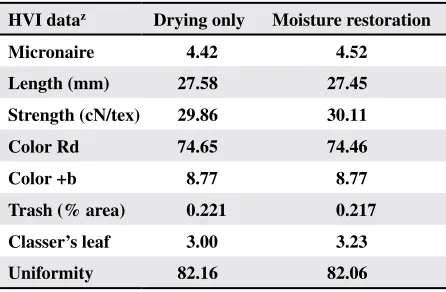
= 0.02) for uniformity but not for any of the other variables. On two days, there was no significant difference in the uniformity between treatments, for one day the uniformity was lower (P = 0.04) and for one day the uniformity was higher (P = 0.02) with moisture addition. This interaction did not appear to be important. Moisture treatment significantly improved the AFIS fiber length properties, such as length exceeded by 2.5% longest fibers by number and length by number and weight, but the difference was not detectable with a single hVI measurement of length per bale made at the AMS classing office.
The increase in fiber length after the lint cleaners of 0.5 mm (0.02 in.) per 1.0% of moisture content increase was projected to result in $2.50 increase in average bale value.
All of the AFIS fiber length measurements were highly correlated. When fiber length mean by weight was considered to be a fixed effect, the AFIS length measurements that best correlated with the moisture content treatment were the length exceeded by the 2.5% longest fibers calculated by number. AFIS short fiber content measurements and measurements of fiber length coefficients of variation provided less additional information about the treatment than that provided by the mean fiber length. Based on these data, the AFIS measurement of long fibers and the average fiber length would provide an indication of fiber length degradation for ginning process control.
DISCLAIMER
Mention of a trademark, warranty, proprietary product or vendor is solely for the purpose of provid-ing specific information and does not imply recom-mendation or endorsement by the U. S. Department of Agriculture.
REFERENCES
American Society for Testing and Materials (ASTM). 2001. Standard test method for moisture in cotton by oven-dry-ing (D-2495-01). In 07.01 ASTM Standards on Disk, Textiles. ASTM, West Conshohocken, PA.
Anthony, W. S. 1989. Online assessment of foreign matter in cotton during ginning. Applied Eng. Agric. 5(3):329-333. Anthony, W. S. 2004. Survey of bale moistures at midsouth
gins in 2003. Cotton Gin Oil Mill Press 105(15):8-11. Anthony, W. S. and A. C. Griffin. 2001. Fiber breakage at
gins: moisture and heat. Cotton Gin Oil Mill Press 102(24):6-9.
Bradow, J. M., and G. h. Davidonis. 2000. Quantitation of fiber quality and the cotton production-processing inter-face: a physiologist’s perspective. J. Cotton Sci. 4:34-64 [Online]. Available at http://www.cotton.org/jour-nal/2000-04/1/34.cfm.
Byler, R.K. 2003. Moisture restoration for seed cotton, two approaches. p. 767-771. In Proc. Beltwide Cotton Conf., Nashville, TN. 6-10 Jan. 2003. Natl. Cotton Counc. Am., Memphis, TN.
Childers, R. E. and R. V. Baker. 1977. Effect of moisture conditioning on ginning performance and fiber quality of high plains cotton. Trans. ASAE 21(2):379-384.
Table 12. Means of HVI data of samples taken at the lint slide for each treatment
HVI dataz Drying only Moisture restoration
Micronaire 4.42 4.52
Length (mm) 27.58 27.45 Strength (cN/tex) 29.86 30.11
Color Rd 74.65 74.46
Color +b 8.77 8.77
Trash (% area) 0.221 0.217 Classer’s leaf 3.00 3.23 Uniformity 82.16 82.06
z None of the HVI means were significantly different
be-tween treatments. None of the treatment by day interac-tions were significant, except for uniformity (P = 0.02).
CONCLUSIONS
The equipment used in this study was adequate to change the conditions of the air in the second tower drier, which allowed tests of moisture conditioning rather than only drying in this portion of the gin sys-tem. The procedure produced lint with significantly different moisture content after the gin stand, so that the effects of ginning with two seed cotton moisture treatments on fiber properties could be measured.
154
Gerdes, F. L., R. A. Rusca and V. L. Stedronsky. 1941. Drying of seed cotton at gins. USDA-AMS. U.S. Gov. Print. Of-fice, Washington DC.
Griffin, A. C. Jr. and C. M. Merkel. 1953. Moisture content of seed cotton in relation to cleaning and ginning efficiency and lint quality. USDA - Production and Marketing Administration, Cotton Branch. U.S. Gov. Print. Office, Washington DC.
Knowlton, J. L. 2004. Evaluation of short fiber measurement methods. p. 2370-2377. In Proc. Beltwide Cotton Conf., San Antonio, TX. 5-9 Jan. 2004. Natl. Cotton Counc. Am., Memphis, TN.
Krifa, M. 2004. AFIS length distribution in cotton spinning preparation. p. 3072-3076. In Proc. Beltwide Cotton Conf., San Antonio, TX. 5-9 Jan. 2004. Natl. Cotton Counc. Am., Memphis, TN.
Leonard, C. G., J. E. Ross and R. A. Mullikin. 1970. Mois-ture conditioning of seed cotton in ginning as related to fiber quality and spinning performance. USDA-ARS, Marketing Research Report 859. U.S. Gov. Print. Office, Washington DC.
Lyford, C. P., S. Jung, and D. E. Etheridge. 2003. Price-quality relationships in U.S. cotton at the mill level. p. 383-387. In Proc. Beltwide Cotton Conf., Nashville, TN. 10-16 Jan. 2003. Natl. Cotton Counc. Am., Memphis, TN.
Mangialardi, G. J. and A. C. Griffin. 1977. A method for restoring moisture to cotton at gins. Trans. ASAE 20(5):980-984.
Mangialardi, G. J., A. C. Griffin, and E. h. Shanklin. 1965. Moisture restoration to cotton at the gin: effects on fiber and spinning properties. USDA-ARS, Marketing Research Report 708. U.S. Gov. Print Office, Washington DC.
Moore, V. P. and C. Griffin, Jr. 1964. The relationship of mois-ture to cotton quality preservation at gins. USDA-ARS, ARS 42-105. U.S. Gov. Print. Office, Washington DC. Seals, R. L. 2004. Quality of the 2003 crop. p. 927-928. In Proc. Beltwide Cotton Conf., San Antonio, TX. 5-9 Jan. 2004. Natl.Cotton Counc. Am., Memphis, TN.