http://www.sciencepublishinggroup.com/j/sjph doi: 10.11648/j.sjph.20180601.14
ISSN: 2328-7942 (Print); ISSN: 2328-7950 (Online)
Implementation of Treating Chronic Hepatitis C in a
Correcting Institute by a Hospital-Backup Clinic
Lian-Feng Lin
1, 2, *, Yi-Chun Chan
1, Seng Howe Nguang
11Department of Gastroenterology, Pingtung Christian Hospital, Pingtung, Taiwan 2
Department of Nursing, Meiho University, Pingtung, Taiwan
Email address:
[email protected] (Lian-Feng Lin)
*Corresponding author
To cite this article:
Lian-Feng Lin, Yi-Chun Chan, Seng Howe Nguang. Implementation of Treating Chronic Hepatitis C in a Correcting Institute by a Hospital-Backup Clinic. Science Journal of Public Health. Vol. 6, No. 1, 2018, pp. 21-25. doi: 10.11648/j.sjph.20180601.14
Received: September 5, 2017; Accepted: December 23, 2017; Published: January 15, 2018
Abstract:
Background: chronic viral hepatitis C (HCV) is endemic in the correctional facilities due to intravenous drug use (IDU). In Taiwan, the health insurance reimbursed the interferon-based dual therapy for chronic HCV in the correcting institute since Jan 2013. Therefore, this work is to investigate the feasibility and safety of a hospital-backup clinic care to treat HCV with dual therapy in a correcting facility. Pingtung Christian Hospital established regular clinics on weekdays inside this correcting facility, and offered the computer system, physicians, clinical nurses, laboratory and pharmacy. The chronic HCV infected prisoner was cared in a regular hepatitis clinic, the consultation, blood test, serology and virology test, sonogram, interferon injection were implemented in the clinics, but EPO and transfusion was not offered. Prisoners, who had the will and fitted the indication/contra-indication of interferon-based therapy, were enrolled for treatment. The therapy was guided by Taiwan health insurance guideline--- Pegasys 180 mcg/week combined ribavirin 15 mg/kg/day for 6 months if rapid viral response (RVR) achieved, and 12 months if RVR not achieved but early viral response achieved regardless of genotype. From Apr 2013 to Dec 2016, 103 voluntary prisoners, mean 39.3 ± 5.9 years old, all male and IDU, were enrolled for dual therapy. All the treatment-related events were managed inside the facility and the most common side effects of therapy is skin rash with itching in which anti-histamine medication was necessary but did not cause withdrawing. The rapid viral response rate was achieved in 70.9% of treatment inmates, 11 patients withdrew from therapy due to 4 influenza-like side effects, 1insomnia, 1 hyperthyroidism, 1 flared psoriasis, 2 early releases and 2 transferring prison. Among the 92 cases of complete treatment, 8 patients lose SVR follow-up owing to 5 transferring and 3 early releasing. SVR was achieved in 80 patients. The per-protocol and intention-to-treat SVR is 95.2% (80/84) and 82.7% (85/103) respectively. Five patients of the 7 withdrawers achieved SVR in spite of incomplete therapy due to side effect. All of the side effect could be managed in the clinic. In conclusion, this model of hospital back-up clinic to execute interferon-based therapy for chronic HCV infected inmates was feasible and it achieves excellent eradication rate. But early release and transferring prison may interfere the comprehensive treatment and post-treatment following up, the efforts to improve the coordination between correction institutes or community should be made.Keywords:
Chronic Hepatitis C, Correction Facility, Inmate, Pegylated Interferon1. Introduction
The prevalence of HCV infection is around 4.4% in Taiwan general population, and up to 58% in some hyper endemic areas in south Taiwan [1, 2].Although interferon-free oral anti-HCV agents currently replace the role of interferon-based therapy in the developed countries, but pegylated interferon combined with ribavirin (peg-riba) is still the standard
treatment for chronic hepatitis C in Asia-Pacific region because of its good response and the economic limitation. In Taiwan, the HCV eradication rate is about 76-94% among community population [3, 4, 5, 6]. Therefore, majority of known chronic HCV infected adults in community could be cured since this standard-of-care was reimbursed by the Bureau of National Health Insurance (BNHI) in 2006.
8, 9], but the treatment for HCV prisoners was not initiated before 2013 due to lack of healthcare system inside the correctional system, and lack of reimbursement. Therefore, no any data was described about the treatment for the chronic hepatitis C prisoners in Taiwan although case studies regarding treatment of the HCV-infected inmates with peg-riba in the west have concluded it is feasible and the overall eradication was around 28%-52% (18-43% for genotype 1, 50-68% for genotype 2/3) [10, 11, 12, 13]. BNHI began to cover the healthcare of the correctional systems since Jan 2013, and the hospital-backup care could enter the correctional facilities to care the HCV inmates. So, this work is to investigate the clinical outcome of peg-riba for treating the incarcerated HCV patients by a hospital-backup clinic in a correcting facility
2. Material and Methods
2.1. Materials
Pingtung Christian hospital, the largest community hospital in Pingtung county in the south of Taiwan, had been engaged in the primary health care of the Pingtung correcting institute for 20 years. Since Jan 2013 when the national health insurance reimbursed the health care of the correcting system, clinics was established during the weekdays inside this correcting institute, and computer system, physicians, clinical nurses were offered from the hospital. The blood sampling was collected in the institute and sent back to hospital laboratory, and prescribed medicine was delivered to the institute from the hospital pharmacy. The chronic HCV infected prisoner was cared in a regular hepatitis clinic which is only open on Wednesday, the consultation, blood sampling, sonogram, interferon injection were carried out in the clinics but EPO and transfusion was not offered. The administration of interferon and ribavirin, regular test of blood cell count, biochemistry, serology and HCV viral load could be easy to carry out as follow-up schedule inside the institute. Prisoners who had inadequate sentence period to check viral load 6 months after treatment, co-infection of HIV or HBV, severe comorbidity, HCC, old age >65 y/o, decompensated cirrhosis, thrombocytopenia <90000 cells/u, leukopenia <1500 cells/u, anemia <10g/dL and autoimmune disease were excluded.
2.2. Methods
All patients were informed about the side effect and treatment plan of peg-riba. The Peg-riba therapy is guided by Taiwan health insurance guideline--- pegasys 180 mcg/week combined ribavirin 15 mg/kg/day for 6 months if rapid viral response (RVR) achieved, and 12 months if RVR not achieved but early viral response (EVR) achieved regardless of genotype. The sustained viral response (SVR) is the primary outcome and the demographic data, biochemistry, genotype distribution, adverse effects, missing follow-up and withdraw rate were measured as the secondary outcomes. RVR was defined as negative HCV RNA at week 4 of therapy. EVR was defined as negative HCV RNA or at least 2 –log10 decrease in
the serum HCV RNA level from baseline at week 12 of treatment. SVR was defined as negative HCV RNA at month 6 after the end of treatment and it means successful eradication of HCV.
3. Results
3.1. Operation of the Hospital Back-up Clinic in Correctional Facility
A regular hepatitis clinic on Wednesday was set up inside the correcting facility and three experienced hepatologist were in charge of the regular care of the HCV infected prisoners after the NHI reimbursed the health care for the inmates since 2013. The HCV inmates intended to receive therapy was evaluated and informed about the treatment plan on the first visit and then started peg-riba therapy on the next visit if the biochemistry, serology, virology and sonogram examination fitted the reimbursement criteria and inclusion criteria. The treated inmates were followed every 4 weeks at the hepatitis clinic by his hepatologist who can see the abnormal data from the IT system at any time in the hospital and the inmate can seek medical care for peg-riba related side effect at the general clinic on the weekdays.
3.2. The Characteristics of Patients
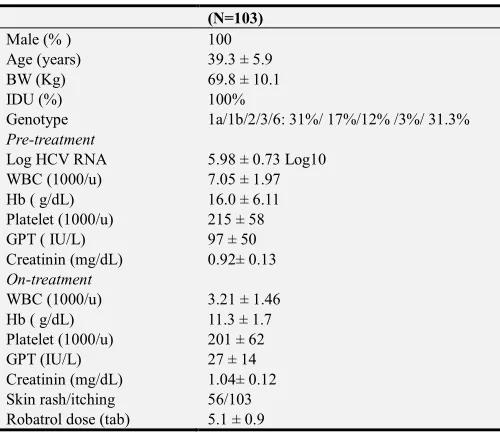
As Table 1 showed, from Apr 2013 to Dec 2016, totally 103 incarcerated HCV patients were enrolled for treatment and they were all male, mean 39.3 ± 5.9 years old, all IDU and the HCV genotyping distribution is G1a 31%, G1b 17%, G2 12%, G3 3% and G6 31.3%. The mean body weight is 69.8±10.1 Kg, HCV viral load 5.98 ± 0.73 Log10, GPT 97 ± 50 IU/L before
treatment and normalized 27.7±14.6 IU/L on treatment, WBC 7045 ±1986/u before treatment and 3215 ±1465/u on treatment, Hemoglobin 16±6.1g/dL before treatment and 11.3±1.7g/dL on treatment, Platelet 215±58 (1000/u) before treatment and 210±64 (1000/u).
Table 1. Characteristics of the incarcerated HCV patients.
(N=103)
Male (% ) 100
Age (years) 39.3 ± 5.9
BW (Kg) 69.8 ± 10.1
IDU (%) 100%
Genotype 1a/1b/2/3/6: 31%/ 17%/12% /3%/ 31.3% Pre-treatment
Log HCV RNA 5.98 ± 0.73 Log10
WBC (1000/u) 7.05 ± 1.97
Hb ( g/dL) 16.0 ± 6.11
Platelet (1000/u) 215 ± 58
GPT ( IU/L) 97 ± 50
Creatinin (mg/dL) 0.92± 0.13 On-treatment
WBC (1000/u) 3.21 ± 1.46
Hb ( g/dL) 11.3 ± 1.7
Platelet (1000/u) 201 ± 62
GPT (IU/L) 27 ± 14
(N=103)
RVR 73 (70.9%)
Withdrawal of treatment
Side effect 7 (6.8%)
transfer/release 3
Post-Treatment
Missing follow-up 8 (7.8%) SVR
Intention-to-treat 82.5% (85/103)
Per-protocol 95.2% (80/84)
3.3. Clinical Outcomes of Treatment
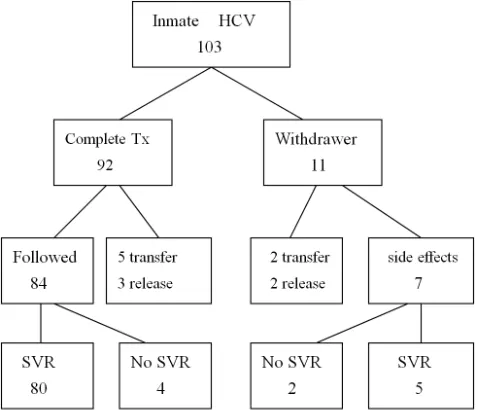
All the treatment related adverse events could be cared in the clinic, the most common subjective side effects of peg-riba therapy is skin rash with skin itching in which anti-histamine medication was necessary but did not cause withdrawing of therapy. Interferon related hematologic abnormality and ribavirin related anemia did not cause morbidity among these prisoners who presented with symptomatic palpitation and mild exertion dyspnea. Insomnia is a problem after interferon injection, the sedatives is prohibited by the prison initially and it is allowed later after negotiation with the correction institute. The rapid viral response rate was achieved in 70.9% of treatment inmates, 11 patients withdrew from therapy due to 4 influenza-like side effects, 1insomnia, 1 hyperthyroidism, 1 flared psoriasis, 2 early releases and 2 transferring prison. Among the 92 cases of complete treatment, 8 patients lose final post-treatment virology follow-up owing to 5 transferring and 3 early releasing. SVR was achieved in 80 patients and SVR was not achieved in 4 patients although among whom 3 patients have gained RVR. The per-protocol and intention-to-treat SVR is 95.2% (80/84) and 82.5% (85/103) respectively. Five patients of the 7 withdrawers still could achieve SVR in spite of incomplete therapy due to side effects. Treatment plan was interfered by 7 side effects and 12 early releasing or transferring prison, and only 84 inmates finished the treatment planning [Figure 1].
Figure 1. Flow chart of the treated HCV inmates.
4. Discussion
The HCV infection in the correcting facility is prevalent than the general population but it is rare to eradicate HCV infection because of limited budget and health care in the east countries although interferon-based dual therapy was reported safe to treat the incarcerated hepatitis C patients in the west countries. This study is the first prospective observational study in Taiwan to investigate the clinical outcome of treating chronic hepatitis C by hospital-backup clinic in the correcting facility.
In Taiwan general population, HCV 1b is the dominant genotype—around 58-73% in north Taiwan and 48-64.3% in south Taiwan [2, 14, 15, 16, 17], but in this study, different distribution of genotype 1a (31.4%), 6 (28.3%) and 1b (19.7%) were observed. Genotype 6 is rare and 1a is inferior to 1b in general prevalence, but the dominance of genotype reverses in the incarcerated HCV patients due to using of intravenous drugs. This observation is comparable with previous Taiwan study in HIV infected IDUs---the predominance of HCV genotype is 1a (29.2%), 6 (28%), and 1b (13.2%), although the patients of this study is not infected by HIV [18].
This study indicates that treating HCV infection in the incarcerated populations could reach high success rate 95.2%, even inadequate duration of therapy due to side effects in some cases, the reasonable explanation is that most of the inmates are young so that the infection period is not long and that they also can endure the side effect of peg-riba regimen. Second, during the HCV eradication therapy, the correctional environment provides better access to health service from the hospital backup, directly observed treatment and control of risk behavior such as alcoholism, drug addiction…. etc. Third, the inmate can tolerate treatment-related side effect because of less physical activity burden in the prison. So, some studies had indicated that imprisonment represents an optimal opportunity to implement control and treatment of chronic hepatitis [19, 20].
The European experience disclosed the discontinuing therapy of treating HCV inmates due to adverse effect is 13-36%.[10-13] Initially, the withdrawing rate was predicted to be not rare because of the possible personality disorder in these IDU inmates. Compared with the data of the west, this investigation reveals lower discontinuing therapy from medical cause. During the early period to start treating HCV, the intend-to-treat HCV inmates were all voluntary for therapy and these inmates have strong motivation for treatment after the treatment course and possible side effects of dual therapy informed. After the treatment started, the experience of HCV treatment spread among the inmates, so the following inmates came for treatment understood the treatment side effects, the cost and benefits. Those who worry the side effects never came to this clinic for treatment. That is why the discontinuation rate due to side effects was not higher in these incarcerated patients. As the Spanish study described, the personality disorder did not affect discontinuation and SVR for chronic HCV infection in prisoners [21].
a problem in the community experience of treating HCV infection and case management is very important to follow these patients. Given that the correctional facility provided a close environment, surveillance of adherence and follow-up of treatment outcome should not be a problem among the incarcerated inmates. However, this observation indicates the discontinuation of treatment and miss of following up due to non-medical cause was not rare in the correcting facility. Although the length of penalty was issued to ensure post-treatment follow of outcome, the interruption of treatment plan occurred 11.1% from early release or transfer prison--treatment withdrawing 3.9% (4/103) and the missing follow-up 7.8% (8/103).A study in Spanish reveals that the most common causes is early release or transferring prison (7.9% ) among the discontinuation of therapy (22.5%) in treating the HCV-infected inmate whose residual sentence is longer than 2 years. [22]The overall treatment discontinuation of our group is less frequent (11.1% vs. 22.5%), lower discontinuation due to early release or transferring prison (2.9% vs. 7.9%) but the missing follow up after complete treatment due to release/transfer is 7.8% and it is not discussed in this Spanish study. It suggests further effort should be made to improve the coordination between the prison settings and external centers to ensure treatment or following up after the inmates were released early to community or transferred to other prisons.
5. Conclusion
To treat the incarcerated chronic hepatitis C patients by a hospital-backup clinic is feasible and safe to implement and it achieved excellent success rate up to 95% because of the younger age and good adherence in the incarcerated patients. The side effects from therapy could be managed by clinics care inside the correctional facility. However, the interruption of treatment or follow-up due to early release or transferring prison is a more important issue to execute HCV treatment in the correctional facilities. Therefore, this model of hospital-backup clinic care could be extended to all the correctional institutions to eradicate HCV in the “golden period” but the coordinated cares between the correctional facilities, or between facilities and the external center is very important to eliminate the treatment discontinuation and missing of follow-up due to early release or transferring prison.
References
[1] Chen CH, Yang PM, Huang GT, Lee HS, Sung JL, Sheu JC. Estimation of seroprevalence of hepatitis B virus and hepatitis C virus in Taiwan from a large-scale survey of free hepatitis screening participants. Formosa Med Assoc 2007; 106: 148-55.
[2] Yu ML, Chuang WL, Chen SC, Dai CY, Hou C, Wang JH, et al. Changing prevalence of hepatitis C virus genotypes: molecular epidemiology and clinical implications in the hepatitis C virus hyperendemic areas and a tertiary referral center in Taiwan. J.
Med. Virol. 2001; 65: 58-65.
[3] Liu CJ, Chuang WL, Lee CM, Yu ML, Lu SN, Wu SS, et al. Peginterferon Alfa-2a plus ribavirin for the treatment of dual chronic infection with hepatitis B and C viruses. Gastroenterolology 2009; 136: 496-504.
[4] Liu CH, Liu CJ, Lin CL, CC Liang, SJ Hsu, SS Yang, et al. Pegylated interferon-alpha-2a plus ribavirin for treatment-naïve Asian patients with hepatitis C virus genotype 1 infection: a multicenter, randomized controlled trial. Clin. Infect. Dis. 2008: 47; 1260-9.
[5] Yu ML, Dai CY, Huang JF, Chiu CF, Yang YH, Hou NJ, et al. Rapid virological response and treatment duration for chronic hepatitis C genotype 1 patients: a randomized trial. Hepatology 2008; 47: 1884-93.
[6] Yu ML, Dai CY, Huang JF, Hou NJ, Lee LP, Hsieh MY, et al. A randomized study of peginterferon and ribavirin for 16 versus 24 weeks in patients with genotype 2 chronic hepatitis C. Gut 2007; 56: 553-9.
[7] Chang CJ, Lin CH, Lee CT, Chang SJ, Ko YC, Liu HW. Hepatitis C virus infection among short-term intravenous drug users in southern Taiwan. Eur J Epidemiol. 1999; 15: 597-601.
[8] Liao KF, Peng CY, Lai SW, Chang Wl, Hsu NY. Descriptive epidemiology of hepatitis C virs among male heroin abusers in Taiwan. South Med J. 2006; 99: 348-51.
[9] Sieh MH, Tsai JJ, Hsieh My, Huang CF, Yeh ML, Yang JF, et al. Hepatitis C virus infection among injection drug users with and without HIV coinfection. PLoS One. 2014; 9 (4): e94791.
[10] Chew KW, Allen SA, Taylor LE, Rich JD, Feller E. Treatment outcomes with pegylated interferon and ribavirin for male prisoners with chronic hepatitis C. J Clin Gastroenterol 2009; 43: 686-691.
[11] Strock P, Mossong J, Hawotte K, Arendt V. Access to treatment of hepatitis C in prison inmates. Dig Dis Sci 2009; 54: 1325-1330.
[12] Maru DS, Bruce RD, Basu S, Altice FL. Clinical outcomes of hepatitis C treatment in a prison setting: feasibility and effectiveness for challenging treatment populations. Clin Infect Dis 2008; 47: 952-961.
[13] Iacomi F, Iannicelli G, Franceschini A, Migliorisi P, Rosati S, Piselli P, et al. HCV infected prisoners: should they be still considered a difficult to treat population? BMC Infect Dis. 2013 Aug 14; 13: 374.
[14] Chen CH, Sheu JC, Wang JT, Huang GT, Yang PM, Lee HS, et al. Genotypes of hepatitis C virus in chronic liver disease in Taiwan. J Med Virol 1994; 44: 234-6.
[15] Kao JH, Chen PJ, Lai MY, Yang PM, Sheu JC, Wang TH, et al. Genotypes of hepatitis C virus in Taiwan and the progression of liver disease. J Clin Gastroenterol 1995; 21: 233-7.
[16] Lin HH, Kao JH, Mizokami M, SC Huang, PJ Chen, DS Chen, et al. Serotypes, genotypes and levels of hepatitis C viremia in pregnant women in Taiwan. J Formos Med Assoc 1996; 95: 429-34.
[18] Liu JY, Lin HH, Liu YC, Lee SJ, Chen YL, Hung CC, et al. Extremely high prevalence and genetic diversity of hepatitis C virus infection among HIV-infected injection drug users in Taiwan. Clin Infect Dis. 2008; 46: 1761-8.
[19] McGovern B. A golden opportunity: the treatment of hepatitis C in HIV-infected inmate. J Addit Dis 2008; 27: 69-73.
[20] Vallabhaneni S, Macalino GE, Reinert SE, Schwartzapfel B, Wolf FA, Rich JD. Prisoners favor hepatitis C testing and treatment. Epidemiol Infect 2006; 134: 243-248.
[21] Marco A, Anton JJ, Trujols J, de Juan J, Faraco I, Caylà JA, et al. Personality disorders do not affect treatment outcomes for chronic HCV infection in Spanish prisoners: the Perseo study. BMC Infect Dis. 2015; 15: 355.