Hong Yu (Correspondence)
yuhong0532 @ 126.com
+This article is published under the terms of the Creative Commons Attribution License 4.0 Author(s) retain the copyright of this article. Publication rights with Alkhaer Publications. Published at: http://www.ijsciences.com/pub/issue/2018-03/
DOI: 10.18483/ijSci.1616; Online ISSN: 2305-3925; Print ISSN: 2410-4477
Prognostic Value of Hypoxia-Inducible Factor 1α
in Solid Malignancies: A Meta-Analysis
Yuewen Qi
1
, Shuai Zhang
1,2
, Zhe Sun
1
, Xiaolu Fang
1
, Hong Yu
1
1
Department of Pathogen Biology, Qingdao University, Qingdao 266001, Shandong, China
2
Clinical Laboratory, Jinan minzu hospital, jinan250000, Shandong, China
Abstract: Numerous studies have reported the prognostic role of Hypoxia-Inducible Factor 1α(HIF-1α)and solid malignancies, but the data of different reports remains controversial. To accurately evaluate the prognostic value of HIF-1α expression in solid malignancies, a meta-analysis based on published studies was conducted. Relevant studies from 34 observational articles with 3828 patients were collected via PubMed, Embase. These studies were chosen for the meta-analysis based on requisite criteria and the quality was evaluated using the Newcastle Ottawa Quality Assessment Scale. Hazard ratios (HRs) and 95% confidence interval (CIs) were pooled from studies on overall survival (OS) and disease-free survival (DFS) to estimate the association. The pooled HRs (95% CIs) of HIF-1α for OS and DFS were 1.94 [1.74, 2.16] and 2.16 [1.71, 2.74], respectively. The overall data of the shown meta-analysis suggested that the high expression of HIF-1α is correlated with poor survival outcome in solid malignancies.
Keywords: Hypoxia-Inducible Factor 1α, Prognostic, Solid Malignancies, Meta-Analysis
Introduction
Accumulating evidence shows that hypoxia is a common trait of solid malignancies, and tumors outgrow their own vasculature scale out a certain size could lead to hypoxia. Hypoxia-inducible factor 1 (HIF-1), a heterodimer composing of hypoxia-inducible factor 1α and hypoxia-inducible factor 1β subunits, is a major transcription factor regulating the tumorigenic response to hypoxia in micro-environmental oxygenation [1, 2]. HIF-1α has been found to be up-regulated in many types of human malignancies, leading to a more aggressive phenotype with increased proliferation, invasiveness, metastases, epithelial-mesenchymal transition and stem-cell maintenance [3-5]. The expression of HIF-1α is regulated by the oxygen level, whereas the β subunit is constitutively expressed. Under hypoxic
conditions, the degradation of HIF-1α is suppressed and the expression of HIF-1α would increase [1, 6]. HIF-1α could bind to hypoxia response elements (HRE) in the promoter of target genes and activate their expressions to mediate adaptive responses to decreased oxygen concentration, such as the formation of new blood vessels via proliferation and migration of endothelial cells toward tumor developing. However, in normoxic conditions, HIF-1α would be degraded due to targeted ubiquitination and degradation by the proteasome[1, 6].
Prognostic Value of Hypoxia-Inducible Factor 1α in Solid Malignancies: A Meta-Analysis
http://www.ijSciences.com
Volume 7
– March
2018 (03
)
112
carcinoma and some other malignancies. However, the results are controversial or inconclusive. This discrepancy is mostly owing to the genuine heterogeneity, relatively small sample size or different detecting methods. Therefore, we conducted this meta-analysis involving available evidences to estimate the prognostic value of HIF-1α expression in solid malignancies. We also evaluated whether the relevance between HIF-1α expression and outcome of patients is different between malignancy types, thereby it’s nceessary to comprise more clearly on the development of therapy and prognostic verification through biological target of HIF-1α in solid malignancies.
Materials and Methods
Search strategy and study selection
To get access to potentially eligible studies, we conducted an thorough electronic search for relevant studies using PubMed, Embase (up to August, 2017), the following terms were applied by “HIF-1α OR hypoxia-inducible factor-1α” (all fields) AND cancer OR neoplasm OR carcinoma OR malignancy” (all fields) AND “prognosis OR prognostic OR survival OR outcome” (all fields), and we initially identified 4237 studies for further examination. The reference lists of relevant articles were searched manually as well.
Publications were considered eligible in our quantitative meta-analysis when they met all of the following criteria: ① articles published before SEP. 2017; ② articles provided sufficient data to appraise the hazard ratio (HR) and 95% confidence intervals (CI) ; ③ a minimal follow-up duration of 3 years; ④ a minimal sample-size of 50 participants; ⑤ the diagnosis of solid malignancy was histologically and pathologically confirmed ⑥ immunohistochemistry(IHC) method was performed to detect the expression of HIF-1α. Publications were excluded based on the following criteria: ① duplicate publications; ② studies lack of usable statistical data to calculate log hazard ratio (logHR) and SE; ③ review articles or case reports; ④
non-human studies or letters; and ⑤ articles based on the Geo database[7]. Abstracts and full texts were reviewed for all searched papers, reference list were also searched for potentially eligible studies based on the above criteria. Two independent reviewers (ZS, SZ) evaluated titles and abstracts eligibility and excluded those were considered irrelevant. Disagreements were resolved by discussion.
Data extraction
The primary interest data was Overall survival (OS) ratio and disease free survival (DFS) ratio of HIF-1α in solid malignancies, including hazard ratio (HR) and 95% confidence interval (CI), or the Kaplan–Meier survival curves with log-rank p value. Additional data extracted from the studies included first author, publication year, country or region of publication, cancer type, case of patients, male/female, TNM stage, number of HIF-1α over-expression patients and controls, follow-up times, outcome endpoints, analysis model, NOS score. If a study reported both the results of univariate and multivariate analysis, only the latter was selected.
The studies enrolled in this meta-analysis were all cohort studies. Newcastle-Ottawa Scale (NOS) was applied to evaluate the quality of each included study. Scores ranged from 0 (lowest) to 9 (highest) to assess the quality of article, and studies with scores of 6 or more were regarded as high quality. A consensus NOS score for each item was achieved.
Statistical analysis
Data were extracted from the primary articles and meta-analysis was calculated with the use of RevMan5.3 software (Cochrane Collaboration,
Prognostic Value of Hypoxia-Inducible Factor 1α in Solid Malignancies: A Meta-Analysis
http://www.ijSciences.com
Volume 7
– March
2018 (03
)
113
in the study. Otherwise, calculated from available numerical data in the articles based the methods described by Tierney [8]. The data from Kaplan-Meier survival curves were read by Engauge Digitizer version 4.1, and two researchers read the curves to reduce reading variability independently.
Heterogeneity among studies was determined by Chi square-based Q test and I2 statistics. P value higher than 0.05 for the Q test and I2 value less than 50 % were considered to be of no noteworthy heterogeneity, the fixed effects model was adopted (P > 0.05, I2 < 50%); If not, the random effects model was applied. The publication bias was evaluated by funnel plot. All the statistical tests were two-sided, and P < 0.05 was considered as statistically significant publication
bias.
Results
Eligible studies
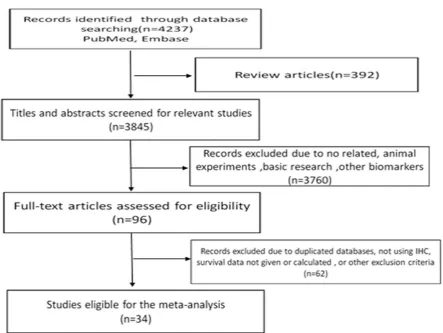
The initial search yielded 4237 references were retrieved from PubMed and Embase databases using the described searching strategy after duplicates were excluded. 392 articles were review among those literatures. After screening the titles and abstracts, 3760 studies were removed. Then 96 articles were further removed after full texts reading according to the criteria. Finally, 34 eligible articles including 3828 patients containing survival outcomes were eligible for our meta-analysis. The selection flow chart was shown in Figure 1.
Prognostic Value of Hypoxia-Inducible Factor 1α in Solid Malignancies: A Meta-Analysis
http://www.ijSciences.com
Volume 7
– March
2018 (03
)
114
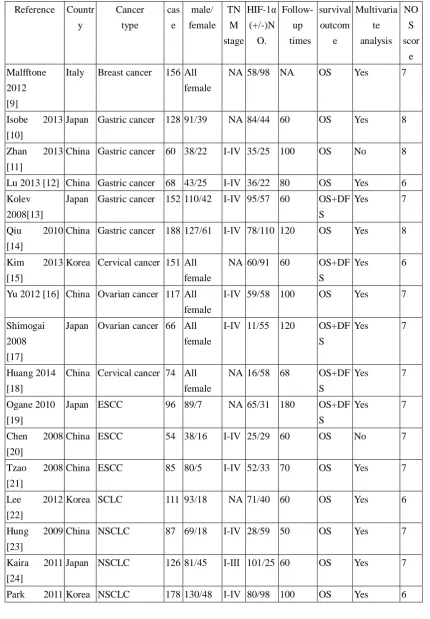
Demographic characteristics of included studiesThese enrolled studies were published from 2004 to 2015. The detailed clinical characteristics of patients and other publication information have been extracted in Table 1.
Table 1. Baseline characteristics of all enrolled studies in the meta-analysis Reference Countr
y
Cancer type
cas e
male/ female
TN M stage
HIF-1α (+/-)N
O.
Follow-up times
survival outcom
e
Multivaria te analysis
NO S scor
e Malfftone
2012 [9]
Italy Breast cancer 156 All female
NA 58/98 NA OS Yes 7
Isobe 2013 [10]
Japan Gastric cancer 128 91/39 NA 84/44 60 OS Yes 8
Zhan 2013 [11]
China Gastric cancer 60 38/22 Ⅰ-Ⅳ 35/25 100 OS No 8
Lu 2013 [12] China Gastric cancer 68 43/25 Ⅰ-Ⅳ 36/22 80 OS Yes 6 Kolev
2008[13]
Japan Gastric cancer 152 110/42 Ⅰ-Ⅳ 95/57 60 OS+DF S
Yes 7
Qiu 2010 [14]
China Gastric cancer 188 127/61 Ⅰ-Ⅳ 78/110 120 OS Yes 8
Kim 2013 [15]
Korea Cervical cancer 151 All female
NA 60/91 60 OS+DF S
Yes 6
Yu 2012 [16] China Ovarian cancer 117 All female
Ⅰ-Ⅳ 59/58 100 OS Yes 7
Shimogai 2008 [17]
Japan Ovarian cancer 66 All female
Ⅰ-Ⅳ 11/55 120 OS+DF S
Yes 7
Huang 2014 [18]
China Cervical cancer 74 All female
NA 16/58 68 OS+DF S
Yes 7
Ogane 2010 [19]
Japan ESCC 96 89/7 NA 65/31 180 OS+DF S
Yes 7
Chen 2008 [20]
China ESCC 54 38/16 Ⅰ-Ⅳ 25/29 60 OS No 7
Tzao 2008 [21]
China ESCC 85 80/5 Ⅰ-Ⅳ 52/33 70 OS Yes 7
Lee 2012 [22]
Korea SCLC 111 93/18 NA 71/40 60 OS Yes 6
Hung 2009 [23]
China NSCLC 87 69/18 Ⅰ-Ⅳ 28/59 50 OS Yes 7
Kaira 2011 [24]
Japan NSCLC 126 81/45 Ⅰ-Ⅲ 101/25 60 OS Yes 7
Prognostic Value of Hypoxia-Inducible Factor 1α in Solid Malignancies: A Meta-Analysis
http://www.ijSciences.com
Volume 7
– March
2018 (03
)
115
[25]
Zhu 2013 [26]
China Pancreatic Cancer
63 42/21 Ⅰ-Ⅳ 27/36 120 OS Yes 6
Matsuo 2014 [27]
Japan Pancreatic Cancer
100 66/34 Ⅰ-Ⅳ 55/45 200 OS Yes 7
Zhang 2010 [28]
China Pancreatic Cancer
65 40/25 Ⅰ-Ⅳ 46/19 36 OS No 7
Liu 2010 [29] China HCC 200 169/31 NA 126/74 96 OS Yes 7 Xia 2012 [30] China HCC 406 331/75 NA 30/39 84 OS No 8 Xiang
2012[31]
China HCC 69 61/8 NA 30/39 84 OS Yes 7
Dai 2009 [32] China HCC 110 95/15 NA 39/71 72 OS+DF S
No 7
Zhao 2015 [33]
China Osteosarcoma 88 69/19 NA 50/38 107 OS Yes 7
Hu 2015 [34] China Osteosarcoma 50 NA NA 29/21 36 DFS No 6 Kim 2015
[35]
Korea Soft tissue Sarcoma
55 29/26 Ⅰ-Ⅳ 30/25 180 OS+DF S
Yes 7
Cao 2009 [36]
China Colorectal Cancer
71 43/28 Ⅰ-Ⅳ 39/32 60 OS Yes 8
Yoshimura 2004 [37]
Japan Colorectal Cancer
87 51/36 Ⅰ-Ⅳ 39/48 120 OS Yes 7
Xie 2013[38] China Colorectal Cancer
60 40/20 Ⅰ-Ⅳ 30/30 120 OS Yes 7
Hong 2012 [39]
Austra lia
Oropharyngeal Cancer
233 186/47 Ⅰ-Ⅳ 137/96 NA OS Yes 6
Eckert 2011 [40]
Germa ny
Oral squamous cell carcinoma
82 62/20 Ⅰ-Ⅳ 47/35 60 OS Yes 6
Sun 2012 [41]
China Gallbladder Carcinoma
72 27/44 NA 23/48 60 OS Yes 8
Zheng 2013 [42]
China Tongue Carcinoma
120 66/54 Ⅰ-Ⅳ 75/55 60 OS+DF S
Yes 7
Abbreviations: ESCC=esophageal squamous cell carcinoma; NSCLC=non-small cell lung cancer; SCLC=Small Cell lung Cancer; HCC=hepatocellular carcinoma; NA=not available; OS=overall survival; DFS=disease-free survival; NOS=Newcastle-Ottawa Scale.
Survival outcomes
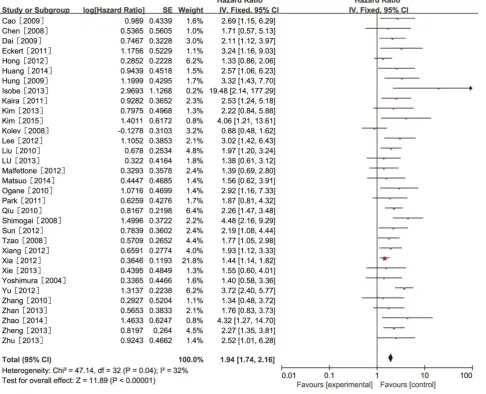
Thirty-three studies, including 3778 patients, provided eligible data for OS analysis. Figure 2 showed that the pooled HR (95% CI) of these studies for OS was 1.94 [1.74, 2.16] (P < 0.00001; I² = 32%). In the stratified analysis of malignancy type, high
Prognostic Value of Hypoxia-Inducible Factor 1α in Solid Malignancies: A Meta-Analysis
http://www.ijSciences.com
Volume 7
– March
2018 (03
)
116
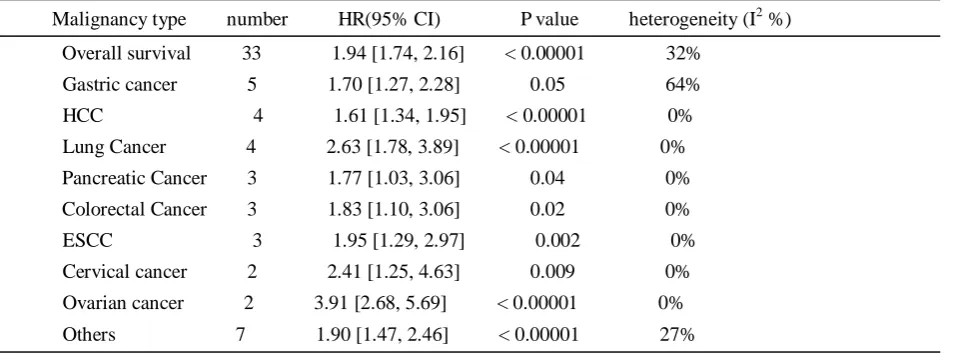
1.77, 95%CI = 1.03-3.06; P = 0.04; I² = 0%), colorectal cancer (pooled HR = 1.83, 95%CI = 1.10-3.06; P = 0.02; I² = 0%), ESCC (pooled HR = 1.95, 95%CI = 1.27-2.97; P = 0.002; I² = 0%), cervical cancer (pooled HR = 2.41, 95%CI = 1.25-4.63; P = 0.009; I² = 0%), ovarian cancer (pooled HR = 3.91, 95%CI = 2.68-5.69; P < 0.00001; I² = 0%), and other malignancies (pooled HR = 2.18, 95%CI = 1.52-3.14; P < 0.00001; I² = 32%) including breast cancer, tongue Carcinoma, Osteosarcoma, Soft tissue Sarcoma, Gallbladder Carcinoma, Oral
squamous cell carcinoma and Oropharyngeal Cancer. However, over-expression of HIF-1α in gastric cancer (pooled HR = 1.73, 95%CI = 0.99-3.02; P = 0.05; I² = 64%) failed to affected OS for patients statistically. All above meta-analysis results were reviewed in Table 2
Nine studies, including 874 patients, provided eligible data for DFS analysis. Figure3 showed that the pooled HR (95% CI) of these studies for DFS was 2.16 [1.71, 2.74] (P < 0.00001; I² = 4%).
Prognostic Value of Hypoxia-Inducible Factor 1α in Solid Malignancies: A Meta-Analysis
http://www.ijSciences.com
Volume 7
– March
2018 (03
)
117
Figure 3: Meta-analysis of disease free survival of HIF-1α expression in solid malignanciesTable 2: Pooled hazard ratios for OS based on malignancy type
Malignancy type number HR(95% CI) P value heterogeneity (I2 %)
Overall survival 33 1.94 [1.74, 2.16] < 0.00001 32%
Gastric cancer 5 1.70 [1.27, 2.28] 0.05 64%
HCC 4 1.61 [1.34, 1.95] < 0.00001 0%
Lung Cancer 4 2.63 [1.78, 3.89] < 0.00001 0%
Pancreatic Cancer 3 1.77 [1.03, 3.06] 0.04 0%
Colorectal Cancer 3 1.83 [1.10, 3.06] 0.02 0%
ESCC 3 1.95 [1.29, 2.97] 0.002 0%
Cervical cancer 2 2.41 [1.25, 4.63] 0.009 0%
Ovarian cancer 2 3.91 [2.68, 5.69] < 0.00001 0%
Others 7 1.90 [1.47, 2.46] < 0.00001 27%
Sensitivity analysis
Eliminating studies about gastric cancer (n = 29, pooled HR = 1.98, 95%CI = 1.76-2.23; P < 0.00001; I² =23%) had no substantial effect on the outcome of overall survival, and a lower heterogeneity was consistently observed.
Removal of studies that scored 6 on the NOS scale (n
=29, pooled HR = 1.96, 95%CI = 1.74-2.21; P < 0.00001; I² =23%) did not change the unfavorable prognostic effect of HIF-1α over-expression on the overall survival in patients with solid malignancies.
Potential publication bias
Prognostic Value of Hypoxia-Inducible Factor 1α in Solid Malignancies: A Meta-Analysis
http://www.ijSciences.com
Volume 7
– March
2018 (03
)
118
Figure 4: Funnel plot to assess the potential publication bias in the impact of HIF-1α on overall survival (A) anddisease-free survival (B)
Discussion
HIF1α plays a critical role in hypoxia to improve glycolysis, oxygen delivery, and angiogenesis for tumor cells [43]. Recent studies have demonstrated that HIF1α is over-expressed in various human malignancies and intimately correlates with tumorgenesis, tumor progression, metastasis potential, treatment failure and increased mortality in many malignancies [44-46]. Dysregulation of HIF1α expression and HIF1α signal pathway in tumor microenvironment may serve as a key factor in human cancer development [46, 47]. In view of its role in regulating tumor pathophysiology, evaluating its prognostic value in malignancies is of great clinical importance, which may lead to better patient stratification and targeted therapies in the future.
The prognostic role of HIF-1α expression has been proven in the recent meta-analysis in gastric cancer [48], hepatocellular carcinoma [49], lung cancer [50] and some other tumors. As far as we know, this study was the most well-rounded assessment of the studies towards HIF-1α expression and malignancies prognosis to date. Systematically, we evaluated survival data for 3778 patients included in 34 studies containing 15 different solid malignancies. In this meta analysis, the pooled HRs (95% CI) of HIF-1α expression for OS and DFS were 1.94 [1.74, 2.16] and 2.16 [1.71, 2.74] respectively. The combined
results of OS and DFS suggested that high expressions of HIF-1α were obviously related with poor survival outcome, which indicates that that the expression of HIF-1α could be deemed as a potential biomarker of poor prognosis in most patients with solid malignancies. As for malignancy types, the high expression of HIF-1α in malignancy tissues were associated with worse OS of most human solid malignancies, such as HCC, lung cancer, ovarian cancer, pancreatic cancer and some other malignancies. Statistically, we failed to draw the correlation between HIF-1α expression and overall survival of gastric cancer.
Prognostic Value of Hypoxia-Inducible Factor 1α in Solid Malignancies: A Meta-Analysis
http://www.ijSciences.com
Volume 7
– March
2018 (03
)
119
less convincible. Lastly, there were too many literatures about the prognosis of HIF-1α and human malignancies, we failed to spread out them all, which may lead to publication bias or even inaccurate results.
In conclusion, over-expression of HIF-1α was correlated with poor survival in patients with solid malignancies. These findings suggested that HIF-1α inhibition therapy could be an important method in malignancies, and that HIF-1α might be routinely detected to predict prognosis in solid malignancies. However, more literatures need to be adopted for further verification of our results.
Disclosure of conflict of interest
None
References
1. Wang GL, Jiang BH, Rue EA and Semenza GL. Hypoxia-inducible factor 1 is a basic-helix-loop-helix-PAS heterodimer regulated by cellular O2 tension. Proceedings of the National Academy of Sciences of the United States of America. 1995; 92(12):5510-5514.
2. Wang GL and Semenza GL. Purification and characterization of hypoxia-inducible factor 1. The Journal of biological chemistry. 1995; 270(3):1230-1237.
3. Birner P, Schindl M, Obermair A, Plank C, Breitenecker G and Oberhuber G. Overexpression of hypoxia-inducible factor 1alpha is a marker for an unfavorable prognosis in early-stage invasive cervical cancer. Cancer research. 2000; 60(17):4693-4696.
4. Unruh A, Ressel A, Mohamed HG, Johnson RS, Nadrowitz R, Richter E, Katschinski DM and Wenger RH. The hypoxia-inducible factor-1 alpha is a negative factor for tumor therapy. Oncogene. 2003; 22(21):3213-3220. 5. Semenza GL. Hypoxia-inducible factors: mediators of cancer
progression and targets for cancer therapy. Trends in pharmacological sciences. 2012; 33(4):207-214.
6. Kaelin WG, Jr. and Ratcliffe PJ. Oxygen sensing by metazoans: the central role of the HIF hydroxylase pathway. Molecular cell. 2008; 30(4):393-402.
7. Parmar MK, Torri V and Stewart L. Extracting summary statistics to perform meta-analyses of the published literature for survival endpoints. Statistics in medicine. 1998; 17(24):2815-2834.
8. Tierney JF, Stewart LA, Ghersi D, Burdett S and Sydes MR. Response to: Practical methods for incorporating summary time-to-event data into meta. Authors' reply. Trials. 2013; 14:391.
9. Malfettone A, Saponaro C, Paradiso A, Simone G and Mangia A. Peritumoral vascular invasion and NHERF1 expression define an immunophenotype of grade 2 invasive breast cancer associated with poor prognosis. BMC cancer. 2012; 12:106.
10. Isobe T, Aoyagi K, Koufuji K, Shirouzu K, Kawahara A,
Taira T and Kage M. Clinicopathological significance of hypoxia-inducible factor-1 alpha (HIF-1alpha) expression in gastric cancer. International journal of clinical oncology. 2013; 18(2):293-304.
11. Zhan H, Liang H, Liu X, Deng J, Wang B and Hao X. Expression of Rac1, HIF-1alpha, and VEGF in gastric carcinoma: correlation with angiogenesis and prognosis. Onkologie. 2013; 36(3):102-107.
12. Lu XX, Chen YT, Feng B, Mao XB, Yu B and Chu XY. Expression and clinical significance of CD73 and hypoxia-inducible factor-1alpha in gastric carcinoma. World journal of gastroenterology. 2013; 19(12):1912-1918. 13. Kolev Y, Uetake H, Takagi Y and Sugihara K. Lactate
dehydrogenase-5 (LDH-5) expression in human gastric cancer: association with hypoxia-inducible factor (HIF-1alpha) pathway, angiogenic factors production and poor prognosis. Annals of surgical oncology. 2008; 15(8):2336-2344.
14. Qiu MZ, Han B, Luo HY, Zhou ZW, Wang ZQ, Wang FH, Li YH and Xu RH. Expressions of hypoxia-inducible factor-1alpha and hexokinase-II in gastric adenocarcinoma: the impact on prognosis and correlation to clinicopathologic features. Tumour biology : the journal of the International Society for Oncodevelopmental Biology and Medicine. 2011; 32(1):159-166.
15. Kim BW, Cho H, Chung JY, Conway C, Ylaya K, Kim JH and Hewitt SM. Prognostic assessment of hypoxia and metabolic markers in cervical cancer using automated digital image analysis of immunohistochemistry. Journal of translational medicine. 2013; 11:185.
16. Yu L, Wu SW, Zhou L and Song WQ. [Correlation between bacterial L-form infection, expression of HIF-1alpha/MMP-9 and vasculogenic mimicry in epithelial ovarian cancer]. Sheng li xue bao : [Acta physiologica Sinica]. 2012; 64(6):657-665.
17. Shimogai R, Kigawa J, Itamochi H, Iba T, Kanamori Y, Oishi T, Shimada M, Sato S, Kawaguchi W, Sato S and Terakawa N. Expression of hypoxia-inducible factor 1alpha gene affects the outcome in patients with ovarian cancer. International journal of gynecological cancer : official journal of the International Gynecological Cancer Society. 2008; 18(3):499-505.
18. Huang M, Chen Q, Xiao J, Yao T, Bian L, Liu C and Lin Z. Overexpression of hypoxia-inducible factor-1alpha is a predictor of poor prognosis in cervical cancer: a clinicopathologic study and a meta-analysis. International journal of gynecological cancer : official journal of the International Gynecological Cancer Society. 2014; 24(6):1054-1064.
19. Ogane N, Yasuda M, Shimizu M, Miyazawa M, Kamoshida S, Ueda A, Takata K, Sakuma Y, Miyagi Y and Kameda Y. Clinicopathological implications of expressions of hypoxia-related molecules in esophageal superficial squamous cell carcinoma. Annals of diagnostic pathology. 2010; 14(1):23-29.
20. Chen Y, Lu Y, Lu C and Zhang L. Beclin-1 expression is a predictor of clinical outcome in patients with esophageal squamous cell carcinoma and correlated to hypoxia-inducible factor (HIF)-1alpha expression. Pathology oncology research : POR. 2009; 15(3):487-493.
21. Tzao C, Lee SC, Tung HJ, Hsu HS, Hsu WH, Sun GH, Yu CP, Jin JS and Cheng YL. Expression of hypoxia-inducible factor (HIF)-1alpha and vascular endothelial growth factor (VEGF)-D as outcome predictors in resected esophageal squamous cell carcinoma. Disease markers. 2008; 25(3):141-148.
Prognostic Value of Hypoxia-Inducible Factor 1α in Solid Malignancies: A Meta-Analysis
http://www.ijSciences.com
Volume 7
– March
2018 (03
)
120
Lee JS. Hypoxia-inducible factor-1alpha and excision repair cross-complementing 1 in patients with small cell lung cancer who received front-line platinum-based chemotherapy: a retrospective study. Journal of thoracic oncology : official publication of the International Association for the Study of Lung Cancer. 2012; 7(3):528-534.
23. Hung JJ, Yang MH, Hsu HS, Hsu WH, Liu JS and Wu KJ. Prognostic significance of hypoxia-inducible factor-1alpha, TWIST1 and Snail expression in resectable non-small cell lung cancer. Thorax. 2009; 64(12):1082-1089.
24. Kaira K, Nakagawa K, Ohde Y, Okumura T, Takahashi T, Murakami H, Endo M, Kondo H, Nakajima T and Yamamoto N. Depolarized MUC1 expression is closely associated with hypoxic markers and poor outcome in resected non-small cell lung cancer. International journal of surgical pathology. 2012; 20(3):223-232.
25. Park S, Ha SY, Cho HY, Chung DH, Kim NR, Hong J and Cho EK. Prognostic implications of hypoxia-inducible factor-1alpha in epidermal growth factor receptor-negative non-small cell lung cancer. Lung cancer (Amsterdam, Netherlands). 2011; 72(1):100-107.
26. Zhu GH, Huang C, Feng ZZ, Lv XH and Qiu ZJ. Hypoxia-induced snail expression through transcriptional regulation by HIF-1alpha in pancreatic cancer cells. Digestive diseases and sciences. 2013; 58(12):3503-3515. 27. Matsuo Y, Ding Q, Desaki R, Maemura K, Mataki Y, Shinchi
H, Natsugoe S and Takao S. Hypoxia inducible factor-1 alpha plays a pivotal role in hepatic metastasis of pancreatic cancer: an immunohistochemical study. Journal of hepato-biliary-pancreatic sciences. 2014; 21(2):105-112. 28. Zhang JJ, Wu HS, Wang L, Tian Y, Zhang JH and Wu HL.
Expression and significance of TLR4 and HIF-1alpha in pancreatic ductal adenocarcinoma. World journal of gastroenterology. 2010; 16(23):2881-2888.
29. Liu L, Zhu XD, Wang WQ, Shen Y, Qin Y, Ren ZG, Sun HC and Tang ZY. Activation of beta-catenin by hypoxia in hepatocellular carcinoma contributes to enhanced metastatic potential and poor prognosis. Clinical cancer research : an official journal of the American Association for Cancer Research. 2010; 16(10):2740-2750.
30. Xia L, Mo P, Huang W, Zhang L, Wang Y, Zhu H, Tian D, Liu J, Chen Z, Zhang Y, Chen Z, Hu H, Fan D, Nie Y and Wu K. The TNF-alpha/ROS/HIF-1-induced upregulation of FoxMI expression promotes HCC proliferation and resistance to apoptosis. Carcinogenesis. 2012; 33(11):2250-2259. 31. Xiang ZL, Zeng ZC, Fan J, Tang ZY, He J, Zeng HY and
Chang JY. The expression of HIF-1alpha in primary hepatocellular carcinoma and its correlation with radiotherapy response and clinical outcome. Molecular biology reports. 2012; 39(2):2021-2029.
32. Dai CX, Gao Q, Qiu SJ, Ju MJ, Cai MY, Xu YF, Zhou J, Zhang BH and Fan J. Hypoxia-inducible factor-1 alpha, in association with inflammation, angiogenesis and MYC, is a critical prognostic factor in patients with HCC after surgery. BMC cancer. 2009; 9:418.
33. Zhao H, Wu Y, Chen Y and Liu H. Clinical significance of hypoxia-inducible factor 1 and VEGF-A in osteosarcoma. International journal of clinical oncology. 2015; 20(6):1233-1243.
34. Hu T, He N, Yang Y, Yin C, Sang N and Yang Q. DEC2 expression is positively correlated with HIF-1 activation and the invasiveness of human osteosarcomas. Journal of experimental & clinical cancer research : CR. 2015; 34:22. 35. Kim JI, Choi KU, Lee IS, Choi YJ, Kim WT, Shin DH, Kim
K, Lee JH, Kim JY and Sol MY. Expression of hypoxic markers and their prognostic significance in soft tissue sarcoma. Oncology letters. 2015; 9(4):1699-1706.
36. Cao D, Hou M, Guan YS, Jiang M, Yang Y and Gou HF. Expression of HIF-1alpha and VEGF in colorectal cancer: association with clinical outcomes and prognostic implications. BMC cancer. 2009; 9:432.
37. Yoshimura H, Dhar DK, Kohno H, Kubota H, Fujii T, Ueda S, Kinugasa S, Tachibana M and Nagasue N. Prognostic impact of hypoxia-inducible factors 1alpha and 2alpha in colorectal cancer patients: correlation with tumor angiogenesis and cyclooxygenase-2 expression. Clinical cancer research : an official journal of the American Association for Cancer Research. 2004; 10(24):8554-8560. 38. Xie YQ, Fu D, He ZH and Tan QD. Prognostic value of
Annexin A3 in human colorectal cancer and its correlation with hypoxia-inducible factor-1alpha. Oncology letters. 2013; 6(6):1631-1635.
39. Hong A, Zhang M, Veillard AS, Jahanbani J, Lee CS, Jones D, Harnett G, Clark J, Elliott M, Milross C and Rose B. The prognostic significance of hypoxia inducing factor 1-alpha in oropharyngeal cancer in relation to human papillomavirus status. Oral oncology. 2013; 49(4):354-359.
40. Eckert AW, Lautner MH, Schutze A, Taubert H, Schubert J and Bilkenroth U. Coexpression of hypoxia-inducible factor-1alpha and glucose transporter-1 is associated with poor prognosis in oral squamous cell carcinoma patients. Histopathology. 2011; 58(7):1136-1147.
41. Sun W, Shen ZY, Zhang H, Fan YZ, Zhang WZ, Zhang JT, Lu XS and Ye C. Overexpression of HIF-1alpha in primary gallbladder carcinoma and its relation to vasculogenic mimicry and unfavourable prognosis. Oncology reports. 2012; 27(6):1990-2002.
42. Zheng Y, Ni Y, Huang X, Wang Z and Han W. Overexpression of HIF-1alpha indicates a poor prognosis in tongue carcinoma and may be associated with tumour metastasis. Oncology letters. 2013; 5(4):1285-1289. 43. Harris AL. Hypoxia--a key regulatory factor in tumour
growth. Nature reviews Cancer. 2002; 2(1):38-47.
44. Semenza GL. HIF-1 and tumor progression: pathophysiology and therapeutics. Trends in molecular medicine. 2002; 8(4 Suppl):S62-67.
45. Zhang H, Qian DZ, Tan YS, Lee K, Gao P, Ren YR, Rey S, Hammers H, Chang D, Pili R, Dang CV, Liu JO and Semenza GL. Digoxin and other cardiac glycosides inhibit HIF-1alpha synthesis and block tumor growth. Proceedings of the National Academy of Sciences of the United States of America. 2008; 105(50):19579-19586.
46. Zhang M, Li W, Yu L and Wu S. The suppressive effect of resveratrol on HIF-1alpha and VEGF expression after warm ischemia and reperfusion in rat liver. PloS one. 2014; 9(10):e109589.
47. Chen T, Ren Z, Ye LC, Zhou PH, Xu JM, Shi Q, Yao LQ and Zhong YS. Factor inhibiting HIF1alpha (FIH-1) functions as a tumor suppressor in human colorectal cancer by repressing HIF1alpha pathway. Cancer biology & therapy. 2015; 16(2):244-252.
48. Zhu CL, Huang Q, Liu CH, Lin XS and Xie F. Prognostic value of HIF-1alpha expression in patients with gastric cancer. Molecular biology reports. 2013; 40(11):6055-6062. 49. Cao S, Yang S, Wu C, Wang Y, Jiang J and Lu Z. Protein
expression of hypoxia-inducible factor-1 alpha and hepatocellular carcinoma: a systematic review with meta-analysis. Clinics and research in hepatology and gastroenterology. 2014; 38(5):598-603.