Linear-Time Computation of Similarity Measures for Sequential Data
Konrad Rieck [email protected]
Pavel Laskov [email protected]
Fraunhofer FIRST.IDA Kekul´estraße 7
12489 Berlin, Germany
Editor: Nello Cristianini
Abstract
Efficient and expressive comparison of sequences is an essential procedure for learning with se-quential data. In this article we propose a generic framework for computation of similarity mea-sures for sequences, covering various kernel, distance and non-metric similarity functions. The basis for comparison is embedding of sequences using a formal language, such as a set of natu-ral words, k-grams or all contiguous subsequences. As realizations of the framework we provide linear-time algorithms of different complexity and capabilities using sorted arrays, tries and suffix trees as underlying data structures.
Experiments on data sets from bioinformatics, text processing and computer security illustrate the efficiency of the proposed algorithms—enabling peak performances of up to 106pairwise com-parisons per second. The utility of distances and non-metric similarity measures for sequences as alternatives to string kernels is demonstrated in applications of text categorization, network intru-sion detection and transcription site recognition in DNA.
Keywords: string kernels, string distances, learning with sequential data
1. Introduction
Sequences of discrete symbols are one of the fundamental data representations in computer sci-ence. A great deal of applications—from search engines to document ranking, from gene finding to prediction of protein functions, from network surveillance tools to anti-virus programs—critically depend on analysis of sequential data. Providing an interface to sequential data is therefore an essential prerequisite for applications of machine learning in these domains.
Machine learning algorithms have been traditionally designed for vectorial data—probably due to the availability of well-defined calculus and mathematical analysis tools. A large body of such learning algorithms, however, can be formulated in terms of pairwise relationships between objects, which imposes a much looser constraint on the type of data that can be handled. Thus, a powerful abstraction between algorithms and data representations can be established.
abstraction from data representation has been quickly realized (e.g., Vapnik, 1995). Consequently kernel-based methods have been proposed for non-vectorial domains, such as analysis of images (e.g., Sch¨olkopf et al., 1998a; Chapelle et al., 1999), sequences (e.g., Jaakkola et al., 2000; Watkins, 2000; Zien et al., 2000) and structured data (e.g., Collins and Duffy, 2002; G¨artner et al., 2004).
Although kernel-based learning has gained significant attention in recent years, a Mercer kernel is only one of many possibilities for defining pairwise relationships between objects. Numerous applications exist for which relationships are defined as metric or non-metric distances (e.g., An-derberg, 1973; Jacobs et al., 2000; von Luxburg and Bousquet, 2004), similarity or dissimilarity measures (e.g., Graepel et al., 1999; Roth et al., 2003; Laub and M¨uller, 2004; Laub et al., 2006) or non-positive kernel functions (e.g., Ong et al., 2004; Haasdonk, 2005). It is therefore imperative to address pairwise comparison of objects in a most general setup.
The aim of this contribution is to develop a general framework for pairwise comparison of sequences. Its generality is manifested by the ability to handle a large number of kernel func-tions, distances and non-metric similarity measures. From considerations of efficiency, we focus on algorithms with linear-time asymptotic complexity in the sequence lengths—at the expense of narrowing the scope of similarity measures that can be handled. For example, we do not consider super-linear comparison algorithms such as the Levenshtein distance (Levenshtein, 1966) and the all-subsequences kernel (Lodhi et al., 2002).
The basis of our framework is embedding of sequences in a high-dimensional feature space using a formal language, a classical tool of computer science for modeling semantics of sequences. Some examples of such languages have been previously used for string kernels, such as the bag-of-words, k-gram or contiguous-subsequence kernel. Our formalization allows one to use a much larger set of possible languages in a unified fashion, for example subsequences defined by a finite set of delimiters or position-dependent languages. A further advantage of embedding using formal languages is separation of embedding models from algorithms, which allows one to investigate different data structures to obtain optimal efficiency in practice.
Several data structures have been previously considered for specific similarity measures, such as hash tables (Damashek, 1995), sorted arrays (Sonnenburg et al., 2007), tries (Leslie et al., 2002; Shawe-Taylor and Cristianini, 2004; Rieck et al., 2006), suffix trees using matching statistics (Vish-wanathan and Smola, 2004), suffix trees using recursive matching (Rieck et al., 2007) and suffix arrays (Teo and Vishwanathan, 2006). All of these data structures allow one to develop linear-time algorithms for computation of certain similarity measures. Most of them are also suitable for the general framework developed in this paper; however, certain trade-offs exist between their asymp-totic run-time complexity, implementation difficulty and restrictions on embedding languages they can handle. To provide an insight into these issues, we propose and analyze three data structures suitable for our framework: sorted arrays, tries and suffix trees with an extension to suffix arrays. The message of our analysis, supported by experimental evaluation, is that the choice of an optimal data structure depends on the embedding language to be used.
2. Related Work
Assessing the similarity of two sequences is a classical problem of computer science. First ap-proaches, the string distances of Hamming (1950) and Levenshtein (1966), originated in the domain of telecommunication for detection of erroneous data transmissions. The degree of dissimilarity be-tween two sequences is determined by computing the shortest trace of operations—insertions, dele-tions and substitudele-tions—that transform one sequence into the other (Sankoff and Kruskal, 1983). Applications in bioinformatics motivated extensions and adaptions of this concept, for example defining sequence similarity in terms of local and global alignments (Needleman and Wunsch, 1970; Smith and Waterman, 1981). However, similarity measures based on the Hamming distance are re-stricted to sequences of equal length and measures derived from the Levenshtein distance (e.g., Liao and Noble, 2003; Vert et al., 2004), come at the price of computational complexity: No linear-time algorithm for determining the shortest trace of operations is currently known. One of the fastest exact algorithms runs in O(n2/log n)for sequences of length n (Masek and Patterson, 1980).
A different approach to sequence comparison originated in the field of information retrieval with the vector space or bag-of-words model (Salton et al., 1975; Salton, 1979). Textual documents are embedded into a vector space spanned by weighted frequencies of contained words. The similarity of two documents is assessed by an inner-product between the corresponding vectors. This concept was extended to k-grams—k consecutive characters or words—in the domain of natural language processing and computer linguistic (e.g., Suen, 1979; Cavnar and Trenkle, 1994; Damashek, 1995). The idea of determining similarity of sequences by an inner-product was revived in kernel-based learning in the form of bag-of-words kernels (e.g., Joachims, 1998; Drucker et al., 1999; Joachims, 2002) and various string kernels (e.g., Zien et al., 2000; Leslie et al., 2002; Vishwanathan and Smola, 2004). Moreover, research in bioinformatics and text processing advanced the capabilities of string kernels, for example, by considering gaps, mismatches and positions in sequences (e.g., Lodhi et al., 2002; Leslie et al., 2003; Leslie and Kuang, 2004; Rousu and Shawe-Taylor, 2005; R¨atsch et al., 2007). The comparison framework proposed in this article shares the concept of embedding sequences with all of the above kernels, in fact most of the linear-time string kernels (e.g., Joachims, 1998; Leslie et al., 2002; Vishwanathan and Smola, 2004) are enclosed in the framework.
A further alternative for comparison of sequences are kernels derived from generative proba-bility models, such as the Fisher kernel (Jaakkola et al., 2000) and the TOP kernel (Tsuda et al., 2002). Provided a generative model, for example a HMM trained over a corpus of sequences or modeled from prior knowledge, these kernel functions essentially correspond to inner-products of partial derivatives over model parameters. The approach enables the design of highly specific sim-ilarity measures which exploit the rich structure of generative models, for example, for prediction of DNA splice sites (R¨atsch and Sonnenburg, 2004). The run-time complexity of the kernel com-putation, however, is determined by the number of model parameters, so that only simple models yield run-time linear in the sequence lengths. Moreover, obtaining a suitable parameter estimate for a probabilistic model can be difficult or even infeasible in practical applications.
3. Similarity Measures for Sequential Data
Before introducing the framework for computation of similarity measures, we need to establish some basic notation. A sequence x is a concatenation of symbols from an alphabetA. The set of
of length k byAk. A formal language L
⊆A∗is any set of finite-length sequences drawn fromA
(Hopcroft and Motwani, 2001). The length of a sequence x is denoted by|x|and the size of the alphabet by|A|. A contiguous subsequencewof x is denoted byw⊑x, a prefix of x byw⊑px
and a suffix byw⊑sx. Alternatively, a subsequencewof x ranging from position i to j is referred
to as x[i..j ].
3.1 Embedding Sequences using a Formal Language
The basis for embedding of a sequence x is a formal language L, whose elements are sequences spanning an |L|-dimensional feature space. We refer to L as the embedding language and to a sequencew∈L as a word of L. There exist numerous ways to define L reflecting particular aspects
of application domains, yet we focus on three definitions that have been widely used in previous research:
1. Bag-of-words. In this model, L corresponds to a set of words from a natural language. L can be either defined explicitly by providing a dictionary or implicitly by partitioning sequences according to a set of delimiter symbols D⊂A(e.g., Salton, 1979; Joachims, 2002).
L=Dictionary (explicit), L=(A\D)∗(implicit).
2. K-grams and blended k-grams. For the case of k-grams (in bioinformatics often referred to as k-mers), L is the set of all sequences of length k (e.g., Damashek, 1995; Leslie et al., 2002). The model of k-grams can further be “blended” by considering all sequences from length j up to k (e.g., Shawe-Taylor and Cristianini, 2004).
L=Ak (k-grams), L=
k
[
i=j
Ai (blended k-grams).
3. Contiguous sequences. In the most general case, L corresponds to the set of all contiguous sequences or alternatively to blended k-grams with infinite k (e.g., Vishwanathan and Smola, 2004; Rieck et al., 2007).
L=A∗ or L= ∞ [
i=1
Ai.
Note that the alphabetAin the embedding languages may also be composed of higher semantic constructs, such as natural words or syntactic tokens. In these cases a k-gram corresponds to k consecutive words or tokens, and a bag-of-words models could represent textual clauses or phrases. Given an embedding language L, a sequence x can be mapped into the|L|-dimensional feature space by calculating a functionφw(x)for everyw∈L appearing in x. The embedding function8
for a sequence x is given by
8: x7→(φw(x))w∈L with φw(x):=occ(w,x)·Ww (1)
While the choice and design of an embedding language L offer a large degree of flexibility, it is often necessary to refine the amount of contribution for each wordw∈ L, for example it is
a common practice in text processing to ignore stop words and terms that do not carry semantic content. In the embedding function (1) such refinement is realized by the weighting termWw. The
following three weighting schemes for definingWw have been proposed in previous research:
1. Corpus dependent weighting. The weightWwis based on the occurrences ofwin the corpus of sequences (see Salton et al., 1975). Most notable is the inverse document frequency (IDF) weighting, in whichWw is defined over the number of documents N and the frequency d(w)
ofwin the corpus.
Ww=log2N−log2d(w)+1.
If occ(w,x)is the frequency ofwin x, the embedding function (1) corresponds to the well-known term frequency and inverse document frequency (TF-IDF) weighting scheme.
2. Length dependent weighting. The weightWw is based on the length|w|(see Shawe-Taylor and Cristianini, 2004; Vishwanathan and Smola, 2004), for example, so that longer words contribute more than shorter words to a similarity measure. A common approach is defining
Ww using a decay factor 0≤λ≤1.
Ww=λ−|w|.
3. Position dependent weighting. The weight Ww is based on the position ofwin x. Vish-wanathan and Smola (2004) propose a direct weighting scheme, in whichWw is defined over
positional weightsW(k,x)for each position k in x as
Ww=Wx[i..j ]=
j
X
k=i
W(k,x).
An indirect approach to position dependent weighting can be implemented by extending the alphabetAwith positional information toA˜=A×N, so that every element(a,k)∈ ˜A of the extended alphabet is a pair of a symbol a and a position k.
The introduced weighting schemes can be coupled to further refine the embedding based on
L, for example, in text processing the impact of a particular term might be influenced by the term
frequency, inverse document frequency and its length.
3.2 Vectorial Similarity Measures for Sequences
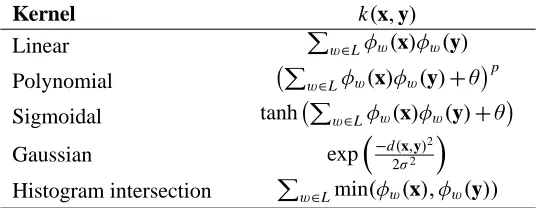
With an embedding language L at hand, we can now express common vectorial similarity measures in the domain of sequences. Table 1 and 2 list well-known kernel and distance functions (see Vapnik, 1995; Sch¨olkopf and Smola, 2002; Webb, 2002) in terms of L. The histogram intersection kernel in Table 1 derives from computer vision (see Swain and Ballard, 1991; Odone et al., 2005) and the Jensen-Shannon divergence in Table 2 is defined using H(x,y)=x logx2x+y+y logx2y+y.
Kernel k(x,y)
Linear Pw∈Lφw(x)φw(y)
Polynomial Pw∈Lφw(x)φw(y)+θ
p
Sigmoidal tanh Pw∈Lφw(x)φw(y)+θ
Gaussian exp−d2(σx,2y)2
Histogram intersection Pw∈Lmin(φw(x), φw(y))
Table 1: Kernel functions for sequential data.
Distance d(x,y)
Manhattan Pw∈L|φw(x)−φw(y)|
χ2distance P
w∈L
(φw(x)−φw(y))2
φw(x)+φw(y)
Canberra Pw∈L |
φw(x)−φw(y)|
φw(x)+φw(y)
Minkowskip P
w∈L|φw(x)−φw(y)| p
Distance d(x,y)
Chebyshev maxw∈L|φw(x)−φw(y)|
Geodesic arccosPw∈Lφw(x)φw(y)
Hellinger2 P
w∈L( √
φw(x)−√φw(y))2
Jensen-Shannon Pw∈LH(φw(x), φw(y))
Table 2: Distance functions for sequential data.
components (0/1) and right mismatching components (1/0) in two binary vectors. Common similar-ity coefficients are given in Table 3. For application to non-binary vectors the summation variables
a,b,c can be extended in terms of an embedding language L (Rieck et al., 2006):
a=X
w∈L
min(φw(x), φw(y)),
b=X
w∈L
[φw(x)−min(φw(x), φw(y))],
c=X
w∈L
[φw(y)−min(φw(x), φw(y))].
The above definition of a matches the histogram intersection kernel k provided in Table 1, so that alternatively all summation variables can be expressed by
a=k(x,y), b=k(x,x)−k(x,y),c=k(y,y)−k(x,y). (2)
Sim. Coeff. s(x,y)
Simpson a/min(a+b,a+c)
Jaccard a/(a+b+c)
Braun-Blanquet a/max(a+b,a+c) Czekanowski,
Sørensen-Dice 2a/(2a+b+c)
Sim. Coeff. s(x,y)
Kulczynski (1) a/(b+c)
Kulczynski (2) 12(a/(a+b)+a/(a+c))
Otsuka, Ochiai a/√(a+b)(a+c) Sokal-Sneath,
Anderberg a/(a+2(b+c))
Hence, one can consider the similarity coefficients given in Table 3 as variations of the histogram intersection kernel, for example, the Jaccard coefficient can be formulated solely in terms of k:
s(x,y)= a
a+b+c =
k(x,y)
k(x,x)+k(y,y)−k(x,y).
3.3 A Generic Framework for Similarity Measures
All of the similarity measures introduced in the previous section share a similar mathematical con-struction: an inner component-wise function is aggregated over each dimension using an outer operator, for example, the linear kernel is defined as the sum of component-wise products and the Chebyshev distance as the maximum of component-wise absolute differences.
One can exploit this shared structure to derive a unified formulation for similarity measures (Rieck et al., 2006, 2007), consisting of an inner function m and an outer operator⊕ as follows
s(x,y)=M
w∈L
m(φw(x), φw(y)). (3)
For convenience in later design of algorithms, we introduce a “multiplication” operator⊗which corresponds to executing the⊕operation k times. Thus, for any n∈Nand x ∈R, we define⊗as
x⊗n :=x⊕. . .⊕x
| {z }
n .
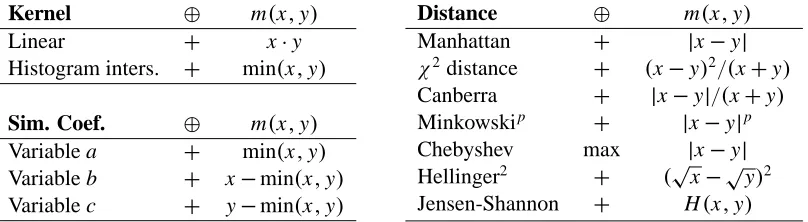
Given the unified form (3), kernel and distance functions presented in Table 1 and 2 can be re-formulated in terms of⊕ and m. Adaptation of similarity coefficients to the unified form (3) involves a re-formulation of the summation variables a, b and c. The particular definitions of outer and inner functions for the presented similarity measures are given in Table 4. The polynomial and sigmoidal kernels as well as the Geodesic distance are not shown since they can be expressed using a linear kernel. For the Chebyshev distance the operator⊗ represents the identity function, while for all other similarity measures it represents a multiplication.
Kernel ⊕ m(x,y)
Linear + x·y
Histogram inters. + min(x,y)
Sim. Coef. ⊕ m(x,y)
Variable a + min(x,y)
Variable b + x−min(x,y)
Variable c + y−min(x,y)
Distance ⊕ m(x,y)
Manhattan + |x−y|
χ2distance
+ (x−y)2/(x
+y)
Canberra + |x−y|/(x+y)
Minkowskip + |x−y|p
Chebyshev max |x−y|
Hellinger2
+ (√x−√y)2
Jensen-Shannon + H(x,y)
Table 4: Unified formulation of similarity measures.
As a last step towards the development of comparison algorithms, we need to address the high dimensionality of the feature space induced by the embedding language L. The unified form (3) theoretically involves computation of m over allw∈L, which is practically infeasible for most L.
Yet the feature space induced by L is sparse, since a sequence x comprises only a limited number of contiguous subsequences—at most(|x|2
only very few termsφw(x)andφw(y)in the unified form (3) have non-zero values. We exploit this
fact by defining m(0,0)=e, where e is the neutral element for the operator⊕, so that for any x ∈R holds
x⊕e=x, e⊕x=x.
By assigning m(0,0)to e, the computation of a similarity measure can be reduced to cases where eitherφw(x) >0 orφw(y) >0, as the term m(0,0)does not affect the result of expression (3). We
can now refine the unified form (3) by partitioning the similarity measures into conjunctive and
disjunctive measures using an auxiliary functionm:˜
s(x,y)=M
w∈L
˜
m(φw(x), φw(y)).
1. Conjunctive similarity measures. The inner function m only accounts pairwise non-zero components, so that for any x∈Rholds m(x,0)=e and m(0,x)=e.
˜
m(x,y)=
(
m(x,y) if x>0 and y>0
e otherwise.
Kernel functions fall into this class, except for the distance-based RBF kernel. By using a kernel to express similarity coefficients as shown in expression (2), similarity coefficients also exhibit the conjunctive property.
2. Disjunctive similarity measures. The inner function m requires at least one component to be non-zero, otherwise m(0,0)=e holds.
˜
m(x,y)=
(
m(x,y) if x>0 or y>0
e otherwise.
Except for the Geodesic distance, all of the presented distances fall into this class. Depend-ing on the embeddDepend-ing language, this class is computational more expensive than conjunctive measures.
As a result, any similarity measure, including those in Table 1, 2 and 3, composed of an inner and outer function can be applied for efficient comparison of embedded sequences, if (a) a neutral element e for the outer function ⊕ exists and (b) the inner function m is either conjunctive or disjunctive, that is at least m(0,0)=e holds.
4. Algorithms and Data Structures
We now introduce data structures and algorithms for efficient computation of the proposed similarity measures. In particular, we present three approaches differing in capabilities and implementation complexity covering simple sorted arrays, tries and generalized suffix trees. For each approach, we briefly present the involved data structure, provide a discussion of the comparison algorithm and give run-time bounds for extraction and comparison of embedded sequences. Additionally, we provide implementation details that improve run-time performance in practice.
As an example running through this section we consider the two sequences x=abbaa and
y=baaaab from the binary alphabetA= {a,b}and the embedding language of 3-grams, L=A3.
For a data structure storing multiple wordsw∈L of possibly different lengths, we denote by k the
4.1 Sorted Arrays
Data structure. A simple and intuitive representation for storage of embedded sequences are
sorted arrays or alternatively sorted lists (Joachims, 2002; Rieck et al., 2006; Sonnenburg et al.,
2007). Given an embedding language L and a sequence x, all words w∈ L satisfyingw⊑x are
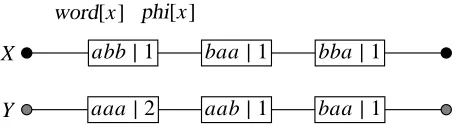
maintained in an array X along with their embedding valuesφw(x). Each field x of X consists of two attributes: the stored wordword[x] and its embedding value phi[x]. The length of an array X is denoted by|X|. In order to support efficient comparison, the fields of X are sorted by contained words, for example, using the lexicographical order of the alphabetA. Figure 1 illustrates the sorted
arrays of 3-grams extracted from the two example sequences x and y.
X
word[x] phi[x]
abb|1 baa|1 bba|1
Y aaa|2 aab|1 baa|1
Figure 1: Sorted arrays of 3-grams for x=abbaa and y=baaaab. The number in each field
indicates the number of occurrences.
Algorithm. Comparison of two sorted arrays X and Y is carried out by looping over the fields
of both arrays in the manner of merging sorted arrays (Knuth, 1973). During each iteration the inner function m is computed over contained words and aggregated using the operator ⊕. The corresponding comparison procedure in pseudo-code is given in Algorithm 1. Herein, we denote the case where a wordwis present in x and y as match and the case ofwbeing contained in either
x or y as mismatch. For run-time improvement, these mismatches can be ignored in Algorithm 1 if
a conjunctive similarity measure is computed (cf. Section 3.3).
Algorithm 1 Array-based sequence comparison
1: function COMPARE(X,Y : Array) : R 2: s←e, i←1, j←1
3: while i≤ |X|or j≤ |Y|do
4: x ←X [i ], y←Y [ j ]
5: if y=NILorword[x]<word[y] then ⊲Mismatch at x
6: s←s⊕m(phi[x],0)
7: i←i+1
8: else if x=NILorword[x]>word[y] then ⊲Mismatch at y
9: s←s⊕m(0,phi[y])
10: j← j+1
11: else ⊲Match at x and y
12: s←s⊕m(phi[x],phi[y])
13: i←i+1, j← j+1
Run-time. The comparison algorithm based on sorted arrays is simple to implement, yet it does not enable linear-time comparison for all embedding languages, for example, if L=A∗. However,
sorted arrays enable linear-time similarity measures, if there exist O(|x|)words withw⊑x, which
implies allw∈ L have no or constant overlap in x. Examples are the common bag-of-words and k-gram embedding languages.
Under these constraints a sorted array is extracted from a sequence x in O(k|x|) time using linear-time sorting, for example, radix sort (Knuth, 1973), where k is the maximum length of all wordsw∈L in x. The comparison algorithm requires at most|x| + |y|iterations, so that the worst-case run-time is O(k(|x| + |y|)). For extraction and comparison the run-time complexity is linear in the sequence lengths due to the constraint on constant overlap of words, which implies k|x| ∈O(|x|)
for any k and x.
Implementation notes. The simple design of the sorted array approach enables a very efficient
extension. If we consider a CPU with registers of b bits, we restrict the maximum word length k, so that every word fits into a CPU register. This restriction enables storage and comparison operations to be performed directly on the CPU, that is operations on wordswwith|w| ≤k are executed in O(1) time. Depending on the size of the alphabet |A|and the CPU bits b, the maximum word
length is⌊b/log2|A|⌋. In many practical applications one can strongly benefit from this extensions,
as k is either bounded anyway, for example, for k-grams, or longer words are particular rare and do not increase accuracy significantly. For example on current 64 bit CPU architectures one can restrict k to 32 for DNA sequences with|A| =4 and to k=10 for textual documents with|A| ≤64.
Alternatively, embedded words may also be represented using hash values of b bits, which enables considering words of arbitrary length, but introduces a probability for hash collisions (Knuth, 1973). Another extension for computation of conjunctive measures using sorted arrays has been pro-posed by Sonnenburg et al. (2007). If two sequences x and y have unbalanced sizes |x| ≪ |y|, one loops over the shorter sorted array X and performs a binary search procedure on Y , in fa-vor of processing both sorted arrays in parallel. The worst-case run-time for this comparison is
O(k(|x|log2|y|)), so that one may automatically apply this extension if for two sequences x and y holds|x|log2|y|<|x| + |y|.
4.2 Tries
Data structure. A trie is a tree structure for storage and retrieval of sequences. The edges of a trie are labeled with symbols ofA(Fredkin, 1960; Knuth, 1973). A path from the root to a marked
node x represents a stored sequence, hereafter denoted byx. A trie node x contains a vector of size¯
|A|linking to child nodes, a binary flag to indicate the end of a sequencemark[x] and an embedding
valuephi[x].1 The i -th child node representing the i -th symbol inAis accessed viachild[x,i ]. If
the i -th child is not presentchild[x,i ]=NIL.
A sequences x is embedded using a trie X by storing allw∈L withw⊑x and corresponding φw(x)in X (Shawe-Taylor and Cristianini, 2004). Figure 2 shows tries of 3-grams for the two
ex-ample sequences x and y. Note, that for the embedding language of k-grams considered in Figure 2 all marked nodes are leaves, while for other embedding languages they may correspond to inner nodes, for example, for the case of blended k-grams, where every node in a trie marks the end of a sequence.
mark[x] phi[x]
X Y
a b a b
b a b a a
b a a a b a
(1) (1) (1) (2) (1) (1)
Figure 2: Tries of 3-grams for x=abbaa and y=baaaab. The number in brackets at leaves
indicate the number of occurrences. Marked nodes are squared. White nodes are implicit and not maintained in a compact trie representation.
Algorithm. Comparison of two tries is performed as in Algorithm 2: Starting at the root nodes,
one recursively traverses both tries in parallel. If the traversal passes at least one marked node the in-ner function m is computed as either a matching or mismatching word occurred (Rieck et al., 2006). To simplify presentation of the algorithm, we assume thatmark[NIL] returns false andchild[NIL,i ]
returnsNIL.
Algorithm 2 Trie-based sequence comparison
1: function COMPARE(X,Y : Trie) :R 2: s←e
3: if X =NILand Y=NILthen ⊲Base case
4: return s
5: for i ←1,|A|do
6: x ←child[X,i ], y←child[Y,i ]
7: ifmark[x] and not mark[y] then ⊲Mismatch at x
8: s←s⊕m(phi[x],0)
9: if notmark[x] and mark[y] then ⊲Mismatch at y
10: s←s⊕m(0,phi[y])
11: ifmark[x] and mark[y] then ⊲Match at x and y
12: s←s⊕m(phi[x],phi[y])
13: s←s⊕COMPARE(x,y)
14: return s
Run-time. The trie-based approach enables linear-time similarity measures over a larger set of
formal languages than sorted arrays. For tries we require allw∈L withw⊑x to have either constant
overlap in x or to be prefix of another word, for example, as for the blended k-gram embedding languages.
invariant for the comparison procedure, the nodes x and y in Algorithm 2 stay at the same depth in each recursion. Hence, the comparison algorithm visits at most k|x| +k|y|nodes, which results in a worst-case run-time of O(k(|x| + |y|)). The extraction and comparison run-time is linear in the sequence lengths, as we require words to either have constant overlap, which implies k|x| ∈O(|x|), or to be prefix of another word, which implies that both words share an identical path in the trie.
Implementation notes. The first extension for the trie data structure is aggregation of embedding values in nodes. If in Algorithm 2 a mismatch occurs at node x, the algorithm recursively descends to all child nodes of x. At this point, however, it is clear that all nodes below x will also be mismatches, as all wordsw with x¯ ⊑pw are not present in the compared trie. This fact can be
exploited by maintaining an aggregated valueϕx at each node x given by
ϕx:=
M
w∈I
φw(x) with I = {w∈L | ¯x⊑pw}.
Instead of recursively descending at a mismatching node x, one usesϕx to retrieve the aggregation
of all lower embedding values. The extension allows disjunctive similarity measures to be computed as efficient as conjunctive measures at a worst-case run-time of O(k min(|x|,|y|)).
The second extension originates from the close relation of tries and suffix trees. The nodes of a trie can be classified as implicit if they link to only one child node and as explicit otherwise. By iteratively removing implicit nodes and appending their labels to edges of explicit parent nodes one obtains a compact trie (cf. Knuth, 1973; Gusfield, 1997). Edges are labeled by subsequences encoded using indices i and j pointing to x[i..j ]. The major benefit of compact tries is reduced
space complexity, which decreases from O(k|x|)to O(|x|)independent of the maximum length k of stored words.
4.3 Generalized Suffix Trees
Data structure. A generalized suffix tree (GST) is a compact trie containing all suffixes of a set of sequences x1, . . . ,xl(Gusfield, 1997). Every path in a GST from the root to a leaf corresponds to one
suffix. A GST is obtained by extending each sequence xi with a delimiter $i ∈/Aand constructing
a suffix tree from the concatenation z=x1$1. . .xl$l.
For each GST node v we denote by children[v] the set of child
root
v
depth[v]
length[v]
nodes, bylength[v] the number of symbols on the incoming edge, by depth[v] the total number of symbols on the path from the root node to
v and byphi[v,i ] the number of suffixes of xi passing through nodev.
As every subsequence of xi is a prefix of some suffix,phi[v,i ] reflects
the occurrences (alternatively frequency or binary flag) for all subse-quences terminating on the edge tov. An example of a GST is given in Figure 3. In the remaining part we focus on the case of two sequences x and y delimited by $1and
$2, computation of similarity measures over a set of sequences being a straightforward extension.
Algorithm. Computation of similarity measures is carried out by traversing a GST in depth-first
a $1 $2 b
(2,4) (2,2)
a $1 b aa $2baa$1
(1,3) (1,1) (1,1)
a $1 b$2 $2 baa$1 aab$2 $1
(0,2)
ab$2 b$2
Figure 3: Generalized suffix tree for x=abbaa$1and y=baaaab$2. The numbers in brackets at each inner nodev correspond tophi[v,1] andphi[v,2]. Edges are shown with associated subsequences instead of indices.
Smola (2004). At a nodevthe function takeslength[v] anddepth[v] ofvas arguments to determine how much the node and its incoming edge contribute to the similarity measure, for example, for the embedding language of k-grams only nodes up to a path depth of k need to be considered.
Algorithm 3 GST-based sequence comparison
1: function COMPARE(X,Y :A∗) :R 2: T ←CONCAT(X,Y)
3: S←SUFFIXTREE(T)
4: return TRAVERSE(root[S])
5: function TRAVERSE(v: Node) :R 6: s←e
7: for c←children[v] do
8: s←s⊕TRAVERSE(c) ⊲Depth-first traversal
9: n←FILTER(length[v],depth[v]) ⊲Filter words on edge tov
10: s←s⊕m(phi[v,1],phi[v,2])⊗n
11: return s
Algorithm 4 shows a filter function for k-grams. The filter returns 0 for all edges that do not correspond to a k-gram, either because they are too shallow or too deep in the GST, and returns 1 if a k-gram terminates on the edge to a nodev.
Algorithm 4 Filter function for k-grams, L=Ak function FILTER(v : Node) :N
ifdepth[v]≥k and dept h[v]−length[v]<k then
Another example of a filter is given in Algorithm 5. The filter implements the embedding language L=A∗. The incoming edge to a nodev contributes to a similarity measure bylength[v],
because exactlylength[v] contiguous subsequences terminate on the edge tov.
Algorithm 5 Filter function for all contiguous subsequences, L=A∗
function FILTER(v : Node) :N
returnlength[v]
The bag-of-words model can be implemented either by encoding each word as a symbol ofAor
by augmenting nodes to indicate the presence of delimiter symbols on edges. Further definitions of weighting schemes for string kernels, which are suitable for Algorithm 3, are given by Vishwanathan and Smola (2004).
Run-time. Suffix trees are well-known for their ability to enhance run-time performance of string algorithms (Gusfield, 1997). The advantage exploited herein is that a suffix tree comprises a quadratic amount of information, namely all suffixes, in a linear representation. Thus, a GST en-ables linear-time computation of similarity measures, even if a sequence x contains O(|x|2)words and the embedding language corresponds to L=A∗.
There are well-known algorithms for linear-time construction of suffix trees (e.g., Weiner, 1973; McCreight, 1976; Ukkonen, 1995), so that a GST for two sequences x and y can be constructed in
O(|x| + |y|)using the concatenation z=x$1y$2. As a GST contains at most 2|z|nodes, the
worst-case run-time of any traversal is O(|z|)=O(|x| + |y|). Consequently, computation of similarity measures between sequences using a GST can be realized in time linear in the sequence lengths independent of the complexity of L.
Implementation notes. In practice the GST algorithm may suffer from high memory
consump-tion, due to storage of child nodes and suffix links. To alleviate this problem an alternative data structure with similar properties—suffix arrays—was proposed by Manber and Myers (1993). A suffix array is an integer array enumerating the suffixes of a sequence z in lexicographical order. It can be constructed in linear run-time, however, algorithms with super-linear run-time are surpris-ingly faster on real-world data (see Manzini and Ferragina, 2004; Maniscalco and Puglisi, 2007).
Abouelhoda et al. (2004) propose a generic procedure for replacing suffix trees with enhanced suffix array, for example, as performed for the string kernel computation of Teo and Vishwanathan (2006). This procedure involves several auxiliary data structures for maintenance of child nodes and suffix links. In our implementation we follow a different approach based on the work of Kasai et al. (2001a) and Kasai et al. (2001b). Using a suffix array and an array of longest-common prefixes (LCP) for suffixes, we replace the traversal of the GST by looping over a generalized suffix array in linear time.
5. Experiments and Applications
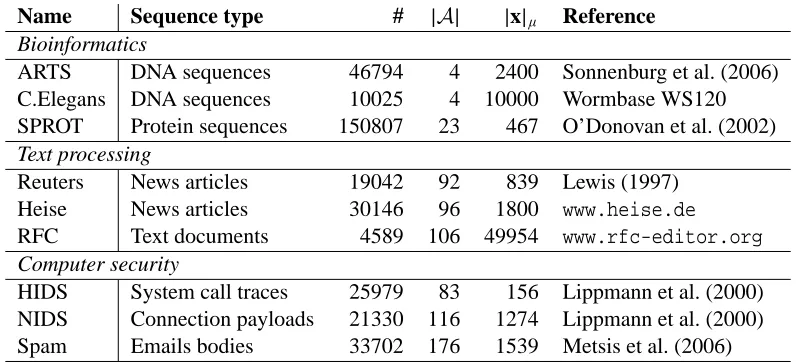
In order to evaluate the run-time performance of the proposed comparison algorithms in practice and to investigate the effect of different similarity measures on sequential data, we conducted experi-ments on real world sequences. We chose nine data sets from the domains of bioinformatics, text processing and computer security. Details about each data set, contained sequences and references are given in Table 5.
Name Sequence type # |A| |x|µ Reference
Bioinformatics
ARTS DNA sequences 46794 4 2400 Sonnenburg et al. (2006)
C.Elegans DNA sequences 10025 4 10000 Wormbase WS120
SPROT Protein sequences 150807 23 467 O’Donovan et al. (2002)
Text processing
Reuters News articles 19042 92 839 Lewis (1997)
Heise News articles 30146 96 1800 www.heise.de
RFC Text documents 4589 106 49954 www.rfc-editor.org
Computer security
HIDS System call traces 25979 83 156 Lippmann et al. (2000)
NIDS Connection payloads 21330 116 1274 Lippmann et al. (2000)
Spam Emails bodies 33702 176 1539 Metsis et al. (2006)
Table 5: Data sets of sequences. The number of sequences in each set is denoted by #, the alphabet size by|A|and the average sequence length by|x|µ.
5.1 Run-time Experiments
The linear-time algorithms presented in Section 4 build on data structures of increasing complexity and capability—sorted arrays are simple but limited in capabilities, tries are more involved, yet they do not cover all embedding languages and generalized suffix trees are relatively complex and support the full range of embedding languages. In practice, however, it is the absolute and not asymptotic run-time that matters. Since the absolute run-time is affected by hidden constant factors, depending on design and implementation of an algorithm, it can only be evaluated experimentally.
Therefore each algorithm was implemented using enhancements covered in implementation notes. In particular, for Algorithm 1 we incorporated 64-bit variables to realize a sorted 64-bit ar-ray, for Algorithm 2 we implemented a compact trie representation and for Algorithm 3 we used generalized suffix arrays in favor of suffix trees. For each of these algorithms we conducted experi-ments using different embedding languages to assess the run-time on the data sets given in Table 5.
We applied the following experimental procedure and averaged run-time over 10 individual runs: 500 sequences are randomly drawn from a data set and a 500×500 matrix is computed for the Manhattan distance using a chosen embedding language. The run-time of the matrix computation is measured and reported in pairwise comparisons per second. Note, that due to the symmetry of the Manhattan distance only(n2
1 2 3 4 5 6 7 8 103
104 105
Comparison of word k−grams (Heise)
operations per second
k−gram length Sorted 64−bit arrays Compact tries Generalized suffix array
1 2 3 4 5 6 7 8
103 104 105
Comparison of word k−grams (Reuters)
operations per second
k−gram length Sorted 64−bit arrays Compact tries Generalized suffix array
1 2 3 4 5 6 7 8
103 104 105
Comparison of word k−grams (RFC)
operations per second
k−gram length Sorted 64−bit arrays Compact tries Generalized suffix array
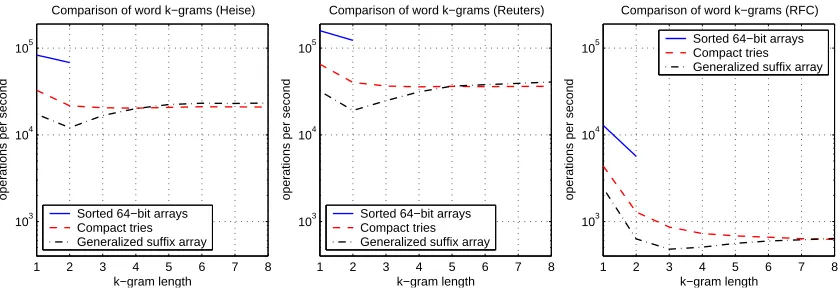
Figure 4: Run-time of sequences comparison over word k-grams for different algorithms. The x-axis gives the word k-gram lengths. The y-x-axis shows the number of comparison opera-tions per second in log-scale.
Embedding language: bag-of-words. As a first embedding language, we consider the
bag-of-words model. Since natural bag-of-words can be defined only for textual data, we limit the focus of this experiment to text data sets in Table 5. In particular, we use the embedding language of word
k-grams—covering the classic “bag of words” as word 1-grams—by using an alphabet of words
instead of characters. Each symbol of the alphabet is stored in 32 bits, so that up to 232 different words can be represented. Experiments are conducted for values of k ranging from 1 to 8.
Figure 4 shows the run-time performance of the implemented algorithms as a function of k on the Reuters, Heise and RFC data sets. The sorted array approach significantly outperforms the other algorithms on all data sets, yet it can only be applied for k≤2, as it is limited to 64 bits. For small values of k suffix arrays require more time for each comparison compared to compact tries, while for k>5 their performance is similar to compact tries. This difference is explained by the number of unique k-gramsνxin each sequence x. For small values of k often holdsνx<|x|, so that a trie comparison requires O(k(νx+νy)) time in contrast to O(|x| + |y|) for a suffix array. The worse run-time performance on the RFC data set is due to longer sequences.
Embedding language: k-grams. For this experiment we focus on the embedding language of
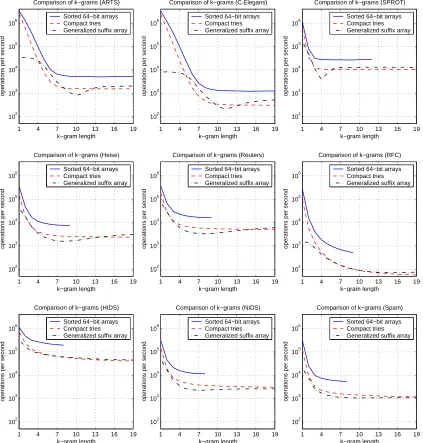
k-grams, which is not limited to a particular type of sequences, so that experiments were conducted for all data sets in Table 5. In contrast to the previous setup, k-grams are associated with the original alphabet of each data set: DNA bases and proteins for bioinformatics, characters for texts, and system calls and bytes for computer security. For each data set the value of k is varied from 1 to 19.
1 4 7 10 13 16 19 102 103 104 105 106
Comparison of k−grams (ARTS)
operations per second
k−gram length Sorted 64−bit arrays Compact tries Generalized suffix array
1 4 7 10 13 16 19
102 103 104 105 106
Comparison of k−grams (C.Elegans)
operations per second
k−gram length Sorted 64−bit arrays Compact tries Generalized suffix array
1 4 7 10 13 16 19
102 103 104 105 106
Comparison of k−grams (SPROT)
operations per second
k−gram length Sorted 64−bit arrays Compact tries Generalized suffix array
1 4 7 10 13 16 19
102 103 104 105 106
Comparison of k−grams (Heise)
operations per second
k−gram length Sorted 64−bit arrays Compact tries Generalized suffix array
1 4 7 10 13 16 19
102 103 104 105 106
Comparison of k−grams (Reuters)
operations per second
k−gram length Sorted 64−bit arrays Compact tries Generalized suffix array
1 4 7 10 13 16 19
102 103 104 105 106
Comparison of k−grams (RFC)
operations per second
k−gram length Sorted 64−bit arrays Compact tries Generalized suffix array
1 4 7 10 13 16 19
102 103 104 105 106
Comparison of k−grams (HIDS)
operations per second
k−gram length Sorted 64−bit arrays Compact tries Generalized suffix array
1 4 7 10 13 16 19
102 103 104 105 106
Comparison of k−grams (NIDS)
operations per second
k−gram length Sorted 64−bit arrays Compact tries Generalized suffix array
1 4 7 10 13 16 19
102 103 104 105 106
Comparison of k−grams (Spam)
operations per second
k−gram length Sorted 64−bit arrays Compact tries Generalized suffix array
are attainable, while for data sets with longer sequences (e.g., Spam, RFC) generally up to 103−104 comparisons per second are achievable at best.
5.2 Applications
We now demonstrate that the ability of our approach to compute diverse similarity measures is beneficial in real applications, especially in unsupervised learning scenarios. Our experiments are performed for: (a) categorization of news articles, (b) intrusion detection in network traffic (c) tran-scription start site recognition in DNA sequences.
Unsupervised text categorization. For this experiment news articles from the topics “Coffee”,
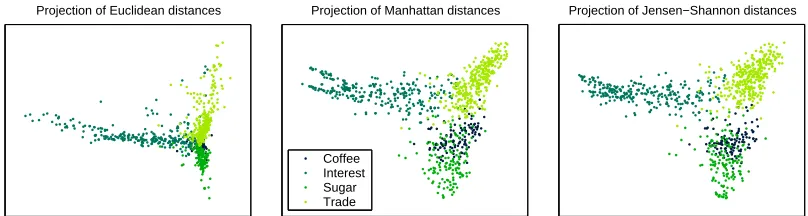
“Interest”, “Sugar” and “Trade” in the Reuters data set are selected. The learning task is to cate-gorize these articles using clustering, without any prior knowledge of labels. As preprocessing we remove all stop words and words that occur in single articles only. We then compute dissimilar-ity matrices for the Euclidean, Manhattan and Jensen-Shannon distances using the bag-of-words embedding language as discussed in Section 3. The embedded articles are finally assigned to four clusters using complete linkage clustering (see Duda et al., 2001).
Figure 6(a) shows projections of the embedded articles obtained from the dissimilarity matrices using multidimensional scaling (see Duda et al., 2001). Although projections are limited in describ-ing high-dimensional data, they visualize structure and, thus, help to interpret clusterdescrib-ing results. For example, the projection of the Euclidean distances in Figure 6(a) noticeably differs in shape compared to the Manhattan and Jensen-Shannon distances.
The cluster assignments are presented in Figure 6(b) and the distribution of topic labels among clusters is given in Figure 6(c). For the Euclidean distance the clustering fails to unveil features discriminative for article topics, as the majority of articles is assigned to a single cluster. In compar-ison, the Manhattan and Jensen-Shannon distance allow categorization of the topics “Coffee” and “Sugar”, due to observed high frequencies of respective words in articles. However, the Manhattan distance does no allow discrimination of the other two topics, as both are mixed among two clus-ters. The Jensen-Shannon distance enables better separation of all four topics. The topics “Coffee” and “Sugar” are almost perfectly assigned to clusters and the topics “Interest” and “Trade” each constitute the majority in a respective cluster.
Network intrusion detection. Network intrusion detection aims to automatically identify hacker
attacks in network traffic. As labels for such data are hard to obtain in practice, unsupervised learning has gained attention in intrusion detection research. The NIDS data set used for the run-time experiments (cf. Table 5) is known to contain major artifacts (see McHugh, 2000). In order to provide a fair investigation of the impact of various similarity measures on detection of attacks, we generated a smaller private data set. Normal traffic was recorded from the members of our laboratory by providing a virtual network. Additionally attacks were injected by a security expert.
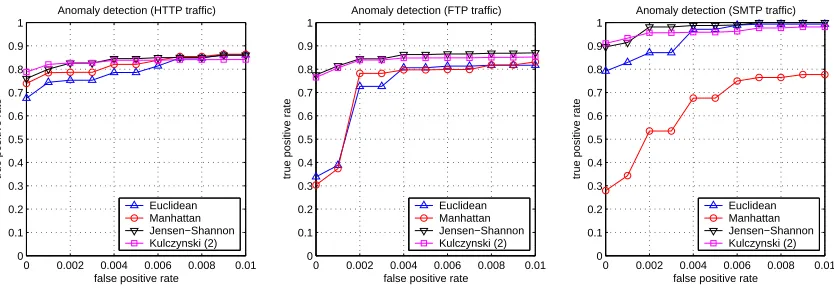
For this experiment we pursue an unsupervised learning approach to network intrusion detection (Rieck and Laskov, 2007). The incoming byte sequences of network connections are embedded using the language of 5-grams, and Zeta, an unsupervised anomaly detection method based on k-nearest neighbors, is applied over the following similarity measures: the Euclidean, Manhattan and Jensen-Shannon distance and the second Kulczynski coefficient (see Section 3.2).
Projection of Euclidean distances Projection of Manhattan distances
Coffee Interest Sugar Trade
Projection of Jensen−Shannon distances
(a) Projection of embedded articles with true topic label assignments
Clustering of Euclidean distances Clustering of Manhattan distances
Cluster 1 Cluster 2 Cluster 3 Cluster 4
Clustering of Jensen−Shannon distances
(b) Projection of embedded articles with cluster assignments
1 2 3 4
0 0.2 0.4 0.6 0.8 1
Clusters
Topic ratio
Topic ratio for Euclidean distance
1 2 3 4
0 0.1 0.2 0.3 0.4 0.5 0.6
Clusters
Topic ratio
Topic ratio for Manhattan distance
Coffee Interest Sugar Trade
1 2 3 4
0 0.1 0.2 0.3 0.4
Clusters
Topic ratio
Topic ratio for Jensen−Shannon distance
(c) Ratio of topic labels in clusters of embedded articles
Figure 6: Clustering of Reuters articles using different similarity measures (bag-of-words).
yield the highest detection accuracy. Over 78% of all attacks are identified with no false-positives in an unsupervised setup. In comparison, the Euclidean and Manhattan distance give significantly lower detection rates on the FTP and SMTP protocols. The poor detection performance of the latter two similarity measures emphasizes that choosing a discriminative similarity measure is crucial for achieving high accuracy in a particular application.
0 0.002 0.004 0.006 0.008 0.01 0 0.1 0.2 0.3 0.4 0.5 0.6 0.7 0.8 0.9 1
false positive rate
true positive rate
Anomaly detection (HTTP traffic)
Euclidean Manhattan Jensen−Shannon Kulczynski (2)
0 0.002 0.004 0.006 0.008 0.01 0 0.1 0.2 0.3 0.4 0.5 0.6 0.7 0.8 0.9 1
false positive rate
true positive rate
Anomaly detection (FTP traffic)
Euclidean Manhattan Jensen−Shannon Kulczynski (2)
0 0.002 0.004 0.006 0.008 0.01 0 0.1 0.2 0.3 0.4 0.5 0.6 0.7 0.8 0.9 1
false positive rate
true positive rate
Anomaly detection (SMTP traffic)
Euclidean Manhattan Jensen−Shannon Kulczynski (2)
Figure 7: ROC curves for unsupervised anomaly detection on 5-grams of network connections and attacks recorded at our laboratory.
0 0.02 0.04 0.06 0.08 0.1
0 0.1 0.2 0.3 0.4 0.5 0.6 0.7 0.8
Unsupervised TSS recognition
false positive rate
true positive rate
0 0.02 0.04 0.06 0.08 0.1
0 0.1 0.2 0.3 0.4 0.5 0.6 0.7 0.8
Supervised TSS recognition
false positive rate
true positive rate
Euclidean Manhattan Kulczynski Euclidean Manhattan Kulczynski
Figure 8: ROC curves for supervised and unsupervised recognition of transcription start sites (TSS) on 6-grams of DNA sequences (ARTS data set).
the data set. Each method is evaluated for the Euclidean distance, the Manhattan distance and the second Kulczynski coefficient. As only 10% of the sequences in the data set correspond to transcription start sites, we additionally apply the unsupervised outlier detection method Gamma (Harmeling et al., 2006), which is similar to the method employed in the previous experiment.
Figure 8 shows the performance achieved by the bagged k-nearest neighbor classifier and the unsupervised learning method.2 The accuracy in both setups strongly depends on the chosen sim-ilarity measures. The metric distances yield better accuracy in the supervised setup. The second Kulczynski coefficient and also the Manhattan distance perform significantly better than the Eu-clidean distance in unsupervised application. In the absence of labels these measures express better discriminative properties for TSS recognition, that are difficult to access through Euclidean dis-tances. For the supervised application, the classification performance is limited for all similarity
measures, as only some discriminative features for TSS recognition are encapsulated in k-gram models (cf. Sonnenburg et al., 2006).
6. Conclusions
The framework for comparison of sequences proposed in this article provides means for efficient computation of a large variety of similarity measures, including kernels, distances and non-metric similarity coefficients. The framework is based on embedding of sequences in a high-dimensional feature space using formal languages, such as k-grams, contiguous subsequences, etc. Three im-plementations of the proposed framework using different data structures have been discussed and experimentally evaluated.
Although all three data structures that were considered—sorted arrays, tries and generalized suffix trees—have asymptotically linear run-time, significant differences in the absolute run-time have been observed in our experiments. The constant factors are affected by various design issues illustrated by our remarks on implementation of the proposed algorithms. In general, we have observed a consistent trade-off between run-time efficiency and complexity of embedding languages a particular data structure can handle. Sorted arrays are the most efficient data structure; however, their applicability is limited to k-grams and bag-of-words models. On the other end of the spectrum are generalized suffix trees (and their more space-efficient implementation using suffix arrays) that can handle unrestricted embedding languages—at a cost of more complicated algorithms and lower efficiency. The optimal data structure for computation of similarity measures thus depends on the embedding language to be used in a particular application.
The proposed framework offers machine learning researchers an opportunity to use a large va-riety of similarity measures for applications that involve sequential data. Although an optimal sim-ilarity measure—as it is well known and has been also observed in our experiments—depends on a particular application, the technical means for seamless incorporation of various similarity mea-sures can be of great utility in practical applications of machine learning. Especially appealing is the possibility for efficient computation of non-Euclidean distances over embedded sequences, which extend applicable similarity measures for sequences beyond inner-products and kernel functions.
In general, the proposed framework demonstrates an important advantage of abstracting data representation—in the form of pairwise relationships—from learning algorithms, which will hope-fully motivate further investigation of learning algorithms using a general form of such abstraction.
Acknowledgments
The authors gratefully acknowledge the funding from Bundesministerium f¨ur Bildung und Forschung under the project MIND (FKZ 01-SC40A) and REMIND (FKZ 01-IS07007A). The authors would like to thank Klaus-Robert M¨uller, S¨oren Sonnenburg, Mikio Braun and Vojtech Franc for fruitful discussions and support.
References
M. Abouelhoda, S. Kurtz, and E. Ohlebusch. Replacing suffix trees with enhanced suffix arrays.
M. Anderberg. Cluster Analysis for Applications. Academic Press, Inc., New York, NY, USA, 1973.
B. Boser, I. Guyon, and V. Vapnik. A training algorithm for optimal margin classifiers. In D. Haus-sler, editor, Proceedings of COLT, pages 144–152. ACM Press, 1992.
W. B. Cavnar and J. M. Trenkle. N-gram-based text categorization. In Proceedings of SDAIR, pages 161–175, Las Vegas, NV, USA., Apr. 1994.
O. Chapelle, P. Haffner, and V. Vapnik. SVMs for histogram-based image classification. IEEE
Transaction on Neural Networks, 10(5):1055–1064, 1999.
V. Cherkassky, S. Xuhui, F. Mulier, and V. Vapnik. Model complexity control for regression using vc generalization bounds. IEEE Transactions on Neural Networks, 10(5):1075–1089, 1999.
M. Collins and N. Duffy. Convolution kernel for natural language. In Advances in Neural
Informa-tion Proccessing Systems, pages 625–632, 2002.
M. Damashek. Gauging similarity with n-grams: Language-independent categorization of text.
Science, 267(5199):843–848, 1995.
H. Drucker, D. Wu, and V. Vapnik. Support vector machines for spam categorization. IEEE
Trans-actions on Neural Networks, 10(5):1048–1054, 1999.
R. Duda, P.E.Hart, and D.G.Stork. Pattern Classification. John Wiley & Sons, second edition, 2001.
E. Fredkin. Trie memory. Communications of ACM, 3(9):490–499, 1960.
T. G¨artner, J. Lloyd, and P. Flach. Kernels and distances for structured data. Machine Learning, 57 (3):205–232, 2004.
T. Graepel, R. Herbrich, P. Bollmann-Sdorra, and K. Obermayer. Classification on pairwise prox-imity data. In Advances in Neural Information Processing Systems, volume 11, 1999.
D. Gusfield. Algorithms on Strings, Trees, and Sequences. Cambridge University Press, 1997.
B. Haasdonk. Feature space interpretation of svms with indefinite kernels. IEEE Transactions on
Pattern Analysis and Machine Intelligence, 27(4):482–492, 2005.
R. W. Hamming. Error-detecting and error-correcting codes. Bell System Technical Journal, 29(2): 147–160, 1950.
S. Harmeling, A. Ziehe, M. Kawanabe, and K.-R. M¨uller. Kernel-based nonlinear blind source separation. Neural Computation, 15:1089–1124, 2003.
S. Harmeling, G. Dornhege, D. Tax, F. C. Meinecke, and K.-R. M¨uller. From outliers to prototypes: ordering data. Neurocomputing, 69(13–15):1608–1618, 2006.
J. Hopcroft and J. Motwani, R. Ullmann. Introduction to Automata Theory, Languages, and
Com-putation. Addison-Wesley, 2 edition, 2001.
D. Jacobs, D. Weinshall, and Y. Gdalyahu. Classification with nonmetric distances: Image retrieval and class representation. IEEE Transactions on Pattern Analysis and Machine Intelligence, 22 (6):583–600, 2000.
T. Joachims. Learning to Classify Text using Support Vector Machines. Kluwer, 2002.
T. Joachims. Text categorization with support vector machines: Learning with many relevant fea-tures. In Proceedings of ECML, pages 137 – 142. Springer, 1998.
T. Kasai, H. Ariumar, and A. Setsuo. Efficient substring traversal with suffix arrays. Technical report, 185, Department of Informatics, Kyushu University, 2001a.
T. Kasai, G. Lee, H. Arimura, S. Arikawa, and K. Park. Linear-time longest-common-prefix com-putation in suffix arrays and its applications. In Combinatorial Pattern Matching (CPM), 12th
Annual Symposium, pages 181–192, 2001b.
D. Knuth. The Art of Computer Programming, volume 3. Addison-Wesley, 1973.
J. Laub and K.-R. M¨uller. Feature discovery in non-metric pairwise data. Journal of Machine
Learning, 5(Jul):801–818, July 2004.
J. Laub, V. Roth, J. Buhmann, and K.-R. M¨uller. On the information and representation of non-euclidean pairwise data. Pattern Recognition, 39(10):1815–1826, Oct. 2006.
C. Leslie and R. Kuang. Fast string kernels using inexact matching for protein sequences. Journal
of Machine Learning Research, 5:1435–1455, 2004.
C. Leslie, E. Eskin, and W. Noble. The spectrum kernel: A string kernel for SVM protein classifi-cation. In Proc. Pacific Symp. Biocomputing, pages 564–575, 2002.
C. Leslie, E. Eskin, A. Cohen, J. Weston, and W. Noble. Mismatch string kernel for discriminative protein classification. Bioinformatics, 1(1):1–10, 2003.
V. I. Levenshtein. Binary codes capable of correcting deletions, insertions, and reversals. Doklady
Akademii Nauk SSSR, 163(4):845–848, 1966.
D. Lewis. Reuters-21578 text categorization test collection. AT&T Labs Research, 1997.
L. Liao and W. Noble. Combining pairwise sequence similiarity and support vector machines for detecting remote protein evolutionary and structural relationships. Journal of Computational
Biology, 10:857–868, 2003.
R. Lippmann, J. Haines, D. Fried, J. Korba, and K. Das. The 1999 DARPA off-line intrusion detection evaluation. Computer Networks, 34(4):579–595, 2000.
H. Lodhi, C. Saunders, J. Shawe-Taylor, N. Cristianini, and C. Watkins. Text classification using string kernels. Journal of Machine Learning Research, 2:419–444, 2002.
U. Manber and G. Myers. Suffix arrays: a new method for on-line string searches. SIAM Journal
M. Maniscalco and S. Puglisi. An efficient, versatile approach to suffix sorting. Journal of
Experi-mental Algorithmics, 12, Article No. 1.2, 2007.
G. Manzini and P. Ferragina. Engineering a lightweight suffix array construction algorithm.
Algo-rithmica, 40:33–50, 2004.
W. Masek and M. Patterson. A faster algorithm for computing string edit distance. Journal of
Computer and System sciences, 20(1):18–31, 1980.
E. M. McCreight. A space-economical suffix tree construction algorithm. Journal of the ACM, 23 (2):262–272, 1976.
J. McHugh. Testing intrusion detection systems: a critique of the 1998 and 1999 DARPA intru-sion detection system evaluations as performed by Lincoln Laboratory. ACM Transactions on
Information Systems Security, 3(4):262–294, 2000.
V. Metsis, G. Androutsopoulos, and G. Paliouras. Spam filtering with naive bayes - which naive bayes? In Proc. of the 3rd Conference on Email and Anti-Spam (CEAS), 2006.
K.-R. M¨uller, S. Mika, G. R¨atsch, K. Tsuda, and B. Sch¨olkopf. An introduction to kernel-based learning algorithms. IEEE Neural Networks, 12(2):181–201, May 2001.
S. B. Needleman and C. D. Wunsch. A general method applicable to the search for similarties in the amino acid sequence of two proteins. Journal of Molecular Biology, 48:443–453, 1970.
F. Odone, A. Barla, and A. Verri. Building kernels from binary strings for image matching. IEEE
Transactions on Image Processing, 14(2):169–180, 2005.
C. O’Donovan, M. Martin, A. Gattiker, E. Gasteiger, A. Bairoch, and R. Apweiler. High-quality protein knowledge resource: SWISS-PROT and TrEMBL. Briefings in Bioinformatics, 3(3): 275–284, 2002.
C. Ong, X. Mary, S. Canu, and A. Smola. Learning with non-positive kernels. In R. Greiner and D. Schuurmans, editors, Proceedings of ICML, pages 639–646. ACM Press, 2004.
G. R¨atsch and S. Sonnenburg. Accurate splice site prediction for caenorhabditis elegans. In Kernel
Methods in Computational Biology, pages 277–298. MIT Press, 2004.
G. R¨atsch, S. Sonnenburg, J. Srinivasan, H. Witte, R. Sommer, K.-R. M¨uller, and B. Sch¨olkopf. Im-proving the c. elegans genome annotation using machine learning. PLoS Computational Biology, 3:e20, 2007.
K. Rieck and P. Laskov. Language models for detection of unknown attacks in network traffic.
Journal in Computer Virology, 2(4):243–256, 2007.
K. Rieck, P. Laskov, and S. Sonnenburg. Computation of similarity measures for sequential data using generalized suffix trees. In Advances in Neural Information Processing Systems 19, pages 1177–1184, Cambridge, MA, 2007. MIT Press.
V. Roth, J. Laub, M. Kawanabe, and J. Buhmann. Optimal cluster preserving embedding of non-metric proximity data. IEEE Trans. PAMI, 25:1540–1551, Dec. 2003.
J. Rousu and J. Shawe-Taylor. Efficient computation of gapped substring kernels for large alphabets.
Journal of Machine Leaning Research, 6:1323–1344, 2005.
G. Salton. Mathematics and information retrieval. Journal of Documentation, 35(1):1–29, 1979.
G. Salton, A. Wong, and C. Yang. A vector space model for automatic indexing. Communications
of the ACM, 18(11):613–620, 1975.
D. Sankoff and J. Kruskal. Time wraps, String edits, and Macromulecules: The Theory and Practice
of Sequence Comparison. Addision-Wesley Publishing Co., 1983.
B. Sch¨olkopf and A. Smola. Learning with Kernels. MIT Press, Cambridge, MA, 2002.
B. Sch¨olkopf, P. Simard, A. Smola, and V. Vapnik. Prior knowledge in support vector kernels. In
Advances in Neural Information Processing Systems, volume 10, pages 640–646, Cambridge,
MA, 1998a. MIT Press.
B. Sch¨olkopf, A. Smola, and K.-R. M¨uller. Nonlinear component analysis as a kernel eigenvalue problem. Neural Computation, 10:1299–1319, 1998b.
J. Shawe-Taylor and N. Cristianini. Kernel methods for pattern analysis. Cambridge University Press, 2004.
T. F. Smith and M. S. Waterman. Identification of common molecular subsequences. Journal of
Molecular Biology, 147:195–197, 1981.
R. Sokal and P. Sneath. Principles of Numerical Taxonomy. W.H. Freeman and Company, San Francisco, CA, USA, 1963.
S. Sonnenburg, A. Zien, and G. R¨atsch. ARTS: Accurate Recognition of Transcription Starts in Human. Bioinformatics, 22(14):e472–e480, 2006.
S. Sonnenburg, G. R¨atsch, and K. Rieck. Large scale learning with string kernels. In Large Scale
Kernel Machines. MIT Press, 2007.
C. Y. Suen. N-gram statistics for natural language understanding and text processing. IEEE Trans.
Pattern Analysis and Machine Intelligence, 1(2):164–172, Apr. 1979.
M. Swain and D. Ballard. Color indexing. International Journal of Computer Vision, 7(1), 1991.
C. Teo and S. Vishwanathan. Fast and space efficient string kernels using suffix arrays. In
Proceed-ings of ICML, pages 939–936. ACM Press, 2006.

![Figure 3: Generalized suffix tree for x = abbaa$1 and y = baaaab$2. The numbers in brackets ateach inner node v correspond to phi[v,1] and phi[v,2]](https://thumb-us.123doks.com/thumbv2/123dok_us/9830701.1969209/13.612.143.474.90.238/figure-generalized-sufx-baaaab-numbers-brackets-ateach-correspond.webp)