Open Access
Research article
Framingham Stroke Risk Profile and poor cognitive function: a
population-based study
David J Llewellyn*
1, Iain A Lang
2, Jing Xie
1, Felicia A Huppert
3,
David Melzer
2and Kenneth M Langa
4,5,6Address: 1Department of Public Health and Primary Care, University of Cambridge, Cambridge, UK, 2Public Health and Epidemiology Group,
Peninsula Medical School, Exeter, UK, 3Department of Psychiatry, University of Cambridge, Cambridge, UK, 4Department of Internal Medicine,
University of Michigan, Michigan, USA, 5Veterans Affairs Center for Practice Management and Outcomes Research, Michigan, USA and 6Institute
for Social Research, University of Michigan, Michigan, USA
Email: David J Llewellyn* - [email protected]; Iain A Lang - [email protected]; Jing Xie - [email protected]; Felicia A Huppert - [email protected]; David Melzer - [email protected]; Kenneth M Langa - [email protected] * Corresponding author
Abstract
Background: The relationship between stroke risk and cognitive function has not previously been examined in a large community living sample other than the Framingham cohort. The objective of this study was to examine the relationship between 10-year risk for incident stroke and cognitive function in a large population-based sample.
Methods: Participants were 7377 adults aged 50 years and over of the 2002 wave of the English Longitudinal Study of Ageing, a prospective cohort study. A modified version of the Framingham Stroke Risk Profile (incorporating age, sex, systolic blood pressure, antihypertensive medication, diabetes, smoking status, cardiovascular disease, and atrial fibrillation) was used to assess 10-year risk of stroke. Linear regression models were used to determine the cross-sectional relationship of stroke risk to global cognitive function and performance in multiple cognitive domains.
Results: In unadjusted models 10 percentage point increments of 10-year stroke risk were associated with poor global cognitive function (-0.40 SD units, 95% CI -0.43 – -0.38), and lowered performance in all cognitive domains. After statistical adjustment for age, sex, testing interval and other correlates of cognitive function the association with stroke risk was attenuated though remained significant for global cognitive function (-0.06 SD units, 95% CI -0.09 – -0.03), immediate and delayed verbal memory, semantic verbal fluency and processing speed.
Conclusion: In individuals free from a history of stroke or dementia, high subclinical cerebrovascular disease burden was associated with worse cognitive function in multiple domains.
Background
Risk factors for incident stroke such as smoking status and diabetes predispose older adults to brain atrophy, white matter abnormalities and silent cerebral infarction in
addition to clinical stroke, [1-4] and biological aging of the brain is partly attributable to aging of the cerebrovas-cular circulation and the effects of these vascerebrovas-cular changes on the brain.[5,6] Differences in subclinical cerebrovascu-Published: 22 April 2008
BMC Neurology 2008, 8:12 doi:10.1186/1471-2377-8-12
Received: 25 October 2007 Accepted: 22 April 2008
This article is available from: http://www.biomedcentral.com/1471-2377/8/12
© 2008 Llewellyn et al; licensee BioMed Central Ltd.
lar pathology may therefore help to explain the marked individual differences in cognitive function and rate of decline observed during late adulthood.[7,8] As Hachin-ski recently noted, the relationship between subclinical cerebrovascular pathology and cognition has effectively been neglected, and provides a great opportunity for pre-vention if implemented at the 'brain at risk' stage.[9]
Brady and colleagues[6] observed that the Framingham Stroke Risk Profile (FSRP),[10,11] a previously validated index of cerebrovascular disease burden, predicted 3-year semantic verbal fluency decline. Their analyses incorpo-rated 235 male Veterans Administration patients free of stroke or dementia, and they controlled for age, educa-tion, and baseline performance. However, they observed no association between stroke risk and decline in memory (including immediate and delayed verbal recall) or visual-spatial function. They argued that stroke risk factors may therefore have a particularly damaging effect on frontally mediated cognitive functions (e.g. semantic verbal flu-ency) in comparison with functions mediated by other brain regions (e.g. memory). Their study was limited by the small institutionalized male sample and the lack of adjustment for additional correlates of cognition.
Elias and colleagues discovered significant associations between a modified FSRP and a wide range of cognitive abilities (abstract reasoning, visual-spatial memory, visual organization, attention, visual scanning and tracking) in 1011 men and 1164 women free of dementia and stroke from the Framingham Offspring Study.[12] However, stroke risk was not significantly associated with verbal memory or paired associate learning. They adjusted for age, sex, education, depressed mood, alcohol consump-tion, BMI, and total serum cholesterol in their full covari-ate model. The sample was largely composed of highly educated individuals, and the authors argue that further research is necessary to extend this work to a more repre-sentative study population. Recent American Heart Asso-ciation and the American Stroke AssoAsso-ciation Stroke Council guidelines also stress the need for further research using the FSRP with groups other than the Framingham cohort.[13] Given that the main evidence linking stroke risk and cognitive function incorporates the same sample used for the development of the FSRP itself, further research is clearly needed to examine whether this associ-ation generalizes to an independent and more representa-tive cohort.
We used a modified version of the FSRP to study the rela-tionship between stroke risk and cognitive function. The major risk factors for stroke are combined and weighted to produce a convenient and cost-effective score that predicts the 10-year probability of incident stroke in stroke-free individuals. The FSRP is predictive of brain atrophy,[4]
which is in turn associated with an increased subsequent risk of dementia.[14,15] The relationship between the FSRP and cognition has not previously been examined in a large population-based sample other than the Framing-ham cohort itself. Our objective was to investigate whether stroke risk was associated with cognitive function in a large nationally representative population.
Methods
Subjects
Participants were from the 2002 wave of the English Lon-gitudinal Study of Ageing (ELSA) who were born between 1901 and 1952.[16] Following ethical approval from the Multicentre Research and Ethics Committee the ELSA sample was drawn from households participating in the Health Survey for England (HSE), a nationally represent-ative multi-stage stratified random sample of the commu-nity living English population. First, 1759 postcode sectors (geographic areas) were selected from the Post-code Address File, stratified by health authority and pro-portion of households in non-manual socioeconomic groups. Second, households were randomly selected, and a specified number of adults and children were deemed eligible for interview. Households were included in ELSA if one or more individuals living there was aged 50 or over. 11392 individuals took part in the HSE and ELSA and were eligible for the analysis. The final ELSA sample contained 708 additional respondents who had joined eligible households since HSE, though these individuals were precluded from our analyses. Comparison with cen-sus results suggests that the ELSA sample has the same demographic profile as the English community living population.[16] Information on all FSRP components was collected from a subsample of 7716 individuals. 339 (4%) participants with a history of clinical stroke or dementia were excluded. The remaining 7377 participants formed the sample for our analyses.
Stroke Risk Profile
dia-betes or use of a hypoglycaemic agent or insulin. Partici-pants were categorized as current cigarette smokers or not by current cigarette smoking status. Previous diagnoses of cardiovascular disease (defined here as coronary heart ease, congestive heart failure, or peripheral vascular dis-ease) and atrial fibrillation were also incorporated. We did not incorporate left ventricular hypertrophy in the present analysis as ECG data were not available. Risk of stroke was defined as the 10-year risk or predicted proba-bility of incident stroke expressed as a percentage.[11] Levels of 10-year stroke risk ranged from 3% to 68% for men and 1% to 84% for women.
Neuropsychological Test Battery
The neuropsychological tests incorporated in the 2002 wave of ELSA to assess cognition are summarized below and described in detail elsewhere.[17] Time orientation was assessed using questions from the Mini-Mental State Examination (MMSE).[18] Immediate and delayed verbal memory were assessed using a 10-word learning task from the Health and Retirement Study (HRS).[19] Ten com-mon words are presented aurally by computer at a rate of one word every 2 seconds. The sound level is adjusted to meet the requirements of each participant. Participants are then asked to recall as many words as possible imme-diately and again after a short delay during which they complete other cognitive tests. Four different randomly assigned word lists are used, and members of the same household are given different versions. Prospective mem-ory (or 'remembering to remember') was assessed by ask-ing participants to remember to write their initials in the top left corner of a page of a clipboard when it is handed to them later in the session (closely based on a task incor-porated in the MRC Cognitive Function and Ageing Study [MRC CFAS]),[20] and asking participants to remind the interviewer to record the time when the interviewer announces that the cognitive section is finished. Numer-acy was assessed using questions relating to simple calcu-lations based on everyday situations, and these items have also been incorporated in the HRS.[19] The semantic ver-bal fluency task was taken from the CAMCOG,[21] and examines how many animals people are able to name in one minute. The same task has been used in many other studies, including MRC CFAS. Attention and processing speed were assessed using the letter cancellation task from the MRC National Study of Health and Development.[22] Participants are asked to cross out as many of the 65 target letters (P and W) as possible in 1 minute on a page incor-porating 780 letters in a grid. The total number of letters searched provides a measure of processing speed. The ratio of correctly identified target letters to all target letters scanned provides a measure of search accuracy. As the scoring of each individual test varies, we standardized test scores to give a mean of 0 and a standard deviation of 1 (z-scores). We obtained a global cognitive function score
by standardizing the summed z-scores on all neuropsy-chological tests.
Statistical Analysis
Multivariable linear regression models were used to deter-mine the relationship of 10-year stroke risk to cognitive function and performance in multiple cognitive domains. We first examined unadjusted models. To facilitate inter-pretation we examined 10-year stroke risk (FSRP scores) in 10 percentage point increments. For basic adjustment we controlled for interval in years between blood pressure measurement and cognitive testing, and those elements of the FSRP that are not amenable to intervention (age and sex). In full covariate models we added additional corre-lates of cognitive function in order to examine whether 10-year stroke risk was independently predictive: educa-tion (school leaving age in years), socioeconomic status (based on National Statistics-socioeconomic classifica-tion 3 based occupaclassifica-tional categories: professional/mana-gerial, intermediate, routine/manual),[23] total net non-housing wealth, BMI (wt/ht2), alcohol consumption (g/
day), and depressive symptoms (> 3 depressive symptoms on the 8-item Center for Epidemiological Studies Depres-sion Scale [CESD]).[24,25] Analyses of FSRP components were undertaken to further explore their independence as risk factors. We conducted sensitivity analyses to adjust for total serum cholesterol (mmol/L) for a subsample of participants (n = 2746), and examine whether the same pattern of associations was observed for those with and without educational qualifications. Official ELSA weights were used to adjust for the survey design.[16] All statistical levels quoted (P values) are two-tailed. Data were ana-lyzed using Stata SE version 9.2.[26]
Results
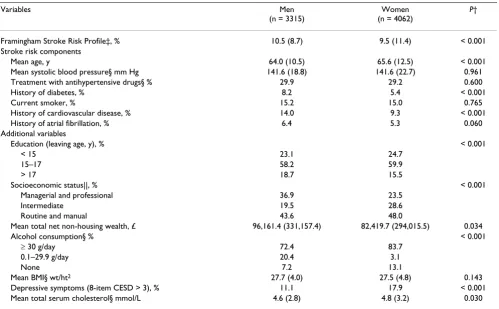
The characteristics of the study sample are described in Table 1. Men had a significantly higher 10-year risk of stroke than women, and were significantly younger than women. A greater proportion of men had diabetes and cardiovascular disease than women. Descriptive statistics for the neuropsychological tests are presented in Table 2. Women performed better on time orientation, immediate verbal memory, delayed verbal memory, and processing speed. Conversely men performed better on prospective memory, semantic verbal fluency, and numeracy.
and sex), though remained significant (β= -0.086, 95% CI -0.117 – -0.056, P < 0.001). Similarly in the fully adjusted model the association between stroke risk and cognitive function remained significant (β= -0.057, 95% CI -0.089
– -0.025, P < 0.001). The association between stroke risk and poor cognitive function observed was not simply due to the associations with age, sex and additional variables associated with cognition.
Table 1: Characteristics of the Study Population*
Variables Men
(n = 3315)
Women (n = 4062)
P†
Framingham Stroke Risk Profile‡, % 10.5 (8.7) 9.5 (11.4) < 0.001 Stroke risk components
Mean age, y 64.0 (10.5) 65.6 (12.5) < 0.001
Mean systolic blood pressure§ mm Hg 141.6 (18.8) 141.6 (22.7) 0.961
Treatment with antihypertensive drugs§ % 29.9 29.2 0.600
History of diabetes, % 8.2 5.4 < 0.001
Current smoker, % 15.2 15.0 0.765
History of cardiovascular disease, % 14.0 9.3 < 0.001
History of atrial fibrillation, % 6.4 5.3 0.060
Additional variables
Education (leaving age, y), % < 0.001
< 15 23.1 24.7
15–17 58.2 59.9
> 17 18.7 15.5
Socioeconomic status||, % < 0.001
Managerial and professional 36.9 23.5
Intermediate 19.5 28.6
Routine and manual 43.6 48.0
Mean total net non-housing wealth, £ 96,161.4 (331,157.4) 82,419.7 (294,015.5) 0.034
Alcohol consumption§ % < 0.001
≥ 30 g/day 72.4 83.7
0.1–29.9 g/day 20.4 3.1
None 7.2 13.1
Mean BMI§ wt/ht2 27.7 (4.0) 27.5 (4.8) 0.143
Depressive symptoms (8-item CESD > 3), % 11.1 17.9 < 0.001 Mean total serum cholesterol§ mmol/L 4.6 (2.8) 4.8 (3.2) 0.030
CESD indicates Center for Epidemiological Studies Depression Scale. Values are mean (SD) where appropriate. *339 persons with a history of stroke or dementia were excluded.
†P value for mean difference between men and women. ‡Excluding left ventricular hypertrophy.
§Variable derived from the Health Survey for England (HSE).
||Based on current or former occupation according to National Statistics-socioeconomic classification 3. [23]
Table 2: Neuropsychological Test Raw Scores*
Men (n = 3315) Women (n = 4062)
Cognitive Domain Range Mean SD Mean SD P†
Time orientation 0 – 4 3.67 0.69 3.73 0.61 < 0.001
Immediate verbal memory 0 – 10 5.38 1.76 5.50 1.75 0.002
Delayed verbal memory 0 – 10 3.92 2.08 4.07 2.11 0.001
Prospective memory 0 – 2 1.12 0.80 0.99 0.80 < 0.001
Semantic verbal fluency 0 – 8 19.94 6.39 18.83 6.20 < 0.001 Processing speed 0 – 780 295.26 92.71 317.30 96.11 < 0.001
Attention 0 – 1 0.79 0.14 0.79 0.14 0.957
Numeracy 0 – 6 4.31 1.35 3.58 1.33 < 0.001
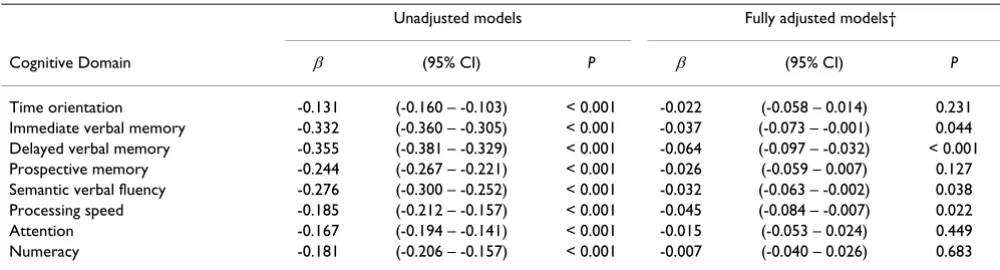
Performance in all individual cognitive domains was sig-nificantly associated with stroke risk in unadjusted linear regression models (Table 3). For example, each 10 per-centage point increment in 10-year stroke risk was associ-ated with a decrement of 0.355 SD for delayed verbal memory. In the full covariate models stroke risk remained significantly associated with immediate verbal memory, delayed verbal memory, semantic verbal fluency, and processing speed. As the range of values for prospective memory and time orientation were limited to a small number of discrete categories we calculated additional ordered logistic regression models, though this made no difference, and the pattern of results was not sensitive to the choice of model.
In order to further investigate which individual risk factors were driving the results, each of the FSRP components was related to global cognitive function. In an unadjusted lin-ear regression model all individual risk factors were inversely and significantly related to cognitive function (range, β= -0.152, P < 0.001 to β= -0.011, P = 0.03), with the exception of sex which was not significantly associated (β= 0.002, P = 0.904), and atrial fibrillation which was positively and significantly associated (β = 0.024, P = 0.003). In an adjusted model (also incorporating educa-tion, testing interval, socioeconomic status, total net non-housing wealth, BMI, alcohol consumption and depres-sive symptoms) age, diabetes, smoking, cardiovascular disease and sex (males higher) were inversely and signifi-cantly associated with cognitive function (range, β = -0.118, P < 0.001 to β= -0.031, P < 0.01). However, neither systolic blood pressure (β= -0.005, P = 0.286) nor atrial fibrillation (β= 0.015, P = 0.071) were significantly asso-ciated with cognitive function in the adjusted model.
Finally, sensitivity analyses to examine the robustness of our results showed that the same association between
stroke risk and cognitive function was observed when total cholesterol was also adjusted for in a subsample of participants. Analysing those with and without educa-tional qualifications separately also showed the same pat-tern of results. The association between stroke risk and cognitive function was not therefore limited to highly educated participants.
Discussion
Summary
In a large population-based cohort of English men and women with no prior history of dementia or stroke, we found a 10 percentage point increase in 10-year stroke risk was associated with a large decrement in global cognitive function (-0.40 SD units), and poor performance all cog-nitive domains. The association between stroke risk and cognitive function was not simply a reflection of age and sex as risk factors, lending support to the notion that the aggressive treatment of cerebrovascular risk factors may be effective in preserving cognitive health. In full covariate models (adjusted for age, sex, testing interval, socioeco-nomic status, total net non-housing wealth, BMI, alcohol consumption, and depressive symptoms) stroke risk remained significantly associated with global cognitive function, immediate and delayed verbal memory, seman-tic verbal fluency and processing speed.
Critique of methods
The strengths of our study include the large population-based sample and the wide range of neuropsychological tests incorporated. We used survey weights to adjust for the complex sampling design, and comparison with cen-sus results suggests that ELSA has the same demographic profile as the English community living population.[16] Practice or learning effects were not an issue as we exam-ined the first administration of these tests. We were also able to adjust for a wide range of potential confounders.
Table 3: Regression Coefficients Expressing Cognitive Function Decrements (in SD units) for Each 10 Percentage Point Increment in 10-Year Risk of Stroke*
Unadjusted models Fully adjusted models†
Cognitive Domain β (95% CI) P β (95% CI) P
Time orientation -0.131 (-0.160 – -0.103) < 0.001 -0.022 (-0.058 – 0.014) 0.231 Immediate verbal memory -0.332 (-0.360 – -0.305) < 0.001 -0.037 (-0.073 – -0.001) 0.044 Delayed verbal memory -0.355 (-0.381 – -0.329) < 0.001 -0.064 (-0.097 – -0.032) < 0.001 Prospective memory -0.244 (-0.267 – -0.221) < 0.001 -0.026 (-0.059 – 0.007) 0.127 Semantic verbal fluency -0.276 (-0.300 – -0.252) < 0.001 -0.032 (-0.063 – -0.002) 0.038 Processing speed -0.185 (-0.212 – -0.157) < 0.001 -0.045 (-0.084 – -0.007) 0.022 Attention -0.167 (-0.194 – -0.141) < 0.001 -0.015 (-0.053 – 0.024) 0.449 Numeracy -0.181 (-0.206 – -0.157) < 0.001 -0.007 (-0.040 – 0.026) 0.683
Pooled data are shown as sex-specific analyses gave similar results. Persons with a history of stroke or dementia were excluded. *Modified Framingham Stroke Risk Profile excluding left ventricular hypertrophy.
As many of the risk factors for poor cognition are also risk factors for stroke,[9] this may have misleadingly attenu-ated the relationship between stroke risk and cognitive function. However, the inverse association observed remained significant even in the full covariate model, sug-gesting that stroke risk is robustly and independently associated with levels of cognitive function.
Our analyses were restricted to community living individ-uals. However, dementia is highly prevalent in institu-tional care in England,[27] and as we excluded individuals with a history of dementia many of these indi-viduals would have been excluded. The possibility of residual confounding and the cross-sectional design pre-clude us from making definitive conclusions about causal-ity, and the reliance on self-reported diagnosed medical conditions (including stroke and dementia) is also a lim-itation. There was evidence for a ceiling effect with the time orientation questions, which may have attenuated their association with the FSRP. As ECG data were not available we did not incorporate left ventricular hypertro-phy in the present analyses. However, the prevalence of left ventricular hypertrophy is very low,[28] it is given lit-tle weighting in the FSRP,[10,11] and the association between left ventricular mass and cognition is rendered non-significant after adjustment for cardiovascular risk factors and cardiovascular disease.[29]
Results in comparison with literature
FSRP scores observed in the present analyses were higher than those observed by Elias and colleagues,[12] as in comparison the ELSA cohort was slightly older, had higher mean systolic blood pressure, and a higher propor-tion of current smokers. Our results are consistent with their results suggesting that after adjustment for age, sex, education and other correlates of cognition 10-year stroke risk is associated with poor cognition in multiple domains. These findings run contrary to a small longitu-dinal study of institutionalized males.[6] suggesting that the association between cognition and stroke risk is con-fined to semantic verbal fluency (or frontally mediated forms of cognition). It appears that stroke risk is associ-ated with cognition in multiple cognitive domains, even after adjustment for a wide range of potential confound-ers.
Our findings are also consistent with a broader body of research suggesting that individual risk factors for stroke are associated with cognitive function.[9] While the neu-ropsychological tests incorporated in our analyses differ from those used by Elias and colleagues, both studies included measures of processing speed that were associ-ated with stroke risk in full covariate models. While we observed an association with verbal memory, Elias and colleagues did not. This may reflect differences in the
ver-bal memory tasks incorporated, as we incorporated a list learning task and Elias and colleagues included a para-graph recall task. Age, sex, education, BMI, alcohol con-sumption, and depressive symptoms were adjusted for in the full covariate models of both studies. Elias and col-leagues adjusted for total serum cholesterol, while we adjusted for this in a sensitivity analysis with a subsample of individuals. Elias and colleagues' sample was largely comprised of highly educated individuals, whereas the ELSA sample is more diverse and shares the same sociode-mographic profile as the community living population. Our study therefore extends our understanding of the rela-tionship between stroke risk and cognitive function by demonstrating that it is not restricted to highly educated individuals or the cohort used to develop the FSRP itself. This study is also the first to incorporate additional adjust-ment for socioeconomic status and wealth, which are well established correlates of cognitive function.[30]
Subclinical cerebrovascular disease may provide an important link between the major risk factors for stroke and cognition. Brain atrophy, white matter abnormalities and silent cerebral infarction are possible mechanisms underlying the association between stroke risk and cogni-tive function. [1-4] For example, the FSRP has been shown to predict brain atrophy,[4] which is in turn associated with an increased subsequent risk of dementia.[14,15] In the population-based Rotterdam Scan Study white matter hyperintensities, generalized brain atrophy, and brain inf-arcts on MRI were associated with steeper decline in processing speed and executive function during 5.2 years mean follow-up.[31] After excluding participants with an incident stroke several associations were no longer signif-icant, suggesting that stroke risk is predictive of decline in processing speed and executive function. Similarly, in a 3-year prospective study of 554 subjects,[32] periventricular white matter hyperintensity volume at baseline predicted longitudinal decline in processing speed.
Conclusion
In summary, this is the first study to examine the relation-ship between stroke risk and cognitive function in a large population-based sample in a cohort other that that used to develop the FSRP itself. Our findings are important as they suggest that risk of stroke is robustly associated with cognitive function in stroke- and dementia-free individu-als, likely reflecting differences in subclinical cerebrovas-cular pathology. Stroke risk remained significantly associated with cognitive function in multiple domains even after adjustment for a wide range of factors correlated with cognition.
vul-nerable older adults at the 'brain at risk' stage,[9] and further research is needed to establish whether the tar-geted aggressive treatment of cerebrovascular risk factors is an effective preventative strategy for cognitive decline.
Competing interests
The authors declare that they have no competing interests.
Authors' contributions
DL, IAL, DM and KML conceived of the study. DL acquired the data and DL and JX conducted the statistical analysis. DL, IAL, FAH, DM and KML participated in the management, analysis, interpretation of data, and draft-ing of the manuscript. All have critically revised the man-uscript for important intellectual content and seen and approved the final version.
Acknowledgements
ELSA is funded by the US National Institute on Aging (NIA) and a consor-tium of UK Government departments. Dr Llewellyn was supported by grants from the Health Foundation (543/2216) and the Isaac Newton Trust. Dr Lang is an Academic Speciality Registrar in Public Health supported by the NHS South-West Region Public Health Training Scheme. Dr Langa was supported by grants from the NIA (K08 AG019180 and R01 AG027010) and a Paul Beeson Physician Faculty Scholars in Aging Research award.
References
1. Vermeer SE, Prins ND, den Heijer T, Hofman A, Koudstaal PJ, Breteler MM: Silent brain infarcts and the risk of dementia and cognitive decline. The New England journal of medicine 2003,
348(13):1215-1222.
2. DeCarli C, Miller BL, Swan GE, Reed T, Wolf PA, Garner J, Jack L, Carmelli D: Predictors of brain morphology for the men of the NHLBI twin study. Stroke; a journal of cerebral circulation 1999,
30(3):529-536.
3. Desmond DW: Cognition and white matter lesions. Cerebrovas-cular diseases (Basel, Switzerland) 2002, 13 Suppl 2:53-57.
4. Seshadri S, Wolf PA, Beiser A, Elias MF, Au R, Kase CS, D'Agostino RB, DeCarli C: Stroke risk profile, brain volume, and cognitive function: the Framingham Offspring Study. Neurology 2004,
63(9):1591-1599.
5. Seshadri S: Methodology for measuring cerebrovascular dis-ease burden. International review of psychiatry (Abingdon, England)
2006, 18(5):409-422.
6. Brady CB, Spiro A 3rd, McGlinchey-Berroth R, Milberg W, Gaziano JM: Stroke risk predicts verbal fluency decline in healthy older men: evidence from the normative aging study. The journals of gerontology 2001, 56(6):P340-6.
7. Martins CA, Oulhaj A, de Jager CA, Williams JH: APOE alleles pre-dict the rate of cognitive decline in Alzheimer disease: a non-linear model. Neurology 2005, 65(12):1888-1893.
8. Binetti G, Locascio JJ, Corkin S, Vonsattel JP, Growdon JH: Differ-ences between Pick disease and Alzheimer disease in clinical appearance and rate of cognitive decline. Archives of neurology
2000, 57(2):225-232.
9. Hachinski V: The 2005 Thomas Willis Lecture: stroke and vas-cular cognitive impairment: a transdisciplinary, translational and transactional approach. Stroke; a journal of cerebral circulation
2007, 38(4):1396.
10. Wolf PA, D'Agostino RB, Belanger AJ, Kannel WB: Probability of stroke: a risk profile from the Framingham Study. Stroke; a journal of cerebral circulation 1991, 22(3):312-318.
11. D'Agostino RB, Wolf PA, Belanger AJ, Kannel WB: Stroke risk pro-file: adjustment for antihypertensive medication. The Fram-ingham Study. Stroke; a journal of cerebral circulation 1994,
25(1):40-43.
12. Elias MF, Sullivan LM, D'Agostino RB, Elias PK, Beiser A, Au R, Ses-hadri S, DeCarli C, Wolf PA: Framingham stroke risk profile and lowered cognitive performance. Stroke; a journal of cerebral circu-lation 2004, 35(2):404-409.
13. Goldstein LB, Adams R, Alberts MJ, Appel LJ, Brass LM, Bushnell CD, Culebras A, Degraba TJ, Gorelick PB, Guyton JR, Hart RG, Howard G, Kelly-Hayes M, Nixon JV, Sacco RL: Primary prevention of ischemic stroke: a guideline from the American Heart Asso-ciation/American Stroke Association Stroke Council: cosponsored by the Atherosclerotic Peripheral Vascular Dis-ease Interdisciplinary Working Group; Cardiovascular Nurs-ing Council; Clinical Cardiology Council; Nutrition, Physical Activity, and Metabolism Council; and the Quality of Care and Outcomes Research Interdisciplinary Working Group: the American Academy of Neurology affirms the value of this guideline. Stroke; a journal of cerebral circulation 2006,
37(6):1583-1633.
14. Erten-Lyons D, Howieson D, Moore MM, Quinn J, Sexton G, Silbert L, Kaye J: Brain volume loss in MCI predicts dementia. Neurol-ogy 2006, 66(2):233-235.
15. den Heijer T, Geerlings MI, Hoebeek FE, Hofman A, Koudstaal PJ, Breteler MM: Use of hippocampal and amygdalar volumes on magnetic resonance imaging to predict dementia in cogni-tively intact elderly people. Archives of general psychiatry 2006,
63(1):57-62.
16. Taylor R, Conway L, Calderwood L, Lessof C: Methodology. In
Health, wealth and lifestyles of the older population in England: The 2002 English Longitudinal Study of Ageing Edited by: Marmot M, Banks J, Blun-dell R, Lessof C, Nazroo J. London , Institute of Fiscal Studies; 2003:357-374.
17. Huppert FA, Gardener E, McWilliams B: Cognitive function. In
Retirement, health and relationships of the older population in England: the 2004 English longitudinal study of ageing (Wave 2) Edited by: Banks J, Breeze E, Lessof C, Nazroo J. London , Institute for Fiscal Studies; 2006:217-242.
18. Folstein MF, Folstein SE, McHugh PR: "Mini-mental state". A practical method for grading the cognitive state of patients for the clinician. Journal of psychiatric research 1975, 12(3):189-198. 19. Ofstedal MB, Fisher GG, Herzog AR: Documentation of Cogni-tive Functioning Measures in the Health and Retirement Study. [http://hrsonline.isr.umich.edu/docs/userg/dr-006.pdf]. 20. Huppert FA, Johnson T, Nickson J: High prevalence of
prospec-tive memory impairment in the elderly and in early-stage dementia: Findings from a population-based study. Applied Cognitive Psychology 2000, 14(7):S63-S81.
21. Roth M, Tym E, Mountjoy CQ, Huppert FA, Hendrie H, Verma S, Goddard R: CAMDEX. A standardised instrument for the diagnosis of mental disorder in the elderly with special refer-ence to the early detection of dementia. Br J Psychiatry 1986,
149:698-709.
22. Richards M, Kuh D, Hardy R, Wadsworth M: Lifetime cognitive function and timing of the natural menopause. Neurology 1999,
53(2):308-314.
23. Office for National Statistics: The National Statistics socio-eco-nomic classification. User manual. Basingstoke , Palgrave Mac-millan; 2005.
24. Cornoni-Huntley J, Ostfeld AM, Taylor JO, Wallace RB, Blazer D, Berkman LF, Evans DA, Kohout FJ, Lemke JH, Scherr PA, Korper SP:
Established populations for epidemiologic studies of the eld-erly: study design and methodology. Aging (Milan, Italy) 1993,
5(1):27-37.
25. Fechner-Bates S, Coyne JC, Schwenk TL: The relationship of self-reported distress to depressive disorders and other psycho-pathology. Journal of consulting and clinical psychology 1994,
62(3):550-559.
26. StataCorp: Stata Statistical Software: Release 9.2. College Sta-tion , StataCorp LP; 2005.
27. Matthews FE, Dening T: Prevalence of dementia in institutional care. Lancet 2002, 360(9328):225-226.
28. Drazner MH, Dries DL, Peshock RM, Cooper RS, Klassen C, Kazi F, Willett D, Victor RG: Left ventricular hypertrophy is more prevalent in blacks than whites in the general population: the Dallas Heart Study. Hypertension 2005, 46(1):124-129. 29. Elias MF, Sullivan LM, Elias PK, D'Agostino RB Sr., Wolf PA, Seshadri
pres-Publish with BioMed Central and every scientist can read your work free of charge
"BioMed Central will be the most significant development for disseminating the results of biomedical researc h in our lifetime."
Sir Paul Nurse, Cancer Research UK
Your research papers will be:
available free of charge to the entire biomedical community
peer reviewed and published immediately upon acceptance
cited in PubMed and archived on PubMed Central
yours — you keep the copyright
Submit your manuscript here:
http://www.biomedcentral.com/info/publishing_adv.asp
BioMedcentral sure, and lowered cognitive performance in the
Framing-ham offspring. Hypertension 2007, 49(3):439-445.
30. Hendrie HC, Albert MS, Butters MA, Gao S, Knopman DS, Launer LJ, Yaffe K, Cuthbert BN, Edwards E, Wagster MV: The NIH Cogni-tive and Emotional Health Project: Report of the Critical Evaluation Study Committee . Alzheimer's & Dementia 2006,
2(1):12-32.
31. Prins ND, van Dijk EJ, den Heijer T, Vermeer SE, Jolles J, Koudstaal PJ, Hofman A, Breteler MM: Cerebral small-vessel disease and decline in information processing speed, executive function and memory. Brain 2005, 128(9):2034-2041.
32. van den Heuvel DM, ten Dam VH, de Craen AJ, Admiraal-Behloul F, Olofsen H, Bollen EL, Jolles J, Murray HM, Blauw GJ, Westendorp RG, van Buchem MA: Increase in periventricular white matter hyperintensities parallels decline in mental processing speed in a non-demented elderly population. Journal of neurology, neu-rosurgery, and psychiatry 2006, 77(2):149-153.
Pre-publication history
The pre-publication history for this paper can be accessed here: