Open Access
Methodology
A novel fluorescent pH probe for expression in plants
Alexander Schulte
1,2, Inken Lorenzen
2, Markus Böttcher
3,4and
Christoph Plieth*
1Address: 1Zentrum für Biochemie und Molekularbiologie, Universität Kiel, Am Botanischen Garten 9, 24118 Kiel, Germany, 2Biochemisches Institut, Universität Kiel, Rudolf-Höber-Str. 1, 24098 Kiel, Germany, 3Botanisches Institut, Universität Kiel, Am Botanischen Garten 9, 24118 Kiel, Germany and 4Institut für Physiologie, Universität zu Lübeck, Ratzeburger Allee 160, 23538 Lübeck, Germany
Email: Alexander Schulte - [email protected]; Inken Lorenzen - [email protected]; Markus Böttcher - [email protected]; Christoph Plieth* - [email protected]
* Corresponding author
Abstract
Background: The pH is an important parameter controlling many metabolic and signalling pathways in living cells. Recombinant fluorescent pH indicators (pHluorins) have come into vogue for monitoring cellular pH. They are derived from the most popular Aequorea victoria GFP (Av-GFP). Here, we present a novel fluorescent pH reporter protein from the orange seapen Ptilosarcus gurneyi (Pt-GFP) and compare its properties with pHluorins for expression and use in plants.
Results: pHluorins have a higher pH-sensitivity. However, Pt-GFP has a broader pH-responsiveness, an excellent dynamic ratio range and a better acid stability. We demonstrate how Pt-GFP expressing Arabidopsis thaliana report cytosolic pH-clamp and changes of cytosolic pH in the response to anoxia and salt-stress.
Conclusion: Pt-GFP appears to be the better choice when used for in vivo-recording of cellular pH in plants.
Introduction
Fluorescent proteins have revolutionized the understand-ing of cellular event cascades, signal transduction, and structure dynamics [1,2]. The green fluorescent protein from Aequorea victoria (Av-GFP) is the most popular spe-cies used by scientists to date. Av-GFP and its correspond-ing cDNA has been altered many times to give fluorescent proteins of higher quantum efficiency, different spectral characteristics, less temperature sensitivity, improved sol-ubility, and higher expression levels in other organisms [e.g. [3,4]]. Enhanced variants of Av-GFP are frequently used to decorate cellular structures and proteins in order to observe shape, location and dynamics in vivo [e.g.
[5-12]] or to visualize gene expression and/or activity of pro-moters or enhancers [13].
One of the advantages of GFPs is their ability to be engi-neered to indicators for cellular signal transduction stud-ies [e.g. [14-16]]. Engineered GFPs have been used in plants to report cellular concentrations of Ca2+, H+, Cl-,
and NO3- [e.g. [17-23]]. No loading of the indicator is
nec-essary with GFP-based probes and they can be precisely targeted to almost any organelle, compartment or tissue in question [e.g. [8,9,11,12,24]]. This potentially makes GFP-derived probes superior to small molecular weight fluorescent dyes used as ion indicators provided they can
Published: 06 April 2006
Plant Methods 2006, 2:7 doi:10.1186/1746-4811-2-7
Received: 19 January 2006 Accepted: 06 April 2006
This article is available from: http://www.plantmethods.com/content/2/1/7
© 2006 Schulte et al; licensee BioMed Central Ltd.
replicate the sensitivity and responsiveness of these probes.
In particular two pH-sensitive variants of Av-GFP (so-called pHluorins) have been engineered [25]. These two reporters are called 'ratiometric' and 'ecliptic' pHluorin. They both allow ratiometric in vivo-pH recording. Ratio-metric pHluorin is a double excitation indicator whereas ecliptic pHluorin has to be used in the double emission mode [21]. The amendments necessary for sufficient expression of Av-GFPs in plants (i.e. removal of the cryptic intron, changes to A. thaliana codon usage and improve-ment of solubility) have been combined with the proper-ties of pHluorins. The resulting pH indicators have been successfully expressed and used in Arabidopsis [21,26,27].
However, more and more fluorescent proteins (FPs) from other marine organisms are being discovered with other interesting properties [28-35]. Some of these newly dis-covered FPs unveil advantages when compared with Av -GFP variants. We have expressed the -GFP from the orange seapen (Ptilosarcus gurneyi) in bacteria and plants. Here, we compare ratiometric properties of Pt-GFP with those of pHluorins and also with conventional fluorescent dyes often used for ratiometric pH measurements in vivo.
The spectrum of a fluorescent ratiometric indicator is in a first approach mainly the sum or overlap of two spectra [36]: First, the spectrum of the free indicator (in case of pH indicators the de-protonated form) and second the spec-trum of the bound (protonated) indicator molecules. There are further two different effects on the fluorescence of pH indicators which need to be distinguished when the pH is lowered: First a fluorescence quenching at all wave-lengths. Second, the spectral disproportionation (i.e. the attenuation of the spectrum from de-protonated indicator for the benefit of the fluorescence spectrum formed by the protonated molecules). Ratiometric fluorescence meas-urements have been established to cancel down all side-effects based on variations in indicator concentration, illumination intensity, detector sensitivity etc. [37,38]. So, only the second effect, namely spectral disproportiona-tion is essential and relevant for ratiometry and, in theory, the ratio solely correlates with the analyte concentration (here [H+]). A quenching at all wavelengths can be
consid-ered an apparent decrease in indicator concentration and is thus irrelevant for ratiometry.
Here all spectra are presented normalized by their area for three reasons: First, this is a way to uncover all spectral effects relevant for ratiometric measurements. Second, it is the optimal way to present the potential capabilities of the indicator (i.e. best pair of wavelengths, dynamic ratiomet-ric change etc.) when intended for ratiometry and/or ratio
imaging. Third, it does not require an a-priori-knowledge of the isosbestic point.
By calculating the so-called minimax spectrum (i.e. the spectrum that is obtained when the minimum fluores-cence is substracted from the maximum fluoresfluores-cence at each wavelength within a scanned set of spectra) it is pos-sible to derive two important indicator characteristics: First, the real isosbestic point is the wavelength where the fluorescence is independent from spectral disproportion-ation. Here, the minimax spectrum, in theory, is zero with discontinuous slope, but, in practice, approaches a mini-mum close to zero. Second, the sensitivity of the indicator which is defined here as the integral of the minimax spec-trum. The sensitivity is a number in the range between zero and two. It is two when there is no spectral overlap of the protonated and the de-protonated form of the indica-tor (ideal ratiometric indicaindica-tor). It approaches zero when the indicator is less suitable for ratiometry. Consequently, the normalized spectra give the real isosbestic point while in the raw data spectra (not given here) this point is shifted by the superposed quench effect and is then distin-guished here as 'apparent' isosbestic point.
Results & Discussion
Spectral properties of recombinant pH indicators
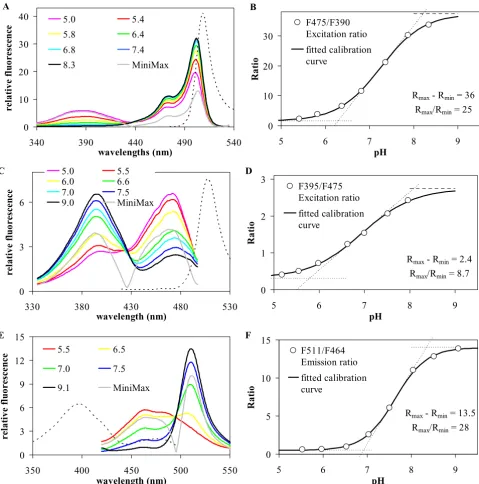
Ratiometric fluorescent indicators are typically character-ized by a set of fluorescence spectra taken under different analyte concentrations (here: different pH values) and otherwise identical conditions. The normalized spectra (coloured curves in Figure 1) allow to calculate the mini-max spectrum (grey lines in Figure 1) and to extract a number of characteristic parameters which give clues about signal quality, signal-to-noise ratio, sensitivity, and the best application range of the indicator and about the optimal optical setting when used in vivo. The parameters most relevant for practical work are:
1 The isosbestic points λiso (precisely, the isoexcitation
points in case of a double excitation probe or the isoemis-sion points in case of a double emisisoemis-sion probe) are the wavelengths where the fluorescence is independent of the indicated analyte (ion) concentration. Here, the real isos-bestic point is distinguished from the apparent isosisos-bestic point.
2 Spectral peaks or shoulders left (λ1) and right (λ2) of the
isosbestic point λiso which vary in opposite direction when the analyte concentration is changed.
Fluorescence properties of genetically encoded pH-indicators Figure 1
Fluorescence properties of genetically encoded pH-indicators. Spectra taken at different pHs are given for Pt-GFP (A), ratio-metric pHluorin (C) and ecliptic pHluorin (E). Corresponding ratio curves are on the right hand side (B, D, F). A: Excitation spectra of Pt-GFP at λem = 540 nm. The dotted line represents the emission spectrum (λex = 470 nm) corresponding to pH = 7.4. B: Dependency of fluorescence excitation ratios R(475ex/390ex; 540em) of PtGFP on pH. C: Excitation spectra of ratio-metric pHluorin at λem = 508 nm. The dotted line represents the emission spectrum (λex = 390 nm) corresponding to pH 7.5. D: Dependency of fluorescence excitation ratios R(395ex/475ex; 508em) of ratiometric pHluorin on pH. E: Emission spectra of ecliptic pHluorin taken at different pH (λex = 400 nm). The dotted line represents the excitation spectrum (λem = 508 nm) corresponding to pH 7.5. F: Dependency of fluorescence excitation ratios R(400ex; 511em/464em) of ecliptic pHluorin on pH. All spectra are normalized by their area. The grey curve in each set of spectra (A, C, E) represents the corresponding mini-max spectrum (mini-maximum fluorescence difference for each wavelength). Its minimum designates the isosbestic point. Ratio data (B, D, F) were fitted with a sigmoidal Boltzmann fit.
0 10 20 30 40
340 390 440 490 540
wavelengths (nm)
rel
a
ti
v
e fl
uo
res
cenc
e 5.0 5.4
5.8 6.4
6.8 7.4
8.3 MiniMax
A
0 10 20 30
5 6 7 8 9
pH
Rat
io
F475/F390 Excitation ratio
fitted calibration curve
B
Rmax - Rmin = 36 Rmax/Rmin = 25
0 3 6
330 380 430 480 530
wavelength (nm)
rel
a
ti
v
e f
luo
res
ce
nce
5.0 5.5
6.0 6.6
7.0 7.5
9.0 MiniMax
C
0 1 2 3
5 6 7 8 9
pH
Rat
io
F395/F475 Excitation ratio
fitted calibration curve
D
Rmax - Rmin = 2.4 Rmax/Rmin = 8.7
0 3 6 9 12 15
350 400 450 500 550
wavelength (nm)
rel
a
ti
v
e f
luo
res
cence
5.5 6.5
7.0 7.5
9.1 MiniMax
E
0 5 10 15
5 6 7 8 9
pH
Rat
io
F511/F464 Emission ratio
fitted calibration curve
F
Rmax - Rmin = 13.5
4 The Stokes-shift of a fluorescent probe is defined by the difference between the wavelength of its absorption peak (Figure 2) and the wavelength of its emission peak (Figure 1).
5 The maximum and minimum ratios, Rmax and Rmin (i.e. the ratios taken in the absence of the analyte or when the indicator is saturated with analyte).
6 The apparent pK (i.e. midpoint of the calibration curve where the ratio reaches half maximum between Rmin and Rmax) is dependent on the ratiometric wavelengths chosen
(see supplemental data in additional file 1). Ideally, the apparent pK is about the dissociation constant which is defined by the analyte concentration where the indicator is half-saturated.
7 The useful concentration range (x-axis range) in which the indicator is reasonably applied and where the loga-rithm of the ratio depends approximately linear on the logarithm of analyte concentration. In the case of pH-indicators this range is given by the pH values where the straight line through the midpoint of the logarithmic cal-ibration curve intersects with log(Rmax) and log(Rmin) (Figure 3).
8 The sensitivity S of the indicator is defined here (see introduction section) by the area or integral of the mini-max spectrum. The sensitivity is excellent when S > 0.5 (Table 1) and it is negligible when S < 0.1 (Table 4).
The parameters for the three pH-reporter proteins dis-cussed here, namely Pt-GFP, ratiometric, and ecliptic pHluorin are given for comparison in Tables 1 and 2. Spectra and calibration curves are depicted in Figure 1. Parameters of some chemical fluorescent dyes often used as ratiometric in vivo pH indicators are given for further comparison in an additional file (Table).
When doing ratio imaging, a maximum dynamic fluores-cence ratio range (i.e. a maximum fold fluoresfluores-cence ratio increase Rmax/Rmin) is desired in order to gain an optimal signal to noise ratio. However, the experimental condi-tions – in particular the spectral characteristics of the available filter set and/or dichroic mirror – are often not optimised for the ratiometric probe in use or the Stokes-shift of the indicator is too small for reliably separating fluorescence emission from excitation light. In case of
Pt-GFP, for instance, the Stokes-shift is just 6 nm (i.e. right excitation peak λ2 = 502 nm; maximum emission λmax = 508 nm; see Table 1). This is too close to be separated by conventional microscopic filter sets. Hence, wavelengths other than those giving the maximum dynamic ratio range are compulsorily chosen. Thereby, it should be kept in mind that responsiveness and midpoint of the calibra-tion curve (apparent pK) depend on the two wavelengths chosen for ratio measurements. This effect is demon-strated as supplemental data in additional file 1 (Figure S1, Table S2).
For in vivo comparison of ratiometric pHluorin and
Pt-GFP we used the F475 nm/F390 nm pair for excitation
Comparison of all three recombinant pH-probes on a log-log scale
Figure 3
Comparison of all three recombinant pH-probes on a log-log scale. The areas of best responsiveness are highlighted by coloured rectangles: ecliptic pHluorin in red (emission ratio Rem = F511/F465 at λex = 400 nm); ratiometric pHluorin in green (excitation ratio Rex = F390/F475 at λem = 508 nm), and Pt-GFP in blue (excitation ratio Rex = F475/F390 at λem = 540 nm).
Absorption spectra of pH sensitive GFPs Figure 2
Absorption spectra of pH sensitive GFPs. The spectra were taken in phosphate buffer (pH = 7.4) and normalized by A280. The absorption spectra coincide with the excitation spectra shown in Figures 1.
0.0 0.5 1.0 1.5 2.0
250 300 350 400 450 500
wavelengths (nm)
re
la
ti
v
e
a
b
so
rba
nce
Pt-GFP
ratiometric At-pHluorin
with an emission range between 510 nm ≤λem ≤ 560 nm.
In Table 2 the optical properties for this particular pair are listed for comparison.
Both, ratiometric and ecliptic pHluorins do not differ sig-nificantly in their spectra when other proteins are fused to the N- and/or the C-terminus [21]. This is also true for
Pt-GFP (unpublished observations). This property is impor-tant since fusions with transit or signal peptides are often used to specifically target the indicator to subcellular loca-tions.
For direct comparison of all three pH-probes the ratios where plotted on a log-log-scale (Figure 3). This allows to determine the area of best indicator responsiveness (dynamic ratio range vs. dynamic pH range). The diagram (Figure 3) clearly shows that Pt-GFP has the best respon-siveness (∆log(R)·pH = 9.8) and the broadest pH-applica-tion range. The responsiveness is lower with ratiometric
pHluorin (2.9) and ecliptic pHluorin (2.0). Pt-GFP responsiveness also exceeds that of conventional pH-indi-cators (Table S1 in 1). However, Aequorea GFPs have a bet-ter sensitivity than Pt-GFP (Table 1) but the sensitivities of all three recombinant indicators are of similar magnitude (0.65 < S < 1) when compared with conventional dyes (Table S1).
pH-stability of GFPs
The fluorescence quench at all wavelengths by low pH has already been mentioned above. This is due to reversible protonation of Av-GFPs in the range 7 > pH > 5 and by irreversible conformational changes leading to protein instability in the range pH < 5 [39,40]. The latter effect is undesirable when GFPs are used as pH-probes in plants. The apoplast of plant cells is usually acidic (pH < 6.5) [21,41,42], and also some vacuoles have low pH. Thus, cytoplasmic pH changes can be drastic in plants (see e.g.
in vivo experiments below). Therefore it is good to have a pH indicator with high acid stability and ratiometric responsiveness in the lower pH range.
To quantify indicator stability at low pH we recorded GFP fluorescence and its reversibility during low pH-treatment (Figure 4). GFPs from Aequorea victoria (Av-GFPs) do not recover from a treatment with pH lower than 4 (Figure 4B) whereas Ptilosarcus GFP is more stable at low pH and does recover to approx. 40% even after 30 min at pH = 2.5 (Figure 4A). This acid stability of Pt-GFP is a special advantageous feature that will allow to overcome difficul-ties that have been experienced when Av-GFP was used for labelling plant vacuoles [8,12]. Together with the broader pH application range Pt-GFP can also be used to monitor Table 2: Comparison of ratiometric pHluorin an Pt-GFP when
excitation ratios R(F475; F390) are taken. The optimal pH-range is calculated here from a double log-plot as shown in Figure 3
GFP-species
parameter ratiometric pHluorin Pt-GFP
Rmax 2.65 37.4
Rmin 0.3 1.5
Rmax/Rmin 8.8 25
Rmax - Rmin 2.35 36
apparent pK (390 nm; 475 nm) 6.9 7.3
optimal pH-range 4.8 < pH < 7.6 3.8 < pH < 8.2
Table 1: Spectral characteristics of recombinant pH-probes. The real isosbestic point is derived from normalized spectra whereas the apparent isosbestic point is from the raw data. The Stokes-shifts are defined here by the difference between the wavelength of the major (and the minor) absorption peak and the wavelength of the emission peak. Index 'x' of S designates sensitivity calculated from excitation spectra, and index 'm' values are calculated from emission spectra. 'em', 'ex', and 'abs' designate wavelengths in the emission spectrum, the excitation spectrum, and in the absorption spectrum, respectively.
GFP-species
parameter ratiometric pHluorin ecliptic pHluorin Pt-GFP
real isosbestic point λiso 426 nm (ex) 495 nm (em) 437 nm (ex)
apparent isosbestic point 428 nm (ex) 489 nm (em) 430 nm (ex)
left peak WL (λ1 < λiso) 395 nm (ex, abs) 464 nm (em) 390 nm (ex)
right peak WL(λ2 > λiso) 475 nm (ex) 511 nm (em) 502 nm (ex)
Stokes-shift (λem - λabs) 113 nm (33 nm) 114 nm (35 nm) 6 nm
maximum WL (λmax) 508 nm (em) 397 nm (ex, abs) 508 nm (em)
Rmax (F(λ1)/F(λ2)) 2.75 14 107
Rmin (F(λ1)/F(λ2)) 0.3 0.5 4.2
Rmax - Rmin 2.44 13.5 103
Rmax/Rmin 8.7 27 26
apparent pK (λ1; λ2) 6.9 7.6 7.3
Responsiveness (∆log(R)·∆pH) 2.9 2.0 9.8
pH sensitivity (Sx) 0.77 0.41 0.69
pH changes in vacuoles and other acidic compartments or in the cytoplasm under conditions when the cellular envi-ronment is switched towards the acidic.
Mass properties of recombinant pH indicators
The predicted protein masses of Pt-GFP and pHluorins are approximately 27 kDa. We confirmed this by denaturat-ing SDS PAGE (data not shown). However, when native proteins were run on FPLC different masses were detected.
Pt-GFP exhibited a mass of approx. 105 kDa, whereas pHluorins were detected at around 55 kDa. This indicates the formation of dimers in case of pHluorins and of tetramers in case of Pt-GFP.
Cross-sensitivities of recombinant pH indicators
Cross-sensitivities are often major drawbacks when fluo-rescent proteins are engineered to indicators for cellular signal transduction studies [19,43]. Therefore
fluores-cence spectra of all three pH-probes were taken in vitro
with purified protein to check for possible chloride and redox cross-sensitivities. The chloride sensitivities found (Table 3) in the range of 0 < [Cl-] < 1 M (at pH = 7.5 in 50
mM Hepes) are negligible (i.e. S << 0.1) and there are also no noteworthy spectral differences between reduced and oxidize probes (i.e. 20 mM DTT in degassed PBS vs. 50 mM H2O2 in PBS).
In vivo properties of recombinant pH indicators
When cDNA encoding Pt-GFP is transferred into the genome of Arabidopsis under the control of the CaMV 35S promoter, the fluorescent protein is readily expressed in all cells of the plant and distributes well in the cytoplasm (Figure 5). From Av-GFP it has been experienced that this is not a matter of course. First, the Av-GFP gene was not entirely accepted by Arabidopsis and was expressed only after a cryptic intron was removed from the cDNA [3]. Sec-ond, the quantum efficiency was poor in the beginning and mutations were introduced to increase the brightness. Third, the distribution in the cytoplasm was found to be inhomogeneous and further amendments were necessary to increase the cytoplasmic solubility of the protein [4]. Both, the high quantum efficiency of Pt-GFP [35] (US Pat-ent No. 6,232,107) and its good expression in plants (Fig-ure 5) do not make any alterations of aminoacid sequence or codon usage necessary.
However, quantum efficiency or brightness of GFPs can-not be directly compared in vivo since a lower quantum
pH-stability of Pt-GFP (A) and ratiometric pHluorin (B) Figure 4
pH-stability of Pt-GFP (A) and ratiometric pHluorin (B). Agarose beads decorated with GFP and sandwiched between sheets of cellophane were dialysed against buffers of different pH as indicated by the top bars of the graphs and fluorescence (Fem = 535 ± 25 nm) was recorded with a fluorescence microscope. (Buffer composition: 50 mM Hepes, 50 mM Mes, 200 mM NaCl adjusted with NaOH or HCl to the desired pH).
0
20
40
60
80
100
0
1
2
3
4
5
time (h)
rel
a
ti
v
e F
ex
47
5 (
%
)
7.5 5.5 7.5 4.5
7.5 3.5
7.5
2.5
7.5
A
Pt
GFP
0
20
40
60
80
100
0
1
2
3
time (h)
rel
a
ti
v
e F
ex
39
0 (
%
)
7.5
4.5
7.5
3.5
7.5
B
ratiometric
At
pHluorin
Table 4: Comparison of camera exposure times needed for ratiometric pHluorin and Pt-GFP when excitation ratios R(F475; F390) are taken in plants under otherwise identical settings.
GFP-species
parameter ratiometric pHluorin Pt-GFP
390 nm 180 300
efficiency could be compensated by a higher expression level. But, the excitation energy or dose is crucial for prac-tical work because it may lead to photodamage or -bleach-ing when too high. Therefore, we compared exposure times necessary to reach a reasonable signal at the two wavelengths used for in vivo ratiometry (Table 4). CCD camera-based in vivo ratio imaging systems allow wave-length-independent adjustments of exposure times.
In Figure 2 absorption is normalized by the protein con-centration (i.e. by A280). This allows direct comparison of absorption in the visible and demonstrates that Pt-GFP has a higher peak absorption here than pHluorins. This promises the need of lower excitation energy. But its very low absorption at 390 nm requires the F390 nm signal having threefold the exposure time of the F475 nm signal to be in the optimal range (Table 4). Fluorescein deriva-tives like BCECF and FITC have similar asymmetric spec-tra like Pt-GFP and also require appropriate adjustments. For AtpHluorins in contrast such asymmetric adjustment of exposure times is not needed because of the greater symmetry in their spectra. Hence, the higher quantum efficiency of Pt-GFP does not necessarily carry forward in a lower excitation energy needed for balanced signals. A way to circumvent this may be to choose instead of 390 nm a wavelength at or closer to the isosbestic point.
'In situ'-calibration
For converting fluorescence ratio data taken from living cells into pHcyt values, an 'in-situ' calibration procedure was performed using the same optical set-up as for in vivo
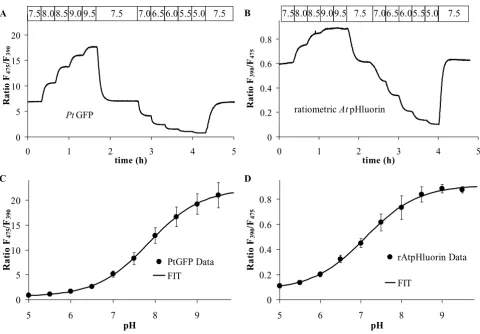
measurements. Therefore, agar beads were decorated with fluorescent protein, sandwiched between sheets of cello-phane and dialysed on the microscope against buffers of different adjusted pH (Figures 6A, B). Ratios were plotted over pH and a sigmoidal curve (Boltzmann function) fit-ted to the data. The low excitation peak of Pt-GFP at 390 nm (Figure 1) could be argued to lead to increased vari-ance in the ratio in particular at physiological pH values when F390 is used as denominator. Such spectral imbal-ance between the two excitation wavelengths used for ratioing is also found with conventional fluorescein deriv-atives used for pH measurements like BCECF or FITC. However, the errorbars in Figures 6C and 6D show that the scatter of Pt-GFP ratios is negligibly increased when compared with ratiometric pHluorin.
Microenvironmental parameters such as viscosity, hydro-phobicity, protein mobility, and binding interactions [44] as well as spectral imbalance can be attributed to shifts in the response of an indicator when going from in vitro
(spectrometer) to in situ or to in vivo (microscope) record-ing. Noticeable here is a shift of the apparent pK when comparing Figures 1B and 6C. However, this is not
disas-Arabidopsis line expressing Pt-GFP Figure 5
Arabidopsis line expressing Pt-GFP. A: Confocal image of Ara-bidopsis guard cells expressing Pt-GFP in the cytoplasm. The red fluorescence is chlorophyll autofluorescence from chlo-roplasts. B: Confocal optical sections and C: corresponding bright-field image of a root segment. Excitation with Argon laser line 476 nm; emission at 500–540 nm (green channel) and 600–660 nm (red channel); Leica TCS SP confocal laser scanning system; HC PL APD objective (40× oil).
15µm
A
B C
Table 3: Cross-sensitivities of recombinant pH-probes. Index 'x' designates sensitivity calculated from excitation spectra, and 'm' calculated from emission spectra
GFP-species parameter ratiometric
pHluorin
ecliptic pHluorin Pt-GFP
Sx (Chloride) 0.03 0.04 0.04
Sm (Chloride) 0.02 0.02 0.02
Sx (red/ox) 0.04 0.05 0.03
trous as long as recordings of calibration data and in vivo
data are identical.
pH-clamp
The cytoplasmic pH in plants is well buffered [45] and strictly regulated [46]. However, it is possible to adjust cytoplasmic pH values different from the cell's set-point by using weak acids [44,45] or weak bases. Here we per-formed pH-clamp experiments with Arabidopsis expressing
Pt-GFP and ratiometric pHluorin and recorded the cyto-plasmic pH (pHcyt) under identical conditions (Figure 7).
Anoxia – an abiotic stimulus that heavily affects cytoplasmic pH
Anoxia is a typical abiotic stress factor that appears for instance in clayey or waterlogged soils. Anoxia is known to produce massive acidification of the cytoplasm. Here we demonstrate how Arabidopsis expressing Pt-GFP report this effect (Figure 8). Cytoplasmic pH shifts in response to
low oxygen have been reported many times and quanti-fied by different methods [46,47]. Felle [48] used pH-spe-cific microelectrodes and recorded in Medicago sativa
under anoxia a fall of pHcyt down to 6.8. This is approxi-mately half a pH unit below the normal cytoplasmic level. A shift of similar magnitude was reported from maize roots [49] and from sycamore cells [50] by 31P-NMR. The
results presented here (Figure 8) match well with the experiments from Felle [48], Ratcliffe [49], and Gout et al. [50].
Salt stress – an abiotic stimulus that hardly affects cytoplasmic pH
Salt stress is a major stress factor leading to massive cuts in crop yield worldwide ([51]; http://www.plantstress.com). One way to combat this problem is to produce crop plants with improved salt tolerance [52-54]. A pre-requisite for this is to understand ion-transport and the mechanisms underlying salt tolerance on cellular and subcellular level. 'In situ' calibration procedure
Figure 6
'In situ' calibration procedure. A, B: Fluorescence ratio time series of agar beads decorated with Pt-GFP (A) or ratiometric pHluorin (B) during dialysis against buffers of different pH as indicated by the top bar. C, D: Resulting calibration curves. Error bars indicate standard deviation. Data in C are averages of 9 from 7 individual experiments and data in D are averages of 14 from 4 individual experiments.
0 5 10 15 20
0 1 2 3 4 5
time (h)
Ra
ti
o
F
47
5
/F
39
0
7.58.08.59.09.5 7.5 7.06.56.05.55.0 7.5
PtGFP
A
0 0.2 0.4 0.6 0.8
0 1 2 3 4 5
time (h)
Ra
ti
o
F
39
0
/F
47
5
7.58.08.59.09.5 7.5 7.06.56.05.55.0 7.5
ratiometric AtpHluorin
B
0 5 10 15 20
5 6 7 8 9
pH
Rat
io F
47
5
/F
39
0
PtGFP Data FIT
C
0 0.2 0.4 0.6 0.8
5 6 7 8 9
pH
Rat
io F
39
0
/F
47
5
rAtpHluorin Data
FIT
We started to study changes in cellular ion relations under salt stress [21,23]. Here we use Pt-GFP expressing Arabi-dopsis to demonstrate how the cytoplasmic pH is affected by increasing concentrations of NaCl (Figure 9). The result coincides well with a similar experiment performed with ratiometric pHluorin [21]. Arabidopsis seems to strictly control pHcyt when confronted with salt stress.
Here (Figure 9) NaCl concentrations above 100 mM leads to slight acidification of approx 0.04 pH units. However, a more pronounced acidification of about 0.2 pH units is observed when saltstress is released. This latter effect can be attributed to H+ coupled Na+ export via Na+/H+
anti-porter [55]. Other studies on different plant species and conducted with different methods show inconsistent results [55-60]. However, all clearly confirm that salt stress (Figure 9) if at all only slightly (i.e. ∆pHcyt < 0.3) affects pHcyt when compared to anaerobiosis (Figure 8).
Summary
Advantages have been found when comparing Pt-GFP with pHluorins:
1 Pt-GFP is readily expressed by Arabidopsis without any cDNA modifications (Figure 5). Although the cDNA is derived from a distinct and totally unrelated organism, the codon-usage is accepted by Arabidopsis and the plant constitutively expresses the protein with high yield under the control of a single 35S-promotor. The use of Av-GFP in higher plants, in contrast, was initially limited. Altera-tions of the codon usage and the removal of a cryptic intron were found necessary to express Av-GFP in Arabi-dopsis [3].
2 Pt-GFP is readily soluble and distributes well when expressed in the cytoplasm of plants (Figure 5) whereas for Av-GFPs modifications where found beneficial to increase protein solubility in the plant cytoplasm [4]. Anoxia-induced pH-deprivation in roots cells (elongation
zone near the root tip) of Arabidopsis expressing Pt-GFP Figure 8
Anoxia-induced pH-deprivation in roots cells (elongation zone near the root tip) of Arabidopsis expressing Pt-GFP. Given is the average of 7 from 5 individual experiments. Error bars indicate standard deviations. The dotted line gives a first order exponential fit to extrapolate the new predicted steady state pH value (6.95) under anoxia.
6.9 7.0 7.1 7.2 7.3 7.4 7.5 7.6
0 1 2 3
time (h)
pH
cyt
Avrg Fit
O2 N2 O2 N2 O2 N2 O2
pH-clamp in Arabidopsis root cells (hairy zone near the hypocotyl) expressing Pt-GFP (A) and ratiometric pHluorin (B) Figure 7
pH-clamp in Arabidopsis root cells (hairy zone near the hypocotyl) expressing Pt-GFP (A) and ratiometric pHluorin (B). Perifu-sionbuffers were MES-buffer (i.e. KCl, CaCl2, MgCl2 0.1 mM each, 5 mM MES/NaOH pH 5.4) and supplemented with Na-Butyrate of mM-concentrations as indicated by the top bar of the graphs. Curves are averages of 5 from 3 individual experi-ments. Error bars indicate standard deviation.
6.4 6.7 7 7.3 7.6
0 20 40 60 80 100 120 140
time (min)
pH
cy
t
Mes 4 12 36 Mes
A
6.4 6.7 7 7.3 7.6
0 20 40 60 80 100 120 140
time (min)
pH
cy
t
Mes 4 12 36 Mes
4 The fluorescence excitation ratio of Pt-GFP has a maxi-mum dynamic range (Rmax - Rmin) 15 times and a maxi-mum ratio increase (Rmax/Rmin) three times higher than that of ratiometric pHluorin when using excitations at 390 nm and 475 nm (Table 2). It further has a broader area of responsiveness (Figure 3) and thereby also exceeds conventional fluorescein derivatives used for ratiometric
in vivo pH-measurements (supplemental data in 1 Table S1).
5 Pt-GFP is much more robust at low pH (Figure 4). This makes it also suitable for monitoring pH in acidic subcel-lular compartments or under conditions when the celsubcel-lular pH is shifted towards the acidic.
Taken together, Pt-GFP is an excellent pH indicator for excitation fluorescence ratio imaging and in some respects superior to pHluorins when used in plants.
Materials and methods
Standard PCR and cloning techniques [61,62] were employed to engineer all constructs described below. cDNAs coding for pHluorins have been cloned and expressed as described [21].
Bacterial expression, purification, and in vitro-analyses of GFPs
DNA coding for Pt-GFP (Acc.No. AY015995) has been subcloned from a pUC18 vector (Nanolight Technologies,
Pinetop, AZ, USA) into the bacterial expression vector pRSETb (Invitrogen GmbH; Karlsruhe, FRG). Protein pro-duction was induced with 1 mM IPTG when OD600 = 0.6 and expressed at 20°C/300 rpm over night (i.e. 15 h). For protein isolation bacteria were cracked by sonification (HD2200&MS73, Bandelin, Berlin, Germany) in 200 mM phosphate buffer (pH 7.5). Bacterial lysate was pre-cleared at 4,000 × g for 2 h at 4°C. Remaining debris was removed from the supernatant by filtering through a 0.45
µm nylon filter. The 6xHis-tagged fluorescent protein was purified and concentrated through a Ni2+/NTA-agarose
column (Qiagen, Hilden, Germany). Gel filtration through a NAP-25 column (Pharmacia Biotech, Freiburg, Germany) was performed to remove imidazol from the eluted protein. The purified indicator proteins were assessed spectroscopically. Fluorescence spectra (Figure 1) of the proteins were taken with a fluorescence spectrome-ter (F-2500, Hitachi) in 150 mM KCl and 50 mM appro-priate organic buffers (Mes, Pipes, Hepes, Taps) adjusted to the desired pH with NaOH. Absorption spectra (Figure 2) were taken in phosphate buffer (pH = 7.5) with an absorption spectrometer (2100, Hitachi).
Size exclusion chromatography (FPLC)
For FPLC protein was bound to a 0.5 ml column of Toyo-pearl resin (AF-Chelate-650 M; Tosoh Bioscience) washed with Tris/HCl-buffer (50 mM Tris/HCl pH = 8) and treated with Enterokinase (EKMax, Invitrogen) for 24 h at RT. Protein with His-Tag cleaved was washed from the col-umn with 2 ml 1 × PBS and used for fast protein liquid chromatography (FPLC). Briefly, proteins were subjected to FPLC at 4°C with an HiLoad-16/60 Superdex200 col-umn (Amersham Biosciences), equilibrated with 1 × PBS (Medicago AB; Uppsala, Sweden), pre-fitted with a col-umn guard, and driven by a HPLC pump (Äkta-Explorer; Amersham Biosciences) at a flow rate of 1 ml/min. The column was calibrated using a mixture of four proteins of known molecular mass, i.e. catalase (232 kDa), aldolase (158 kDa), chymotrypsinogen A (25 kDa), and ribonucle-ase A (13.7 kDa).
Expression in plants
pHluorins for expression in plants were constructed as described in Gao et al. [21]. Pt-GFP cDNA (Nanolight Technologies, Pinetop, AZ, USA) was expressed in ecotype Columbia-0 of Arabidopsis thaliana under the control of the CaMV 35S promoter using the pART7/pART27 clon-ing/expression system [63]. Full functionality of Pt-GFP in pART7 was assessed by biolistic bombardment and tran-sient expression of young Arabidopsis plants (ecotype Col-0) before subcloning the cDNA cassette from pART7 into the binary vector pART27. For agrobacterium-mediated transformation of Arabidopsis thaliana (Col-0) the floral dip method [64] was applied.
Salt stress-induced pH-changes in roots cells (hairy zone near the hypocotyl) of Arabidopsis expressing Pt-GFP
Figure 9
Salt stress-induced pH-changes in roots cells (hairy zone near the hypocotyl) of Arabidopsis expressing Pt-GFP. Roots were perifused with unbuffered standard medium (SM = KCl, CaCl2, MgCl2 - 0.1 mM each) and millimolar NaCl concentra-tions as indicated by the top bar of the graph. Given is the average of 5 from 4 individual experiments. Error bars indi-cate standard deviations.
Average
6.9 7.0 7.1 7.2 7.3 7.4 7.5 7.6
0 20 40 60 80 100 120 140
time (min)
pH
cyt
H2O 4 12 36 H2O
Confocal laser scanning microscopy (CLSM)
Transient and stable expressions of GFPs (Figures 6) were assessed by CLSM as described [21] using a Leica TCS SP confocal laser scanning system. For Pt-GFP excitation the 476 nm beamline of the Argon laser was chosen; emission at 500–540 nm (green channel) for GFP fluorescence and 600–660 nm (red channel) for chlorophyll autofluores-cence; HC PL APD objective (40× oil).
In situ-calibration of pH probes
For assessment of acid stability (Figure 4) and for in situ-calibration of the pH-indicators (Figure 6) protein was bound to Ni2+-agarose beads (Qiagen, Hilden, FRG).
Flu-orescent beads were sandwiched between two layers of cellulose (Cellophane) and dialysed on the microscope against the buffer solutions indicated in figures.
In vivo pH-recording
For in vivo recording of fluorescence ratios (Figures 7, 8, 9) transgenic Arabidopsis were grown in 9 cm Petri dishes on vertical agar as described [65] and used when 6 to 14 days old. Cytoplasmic pH was measured in the hairy root seg-ments near the hypocotyl. Experimental conditions, peri-fusion technique, and fixation of plant material were described previously [44]. Roots were placed in a volume of 1.6 ml and perifusion flow was adjusted to 2.4 ml/min. The perifused buffer contained KCl, MgCl2, and CaCl2, 0.1 mM each and 5 mM MES/NaOH adjusted to pH = 5.4. For pH-clamp this buffer was supplemented with different concentrations of sodium butyrate as indicated by the top bar of Figure 7.
Fluorescence ratio imaging
Fluorescence imaging was performed essentially as described [21,23]. Briefly, fluorescence images at excita-tion wavelengths of 475 nm and 390 nm were taken every 12 s with a ratio imaging system from TILL-Photonics http://www.TILL-photonics.de fitted to an inverted micro-scope (Diaphot, Nikon) using light from a monochroma-tor (Polychrome IV, TILL). For the emission path a filter block with beamsplitter 500 dcxr and emission filter HQ535/50 (AHF-Analysentechnik, Tübingen, Germany) was used. TILL software (TILLVision 3.3) was used for processing raw data. The fluorescence ratio F475/F390 was taken with Pt-GFP and the ratio (F390/F475) was taken with ratiometric pHluorin as a measure for pH.
Data analysis
Each spectrum is normalized by its integral (i.e. the sum of fluorescence values over all wavelengths λ). The mini-max spectrum Fminimax(λ) of a set of spectra is determined by substracting the minimal fluorescence from the maxi-mal fluorescence at each wavelength within the obtained set of spectra (i.e. within the scanned analyte concentra-tion range). The isosbestic point (λiso) is determined by
looking for the minimum in the minimax spectrum. Ide-ally, the minimax spectrum is zero at the isosbestic point (i.e. Fminimax(λiso) = 0). The sensitivity S is defined here by the integral of the minimax spectrum. The sensitivity S of each reporter protein is calculated for the set of its excita-tion spectra (Sx) as well as for its corresponding set of emission spectra (Sm). The Boltzmann fit has been chosen
here for fitting sigmoidal curves to calibration data since the Boltzmann equation can directly be derived from the Grynkiewicz equation [66] describing the relation of ana-lyte concentration on fluorescence and fluorescence ratios. The fit parameter of the Boltzmann include Rmin,
Rmax, and the apparent pK of the calibrated indicator. Fit-ting has been performed using Origin 7.0 (OriginLab Corp., Northhampton, MA, USA).
Availability of materials
Seeds from Pt-GFP expressing Arabidopsis are freely availa-ble from the European Arabidopsis Stock Centre (Not-tingham, UK; http://arabidopsis.info/). All other novel material described in this studies can be obtained for non-commercial purposes from the corresponding author on request.
Abbreviations
Av = Aequorea victoria, At = Arabidopsis thaliana, CLSM = confocal laser scanning microscopy, DTT = di-Thiotreitol; FPLC = fast protein liquid chromatography, GFP = green fluorescent protein, Hepes = N-2-hydroxy-ethyl-pipera-zine-N'-2-ethane-sulfonic acid, Mes = 2-[N-morpholino]-ethane-sulfonic acid, PBS = phosphate buffered saline; Pt
= Ptilosarcus gurneyi
Competing interests
The author(s) declare that they have no competing inter-ests.
Additional material
Acknowledgements
We are grateful to Bruce Bryan of Prolume Ltd. (Eagar, AZ, USA) for the generous gifts of Pt-GFP cDNA and Toyopearl resin. We thank Gero Miesenböck and James Rothman (Memorial Sloan-Kettering Cancer Cen-tre, New York) for the generous gift of pHluorin cDNA and Jim Haselhoff (Cambridge University) for the binary vector pBINm-gfp5-ER. Also many thanks to Dana Schöneberg and Steffi Schnell for technical assistance and to Hartmut Kaiser for critically reading the manuscript.
Additional file 1
Click here for file
References
1. Pozzan T: Calcium turns turquoise into gold. Nature 1997, 388:834-835.
2. Zhang J, Campbell RE, Ting AY, Tsien RY: Creating new fluores-cent probes for cell biology. Nature Reviews Molecular Cell Biology 2002, 3:906-918.
3. Haseloff J, Siemering KR, Prasher DC, Hodge S: Removal of a cryp-tic intron and subcellular localization of green fluorescent protein are required to mark transgenic Arabidopsis plants brightly. Proceedings of the National Academy of Science USA 1997, 94:2122-2127.
4. Davis SJ, Vierstra RD: Soluble, high fluorescent variants of green fluorescent protein (GFP) for use in higher plants.
Plant Molecular Biology 1998, 36:521-528.
5. Runions J, Brach T, Kühner S, Hawes C: Photoactivation of GFP reveals protein dynamics within the endoplasmic reticulum membrane. Journal of Experimental Botany 2005, 57:43-50. 6. Kwok EY, Hanson MR: GFP-labelled Rubisco and aspartate
aminotransferase are present in plastid stromules and traffic between plastids. Journal of Experimental Botany 2004, 55:595-604. 7. Kwok EY, Hanson MR: In vivo analysis of interactions between GFP-labelled microfilaments and plastid stromules. BMC
Plant Biology 2004, 4:1-9.
8. Flückiger R, Caroli de M, Piro G, Dalessandro G, Neuhaus J-M, Di Sansebastiano G-P: Vacuolar system distribution in Arabidopsis
tissues, visualized using GFP fusion proteins. Journal of
Experi-mental Botany 2003, 54:1577-1584.
9. Brandizzi F, Fricker M, Hawes C: A greener world: the revolution in plant bioimaging. Nature Reviews – Molecular Cell Biology 2002, 3:520-530.
10. Hanson MR, Köhler RH: GFP imaging: methodology and appli-cation to investigate cellular compartmentation in plants.
Journal of Experimental Botany 2001, 52:529-539.
11. Logan DC, Leaver CJ: Mitochondria-targeted GFP highlights the heterogeneity of mitochondrial shape, size and move-ment within living plant cells. Journal of Experimental Botany 2000, 51:865-871.
12. Neuhaus J-M: GFP as a marker for vacuoles in plants. In Annual
Plant Reviews Vacuolar compartmentsVolume 5. Edited by: Robinson
DG. Sheffield Academic Press; 2000:254-269.
13. Tee CS, Marziah M, Tan CS, Abdullah MP: Evaluation of different promoters driving the GFP reporter gene and selected tar-get tissues for particle bombardment of Dendrobium sonia.
Plant Cell Reports 2003, 21:452-458.
14. Fricker M, Runions J, Moore I: Quantitative fluorescence micro-scopy: From art to science. Annual Reviews of Plant Biology 2006, 57:79-107.
15. Chiesa A, Rapizzi E, Tosello V, Pinton P, Virgilio de M, Fogarty KE, Riz-zuto R: Recombinant aequorin and green fluorescent protein as valuable tools in the study of cell signalling. Biochemical Jour-nal 2001, 355:1-12.
16. Xu Y, Piston DW, Johnson CH: A bioluminescence resonance energy transfer (BRET) system: Application to interacting circadian clock proteins. Proceedings of the National Academy of
Sci-ences USA 1999, 96:151-156.
17. Fasano JM, Swanson SJ, Blancaflor EB, Dowd PE, Kao T, Gilroy S: Changes in root cap pH are required for the gravity response of the Arabidopsis root. Plant Cell 2001, 13:907-921.
18. Miyawaki A, Llopis J, Heim R, McCaffery JM, Adams JA, Ikura M, Tsien RY: Fluorescent indicators for calcium based on green fluo-rescent protein and calmodulin. Nature 1997, 388:882-887. 19. Miyawaki A, Griesbeck O, Heim R, Tsien RY: Dynamic and
quan-titative Ca2+ measurements using improved cameleons.
Pro-ceedings of the National Academy of Science USA 1999, 96:2135-2140.
20. Allen GJ, Kwak JM, Chu SP, Llopis J, Tsien RY, Harper JF, Schroeder JI: Cameleon calcium indicator reports cytoplasmic calcium dynamics in Arabidopsis guard cells. Plant Journal 1999, 19:735-747.
21. Gao D, Trewavas AJT, Knight MR, Sattelmacher B, Plieth C: Self-reporting Arabidopsis thaliana expressing pH- and [Ca 2+ ]-indicators unveil ion dynamics in the cytoplasm and in the apoplast under abiotic stress. Plant Physiology 2004, 134:898-908. 22. Kuner T, Augustine GJ: A genetically encoded ratiometric indi-cator for chloride: Capturing chloride transients in culture hippocampal neurons. Neuron 2000, 27:447-459.
23. Lorenzen I, Aberle T, Plieth C: Salt stress – induced chloride flux: a study using transgenic Arabidopsis expressing a fluorescent anion probe. Plant Journal 2004, 38:539-544.
24. Kiegle E, Moore CA, Haseloff J, Tester J, Knight MR: Cell-type-spe-cific calcium responses to drought salt and cold in Arabidopsis
roots. Plant Journal 2000, 23:267-278.
25. Miesenböck G, de Angelis DA, Rothman JE: Visualizing secretion and synaptic transmission with pH-sensitive green fluores-cent protein. Nature 1998, 394:192-195.
26. Plieth C, Sattelmacher B, Trewavas AJ, Hansen UP, Knight MR: Engi-neering plants expressing calcium and pH indicators in the cytoplasm and the apoplast. In Plant Nutrition – Food security and sustainability of agro-ecosystems through basic and applied research (Pro-ceedings of XIV International Plant Nutrition Colloquium, Hannover,
Ger-many, 2001) – Developments in Plant and Soil Sciences – SeriesVolume
92. Edited by: Horst. Kluwer Academic Publishers Dordrecht Neth-erlands; 2001:252-253.
27. Moseyko N, Feldman LJ: Expression of pH-sensitive green fluo-rescent protein in Arabidopsis thaliana. Plant, Cell and Environ-ment 2001, 24:557-563.
28. Shkrob MA, Yanushevich YG, Chudakov DM, Gurskaya NG, Labas YA, Poponov SY, Mudrik NN, Lukyanov S, Lukyanov KA: Far-red fluorescent proteins evolved from a blue chromoprotein from Actinia equina. Biochemical Journal 2005, 392:649-654. 29. Shagin DA, Barsova EV, Yanushevich YG, Fradkov AF, Lukyanov KA,
Labas YA, Semenova TN, Ugalde JA, Meyers A, Nunez JM, Widder EA, Lukyanov SA, Matz MV: GFP-like proteins as ubiquitous metazoan superfamily: Evolution of functional features and structural complexes. Molecular Biology and Evolution 2004, 21:841-850.
30. Shaner NC, Campbell RE, Steinbach PA, Giepmans BNG, Palmer AE, Tsien RY: Improved monomeric red, orange and yellow fluo-rescent proteins derived from Discosoma sp. Nature Biotechnol-ogy 2004, 22:1567-1572.
31. Wenck A, Pugieux C, Turner M, Dunn M, Stacy C, Tiozzo A, Dunder E, van Grinsven E, Khan R, Sigareva M, Wang WC, Reed J, Drayton P, Oliver D, Trafford H, Legris G, Rushton H, Tayab S, Launis K, Chang Y-F, Chen D-F-, Melchers L: Reef-coral proteins as visual, nonde-structive reporters for plant transformation. Plant Cell Reports 2003, 22:244-251.
32. Mazel CH, Lesser MP, Gorbunov MY, Barry TM, Farrell JH, Wyman KD, KFalkowski PG: Green fluorescent proteins in caribbean corals. Limnology and Oceanography 2003, 48:402-411.
33. Papina M, Sakihama Y, Bena C, Woesik van R, Yamasaki H: Seapra-tion of highly fluorescent proteins by SDS-PAGE in Acropo-diae corals. Comparative Biochemistry and Physiology Part B 2002, 131:767-774.
34. Peelle B, Gururaja TL: Characterization and Use of Green Flu-orescent Proteins from Renilla mulleri and Ptilosarcus guernyi
for the Human Cell Display of Functional Peptides. Journal of
Protein Chemistry 2001, 20:507-519.
35. Bryan BJ, Szent-Gyorgyi C: Luciferases, fluorescent proteins, nucleic acids encoding the luciferasses and fluorescent pro-teins and the use thereof in diagnostics, high throughput screening and novelty items. WIPO Patent, C12N 9/00 1999. 36. Popov EG, Gavrilov IY, Pozin EYA, Gabbasov ZA: Multiwavelength
method for measuring concentration of free cytosolic cal-cium using the fluorescent probe indo-1. Archives of Biochemistry
and Biophysics 1988, 261:91-96.
37. Tsien RY, Poenie M: Fluorescence ratio imaging: a new window into intracellular ionic signaling. TIBS 1986, 11:450-455. 38. Bright GR, Fisher GW, Rogowska J, Taylor DL: Fluorescence ratio
imaging microscopy. Methods in Cell Biology 1989, 30:157-192. 39. Kneen M, Farinas J, Li Y, Verkman AS: Green fluorescent protein
as a non invasive intracellular pH indicator. Biophysical Journal 1998, 74:1591-1599.
40. Hanson GT, McAnaney TB, Park ES, Rendell MEP, Yarbrough DY, Chu S, Boxer SG, Montrose MH, Remington SJ: Green fluorescent protein variants as ratiometric dual emission pH sensors. 1. Structural characterization and preliminary application.
Bio-chemistry 2002, 41:15477-15488.
Publish with BioMed Central and every scientist can read your work free of charge "BioMed Central will be the most significant development for disseminating the results of biomedical researc h in our lifetime."
Sir Paul Nurse, Cancer Research UK
Your research papers will be:
available free of charge to the entire biomedical community
peer reviewed and published immediately upon acceptance
cited in PubMed and archived on PubMed Central
yours — you keep the copyright
Submit your manuscript here:
http://www.biomedcentral.com/info/publishing_adv.asp
BioMedcentral 42. Grignon C, Sentenac H: pH and ionic conditions in the apoplast.
Annual Review of Plant Physiology and Plant Molecular Biology 1991,
42:103-128.
43. Griesbeck O, Baird GS, Campbell RE, Zacharias DA, Tsien RY: Reducing the environmental sensitivity of yellow fluorescent protein. The Journal of Biological Chemistry 2001, 276:29188-29194. 44. Fricker MD, Parsons A, Tlalka M, Blancaflor E, Gilroy S, Meyer A,
Pli-eth C: Fluorescent probes for living plant cells. In Plant Cell
Biol-ogy: A Practical Approach 2nd edition. Edited by: Hawes C,
Satiai-Jeunemaitre B. Oxford University Press Oxford; 2001:35-84. 45. Plieth C, Sattelmacher B, Hansen U-P: Cytoplasmic Ca2+-H+
-exchange buffers in green algae. Protoplasma 1997, 198:107-124. and Vol. 199: 223 (correction).
46. Felle HH: pH regulation in anoxic plants. Annals of Botany 2005, 96:519-532.
47. Felle HH: pH: Signal and messenger in plant cells. Plant Biology 2001, 3:577-591.
48. Felle HH: Control of cytoplasmic pH under anoxic conditions and its implication for plasma membrane proton transport in Medicago sativa root hairs. Journal of Experimental Botany 1996, 47:967-973.
49. Ratcliffe RG: In vivo NMR studies of the metabolic response of plant tissues to anoxia. Annals of Botany 1997, 79(Supplement A):39-48.
50. Gout E, Boisson A-M, Aubert S, Douce R, Bligny R: Origin of the cytoplasmic pH changes during anaerobic stress in higher plant cells. Carbon-13 and phosphorous-31 nuclear magnetic resonance studies. Plant Physiology 2001, 125:912-925.
51. Flowers TJ: Improving crop salt tolerance. Journal of Experimental
Botany 2004, 55:307-319.
52. Apse MP, Blumwald E: Engineering salt tolerance in plants.
Cur-rent Opinion in Biotechnology 2002, 13:146-150.
53. Zhang H-X, Hodson JN, Williams JP, Blumwald E: Engineering salt-tolerant Brassica plants: Characterization of yield and seed oil quality in transgenic plants with increased vacuolar sodium accumulation. Proceedings of the National Academy of
Sci-ence USA 2001, 98:12832-12836.
54. Zhang H-X, Blumwald E: Transgenic salt-tolerant tomato plants accumulate salt in foliage but not in fruit. Nature Biotechnology 2001, 19:765-768.
55. Spickett CM, Smirnoff N, Ratcliffe RG: An in vivo nuclear mag-netic resonance investigation of ion transport in maize (Zea mays) and Spartina anglica roots during exposure to high salt concentrations. Plant Physiology 1993, 102:629-638.
56. Felle HH: The H+/Cl- symporter in root hair cells of Sinapis
alba. Plant Physiology 1994, 106:1131-1136.
57. Nakamura Y, Ogawa T, Kasamo K, Sakata M, Ohta E: Changes in cytoplasmic and vacuolar pH in intact cells of mung bean root-tips under high-NaCl stress at different external con-centrations of Ca2+ ions. Plant and Cell Physiology 1992, 33:849-85. 58. Katsuhara M, Kuchitsu K, Takeshige K, Tazawa M: Salt stress-induced cytoplasmic acidification and vacuolar alkalization in Nitellopsis obtusa cells. Plant Physiology 1989, 90:1102-1107. 59. Fan TWM, Higashi RM, Norly J, Epstein E: In vivo 23Na and 31P
NMR measurement of a tonoplast Na+/H+ exchange process and its characteristics in two barley cultivars. Proceedings of the
National Academy of Sciences USA 1989, 86:9856-9860.
60. Be-Hayyim G, Navon G: Phosphorous-31 NMR studies of the wild-type and NaCl-tolerant Citrus cultured cells. Journal of
Experimental Botany 1985, 36:1877-1888.
61. Sambrook J, Fritsch EF, Maniatis T: Molecular cloning – a labora-toy manual. Volume 1–3. Cold Spring Harbor Laboratory Press; 1989.
62. Ausubel FM, Brent R, Kingston RE, Moore DD, Seidman JG, Smith JA, Struhl K: Short protocols in molecular biology. Wiley New York; 1999.
63. Gleave AP: A versatile binary vector system with a T-DNA organisational structure conducive to efficient integration of cloned DNA into the plant genome. Plant Molecular Biology 1992, 20:1203-1207.
64. Clough SJ, Bent AF: Floral dip: a simplified method for Agro-bacterium-mediated transformation of Arabidopsis thaliana.
Plant Journal 1998, 16:735-743.
65. Plieth C, Trewavas AJ: Reorientation of seedlings in the earth's gravitational field induces cytosolic calcium transients. Plant
Physiology 2002, 129:786-796.
66. Grynkiewicz G, Poenie M, Tsien RY: A new generation of Ca2+ indicators with greatly improved fluorescence properties.