R E S E A R C H
Open Access
Naturally occurring 3
RS
, 7
R
, 11
R
-phytanic
acid suppresses in vitro T-cell production of
interferon-gamma
Tomonori Nakanishi
1, Ibuki Motoba
1, Mayuko Anraku
1, Ryoji Suzuki
1, Yuto Yamaguchi
2, Laurie Erickson
3,4,
Nozomu Eto
1, Kazuhiro Sugamoto
2, Yohichi Matsushita
2and Satoshi Kawahara
1*Abstract
Background:Among the eight stereoisomers of phytanic acid (PA), the 3RS, 7R, 11R-isomer is naturally occurring and is present in foods and the human body. PA is considered to have possible health benefits in the immune system. However, it remains undetermined whether these effects are elicited by the 3RS, 7R, 11R-PA isomer, because previous studies used a commercially available PA whose isomer configuration is unknown. In this study, we synthesized a preparation of 3RS, 7R, 11R-PA, and investigated its in vitro immunomodulatory effects, especially the T-cell production of interferon (IFN)-γ, which is associated with various autoimmune diseases. This study also investigated the effects of 3RS, 7R, 11R-PA on NF-κB activity in order to address the mechanism of its
immunomodulatory effects.
Methods:Mouse splenocytes and purified T-cells were stimulated with T-cell mitogens and incubated with 3RS, 7R, 11R-PA, followed by evaluation of IFN-γproduction. The effect of 3RS, 7R, 11R-PA on NF-κB activity was also investigated using an A549 cell line with stable expression of an NF-κB-dependent luciferase reporter gene. Results:3RS, 7R, 11R-PA significantly reduced in vitro IFN-γproduction at both the protein and mRNA levels, and was accompanied by decreased expression of T-bet, a key regulator of Th1 cell differentiation. The results indicated that
NF-κB-mediated transcriptional activity was significantly decreased by 3RS, 7R, 11R-PA and that GW6471, an antagonist of peroxisome proliferator activated receptorα(PPARα), abrogated the inhibitory effect of 3RS, 7R, 11R-PA on NF-κB activity. Conclusions:The present study suggests that 3RS, 7R, 11R-PA is a functional and bioactive fatty acid, and has a
potentially beneficial effect for amelioration of T-cell mediated autoimmune diseases. This study also indicates that interference in the NF-κB pathway via PPARαactivation is a potential mechanism of the immunomodulatory effects of 3RS, 7R, 11R-PA.
Keywords:3RS, 7R, 11R-phytanic aid, T-cell, IFN-γproduction, NF-κB activity, PPARα
Background
Phytanic acid (3, 7, 11, 15-tetramethyl-hexadecanoic acid, PA) is a branched-chain fatty acid and originates from the phytol side chain of chlorophyll. Some microorganisms inhabiting the rumen of ruminants produce phytol from chlorophyll, after which PA is formed via oxidation of phytol to phytenic acid. Therefore, dairy products and ruminant meat as well as some marine lipids are rich
sources of PA [1]. Because humans are not capable of pro-ducing phytol from chlorophyll, PA in the human body is exclusively derived from the above foods.
PA is a ligand for several subtypes of peroxisome pro-liferator activated receptor (PPAR) [2,3]. PPARs regulate gene expression in cellular differentiation, development and metabolism, and are attractive molecular targets for human metabolic disease [4], type 2 diabetes [5] and autoimmune diseases [6]. PA has been shown to stimu-late glucose uptake in primary porcine myotubes, sug-gesting a potential role of PA in the management of insulin resistance [7]. Our previous studies addressing
* Correspondence:[email protected]
1Department of Biochemistry and Applied Biosciences, Faculty of Agriculture,
University of Miyazaki, 1-1 Gakuenkibanadai-nishi, Miyazaki 889-2192, Japan Full list of author information is available at the end of the article
the immunomodulatory effects of PA have demonstrated that PA inhibits T-cell production of cytokines, such as interferon (IFN)-γ, which are associated with various autoimmune diseases [8]. Based on these findings, PA is now recognized as a food component with possible ben-efits for human health, albeit the precise molecular mechanism still remains unclear [9].
PA has three chiral centers at carbon positions 3, 7 and 11, which means that there are theoretically eight stereoisomers. In nature, the methyl groups at 7 and 11 are in the R configuration because they are in chlorophyll-derived phytol (2E, 7R, 11R-isomer). The configuration at position 3 in PA can beRorS, and con-sequently naturally occurring PA (nPA) is the diastereo-meric mixture of 3R, 7R, 11R- and 3S, 7R, 11R-isomers [10]. However, most previous studies have used com-mercially available PA which is a mixture of natural and non-natural isomers or whose isomer information is un-known. Therefore, there are unanswered questions of whether nPA can elicit the above beneficial effects. Be-cause individual isomers of fatty acids differ widely in their biological effects [11], evaluation of nPA is important to determine the biochemical and physiological effects of PA. Here, we synthesized a mixture containing equal amounts of the 3R, 7R, 11R- and the 3S, 7R, 11R-isomers in order to evaluate the in vitro immunomodulatory ef-fects of nPA on IFN-γ production by T-cells, to address the potential for prevention of autoimmune disease. We also investigated the effects of nPA on NF-κB-mediated transcriptional activity to elucidate the mechanism by which nPA elicits the immunomodulatory effects.
Methods
Preparation of nPA from phytol
Phytol 95 containing 92% of phytol derived from chlorophyll was purchased from Tama Biochemical CO., Ltd. (Tokyo, Japan) and was purified by column chromatography on silica gel with hexane−diethyl ether (2:1) as an eluent to give pure phytol. Phytol was converted into nPA (Scheme 1).
Hydrogenation of phytol using Adams’ catalyst gave 3RS-phytanol according to Patton and Benson [12]. For con-version of phytanol into PA, chromic acid oxidation under acidic conditions has been almost exclusively used [12–14], but the use of noxious chromic acid should be avoided if possible. Therefore, we applied ruthenium tetroxide-catalyzed oxidation with NaIO4 [15] instead of the chromic acid oxidation.
Briefly, to a solution of phytol (5.05 g) in ethanol (170 mL) was added 58.6 mg of Adams’catalyst (PtO2). After the atmosphere of reaction vessel had been re-placed with hydrogen, the reaction mixture was stirred at room temperature for 2.5 h under 1 atm of hydrogen. The catalyst was removed from the mixture by filtering through a celite pad. The filtrate was evaporated on a rotary evaporator to 5.7 g of the crude product as a col-orless oil. The crude product was purified by column chromatography on silica gel (50 g) with hexane and then hexane-ethyl acetate (20:1) as an eluent. Phytane (1.27 g) produced by hydrogenolysis was obtained in 26.4% yield from hexane-eluted fraction, and 3RS -phyta-nol (3.64 g) in 71.6% as a colorless oil from the fraction eluted with hexane-ethyl acetate (20:1). The spectral data for synthesized phytanol coincided with those reported by Burns et al. [14].
3RS-phytanol (3.58 g) was dissolved in a mixed solvent of acetonitrile (24 mL) and ethyl acetate (24 mL), and water (36 mL) was added to this solution. To the mixture were added sodium periodate (10.53 g) and ruthenium chloride hydrate (62.2 mg) sequentially. The reaction mixture was stirred at room temperature for 2 h. The reaction mixture was filtered to remove insol-uble solids, and the organic layer was separated from the two-layered filtrate. The aqueous layer was extracted with ethyl acetate (2 × 60 mL). The combined organic layers were dried over anhydrous sodium sulfate, evapo-rated on a rotary evaporator, to afford 3.79 g of the crude product as a brownish yellow oil. Purification of the crude product on silica gel (70 g) with hexane−ethyl
acetate−acetic acid (20:1:0.1) gave the desired nPA (3.03 g) as a colorless oil in 88.2% yield. Its spectral data coincided with those reported by Burns et al. [14].
In this study, nPA was used either as the form of free fatty acids or as nPA-bovine serum albumin (BSA) con-jugates. The conjugation of nPA with BSA was carried out as previously described [16].
Animals and cells
Female C57BL/6 J mice aged 6 weeks were obtained from Japan SLC, Inc. (Shizuoka, Japan). The spleens of mice aged between 8 to 12 weeks were aseptically collected and teased into single-cell suspensions. T-cells were purified from mouse splenocytes by negative immunomagnetic cell sorting (Pan T cell isolation kit II, Miltenyi Biotec, Bergisch Gladbach, Germany). Mouse splenocytes and purified T-cells were incubated in RPMI-1640 medium containing 10% foetal calf serum, 100 units/mL penicillin and 100 μg/mL streptomycin. Animals were used in accordance with the guidelines for the care and use of laboratory animals at the University of Miyazaki and Law No. 105 of the Japanese govern-ment. All experimental protocols were approved by the University of Miyazaki (approval number: 2014–002). A549 human lung epithelial cells with stable expression of an NF-κB-dependent luciferase reporter gene were purchased from Panomics (RC0002, Freemont, CA, USA). A549 cells were grown in Dulbecco’s modified Eagle’s medium supplemented with 10% foetal calf serum, 100 units/mL penicillin and 100 μg/mL strepto-mycin. All cells were incubated at 37°C in a humidified atmosphere of 5% CO2–95% air.
Cellular toxicity
For assessing the cellular toxicity of the test fatty acids, 3.0 × 10⁵mouse splenocytes or purified T-cells, or 5.0 × 10³ A549 cells were independently incubated in flat-bottomed microtiter 96-well plates, along with various concentration of nPA dissolved in dimethyl sulfoxide (DMSO) and added as a final DMSO concentration of 0.1%. The control fatty acid was palmitic acid, whose carbon chain is the same length as that of PA. Following incubation for 72 h, an Alamar blue assay was performed according to the manu-facturer’s instructions (Invitrogen, Gaithersburg, MD, USA). Fluorescence was measured with excitation at 550 nm and emission at 590 nm using a Varioskan Flash 2.4 (Thermo Fisher Scientific Inc., Waltham, MA, USA).
IFN-γsecretion
The 1.5 × 10⁵ mouse splenocytes were incubated as described for the cellular toxicity assay. Cells were stimu-lated with 10 μg/mL phytohaemagglutinin (PHA) for T-cell activation, along with various concentrations of nPA or the control palmitic acid. After incubation at 37 °C
for 72 h, culture supernatants were harvested, and IFN-γ secretion was measured by ELISA using a commercially available kit (Biolegend, Inc., San Diego, CA, USA). Simi-lar experiments were conducted using purified T-cells
stimulated with 50 ng/mL phorbol 12-myristate
13-acetate (PMA) and 500 ng/mL ionomycin and 48 h incubation.
Quantitative reverse-transcription polymerase chain reaction (qRT-PCR) for IFN-γand T-bet mRNA levels The 2.0 × 10⁶ mouse splenocytes were incubated in flat-bottomed 24-well plates along with test substances, and were stimulated with 10μg/mL PHA. Following in-cubation at 37 °C for 24 h, total RNA was extracted from the stimulated splenocytes using TRIzol reagent (Life Technologies, Inc., Grand Island, NY, USA). cDNA was synthesized from 0.5 μg total RNA using ReverTra Ace (Toyobo Co., Ltd., Osaka, Japan). qRT-PCR was done in the AriaMx Realtime PCR system (Agilent Technologies, Inc., Santa Clara, CA, USA) with a com-mercially available kit (Brilliant III Ultra-Fast SYBR Green QPCR Master Mix, Agilent Technologies, Inc.) as per the manufacturer’s instructions. The expression levels of IFN-γ, T-bet and the housekeeping gene GAPDH were assessed using pre-designed primers for
each gene (MA025911, IFN-γ; MA114313, T-bet;
MA050371, GAPDH, Takara Bio Inc., Shiga, Japan). A threshold was set in the linear part of the amplification curve, and the number of cycles required to reach the threshold was calculated for each gene. Melting curve analysis was performed to confirm the purity of the amplified bands. Normalization was done using GAPDH
mRNA as an internal control for IFN-γ and T-bet
mRNA. Similar experiments were conducted using purified T-cells stimulated with PMA and ionomycin as described above.
NF-κB reporter assay
Statistical analysis
Experiments were independently repeated more than three times to confirm reproducibility. Differences between the DMSO control and the test fatty acids were compared using a one-way analysis of variance followed by the Dunnett Multiple Comparison test, or an unpaired t-test. All statistical analyses were performed using the GraphPad Prism version 6.0 (GraphPad Software, San Diego, CA, USA.)
Results
IFN-γproduction and T-bet expression of mouse splenocytes
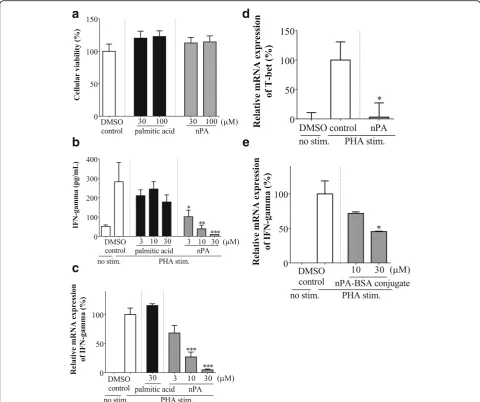
To examine the cellular toxicity of test fatty acids, the viability of mouse splenocytes was evaluated after incu-bation for 72 h. Our results showed that both nPA and the control palmitic acid had no cellular toxicity in con-centrations up to 100 μM (Fig. 1a). The effects of nPA on in vitro IFN-γ secretion were evaluated after PHA stimulation of mouse splenocytes. nPA reduced IFN-γ secretion in a concentration-dependent manner with near-complete inhibition at 30 μM (Fig. 1b). On the other hand, palmitic acid had no obvious effect on IFN-γ secretion. The inhibitory effects of nPA were also observed at the transcriptional level where mRNA expression of IFN-γwas significantly decreased by treat-ment with nPA at concentrations higher than 10 μM (Fig.1c). We also examined the effects of nPA on mRNA expression of the T-box transcription factor T-bet be-cause IFN-γ plays a key role in differentiation of CD4 positive-T-cells to Th1 lineages and T-bet is an import-ant determinimport-ant of Th1 cell differentiation. Our results showed that T-bet mRNA expression was strongly suppressed by 30μM nPA (Fig.1d). Given that free fatty acids are bound to albumin in human plasma, we also evaluated the immunomodulatory effect of the nPA-BSA conjugate. The results indicated that nPA significantly inhibited IFN-γ mRNA expression even in the form of BSA conjugate (Fig.1e). Although the inhibitory effect of the nPA-BSA conjugate was slightly less potent than free fatty acids, further studies were carried out using the free form of nPA to simplify experimental procedures.
T-cell production of IFN-γ
Splenocytes are composed of variety of leucocytes in-cluding T-cells, B-cells, macrophages and dendritic cells, although T-cells are considered the predominant source of IFN-γ production. Therefore, we investigated the direct action of nPA on T-cells. The cellular toxicity of nPA was first evaluated using freshly purified T-cells, showing that nPA had no obvious cellular toxicity in concentrations up to 100 μM (Fig. 2a). The effect of 30μM nPA on in vitro IFN-γproduction was evaluated after PMA/ionomycin stimulation of purified T-cells.
Our results indicated that nPA significantly inhibited
PMA/ionomycin-induced IFN-γ mRNA expression
(Fig. 2b). The inhibitory effect of nPA on IFN-γ produc-tion was also confirmed at the translaproduc-tional level by evaluation of the time course of IFN-γ secretion after PMA/ionomycin stimulation (Fig. 2c). These findings clearly indicated that nPA elicited its immunomodula-tory effects through modification of T-cell function.
NF-κB reporter assay
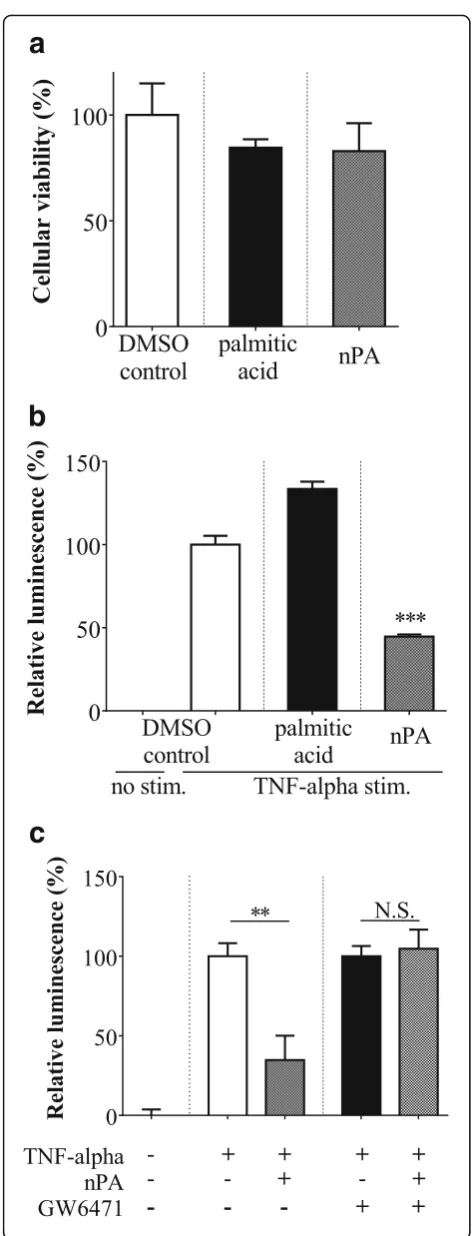
To address the potential mechanism for the immuno-modulatory effects of nPA, an NF-κB-dependent lucifer-ase reporter assay was employed. No toxicity toward A549 cells was observed with 30 μM of either nPA or the control palmitic acid (Fig.3a), consistent with the re-sults on mouse splenocytes and purified T-cells. The in
vitro effects of 30 μM nPA or palmitic acid on
NF-κB-driven transcriptional activity were investigated
using A549 cells with stable expression of an
NF-κB-luciferase reporter gene. Our results indicated that the control palmitic acid increased rather than de-creased NF-κB activity in the A549 cells (Fig.3b). Con-trary to palmitic acid, nPA significantly decreased NF-κB activity (Fig. 3b). The in vitro inhibitory effects of nPA on NF-κB activity were completely abrogated when PPARα was blocked by GW6471 (Fig. 3c), suggesting that PPARα-mediated NF-κB inhibition could be the molecular mechanism for the immunomodulatory ef-fects of nPA.
Discussion
to inhibit in vitro IFN-γproduction by both mouse sple-nocytes (Fig.1bandc) and purified T-cells (Fig.2bandc). In addition, the inhibitory effect of nPA was reproducible in the form of BSA-conjugate which imitates the plasma form (Fig.1e). These findings suggest that nPA is a prom-ising research target not only as a risk factor for Refsum disease but also as a bioactive food component with im-munomodulatory effects.
IFN-γis the only member of the type II interferons and is well known to be secreted by T-cells as well as by natural killer cells [20]. IFN-γ binds to its ubiquitous re-ceptor on almost all cell types, and consequently IFN-γ signaling provides pleiotropic functions and plays a central role in orchestrating the immune system [21]. In adaptive
immunity, IFN-γproduction has been considered the hall-mark of differentiation of CD4 positive-T-cells into Th1 lineages. T-bet is found in Th1 but not Th2 cells, and is the key transcription factor regulating the development and function of IFN-γ-producing Th1 cells [22]. Our present results showed that the inhibitory effects of nPA on in vitro IFN-γ production were accompanied by de-creased levels of T-bet expression (Fig.1d), implying that nPA could interfere with Th1 cell differentiation. Although IFN-γis a pivotal cytokine for immunity against bacterial and viral infections, its overexpression and the Th1/Th2 imbalance can lead to the development of IFN-γ-related autoimmune diseases such as multiple sclerosis, inflam-matory bowel disease and rheumatoid arthritis [23]. Our
a
b
c
e
d
findings demonstrate the inhibitory effects of nPA on in vitro IFN-γproduction and T-bet expression and suggest that nPA has the potential to attenuate the symptoms of these autoimmune diseases.
Both PA and its metabolite pristanic acid were reported to be natural ligands and activators of several PPAR iso-forms, among which PPARα was preferentially activated by nPA [2, 3]. Several studies have demonstrated that PPARα agonists have immunomodulatory effects on T-cells and attenuate the symptoms of autoimmune encephalomyelitis in mouse models of T-cell-mediated disorders [24]. Numerous studies have addressed the mo-lecular mechanism for PPARα-mediated regulation of im-mune and inflammatory responses, and have found that PPARαactivation interferes with NF-κB activity via inhib-ition of both translocation into the nucleus and transcrip-tion initiatranscrip-tion [25]. Given that NF-κB is one of the most
important transcription factors controlling immune re-sponses (including T-cell production of IFN-γand Th1 cell differentiation) [26], we hypothesized that nPA elicits in-hibitory effects on IFN-γ production through modulation of NF-κB activity. We demonstrated significant inhibitory effects of nPA on the NF-κB-driven transcriptional activity in A549 cells (Fig.3b). In addition, this study showed that PPARα was required for the inhibitory effects of nPA on NF-κB activity (Fig.3c). Our studies also found that nPA suppressed in vitro mouse splenocyte production not only of IFN-γ but also of other autoimmunity-associated cyto-kines such as interleukin-17A (Additional file1: Figure S1), whose production also requires NF-κB activation [27]. These findings indicate that interference in the NF-κB path-way via PPARαactivation is a potential mechanism of the immunomodulatory effects of nPA.
Several researchers have reported variation in the abundance ratio between 3R, 7R, 11R- and 3S, 7R, 11R-PA in the human body according to race, owing to their different ratios in foods [28]. For instance, butter made in New Zealand contains fat with a higher ratio of the 3R, 7R, 11R-isomer, which may correspond to the higher abundance of this isomer in New Zealanders [29]. In this study, we used a nPA mixture containing equal amounts of the 3R, 7R, 11R- and the 3S, 7R, 11R -iso-mers. Therefore, it cannot be concluded whether one or both isomers are responsible for the immunomodulatory
a
b
c
effects. Furthermore, because our present study focused on T-cell production of IFN-γ, the effects of nPA on other types of cells and cytokines have not been deter-mined. Although impaired NF-κB activity is a possible mechanism of the immunomodulatory effects of nPA, it is unknown whether nPA affects the activity of other transcription factors such as NFAT, AP-1 and STAT family members, which also play important roles in im-mune cell functions. In this study, the immunomodula-tory effects of nPA were investigated only in cell-based experiments, and the in vivo effects of nPA have not yet been directly addressed, due to the prohibitively high cost of nPA. The use of cell-based assays, by ourselves and other groups [9,30], has provided useful insight into the beneficial effects of PA on human health. Further studies are needed to determine the overall effects of nPA on immune responses and to elucidate whether the in vitro immunomodulatory effect of nPA can be repro-duced under in vivo physiological conditions.
Conclusions
In conclusion, the present study demonstrates that nPA inhibits in vitro T-cell production of IFN-γ and that interference in the NF-κB pathway via PPARαactivation is a possible mechanism of the immunomodulatory effects of nPA. These findings suggest that nPA is a functional and bioactive fatty acid, and has the potential for amelioration of T-cell mediated autoimmune disease.
Additional file
Additional file 1:Figure S1.Effects of nPA on interleukin-17A production in mouse splenocytes. (DOCX 30 kb)
Abbreviations
BSA:Bovine serum albumin; DMSO: Dimethyl sulfoxide; IFN: Interferon; nPA: Naturally occurring phytanic acid; PA: Phytanic acid;
PHA: Phytohaemagglutinin; PMA: Phorbol 12-myristate 13-acetate; PPAR: Peroxisome proliferator activated receptor; TNF: Tumor necrosis factor
Funding
This work was supported by a Grant-in-Aid for Scientific Research from the Japan Society for the Promotion of Science (No. 15K07706 and No. 17K15364).
Availability of data and materials
The data supporting the conclusions of this article are available from the corresponding author on reasonable request.
a
b
c
Authors’contributions
TN designed and performed experiments, analyzed data and drafted the manuscript. IM, MA, RS and YY performed experiments and analyzed the data. LE designed experiments and revised the manuscript critically for important intellectual content. NE, KS and YM designed experiments and drafted the manuscript. SK designed experiments and wrote the manuscript. All authors read and approved the final manuscript.
Ethics approval and consent to participate
All experimental protocols were approved by the University of Miyazaki (approval number: 2014-002).
Competing interests
The authors declare that there is no competing interest associated with this study.
Publisher’s Note
Springer Nature remains neutral with regard to jurisdictional claims in published maps and institutional affiliations.
Author details
1
Department of Biochemistry and Applied Biosciences, Faculty of Agriculture, University of Miyazaki, 1-1 Gakuenkibanadai-nishi, Miyazaki 889-2192, Japan.
2
Department of Applied Chemistry, Faculty of Engineering, University of Miyazaki, 1-1 Gakuenkibanadai-nishi, Miyazaki 889-2192, Japan.3Department
of Biology, Harold Washington City College of Chicago, 30 E. Lake St, Chicago, IL 60601, USA.4Department of Health Sciences, Blitstein Institute of
Hebrew Theological College, 2606 W. Touhy Ave, Chicago, IL 60645, USA.
Received: 27 December 2017 Accepted: 30 May 2018
References
1. Brown PJ, Mei G, Gibberd FB, Burston D, Mayne PD, McClinchy JE, et al. Diet and Refsum's disease. The determination of phytanic acid and phytol in certain foods and the application of this knowledge to the choice of suitable convenience foods for patients with Refsum's disease. J Hum Nutr Diet. 1993;6:295–305.
2. Heim M, Johnson J, Boess F, Bendik I, Weber P, Hunziker W, et al. Phytanic acid, a natural peroxisome proliferator-activated receptor (PPAR) agonist, regulates glucose metabolism in rat primary hepatocytes. FASEB J. 2002;16:718–20.
3. Zomer AW, van Der Burg B, Jansen GA, Wanders RJ, Poll-The BT, van Der Saag PT. Pristanic acid and phytanic acid: naturally occurring ligands for the nuclear receptor peroxisome proliferator-activated receptor alpha. J Lipid Res. 2000;41:1801–7.
4. Chen YC, Kao TH, Tseng CY, Chang WT, Hsu CL. Methanolic extract of black garlic ameliorates diet-induced obesity via regulating adipogenesis, adipokine biosynthesis, and lipolysis. J Funct Foods. 2014;9:98–108. 5. Hsu WH, Liao TH, Lee BH, Hsu YW, Pan TM. Ankaflavin regulates adipocyte
function and attenuates hyperglycemia caused by high-fat diet via PPAR-γ activation. J Funct Foods. 2013;5:124–32.
6. Choi JM, Bothwell AL. The nuclear receptor PPARs as important regulators of T-cell functions and autoimmune diseases. Mol Cells. 2012;33:217–22. 7. Che BN, Oksbjerg N, Hellgren LI, Nielsen JH, Young JF. Phytanic acid
stimulates glucose uptake in a model of skeletal muscles, the primary porcine myotubes. Lipids Health Dis. 2013;12:14.
8. Nakanishi T, Anraku M, Suzuki R, Kono T, Erickson L, Kawahara K. Novel immunomodulatory effects of phytanic acid and its related substances in mice. J Funct Foods. 2016;21:283–9.
9. Roca-Saavedra P, Marino-Lorenzo P, Miranda JM, Porto-Arias JJ, Lamas A, Vazquez BI, et al. Phytanic acid consumption and human health, risks, benefits and future trends: a review. Food Chem. 2017;221:237–47. 10. Verhoeven NM, Jakobs C. Human metabolism of phytanic acid and pristanic
acid. Prog Lipid Res. 2001;40:453–66.
11. O'Shea M, Bassaganya-Riera J, Mohede IC. Immunomodulatory properties of conjugated linoleic acid. Am J Clin Nutr. 2004;79:1199s–206s.
12. Patton S, Benson AA. Synthesis of phytanic acid. J Lipid Res. 1966;7:452–3. 13. Sita LR. Convenient highly stereoselective syntheses of (3R,7R,11R)- and
(3S,7R,11R)-3,7,11,15-tetramethylhexadecanoic acid (phytanic acid) and
the corresponding 3,7,11,15-tetramethylhexadecan-1-ols. J Org Chem. 1993;58:5285–7.
14. Burns CJ, Field LD, Hashimoto K, Ridley DD, Petteys BJ, Rose M. Synthesis of stereoisomerically pure monoether lipids. Aust J Chem. 1999;52:387–94. 15. Prashad M, Lu Y, Kim HY, Hu B, Repic O, Blacklock T. An improved and
practical Sharpless oxidation of primary alcohols to the carboxylic acids. Synth Commun. 1999;29:2937–42.
16. Van Harken DR, Dixon CW, Heimberg M. Hepatic lipid metabolism in experimental diabetes. V. The effect of concentration of oleate on metabolism of triglycerides and on ketogenesis. J Biol Chem. 1969; 244:2278–85.
17. Wierzbicki AS. Peroxisomal disorders affecting phytanic acid alpha-oxidation: a review. Biochem Soc Trans. 2007;35:881–6.
18. Jansen GA, Ofman R, Ferdinandusse S, Iilst L, Muijsers AO, Skjeldal OH, et al. Refsum disease is caused by mutations in the phytanoyl-CoA hydroxylase gene. Nat Genet. 1997;17:190–3.
19. Dhaunsi GS, Alsaeid M, Akhtar S. Phytanic acid activates NADPH oxidase through transactivation of epidermal growth factor receptor in vascular smooth muscle cells. Lipids Health Dis. 2016;15:105.
20. Billiau A, Matthys P. Interferon-gamma: a historical perspective. Cytokine Growth Factor Rev. 2009;20:97–113.
21. Arellano G, Ottum PA, Reyes LI, Burgos PI, Naves R. Stage-specific role of interferon-gamma in experimental autoimmune encephalomyelitis and multiple sclerosis. Front Immunol. 2015;6:492.
22. Szabo SJ, Sullivan BM, Stemmann C, Satoskar AR, Sleckman BP, Glimcher LH. Distinct effects of T-bet in TH1 lineage commitment and IFN-gamma production in CD4 and CD8 T cells. Science. 2002;295:338–42. 23. Hu X, Ivashkiv LB. Cross-regulation of signaling pathways by
interferon-gamma: implications for immune responses and autoimmune diseases. Immunity. 2009;31:539–50.
24. Yang Y, Gocke AR, Lovett-Racke A, Drew PD, Racke MK. PPAR alpha regulation of the immune response and autoimmune encephalomyelitis. PPAR Res. 2008;2008:546753.
25. Zambon A, Gervois P, Pauletto P, Fruchart JC, Staels B. Modulation of hepatic inflammatory risk markers of cardiovascular diseases by PPAR-alpha activators: clinical and experimental evidence. Arterioscler Thromb Vasc Biol. 2006;26:977–86.
26. Corn RA, Aronica MA, Zhang F, Tong Y, Stanley SA, Kim SR, et al. T cell-intrinsic requirement for NF-kappa B induction in postdifferentiation IFN-gamma production and clonal expansion in a Th1 response. J Immunol. 2003;171:1816–24.
27. Cho ML, Kang JW, Moon YM, Nam HJ, Jhun JY, Heo SB, et al. STAT3 and NF-kappaB signal pathway is required for IL-23-mediated IL-17 production in spontaneous arthritis animal model IL-1 receptor antagonist-deficient mice. J Immunol. 2006;176:5652–61.
28. Schröder M, Vetter WGC. EI-MS determination of the diastereomer distribution of phytanic acid in food samples. J Am Oil Chem Soc. 2011;88:341–9. 29. Eldjarn L, Try K. Different ratios of the LDD and DDD diastereoisomers of
phytanic acid in patients with Refsum’s disease. Biochim Biophys Acta. 1968; 164:94–100.