R E S E A R C H A R T I C L E
Open Access
Changes in affect after completing a
mailed survey about trauma: two
pre-and post-test studies in former disability
applicants for posttraumatic stress disorder
Maureen Murdoch
1,2,3,5*, Shannon Marie Kehle-Forbes
2,3,4and Melissa Ruth Partin
2,3Abstract
Background:One potential concern with using mailed surveys containing trauma-related content is the possibility of re-traumatizing survivors without a trained mental health professional present. Prior research provides insufficient guidance regarding the prevalence and magnitude of this risk because the psychological harms of trauma-related surveys have typically been estimated using single post-test observations. Post-test observations cannot quantify magnitude of change in participants’emotional states and may over or under estimate associations between participants’characteristics (risk factors) and post-survey upset.
Methods:We conducted two pre- and post-test studies in samples of former applicants for posttraumatic stress disorder disability benefits: 191 males who served during Gulf War I plus 639 male and 921 female Veterans who served sometime between 1955 and 1998. We used two 9-point items from theSelf-Assessment Manikinsto measure participants’valence (sadness/happiness) and arousal (tenseness/calmness) before and after they completed mailed surveys asking about trauma-related symptoms or experiences. We examined the following potential predictors for post-survey sadness and tenseness: screening positive for posttraumatic stress disorder, having a serious mental illness, and history of military sexual assault or combat.
Results:After the survey, across the groups, 29.3–41.8% were sadder, 45.3–52.2% had no change in valence, and 12.9–22.5% were happier; 31.7–40.2% were tenser, 40.6–48.2% had no change in arousal, and 17.3–24.0% were calmer. The mean increase in sadness or tenseness post-survey was less than one point in all groups (SD’s < 1.7). Cohen’sdranged from 0.07 to 0.30. Most hypothesized predictors were associated with greater baseline sadness or tenseness, but not necessarily with larger post-survey changes. Women with a history of military sexual assault had the largest net post-survey changes in sadness (mean = 0.7, SD = 1.4) and tenseness (mean = 0.6, SD = 1.6).
Conclusion:While a substantial minority of Veterans reported more sadness or tenseness post-survey, the net change in affect was small. Most hypothesized risk factors were actually associated with higher baseline sadness or tenseness scores. When receiving unsolicited, trauma-related surveys by mail, separate protections for Veterans with the risk factors studied here do not seem necessary.
Keywords:Pre-post test observation, Patient surveys, Posttraumatic stress disorder, Ethics, Trauma, Research participation, Iatrogenic, Psychological distress, Affect, Research subjects/psychology
* Correspondence:[email protected] 1
Section of General Internal Medicine, Minneapolis VA Health Care System, Minneapolis, MN, USA
2Center for Chronic Disease Outcomes Research, Minneapolis VA Health Care System, Minneapolis, MN, USA
Full list of author information is available at the end of the article
Background
Mailed surveys are among the most inexpensive methods available for collecting data from large, representative numbers of people. Moreover, when the research topic is sensitive, mailed or other self-administered surveys may generate more complete and accurate information com-pared to other data collection modes, such as face-to-face interviews [1–4]. In the United States, human studies in-volving mailed surveys may be approved under expedited Institutional Review Board (IRB) procedures if they meet “minimal risk”criteria [5]. According to the United States Code of Federal Regulations [6],“minimal risk”pertains if the research’s probability and magnitude of harm or dis-comfort does not exceed the risks of day-to-day living or the risks associated with physical or psychological exami-nations or tests (e.g., as might be encountered during a physician visit). However, expedited or no, many IRBs are reluctant to approve mailed surveys with sensitive content. Particularly when mailed surveys include items about prior traumatic experiences, some IRBs worry that se-lected survivors might be re-traumatized and clinically de-compensate. Given the self-administered nature of mailed surveys, researchers cannot recognize when this has hap-pened and hence cannot offer immediate interventions.
We know of only one randomized controlled trial to examine the risk of clinical decompensation after receiv-ing a mailed survey with trauma-related content. In that study, Veterans with posttraumatic stress disorder (PTSD) randomized to receive the survey had redu-ced—not increased—mental health care visits in the 8 weeks post- survey compared to the 8 weeks pre-survey. This reduction was similar to that seen in the unsurveyed controls [7].
More typically, the probability of harm or discomfort from trauma-related mailed surveys has focused on survey participants’ emotional reactions using single post-test evaluations. For example, Newman et al.’s [8] Reactions to Research Participation Questionnaire (RRPQ), includes the following “upset” question:“ Com-pleting this survey upset me more than I expected.” Re-sponse options range from “Strongly Disagree” to “Strongly Agree.” In a systematic review in which the RRPQ’s use predominated, approximately 1 to 19% of re-search participants reported at least some immediate upset to survey questions about psychiatric symptoms, and about 1 to 32%, to questions about trauma [9]. While only a minority of participants reported upset or distress, the range was wide.
Despite providing important insight into survey recipi-ents’ reactions, the RRPQ does not assess the degree of upset originally anticipated by participants, how upset they were before or after completing the survey, and, by extension, the total degree of upset induced by the survey. In other words, the RRPQ may speak to the
probability of harm, but it does not speak to its magni-tude. If up to a third of trauma survivors were to become unexpectedly upset when participating in trauma-related surveys, then understanding the magni-tude of that upset becomes critical to weighing the harms and benefits of such research.
In the present study we used a pre- and post- test de-sign in 2 randomly selected samples of trauma survivors to: 1) measure participants’ probability of experiencing more negative affect after completing a trauma-related survey compared to just prior to the survey, and 2) measure the magnitude of affective change, if any.
We were also interested to see if certain subgroups might be at particular risk of experiencing negative affect post-survey. Prior research relying mostly on single post-test evaluations suggests that individuals with PTSD diagnosis carry greater odds of post-survey upset to trauma-related surveys than other individuals [10]. We speculated that participants with serious mental ill-ness might also be at increased risk of emotional upset. Lastly, we examined whether the type of trauma partici-pants experienced –namely, combat or military sexual assault, affected their probability of experiencing post-survey upset. Although sexual assault history has been associated with greater odds of emotional upset post-survey in several studies using single post-test evalua-tions [7, 11–13] the association did not reach statistical significance in a recent meta-analysis [10]. Despite com-bat’s saliency to military Veteran populations, associa-tions between combat exposure and post-survey upset have only rarely been addressed [7]. If, when using stronger study designs, subgroups with selected mental health disorders or trauma exposures demonstrate espe-cially high risks or magnitudes of post-survey distress, then special, separate protections might be needed when surveying them.
Methods Study design
We conducted a pre- and a post-test study in two inde-pendent samples. The Minneapolis VA Health Care Sys-tem’s Internal Review Board (IRB) for Human Studies reviewed and approved both studies’protocols. All analyses were pre-planned.
Populations and setting
Sample 1
31, 2008 and included several potentially sensitive ques-tions pertaining to participants’ trauma exposures and subsequent mental health symptoms. Sample 1 will be referred to as the GWESt (Gulf War 1 Era Veterans Study) sample or GWESt men. Overall, 196 (60.4%) of GWESt men responded to this survey.
Sample 2
The sampling frame was a representative, gender-stratified cohort of 871 men and 1,229 women who served in the US Armed Forces sometime between 1955 and 1998 and applied for VA PTSD disability benefits between January 1994 and December 1998. These cohort members were surveyed by mail about their PTSD symptoms and func-tioning between January 1, 2011 and December 30, 2012 (Time 3). They had previously completed surveys between 1998 and 2000 (Time 1) and 2004–2006 (Time 2) that asked extensive questions about their military and post-military trauma exposures and about their symptoms of depression and PTSD [14–17]. Approximately one tenth of the men and one fifth of the women in this sample had a serious psychiatric disorder [18]. Sample 2 will be re-ferred to as the IMPROVe (Interviews to Measure PTSD Recovery of Veterans Study) sample or IMPROVe men and women. 713 (81.9%) IMPROVe men and 1,015 (82.6%) IMPROVe women completed the Time 3 survey.
Protocol
We mailed a study packet to GWESt men’s homes that included a cover letter describing the study’s risks and benefits, a $10 or $20 cash incentive, and 25-page ques-tionnaire. At 2 week intervals, non-respondents were mailed a post-card reminder, second mailing of the ques-tionnaire, and final mailing of the questionnaire via Federal Express overnight mail [19]. IMPROVe men and women received pre-notification letters to their homes followed by a study packet 1 week later that included a cover letter describing the study’s risks and benefits, a $20 cash incentive, and 20-page questionnaire. At 2 week intervals, non-respondents were mailed a post-card reminder, second mailing of the survey, and final mailing of the survey via United States Postal Service Priority Mail. In both studies, return of the survey signified consent to participate.
In both studies, the cover letters explicitly described the surveys’content, warned participants that they might find some questions upsetting, and explicitly encouraged them to skip any upsetting questions or to opt out of the study completely if they were worried it might be too upsetting. We also provided Veterans with several copies of help-line numbers in their mailing packets, printed the same help-line numbers throughout the questionnaires’pages, and posted them on the back page of the questionnaire. The questionnaires’covers included
a warning that some questions might feel too personal to the Veteran and informed them that they could skip any questions they didn’t wish to answer.
In both studies, the questionnaire was bound into a booklet so that all test items were presented in fixed order and could not be shuffled. Pre-testing of the two surveys suggested that most Veterans could complete a questionnaire within 30 to 45 min, though some Veterans required as much as 90 min.
Measures
Although we used the same survey measures in both sam-ples, in the IMPROVe study we assessed military sexual assault and combat exposures at Time 1 only and did not repeat those measures at Time 3. Chart diagnoses of serious mental illness were available for the IMPROVe sample only and were abstracted at Time 2.
Main outcome: affect
According to the circumplex model of affective states [20], all emotions can be mapped along two orthogonal axes. One axis, “valence,” is anchored by happiness on one end and sadness or unhappiness on the other. The other axis,“arousal,” is anchored by tenseness (aroused) on one end and calmness (unaroused) on the other. We used theSelf-Assessment Manikins (SAM) [21] to assess each participant’s sadness/happiness and tenseness/ calmness immediately before and after completing the survey. For valence, a continuum of 5 stylized human figures (manikins) depicts feeling“very happy” (score of 1) to “very sad” (score of 9). For arousal, a second con-tinuum of 5 stylized manikins depicts feeling“very calm” (score of 1) to “very tense” (score of 9). Although there are 5 manikins, intermediate response options allow participants to choose a feeling halfway between two manikins. Thus, there are a total of nine response op-tions for both scales. In both studies, the survey’s first full page presented the valence and arousal manikins and asked participants to select “how happy or sad (or tense or calm) are youright now?”The two sets of mani-kins were repeated on the last full page of the survey, and participants were again asked to mark how happy or sad (or tense or calm) they felt “right now.” A one-unit change on either SAM item indicates a change halfway between manikins, whereas a two-unit change reflects movement from one full manikin to the next.
score changes > 0 = sadder or tenser–that is, undesirable change; 0 = unchanged; and < 0 = happier or calmer.
Predictors or correlates of change in affect
Mental health disorders
In both samples PTSD symptoms were measured con-temporaneously using the Penn Inventory for PTSD[22] and then dichotomized into positive versus negative screens using its published cut point. For IMPROVe only, we also had VA chart diagnoses of persistent ser-ious mental illness between 1994 and 2006. Veterans were categorized as having persistent serious mental illness if they were diagnosed with bipolar disorder, schizophrenia, or schizoaffective disorder at least once in 3 separate calendar years.
Trauma exposures
We used a modified Combat Exposure Index [23] to assess combat exposure in both samples. The modifica-tions added quesmodifica-tions about combat experiences that were especially relevant to Gulf War I. Military sexual assault was assessed using three items from the military version of the criminal sexual misconduct subscale of the Sexual Harassment Inventory [24] plus a fourth Sexual Harassment Inventory item that assesses non-work related sexual assault. Responses were dichoto-mized into“any”versus“none.”
Power
Sample sizes were fixed in both studies and no formal power analysis was done.
Analysis
We limited analyses to the 191 GWESt men, 639 IM-PROVe men, and 921 IMIM-PROVe women who completed pre- and post-survey SAMs. IMPROVe men and women’s results are reported separately to account for IMPROVe’s stratified sampling strategy.
To examine the probability of experiencing more un-desirable affect after completing a trauma-related survey, we report the percentage of participants within each sample who reported increased sadness or tenseness after completing their survey, as well as those who re-ported increased happiness or calmness or no change. Within each sample, results are reported overall and by each hypothesized correlate or predictor. We used χ2 tests to examine the association between affective change category and the hypothesized correlates or pre-dictors. Mean score changes and standard deviations (SD) describe respondents’ magnitude of change in sadness and tenseness overall and by each hypothesized correlate or predictor. We also calculated the overall Cohen’sd[25] for each sample. Finally, because changes in valence and arousal do not necessarily move in lock
step, we report the cross-tabulation of participants’ change in valence versus their change in arousal. Pear-son’srdescribes the concordance of change between the two. We used SPSS version 19 for computations and a conventionalp< 0.05 to denote statistical significance.
Results
Sample descriptives
As Table 1 shows, although both studies were comprised of former applicants for VA PTSD disability benefits, each sample was unique. Each group differed in the per-centage with prior combat and military sexual assault experiences, for example.
Probability of undesirable affective change
As can be seen from Table 2, column 2, between 29.3 and 41.8% of the samples overall reported increased sad-ness post-survey, and 31.7 to 40.2% reported increased tenseness. 40.6 to 48.2% reported“no change” in affect, and 12.9 to 24% reported more happiness or calmness post-survey.
A positive PTSD screen was associated with statisti-cally significantly greater probability of being sadder post-survey in both GWESt men and IMPROVe women but not in IMPROVe men. All groups were more likely to report being tenser post-survey if they had a positive PTSD screen. Persistent serious mental illness was not associated with higher risk of post-survey sadness or
Table 1Characteristics of the two study samples, reported as a percentage (%) of the sample
Characteristic Sample
GWESt IMPROVe
Men Men Women
N= 191 N= 639 N= 921 Sociodemographics
Served during Vietnam Conflict NA 89.3 24.1
Served after Vietnam but before Gulf War I
NA 4.2 35.3
Served during Gulf War I 100 5.8 30.6
Served after Gulf War I NA 0.6 10.0
Age≥50 years 44.3 92.5 62.5
White race 52.1 70.4 74.0
College education 74.5 59.2 88.1
Currently employed 50.8 7.8 27.0
PTSD screen positive 64.6 70.5 61.3
Military exposures
Sexual assault 4.7 5.3 73.6
Combat 53.1 93.0 28.0
tenseness in any group. Combat history was associated with a statistically significantly greater probability of being sadder post-survey in the GWESt men, as was military sexual assault history in the IMPROVe women.
Magnitude of change
As Table 3 shows, across all samples, the mean increase in sadness or tenseness post-survey was less than one point or one“half-manikin”overall. The Additional file 1: Figure S1 shows the mean change in valence and arousal within each affective change category.
The Additional file 2: Table S1 shows that many of the hypothesized predictors or correlates of undesirable affective change were actually associated with greater sadness or tenseness at baseline. After the survey, most individuals with these characteristics still had greater sadness or tenseness compared to their counterparts, but, as Table 3 shows, their mean score changes were less than one point and—for the most part—not signifi-cantly different from their counterparts’ mean score changes. Post-survey, IMPROVe women with positive PTSD screens or a history of military sexual assault had the largest net increases in sadness or tenseness, but the net change was again less than one point. Cohen’sdfor change in valence was 0.07 for GWESt men, 0.14 for IMPROVe men, and 0.30 for IMPROVe women. Cohen’s d for change in arousal was 0.15 for GWESt men, 0.14 for IMPROVe men, and 0.23 for IMPROVe women.
Concordance between changes in valence and arousal post-survey
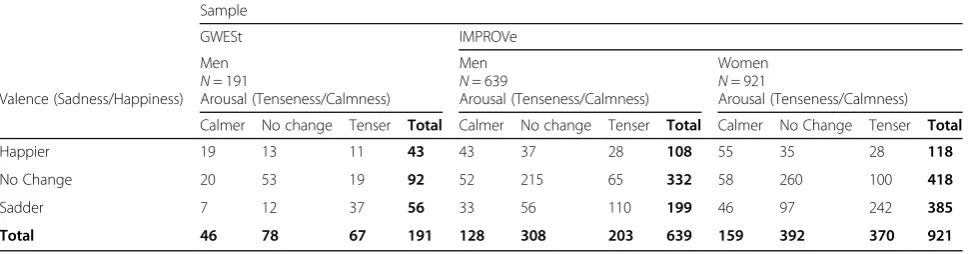
As Table 4 shows, individuals’changes in valence (sad-ness/happiness) post-survey did not necessarily move in the same direction as their changes in arousal (tense-ness/calmness) in any of the samples. Pearson’s r between the changes in valence and arousal post-survey was 0.46 for GWESt men, 0.32 for IMPROVe men, and 0.44 for IMPROVe women (allps < 0.001).
Discussion
The probability of undesirable affective change in the present study ranged from 29.3 to 41.8%. This propor-tion was near the upper range of individuals reporting unexpected upset in a systematic review [9], and could reflect the fact that our samples were drawn from indi-viduals highly impaired by PTSD. Strong, negative emo-tional responses to trauma reminders are a core feature of PTSD. These samples may therefore represent the upper bounds for risks of emotional upset to mailed, trauma-related research. Even so, most respondents had no change in their affect post-survey, and approximately one eighth to one fifth of participants actually reported being happier or calmer. Changes in valence and arousal did not necessarily move in lock-step, so that some
individuals became both happier and tenser post-survey, while others became sadder yet calmer. Given the notable minority of participants who experienced an un-desirable affective change, it is particularly important to note that our data suggest that the magnitude of upset experienced was small. Even in the subgroups with high-est risk of undesirable affective change, such as women with a military sexual assault history, mean score changes tended to be less than one “half-manikin.” Par-ticipants’ net affective change in the present study was approximately one tenth to one half that reported by college students when they looked at magazine adver-tisements with or without background music [26]. Like-wise, effect sizes as measured by Cohen’sdtended to fall in the range considered small [25] and were similar to that reported by university students before and after reading a pamphlet about using nonsexist language in educational publications [27]. By contrast, walking out-doors for 10 min has been associated with medium to large effects sizes on the SAM (Cohen’s d= 0.46 for arousal and 1.12 for valence) [27].
Pre- and post-test evaluations of participants’reactions to trauma-related surveys are regrettably rare—we know of only three others—but their findings are similar to our own. After completing an in-clinic, self-administered questionnaire about combat exposures and PTSD symp-toms, 76 Veterans with PTSD had a 0.50 net increase in their sadness and a 0.26 net increase in their tenseness using the SAM—again, less than one “half-manikin”[28]. Two studies of college undergraduates showed that survey participants had only negligible changes in anxiety, anger, and depression after completing in-class questionnaires about sexual abuse and behaviors [29, 30]. Whether any of these studies can be generalized to mailed surveys, where individuals typically do not agree to receive a question-naire in advance, is uncertain.
with their health care. According to the first author, almost 12% reported being unexpectedly upset by the survey (A. Ferrier-Auerbach, electronic communication, Aug. 29, 2016). Although some Veterans were upset after the survey, participants as a whole had a 0.08-point net reduction in their sadness post-survey and a 0.41-point net reduction in their tenseness as measured by the SAM. This small sized study suggests that survey research unrelated to trauma is not necessarily risk-free; however, there did appear to be slight differences in how the participants reacted to surveys with and without trauma content.
In the present study, women with a history of military sexual assault had the largest net change in sadness and tenseness post-survey, although—again—that change
represented less than one “half-manikin.” Interestingly, respondents’reactions could not have been triggered by sexual assault survey items because we did not ask any on the Time 3 questionnaire. As with Jaffe et al.’s [10] meta-analysis, positive PTSD screens had the most con-sistent effect on probability of undesirable affective change, but the magnitude of change was small. Against expectations, combat history’s association with undesir-able affective change was inconsistent across the groups. Persistent serious mental illness had no association with affective change post-survey.
Strengths and limitations
Our use of a pre- and post-test design allowed us to control for participants’baseline affect. Findings showed
Table 2Affective change category overall and by hypothesized correlate or predictor
Affective Change Category
Overall By Hypothesized Correlate or Predictor
PTSD Screen Positive Persistent SMI Combat Exposure Military Sexual Assault
Yes No Yes No Yes No Yes No
Valence (Sadness/Happiness)
GWESt Men
Sadder 29.3 32.7 15.8* NA NA 39.6 18.0** 22.2 29.7
No Change 48.2 43.8 65.8 NA NA 42.6 53.9 44.4 48.4
Happier 22.5 23.5 18.4 NA NA 17.8 28.1 33.3 22.0
IMPROVe Men
Sadder 31.1 33.6 24.9 29.8 31.2 31.3 26.7 29.4 31.1
No Change 52.2 50.1 57.1 54.4 51.9 51.6 60.0 50.0 52.3
Happier 16.8 16.3 18.0 15.8 17.0 17.1 13.3 20.6 16.6
IMPROVe Women
Sadder 41.8 46.9 33.7*** 40.2 42.2 41.5 41.9 44.8 33.3**
No Change 45.3 40.4 53.1 43.1 46.0 43.0 46.2 43.5 50.2
Happier 12.9 12.7 13.2 16.7 11.8 15.5 11.9 11.7 16.5
Arousal (Tenseness/Calmness)
GWESt Men
Tenser 35.4 39.6 18.4* NA NA 40.2 30.3 22.2 36.1
No change 40.6 35.7 60.5 NA NA 37.3 44.9 33.3 41.0
Calmer 24.0 24.7 21.1 NA NA 22.5 24.7 44.4 23.0
IMPROVe Men
Tenser 31.7 34.7 24.3* 31.6 31.7 31.7 31.1 26.5 32.0
No change 48.2 46.5 52.4 49.1 48.0 48.2 48.9 52.9 47.9
Calmer 20.1 18.8 23.3 19.3 20.2 20.1 20.0 20.6 20.1
IMPROVe Women
Tenser 40.2 43.5 34.8* 38.7 40.5 36.4 41.6 44.2 28.8***
No change 42.6 39.6 47.2 42.6 42.6 44.6 41.8 40.9 47.3
Calmer 17.3 16.8 18.0 18.6 16.9 19.0 16.6 14.9 23.9
PTSDposttraumatic stress disorder,SMIserious mental illness,GWEStGulf War I Era Veterans study,IMPROVeInterviews to Measure PTSD Recovery of Veterans study,NAnot available.Bold face fontsignifies statistically significant association between change in affective state post-survey and the hypothesized correlate or predictor. *p< 0.05, **p< 0.01, ***p< 0.001
that our hypothesized correlates and predictors of un-desirable affect were actually associated with greater baseline sadness and tenseness. Without this baseline, we might have overestimated the impact of combat, sexual assault, PTSD and serious mental illness on participants’ post-survey reactions. We urge caution when interpreting data from single post-test studies. Although each participant served as his or her own con-trol, we did not include an experimental control group, e.g., a no-survey control. Therefore, we cannot say whether the survey or some other factor caused some participants’ affect to change. Some participants may have taken breaks between answering questions on the survey, which would have prolonged the time between the pre- and post-test SAMs and thus potentially intro-duced maturation effects.
“Re-test” effects occur when groups repeatedly responding to the same scale report inexplicable net im-provements despite no interventions being offered [31]. It seems unlikely that the present study was affected by this. Participants’ affective change post-survey was
heterogeneous and on net opposite the direction expected for re-test effect. Furthermore, substantial numbers of test-takers showed opposing changes on the two SAM scales. Were a re-test phenomenon operating, the direction of change should have been desirable and uniform across test-takers and across the two SAM scales. Random error, which undoubtedly affected the present study, typically does not bias the direction or magnitude of an effect size but does increase impreci-sion and Type II error. To the extent that some other, unknowable systematic measurement error affected the study, the effect sizes reported here could be under or over estimates of the true effect.
Including 2 samples, which were comprised of 3 unique groups, increased our understanding of the findings’ generalizability. However, no group could be considered representative of the United States’ general population or even of the US Veteran population. Each group had exceptionally high trauma histories. They also had PTSD symptoms sufficiently severe to prompt them to seek disability benefits. These characteristics might
Table 3Magnitude of affective change post-survey overall and by hypothesized correlates or predictors
Affect Overall Hypothesized Correlates or Predictors
PTSD Screen Positive Persistent SMI by Chart Combat Exposure History Military Sexual Assault History
Yes No Yes No Yes No Yes No
Valence (Sadness/Happiness)
GWESt Men 0.1 (1.4) 0.3 (1.4) −0.1 (1.4) NA NA 0.4 (1.4) −0.2 (1.4) −0.6 (1.6) 0.2 (1.4)
IMPROVe Men 0.3 (1.3) 0.3 (1.2) 0.1 (1.3) 0.3 (1.5) 0.3 (1.3) 0.3 (1.3) 0.2 (1.3) 0.2 (1.0) 0.3 (1.3)
IMPROVe women 0.6 (1.4) 0.6 (1.4) 0.3 (1.3)*** 0.5 (1.5) 0.6 (1.3) 0.5 (1.5) 0.6 (1.3) 0.7 (1.4) 0.3 (1.4)***
Arousal (Tenseness/Calmness)
GWESt Men 0.3 (1.7) 0.5 (1.7) 0.0 (1.5) NA NA 0.5 (1.7) 0.4 (1.9) −0.6 (2.0) 0.4 (1.6)
IMPROVe Men 0.3 (1.4) 0.4 (1.4) 0.1 (1.5)* 0.3 (1.5) 0.3 (1.4) 0.3 (1.4) 0.4 (1.3) 0.2 (1.4) 0.3 (1.4)
IMPROVe women 0.5 (1.6) 0.5 (1.7) 0.4 (1.4) 0.4 (1.9) 0.5 (1.5) 0.2 (1.6) 0.5 (1.6)* 0.6 (1.6) 0.2 (1.5)***
PTSDposttraumatic stress disorder,SMIserious mental illness,GWEStGulf War I Era Veterans study,IMPROVeInterviews to Measure PTSD Recovery of Veterans study,NAnot available,Bold face fontsignifies statistically significant difference between those with and without the hypothesized correlate or predictor. *p< 0.05, ***p< 0.001
Results reported as Mean Score Change and Standard Deviation (SD)
Table 4Cross-Tabulation of Veterans’Affective Changes Post-survey
Sample
GWESt IMPROVe
Men Men Women
N= 191 N= 639 N= 921
Valence (Sadness/Happiness) Arousal (Tenseness/Calmness) Arousal (Tenseness/Calmness) Arousal (Tenseness/Calmness)
Calmer No change Tenser Total Calmer No change Tenser Total Calmer No Change Tenser Total
Happier 19 13 11 43 43 37 28 108 55 35 28 118
No Change 20 53 19 92 52 215 65 332 58 260 100 418
Sadder 7 12 37 56 33 56 110 199 46 97 242 385
Total 46 78 67 191 128 308 203 639 159 392 370 921
GWEStGulf War I Era study,IMPROVeInterviews to Measure PTSD Recovery of Seterans study
have caused them to react more negatively to a trauma-related survey than individuals without PTSD or with less disabling PTSD symptoms.
Labott et al. [32] has found that most participants upset by disclosing traumatic experiences in telephone interviews require 0–0.5 h to “get over” their upset, while a few respondents require as much as 72 h. This study assessed participants’change in emotion immedi-ately after completing a trauma-related survey, but we did not assess the duration of that change. Future stud-ies should consider both the magnitude and duration of undesirable affective change.
The net change in negative affect in the present study was less than that reported for many activities of daily living, suggesting that expedited IRB procedures may be appropriate for trauma-related surveys. This is not the same as saying that trauma-related surveys are risk-free, and it should not be taken to mean that researchers need not concern themselves with an appropriate safety plan for research participants. Our own safety plan explicitly encouraged Veterans to opt out of the study if they felt it might be too upsetting. Therefore, we may have selected out those Veterans at highest risk for an extreme reaction to the questionnaires.
Compared to other measures of affect, such as Emo-cards [33] or smartphone applications, research partici-pants find the SAM relatively easy to use and interpret [34, 35]. Unfortunately, despite the SAM’s widespread use for assessing emotional responses to stimuli, state norms are not readily available. Our participants’baseline valence was similar to that reported for Veterans being seen in a PTSD clinic [28] and approximately 2 full points (or one “full manikin”) sadder than that reported for 92 Spanish University students [35]. Our participants’baseline arousal was slightly tenser than the clinic Veterans’ baseline, but similar to the University students’baseline [28, 35]. Clinic-ally meaningful changes on the SAM have not been defi-ned—a limitation that unfortunately applies to most state measures of affect. Without such definitions, one must rely on less satisfying estimates of effect size, such as Cohen’sd, or on one’s own personal belief as to whether a “half-manikin”or“full-manikin”change is meaningful.
Conclusions
Although a substantial minority of Veterans in these stud-ies reported more sadness or tenseness after completing a trauma-related survey, the net change in undesirable affect was similar to that reported for individuals before and after reading a grammar pamphlet and less than the affective change associated with taking a walk or looking at magazine ads with and without background music. Some respondents became happier or calmer post-survey. Most hypothesized predictors and correlates of undesir-able affective change were actually associated with higher
baseline scores on the SAM and did not necessarily trans-late into larger, undesirable changes post-survey. Our data do not suggest that separate, special protections need to be created for Veterans with PTSD, persistent serious mental illness, combat exposure, or military sexual assault history when receiving unsolicited, trauma-related surveys by mail. Because our study samples were arguably at greater risk for emotional upset than more general popu-lations, these results are cautiously reassuring. Research into the risks and harms of mailed, trauma-related survey research could be considerably strengthened by using more pre- and post- test designs with experimental con-trol groups, by clarifying the risks and harms of mailed surveys that do not ask about trauma, and by defining meaningful clinical changes in outcome measures.
Additional files
Additional file 1:Supplementary material: eFigure.“Mean Change in
Affect by Affective Score Change Category.”(DOCX 105 kb)
Additional file 2:Supplementary material: eTable.“Baseline (Pre-Survey)
and Post-Survey Valence and Arousal Scores by Hypothesized Correlates or Predictors. Results Reported as Means and Standard Deviations (SD).” (DOCX 21 kb)
Abbreviations
GWESt:Gulf War 1 Era Veterans study; IMPROVe: Interviews to Measure PTSD Recovery of Veterans study; IRB: Institutional review board;
PTSD: Posttraumatic stress disorder; RRPQ: Reactions to Research Participation Questionnaire; SAM: Self-Assessment Manikin; SD: Standard deviations; VA: United States Department of Veterans Affairs
Acknowledgements Not applicable.
Funding
The Center for Chronic Disease Outcomes Research is a VA Health Services Research and Development (HSR&D) Service Center of Excellence (Center grant #HFP 98–001). This study was supported by grants #GWI 04–352 and #IIR-09-359 from VA HSR&D service. Dr. Kehle-Forbes was supported by a VA HSR&D Career Development Award (#09-020). Dr. Partin was supported by a VA HSR&D Research Career Scientist Award (#RCS 10–185). The funding agency had no role in the design, data collection, analysis, data interpretation, manuscript writing, or decision to submit the manuscript.
Availability of data and materials
The data that support the findings of this study are available from the corresponding author (MM) upon reasonable request and with local Minneapolis VA Health Care System IRB permission.
Authors’contributions
MM obtained funding; designed the study; oversaw data collection, analysis, interpretation; and drafted the manuscript. SMK-F and MRP contributed to analysis and interpretation of data and subsequent manuscript revisions. All authors read and approved the final manuscript.
Author’s information
MM and SMK-F are core-investigators and MRP, Co-Associate Director, for the Center for Chronic Disease Outcomes Research at the Minneapolis VA Med-ical Center. SMK-F is Research Investigator at the National Center for PTSD, Women’s Health Sciences Division at the VA Boston Healthcare System.
Competing interests
Consent for publication Not applicable.
Ethics approval and consent to participate
The Minneapolis VA Health Care System’s Internal Review Board (IRB) for Human Studies reviewed and approved both studies’protocols (GWESt protocol #3667-B, IMPROVe protocol #3337-A). Participants’signified their consent to participate in the research by returning a completed survey.
Disclaimer
The views presented in this paper are those of the authors and do not necessarily represent the views of the Department of Veterans Affairs.
Publisher’s Note
Springer Nature remains neutral with regard to jurisdictional claims in published maps and institutional affiliations.
Author details
1Section of General Internal Medicine, Minneapolis VA Health Care System, Minneapolis, MN, USA.2Center for Chronic Disease Outcomes Research, Minneapolis VA Health Care System, Minneapolis, MN, USA.3Department of Internal Medicine, University of Minnesota Medical School, Minneapolis, MN, USA.4National Center for PTSD Women’s Health Sciences Division at VA Boston Healthcare System, Boston, MA, USA.5Center for Chronic Disease Outcomes Research (111–0), Minneapolis VA Medical Center, One Veterans Drive, Minneapolis, MN 55417, USA.
Received: 14 November 2016 Accepted: 3 May 2017
References
1. Moum T. Mode of administration and interviewer effects in self-reported symptoms of anxiety and depression. Soc Indic Res. 1998;45(1–3):279–318. 2. Richman WL, Kiesler S, Weisband S, Drasgow F. A meta-analytic study of
social desirability distortion in computer-administered questionnaires, traditional questionnaires, and interviews. J Appl Psychol. 1999;84(5):754–75. 3. Rogers SM, Miller HG, Turner CF. Effects of interview mode on bias in survey
measurements of drug use: do respondent characteristics make a difference? Subst Use Misuse. 1998;33(10):2179–200.
4. Beebe T, Harrison P, Park E, McRae JJ, Evans J. The effects of data collection mode and disclosure on adolescent reporting of health behavior. Soc Sci Computer Rev. 2006;24(4):476–88.
5. 45 CFR: 2009 §46.110. 2009. 6. 45 CFR: 2009 §46.102(i). 2009.
7. Halek K, Murdoch M, Fortier L. Spontaneous reports of emotional upset and health care utilization among veterans with posttraumatic stress disorder (PTSD) after receiving a potentially upsetting survey. Am J Orthopsychiatry. 2005;75(1):142–51.
8. Newman E, Willard T, Sinclair R, Kaloupek D. Empirically supported ethical research practice: the costs and benefits of research from the participants’ view. Account Res. 2001;8:309–29.
9. Jorm A, Kelly C, Morgan A. Participant distress in psychiatric research: a systematic review. Psychol Med. 2007;37:917–26.
10. Jaffe A, DiLillo D, Hoffman L, Haikalis M, Dykstra R. Does it hurt to ask? A meta-analysis of participant reactions to trauma research. Clin Psychol Rev. 2015;40:40–56.
11. Newman E, Wlaker E, Gefland A. Assessing the ethical costs and benefits of trauma-focused research. Gen Hosp Psychiatry. 1999;21(3):187–96. 12. Sandberg A, Murdoch M, Polusny M, Grill J. Reactions to a survey among
those who were and were not sexually assaulted while serving in the military. Psychol Rep. 2012;110(2):461–8.
13. Walker EA, Newman E, Koss M, Bernstein D. Does the study of victimization revictimize the victims? Gen Hosp Psychiatry. 1997;19(6):403–10. 14. Murdoch M, Hodges J, Cowper D, Fortier L, Van Ryn M. Racial disparities in
VA service connection for posttraumatic stress disorder disability. Med Care. 2003;41(4):536–49.
15. Murdoch M, Hodges J, Hunt C, Cowper D, Kressin N, O’Brien N. Gender differences in service connection for PTSD. Med Care. 2003;41(8):950–61. 16. Murdoch M, Hodges J, Cowper D, Sayer N. Regional variation and other
correlates of Department of Veterans Affairs (VA) disability awards for posttraumatic stress disorder. Med Care. 2005;43(2):112–21.
17. Murdoch M, Sayer N, Spoont M, Rosenheck R, Noorbaloochi S, Griffin J, Arbisi P, Hagel E. Long-term outcomes of disability benefits in US Veterans with posttraumatic stress disorder. Arch Gen Psychiatry. 2011;68(10):1072–80. 18. Murdoch M, Spoont M, Kehle-Forbes S, Harwood E, Sayer N, Clothier B,
Bangerter A. Persistent serious mental illness among former applicants for VA PTSD disability benefits and long-term outcomes: symptoms, functioning, and employment. J Trauma Stress. 2017;30(1):36–44. 19. Murdoch M, Simon A, Polusny M, Bangerter A, Grill J, Noorbaloochi S, Partin
M. Randomized controlled trial using pre-merged questionnaires showed that different tracking/privacy conditions and incentives yielded distinctive subpopulations of respondents. BMC Med Res Methodol. 2014;14:90. 20. Posner J, Russell J, Peterson B. The circumplex model of affect: an
integrative approach to affective neuroscience, cognitive development, and psychopathology. Dev Psychopathol. 2005;17(3):715–34.
21. Bradley M, Lang P. Measuring emotion: the Self-Assessment Manikin and the semantic differential. J Behav Ther & Exp Psychiat. 1994;25(1):49–59. 22. Hammarberg M. Penn Inventory for Posttraumatic Stress Disorder:
psychometric properties. Psychol Assess. 1992;4(1):67–76.
23. Janes G, Goldberg J, Eisen S, True W. Reliability and validity of a Combat Exposure Index for Vietnam veterans. J Clin Psychol. 1991;47:80–6. 24. Murdoch M, McGovern P. Development and validation of the Sexual
Harassment Inventory. Violence Vict. 1998;13(3):203–16.
25. Cohen J. Statistical power analysis for the behavioral sciences. 2nd ed. Lawrence Erlbaum Assoc.: Hillsdale; 1988.
26. Morris J, Boone M. The effects of music on emotional response, brand attitude, and purchase intent in an emotional advertising condition. Adv Consum Res. 1998;25:518–26.
27. Ekkekakis P, Hall E, VanLanduyt L, Petruzzello S. Walking in (affective) circles: can short walks enhance affect? J Behav Med. 2000;23(3):245–75. 28. Ferrier-Auerbach A, Erbes C, Polusny M. Does trauma survey research cause
more distress than other types of survey research? J Trauma Stress. 2009; 22(4):320–3.
29. Savell J, Kinder B, Young M. Effects of administering sexually explicit questionnaires on anger, anxiety, and depression in sexually abused and nonabused females: implications for risk assessment. J Sex Marital Therap. 2006;32:161–72.
30. Rojas A, Kinder B. Effects of completing sexual questionnaires in males and females with histories of childhood sexual abuse: implications for institutional review boards. J Sex Marital Therap. 2007;33:193–201. 31. Knowles E, Coker M, Scott R, Cook D, Neville J. Measurement-induced
improvement in anxiety: mean shifts with repeated assessment. J Pers Soc Psychol. 1996;71(2):352–63.
32. Labott S, Johnson T, Fendrich M, Feeny N. Emotional risks to respondents in survey research: some empirical evidence. J Empir Res Hum Res Ethics. 2013;8(4):53–66.
33. Desmet P, Overbeeke C, Tax S. Designing products with added emotional value: develoment and application of an approach for research through design. The Design Journal. 2001;4(1):32–47.
34. Isomursu M, Tahiti M, Vainamo S, Kuuttii K. Experimental evaluation of five methods for collecting emotions in field settings with mobile applications. Int J Human Computer Studies. 2007;65:404–18.
35. Hogarth R, Portell M, Cuxart A, Kolev G. Emotion and reason in everyday risk perception. J Behav Decision Making. 2011;24:202–22.
• We accept pre-submission inquiries
• Our selector tool helps you to find the most relevant journal
• We provide round the clock customer support
• Convenient online submission
• Thorough peer review
• Inclusion in PubMed and all major indexing services
• Maximum visibility for your research
Submit your manuscript at www.biomedcentral.com/submit