Available Online at www.ijpret.com 1401
INTERNATIONAL JOURNAL OF PURE AND
APPLIED RESEARCH IN ENGINEERING AND
TECHNOLOGY
A PATH FOR HORIZING YOUR INNOVATIVE WORK
IMPLEMENTATION OF AN APPROACH TO ENHANCE QOS AND QOE BY
MIGRATING SERVICES IN CLOUD BASED MOBILE ENVIRONMENTS
MS. MAYURI R. GAWANDE1, MS. PARNAL P. PAWADE2
1.M.E Second Year CSE, P.R.Patil COET Amravati, Maharashtra, INDIA. 2.Asst. Prof. IT Dept. P.R.Patil COET Amravati, Maharashtra, INDIA.
Accepted Date: 05/03/2015; Published Date: 01/05/2015
Abstract: Mobile networks currently play a key role in the evolution of the Internet due to exponential increase in demand for Internet-enabled mobile devices and applications. As intelligent mobile phones and wireless networks become more and more popular, network services for users are no longer limited to the home. Multimedia information can be obtained easily using mobile devices; allowing users to enjoy everywhere network services. Here we are focusing on cloud base multimedia services. Multimedia services are mainly based on Quality of service (QoS). QoS contain Bandwidth, throughput, jitter, error rates etc. If the user get the multimedia services with high speed and more security then Quality of Experience (QoE) increases. But now days, there is a major problem of hacking of cloud data. In this paper we provide more security for cloud data using Secure OAuth protocol how it will implement and also when workload increases on cloud then service will serve in some delay. Here for this we are providing the solution by implementing service migration technique and serve the user request in lesser delay. This paper shows the multimedia sharing services over the cloud in a secure and optimized manner.
Keywords: Cloud Computing, Service Migration, QoS, QoE, Mobile Multimedia, Secure OAuth Protocol.
Corresponding Author: MS. MAYURI R. GAWANDE
Access Online On:
www.ijpret.com
How to Cite This Article:
Mayuri R. Gawande, IJPRET, 2015; Volume 3 (9): 1401-1409
Available Online at www.ijpret.com 1402 INTRODUCTION
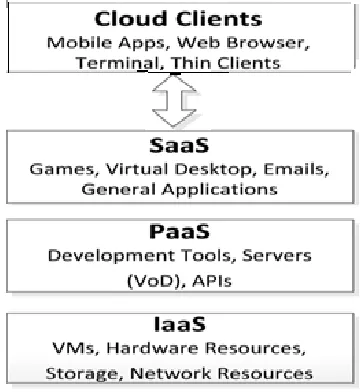
Cloud computing is a relatively new trend in Information Technology that involves the provision of services over a network such as the Internet. The cloud services offered are divided in three categories: Software as a Service (SaaS), Platform as a Service (PaaS) and Infrastructure as a Service (IaaS) as illustrated in Fig.1.SaaS delivers software applications such as word processing over the network. PaaS delivers a host operating system and development tools that come installed on virtualized resources. Such Cloud services are now being used to support Video-on-Demand (VoD) services which have much more demanding Quality of Service (QoS) constraints. Finally, IaaS offers raw resources such as a number of virtual machines or processors and storage space and leaves it up to the user to select how these resources are used [1]. Cloud computing is the delivery of computing services over the Internet. Cloud services allow individuals and businesses to use software and hardware that are managed by third parties at remote locations. The cloud computing model allows access to information and computer resources from anywhere that a network connection is available. Cloud computing provides a shared pool of resources, including data storage space, networks, computer processing power, and specialized corporate and user applications [2]. Mobile computing also becomes more popular due to smartphones and tablet pcs.
Available Online at www.ijpret.com 1403 Fig. 1. Cloud service layers.
II. LITERATURE SURVEY
A. Mobile Multimedia QoS Provision Architecture:
The provision of QoS for mobile multimedia applications requires the support of the architectures, protocols, and applications so that the mobile devices can access the multimedia data ubiquitously: anytime and anywhere. Multimedia transmission needs to meet the following requirements, namely high bandwidth, low error rate, low delay, and very small delay variance. As mentioned in the current research effort cannot provide solutions to fulfill all of these requirements for even the wired media. It is thus well-acknowledged that it is even more challenging to meet these requirements for high-quality multimedia transmission over wireless connections. The QoS of multimedia applications are not limited to bandwidth, delay, and jitter. Furthermore, the services provided to the mobile devices should be personalized. There are two ways of emphasizing Region of Interest (ROI), zooming in and enhancing the quality to optimize the overall user experience of viewing sports videos on mobile phones [3].It found out the overall user experience is closely related to the acceptance of video quality and the interest in video content.
Available Online at www.ijpret.com 1404 1. Incompleteness: current interfaces(e.g.,application programming interfaces such as Berkeley Sockets) are generally not QoS configurable and provide only a small subset of the facilities needed for control and management of multimedia flows;
2. Lack of mechanisms to support QoS guarantees: research is needed in distributed control, monitoring and maintenance QoS mechanisms so that contracted levels of service can be predictable and assured; and
3. Lack of an overall framework: it is necessary to develop an overall architectural framework to build upon and reconcile the existing notion of quality of service at different system levels and among different network architectures.
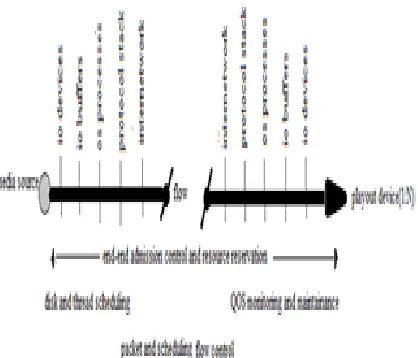
The End-to-End QoS Scenario is shown in Fig 2. In recognition of the above limitations, a number of research teams have proposed a systems architectural approach to QoS provision. In this paper these are referred to as QoS architectures. The intention of QoS architecture research is to define a set of quality of service configurable interfaces that formalize quality of service in the end-system and network, providing a framework for the integration of quality of service control and management mechanisms.
Available Online at www.ijpret.com 1405 B. Features & Challenges
1. Delivery and Distribution Challenges
With mobile multimedia applications, users are more concentrate on-demand services, and telecommunication companies are looking for more alternatives to maintain their income levels. These requirements cause several delivery and distribution issues—such as, QoS, quality of experience (QoE), content adaptation, and security. Addressing these issues will make the multimedia cost-effective for mobile users and will improve the quality.
2. QoE and Core Network Congestion
Although LTE seemingly presents a great opportunity for mobile multimedia applications delivery, MNOs must address some challenges to fully exploit this technology’s power. In 3G and 3.5G mobile networks, congestion occurs more frequently at the physical layer because of the high mobile multimedia applications consumption, which in turn causes more delays on cellular networks and has a direct impact on the users’ QoE. To recognize the increased delays in application delivery and enhance the QoE, content must be adapted or optimized on the basis of metadata related to the network, service, terminals and user [5].
C. Cloud Computing and Mobile Multimedia
To provide good media services, multimedia computing has grown as a eminent technology for generating edit, process and search media contents, such as images, video, audio, graphics, and so on. Now days for multimedia applications and services over the Internet and mobile wireless networks, there are strong demands for cloud computing because of the huge amount of calculations required for serving millions of Internet or mobile users at the same time [5]. In this new cloud-based multimedia-computing model, users store and process their multimedia application data in the cloud in a distributed manner, eliminating full installation of the media application software on the users’ computer or device and thus reducing the burden of multimedia software maintenance and upgrade as well as sparing the computation of user devices and saving the battery of mobile phones.
Available Online at www.ijpret.com 1406 multimedia services may suffer from unacceptable media QoS or QoE [6]. Mobile devices have limitations in memory, computing power, and battery life; thus, they have even more prominent needs to use a cloud to address the tradeoff between computation and communication.
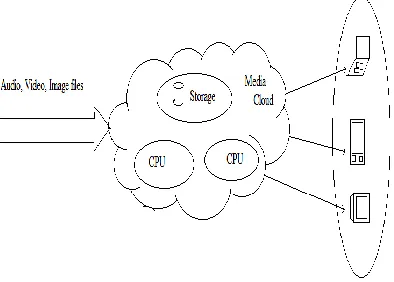
More specifically, in mobile media applications and services, because of the power requirement for multimedia [7] and the time-varying features of the wireless channels, QoS requirements in cloud computing for mobile multimedia applications and services become more stringent than those for the Internet cases. To meet multimedia’s QoS requirements in cloud computing for multimedia services over the internet and mobile wireless networks, we tell the main concepts of multimedia cloud computing for multimedia computing and communications, shown in Fig. 3.
Fig. 3. Fundamental Concept of Multimedia Cloud Computing.
III. PROPOSED SYSTEM
Here we are implemented the Multimedia File Sharing service over the cloud in secured and optimized manner as shown below in the modules.
Database Creation
Available Online at www.ijpret.com 1407 B. Android Application Development for Client
In this module we have created an application which contains description of application and login form. Using this application user can use the file sharing cloud based service. For new user there is an option of signup to system, which takes information from user and store data in database using php. Once user signup successfully then the user can login. The password and secure key which is used for sharing file is in encrypted form. For this AES algorithm is used so a user credentials is more secure on cloud. After signup, user information is stored in second table. Once user signup successfully, login window will open.
After Signup, user credentials check from database if it is valid then user can login by entering password and click on login button then user enters into new window. In that user will upload any file on cloud and share that file. Here we can see secret code. Secret code is nothing but a4 digit random number or alphabet. This is a authorization we are proving for user using OAuth protocol. It is totally based on ip address and imei number (Mobile Device hardware number) which is taken from mobile when this application install in mobile. If imei Number changes then user could not login to the system. If the ip address of user change then user has to remember this secret code and then user will login to system. This is a strong authorization we are proving here so our cloud data will not hack by hacker. As the secret code is only in user’s mind, no one can hack it.
C. Development of cloud
The cloud is developed using php and MySql. This cloud contains multimedia files which are uploaded by user using android phones. Once the user login successfully, user can upload any multimedia file from their mobile sd card and it get store into private cloud. Here we are using private cloud only.
D. Segregation of data into public and private cloud
Here the actual sharing of information is done based on the public private cloud architecture. Here the sharing takes place between two users. For example 2 users A and B have their account on this application. If user A uploaded one file on cloud and user B wants to download this file then user B has to request to user A. The files which are uploaded on cloud are in encrypted form so it will not hack by anyone. For encryption AES algorithm is used.
Available Online at www.ijpret.com 1408 decrypted and then that file get shown in user B Approved Files to download Section. So the sharing will be done in more secured manner. By clicking on that file user can now download it.
The shared file get store in cloud with appropriate file id, user id who share it, user id for whom file get shared, sharing date and approval status for that file.
IV. RESULT ANALYSIS
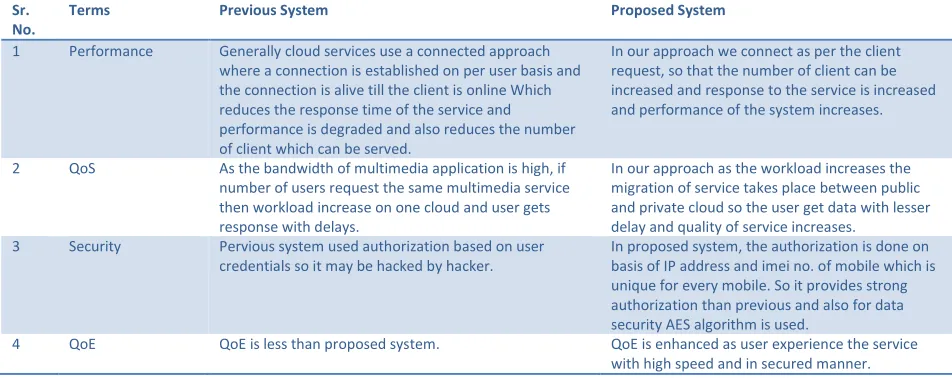
Here the proposed system is providing the enhanced QoS for multimedia cloud based service. As the user get the multimedia file sharing service with high speed and more security the QoE also enhanced as the user experience better service than previous. Here following table clearly show it as follows.
Table 1. Comparison Table
Sr. No.
Terms Previous System Proposed System
1 Performance Generally cloud services use a connected approach where a connection is established on per user basis and the connection is alive till the client is online Which reduces the response time of the service and performance is degraded and also reduces the number of client which can be served.
In our approach we connect as per the client request, so that the number of client can be increased and response to the service is increased and performance of the system increases.
2 QoS As the bandwidth of multimedia application is high, if
number of users request the same multimedia service then workload increase on one cloud and user gets response with delays.
In our approach as the workload increases the migration of service takes place between public and private cloud so the user get data with lesser delay and quality of service increases.
3 Security Pervious system used authorization based on user
credentials so it may be hacked by hacker.
In proposed system, the authorization is done on basis of IP address and imei no. of mobile which is unique for every mobile. So it provides strong authorization than previous and also for data security AES algorithm is used.
4 QoE QoE is less than proposed system. QoE is enhanced as user experience the service
with high speed and in secured manner.
V. CONCLUSION
Available Online at www.ijpret.com 1409 REFERENCES
1. Fragkiskos Sardis, Glenford Mapp, Jonathan Loo, “On the Investigation of Cloud Based
Mobile Media Environment with Service Populating QoS Aware Mechanisms,” IEEE trasaction on multimedia, vol.15, JUNE 2013.
2. http://www.scaledb.com/DBaaS-Database-aa-a Service.php
3. Hongli Luo, Mei-Ling Shyu, “Quality of service provision in mobile multimedia - a survey,”
Human-centric Computing and Information Sciences 2011
4. Hutchison, D., Coulson G., Campbell, A., and G. Blair, “Quality of Service Management in
Distributed Systems,” M. Slomaned., Network and Distributed Systems Management, Addison Wesley, Chapter 11, 1994.
5. RAMESH .B, Ssvitha. N, Manjunath. A.E,” Mobile Applications in Multimedia Cloud
Computing”, Int. J. Computer Technology & Applications, Vol 4 (1), jan-feb 2013, pp. 97-103.
6. M. Armbrust, A. Fox, R. Griffith, A. D. Joseph, R. Katz, A. Konwinski, G. Lee, D. Patterson, A.
Rabkin, I. Stoica, and M. Zaharia. (2009, Feb. 10). Above the clouds: A Berkeley view of cloud computing. EECS Dept., Univ. California, Berkeley, No. UCB/EECS-2009-28 [Online]. Available: http://radlab. cs.berkeley.edu/
7. R. Stankiewicz and A. Jajszczyk, “A Survey of QoE Assurance in Converged Networks”,