Scalable Computing: Practice and Experience
Volume 20, Number 1, pp. 93–99. http://www.scpe.org
ISSN 1895-1767 c
⃝2019 SCPE
ON THE SECURITY OF AUTHENTICATED GROUP KEY AGREEMENT PROTOCOLS
SUMAN BALA∗, GAURAV SHARMA†, HIMANI BANSAL‡, AND TARUNPREET BHATIA§
Abstract. The group key agreement protocol enables to derive a shared session key for the remote members to communicate securely. Recently, several attempts are made to utilize group key agreement protocols for s ecure multicasting in Internet of Things. This paper contributes to identify the security vulnerabilities in the existing protocols, to avoid them in future constructions. The protocols presented by Gupta and Biswas have been found insecure to ephemeral secret key leakage (ESL) attack and also, malicious insiders can impersonate an honest participant. Additionally, the protocol presented by Tan is also ESL-insecure. We also present a fix to the Tan’s protocol to make it secure.
Key words: Group key agreement, Authentication, Insider security, Mutual authentication
AMS subject classifications. 68M12
1. Introduction. The recent security concerns are prevailing when multiple devices over a wireless com-munication interact among them leaking sensitive information to a non-participating entity [20, 19]. A common concern in these real world applications is to establish a secure session among the interested remote participants. It is always challenging to derive a shared secret key which can prevail over the advantages of adversary. A group key agreement (GKA) protocol enables the participating members to establish such a symmetric session key, usually following an asymmetric procedure. This symmetric key is further used for encryption decryption purpose. Various real life applications of GKA includes distributed computations, video conferencing and multi-user games. A variety of key establishment approaches have been presented in literature based on the network characteristics, agreement strategy, communication rounds and contributiveness. The two major classes repre-senting the protocols are either transportation of session key or agreement via participant’s contribution. In the key transport protocols, the session key is derived by one of the powerful nodes and then transferred securely to all the members of the group. The common session key, derived by all the members following an interactive protocol, is known as key agreement protocols.
The hybridization of above two categories can originate another variety of protocols namely, balanced and imbalanced protocols. The balanced protocols are equally contributive protocols while in imbalanced, all the participants contribute but the major part of computations, such as signature verification, is performed by some powerful node. Other than preserving the basic attributes such as known key security and forward secrecy,
contributivenessis an important aspect of a GKA protocol. By contributiveness, we mean that all the member’s contributions are involved so that none of the member can predetermine the session key without incorporation of other members.
Following the Diffie and Hellman [8] work on two-party key exchange, there has been extensive efforts to convert their two-party key exchange protocol to multi-party key exchange protocol [6, 11, 21]. Among the most notable works, Joux’s one round three-party key agreement protocol [13] is considered as a significant contribution for practical GKA protocol due to the functionality of pairing. Based on Joux’s work [13], Barua et al. [1] have presented protocols of multi-party key agreement in two flavours unauthenticated- based on ternary trees and authenticated- from bilinear maps. Unfortunately their protocols are secure against passive adversaries only. As established by Bellare and Rogaway (Crypto’93) [2], to avoid man in the middle (MITM) attack,authentication is an essential security requirement for key exchange protocols.
The first contribution towards modeling provable security for authenticated key exchange (AKE), was commenced by Bresson et al. [3, 4, 5] but their protocol accounts O(n) rounds, which is very expensive. Later in 2003, Katz and Yung [15] presented a scalable compiler to transform any unauthenticated GKA into an authenticated GKA with the additional cost of one round. Since the GKA study involves multiple participants, the consideration of malicious insider is a realistic scenario. Katz and Shin [14] firstly modeled the insider
∗Universit´e Libre de Bruxelles, Belgium ([email protected]) †Universit´e Libre de Bruxelles, Belgium
‡Jaypee Institute of Information Technology, Noida, India §Thapar University, India
security in GKA protocols. Gorantla et al. [9] studied that the compromise of long-term key of one participant should not enable the impersonation of any other participant. The improved security model which addresses the
forward secrecy andkey compromise impersonation resilience (KCIR) for GKA protocols to take into account authenticated key exchange (AKE) security and mutual authentication (MA) security. In 2011, their model was revisited and enhanced by Zhao et al. [30] where they addressed the ephemeral secret key leakage (ESL) attack. The extended model is the strongest model, as it takes into account both the leakage of secret key as well as the leakage of ephemeral key independently. However, Tseng et al. [23] argued about the insufficiency of UF-ACMA secure signature scheme and proposed a UF-ACM-ESL secure signature based on Schnorr [17].
Inidentity basedsetting, the first authenticated ID-based GKA protocol was formalized by Choi et al.[7] in 2004, but their scheme was found vulnerable to insider colluding attack [29]. In 2007, Shim [16] claimed that scheme in [7] is vulnerable to another insider colluding attack and improved the protocol. Unfortunately, none of these AGKA protocols could achieve the perfect forward secrecy. Perfect forward secrecy allows the compromise of long term secret keys of all participants maintaining all earlier shared secrets unrevealed. In 2011, Wu et al. [28] presented a provably secure ID-AGKE protocol from pairings, providing forward secrecy and security against the insider attacks. Later, Wu et al. [27] presented their first revocable ID-based AGKE (RID-AGKE) protocol, which is provably secure and can resist malicious participants as well. The main attraction of this protocol was efficient revocation of group members. However, the protocol takes three rounds but unable to identify malicious participants. In a subsequent improvement, Wu et al. [26] proposed an ID-based AGKE protocol, which can passively detect malicious participants and also proved its security against insider attacks. Although, the protocol was later found insecure against an insider colluding attack by [24]. Afterwards, a two round revocable ID-AGKE protocol was presented by Wu et al. [25] which can identify malicious participants. Another work on authenticated group key agreement protocol without pairing is presented by Sharma et al. [18]. Recently in 2017, Gupta and Biswas [10] presented an ECCbased AGKA protocol and claimed it computationally efficient. However, in this paper, we present security flaws in their construction and proved it insecure. All the above discussed protocols are balanced GKA protocols where all the participants contribute equally and derive a shared session key.
On the other hand, some imbalanced GKA protocols are also presented where one of the powerful node contribute more in the computational sense. A recent contribution to improve the computational efficiency by Islam et al. [12] is presented. This is an ECC-based ID-AGKA protocol for imbalanced mobile networks. The best feature of this protocol is pairing-free property. However, Tan [22] found the Islam et al. [12] construction insecure and improved it. We present an ESL attack on their improved work and attempt to fix it.
Rest of the paper is organized as follows: in Section 2, we introduce necessary definitions, corresponding hardness assumption for AGKA protocol and standard security model for AGKA. Section 3 and Section 4 describes the AGKA protocols and our attacks on their construction, followed by the conclusion Section 5.
2. Preliminaries and Definitions. In this section, we introduce mathematical definitions, hardness assumptions, the notion of AGKA protocol and security model for it. If X is a set, theny ←$ X denotes the operation of choosing an elementy ofX according to the uniform random distribution on X.
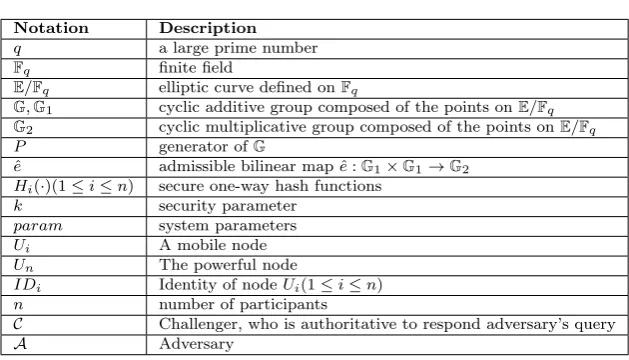
2.1. Notations Used. This section describes the preliminaries used for AGKA protocol. Table 2.1 shows the notations used throughout the paper.
2.2. Definitions and assumptions. Definition 2.1 (Computational Diffie-Hellman Problem (CDHP)).
Let Gbe an additive cyclic group (precisely an elliptic curve group) of order qwith generatorP. LetCDH : G×G→Gbe a map defined by
CDH(X, Y) =Z, whereX =aP, Y =bP andZ =abP .
The computational Diffie-Hellman problem (CDHP) is to evaluateCDH(X, Y) givenX, Y ←$ Gwithout the
knowledge of a, b ∈ Z∗q. (Note that obtaining a ∈ Z∗q, given P, X ∈ G is solving the elliptic curve discrete
logarithm problem (ECDLP).)
Definition 2.2 (Computational Diffie-Hellman Assumption). Given a security parameterλ, let⟨q,G, P, X,
Table 2.1
Notations Used
Notation Description
q a large prime number
Fq finite field
E/Fq elliptic curve defined onFq
G,G1 cyclic additive group composed of the points onE/Fq G2 cyclic multiplicative group composed of the points onE/Fq
P generator ofG
ˆ
e admissible bilinear map ˆe:G1×G1→G2
Hi(·)(1≤i≤n) secure one-way hash functions
k security parameter
param system parameters
Ui A mobile node
Un The powerful node
IDi Identity of nodeUi(1≤i≤n) n number of participants
C Challenger, who is authoritative to respond adversary’s query
A Adversary
attempts to solve CDHP, its advantage
AdvG(A) :=P rob[A(q,G, P, X, Y) =CDH(X, Y)]
is negligible inλ. We say that the (t, ϵ)-CDH assumption holds in groupGif there is no algorithm which takes
at mostt running time and can solve CDHP with at least a non-negligible advantageϵ.
2.3. AGKA Protocol. Let there are total n participants U1, U2,· · ·, Un and any subset with (n ≥ 2) can run the protocol (π). Each participant is provided a (public, private) key pair. In a protocol, we refer by
session a running instance. Each participant is allowed to run multiple sessions concurrently. Anith instance of the protocol is represented as Πi
U, whereU is the corresponding user or participant. We define two identities - the session identity sidi
U which is the session dependent information computed by userU at it’sithinstance using the shared information in that session, and the partner identity pidi
U which is a set of identities of the participants who are involved in generation of the session key with Πi
U . We say an instance Π i
U accepts when it computes a valid session keysk. We say instances Πi
U and Π j U′(for Π
i U ̸= Π
j
U′) are partnered iff (i) they have
both accepted (ii)sidi U =sid
j
U′ (iii)pid
i U =pid
j
U′ . We further define the termfreshness. Definition 2.3 (Freshness). An instanceΠi
U is referred to be fresh if it satisfies the following conditions:
1. If the instance Πi
U is accepted, neither Ui nor any of its partnered instances, can query Reveal key
oracle.
2. No participant is allowed to query Corrupt and Reveal Ephemeral Key simultaneously.
3. In a partnered instance betweenUi andUj, if an adversary Acorrupts Uj, any message sent fromUj
toUi must actually come fromUj.
2.4. Security Model for AGKA Protocol. We analyze the security of proposed protocol within the standard security frame of indistinguishability. For the purpose we define the following experiment between the challenger Cand the adversaryA:
Setup: On input a security parameter 1λ, the challengerCrunsKeyGen(1λ) to generate the public parameter
Params and the system key pair (pk, msk) and gives the adversary A the public key pk. msk is the master secret of the system.
Queries: Acan adaptively make the following queries: • Execute(Πi
U): Any time the adversary A can query for the complete transcripts of an honest execution among the users selected by himself.
• Send(Πi
U, m): During the normal execution of the protocol, this query returns the reply generated by instance Πi
U. • Reveal Key (Πi
• Corrupt(Ui): This query models the reveal of long-term secret key. The participant is honest iff adversaryAhas not made anyCorrupt query.
• Ephemeral Key Reveal(Πi
U): This query models the reveal of ephemeral key of participantUi for instance Πi
U. • Test(Πi
U): This query can be made only once during the execution of protocol π. The challenger responds with a session key.
Challenge: During the Test query, the challenger randomly selects a bit b ← {0$ ,1} and returns the real session key ifb= 0 or a random value ifb= 1.
Guess: Aoutputs its guessb′ forb.
The adversary succeeds in breaking the security if b′
= b. We denote this event by SuccA and define A’s
advantage asAdvA(1k)
def
=|2P r[SuccA]−1|.
Definition 2.4 (AKE-Security). Let Aake be an adversary against AKE-security. It is allowed to make queries to the Execute, Send, RevealKey, Ephemeral Key Reveal, Corrupt oracles. It is allowed to make a single Test query to the instance Πi
U at the end of the phase and given the challenge session key skch,b (depending on
bit b). FinallyAake outputs a bitb′ and wins the game if(1)
b=b′ and(2) the instanceΠi
U is fresh till the end
of the game. The advantage of Aake is AdvAake =|2P r[SuccAake]−1|. The protocol is called AKE-secure if
the adversary’s advantage AdvAake is negligible. Below we recall the MA-security considering both types of adversaries, outsiders and insiders.
Definition 2.5 (MA-security with outsider KCIR). Let Ama,out be an outsider adversary against MA-security. Let pidi
U be a set of identities of participant in the group with whomΠ i
U wishes to establish a session
key andsidi
U denotes a session id of an instance Π i
U. Ama,out is allowed to make queries to the Execute, Send,
RevealKey, EphemeralKey Reveal, Corrupt oracles. Ama,out breaks the MA-security with outsider KCIR notion if at some point there is an uncorrupted instanceΠi
U with the keyskUi and another partyU
′which is uncorrupted
when Πi
U accepts such that there are no other insiders in pidiU and the following conditions hold: • there is no instanceΠi′
U′ with (pid
i′
U′, sid
i′
U′) = (pid
i U, sid
i U)or, • there is an instanceΠi′
U′ with (pidi ′
U′, sidi ′
U′) = (pidiU, sidiU)which has accepted with ski
′
U′ ̸=skUi.
Definition 2.6 (MA-security with insider KCIR).LetAma,inbe an insider adversary against MA-security. It is allowed to query Execute, Send, RevealKey, EmphemeralKey Reveal and Corrupt oracles. It breaks the MA-security with insider KCIR if at some point there is an uncorrupted instance Πi
U which has accepted with the
secret key ski
U and another partyU
′ which is uncorrupted when Πi
U accepts and • there is no instanceΠi′
U′ with (pid
i′
U′, sid
i′
U′) = (pid
i U, sid
i U)or, • there is an instanceΠi′
U′ with (pidi ′
U′, sidi ′
U′) = (pidiU, sidiU)which has accepted with ski
′
U′ ̸=skUi.
3. Review of Tan’s Identity-based Authenticated Group Key Agreement Protocol. This section reviews the Tan’s pairing-free ID-AGKA protocol for imbanced mobile networks. Tan’s pairing-free ID-AGKA protocol consists of five phases namely, Setup phase, Key extraction phase, Key agreement phase, Remove phase and Join phase. The notions used throughout the paper are listed in Table...
Setup: For a given security parameterk, PKG does the following:
• Choose a k-bit primeq and generate a groupGover the elliptic curve, whereP is the generator
of the group of prime orderq. • Choose the master keyx∈Z∗
q and compute the system public keyPpub=xP. • Choose cryptographic hash functions as follows:
– H0:{0,1}∗
×G× · · · ×G×Zq → {0,1}k
– H1:{0,1}∗
×G→Zq – H2:{0,1}∗
×G×G→Zq – H3:{0,1}∗
→Zq
– H4:{0,1}∗
×G× · · · ×G→Zq
• Publish the system parametersG, Fq, q, P, H0(·), H1(·), H2(·), H3(·), H4(·), Ppub.
Key Extraction: Public key generator extracts the secret key ofUi with identifierIDi as follows: • Choose a numberri∈Z∗q and computeRi=riP.
Ui checks if xiP = Ri+H1(IDi, Ri)Ppub. If the equality holds, Ui takes (xi, Ri) as the private long-term key.
Key Agreement: Each node Ui(1 ≤ i ≤ n−1) randomly selects two numbers ai, bi ∈ Z∗q and computes Ti=aixiP, Vi=biP, si=bi+xiH2(IDi, Ti, Vi) modq. Next Ui sends the message (IDi, Ti, Vi, Ri, si) to the powerful nodeUn.
Upon receiving the message (IDi, Ti, Vi, Ri, si),Un executes the following operations:
• ComputePi=Ri+H1(IDi, Ri)Ppub and check if siP =Vi+H2(IDi, Ti, Vi)Pi holds. If it holds, Un authenticatesUi.
• Choose two random numbers an, bn∈Z∗q and compute the following:
Tn=H3(an||xn)P, Vn=bnP, Zi=H3(an||xn)Ti(1≤i≤n−1), sn=bn+xnH4(IDn||Z1||Z2|| · · · ||Zn−1||Vn||Tn) modq
• Broadcast the message (IDn, Vn, Rn, sn, Z1, Z2,· · · , Zn−1) to the groupU. • Compute the session keySK=H0(ID, Z, Tn, sn), where
ID=ID1||ID2|| · · · ||IDn−1||IDn, Z=Z1||Z2|| · · ·...|n−1.
EachUicomputesPn=Rn+H1(IDn, Rn)Ppub, T = (aixi)1Zi, and checks ifsnP =Vn+H4(IDn, Z, Vn, T)Pn modq. If it is valid,Ui computes the group session keySK=H0(ID, Z, T, sn).
3.1. Our Attack and Fix. Recall that, when the leakage of ephemeral secret is included in the security model, the leakage of these short term secrets should not allow the adversary to compute the session key. In Tan’s protocol, the leakage ofaiandbi will allow the adversary to find long term secret key from the signature. The adversary can computexi as xi= (H2(IDi, Ti, Vi))−1(si−bi)modq.
The adversary computes T = (aixi)−1Zi where Zi can be easily eavesdropped from the transcript. The ses-sion key can be computed as SK = H0(ID, Z, T, sn), where ID = ID1||ID2|| · · · ||IDn−1||IDn and Z = Z1||Z2|| · · · ||Zn−1. To fix the above attack, one solution is to use a signature such that the leakage of private key can be avoided on the leakage of ephemeral secrets while other solution suggests to mask the ephemeral secret. The masking can be done by a simple substitution ˜bi=H5(bi, xi), whereH5:Z∗q×Z
∗
q →Z
∗
q. Now, the leakage of ephemeral secretsai andbi will not allow the adversary to computexi from the signature.
4. Gupta and Biswas ECC-based AGKA Protocol. In this section, we first present the AGKA protocol by Gupta and Biswas and then, we discuss about the security vulnerabilities in their proposal. The protocol is insecure against insider colluding attack and ephemeral key leakage attack. The algorithm steps are as follows:
Setup(1λ) : On input security parameter 1λ, this phase outputs the system parametersParamsin the following steps:
• Chooses an elliptic curve group G1 of prime orderq. LetP be a generator of groupG. Let ˆebe
an admissible bilinear map ˆe:G1×G1→G2, whereG2is a multiplicative group.
• Chooses cryptographic hash functions H0:{0,1}∗
→G2,H1:G1×G2→Z∗q.
• Finally publishes the system parameters Params={G1,G2, q, P, H0(·), H1(·),eˆ}. KeyGen(params, IDi) : The phase performs the following for all the group members:
• Each party Pi publishes her public key P Ui = siP and computes her private key as P Ri = si
si+QUi
P, whereQUi =H0(IDi) and si ∈Z∗q is a randomly selected master key of each party Pi.
Key Agreement(xi, pid) : In this phase, all the participating group membersP1, P2,· · · , Pnhave their indexes in cyclic form and also, all the members have already received their public/private key pairs. The steps for key agreement protocol are as follows:
Round 1:
• Each partyPi(1≤i≤n) chooses a random ri∈Z∗q and computesψi=riP andhi=H1(ψi, ri). • Each Party computes the signature on hi as σi=hiP Ri and broadcasts⟨ψi, h
−1
i , σi⟩. • On receiving these signatures⟨ψj, h
−1
j , σj⟩, all participants verify as ˆe(σj, h
−1
Round 2: On successful verification, each Pi computes Xi = ri(ψi+1−ψi−1) and broadcast to all other participants.
Key Computation: Each party computes the shared group key as Ki=nriψi−1+Yi= (r1r2+r2r3+...+rnr1)P
where Yi= (n−1)Xi+ (n−2)Xi+1+...+Xi−2.
4.1. Our Attacks. Here, we list some attacks on the above protocol and prove that the protocol is not secure. The attack points are as follows:
Key Generation Flaw: In this protocol, it is ambiguous to derive the public/private key pair by the par-ticipant itself. Usually, there are three cryptosystems in practice, Public Key Infrastructure (PKI), Identity based Cryptosystem (IBC) and Certificateless Cryptosystem (CL-PKC). In all the cryptosys-tems, the private key is partially or fully generated by the trusted third party. If the user can derive the public/private key pair by themselves, there will be no authentication because an adversary can do the same and hence, anyone becomes a valid member in any communication.
Insider Colluding Attack: The presented protocol is also vulnerable to insider colluding attack. Two insiders Pi−1andPi+1can collude together to impersonate the participantPiin any other group. The malicious participants eavesdrop the transcript ⟨ψi, h
−1
i , σi⟩from the previous session and replay this in a new group. Further, note that the computation of Xi in Round 2 can be easily performed by Pi+1 and Pi−1.
Xi=ri(ψi+1−ψi−1) =riψi+1−riψi−1 =ri+1ψi−ri−1ψi
The common group key can be computed asKi=nri−1ψi+Yi where Yi= (n−1)Xi+ (n−2)Xi+1+...+Xi−2.
Therefore, any two malicious insiders can impersonate a participant without his consensus and agree upon some session key. The adversary in our attack must be an active adversary which has the privilege to callSendoracle in standard security model.
Ephemeral Key Leakage Attack: Another drawback of the scheme is, the leakage of ephemeral key directly compromises the group session key. However, the authors claim in Theorem 7.9 [10], the session key resistance against the leakage of session specific temporary information but the given session key formulaKi=nriψi−1+Yi is completely dependent on ri.
5. Conclusion. In this paper, we analyze two AGKA protocols against the claimed security notions and we found them insecure. The Gupta and Biswas protocol is vulnerable to ESL attack as well as insider colluding attack while the Tan’s AGKA protocol is ESL insecure. We also present a fix to the Tan’s protocol.
REFERENCES
[1] R. Barua, R. Dutta, and P. Sarkar,Extending joux’s protocol to multi party key agreement, in Indocrypt, vol. 2904, Springer, 2003, pp. 205–217.
[2] M. Bellare and P. Rogaway,Entity authentication and key distribution., in Crypto, vol. 93, Springer, 1993, pp. 232–249. [3] E. Bresson, O. Chevassut, and D. Pointcheval,Provably authenticated group diffie-hellman key exchange-the dynamic
case, in Asiacrypt 2001, vol. 2248, Springer, 2001, pp. 290–309.
[4] ,Dynamic group diffie-hellman key exchange under standard assumptions, in Advances in CryptologyEUROCRYPT 2002, Springer, 2002, pp. 321–336.
[5] E. Bresson, O. Chevassut, D. Pointcheval, and J.-J. Quisquater, Provably authenticated group diffie-hellman key exchange, in Proceedings of the 8th ACM conference on Computer and Communications Security, ACM, 2001, pp. 255– 264.
[7] K. Y. Choi, J. Y. Hwang, and D. H. Lee,Efficient id-based group key agreement with bilinear maps, in PKC 2004, Springer, 2004, pp. 130–144.
[8] W. Diffie and M. Hellman,New directions in cryptography, IEEE transactions on Information Theory, 22 (1976), pp. 644– 654.
[9] M. C. Gorantla, C. Boyd, and J. M. G. Nieto,Modeling key compromise impersonation attacks on group key exchange protocols, in PKC 2009, Springer, 2009, pp. 105–123.
[10] D. S. Gupta and G. Biswas,An ecc-based authenticated group key exchange protocol in ibe framework, International Journal of Communication Systems.
[11] I. Ingemarsson, D. Tang, and C. Wong,A conference key distribution system, IEEE Transactions on Information theory, 28 (1982), pp. 714–720.
[12] S. H. Islam and G. Biswas,A pairing-free identity-based authenticated group key agreement protocol for imbalanced mobile networks, Annals of t´el´ecommunications-annales des telecommunications, 67 (2012), pp. 547–558.
[13] A. Joux,A one round protocol for tripartite diffie–hellman, in International algorithmic number theory symposium, Springer, 2000, pp. 385–393.
[14] J. Katz and J. S. Shin,Modeling insider attacks on group key-exchange protocols, in Proceedings of the 12th ACM conference on Computer and communications security, ACM, 2005, pp. 180–189.
[15] J. Katz and M. Yung,Scalable protocols for authenticated group key exchange., in Crypto, vol. 3, Springer, 2003, pp. 110–125. [16] S. Kyung-Ah,Further analysis of id-based authenticated group key agreement protocol from bilinear maps, IEICE Transactions
on Fundamentals of Electronics, Communications and Computer Sciences, 90 (2007), pp. 295–298.
[17] C.-P. Schnorr,Efficient identification and signatures for smart cards, in Conference on the Theory and Application of Cryptology, Springer, 1989, pp. 239–252.
[18] G. Sharma, R. A. Sahu, V. Kuchta, O. Markowitch, and S. Bala,Authenticated Group Key Agreement Protocol Without Pairing, in International Conference on Information and Communications Security, Springer, 2017, pp. 606–618. [19] K. Sharma and B. Gupta,Attack in smartphone wi-fi access channel: State of the art, current issues, and challenges, in
Next-Generation Networks, Springer, 2018, pp. 555–561.
[20] , Taxonomy of distributed denial of service (ddos) attacks and defense mechanisms in present era of smartphone devices, International Journal of E-Services and Mobile Applications (IJESMA), 10 (2018), pp. 58–74.
[21] M. Steiner, G. Tsudik, and M. Waidner,Key agreement in dynamic peer groups, IEEE Transactions on Parallel and Distributed Systems, 11 (2000), pp. 769–780.
[22] Z. Tan,An efficient pairing-free identity-based authenticated group key agreement protocol, International Journal of Commu-nication Systems, 28 (2015), pp. 534–545.
[23] Y.-M. Tseng, T.-T. Tsai, and S.-S. Huang,Enhancement on strongly secure group key agreement, Security and Commu-nication Networks, 8 (2015), pp. 126–135.
[24] F. Wei, Y. Wei, and C. Ma,Attack on an id-based authenticated group key exchange protocol with identifying malicious participants., IJ Network Security, 18 (2016), pp. 393–396.
[25] T.-Y. Wu, T.-T. Tsai, and Y.-M. Tseng,A provably secure revocable id-based authenticated group key exchange protocol with identifying malicious participants, The Scientific World Journal, 2014 (2014).
[26] T.-Y. Wu and Y.-M. Tseng,Towards id-based authenticated group key exchange protocol with identifying malicious partic-ipants, Informatica, 23 (2012), pp. 315–334.
[27] T.-Y. Wu, Y.-M. Tseng, and T.-T. Tsai,A revocable id-based authenticated group key exchange protocol with resistant to malicious participants, Computer Networks, 56 (2012), pp. 2994–3006.
[28] T.-Y. Wu, Y.-M. Tseng, and C.-W. Yu,A secure id-based authenticated group key exchange protocol resistant to insider attacks., J. Inf. Sci. Eng., 27 (2011), pp. 915–932.
[29] F. Zhang and X. Chen, Attack on an id-based authenticated group key agreement scheme from pkc 2004, Information Processing Letters, 91 (2004), pp. 191–193.
[30] J. Zhao, D. Gu, and M. C. Gorantla,Stronger security model of group key agreement, in Proceedings of the 6th ACM Symposium on Information, Computer and Communications Security, ACM, 2011, pp. 435–440.
Edited by: Khaleel Ahmad
Received: Sep 13, 2018