
Available Online at www.ijpret.com 203
INTERNATIONAL JOURNAL OF PURE AND
APPLIED RESEARCH IN ENGINEERING AND
TECHNOLOGY
A PATH FOR HORIZING YOUR INNOVATIVE WORK
OBJECT CATEGORIZATION USING CLASSEMES AND METACLASS
MRS. RUBALA N, PROF. V. S. BHATLAVANDE, PROF. M. S. BIRADAR
Department of E&TC, Siddhant College of Engg, Sudumbare, Pune
Accepted Date: 05/03/2015; Published Date: 01/05/2015
\
Abstract: This paper describes new descriptor for images which allows the construction of efficient and compact classifiers with good accuracy on object category recognition. The descriptors are the classifier that produces the features of each image. The descriptor is the output of a large number of weakly trained object category classifiers on the image. Unlike other attributes and hand defined classes, our features are learned automatically. We first train the classifier using dataset. Then by learning basis classes which gives us features information we are getting good accuracy. All methods are thoroughly evaluated on object classification datasets using a multitude of feature descriptors. The advantage of this descriptor is that it allows object-category queries to be made against image databases using efficient classifiers (efficient at test time).This paper also describes meta-classes which partitions the classes into subsets. In training phase we use support vector machine classifier. The advantage of classemes using classifier is that training and testing can be done efficiently. We provide insight of when combination methods can be expected to work and how the benefit of complementary features can be exploited most efficiently.
Keywords: Classemes, Support Vector Machine, Object classification, Object Recognition, Metaclass
Corresponding Author: MRS. RUBALA N
Access Online On:
www.ijpret.com
How to Cite This Article:
Available Online at www.ijpret.com 204
INTRODUCTION
Over the last decade the accuracy of object categorization systems has dramatically improved. All proposed systems have focused on a scenario of recognition involves a fixed set of categories, known before the creation of the database; the second, is that there are no constraints on the learning and testing time of the object classifiers. In this paper we consider the problem of designing a system that enables accurate real-time recognition of arbitrary categories in gigantic image collections, where the classes are not defined in advance. Categorization is the process in which objects are recognized, differentiated, and understood. Categorization implies that objects are grouped into categories, usually for some specific purpose. In training examples of an object category, we want to recognize a-priori unknown instance of that category and assign the correct category label. In order to transfer this capability to new domains, we aim to learn solely from example images.
As demonstrated in recent literature on object categorization [1], these nonlinearities are critical to achieve good categorization accuracy with low-level features. Probabilistic method of SVM introduced by Luis Gonzalez[2], Support Vector Machines (SVMs) are learning machines which implement the structural risk minimization inductive principle to obtain good generalization on a limited number of learning patterns. Probabilistic outputs according to the method introduced by Sollich are considered in a multi-classification ensemble architecture with several learning machines working in parallel.
The other method is the use of attributes [3], [4] which are fully-supervised classifiers trained to recognize certain properties in the image such as “has beak”, “near water”. While attributes have been used as features for recognition. The description consists of arbitrary semantic attributes, like shape, color or even geographic information [13].
1. PROPOSED METHOD
1.1 Classemes
Available Online at www.ijpret.com 205 with a large learning capacity. The second category involves use of huge number of features In order to be able to keep large data sets in memory with such representations; the vectors must be stored in compressed form and then decompressed on the fly “one at a time” during training and testing. The Third category includes measuring the likelihood that an image belongs to a particular Flickr group using a trained classifier [7] [8]. Our approach is based on Classemes which was first introduced in [8] and uses large image collection. Simple classifiers such as linear SVMs can approach state-of-the art accuracy, satisfying the requirements listed above. We represent image x in C dimensional vector P(x) hence Pc evaluate on x:
𝑃(𝑋) = {𝑃1(𝑋)
𝑃𝐶(𝑋)}
The classifiers h1...C (the basis classifiers) are learned during an offline stage from a large labeled data set of images. The database DS represents our general visual knowledge-base; it should be very large and ideally include all possible visual concepts of the world.
1.2 Classemes Learning
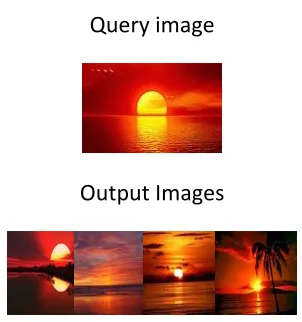
For each category, a set of training images are selected by issuing a query of an image. One of all classifier is trained for each category. The output images are realistic which gives similarity of trained image. The training images are converted to classemes vectors, and then any classifier can be trained We first train our basis classifier on low level representation by texture, shape and visual clues of color distribution and spatial transformation of the image.[3].The basis classifier must be evaluvate as faster[9]. Finite dimensional feature maps for additive kernels. Obtain compact and simple representations that are efficient in both training and testing, have excellent performance, and have a satisfactory theoretical support.
2.3 Metaclass
Available Online at www.ijpret.com 206
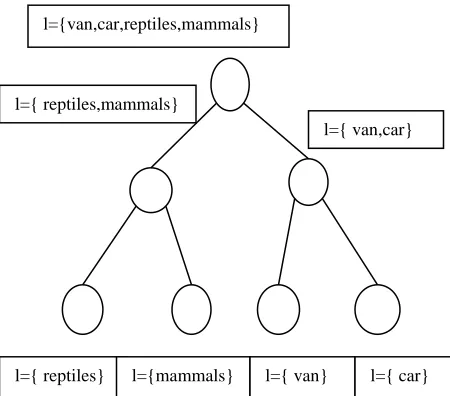
Fig 1: Metaclass label tree and Learning classifier for each metaclass
The label tree is generated in a top-down fashion starting from the root of the tree. Each node has associated a set of object class labels. Let us now consider a node with label set .We need to describe its subset. The two subset define a partition of the label set of the main set .If we denote mm and mn the label set of two subsets, then we need mm U mn = m and mm n mn = ɸ. Ideally we want to choose the partition{ mm, mn} so that a binary classifier h(mm,mn)(X) trained to distinguish these two metaclass makes as few mistakes as possible.Instead, we can use the confusion matrix of one-vs-the-rest classifiers learned for the individual object classes to determine a good partition of intuitively. The final meta-class descriptor is defined as the concatenation of all meta-class classifiers learned in the creation of the tree. To extract low-level features, In our experiment, SVM is used for comparison.SVM is used for training. It is effective for learning with small sampling in high-dimensional spaces. The objective in SVM[14] is to find a decision plane that maximizes the interclass margin that are useful for categorization. Datasets available for prediction tasks are growing over time, resulting in increasing scale in all their measurable dimensions.[11]. Other label tree learning methods described [12][13]. Here we use the label tree training procedure to learn meta classes.
H3 :{Van ,Car} Vs {Reptiles, Mammals} H2 :{Reptiles} Vs { Mammals}
H1 :{Van} Vs { Car}
l={van,car,reptiles,mammals}
l={ reptiles,mammals}
l={ reptiles} l={mammals}
l={ van,car}
Available Online at www.ijpret.com 207
2. EXPERIMENTS AND RESULT
2.1 Dataset
Caltech 256[16]: Database for object categorization containing approximately 30k images which is sub portioned into several categories. These datasets represent a lighting conditions, poses backgrounds, image sizes.In Caltech-256, each category has 80 images. Images from each category are downloaded from google, picsearch. Duplicates will be removed by detecting pixel similarity between images. We select N train and N test images from each class to train and test the classifier. Performance of each class C which are correctly classified as belonging to class C.
2.2 Image Search
While a few scene types (“beach,” “mountain”) can be well described by the statistics of low-level features, models for more complex and subtle categories (“nursery,” “laundromat”) should capture the appearance and spatial configuration of key scene elements – without being told what these elements might be or where they might be located. we are given a set of images containing instances from the same category (“horse,” “bus”) and told to build a model for that category without knowing exactly where these instances are. Scene recognition approaches based on low-level appearance information work poorly on categories that are characterized not by global perceptual characteristics. We train a binary LSVM classifier for each class using images from all the other classes as negative data. At test time, we label the test image with the class getting the highest response.
Query image
Output Images
Available Online at www.ijpret.com 208
Table 2
Object categorization Results Comparison on database
3. CONCLUSION
In this paper we have presented image descriptors, which measure the closeness of visual concepts called basis classes. The images are trained and tested efficiently during offline. These descriptors are useful for high level object recognition. By using the noisy training data from web image search in a novel way: to train “category-like” classifiers, the descriptor is essentially given access to knowledge about what humans consider “similar” when they search for images on the web. We tested our classifier using benchmark: caltech256, Scene recognition. The databases also contains number of images.
REFERENCES
1. P. Gehler and S. Nowozin, “On feature combination for multiclass object classification,” in Proc. IEEE Int. Conf. Comput. Vis., 2005, pp. 221–228.
2. Luis Gonzalez-Abril, Cecilio Angulo and Francisco Velasco,” A probabilistic Tri-class support vector machine”, in Journal of pattern recognition research, 2010.
3. N. Kumar, A. Berg, P. Belhumeur, and S. Nayar, “Attribute and simile classifiers for face verification,” in Proc. IEEE Int. Conf. Comput. Vis., 2009, pp. 365–372.
4. J. S_anchez and F. Perronnin, “High-dimensional signature compression for large-scale image classification,” in Proc. IEEE Conf. Comput. Vis. Pattern Recog., 2011, pp. 1665–1672.
5. P. Gehler and S. Nowozin, “On feature combination for multiclass object classification, in Proc. IEEE Int. Conf. Comput. Vis., 2009, pp. 221–228.
A. Krizhevsky, I. Sutskever, and G. E. Hinton, “Image net classification with deep convolutional neural networks,” in Proc. Advances Neural Inf. Process. Syst., 2012, pp. 1106–1114.
Database Accuracy
Caltech 54.2
Available Online at www.ijpret.com 209 6. G. Wang, D. Hoiem, and D. Forsyth, “Learning image similarity from flickr using stochastic intersection kernel machines,” in Proc. IEEE 12th Int. Conf. Comput. Vis., 2009, pp.428–435.
7. L. Torresani, M. Szummer, and A. Fitzgibbon, “Efficient object category recognition using classemes,” in Proc. 11th Eur. Conf. Comput. Vis., 2010, pp. 776–789.
A. Vedaldi and A. Zisserman, “Efficient additive kernels via explicit feature maps,” IEEE Trans. Pattern Anal. Mach. Intell., vol. 34, no. 3, pp. 480–492, Mar. 2012.
8. J. Weston, and D. Grangier, “Label embedding trees for large multi-class tasks,” in Proc. Adv. Neural Inf. Process. Syst., 2010, pp. 163–171.
9. T.Gao and D. Koller, “Discriminative learning of relaxed hierarchy for large-scale visual recognition,” in Proc. IEEE Int. Conf. Comput. Vis., 2011, pp. 2072–2079.
10.J. Deng, S. Satheesh, A. C. Berg, and F.-F. Li, “Fast and balanced: Efficient label tree learning for large scale object recognition,” in Proc. Adv. Neural Inf. Process. Syst., 2011, pp. 567–575.
11.Shuai Zheng, Ming-Ming Cheng, Jonathan Warrell, and Paul Sturgess, “Dense Semantic Image Segmentation with Objects and Attributes“, IEEE International Conference Computer Vision and Pattern Recognition (IEEE CVPR), 2014.
12.Indira Priyadarsini, Nagaraju Devarakonda and I Ramesh Babu “A Chock-Full Survey on Support Vector Machines” in International Journal of Advanced Research in Computer Science and Software Engineering, Vol. 3, Issue 10, October 2013.
![La politique d'association et de regimes preferentiels de la Communaute = The association policy and preferential regimes of the Community [external relations] SEC (70) 1351 final, 15 April 1970](data:image/gif;base64,R0lGODlhAQABAIAAAP///wAAACH5BAEAAAAALAAAAAABAAEAAAICRAEAOw==)