Available Online at www.ijpret.com 19
INTERNATIONAL JOURNAL OF PURE AND
APPLIED RESEARCH IN ENGINEERING AND
TECHNOLOGY
A PATH FOR HORIZING YOUR INNOVATIVE WORK
VIDEO PROCESSING BASED SMART HELMET FOR TWO WHEELER RIDER
TADVIDI V. NAIK1, GEETA SHET21. P.G. student, Electronics and Telecommunication department, Goa college of Engineering, Farmagudi, Ponda, Goa, India-4034011
2. Assistant Professor, Electronics and Telecommunication department, Goa college of Engineering, Farmagudi, Ponda, Goa, India-4034012
Accepted Date: 23/04/2017; Published Date: 01/05/2017
\
Abstract: - The statistics shows that around 15 million two wheelers are being sold to domestic customers for last 2-3 years, this means there is very rapid rise in the number of people using the two wheelers for travel. As number of two wheelers are increased, the number of accidents of this vehicles and death rate due to this increase drastically. Very little has been worked on the safety of two wheelers riders. This paper present the video processing approach to make a SMART HELMET which will be recording the live video of the rear traffic and will be detecting the presence of vehicle behind the two-wheeler. After accurately detecting the vehicle, two-wheeler rider will be informed about the presence of vehicle hence helping the rider to safely commute. The algorithm designed to detect the vehicle is implemented using MATLAB 2016.
Keywords: Video Processing, Smart Helmet, Detection of Vehicle, Road safety, Anti-collision.
Corresponding Author: MR. TADVIDI V. NAIK
Access Online On:
www.ijpret.com
How to Cite This Article:
Tadvidi V. Naik, IJPRET, 2017; Volume 5 (9): 19-25
Available Online at www.ijpret.com 20 INTRODUCTION
For past two decades, the number of two wheeler vehicles in India has seen a steep ascent. Making it obvious that the number of accidents of two-wheelers in India is largest. The number of deaths and injuries are increasing day by day because of this. Almost one lakh plus individuals are losing their lives on India’s roads throughout a year that’s almost 360 deaths daily. This death rate is more than the rate of deaths caused by terrorism related incidents. The report of Ministry of Road Transport & Highways, say that, the number of deaths in road accidents started rising after year 2014. The most of the deaths are because of the fault of the rider.
Some of the reasons for the increasing number of two wheeler accidents are bad roads or road which are continuously under construction phase, Skidding of two wheeler due to the wet roads or oil/fuel spilled on roads. Another reason for the majority of accidents caused are, sloppy driving by the people of other vehicles like trucks, buses, cars etc. Sometimes inattentive riding by the rider itself, not having a proper look at the traffic behind the bike while changing lanes or taking left or right turns. Invention of protective helmet has reduced the amount of severe injuries caused to the two wheeler rider. Despite of the fact that Government of India have made it compulsory to wear a helmet while driving the two wheeler some people avoid wearing it for simple reasons. Wearing a helmet can reduce the risk of severe injury by 70% and the risk of death by 40%, according to the World Health Organization. Use of helmet is necessary but rider is also encountered with problems while wearing helmets. It’s because of the size of helmet. Every two wheeler is provided with the set of mirrors on handlebars to have a view of traffic behind the bike. But the view in mirrors is limited to certain area. The area which cannot be seen in mirrors is called as Blind spot. The rider cannot view the vehicle in mirror if it’s in the blind spot of the mirror, and rider can misjudge and accident can happen. This blind spot area increases when the rider wears helmet as the sides of helmet cover most of the rear view in mirror. To overcome this problem we need to have a system which can have a view of the rear traffic and convey this information about traffic to the two wheeler rider. In this paper, we discuss the video processing based method to develop a system which will record the rear view and will detect the vehicles using computer vision approach. After vehicle detection the information will be conveyed to two wheeler rider. This will help the rider to
Available Online at www.ijpret.com 21 II. EXISTING METHODOLOGIES
The work that has been done in the area of two wheeler accident avoidance is very less compared to what has been done in the area of four wheelers. Even in four wheelers most of the research paper discuss about lane detection or front collision avoidance in driverless four wheelers. The research that has been to make Smart Helmet is also limited to some extent. It discusses only if rider is wearing helmet, or rider has consumed alcohol above certain limit.
The recent researches done in the area of video processing based vehicle detection, [1] explains the method of detecting the vehicles which are at the back of the two wheeler using video processing technique. A basic algorithm of converting a color image to binary\black and white image and pixel counting is used for vehicle detection in a frame/image is described in the research work [1]. Another research work presented [2] discusses a method to detect rear end collisions using multi-layer perception neural networks. Likewise another [3] Research work elaborates a system which is video processing based for rear end collision detection. As we see above there is not much of a literature done on making helmet smart to improve the safety of riders riding the two-wheelers. This paper sheds light on the methods of video processing to detect the vehicular traffic more efficiently and hence improve the safety of the rider.
III. METHODOLOGY
The system design is divided in two parts, hardware and software.
A)Hardware Implementation
In hardware, basic part is Camera. For now, a web camera is being used. The camera is mounted on the helmet in such a way that it has perfect view of road behind the two wheeler. This will help camera to record the live feed of the vehicles or traffic behind the bike. The camera used is having video resolution of 1.3 megapixels at 30fps. This quality of video is enough for detecting vehicles accurately.
Available Online at www.ijpret.com 22 Fig.1. Camera placement on helmet
B)Software Implementation
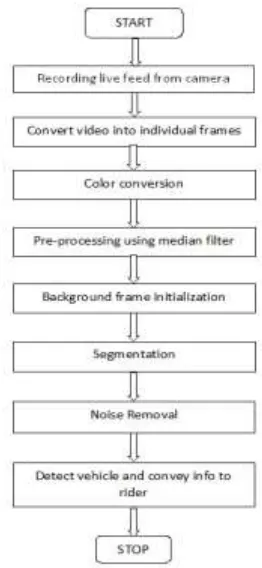
In software, we need to detect the presence of vehicle in the frames/images of live video. This is done by image processing technique using MATLAB2016 simulation software. The following flow chart describes the steps involved in video processing.
Available Online at www.ijpret.com 23 IV. ALGORITHM
A. Taking Input: Live video from the camera placed on helmet is given to the Matlab simulation
software for video processing. The first step in video processing is to convert the video into frames to perform image processing on it.
B. Color to Grayscale conversion: The video frames are generally Color images. The second
step is to convert this Color images to grey scale. This is done to save processing time.
C. Image Pre-processing: The image which is taken from video may contain noise. We need to
reduce this noise from the image. For this purpose various pre-processing methods are used. One of which is by using various filters, to name a few are median filter, mean filter, and convolution filter. We have tried with median filter as it was suitable for use.
D.Background frame initialization and subtraction: The next step after the pre-processing is
background frame initialisation. The average of the brightness of the frames is taken as a background frame and foreground is taken from subsequent frames. After background frame initialization we can perform background subtraction pixel by pixel.
E. Segmentation: In segmentation, we determine the threshold value practically and set it for
thresholding. Now depending on the value of the pixel, a frame or image is distinguished either as a background image or foreground image. Using thresholding the image pixel value is set to either binary 1 for black color or binary 0 for white color. A clear distinction between road and vehicles can be made after segmentation and thresholding.
F. Morphological operations for noise filtering: After segmentation we can distinguish between
the vehicle part and the road. But some of the regions of road can be wrongly detected as vehicles or vice versa due to noise. To overcome this noise morphological operations are done on image to reduce the noise. The pixel which have been wrongly identified as that belonging to vehicle though belonging to road can be removed using EROSION process. Disadvantage of erosion is, sometimes it wrongly considers a part of the vehicle itself as noise and diminishes the same. DIALATION is done to overcome this disadvantage of erosion process i.e. to retrieve back the lost part of the vehicle.
G.Conveying info to rider: After the vehicle is detected in the video frame, the rider need to be
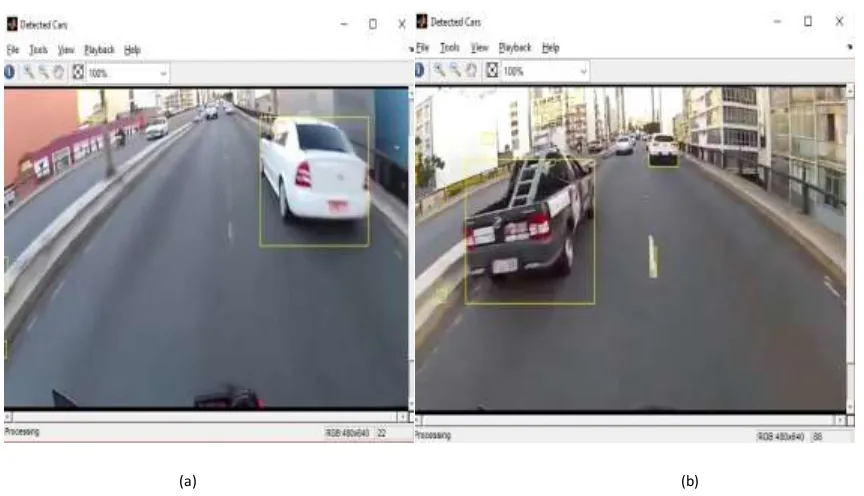
Available Online at www.ijpret.com 24 Fig. 2 Output showing the vehicle being detected.
V. CONCLUSION
A Smart helmet based on video processing, in order to improve the safety of riders riding motorbikes is being presented in above work. The algorithm to detect vehicles in the rear end of the bike and also a system to alert the rider of their existence is implemented. This system is most useful to ensure safety especially while taking turns by the rider and also while changing the lanes at higher speeds. The time required for video processing to detect the vehicle is very less. By using a camera which costs few rupees and by using the video processing method specified in this paper, a huge number of fatalities due to rear end collisions could be avoided and a large number of lives can be saved every day.
ACKNOWLEDGMENT
I am deeply indebted to my guide, Prof. Geeta Shet, Assitant Professor, Department of Electronics and Telecommunication Engineering, for allowing me to carry out this project under her supervision. She has given me a confidence to take up this project and guided me at the times of difficulty.
Available Online at www.ijpret.com 25
I thank my teachers, who have taught enthusiastically at the Goa College of Engineering. I also thank Dr. Hassanali Virani, (Head of the Department), Department of Electronics and Telecommunication Engineering, and Dr. Vinayak N. Shet (Principal), Goa College of Engineering.
REFERENCES
1. Sudhir Rao Rupanagudi, Sumukha Bharadwaj, Varsha G. Bhat, S. Eshwari, S. Shreyas, B. S. Aparna, Anirudh Venkatesan, Amrit Shandilya “A Novel Video Processing Based Smart Helmet for Rear Vehicle Intimation & Collision Avoidance”, 2015 Intl. Conference on Computing and Network Communications (CoCoNet'15), Dec. 16-19, 2015, Trivandrum, India.
2. Lee, D.; Yeo, H., "A study on the rear-end collision warning system by considering different perception-reaction time using multi-layer perceptron neural network," in Intelligent Vehicles Symposium (IV), 2015 IEEE, vol., no., pp.24-30, June 28 2015-July 1 2015
3. Jhonghyun An; Baehoon Choi; Beomseong Kim; Euntai Kim; Jaeho Hwang, "Rear-end Collision warning system using linear discriminant analysis," in Soft Computing and Intelligent Systems (SCIS), 2014 Joint 7th International Conference on and Advanced Intelligent Systems (ISIS), 15th International Symposium on, vol., no., pp.218-221, 3-6 Dec. 2014 K. Erickson, Programmable Logic Controllers: An Emphasis on Design and Applications, Rolla: Dogwood Valley Press, 2005, pp. 1-20.
4. Prem Kumar Bhaskar., “Image Processing Based Vehicle Detection and Tracking Method”, 2014 IEEE.
5. “Motorcycle Blind Spot”, [Online]. Available:
http://www.motorcyclebasics.com/blindspots.html. [Accessed oct, 2016].