Available Online at www.ijpret.com
208
INTERNATIONAL JOURNAL OF PURE AND
APPLIED RESEARCH IN ENGINEERING AND
TECHNOLOGY
A PATH FOR HORIZING YOUR INNOVATIVE WORK
SECURING MOBILE SYSTEM LOCATIONS BY ANONYMOUS SERVER DESIGN
BASED ON K OPTIMAL PRINCIPLE
MR. DATTATRAY S. SHINGATE, MRS. S. A. BHAVSAR
Department of Computer Engineering, Matoshri College of Engineering and Research
Center, Nashik.
Accepted Date: 15/02/2014 ; Published Date: 01/04/2014
\
Abstract: In today’s world there is rapid advancement in location tracking and positioning capabilities of mobile phones, much needed thing is securing the mobile locations by designing trusted third party privacy framework that utilizes K optimal principle. if k other users may not be available at the time of requests . These requests are discarded because of quality of service (QoS) as they requirement cannot be satisfied. So motivation is to generate remaining dummy requests at realistic time (appears as real requests) to satisfy K principle. Another motivation is to share additional load that occurs on LBS by adding intermediator(AS) in between MS and LBS for finding out nearby locations(Hotels, Banks, Temples etc.).The value k may be defined as a uniform system parameter for all mobile users. In this system the implementation of an algorithm that process a mobile request using k anonymity with diversity considerations and also various conditional parameters like using real world traffic volume data and dummy mobile users generated realistically by a mobile object generator so as to achieve K-optimal principle. By doing this the problem of temporal cloaking get solved as there is no waiting if actual user requests are not available by adding dummy record and also not to worry about request drop as all queries get served and success rate improved.
Keywords: k-anonymity, Location Based Services, Privacy, Mobility, L-diversity
Corresponding Author: Mr. DATTATRAY S. SHINGATE
Access Online On:
www.ijpret.com
How to Cite This Article:
Dattatray Shingate, IJPRET, 2014; Volume 2 (8): 208-218
Available Online at www.ijpret.com
209 INTRODUCTION
Location Based Services (LBS) are enhanced due to rapid improvement of the mobile phone Capabilities such as GPS and multimedia. Location based services (LBS) applications are take the geographic location into consideration. Example of location based services is Transit Genie, Next Bus, and Google Latitude [5]. In general a user submits a request to some database or location based server and receives a response from LBS. A typical request from a user include location criteria and in the form of <id, time, location(x,y),query>.With untrusted servers the privacy and security of an individual may be leaked to adversaries. Several reports are available where GPS devices were used to find out user locations [3, 4].
Knowledge of location may lead to tracking or unwanted advertisements sent to your mobile device. There are several architectures that are considered for privacy aware location based services. These architectures are peer based, trusted third party, and client-server. In the peer based model clients communicate directly with each other peers. In the client server architecture clients communicate directly with the LBS by submitting a request, the LBS then returns a response directly to the client [10, 11]. The intention of the clients
is to cloak with each other in order to satisfy the K-anonymous principle. The trusted third party model utilizes the concept of a middle-ware between the mobile user and the LBS. We sometimes refer to the middle-ware as anonymization server or AS. Mobile requests are first sent to the middleware, the request is then cloaked into a region with the spatial and temporal tolerance, and we refer to this as a region request. The request is then cloaked with other users’ region request. We refer to it as an aggregate region request.
Our work is focused on the trusted third party architecture design. Location privacy in location based system is to prevent adversaries from locating mobile user past or current locations and the time the locations where visited. We used the concept of k-anonymity [8, 9] and L-diversity [7] to prevent request linking. Mobile users in these frameworks are considered K-anonymous if a mobile user cannot be distinguished from at least k-1 other mobile users in the same region request. The concept of L-diversity ensures that the queries in region request are not homogenous.
II.RELATED WORK
Available Online at www.ijpret.com
210
anonymity, meaning that eavesdroppers on the network and LBS providers cannot determine the originator of a message. The drawback of paper was Communication privacy threat.
In 2005,the researchers Y.Yanagisarva, H. Kido T.Satoh”Location traceability of user in location Based service” briefly introduced that Location privacy of moving object or moving user but the drawback was in Formalized tree structure that is to locate path from source to destination by considering all possible paths.
In the same year 2005, the researchers Bugra Gedik, Ling Liu”Location Privacy in Mobile system: personalize anonymization model” briefly introduced concept of personalized K-anonymity model for providing location privacy. They developed a Novel message perturbation engine based on Clique cloak algorithm to implement the system model. The drawback of system as that 10 percent of all request messages were dropped and success rate reduced.
In 2007, the researchers Tanzima Hashem, Lars Kulik “Safe guarding location privacy in wireless and adhoc networks”. They introduced concept of hiding user identification and position- using K anonymity principle achieve QoS.The main drawback was if K requests are not available at time of request then user request maybe dropped.
Again, in 2007, the researcher Ling Liu” From data privacy to Location privacy” briefly introduced that Location privacy from data privacy. It also introduced combination of 2 location privacy models that is privacy based and Location based location privacy mechanism (Location K anonymity and Location L-diversity).The main drawback was that how to adequate control the location cloaking process in terms of location K-anonymity and location L-diversity.
In 2009, the researchers Christian S. Jensen, Hua lu and Man lung Yiu ” Location privacy technique in client server architecture” introduced concept of the features where client can hide its true location among fake locations using dummy based technique and also it is easy to implement as they do not rely on any third party. In this architecture clients communicate directly with the LBS by submitting a request, the LBS then return a response directly to the client. The pitfall of the system was that it lacks any trusted component in between MS and LBS.
Available Online at www.ijpret.com
211
network with location, time and listing of who appears in photo. The main issue related was publication delay.
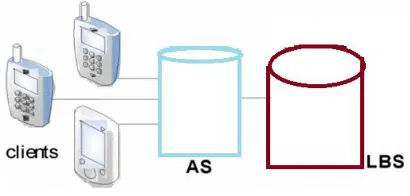
Experimental setup including SRS: The experiments were conducted on a PC with min 10 GB hard-disk and 512 MB RAM running Windows-7 containing a P6200 Intel DUO 2.13 GHz processor. The algorithms (General algorithm, CloakLess-K, Cloaked-K and dummies generation) where implemented using Jdk 1.6 and the development environment Platform version is Netbeans 7.At the back end we are using MS-SQL server / Oracle for database storage and access. Clients are nothing but Wifi Mobile having Symbian OS used for sending request to finding out nearby desired location. The experimetal setup of ovarall system is as shown in Figure 1.
Figure 1: Experimental Setup
III. PROGRAMMER’S DESIGN
Input: Request Query. In this algorithm the user has to submit a request in the form of Query <user_id,msg_no,(t,x,y),(dx,dy,dt),P,C> having latitude and longitude dimension for searching nearby hotels, banks, temples etc. Where user_id is unique identification number, msg_no is messade identification number. We are going to use combination of both which is unique for message. (t,x,y) is the temporal and spatial property of the request, (dx,dy, dt) is the spatial and temporal resolution demanded by the mobile user. P is the percentage of privacy desired and C is the request content.
Outcomes: I) Reply from AS (Anonymization Server) As a respond for requested query from user
for finding nearby locations AS forwarded it to LBS.LBS checks its current position returns reply
Available Online at www.ijpret.com
212
services (QoS) can be satisfied using trusted third party architecture. II) And also effective work against corollary history attack by utilizing realistic diverse dummies.
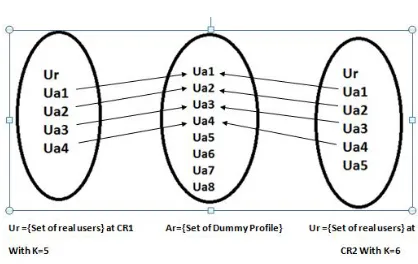
3.1Mathematical Model: Once user submit request query, it contains percentage privacy level (P) as per user demanded. Depending on P we have to map some value of K by using mapping function. We refer it as a transformation phase. Let n be the total number of users that should be in the cloaking region to guarantee P (percentage privacy). Let P be the percentage of privacy desired by a real user (Ur). Ur: We define k= ceiling (100/ (100-P)).
Intersect and Merge approach:
Figure 2: Mathematical Model
Available Online at www.ijpret.com
213
3.2 Dynamic Programming and Serialization: In our system, there is a concept of cloaking that is we have 2 approaches: CloakedK and CloaklessK, Here at this point user has to select any one approach and then go for serialization.
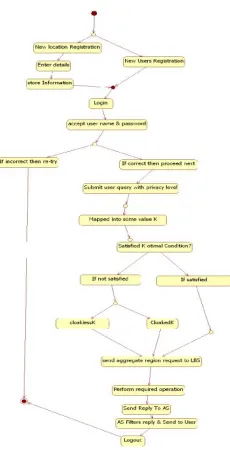
Algorithmic Steps of Overall system (Serialization): This algorithm runs on trusted third party Anonymization Server (AS).1) Request Sending to AS: In this phase, User has to send region request to AS. Request contains percentage privacy levels, as per user requirement.2) Transformation Phase: In this phase, as per user privacy percentage is transformed into some value of by using mapping function. 3) Here, at this point user has 2 options:-CloaklessK and CloakedK i) In CloaklessK, Once AS get region request, It immediate generate remaining dummies to achieve K-optimal principle ii)In CloakedK, Once AS get region request, It will search for more request if K value is not achieved and add it into region request even if it is not satisfied then it will generate remaining dummies and send aggregate region request to LBS.4) LBS processes on queries and send appropriate reply to AS 5)Finally, AS Filters the reply messages for precise results and send it to various users. Realistic time dummy generation, separating real user request from dummy request (Filtering) and intersect and merging
methods uses dynamic programming approach i.e. divide and conquer strategy is used.
Realistic Dummy generation Algorithm: 1) Initialize profileCount to max value of K. The
profileCount canbe defined as total no of dummy request associated with real user. 2) Read
dummy profile by passing userid and msgno and find out total dummies needed. 3) To generate dummies realistically we use here is spatial and temporal properties of real user.i.e. His current location dimensions and current time (t, x, y).
3.3 Data independence and Data Flow architecture Data independence part comes into picture at CloaklessK and CloakedK algorithm.
CloaklessK Algorithm:
Input: request <user_id,msg_num,(t,x,y),(dx,dy,dt),p,C>
1) Calculate hash value based on (user_id, msg_num). 2) Calculate value of K, Depending on percentage privacy level using transformation function. 3) Create aggregate region. 4) Insert real user request.5) Add dummies into real user requests.6) Send region requests to LBS.
Available Online at www.ijpret.com
214
Input:request <user_id,msg_num,(t,x,y),(dx,dy,dt),p,C> 1)Calculate hash value based on(user_id,msg_num). 2) Calculate value of K, Depending on percentage privacy level using transformation function. 3) Create aggregate region. 4) Insert real user request. 5) Finding out more nearby requests.6) If till k-optimal condition is not satisfied then add dummies into real user.7) Send region request to LSB.The system data flow architecture is shown in figure3.
Figure 3: Data Flow Diagram
3.4 Turing Machine: A simple state diagram showing possible changes in states incorporating multiplexer logic is shown in figure4.
Available Online at www.ijpret.com
215
IV. RESULTS and DISCUSSION
One of the most important evaluation criteria is success rate. The main goal of anonymization server is to maximize the number of user requests that can be added successfully. We can measure the success rate as the ratio of the number of anonymized request by the total number of individual mobile request. As we are going to add dummies into real requests so there is not at all chances of request drop, So AS server achieves 100percent success rate. Another evaluation criterion is the cloaking time. The cloaking time of an algorithm is the time taken to perturb the requests. An algorithm cloaked-K provides remarkable cloaking time as compared to Cloakless-K. Cloaking time is a performance measure. The third evaluation considered is the communication cost. Communication cost defined as the number of region request sent to the LBS by the AS for a fixed amount of request. As in our algorithm we are using 2 models: Cloakless-K and Cloaked-K. Cloakless-K have fixed communication cost while Cloaked-K have much lower communication Cost. If number of requests increases Cloaked-K provides good results for communication cost.
Cloaking Time and Communication Cost
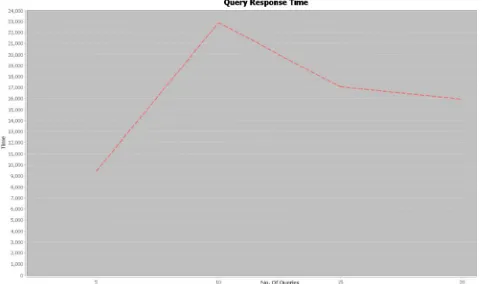
The following table shows the time need for getting precise response from AS server by using 2 strategies:CloaklessK and CloakedK and the Figure depicts the cloaking time(ms) need for serving different number of bunch of user requests.
Table1: Comparative Result Table for Cloakless-k Vs Cloaked-k Over 2000*2000 Spatial Resolution.
Sr. No. Total no. of user
requests
Cloakless-k (average response time in ms)
Cloaked-k (average response time in ms)
1 5 6630.23 9200.33
2 10 20100.0 23018.58
3 15 16100.13 17010.23
Available Online at www.ijpret.com
216
Thus, it introduced an algorithms Cloakedk and Cloaklessk. Both algorithms CloakLessK and CloakedK are able to achieve the maximum success rate under any anonymity level or spatial resolution.
Figure 5: Average time needed for Cloakless-k Approach under 2000*2000 spatial resolution
The cloaking time of both algorithms in the system collection are approximately the same with CloakLessK doing slightly better when the average anonymity level is small. With regards to communication cost CloakedK outperforms CloakLessK. Average time needed for Cloakless-k Approach under 2000*2000 spatial resolution.
Figure 6: Average time needed for Cloaked-k approach under 2000*2000 spatial resolution.
Comparison between CloaklessK and CloakedK
Available Online at www.ijpret.com
217
Figure 8: Communication Cost for Cloaked-k and Cloakless-k approach under 2000*2000 spatial resolution
Locating Shortest Path
The Figure shows map for the shortest path from source location to desired destination. location which user has to preferred.
Figure 7: Locating Shortest Path
In above map user is at position A where he sends request for finding out nearby restaurant which is at location B ,the preferable path and intermediate station between A and
V. CONCLUSIONS
Available Online at www.ijpret.com
218
search for K other requests. 3) Temporal cloaking problem solved, as no waiting for actual request by adding dummies. 4) Communication cost reduced as in our algorithm we are using 2 models: Cloakless-K and Cloaked-K. Cloakless-K have fixed communication cost while Cloaked-K have much lower communication Cost. If number of requests increases Cloaked-K provides good results for communication cost. 5) Corollary History attack protection.
REFERENCES
1. Leon Stenneth Phillip S. Yu Ouri Wolfson, Phillip S. Yu, Ouri Wolfson, ”Mobile Systems Location Privacy: ”Mobi Priv” A Robust K Anonymous System”.2010 IEEE 6th International
Conference on Wireless and Mobile Computing, Networking and Communications
2. R. Agrawal and E. Wimmers. A Framework for Expressing and Combining Preferences. In
Proceedings of the ACM International Conference on Management of Data, SIGMOD, 2000.
3. Federal Communications Commission http://www.fcc.gov/cgb/consumerfacts/wireless911 srvc.html
4. S. Mascetti, C. Bettini, D. Freni, X. Wang. Spatial Generalization Algorithms for LBS Privacy
Preserva-tion. Journal of Location Based Services ISSN I7489725/ISSN 1748-9733, 2007
5. Google Latitude Website http://www.google.com/latitude/intro.html
6. Lui, From Data Privacy to Location Privacy: Models and Algorithms. VLDB, 2007
7. F. Liu, K. Hua, Y. Cai. Query I-Diveristy in Location Based Services. International Conference On Mobile Data Management, 2009.
8. M. Grusteser and D. Grunwald. Anonymous usage of location based services through spatial and temporal cloaking. ACM/USENIX MobiSys, 2003
9. H. Kido, Y. Yanagisawa, T. Satoh. An Anonymous Communication Technique using Dummies
for Location Based Services. Second International Conference on Pervasive Services, 2005.
10.C. Chow, M. Mokbel, X. Liu . A peer to Peer Spatial Cloaking Algortihm for Anonymous Location Based Services. ACM GIS, 2006