ISSN: 1942-9703 / © 2016 IIJ Abstract— This paper describes the efforts made by the
research team to empower batik crafts people by introducing and utilizing ICT in their activities. Different levels of ICT training were conducted to elevate the artisans’ knowledge and skills. ICT is also implemented as a means of communication among the groups, and provides them with more access to productive resources and markets. The research also aims at promoting the alternative markets, the Fair Trade. Institutionalization of production groups were formed in different target of batik-producing areas in Central Java.
Index Terms— batik, Fair Trade, home-workers, knowledge management
I. INTRODUCTION
HE Indonesian batik is priceless art work that is recognized by UNESCO as one of the world intangible cultural heritage elements along with kris, the shadow puppet wayang, the bamboo musical instrument angklung, the Saman dance, and the Papuan knotted bag noken. Batik is included in the "Representative List of the Intangible Cultural Heritage of Humanity", officially inscribed on 2nd October 2009 (http://www.unesco.org/culture) [1]. The discussion of batik will go beyond business, production and factories; it conveys the values of national identity and integrity, pride, culture, and art. It is nevertheless undeniable that such values are often neglected and left unnoticed in a batik product. Consumers generally consider other things in the purchase of the product, namely the fineness of the cloth, the brightness of the color, and beauty of the drawing. Those are the general factors of the product pricing. In the process of creating the batik product, however, there are symbolically and high values such as the art of drawing on fabric, the use of the drawing apparatus and wax, and the dyeing techniques. The art workers, who are notably laborers, are often lowly-paid considering the high skills they must possess. The selling price of the finalized
Manuscript received July 9, 2015. This work was supported by Directorate General of Higher Education of the Indonesia Ministry of Education and Culture under research Grant 001/K6/KL/SP/PENELITIAN/2014. Eko Sediyono is with the Post Graduate of Information Systems, Satya Wacana Christian University, Jl. Diponegoro 52-60 Salatiga, Indonesia (corresponding author, phone: +62817 417 6380; fax: +62298 321 433; email: eko@ staff.uksw.edu). Tundjung Mahatma is with the Department of Mathematics, Faculty of Science and Mathematics, Satya Wacana Christian University, Jl. Diponegoro 52-60 Salatiga, Indonesia (e-mail: [email protected]). Arianti Ina Restiani Hunga is with the Gender Research Center, Satya Wacana Christian University, Jl. Diponegoro 52-60 Salatiga, Indonesia (email: [email protected]).
piece they originally created can be many times higher than the original cost. The gap between the original producer and the seller is too wide; inequities are huge in terms of economic benefits. Original producers usually remain poor. Such a common market model may not be suitable for products with cultural values like batik.
In the light of the situation, Fair Trade comes up with principles, strategies, and practices that may become the solution. Fair Trade is a trading system orientating at sustainable development by helping marginalized producers – such as artisans / craftspeople, farmers, or fishermen– to get fair prices, good working conditions, technical assistance, capacity building, transparency and accountability, trustworthiness, and minimize environmental impacts. Those are efforts to develop a sustainable economy and new market in and among developing countries, and at the same time preserving local values and tradition (
http://forumfairtradeindonesia.org/fair-trade/what-is-fairtrade) [2]. Realizing Fair Trade is not a simple matter, however, for example, in terms of the institution that is willing to aid disadvantaged producers. Which institution? Should it be government institutions, or NGO? An interesting experience was found in Thailand, where a group of artisans called ThaiCraft (http://www.thaicraft.org/) [3] states:
‘Just “creating enterprises” and “doing business” does NOT automatically mean improved livelihoods and a better society. Good Practice needs to be anchored on: Core Social Values, Environmental Awareness, Sound Business Application (& ethically based). Always ask for a statement of values and how these have worked for and maintained.’
In this case social ethic is eternalized within the artisan group.
Bahfen et al. [4] of The Asian Foundation say that home-workers –especially women– play significant roles in the informal sectors due to the high numbers and their potential contribution in the future. Accordingly, they need to be empowered with capabilities to access business funds and other resources. A way to do this is by providing trainings to create and to utilize a network of micro business groups. Trainings on ICT by The Asia Foundation for groups of home-workers have enabled them to sell their products, and directly meet the customers by means of the Pan ASEAN eMall portal. Such abilities enable them to gain higher revenues, and ultimately reduce poverty. The same problems occurs in soap industries for batik. The process of soap making for batik
Strengthening Batik Home-workers through ICT
based Fair Trade
Eko Sediyono,
Member, IEEE
, Tundjung Mahatma, and Arianti Ina Restiani Hunga
needs to be improved by using modern automation systems in order gain efficiency and quality assurance [5].
The facts stated above demonstrate the advantages of the application of ICT, and –indirectly– of online / e-commerce. It is realized, however, that such application among small- and medium-sized enterprises (SMEs) is still difficult. In this case the implementation of Internet of Things (IoT) is still far to be applied for batik. In [6], it has been shown the refusal of batik artisans in Solo in utilizing ICT for the online commerces. They argue that the batik business has been traditionally carried out from their ancestors. Apart from the facts that they have low intellectual capabilities, they think that it is more comfortable to deal directly with customers, face-to-face. This attitude is also confirmed by Hairuddin [7] in a research among batik artisans in Malaysia. Based on the problems faced by batik artisans, and also best practices gained from researches on ICT implementation in helping home-workers in several countries, this research proposes an ICT-based information system of Indonesian batik knowledge which promotes Fair Trade.
II. LITERARYREVIEW
A. Related Researches
Noor [8] has conducted a research on the factors required to apply the information-communication technology to batik SMEs in Malaysia. It has been found that the sustainability of the batik craft depends on competence and marketing dimensions. In [8], Noor analyzes the dimension competence and grouping it into three categories, namely lack of knowledge of batik culture, the copying habit of most of the artisans, and lack of knowledge for basic esthetics. Using the findings [8], core concepts are then formulated. This involves improvement of contents that is the batik knowledge domain, of the batik culture, and of the context, mainly critical issues on batik business sustainability. The research visualized batik drawing as knowledge domain in the form of digital images to be displayed in a museum and also published as a book. Artisans have been assisted in the process of batik creation so as to improve the ethical and esthetical elements. The problem of batik sustainability is dealt with by adopting ICT. The technology is to be utilized in order to handle the batik cultural decadence among batik lovers and makers. Figure 1 and 2 visualize the research findings and follow-up.
Fig. 2. Conceptualization of Malaysian Batik Technology [8]
B. Fair Trade for Batik SMEs
Institutional transformation and institutionalisation of batik SMEs give emphasis on four comprehensive-integrative program aspects, namely [9]:
1. Institutionalisation and development of information as an instrument for the transformation of Putting Out System (POS). This includes:
a. The development of batik products orientating on economic and social-cultural values and the alternative market penetration. Product development includes designs which convey local and intercultural values; efficient dyeing techniques which are environment-friendly; efficient production techniques by finding alternative and combined techniques; and product knowledge based on contextual socio-culture.
b. Supports for production processes to boost efficiency and productivity, including management and production administration, and simple bookkeeping. c. Supports for marketing, including internet-based
information system, product catalogue, and eco-labelling.
d. Building and promoting fair business relations as prescribed by the alternative market / Fair Trade. e. Integrating research results which relate to
POS-based / home-POS-based industry into the teaching-learning activities, researches, and community outreach, by means of focal points and learning materials.
f. Publication and the dissemination of information in the forms of innovative products, modules, and models.
2. Institutionalisation on production basis and work relationships through production-based communities, by: a. Reorganization of the production chain through
processes of mapping and organization to create a unified process; creation and placement of production chains to increase added value; and organization to achieve efficiency and continuity.
b. The transfer of information, innovation, and technology related to 1) intensification and diversification of product development techniques, of markets and funds access; 2) recognition and protection of home-based work; 3) uplift of the Fig. 1. Synthesis of the understanding of Batik Maker Malaysia [8]
ISSN: 1942-9703 / © 2016 IIJ bargaining position of home-based workers relative
to the employers.
c. Maintaining the management of home-based work groups, developing new groups, and developing intergroup networks.
3. Institutionalisation at the level of information management and the internet-based alternative marketing through communities and alliance of producers and Fair Trade experts.
a. Development of the internet-based information system which is used to promote Fair Trade.
b. Development of home-based worker partnership. c. Building of network of capacity building institutions
to enhance market access.
d. Building of networks of domestic and exporting customers.
A model of putting-out system transformation has been developed to protect, to empower, and to enhance the competitive advantages of the home-workers, depicted in Figure 3 below.
Fig. 3. Indonesian Batik "Putting Out System" Transformation Model [9]
C. Information Systems of Batik Knowledge
According to Whitten [10], information system
development consists of four elements i.e. User, management, strategy, and technology. In the early stages of the information system development, the user element involves are System Owner, Designer, and System User. The management elements include a definition of project scope, problem analysis, requirement analysis, logical design, and decision analysis. Strategies that may be employed include business planning and information system planning. The planning is needed to build knowledge, processes, and the information system. System building is supported by various technologies such as database, data processing, and system interface technologies. The interaction of the elements is depicted by Figure 4 at the enclosure.
The information system developed in the research is not meant for business transaction; instead it is developed for batik knowledge management with the goal of enhancing the perception of batik. It is hoped that it may give batik crafts- people better access to resources and potential customers. A
similar system is proposed by Suzanti, et al. [11], reporting the identification and requirement analysis of knowledge needed by batik SMEs.
The paper also reviews the gap of the knowledge possessed by the batik SMEs and the batik knowledge management processes. It continues with the development of knowledge management system by employing the SECI model. The dissemination of the knowledge is further expected to preserve and develop the batik industry to compete in the global economy. To capture knowledge from system users, Alavi [12] suggests two conditions. First, due to the fact that knowledge is personal, and in order that knowledge be useful to others, communication is to be established such that knowledge transfer between individuals happens. Second, information hoard is of no value. Only information which is actively processed in the memory and through reflection, enlightment, and learning, is valuable. Management information systems should therefore be able to acquire, manage, and communicate both tangible and intangible knowledge systematically and in an organized manner.
Fig. 4. Information System Building Block [10]
III. RESEARCH METHOD
training on ICT is to be conducted to narrow it, and communication among the different batik makers is expected to be better with the use of information technology. Communication among them is recorded and analyzed, so as to transform the tacit knowledge to explicit one. The part of this knowledge can be seen in Figure 5.
Figure 5 shows that Indonesian batik display case is used to display batik products, and used to give a better image of batik products from the research sample region. Batik fair trade market portal is used for the transaction of fair trade that is managed by Parahita Craft. This system is not intended to use to pure e-commerce, but attempts to buyers to come and see directly to the workshop of the batik craftsman. The buyers are expected to be able to learn how the craftsmen working on batik, and know how the batik craftsman saves the nature. Besides, it opens the opportunity to do tourism business in those places.
IV. RESULTS AND DISCUSSION
The resulted website is used as a means to empowerment of the home-worker communities. It also strives to promote the implementation of Fair Trade. The features include information on production processes, artisan profiles, product specification, empowerment activities. A screen capture of the website is presented in Figure 6.
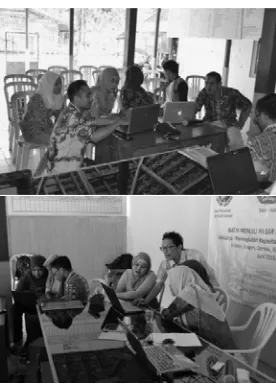
An association of home-workers and POS-based SMEs was formed, and ICT-related trainings have been conducted, especially in targeted batik-developing areas. Figure 7 shows an ICT training activity by the team.
Technology and innovation instruments resulted in this research include natural coloring substances catalogue (see Figure 8), product catalogue, product samples, and production procedures. Product designs are thus provided with easy access to batik craftspeople, and continue to be developed as new concepts emerge.
The system on Parahita Craft website and the activities (‘actions’) yield more effective batik workgroups (or clusters). As seen in Figure 3, The KKBs (Working groups) were restricted by the geographical area. For example, artisans in Klaten discovered and had developed new natural dyes. New techniques and substances are discovered, but are employed only among the artisans in the region, unshared to other workers in different areas. The system is expected to help sharing such knowledge. A few of Fair Trade principles are also addressed, namely transparency, and promotion of small home-workers. Not directly resulted from the application of the system, it is a direct knowledge exchange among batik crafts- people from different regions. The system is yet to be further developed, to include another Fair Trade Principle, i.e. price transparency.
V. CONCLUSION
By the time of this research report is written, the performance of the batik POS- and home-worker-based industry is not yet measured. Technological competence gaps among the craftspeople are yet to be dealt with.
Impacts of the action research described in this paper are, among others the recognition, empowerment, and protection of the home-workers who initiate the employment of ICT.
Indonesian Batik Heritage knowledge
Indonesian Batikdisplay case
(Parahita Craft website) - Resulting products Batik fair-trade
market - Model - Transaction Batik
knowledge/product Inovasion -History - Batik motive in Central Java - Natural coloring - Batik making process
Listed project& publication (Roadmap)
Fig. 5. The Design of Knowledge Information Systems of Indonesian Batik Heritage
Fig. 7. ICT Training for Batik Artisans
ISSN: 1942-9703 / © 2016 IIJ ACKNOWLEDGMENT
Special thanks to the Indonesia Ministry of Education and Culture, especially to the Directorate General of Higher Education who provides the research fund through Grant #001/K6/KL/SP/PENELITIAN/2014, to cover the research and publication.
REFERENCES
[1] UNESCO, Lists of Intangible Cultural Heritage and Register of best Safeguarding Practices, 2014. Available: http://www.unesco.org/culture. [2] Forum Fair Trade Indonesia Available :
http://forumfairtradeindonesia.org/fair-trade/what-is-fair-trade/ [3] ThaiCraft Fair Trade. Available: http://www.thaicraft.org/
[4] Bahfen E., and J. Baggaley, "Homeworkers and ICTs-- Indonesia --", The Asean Foundation Final Report, September 2006.
[5] Ernawati and E. Joelianto, “Environmentally friendly batik cleaner from sapindus mukorossi using taguchi method,” International Conference on Technology, Informatics, Management, Engineering, and Environment (TIME-E), IEEE, pp. 57-61, 2013.
[6] Samsiyah Siti, "Pemanfaatan Information Communication Technology (ICT) dalam Pemberdayaan Small and Medium Enterprises (SME) Studi Kasus UKM – Batik Di Daerah Kauman, Solo, Jawa Tengah", Universitas Terbuka, 2011. (In Indonesian)
[7] Hairuddin, Hanitahaiza, Nor Laila Md. Noor, and Ariff Md Ab Malik, "Why do Microenterprise Refuse to Use Information Technology: A Case of Batik Microenterprises in Malaysia," International Conference on Asia Pacific Business Innovation and Technology Management, Procedia - Social and Behavioral Sciences, 57, pp. 494 – 502, 2012. [8] Noor Nor Laila Md, and A. Nordin,"Requirements Elicitation for the
Technology Conception of a Community Information System for the Indigenous Microenterprise: A Contextual Multi-Analysis Approach on Business and Community Requirements of Batik Making," Electronic Journal Information Systems Evaluation, Vol. 15 Issue 1, 2012. [9] Hunga, A. I., E. Sediyono, and T. Mahatma, "Laporan Penelitian Hibah
Kompetensi tahun 2014", Universitas Kristen Satya Wacana, Salatiga, 2014.
[10] Whitten, J.L. and L.D. Bentley, System Analysis and Design Methods, 7th- edition McGraw-Hill/Irwin, 2012.
[11] Suzianti, A., S.R. Hanum, N.N. Anisah, and S. Aprilliandary, “Knowledge management system for creative small medium enterprise in Indonesia - Case study: Batik”, International Journal of Sustainable Human Development, Vol. 2 (2), pp. 64-73, 2014.
[12] Maryam, A. and D. Leidner, “Knowledge Management Systems: Emerging Views and Practices from the Field,” Proceedings of the 32nd Hawaii International Conference on System Sciences –2007.
Eko Sediyono received his first degree in Statistics from Bogor Agricultural Institute, Bogor, Indonesia, in 1985. He got a Master’s Degree in Computer Science from Indonesian University in 1994 and his Ph.D in Computer Science Department of University of Indonesian in 2006. He is a professor in Computer Sciences at Satya Wacana Christian University Salatiga, Indonesia since 2008.
Tundjung Mahatma received his first degree is Education. In 1990/91 he took a program and awarded a postgraduate Diploma in Computing from University of Essex, England. He has worked in IT-related supporting units of Satya Wacana Christian University (SWCU) Salatiga, at different positions – incl. Director– before the year of 2000 when he became a lecturer at the Faculty of Science and Mathematics – SWCU. In 2007 he received a Master’s Degree in Computer Science from Gadjah Mada University, Yogyakarta, Indonesia, after finishing a two-year program.
![Fig. 2. Conceptualization of Malaysian Batik Technology [8]](https://thumb-us.123doks.com/thumbv2/123dok_us/8755349.1749772/2.612.55.296.585.693/fig-conceptualization-malaysian-batik-technology.webp)
![Fig. 4. Information System Building Block [10]](https://thumb-us.123doks.com/thumbv2/123dok_us/8755349.1749772/3.612.312.565.302.583/fig-information-system-building-block.webp)