The Effects of Back and Front Squat Exercises on Sprint
Speed and Vertical Jump: A Pilot Study
Afton Staheli Balderree, Mark DeBeliso*
Southern Utah University, Department of Kinesiology and Outdoor Recreation, Cedar City, UT, USA
Abstract Performing back squats (BSQ) has been one of the most common and popular types of resistance training (RT)
modalities to increase muscular strength and power output for the purpose of improving athletic performance. Front squats (FSQ), while not as popular as the BSQ, are arguably another squat modality that may improve athletic performance.Purpose: This study compared the effects of performing the BSQ or FSQ on sprint speed, vertical jump (VJ) and squat strength. Methods: Recreationally active individuals both male (n=9, age: 30.6±7.6 yrs, height: 179.1±3.8 cms, mass: 87.8±7.8 kgs) and female (n=16, age: 29.4±6.5 yrs, height: 165.3±5.9 cms, mass: 68.5±10.7 kgs) were separated into two groups via a randomized matched pair design based on initial 1-RM squat strength. Both experimental groups employed a linear progressive overload model differing only in that one group executed the BSQ and the other group performed the FSQ as the lower body exercise. No additional lower body auxiliary movements were performed in the study. Vertical jump (VJ), 36.6 meter sprint time, and 1-RM squat strength were collected prior to and following the 6-week RT period. Dependent t-tests were used to compare the 1-RM squat, 36.6 meter sprint times, and VJ scores from pre to post study within experimental groups. Likewise, independent t-tests were used to compare dependent variable gain scores between groups
(α<0.05). Results: Both the BSQ and FSQ significantly improved 1-RM SQ, VJ and 36.6-meter sprint time (p<0.05). There
was no statistically significant differences in gain scores for VJ or 36.6-meter sprint times (p>0.05). The 1-RM SQ gain scores for the two experimental groups were similar (p>0.05). Conclusion: Within the parameters of this study, both FSQ and BSQ RT programs improved lower body muscular strength, sprint speed, and power output.
Keywords Exercise, Strength, Performance
1. Introduction
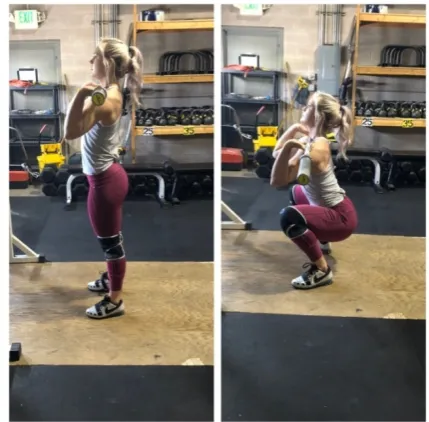
Performing back squats has been one of the most common types of strength training exercise [8]. There are many reasons explaining why performing the back squat (BSQ) has been a popular exercise. For example, research has demonstrated that the back BSQ when employed in a resistance training (RT) protocol can improve athletic performance [27, 28]. This is primarily because the BSQ (Figure 1) is a multi-joint, multi-large muscle group exercise and encompasses almost a full body stimulus [31].
Another variation of the squat is the front squat (FSQ) where the bar is positioned across the collarbones, as opposed to the dorsal side of the body (Figure 2). Introducing the FSQ in place of the BSQ in resistance training (RT) programs has occurred in some athletic strength and conditioning programs [5]. It is more common
* Corresponding author:
[email protected] (Mark DeBeliso) Published online at http://journal.sapub.org/sports
Copyright©2019The Author(s).PublishedbyScientific&AcademicPublishing This work is licensed under the Creative Commons Attribution International License (CC BY). http://creativecommons.org/licenses/by/4.0/
to see either both variations of the squat used in strength and conditioning programs or just the BSQ alone [11, 14].
Research has shown that lower-body muscular activity is similar for both BSQ and FSQ [9]. Hamstring, gluteal, and quadriceps muscles are working in the descent and ascent phase of both squat variations. However, a difference between the two squat variations is that the FSQ uses more quadriceps activity to execute the movement while the BSQ relies upon a greater activation of the hamstring-gluteal complex [7]. Some research has indicated that the FSQ maybe a safer movement as the compressive forces on the knee and lumbar spine are considerably lower when compared to executing the BSQ [5, 31].
vertical jump (VJ) is common among many sport and conditioning programs. It has been shown that increasing an athlete’s lower body power output by increasing their muscular strength, will increase their VJ [1, 6, 28].
Many recreationally active individuals also follow strength and conditioning programs [30]. Similar to college and elite athletes, common goals among recreationally active individuals also include the desire to improve athletic performance [20]. Many recreationally active individuals have a competitive drive and may still participate in extra-curricular sports and activities [4].
With the common goal of wanting to improve overall strength and performance measures such as sprint speed and jumping ability, recreationally active individuals should consider implementing the squat in their RT regimen. This poses the question of: “is there a difference in using either the BSQ or FSQ in a RT program for the purpose of enhancing athletic performance measures?” Hence, the purpose of this study was to examine the effects of the two squat variations on dependent variables of lower body strength, sprint speed, and VJ. Given that the BSQ allows for greater training loads to be employed in a RT program, it was hypothesized that use of the BSQ would provide superior improvements for each dependent variable.
2. Methods
2.1. Participants
Thirty recreationally active individuals, male and female, aged 21-40 years old participated in the study. The participant’s recreational activities varied (Crossfit, free weight, and machine resistance exercises) but included at least 1-year of RT history. With that said, all of the participants were familiar with executing the BSQ and FSQ movements. Permission to conduct this study was obtained through an University Institutional Review Board (#07-042017A), and each participant gave written consent prior to engaging in the study. Criteria for study inclusion was that the participants be injury and disability free such that they would not be prevented from full participation in the study training sessions and testing protocols.
2.2. Instruments and Apparatus
All training sessions were held at Hermes Crossfit in Spanish Fork, Utah. The site for pre and post assessments was held at the Indoor Practice Facility at Brigham Young University in Provo, Utah. Equipment required to collect the 1-RM BSQ and FSQ in this study included a 20.45 kg barbell and weighted plates (ranging from 1.14-20.45 kg) as well as squat racks housed in the Weight Room. The VJ measures were collected with a portable jump mat manufactured by Probotics Inc. Huntsville, AL, USA (model #22580). The 36.6 meter sprint times were collected by using a marked football turf field and a handheld stopwatch.
2.3. Procedures for Assessments
Prior to the RT intervention, the participant’s demographic information was collected (height, mass, and age). Additionally the participants were assessed for the VJ, 36.6 meter sprint, the 1-RM BSQ and 1-RM FSQ. Prior to collecting the VJ and 36.6 meter sprint times the participants performed a dynamic warm-up. The dynamic warm-up consisted of: the participants self-selecting a slow paced jog, rowing, or biking for five minutes, followed by 20 repetitions of leg swings, ball slams, superman stretches, air squats, and dynamic lower back floor stretches. Each participant was allotted three trials for the VJ and 36.6 meter sprint assessments in a manner consistent with that described by Baechle [3].
Figure 1. Participant performing the BSQ with starting position in the
left pane and the bottom position in the right pane
Figure 2. Participant performing the FSQ with starting position in the left
The VJ test consisted of each participant, one at a time, stepping onto the Jump Mat. Each participant then proceeded to start the jump by going through a counter movement, which consists of a slight dip of the lower body downward and then jumping as high as they could. Data of how high each participant jumped was then recorded by hand according to the reading given by the portable jump mat digital display.
For the 36.6 meter sprint, each participant lined up at the starting line, starting in a staggered stance (i.e. one foot in front of the other). When given the signal, which was the drop of the timers initially raised hand, the participants proceeded to sprint with a maximal effort towards the finish line. The sprint trials were conducted on a turf field and the participants wore their own training shoes, no cleats were allowed. The sprint times were recorded with a handheld stopwatch.
A two-three minute rest was provided between each VJ attempt and sprint trial. The average of all three attempts for the VJ and 36.6 meter sprint was then used as the pre-assessment score of the dependent variables.
On a separate day both the BSQ and FSQ 1-RM scores were assessed. The participants were instructed to perform the previously described dynamic warm-up then proceeded to follow the progression in Table 1 to establish their 1-RM squat scores. The BSQ 1-RM was assessed first followed by a 10 minute rest, then the FSQ 1-RM was assessed. Once the athlete had failed an attempt, or squat form had deteriorated, the weight successfully lifted was recorded.
2.4. Procedures for RT Intervention
Following the collection of the 1-RM BSQ and 1-RM FSQ scores, experimental groups were randomly formed based on rankings of the total weight lifted based on sum of the 1-RM BSQ and 1-RM FSQ scores. Specifically, the participants with the two highest ranking in total scores were randomly assigned to the two experimental groups. Next, the participants with the second two highest ranking in total scores were randomly assigned to the two experimental groups. This process continued until the experimental groups were fully formed with 15 participants in the FSQ group and the BSQ group respectively. This group assignment procedure assured that the experimental groups were essentially equal with respect to initial 1-RM BSQ and 1-RM FSQ strength scores. Further, the experimental groups were randomly balanced for gender.
Both groups performed identical RT protocols consisting of training two days/week for 6 weeks with the exception of the squat modality. The FSQ group employed the FSQ as the squat modality, while the BSQ group employed the BSQ as the squat modality. All training sessions included the previously discussed dynamic warm-up. The following
progression was then implemented during each RT training session for the two squat variations prior to the loads and sets listed in Table 2: Ten repetitions with an empty bar or less than 60% 1-RM, 8 repetitions at 60% 1-RM, and then 6 repetitions at 70% 1-RM.
The detailed program which both experimental groups followed can be found in Table 2. The first weekly day of training consisted of lifting 80 percent of their pre-assessed 1-RM squat for five repetitions for five sets. The participants were given two and half minutes of rest in between each set. The second day of training consisted of the participants lifting 85 percent of their pre-assessed 1-RM squat for three repetitions, for five sets. The same amount of rest, two and a half minutes, was given in between sets. The participants were required to perform the BSQ and FSQ to a depth in which the top of the quadriceps was parallel to the floor.
The RT program was designed to follow a linear progressive overload protocol whereby if the participant successfully lifted the assigned weight both training days for two consecutive weeks, 2.27-4.54 kgs (5-10 pounds) was added to the training load for the next week of RT. The weekly train sessions were separated by 48 hours.
Following the 6-week study period the DVs were retested using identical procedures as in the pre-test. The principal investigator monitored and tracked all training sessions and carried out the assessment sessions. The aforementioned principle investigator is a National Strength and Conditioning Association (NSCA) Certified Strength and Conditioning Specialist (CSCS).
2.5. Reliability
Dependent variables (DVs) for this study were the 1-RM BSQ and FSQ, VJ and the 36.6 meter sprint times. These dependent variables were collected as prescribed by Baechle [3]. The VJ as measured by the Jump Mat has been reported to have a reliability coefficient of ICC=0.90-0.93 [21]. Sprint speed as assessed by a handheld stopwatch is a reliable measure of sprint speed (ICC=0.92) [13, 19]. The reliability of the 1-RM squat has been reported by McBride [17] as ICC=0.99.
2.6. Design and Analysis
VJ height, 36.6 meter sprint time, 1-RM BSQ and FSQ scores were compared pre and post intervention with a paired t-tests. A common gain score was also calculated for the dependent variables (post-pre) of: 1-RM BSQ, 1-RM FSQ, VJ, and 36.6 meter sprint times. Gain scores were compared between experimental groups (FSQ and BSQ) for each DV with independent t-tests. Statistical significance was α≤0.05.
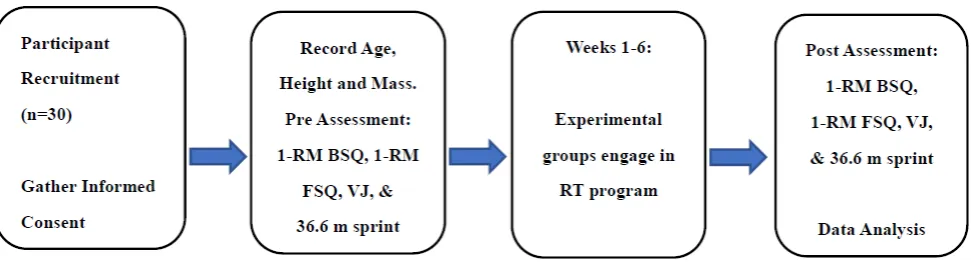
Figure 3. Study timeline (BSQ-back squat; FSQ-front squat; 1-RM-one repetition maximum; VJ-vertical jump)
Table 1. Participant’s progression protocol for assessing 1-RM BSQ and
FSQ
Repetitions of FSQ/BSQ Load
10 Empty bar
7 ≈65% 1-RM
5 ≈75% 1-RM
3 ≈80% 1-RM
1 ≈85-90% 1-RM
1 >90%
1, 1, 1 Until failure/find max
Table 2. Experimental training program participants followed for 6-week
protocol
Week Day One Day Two
1-2 5x5 @ 80% 1-RM 5x3 @ 85% 1-RM 3-4 5x5 @ >80% 1-RM* 5x3 @ >85% 1-RM* 5-6 5x5 @ >80% 1-RM** 5x3 @ >85% 1-RM** * 4.54 kg (10 pounds) was added, if first two weeks were successfully lifted with both training sessions per week.
** 2.27 kg (5 pounds) was added, if weeks 3 and 4 were successfully lifted with both training sessions per week.
*** Note: the FSQ group employed the FSQ as the squat modality, while the BSQ group employed the BSQ as the squat modality.
3. Results
A total of thirty participants originally engaged in the study with each experimental group consisting of 15 participants. Due to health reasons unrelated to the study, five participants dropped out, leaving twenty-five participants completing the study. The experimental groups were comprised of 12 participants in the FSQ group (male n=4, female=8) and 13 participants in the BSQ group (male n=5, female=8).
No participant missed more than two training sessions during the study period. The threshold for dismissal in the study was set at three or more missed training sessions. Further, there were no injuries or complications experienced by the participants as a result of engaging in the training sessions or dependent variable assessments.
Table 3 presents the mean and standard deviation results for the participant descriptive information. Table 4 through 6
provide the mean and standard deviation results for the participant’s VJ, 36.6 meter sprint times, and 1-RM squat scores.
Table 3. Participant Descriptive Information
Age (years) Height (cm) Body Mass (kg)
FSQ n=12 28.3±7.1 170.8±9.6 80.5±12.1 BSQ n=13 31.6±6.4 169.7±7.7 70.8±13.4
Mean ± standard deviation.
Both groups were assessed on strength, power production and sprint speed (1-RM squat, VJ, and 36.6 meter sprint) pre and post the 6-week training intervention. Both the FSQ and BSQ groups significantly improved all of the DVs as a result of the RT intervention (p<0.05) with absolute effect sizes
ranging from ES=0.23 to 0.72.
Table 4. Vertical Jump
Vertical Jump (cm)
Pre Post Gain ES
FSQ n=12 47.4±10.9 49.9±12.1* 2.5±2.6 0.23 BSQ n=13 52.9±10.1 56.0±10.9* 3.2±2.8 0.32 *Significant improvement pre-post intervention (p<0.05). Mean ± standard deviation. ES-effect size in standard deviations.
Table 5. Sprint times
36.6-meter times (sec)
Pre Post Gain ES
FSQ n=12 6.3±0.7 5.8±0.6* -0.5±0.4 -0.72 BSQ n=13 5.9±0.7 5.6±0.5* -0.3±0.5 -0.39 *Significant improvement pre-post intervention (p<0.05). Mean ± standard deviation. ES-effect size in standard deviations.
Table 6. Squat 1-RM
1-RM SQ (kg)
Pre Post Gain ES
There was no difference in gain scores between experimental groups for either the VJ height or 36.6-meter sprint times (p>0.05). Statistical gain score comparisons between experimental groups for the 1-RM squat were not conducted as the squat modalities were different for each group. However, the 1-RM squat gain scores for the two experimental groups were near identical.
4. Discussion
The purpose of this study was to determine the effects of engaging a RT program utilizing either the BSQ or the FSQ on the 36.6-meter sprint, VJ, and squat strength. It was hypothesised that the experimental group using the BSQ as the squat modality would demonstrate superior gains in the DVs when compared to the experimental group using the FSQ as the squat modality. The hypothesis was not supported as the FSQ group experienced similar gains as the BSQ group. Both groups improved squat strength, VJ, and 36.6-meter sprint times (p<0.05).
Normative data for NCAA athletes regarding the VJ average from 64-65 cm for men and 41-47 cm for women [3]. The 36.6-meter sprint normative data for NCAA athletes are 5.0 seconds for men and 5.5-5.96 seconds for women [3]. BSQ strength for NCAA women are 66-84 kg for the 90th percentile [3]. Whereas for men’s 90th percentile NCAA sports are 143-227 kg for the BSQ [3]. The normative data of NCAA athletes in comparison with the data collected in this study show that active individuals, who engage in RT, can achieve performance measures comparable to NCAA athletes. It can be further postulated that NCAA athletes may also benefit from the particular RT introduced in this study.
Today, many sports and daily activities include using strength and using it as rapidly as possible. This is known as producing power, which is the amount of force a muscle can exert within a given time frame [1]. Strength is a known factor within power, and to increase power, one must increase strength. There are three defined methods that are used within a RT program to increase athletic performance. They are: heavy strength/hypertrophic training, plyometric training, and explosive weight/power training [16]. Within these three methods heavy strength training influences the predominant increases in muscle mass and force production [16]. One of the most common exercise that falls under the heavy strength training method is the BSQ.
Other previous research has shown that sprint times and VJ can be enhanced by employing the BSQ in a RT protocol [1, 16, 27, 28, 29]. In one particular study, as a result of utilizing the BSQ in a RT regimen there was an increase of
strength by ≈ 24 percent, as well as improvements in the 20-meter sprint times and VJ [28].
From a research overview both FSQ and BSQ activate the same muscle groups, but there are small discrepancies within how much muscle recruitment occurs in each muscle [5]. However, despite these small differences, the author [5] stated that the FSQ could increase sprint times, just as
well as the BSQ [5]. Both types of squats involve the lower back, hip and leg muscles [31]. A study using EMG (electromyography) technology comparing the muscles activated during the FSQ and BSQ noted several differences. The vastus medialis, a knee extensor muscle, showed greater EMG activation during the FSQ in the ascending phase. Whereas, the semitendinosus, a knee flexor muscle, demonstrated greater EMG activity in the BSQ ascending phase [31]. Looking at other musculature involved in both squat variations are the gluteal muscles. EMG activity of the gluteus maximus during a BSQ has been documented to be approximately 35 percent of maximal voluntary contraction (MVC) [7]. The EMG activity of the gluteus maximus during the FSQ has been reported to be 29 percent MVC [9].
These aforementioned studies suggest that both the FSQ and BSQ may be effective employed in a RT program for the purpose of improving performance measures. Increasing the strength and power of the lower body musculature can improve the performance of an athlete [12, 25, 27, 28].
Data found within this particular study demonstrated that not only can the BSQ improve strength and athletic performance measures within recreationally active individuals, so can the FSQ. The data gathered in this study also indicated that gains in strength, speed, and power are affected essentially the same by both the FSQ and the BSQ modalities. This evidence suggests that either squat modality could be effectively employed in an RT program for the purpose of improving lower body strength, VJ ability, and sprint speed (hence providing RT program variability). For example, the BSQ can place the shoulders in a stressful position [10, 18] and there may be times when one needs to avoid this additional stress such as post-surgery or baseball pitchers and quarter backs who need time for their throwing arms to recover [18]. Another potential benefit has to do with the total training load of the RT protocols. In the current study the BSQ group was training with a greater load then the FSQ group because the training loads were based on a percent of the pre-assessment squat modality 1-RM, which was 29% greater for the BSQ. As such, one could reduce the load being encountered during an RT protocol and expect similar training effects by switching to the FSQ. This reduction in training load could have very import ramifications for athletes in season who are challenged for recovery time between competitive events. Finally, research has indicated that the FSQ maybe a safer movement compared to the BSQ as the compressive forces on the knee and lumbar spine are considerably lower than when executing the FSQ [5, 31]. As such, individuals looking to mitigate joint stress may choose the FSQ as the preferred squat modality.
much larger number of participants. It should also be noted that the subjects living patterns outside of the study were not controlled. Which could include diet variations, weight gain or loss, sleep and recovery techniques, all of which may have affected the study outcome. However it was assumed that the random nature of assembling the experimental groups would provide a measure of internal validity in this regard.
Further research could be conducted on additional benefits that both squat modalities may have to offer. Specifically, repeating the current study among athletes at various levels of development. One could dive deeper into studying the FSQ and examine the performance benefits in regards to agility among active individuals as well as athletes. Or further studies could be conducted using the same RT program given in this study and assess if there is a positive transfer to explosive power movements as measured by pulling derivatives such as the hang snatch and hang clean Olympic lifts [2].
5. Practical Applications
Practical applications based on this study include the use of the RT program employed in the study by other recreationally trained individuals looking to improve sprint speed, VJ ability and lower body strength. Additionally, since there was no difference in which squat modality was more beneficial regarding improving the DVs, either the FSQ or BSQ may be effectively used in RT protocols. This finding provides individuals (or their personal trainers) with evidence based options with respect to RT protocol design as to which squat modality (or both) will be employed in a RT protocol.
REFERENCES
[1] Adams, K., O'Shea, J. P., O'Shea, K. L., & Climstein, M. (1992). The effect of six weeks of squat, plyometric and squat-plyometric training on power production. Journal of Applied Sport Science Research, 6, 36-41.
[2] Ayers, J., DeBeliso, M., Sevene, T., & Adams, K.J. (2016). Effects of the hang clean and the hang snatch in women athletes. Biology of Sport, 33(3), 251-256.
[3] Baechle, T.R. & Earle, R.W. (2008). Essentials of Strength Training and Conditioning, (3. Ed.). Champaign, IL. Human Kinetics.
[4] Baker, C. S., Medina McKeon, J. M., & Usher, E. L. (2017). Development of the self-efficacy of balance scale (SEBS) for young, active individuals. Journal of Clinical Sport Psychology, 11(4), 352-373.
[5] Bird, S. P., & Casey, S. (2012). Exploring the front squat. Strength & Conditioning Journal, 34(2), 27-33.
[6] Brandon, R., Howatson, G., Strachan, F., & Hunter, A. M. (2015). Neuromuscular response differences to power vs
strength back squats exercise in elite athletes. Scandinavian Journal of Medicine & Science in Sports, 25(5), 630-639. [7] Caterisano, A., Moss, R., Pellinger, T., Woodruff, K., Lewis,
V., Booth, W., & Khadra, T. (2002). The effect of back squat depth on the EMG activity of three superficial hip and thigh muscles. Journal of Strength & Conditioning Research, 16(3), 428-432.
[8] Chandler, T., & Stone, M. H. (1991). The squat exercise in athletic conditioning: A review of literature. National Strength & Conditioning Association Journal, 13(5), 51-58. [9] Contreras, B., Vigotsky, A. D., Schoenfeld, B. J., Beardsley,
C., & Cronin, J. (2016). A Comparison of gluteus maximus, biceps femoris, and vastus lateralis electromyography amplitude in parallel, full, and front squat variations in resistance-trained females. Journal of Applied Biomechanics, 32(1), 16-22.
[10] Durral, C. J., Manske, R. C., & Davies, G. J. (2001). Avoiding shoulder injury from resistance training. Strength & Conditioning Journal, 23(5), 10-18.
[11] Fleck, S. J., and Kraemer, W. J. (2014). Designing resistance training programs. Champaign: Human Kinetics.
[12] Gabbett, T. J. (2016). The training – injury prevention paradox: should athletes be training smarter and harder? British Journal of Sports Medicine.
doi:10.1136/bjsports-2015-095788.
[13] Hetzler, R. K., Stickley, C. D., Lundquist, K. M., & Kimura, I. F. (2008). Reliability and accuracy of handheld stopwatches compared with electronic timing in measuring sprint performance. The Journal of Strength & Conditioning Research, 22(6), 1969-1976.
[14] Hoffman, J. R. Ratamess, N. A., Klatt, M., Faigenbaum, A., D., Ross, R. E., Tranchina N. M., … Kraemer, W. J. (2009). Comparison between difference off-season resistance training programs in division III American college football players. Journal of Strength & Conditioning Research, 23(1), 11-19. [15] Holding, R. C., Meir, R. A., & Shi, Z. (2013). Responding to
the “change” in the sporting environment: A brief review of recent agility testing and training research. Journal of Australian Strength & Conditioning, 21(3), 21-29.
[16] Marian, V., Katrina, L., David, O., Matus, K., & Simon, W. (2016). Improved maximum strength, vertical jump and sprint performance after 8 weeks of jump squat training with individualized loads. Journal of Sports Science & Medicine, 15(3), 492-500.
[17] McBride, J. M., Triplett-McBride, T., Davie, A., & Newton, R. U. (2002). The effect of heavy-vs. light-load jump squats on the development of strength, power and speed. Journal of Strength & Conditioning Research, 16(1), 75-82.
[18] Meldrum, R. & DeBeliso, M. (2018). A comparison of back squat & safety squat bar on measures of strength, speed, and power in NCAA division I baseball players, International Journal of Sports Science, 8(5), 137-144.
doi: 10.5923/j.sports.20180805.01.
[20] Munroe-Chandler, K. J., C. R., & Weinberg, R. S. (2004). A qualitative analysis of the types of goals athletes set in training and competition. Journal of Sports Behavior, 27(1), 58-74.
[21] Nuzzo, J.L., Anning, J.H., & Scharfenberg, J.M. (2011). The reliability of three devices used for measuring vertical jump height. The Journal of Strength & Conditioning Research, 25(9), 2580-2590.
[22] Palfrey, M. (2013). An alternative approach to exercise prescription- Part 2. Sportex Dynamics, (36), 10-20.
[23] Raya, M. A., Gailey, R. S., Gaunaurd, I. A., Jayne, D. M., Campbell, S. M., Gagne, E., & ... Tucker, C. (2013). Comparison of three agility tests with male service members: Edgren Side Step Test, T-Test, and Illinois Agility Test. Journal of Rehabilitation Research & Development, 50(7), 951-960.
[24] Rhea, M. R. (2004). Determining the magnitude of treatment effects in strength training research through the use of the effect size. Journal of Strength & Conditioning Research, 18, 918-920.
[25] Sheppard, J., & Young, W. (2006). Agility literature review: Classifications, training and testing. Journal of Sports Sciences, 24(9), 919-932.
[26] Stojanovic, T., Stojanovic, N., & Nesic, G. (2011). Metric characteristics of new tests constructed to assess jumping agility. Serbian Journal of Sports Science, 5(2), 51-59.
[27] Styles, W. J., Matthews, M. J., & Comfort, P. (2016). Effects of strength training on squat and sprint performance in soccer players. Journal of Strength & Conditioning Research, 30(6), 1534-1539.
[28] Talpey, S. W., Young, W. B., & Saunders, N. (2016). Is nine weeks of complex training effective for improving lower body strength, explosive muscle function, sprint and jumping performance? International Journal of Sports Science & Coaching, 11(5), 736-745.
[29] Tillin, N. A., Pain, M. G., & Folland, J. (2013). Explosive force production during isometric squats correlates with athletic performance in rugby union players. Journal of Sports Sciences, 31(1), 66-76.
[30] Waryasz, G. R., Daniels, A. H., Gil, J. A., Suric, V., & Eberson, C. P. (2016). Personal trainer demographics, current practice trends, and common trainee injuries. Orthopedic Reviews, 8(3). Retrieved from https://www.ncbi.nlm.nih.gov /pmc/articles/PMC5066109/.