Comparative Analysis of on demand routing
protocols for mailing application
Kamaljit Singh
1, Dr.Suyeb Khan
2Shiv Shankar Institute of Engineering & Technology, Patti, India1,2
Abstract - Paper provides the detailed investigation of three well-known MANET routing protocols namely DSR, AODV and TORA for E-mail traffic under four different physical characteristics: Direct sequence, Frequency Hopping, Infra Red and Extended Rate PHY (802.11g). The assessment is based on end-to-end delay, media access delay, retransmission attempts and throughput. The premise in this research is that no single routing protocol among AODV, DSR and TORA is clearly superior to the others in terms of overall network performance. One protocol may be superior in terms of average end-to-end delay while another may perform better in terms of routing overhead and throughput. The performance of the routing protocol will greatly depend on various factors such as network load and mobility effects.
Keywords - MANET, DSR, AODV, TORA, OPNET, Delay, Throughput.
General Terms
End-To-End Delay, Media Access Delay, Retransmission Attempts, Throughput, Direct Sequence, Frequency Hopping, Infra Red, Extended Rate PHY (802.11g).
I. INTRODUCTION
MANET is expanded as Mobile Ad hoc Network [1]. It is a robust infrastructure less wireless network [2]. A MANET may consist of mobile nodes or the combination of both mobile and fixed nodes which randomly associate with each other forming arbitrary topologies. These nodes can perform both the functions of a router as well as a host [3]. Therefore the versatility in their nature makes them promisingly suitable for wide range of applications. Deployment of such networks is quick and require minimal configuration thus making them ideal candidate for emergencies such as natural disasters [4]. MANETs prove to be very cost effective in terms of extending the service coverage. The world we live in today give rise to new advancements every day in all the fields, among which MANETs occupy a very important place and plays a vital role. The inherited talent of mobile routers to self-configure make MANETs best suited to provision communication in the areas hit by disasters which destroys communication
infrastructure and also facilitates the need of urgent network connection as in emergency search and rescue operations.
Among the wide variety of routing protocols available for wireless ad hoc network, DSR, AODV and TORA [4, 5, 6] have gained extreme popularity because of their varying qualities for different wireless routing aspects, which make the choice of the routing protocols a very critical process. In relation to this our research focuses on the overall behavior of routing protocols. Paper also gives verdict that which protocol should be preferred for MANETs and the influence of different physical characteristics on these protocols. The application chosen is E-mail because of its importance in the Internet to send and receive messages by mail from anywhere.
Simulation is carried out with the help of Optimized Network Engineering Tool (OPNET) which gives the better edge over other network simulation tools available [7].
II. RELATED WORK
performance of different routing protocols on the basis of two parameters: delay and throughput for four different scenarios having 3, 5, 15, and 30 mobile nodes which concluded that AODV gives the best all round performance for MANETs . Manijeh Keshtgary et al [12] evaluated the performance of four MANET routing protocols using simulations: AODV, OLSR, DSR and GRP on the basis of End-to-End delay, network load, throughput and media access delay. The results illustrated that AODV and OLSR perform better than the others and DSR is the worst routing protocol. Diya Naresh Vadhwani and Deepak Kulhare [13] analyzed the traffic flows for 42 mobile nodes for each different MANET routing protocols that are AODV, DSR and OLSR and concluded that the DSR protocol has 27 flows and OLSR has 30 flows, also AODV has 27 flows. Average Volume per Flow for DSR is less than Average Volume per Flow in OLSR. In the research the similar situation is considered which don’t intend to dispute or concur with the conclusion drawn by the authors as the simulations are performed on different foundation. However, the present research draws its own conclusions of the situation.
III. DYNAMIC SOURCE ROUTING (DSR) DSR is a source routing based reactive routing protocol for ad hoc wireless networks. The way by which the routing decisions are made differentiates it from table-driven and link-state routing. In source routing, source node has the responsibility of making routing decisions. The node wishing to send a packet specifies the route for that packet. The whole path information for the packet traversing the network from its source to the destination is set in the packet by the sender [13]. Therefore, DSR protocol requires each packet to carry the full address including each and every hop in the route. This means that DSR can only be preferred for small and moderate networks as in larger networks the amount of packet overhead increases with increasing diameter of the network [14].
IV. AD HOC ON-DEMAND DISTANCE VECTOR (AODV)
AODV is an on-demand routing protocol used in ad hoc networks and is adjustable to highly dynamic networks as it facilitates a smooth adaptation to changes in the link conditions. The notifications also are sent only to the affected nodes in case a link fails enabling the affected nodes invalidate all the routes through the failed link. In comparison to DSR it has less overhead because the packet carries only the destination address instead of carrying full routing information [14]. As the routes are built on demand this minimizes the routing traffic in the network. It
does not allow nodes to keep routes that are not in use. AODV is loop free. It uses Destination Sequence Numbers (DSN) to avoid counting to infinity. The route replies only carry the destination IP address and the sequence number. Requesting nodes in a network send DSNs together with all routing information to the destination. It also selects the optimal route based on the sequence number [15].
V. TEMPORALLY-ORDERED ROUTING ALGORITHM (TORA)
TORA is an adaptive routing protocol. It is therefore used in multi-hop networks. TORA is mainly used in MANETs to enhance scalability. The main objective of TORA is to limit control message propagation in the highly dynamic mobile computing environment. TORA belongs to a class of algorithms called the link reversal algorithms. TORA essentially performs three tasks:
Creation of a route from a source to a destination.
Maintenance of the route.
Erasure of the route when the route is no longer valid.
A destination node and a source node are set. TORA uses Directed Acyclic Graph (DAG) built in the destination node to establish the scaled routes between the source and the destination [16]. TORA builds optimized routes using four messages [16]. Its starts with a Query message followed by an Update message then Clear message and finally Optimization message. TORA is a fairly complicated protocol but its main feature is that when a link fails the control messages are only propagates around the point of failure. While other protocols need to re-initiate a route discovery when a link fails, TORA would be able to patch itself up around the point of failure. This feature allows TORA to scale up to larger networks but has higher overhead for smaller networks.
VI. SIMULATION MODEL
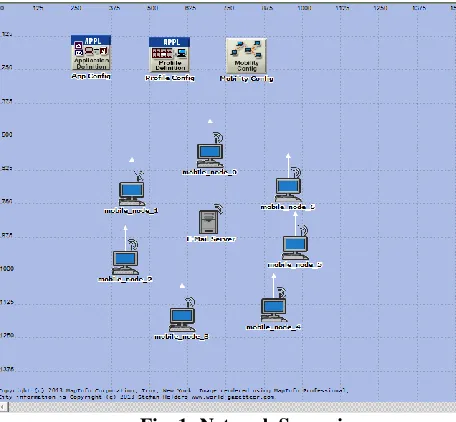
Fig. 1: Network Scenario
Table 1: Main Characteristics of Scenario
Parameters Values
Simulator OPNET Modeler 14.5
Protocols Studied DSR, AODV, TORA
Scenario Size 1500 m X 1500 m
Number of mobile nodes 7
Data Rate 2 Mbps
Application Definition E-mail
Physical Characteristics Direct Sequence, Frequency Hopping, Infra Red and Extended Rate PHY (802.11g) Node Movement Model Random Waypoint Model Transmit Power (w) 0.005
Buffer Size (bits) 256000
Performance Metrics End-to-end delay, media access delay, retransmission attempts and throughput.
VII. SIMULATION RESULTS AND
ANALYSIS
Sixteen graphs were selected i.e. four graphs showing different performance metric for different physical characteristics. The results obtained after testing the scenarios are given below.
i. End-to-end delay
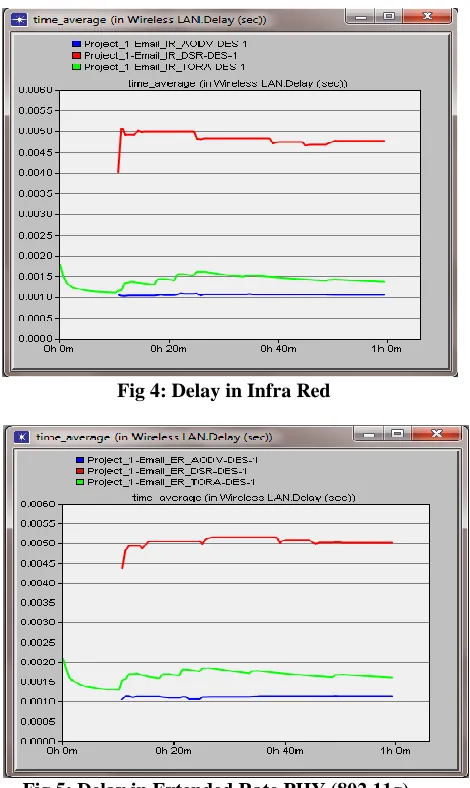
The packet end-to-end delay is the average time that packets take to traverse the network. This is the time from the generation of the packet by the sender up to their reception at the destination application layer and is expressed in seconds [6]. Observing the characteristics in figures 2, 3, 4 and 5, it is evident that AODV gives the lowest delay out of three
protocols followed by TORA whose value decreases exponentially at the start. DSR attains the higher value of delay throughout the period of simulation. Initially its value increases in step to some high value for all the characteristics. AODV delay for direct sequence is of 0 .001418 sec, for frequency hopping it degrades to 0 .001355 sec, for infra red it is 0.001062 sec and in case of extended rate PHY (802.11g) delay is 0 .001138 sec. Hence among AODV the delay is lowest for infra red whereas it is maximum for direct sequence. This means that for AODV protocol the packets will take the lowest time to travel from one end to the other end of the network. Also the performance of infra red is best among other characteristics followed by extended rate and is poor for direct sequence.
Fig 2: Delay in Direct Sequence
Fig 4: Delay in Infra Red
Fig 5: Delay in Extended Rate PHY (802.11g)
ii. Media Access Delay
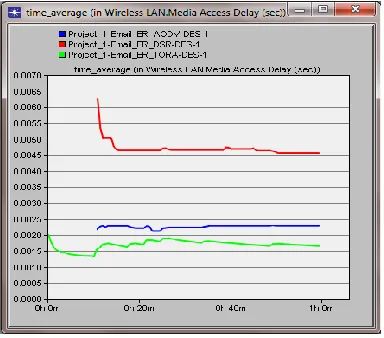
Media access delay is the time a node takes to access media (link) to start its transmission. It includes queuing delays, the delays due to contentions and back offs [6]. The figures 6, 7, 8, 9 present the media access delay of different protocols for all the four physical characteristics. Observations showed that TORA performs best in terms of media access delay followed by AODV and DSR again performs poor as it takes the highest time to access the link for the transmission of packets. The media access delay for TORA attains a peak value when the half interval is passed after possessing an initial exponential decrease and degrades to 0.002659 sec, 0.002494 sec, 0.001681 sec, 0.001677 sec for direct sequence, frequency hopping, infra red and extended rate respectively at the end of hour. This means that TORA is fastest to get access over a media for transmission among all the protocols while the
performance is best in case of extended rate PHY (802.11g).
Fig 6: Media Access Delay in Direct Sequence
Fig 7: Media Access Delay in Frequency Hopping
Fig 9: Media Access Delay in Extended Rate
iii. Retransmission Attempts
Retransmission attempts are the resending of packets which have been either damaged or lost. Protocols which provide reliable communication over such networks use a combination of acknowledgements i.e. an explicit receipt from the destination of the data, retransmission of missing and/or damaged packets and checksums to provide that reliability [6]. The retransmission attempts of all the protocols under different physical characteristics are given in figures 10, 11, 12 and 13. Results illustrated that the retransmission attempts for AODV are least in all the cases except for infra red in which it is DSR. The highest retransmission attempts are encountered for TORA. For infra red the AODV gives retransmission attempts of 0.06897 packets after 10 minutes which rapidly degrades to 0.02586 packets in the next two minutes and start decreasing , DSR gives 0.012990 packets after 10 minutes which rises in a minute to 0.03774 packets which again drops to its initial value after 15 minutes. Hence there is more loss of packets for TORA. It is also evident that infra red performs better among physical characteristics.
Fig 10: Retransmission Attempts in Direct Sequence
Fig 11: Retransmission Attempts in Frequency Hopping
Fig 12: Retransmission Attempts in Infra Red
Fig 13: Retransmission Attempts in Extended Rate
iv. Throughput
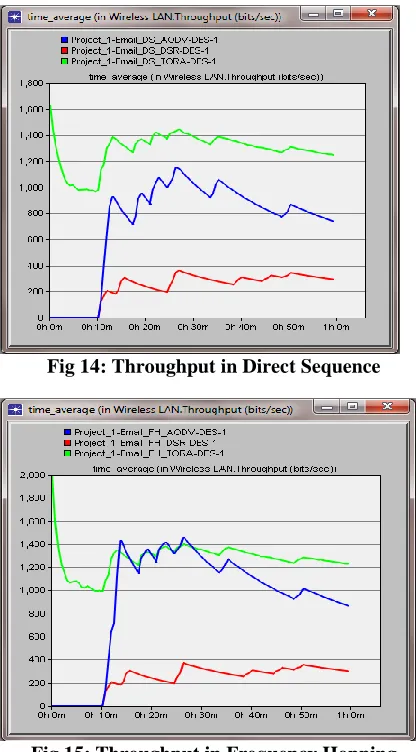
metric show the total number of packets that have been successfully delivered to the destination nodes. The throughput is defined as the total amount of data a receiver receives from the sender divided by the time it takes for the receiver to get the last packet. It is expressed in bits per second or packets per second. The observations of the throughput as noticed from figures 14, 15, 16 and 17 explains that the routing protocol TORA outperforms other protocols under all the considered physical characteristics. The throughput for TORA posses an exponential decrease from some high value and finally degrades to 1000 bits/sec. There is no value of throughput given by AODV and TORA for the first 10 minutes in all the cases. After 10 minutes the throughput of AODV rises abruptly and degrades to some low value after possessing multiple peaks. The value of throughput is same for DSR under all the physical characteristics i.e. between 200 bps to 400 bps. Also frequency hopping gives good performance amongst all other characteristics.
Fig 14: Throughput in Direct Sequence
Fig 15: Throughput in Frequency Hopping
Fig 16: Throughput in Infra Red
Fig 17: Throughput in Extended Rate
VIII. CONCLUSION
REFERENCES
[1] Agustin Zaballos, Alex Vallejo et. “Ad Hoc routing Performance study using Opnet Modeller”, University Ramon Llull, Barcelona, Spain.
[2] Anil Kumar Verma, “Performance Analysis of cluster based routing in manets” MAY 2006.
[3] Sandeep Kaur, “Simulation Analysis of AODV Routing Protocol of MANET using OPNET” IJCST Vol. 2, Issue 3, September 2011.
[4] R. Al-Ani, “Simulation and performance analysis evaluation for variant MANET routing protocols”, International Journal of Advancements in Computing Technology, Volume 3, Number 1, February 2011.
[5] Puneet Dadral, Rajan Vohra Ravinder Singh Sawhney, “Metrics improvement of MANET using reactive protocol approach”, proceedings for 2nd IEEE conference on Parallel,
Distributed and Grid Computing – PDGC2012, Jaypee University of Information Technilogy, Solan, Himachal Pradesh; 12/2012.
[6] Puneet, R S Sawhney, Rajan Vohra, “Physical Characteristics based MANET Routing Protocols for Campus Network”, International Journal of Computer Applications in Technology 07/2012; 48:975-8887.
[7] OPNET MODELER version 14.5, Modeler Wireless Suite. http://www.opnet.com/products/modeler.
[8] Kaosar, Md. Golam; Hafizm Asif, Tarek R. Sheltami, Ashrof S. Hasan Mahmoud – “Simulation – Based Comparative Study of on Demand Routing Protocols for MANET.” Department of Computer Engineering, King Fahd University of Petroleum and Minerals, Dhahvan 31261, USA.
[9] Qasim Nadia, Said Fatin & Aghvami Hamid – “Mobile Ad Hoc Networking Protocol’s Evaluation through Simulation for Quality of Service.” - IAENG International Journal of Computer Science, 36:1, IJCS_36_1_10, 17 February, 2009. [10] Jahangir Khan, Dr. Syed Irfan Hyder, “Modeling and
Simulation of Dynamic Intermediate Nodes and Performance Analysis in MANETs Reactive Routing Protocols”, International Journal of Grid and Distributed Computing, Vol. 4 No. 01 March 2011.
[11] Khushboo Singh, N.S. Killarikar “Assessment of Mobile Ad-Hoc Network Routing Protocols in Increasing number of Mobile Nodes Scenario”, International Conference on Advances in Communication and Computing Technologies (ICACACT) 2012 Proceedings published by International Journal of Computer Applications® (IJCA)
[12] Manijeh Keshtgary, Vahide Babaiyan, Shiraz, Iran, “Performance Evaluation of Reactive, Proactive and Hybrid Routing Protocols in MANET”, International Journal on Computer Science and Engineering (IJCSE), Vol. 4 No. 02 February 2012.
[13] Diya Naresh Vadhwani, Deepak Kulhare, “Traffic Analysis Of DSR, AODV and OLSR Using TCP and UDP”, International Journal on Computer Science and Engineering (IJCSE), Vol. 5 No. 04 Apr 2013.
[14] Mehran Abolhasan, Tadeusz Wysocki, Eryk Dutkiewicz, “A review of routing protocols for mobile ad hoc networks”, www.elsevier.com/locate/adhoc.
[15] Lijuan Cao, K. Sharif, Yu Wang, T. Dahlberg, “Adaptive Multiple Metrics Routing Protocols for Heterogeneous Multi-Hop Wireless Networks”, proceedings for 5th CCNC Consumer Communications and Networking Conference, IEEE, 2008, pp. 13 – 17.