Available Online at www.ijpret.com 20
INTERNATIONAL JOURNAL OF PURE AND
APPLIED RESEARCH IN ENGINEERING AND
TECHNOLOGY
A PATH FOR HORIZING YOUR INNOVATIVE WORK
STUDY OF ACOUSTICAL PARAMETERS OF BINARY LIQUID MIXTURES AT 298K
AND 2 MHZ FREQUENCY
GAJENDRA R. BEDARE
Dept of Physics, N. S. Sci. & Arts College, Bhadrawati Dist– Chandrapur, India Accepted Date: 15/03/2016; Published Date: 01/05/2016
\
Abstract:Ultrasonic velocity, density and viscosity of a binary system of Methylmethacrylate
in Acetone have been measured at 298K and 2 MHz frequency. Experimental data of the ultrasonic sound velocity, density and viscosity have been used to calculate various acoustical parameters such as adiabatic compressibility (βa), intermolecular free length (Lf),
free volume (Vf), excess values of adiabatic compressibility (βaE), excess values of free length
(LfE) and excess values of free volume (VfE). It is observed from these acoustical parameters
that, weak intermolecular interactions are confirmed in this system. Dipole inducement in the system is found to be more predominant. The nonlinear behavior of all these parameters throws more light on the various interactions among the molecules.
Keywords: Acoustical parameters, Methylmethacrylate, binary liquid mixture, Acetone, molecular interactions and ultrasonic velocity.
Corresponding Author: MR. GAJENDRA R. BEDARE
Access Online On:
www.ijpret.com
How to Cite This Article:
Gajendra R. Bedare, IJPRET, 2016; Volume 4 (9): 20-27
Available Online at www.ijpret.com 21 INTRODUCTION
The non-linear variation of ultrasonic velocity, density, viscosity and other calculated acoustic parameters, such as adiabatic compressibility (βa), intermolecular free length (Lf) and free
volume (Vf ), along with their excess values in binary liquid mixtures with respect to mole
fractions of one components are of large importance for industrial applications in recent years. The ultrasonic study of binary liquid mixtures containing polar and non-polar components find various applications, as such liquid mixtures with appropriate properties provide a wide range of solutions [1-4].
Ultrasonic velocity measurements are used to study physicochemical behavior and molecular interactions in pure liquids and liquid mixtures. The ultrasonic velocity gives information about the bonding of molecules and formation of complexes at various temperatures through molecular interactions. To study important thermodynamic parameters of solutions, it is necessary to use their ultrasonic velocity, density and viscosity. Ultrasonic velocity and viscosity measurements have been used widely in molecular interactions and structural evaluations [5-7].
In the present work, the binary solutions of Methylmethacrylate in Acetone were studied, in terms of adiabatic compressibility, intermolecular free length, free volume according to the ultrasonic measurement results at 298K. The observations can be interpreted in terms of molecular interaction between the components of the mixtures.
I. MATERIALS AND METHODS
The chemicals Acetone and Methylmethacrylate, used in the present work were of AR grade. Solutions of different concentrations were prepared with all precautions to minimize the possible experimental error. Ultrasonic velocity (U) of the liquid mixtures were measured at 298K by using an ultrasonic interferometer (Mittal Enterprises, Model F-81) working at 2 MHz. The accuracy of sound velocity was ±0.1m/s. Constant temperature water bath was used in which water was circulated through double walled measuring cell made up of steel containing at 298K. Densities of pure liquids and the mixtures were measured by using pycknometer with an accuracy of ±0.1Kgm-3. An Ostwald’s viscometer was used for the viscosity measurement
with an accuracy of ±0.0001NSm-2. The temperature fluctuation around the viscometer and
Available Online at www.ijpret.com 22
II. RESULTS AND DISCUSSION
The experimental data of ultrasonic sound velocity, density and viscosity were used to calculate various acoustical parameters, such as adiabatic compressibility (βa), intermolecular free length
(Lf), free volume (Vf), by using the following equations (1-3):
βa = (U2 ρ)-1 ...… (1)
Lf = KTβa 1/2 ….. (2)
Vf = (Meff U/ηK)3/2 …… (3)
where, KT in equation (2) is the temperature dependent constant having a value of
205.8336*10-8 in MKS system at 298K, K in equation (3) is a constant equal to 4.28*109 in MKS
system, Meff = Σ ximi, where xi is the mole fraction and mi is the molecular weight of the
component. The excess values like VfE, βE, LfE have been calculated using the following standard
relation: AE = A
exp – Aid . Where, Aid = ΣAiXi, where, Ai is any acoustical parameter and Xi is
the mole fraction of liquid component.
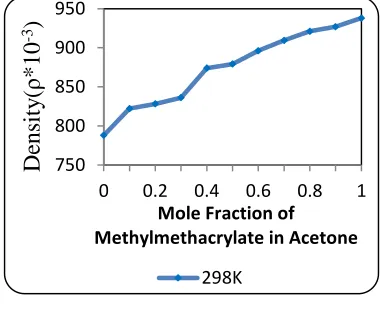
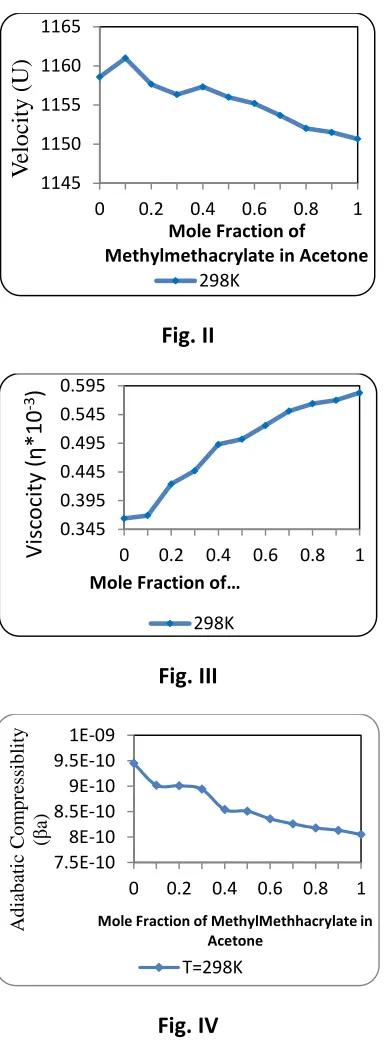
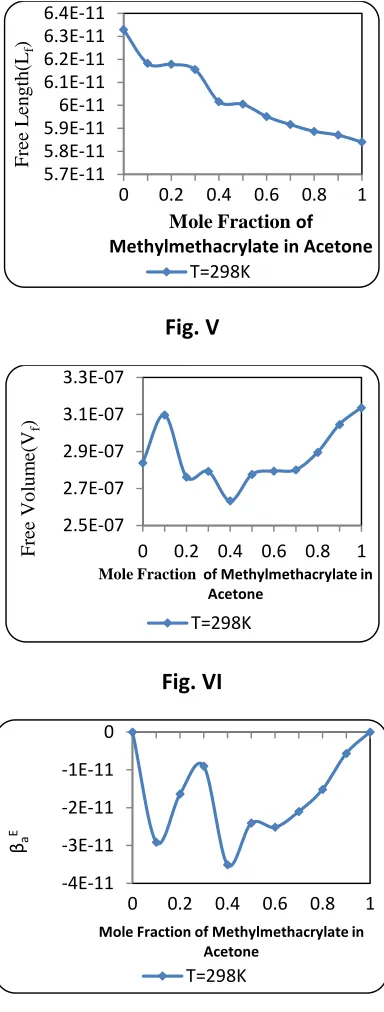
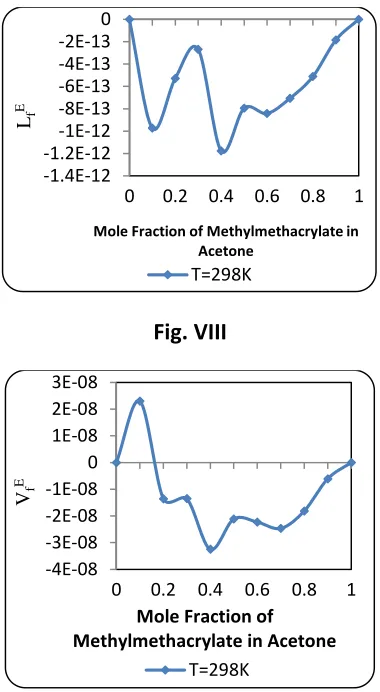
The measured parameters viz., density (ρ), ultrasonic velocity (U) and viscosity (η) and calculated parameters such as adiabatic compressibility (βa), intermolecular free length (Lf) and
free volume (Vf) for the system 298K are shown in figure I-VI for the binary system of
Methylmethacrylate in Acetone at 298K.
Figure shows that, density increases with concentration of Methylmethacrylate in Acetone But the ultrasonic velocity decreases in the system. Viscosity increases in the system, suggesting thereby more association between solute and solvent molecules.
From the figure, the adiabatic compressibility and free length decreases with increase of mole fraction of the Methylmethacrylate. This may lead to the presence of specific molecular interaction between the molecules of the liquid mixture. The adiabatic compressibility and free length are the deciding factors of the ultrasonic velocity in liquid systems. Decrease in intermolecular free length in the system leads to negative deviation in compressibility. This indicates that the molecules are nearer in the system.
Available Online at www.ijpret.com 23 between the Methylmethacrylate and Acetone molecules. Thus, a progressive increase in free volume in mixtures clearly indicates the existence of intermolecular interaction, due to which the structural arrangement is considerably affected.
Fig. VII and VIII indicates that βaE and L
fE are negative over the entire mole fraction range. The
negative βaE clearly suggests that weak dispersive interactions between the components of the
mixture. The trends of fig. shows that βaE and L
fE are increasingly negative as
Methylmethacrylate mole fraction is increased. Thus, strong dipolar interactions are restricted more and more whereas the weak dispersive interactions are predominating and are maximum around 0.4 mole fractions. As the molecular symmetry is retained to a greater extent at 0.9 mole fraction, βaE and L
fE are found to decrease. However, VfE for the system is mostly negative
fig. IX, existing weak dispersive interactions [8-11].
Figure I - IX: The variations of Density (ρ), Ultrasonic velocity (U), Viscosity (η), adiabatic compressibility (βa), free length (Lf) and free Volume (Vf) and their excess parameters w. r. to
mole fraction (x) of system Methylmethacrylate in Acetone at 298K are shown in Figure I, II, III, IV, V, VI, VII, VIII and IX respectively.
Fig. I
750 800 850 900 950
0 0.2 0.4 0.6 0.8 1
De
nsit
y
(ρ
*10
-3 )
Mole Fraction of Methylmethacrylate in Acetone
Available Online at www.ijpret.com 24 Fig. II
Fig. III
Fig. IV
1145 1150 1155 1160 1165
0 0.2 0.4 0.6 0.8 1
V
elocity
(U
)
Mole Fraction of Methylmethacrylate in Acetone
298K
0.345 0.395 0.445 0.495 0.545 0.595
0 0.2 0.4 0.6 0.8 1
V
isc
ocit
y (
η
*1
0
-3)
Mole Fraction of …
298K
7.5E-10 8E-10 8.5E-10 9E-10 9.5E-10 1E-09
0 0.2 0.4 0.6 0.8 1
A
d
iab
atic
C
o
m
p
ress
ib
lity
(β
a)
Mole Fraction of MethylMethhacrylate in Acetone
Available Online at www.ijpret.com 25 Fig. V
Fig. VI
Fig. VII
5.7E-11 5.8E-11 5.9E-11 6E-11 6.1E-11 6.2E-11 6.3E-11 6.4E-11
0 0.2 0.4 0.6 0.8 1
Fre
e
L
en
g
th
(L
f
)
Mole Fraction of Methylmethacrylate in Acetone
T=298K
2.5E-07 2.7E-07 2.9E-07 3.1E-07 3.3E-07
0 0.2 0.4 0.6 0.8 1
Fre
e
Vo
lu
m
e(
Vf
)
Mole Fraction of Methylmethacrylate in Acetone
T=298K
-4E-11 -3E-11 -2E-11 -1E-11 0
0 0.2 0.4 0.6 0.8 1
βa
E
Mole Fraction of Methylmethacrylate in Acetone
Available Online at www.ijpret.com 26 Fig. VIII
Fig. IX
III. CONCLUSIONS
The existence of solute-solvent type molecular interaction is favored in system studied, confirmed from the U, ρ, η, βa, Lf and Vf data. The variation in all parameters is non-linear.
Ultrasonic velocities of the system decreases, depending on the concentration of Methylmethacrylate. The nonlinear behavior confirms the presence of solute-solvent and solvent-solvent interactions. As Methylmethacrylate and Acetone are polar in this system; dipole - dipole interaction is present. The excess parameters give a measure of non-ideality of system as a consequence of associative or of other interactions. Measurements of acoustic parameters and their excess values are strongly correlated with each other.
-1.4E-12 -1.2E-12 -1E-12 -8E-13 -6E-13 -4E-13 -2E-13 0
0 0.2 0.4 0.6 0.8 1
Lf
E
Mole Fraction of Methylmethacrylate in Acetone
T=298K
-4E-08 -3E-08 -2E-08 -1E-08 0 1E-08 2E-08 3E-08
0 0.2 0.4 0.6 0.8 1
Vf
E
Mole Fraction of Methylmethacrylate in Acetone
Available Online at www.ijpret.com 27
IV. ACKNOWLEDGEMENT
Author [File No.:47-1774/10(WRO)] acknowledge the financial assistance from UGC, in the form of MRP grant.
REFERENCES:
1. Blitz J, “Fundamental of Ultrasonics, Butterworth”, (London, 1963).
2. Nithiyanantham S. & Palaniappan L., “Ultrasonic Study on Glucose with a- amylase in aqueous media”, Acta Ciencia Indica, 31(4), 2005, 533-538.
3. Nithiyanantham S. and Palaniappan L., “Molecular Interaction studies of fructose in aqueous amylase solution”, Acta Ciencia Indica, 32(3), 2006, pp 387-391,
4. Nithya R., Mullainathan S., et. al., “Ultrasonic Investigation of Molecular Interactions in Binary Mixtures at 303 K”. E J. of Chem., 6(1), 2009, pp 138-142.
5. Nithiyanantham S. and Palaniappan L., “Acoustical studies on some disaccharides (sucrose, lactose, maltose) in Aqueous media at room temperature”, Metals Materials and Processes, 20(3), 2008, pp 203-208.
6. S. Thirumaran and M. Rajeswari, “Acoustical studies on binary liquid mixtures of some aromatic hydrocarbons with ethylsulphoxide (DMSO) at 303.15 K”, Arch. of Phy. Research, 2011, 2 (2), pp 149-156.
7. K. Rajagopal and S. Chenthilnath, “Molecular interaction studies and theoretical estimation of ultrasonic speeds using scaled particle theory in binary mixtures of toluene with homologous nitriles at different temperatures”, Thermochimica Acta, 498(1-2), 2010, pp 45-53.
8. Velusamy V., Nithiyanantham S. & Palaniappan L., “Ultrasonic study of adsorption in Polysaccharides Metabolism”, Main Group Chem., 6(1), 2007, pp 53-58.
9. A. N. K annappan, R. Palani, “Acoustical Behavior of Glycerine, Dextrose and Sucrose in Na2CO3 and NaHCO3 Buffer Solution”, Ind. J. Pure Appl. Phys., 45, 2007, 573-579.
10. S. Thirumaran and J.Earnest Jayakumar, “Ultrasonic study of n-alkanols in toluene with nitrobenzene, Indian J Pure & Appl. Physics”, 47, 2009, pp 265-272.