Music as a Complementary Approach to Controlling
Primary Headache
Sanaz Tajadini1, Hamid Reza Farpour2,*, Sima Farpour3
1General Linguistics, Ph.D. student, Department of Foreign Languages and Linguistics, Shiraz University, Shiraz, Iran
2Assistant Professor of Physical Medicine and Rehabilitation, Shiraz Geriatric Research Center, Bone and Joint Diseases Research Center, Shiraz University of Medical Sciences, Shiraz, Iran
3MSc of Speech and Language Therapy, Shiraz Geriatric Research Center, Shiraz, University of Medical Sciences, Shiraz, Iran
Abstract
Objectives: Headache is one of the most common complaints in patients due to physical and mental Problems. Music intervention is proven to have an effective role on reducing and tranquilizing pain intensity in patients. To our knowledge, there is a paucity of evidence for the benefit of music therapy in headache management. The objective of this review was to evaluate the use of music as a complementary approach for primary headache control. Method: Five electronic data bases (Pubmed, Scopus, Science direct, EMBASE, and Central) from 2000 to January 2018 were searched using various keywords: “Tension- type headache”, “Migraine”, “Sound therapy”, and “Music therapy” including the word (and) between these words. Studies were included based on the following criteria: (1) the participants were individuals with TTH and migraine headache; (2) studies assessed headache management; (3) studies assessed the effectiveness of music therapy on these two kinds of headaches. Studies were excluded if participants had any type of secondary or other primary headache and music therapy was not evaluated. Results: Search results identified 19 articles. After manual review of abstracts, 6 of these articles met the inclusion criteria. Conclusion: The combined findings of these articles provide support for the use of music as a complementary, cost effective, and noninvasive approach to the routine care of patients with primary headaches, yet more validated scientific research is still required to explore information about the types of music, optimum duration, and dose of the music with best impact on individuals’ treatment. Further researches should address this issue. The findings of this review are expected to have important implications for clinical settings.Keywords
Pain,Tension-type headache, Migraine, Music therapy1. Introduction
Pain is one of the most common complaints and subjective phenomena in patients due to physical and mental Problems. [1] It has serious impact on health status, quality of life, work, social performance and societal costs. [2, 3] Headache is a common type of pain with the most prevalent neurological disorders. [4] It can be subdivided into primary (Tension-type headache, Migraine, and Cluster headache) and secondary headaches which can have their own set of symptoms, reasons and different kinds of treatment. [5]
Tension-type headache (TTH)
With a focus on Tension-type headache (TTH) as a non-vascular form of primary headaches, it can be said, TTH is attributed to abnormalities in peripheral and central
* Corresponding author:
[email protected] (Hamid Reza Farpour) Published online at http://journal.sapub.org/medicine
Copyright©2018The Author(s).PublishedbyScientific&AcademicPublishing
This work is licensed under the Creative Commons Attribution International License (CC BY). http://creativecommons.org/licenses/by/4.0/
nociceptive systems in combination with environmental and genetic factors that takes place over hours to days. [6] Environmental and psychological factors (depression, anxiety and stress) are indexed for the development of TTH. [7] It has long been recognized that TTH has high socio-economic impact with a life time prevalence in the general population ranging between 30% and 78% in different studies. [8, 9] With respect to middle age groups, TTH remains more prevalent in women (27.1%) than men (25.6%). [10, 11] One survey by Schawrtz and colleagues on the general population in the United States indicated that episodic tension-type headache with an annual prevalence of 38.3% was highly persistent in many patients. [12]
Migraine headache
of population. [16] Based on three large epidemiological studies, 17.6% of females and 5.7% of males were affected by migraine attacks in the United States. [17] It is sub-classified into common migraine (without aura) and classic migraine (with aura). [18]
Music therapy
To manage these headaches with mild to moderate degree, both pharmacological and non-pharmacological preventive therapies are recommended as alternative and complementary treatments, respectively. The provision of complementary therapy (relaxation therapy, cognitive therapy, music therapy, and meditation), as non-invasive, safe, and inexpensive way to reduce symptoms of headache in many people who are reluctant to use traditional treatment methods or concerned about the toxic effects of the medicines, is primarily the domain of the first line treatment. [19-22] Music therapy as one of the oldest and complementary technique is known to have been used with the aim of promoting a mind-body interaction without side effects. [23] Mechanistically, music has a practical role through the entertainment of body rhythms [24, 25], by releasing of endogenous opioids and dopamine, and changing in hormone modulation. [26] Chlan [27] reported salient features of this recovery positive model of medical treatment, it is easy to apply and to use; it is cost-effective; it does not have adverse effects.
Subsequently, the influence of music therapy on headaches became the basic of study. In a previous study, music has been shown to have positive role in the treatment of adults with headache. [28] Thus far, in research conducted by Koeing etal [29] to examine the impact of music therapy among patients with chronic painful conditions, it was found that listening to music decreased pain scores.
Although aforementioned studies provide important implications regarding the effects of music therapy on headaches, little attention has been paid to especially randomized controlled trial for evaluation possible effects of music on patients with TTH and migraine. The aim of this review paper is to provide an overview on the impact of music therapy as a conservative management for patients with TTH and migraine.
2. Method
Search StrategyFive electronic data bases (Pubmed, Scopus, Science direct, EMBASE, and Central) from 2000 to January 2018 were searched by applying the following title keyword search terms: “Pain”, “Tension-type headache”, “Migraine”, and “Music therapy”.
Inclusion / Exclusion criteria
Studies were included based on the following criteria: (1) the participants were individuals with TTH and migraine headache; (2) studies assessed headache management; (3) studies assessed the effectiveness of music therapy on
these two kinds of headaches. Studies were excluded if participants had any type of secondary or other primary headache and music therapy was not evaluated.
Data Extraction and Analysis
Data extraction was performed on all articles according to inclusion criteria as (1) the participants’ characteristics, (2) headache assessment, and music therapeutic management of headache assessment.
3. Results
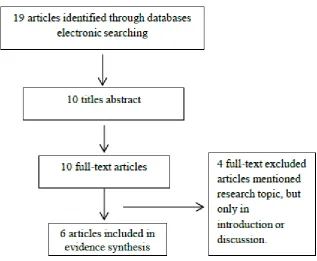
Search results identified 19 articles. After manual review of abstracts, 6 of these articles met the inclusion criteria, [28-33] among which 2 articles [28, 29] were found in the reference list. The protocol of this review is presented as a flow diagram in Figure (1).
Main Findings
group was exposed to pharmacological assessment and the other group received self-selected music sessions for the next six months along with pharmacotherapy. After listening to music adjunct to pharmacotherapy, in the second group, a number of headache index decreased significantly at the end of six months. One pilot study [29] was found in the primary- headache population. Music intervention was provided for the 19 patients of the study ranging in age from 12 to 17 years old who were diagnosed with either a tension-type or a migraine headache. The study group received two dose-frequency modes of treatment (standards vs compact). During standard treatment (12 weekly session over three months), patients listened to music for 50 minutes each session whereas in compact treatment (12 session within one week). The results showed reduction of headache intensity over time differed significantly when compared to the pre-treatments in both alternatives but there was a small effect on headache frequency. One study [32] in Turkey was identified in which Turkish music was administered to decrease pain in subjects with primary headache. This experimental study included 43 patients 14 to 81 years and lasted for 3 weeks. The experimental group listened to live music which supposed not to have been listened by the group before, once a week within three week-period. The music therapy plan classified as active (relaxation exercises) and passive (just hearing) techniques. A questionnaire was related to the therapy process were obtained after the music sessions. Finally, the study group demonstrated higher
satisfaction with their hospital and emotional experience (thinking positively, relaxing, feeling at peace and reducing the pains). In order to support the assertion between using music and reduction in primary headache intensity and severity, the last randomized, attention-placebo- controlled parallel group trial consisted of 71 patients between the ages of 12 and 17 years was conducted. [33] According to the International Classification of Headache Disorders (ICHD-II), patients were reported with one or multiple diagnosis having migraine without aura, migraine with aura, chronic migraine, frequent episodic TTH or chronic TTH. The study was divided into 4 phases: an 8-week baseline assessment; an 8-week treatment phase (6 sessions of 90 minutes each), an 8-week post treatment assessment phase (post-line), and 8- week follow-up assessment phase (6 months after the end of the treatments phase. Patients were randomized to two groups. The first group (34) was encourage to use the music therapy and the second one (37) use rhythm pedagogic program as an “attention placebo” measurements were obtained immediately before and after treatments. Data collection indicated significant reduction (50%) of both headache frequency and intensity after treatment as well as a time to follow-up with the subjects, in both groups.
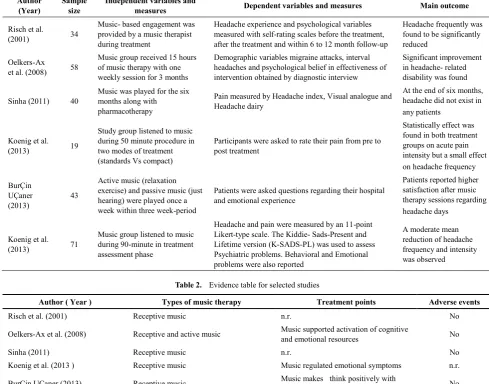
Information about music therapy as an adjuvant intervention for primary headache is presented in Table 1 and 2.
Table 1. Evidence table for selected studies Author
(Year) Sample size Independent variables and measures Dependent variables and measures Main outcome
Risch et al.
(2001) 34
Music- based engagement was provided by a music therapist during treatment
Headache experience and psychological variables measured with self-rating scales before the treatment, after the treatment and within 6 to 12 month follow-up
Headache frequently was found to be significantly reduced
Oelkers-Ax
et al. (2008) 58
Music group received 15 hours of music therapy with one weekly session for 3 months
Demographic variables migraine attacks, interval headaches and psychological belief in effectiveness of intervention obtained by diagnostic interview
Significant improvement in headache- related disability was found
Sinha (2011) 40 Music was played for the six months along with pharmacotherapy
Pain measured by Headache index, Visual analogue and Headache dairy
At the end of six months, headache did not exist in any patients
Koenig et al.
(2013) 19
Study group listened to music during 50 minute procedure in two modes of treatment (standards Vs compact)
Participants were asked to rate their pain from pre to post treatment
Statistically effect was found in both treatment groups on acute pain intensity but a small effect on headache frequency
BurÇin UÇaner
(2013) 43
Active music (relaxation exercise) and passive music (just hearing) were played once a week within three week-period
Patients were asked questions regarding their hospital and emotional experience
Patients reported higher satisfaction after music therapy sessions regarding headache days
Koenig et al.
(2013) 71
Music group listened to music during 90-minute in treatment assessment phase
Headache and pain were measured by an 11-point Likert-type scale. The Kiddie- Sads-Present and Lifetime version (K-SADS-PL) was used to assess Psychiatric problems. Behavioral and Emotional problems were also reported
A moderate mean reduction of headache frequency and intensity was observed
Table 2. Evidence table for selected studies
Author ( Year ) Types of music therapy Treatment points Adverse events
Risch et al. (2001) Receptive music n.r. No
Oelkers-Ax et al. (2008) Receptive and active music Music supported activation of cognitive and emotional resources No
Sinha (2011) Receptive music n.r. No
Koenig et al. (2013 ) Receptive music Music regulated emotional symptoms n.r.
BurÇin UÇaner (2013) Receptive music Music makes think positively with induction of relaxation No
Koenig et al. (2013) Receptive and active music Music increased physical perception and expression No
n.r.; not reported
receptive music; just hearing active music; client makes music
4. Discussion
The experience of headache and its management are major issues in clinical practice. It is prudent to manage headache and relevant problems when they are deemed significant. Some patients may wish to avoid treating their headache with drugs (e.g. analgesics) which can compromise quality of life due to their side effects. Hence, it is a general recommendation to consider the potential adverse effects of pharmacological treatment. Music has been proven as a valuable complementary modality in clinical situations to reduce the frequency and severity of headache, and limit reliance on medications. Music can be effective not only for headache management but also for improvement of quality of life. A reasonable interpretation is that music influences the mind and body with reducing blood pressure, heart rate,
stress, depression, and anxiety levels among patients. Additionally, it can decrease high doses of some drugs which most commonly associated with adverse effects. [34, 35] Moreover, being a noninvasive, inexpensive, and non-time-consuming intervention, music provides its specialized using as a complementary technique in a therapeutic setting.
To our knowledge, there are not many studies taking into account the effect of music therapy on primary headaches. The mechanisms of the relationship between music therapy and headache problems are not yet fully understood. This first review aimed to improve our understanding of headache disabilities to scrutinize the possible role of music therapy in headache management.
between control and experimental group, and also there is not enough description of experimental design in some studies. Another limitation, concerns about no mention of reliability and validity for the scales used for assessment of headache and several measures were patients’ self-reported which could have affected some response bias in terms of researchers’ presence. Moreover, it is a limitation that there is allowance of self-selection of music in one study which could potentially have produced a biased change scores. Therefore, to avoid accepting a false hypothesis, enough attention should be paid to these restrictions in future research.
It may seem straightforward that there is abundance great number of studies on primary headache management but specific information regarding the relationship between primary headache management and music therapy is scarce. Hence, future studies should consider measurements of headache and music in patients using valid and reliable interventions in order to describe more details of the relationship. Overall, due to the complexity of variety of music experiences (e.g., active music making vs. receptive music listening), [36] further studies are needed to explore the types of music, optimum duration, and dose of the music with best impact on individuals’ treatment. The body of knowledge in this area would benefit to develop strategies to promote headache management of techniques.
5. Conclusions
By analyzing qualified studies, it can be concluded that music as a simple and straightforward approach has numerous profound effects not only in headache management but also for social effects with having a large emotional component. These effects may have important implementation for the use of music therapy for headache rehabilitation in people needs to be considered carefully.
ACKNOWLEDGEMENTS
The authors would like to thank Shiraz University of Medical Sciences, Shiraz, Iran, Center for Development of Clinical Research of Nemazee Hospital and Dr. Nasrin Shokrpour for editorial assistance.
REFERENCES
[1] Tarek, A. Ghonemy, Hala, M. Allam, Amir, M. Elokely, Yosef, A. Kardy, & Hesham, M. Omar. Chronic pain in hemodialysis patients: Role of bone mineral metabolism.
Alexandria Journal of Medicine. 2016; 52, 337-34.
[2] Kroenke K., Krebs EE., Bair MJ. Pharmacotherapy of chronic pain: a synthesis of recommendations from systematic reviews. Gen Hosp Psychiatry. 2009; 31: 206-19.
[3] Bonica JJ. The need of a taxonomy. Pain. 1979; 6: 247-8. [4] Yarem chuk, O., Yaremchuk. Headache among medical
students in Bukovina Region of Ukraine. Department of
Nervous Disease, Psychiatry and Medical psychology. 2017;
2(5): 176-246.
[5] Headache Classification Committee of the International Headache Society. The International Classification of Headache Disorders, 3rd edition (beta version). Cephalalgia. 2013; 33 (9):629-808.
[6] Ashina, S., & Bendtsen, L. Pathophysiology and Genetics of
Tension-Type Headache. Frist edition. Headache, Ltd. 2013.
[7] Rasmussen, Bk. Migraine and tension-type headache in a general population: precipitating factors, female hormones, sleep pattern and relation to lifestyle. Pain. 1993; 53: 6-72. [8] Bendtsen L, Jensen R. Tension-type headache: the most
common, but also the most neglected, headache disorder.
Curr Opin Neurol. 2006; 19:305-309.
[9] Jensen R., Symon D. Epidemiology of tension-type
headaches. In: Olesen J, Goadsby PJ, Ramadan N, eds. The
Headaches. 3 Ed. Philadelphia: Lippincott Williams & Wilkins; 2005: 621–624.
[10] Abu-Arafeh, RS., Sivaraman, B., Graham, C. Prevalence of headache and migraine in children and adolescents: a systematic review of population-based studies. Dev Med
Child Neural. 2012; Dec; 52: 1088-97.
[11] Lewis, DW. Headaches in children and adolescents. Curr
Probl Pediatr Adolsc Health Care. 2007, Jul; 37: 207-46.
[12] Schwartz BS., Stewart WF., Simon D., Lipton R. Epidemiology of tension-type headache. JAMA. 1998; 279: 381-383.
[13] Tajti, J., Szok, D., Csati. A., Vescel, L. Prophylactic drug treatment of migraine in children and adolescents: An update. Curr Pain Headache Rep. 2016;
DOI: 10.1007/s11916-015-0536-6.
[14] Abel, H. Migraine headaches: diagnosis and management.
Optometry. 2009; 80: 138-148.
[15] Shapiro RE: Pathophysiology and genetics of migraine and
cluster headache, in Levin M (ed): Comprehensive Review
of Headache Medicine. New York, NY, Oxford University Press. 2008; 21-38.
[16] Marisa chang, MD., Alan, M. Rapport, MD. Acute treatment of migraine headache. Techniques in Regional
Anesthesia and pain Management. 2009; 13, 9-15.
[17] Lipton, RB., Bigal ME., Kolodner K., Stewart WF., Liberman JN., Steiner TJ. The family impact of migraine: population- based studies in the USA and UK. Cephalalgia. 2003; 23(6): 429-440.
[18] Levin, M.: The international classification of headache disorders and classification and diagnosis of migraine, in
Levin M (ed): Comprehensive Review of Headache Medicine.
New York, NY, Oxford University Press, 2008, 59-72. [19] Wong, H. H., & Smith, R.G. Patterns of complementary and
alternative medical therapy use in children diagnosed with autism spectrum disorders. Journal of Autism Development
[20] Chlan, L. A. Single session of music therapy decreased anxiety and improved relaxation in adult who required mechanical ventilation. Evidence-Based nursing. 1999; 2, 49. [21] Chlan, L.L., Engeland, w., C., Anthony, A., Guttormson, J. Influence of music on the stress response in patients receiving mechanical ventilatory support: A Pilot study.
American Journal of critical care, 2007; 16, 141-145.
[22] Wigram, T., Pedersen, I.N., & Bonde, L., O. A comprehensive Guide to Music therapy: theory, clinical
Practice, Research and Training. Jessica Kingsley
Publishers, London and Philadelphia. 2002.
[23] McCaffrey R. Music listening, its effects in creating a healing environment. Journal of Psychosocial Nursing. 2008; 46(10): 39-44.
[24] Haas F, Distenfeld S, Axen K. Effects of perceived musical rhythm on respiratory pattern. Journal of Apply Physiology. 1986; 6: 1185-91.
[25] Watkins GR. Music therapy: proposed physiological mech- anisms and clinical implication. Clinical Nurse Specialist. 1997; 11: 43-50.
[26] L. Ripley, G. Christopoulos, T.T. Michael, M. Alomar, B.V. Rangan, M. Roesle, et al., Randomized controlled trial on the impact of music therapy during cardiac catheterization on reactive hyperemia index and patient satisfaction: the Functional Change in Endothelium after Cardiac Catheterization, with and without Music Therapy (FEAT) study, J. invasive Cardiol. 26 (9); 2014.437e442.
[27] Chlan, L. Integrating nonpharmacological, adjunctive interventions into critical care practice: A means to humanize care? American Journal of Critical Care. 2002; 11, 1416.
[28] Risch, M., Scherg, H., & Verres R. Music therapy for chronic headaches. Evaluation of music therapeutic groups for patients suffering from chronic headaches. Schmerz. 2001; 15: 116-125.
[29] Koenig, J., kaess, M. Oelkers-AX , R., Parzer, P., Lenzen, C., Hillecke, Tk., et al. Recurrent Primary headache in adolescence-pilot study on music therapeutic interventions. J
pain. 2013; 52 (3): 285-91.
[30] Oelkers-AX, R., Leins, A., Parzer. P., Hillecke, T., Balay, HV., Fischer, J., et al. Butterbur root extract and music therapy in the prevention of childhood migraine: an explorative study. Eur J Pain. 2008; Apr, 12 (13): 301-13. [31] Sinha, V., Gurnani, K.C. Role of Music Therapy in Tension
Headache. Asian Journal of psychiatry. 2011; S1-S3. [32] Uçaner, B. Therapy-Related Views of Patients with
Headache Undergoing Therapy with Turkish Music. RMJ. 2013; 8-21.
[33] Koenig, J., Oelkers-Ax, R., Kaess, M., Parzer, P., Lenzen, C., Hillecke, TK., et al. Specific music therapy techniques in the treatment of primary headache disorders in adolescents: a randomized attention-placebo-controlled trial. J pain. 2013; Oct, 14 (10): 1196-207.
[34] Borczon, R.M. Developing decision making skills with the psychiatric client: A cognitive-behavioral approach utilizing song analysis. MUSIC Therapy Regional
Conference, Seatle, WA. 1995.
[35] Tan, X., Yowler, C.J., Super, D. M., & Fratinne, R. B. The efficacy of music therapy protocols for decreasing pain, anxiety, and muscle tension levels during burn dressing changes: A prospective randomized crossover trial. Journal
of Burn Care & Research. 2010; 31, 590-597.
[36] Robb, S.L., Hanson-Abromeit, D., May, L., Hernandez-Ruiz, E., Allison, M., Beloat, A., et al. Reporting quality of music intervention research in healthcare: A systematic review.