Available Online at www.ijpret.com 1368
INTERNATIONAL JOURNAL OF PURE AND
APPLIED RESEARCH IN ENGINEERING AND
TECHNOLOGY
A PATH FOR HORIZING YOUR INNOVATIVE WORK
CLOUD COMPUTING DATA SECURITY: A REVIEW
POONAM M. UMBARKAR1, M. A. KALYANKAR2
1.M.E. Department of Computer Science & Engineering, KGIET, Amravati, India. 2.Professor, Department of Computer Science& Engineering, KGIET, Amravati, India.
Accepted Date: 05/03/2015; Published Date: 01/05/2015
Abstract: The ever-growing computing and networking technologies today are enabling a fundamental paradigm shift in how people deploy and deliver computing services: computing outsourcing. While moving data and computing services to the cloud a like infrastructures promises to provide unprecedented benefits like ubiquitous network access, rapid resource elasticity, minimal management overhead, etc., it simultaneously deprives users of direct control over the systems that manage their data and applications, raising security and privacy the primary obstacles to the public cloud adoption. So Data security is one of the biggest concerns in adopting Cloud computing. In Cloud environment, users remotely store their data and relieve themselves from the hassle of local storage and maintenance. However, in this process, they lose control over their data. Existing approaches do not take all the facets into consideration viz. dynamic nature of Cloud, computation & communication overhead etc. In this paper, we propose Data Storage Security by using Trusted Platform Module to achieve storage correctness incorporating Cloud’s dynamic nature while maintaining low computation and communication cost and ensure the security of static data.
Keywords:Cloud computing, Encryption/decryption service
Corresponding Author: MS. POONAM M. UMBARKAR
Access Online On:
www.ijpret.com
How to Cite This Article:
Poonam M. Umbarkar, IJPRET, 2015; Volume 3 (9): 1368-1376
Available Online at www.ijpret.com 1369 INTRODUCTION
In recent years, cloud computing fig 1 has become a hot topic in the global technology industry. The initiatives include Google’s research project for building an infrastructure to support research needs of top-tier American universities. Weiss noted that cloud computing services include several existing computing technologies, such as service-oriented utility computing, grid computing with large amount of computing resources, and that using data centres for data storage services[1].
Several trends are opening up the era of Cloud Computing, which is an Internet-based development and use of computer technology. The ever cheaper and more powerful processors, together with the software as a service (SaaS) computing architecture, are transforming data centres into pools of computing service on a huge scale. The increasing network bandwidth and reliable yet flexible network connections make it even possible that users can now subscribe high quality services from data and software that reside solely on remote data centres[2]
Prior to the development of the concept of cloud computing Fig 1 critical industrial data was stored internally on storage media, protected by security measures including firewalls to prevent external access to the data and including organizational regulations to prohibit unauthorized internal access. In the cloud computing environment, storage service providers must have in place data security practices to ensure that their clients’ data is safe from unauthorized access and disclosure. More importantly, the regulations and measures for preventing privileged users such as system administrators from unauthorized access must be rigorously established and implemented.[1]
Fig.1 Cloud computing
Available Online at www.ijpret.com 1370
additional encryption, but if the storage and encryption of a given user’s data is performed by the same service provider, the service provider’s internal staff (e.g., system administrators and authorized staff) can use their decryption keys and internal access privileges to access user data. From the user’s perspective, this could put his stored data at risk of unauthorized disclosure.[1]
I. CLOUD COMPUTING
The term cloud has been used historically as a metaphor for the Internet. This usage was originally derived from its common depiction in network diagrams as an outline of a cloud, used to represent the transport of data across carrier backbones (which owned the cloud) to an endpoint location on the other side of the cloud. This concept dates back as early as 1961,when Professor John McCarthy suggested that computer time-sharing technology mightlead to a future where computing power and even specific applications might be sold through a utility-type business model. This idea became very popular in the late 1960s, but by the mid-1970s the idea faded away when it became clear that the IT-related technologies of the day were unable to sustain such a futuristic computing model. However, since the turn of the millennium, the concept has been revitalized. It was during this time of revitalization that the term cloud computing began to emerge in technology circles.[8]
II. LAYERS OF CLOUDS
A. Infrastructure-as-a-Service(IaaS)—the Infrastructure services layer:
Available Online at www.ijpret.com 1371 B. Platform-as-a-Service (PaaS)—the Platform layer:
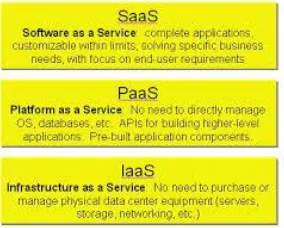
This layer provides a platform for creating applications. PaaS solutions are essentially development platforms for which the development tool itself is hosted in the Cloud and accessed through a browser. With PaaS, developers can build Web applications without installing any tools on their computers and then deploy those applications without any specialized systems administration skills. Today, PaaS is being delivered like a utility say, water or electricity over the Internet, with ISVs and corporate IT departments, paying according to usage. Owing to PaaS, there has been a jump in the number of people who can develop, maintain and deploy web-based applications without requiring specialized expertise. An example of PaaS is Microsoft’s Azure, which the company is providing as a cutting-edge cloud-based platform on which applications can be built.[9]
Fig. 3 Layers of clouds
C. Software-as-a-Service (SaaS)—the Application layer:
Available Online at www.ijpret.com 1372
Server 2008 R2), it is becoming increasingly affordable for enterprises. A more recent, architecturally new concept in Cloud computing is the hybrid Cloud, which is a blend of the public and private Cloud. The hybrid Cloud, created by the enterprise, can leverage the benefits provided by both public and private Clouds. However, issues related to the sharing of responsibilities between the enterprise and the third party vendor and governing such a Cloud, make it a slightly complex deployment option.[9]
III. DEPLOYMENT MODES IN CLOUD
There are four types of cloud available in cloud computing i.e. private cloud, public cloud, hybrid cloud and community cloud.
A) Private cloud: The cloud infrastructure is provisioned for exclusive use by a single organization comprising multiple consumers (e.g. business units).[10] It may be owned, managed, and operated by the organization, a third party, or some combination of them, and it may exist on or off premises.[6]
B) Public cloud: The cloud infrastructure is provisioned for open use by the general public.[10] It may be owned, managed, and operated by a business, academic, or government organization, or some combination of them. It exists on the premises of the cloud provider [6].
C) Community cloud: The cloud infrastructure is provisioned for exclusive use by a specific community of consumers from organizations that have shared concerns (e.g., mission, security requirements, policy, and compliance considerations) [6]. It may be owned, managed, and operated by one or more of the organizations in the community, a third party, or some combination of them, and it may exist on or off premises.
D) Hybrid cloud: Hybrid cloud infrastructure is a composition of two or more distinct cloud infrastructures (private, community, or public) that will be unique entities, but bound together by standardized technology that enables data and application portability (e.g., cloud bursting for load balancing between clouds) [6],[10].
V.OVERVIEW OF CLOUD COMPUTING
Available Online at www.ijpret.com 1373
computing that describe and differentiate Cloud services from conventional computing approaches:
Self Service
Firstly On-demand self-service involves customers using a web site or similar control panel interface to provision computing resources such as additional computers, network bandwidth or user email accounts, without requiring human interaction between customers and the vendor.
Network Access
Secondly broad network access enables customers to access computing resources over networks such as the Internet from a broad range of computing devices such as laptops and smart phones.
Resource Pooling
Thirdly Resource pooling involves vendors using shared computing resources to provide cloud services to multiple customers. Virtualization and multitenancy mechanisms are typically used to both segregate and protect each customer and their data from other customers, and to make it appear to customers that they are the only user of a shared computer or software application.
Rapid elasticity
Rapid elasticity enables the fast and automatic increase and decrease to the amount of available computer processing, storage and network bandwidth as required by customer demand.
Pay-per-use
Lastly Pay-per-use measured service involves customers only paying for the computing resources that they actually use, and being able to monitor their usage. This is analogous to household use of utilities such as electricity.[12]
VI. INCREASING THE CLOUD SECURITY
Available Online at www.ijpret.com 1374
issues that are now high priority. A number of TCG technologies and standards, including the Trusted Platform Module (TPM), network security, and self-encrypting drives can be used to provide security for systems, networks, and data. TCG also is addressing how to interface various technical standards to create an end-to-end enterprise solution that is tailored to meet mission and business needs and comply with security policies within public and private cloud networks. TPM (Trusted Platform Module) is a computer chip (microcontroller) that can securely store artifacts used to authenticate the platform (your PC or laptop). These artifacts can include passwords, certificates, or encryption keys. A TPM can also be used to store platform measurements that help ensure that the platform remains trustworthy. Authentication (ensuring that the platform can prove that it is what it claims to be) and attestation (a process helping to prove that a platform is trustworthy and has not been breached) are necessary steps to ensure safer computing in all environments [13].
VII. CONCLUSION
In this paper, Cloud Computing is an emerging commercial infrastructure paradigm that promises to eliminate the need for maintaining expensive computing hardware. As market grows the threat on data also grows. In this paper we have proposed a model which helps to use trusted platform module widely for the security of cloud storage. We have design a new trust model which uses TPM store encrypted data to the cloud, which is unprofitable to the other users. The data will be safe in the public cloud also. Kerberos is the secure method to authenticating requests for any service, is used to authenticate users to the trusted gateway. In TPM access to keys, data or systems is often protected and requires authentication by presenting a password
ACKNOWLEDGMENT
I express my sincere gratitude to Prof. V. P. Nikam, Head Department of CSE, for his valuable guidance and advice. Also I would like to thanks to my guide Prof. M. A. Kalyankar and the faculty members for their continuous support and encouragement.
REFERENCES
Available Online at www.ijpret.com 1375
2. Cong Wang, Qian Wang, and KuiRen, Wenjing Lou,” Ensuring Data Storage Security in Cloud Computing”
3. AviKak Lecture 8: AES: The Advanced Encryption Standard Lecture Notes on “Computer and Network Security”
4. Dieter Gollmann (2006). Computer Security Second Edition West Sussex, England: John Wiley &Sons, Ltd.
5. Williamson, August 10, 1976. Diffie, W.; Hellman, M. (1976). "New directions in cryptography"(http://www-ee.stanford.edu/%7Ehellman/publications/24.pdf). IEEE Transactions on Information Theory 22 (6):644–654. doi:10.1109/TIT.1976.1055638 (http://dx.doi.org/10.1109%2FTIT.1976.1055638).
6. Bhavna Makhija, Vinit Kumar Gupta, Indrajit Rajput,” Enhanced Data Security in Cloud Computing with Third Party Auditor” proceeding of the , February 2013 International Journal of Advanced Research in Computer Science and Software Engineering.
7. Qian Wang, Student Member, IEEE, Cong Wang, Student Member, IEEE, KuiRen, Member, IEEE, Wenjing Lou, Senior Member, IEEE, and Jin Li” Enabling Public Auditability and Data Dynamics for Storage Security in Cloud Computing”
8. John W. Rittinghouse, James F. Ransome© 2010 by Taylor and Francis Group, LLC CRC Press is an imprint of Taylor & Francis Group, an Informa business” Cloud Computing Implementation, Management, and Security”
9. http://www.microsoft.com/india/msindia/perspective/interfaces_cloud_three_layers.aspx
10.Cong Wang, Qian Wang, KuiRen, and Wenjing Lou, Privacy-Preserving Public Auditing for Data Storage Security in Cloud Computing‖ in IEEE INFOCOM 2010, San Diego, CA, March 2010.
11.Ashish Bhagat, Ravi Kant Sahu “Using Third Party Auditor for Cloud Data Security: A Review” International Journal of Advanced Research in Computer Science and Software Engineering Volume 3, Issue 3, March 2011.
Available Online at www.ijpret.com 1376