Investigating Predictors of High School Students’ Negative
Attitudes Towards Learning English by Developing,
Validating, and Running a Questionnaire
1Atefeh Ghaedsharafi2, Mortaza Yamini3, & Farzaneh Dehghan4
Received: 27/08/2018 Accepted: 10/05/2019
Abstract
The purpose of this study was to explore the predictors of negative attitudes towards learning English from L2 learners’ points of view. A mixed methods research approach was adopted with a sequential exploratory design, followed by an endorsement phase. Eighteen high school students in Fars province (Iran) were interviewed on the sources of negative attitudes towards learning English. Based on the interviews, a questionnaire was developed and pilot-tested. Results of exploratory factor analysis (EFA) showed 6 latent variables: materials, difficulty of learning English, affective factors, teaching methodology, school policy, and learning environment. Questionnaire was administered to 980 high school students. Through a confirmatory factor analysis (CFA) and simple linear regression, we found that the variable materials was the best predictor of negative attitudes. Then, came the variable affective factors that predicted negative attitudes better than the variables teaching methodology and learning environment, and the least predicting variable was difficulty of learning English.
Keywords: Confirmatory Factor Analysis (CFA); Learning English; Mixed Methods
Approach; Negative Attitudes
1Please cite this paper as follows:
Ghaedsharafi, A., Yamini, M., & Dehghan, F. (2019). Investigating predictors of high school students’ negative attitudes towards learning English by developing, validating, and running a questionnaire. Journal of Research in Applied Linguistics, 10(2), 136-158.
2Department of English Language, Qeshm Branch, Islamic Azad University, Qeshm, Iran; [email protected]
3Corresponding author, English Department, Zand Institute of Higher Education, Shiraz, Iran; [email protected]
1. Introduction
Attitudes, according to Allport (1935), can be defined as “a mental and neural state of readiness, organized through experience, exerting a directive or dynamic influence upon the individual’s response to all objects and situations with which it is related,” (p. 810). Because attitude is an evaluative reaction to objects or environmental factors it can be affirmative or negative (Bogardus, 1931; Gardner, 1985). Attitudes towards a language reflect the perception about the linguistic ease or difficulty of that particular language and, thus, contributes to the simplicity or difficulty of learning (Richards, Platt, & Platt, 1992). L2 students’ attitudes can be an obstacle if they believe that they are unable to learn the L2 successfully (Lennartsson, 2008). In L2 learning, attitude can be of two different types: educational and social. Educational attitudes refer to a set of beliefs L2 learners hold towards the teachers, the course, materials, learning the language, and so on. The second type involves attitudes towards the L2 community, the social aspect, and the cultural implication of SLA (Gardner, 1985). As research in the first area has shown more correlation with achievement than the latter, the present study concerned itself with the first type.
Negative attitudes do not form by accident, “but have some reasons for emergence” (Ata, 2015, p. 65). There are various factors that can affect L2 learners’ attitudes towards learning an L2 (Baker, 1985). These factors and their relationship to learning EFL have been studied by many scholars. However, to the best knowledge of the authors, almost no studies have sought EFL learners’ own points of view regarding the sources of their negative attitudes towards learning English. Hence, the present study was an attempt in this respect. In other words, the main objective of the study was to explore sources that make the Iranian EFL learners hold negative attitudes towards learning English, though they have been reported to have high degrees of instrumental motivation and are aware of the role of English as a useful, practical, and international language (Aliakbari & Monfared, 2014; Mehrpour & Vojdani, 2012; Rahimi & Hasani, 2012; Rashidi, Rahimi, & Alimorad, 2014; Vaezi, 2008). A second objective of the present study was to develop a questionnaire on the sources of negative attitudes towards learning English based on the qualitative exploration into the learners’ perceptions and the endorsement of the newly developed questionnaire with a large sample to study the predictors of negative attitudes towards learning English.
2. Literature Review
outcome. It was proposed that unsuccessful learning achievement promotes negative attitudes and negative attitudes cause lower achievement; further, this causal relationship was supported by some empirical studies (Burstall, 1975; Hermann, 1980; Smith, 1971; Watson & Clark, 1984). Language attitudes have been the center of attention in L2 studies throughout the years and researchers have tried to investigate attitudes from different aspects. Numerous researchers have investigated the influence of attitudes on language learning and found attitudes and motivation as crucial factors in successful language learning (Bagheri & Andi, 2015; Fakeye, 2010; Gardner & MacIntyre, 1993; Lightbown & Spada, 1993; Petrides, 2006). Additionally, many studies have revealed that attitudes are related strongly to motivation, so L2 learners with negative attitudes towards the L2 may not be motivated L2 learners (Burden, 2004; Dörnyei & Schmidt, 2001; Katz, 1960; Wilhelm, 1999). A large body of research has targeted the relationship between attitudes and other variables, revealing that attitudes towards L2 study are significantly related to world-mindedness and social distance (Sakuragi, 2006), and there is a positive relationship between L2 learners’ beliefs about language learning and their attitudes towards their teachers (Tavassoli & Kasraeean, 2014); however, a low correlation between achievement and instrumental motivation was reported by Genc and Aydin (2017), arguing that there was not a significant correlation between the learners’ attitudes and achievement variables, even though almost all the participants indicated a positive attitude towards learning the English language; they suggested that the factors that affected the learners’ attitudes in the processes of language learning should be taken into account.
Aydin, 2017; Henter, 2014; Nahavandi & Mukundan, 2013; Tahaineh & Dana, 2013; Zaire & Elakaei, 2012) have mostly relied on ready-made questionnaires that may not include many context-specific sources of negative attitudes. Therefore, there is a need to develop questionnaires based on L2 learners’ perceptions in order to explore factors contributing to negative attitudes towards learning English.
3. Methodology
This study was a mixed methods approach with a sequential exploratory design in which qualitative data collection and analysis was followed by an instrument development and endorsement phase.
3.1. Qualitative Phase
The aim of this phase of the study was to explore the sources of negative attitudes towards learning English held by high schoolers of Fars province as an EFL setting.
3.1.1. Instrument
The main data collection instrument applied in this stage of the study was unstructured interview. Based on the nature of this method of data collection, neither the questions nor the answer categories were predetermined (Minichiello, Aroni, Timewell, & Alexander, 1990). The interviews started with an open-ended question and other questions were made spontaneously.
3.1.2. Participants
Some high school students from some regions of Fars province (Shiraz, Zarghan, and Marvdasht) took part in the study. The regions were selected based on convenient sampling, but in each region, the high schools and students were selected randomly. They were from public schools including both girls and boys, with the age span of 15 to 18. They were in grades 9-12, with different English proficiency levels, but they all studied the same series of English textbooks for 2 hr a week from grade 7 onwards.
3.1.3. Data collection
recorded with the participants’ permission. They were ensured about the confidentiality of their identity and anonymity of the gathered information. In order to interview the participants, the parents’ permission was assured by the high school principals.
3.1.4. Data analysis
The first step in the data analysis was to transcribe the interviews. Once this was done, an inductive coding system was employed (Ary, Jacob, & Sorensen, 2010) to extract any sources for negative attitudes. Then, the related codes were categorized and some themes were identified.
3.2. Quantitative Phase
The quantitative phase was conducted in two stages: the pilot and main studies. In the following sections, the full description of these phases is presented. 3.2.1. Pilot study
Based on the emerging themes in the qualitative phase, which was itself based on a review of the literature, a pool of items was developed, including items related to each theme. Then, this newly made questionnaire was piloted before being applied in the main phase. It was carried out with 417 high school students (61% female & 39% male) in Shiraz, Borazjan, and Bushehr. The participants were from public high schools, with an age range of 15 to 18. They were in grades 9-12, studying the same series of English textbooks since grade 7 for 2 hr per week.
Table 1. KMO and Bartlett’s Test
Kaiser-Meyer-Olkin Measure of Sampling Adequacy .88 Bartlett’s Test of Sphericity Approx. Chi-Square df 3833.3 465
Sig. .00
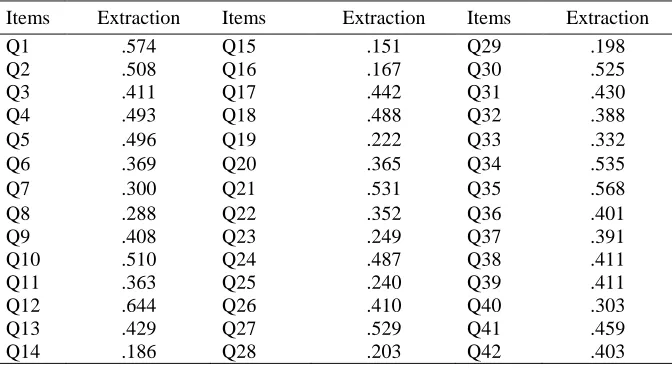
In order to extract the items that shared low amount of variance with other variables, the results of communalities were considered. The minimum requirement for loading, a value of 0.3, was considered (Yamini & Rahimi, 2007). Consequently, 9 items were deleted due to their low loading factors (see Table 2):
Table 2. Communalities
Items Extraction Items Extraction Items Extraction
Q1 .574 Q15 .151 Q29 .198
Q2 .508 Q16 .167 Q30 .525
Q3 .411 Q17 .442 Q31 .430
Q4 .493 Q18 .488 Q32 .388
Q5 .496 Q19 .222 Q33 .332
Q6 .369 Q20 .365 Q34 .535
Q7 .300 Q21 .531 Q35 .568
Q8 .288 Q22 .352 Q36 .401
Q9 .408 Q23 .249 Q37 .391
Q10 .510 Q24 .487 Q38 .411
Q11 .363 Q25 .240 Q39 .411
Q12 .644 Q26 .410 Q40 .303
Q13 .429 Q27 .529 Q41 .459
Q14 .186 Q28 .203 Q42 .403
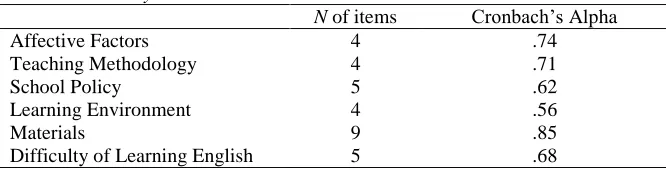
The scree plots, as the most common approach to decide the number of factors, were generated (Jain & Shandliya, 2013) and, finally, six factors or latent constructs were extracted: (1) affective factors (items # 35, 34, 24, & 36); (2) teaching methodology (items # 1, 2, 5, & 3); (3) school policy (items # 41, 42, 39, 40, & 20); (4) learning environment (items # 22, 32, 38, & 37); (5) materials (items # 31, 30, 33, 9, 10, 18, 13, 21, & 17); and (6) difficulty of learning English (items # 6, 12, 7, 27, & 4). The results of the rotated component matrix are presented Appendix A. The items were rated on a 5-point Likert scale, ranging from 1 (Strongly Disagree), 2 (Disagree), 3 (Undecided), 4 (Agree), to 5 (Strongly Agree).
Table 3. Reliability Indices
N of items Cronbach’s Alpha
Affective Factors 4 .74
Teaching Methodology 4 .71
School Policy 5 .62
Learning Environment 4 .56
Materials 9 .85
Difficulty of Learning English 5 .68
3.2.2. Main study
After establishing the validity and reliability of the newly made questionnaire, it was administered in the main phase of the study.
3.2.2.1. Instrument
The validated questionnaire was applied as the instrument of this phase of the study with 31 Likert-type items. It was in Persian so that its administration to the Iranian students at different levels of language proficiency would be easier.
3.2.2.2. Participants
The sample comprised 980 high school students (59.8% females & 40.2% males), ranging in age from 15 to 18. From different regions of Fars province, five regions including Shiraz, Zarghan, Marvdasht, Lar, and Darb were selected based on convenient sampling, but the state high schools in each region and the classes at each high school were selected at random. The participants’ age, gender, background, and location were not considered in the data analysis, so they were assumed as a homogenous group with regard to their age, textbooks, English teaching methodology, and types of schools.
3.2.2.3. Data collection
To gather the data, the students received enough explanation about the nature and purpose of the study and were asked to complete the questionnaire anonymously in order to increase accuracy in collecting the data. No time limit was considered to give the participants enough time to reflect on the questions.
3.2.2.4. Data analysis
represent their attitudes towards learning English). Then, simple linear regression was applied to find out the weighting of those factors that significantly predict negative attitudes towards learning English
4. Results
The qualitative phase of the study yielded a pool of items reflecting the causes of negative attitudes. Piloting the items, six latent variables were determined through EFA: materials, affective factors, school policy, learning environment, teaching methodology, and difficulty of learning English. The variable materials refers to the course books the students study at high schools in Iran; the variable affective factors reflects the learners’ feeling to the teachers, classmates, and class environment (Ripple, 1965); the variable school policy refers to the principles and procedures adopted by high schools in the process of teaching and learning English (ET 2020 Working Group Schools, 2018); the variable learning environment is physical, psychological, and instructional atmosphere (learning environment in the classroom: Definition, impact, & importance.), but physical atmosphere was not considered in the current study; the variable teaching methodology refers to the procedures of teaching as well as the principles underlying them (Richards & Schmidt, 2002); and the variable difficulty of learning English reflects the challenges the Iranian students face due to the nature of the English language.
The descriptive statistics of the participants’ scores from the questionnaire administration in the main study is presented in Table 4:
Table 4. Descriptive Statistics of Learners’ Scores From the New Questionnaire
N Minimum Maximum Mean Std. Deviation
Grades 980 42.00 150.00 90.10 18.84
4.1. Confirmatory Factor Analysis (CFA)
In order to perform CFA, Lisrel 8.8 was utilized. The factor structures from EFA including the observed variables and unobserved constructs were tested by sets of specific indexes (criteria) to determine model fitting. Chi-squared test (χ2), root mean square error of approximation (RMSEA), goodness-of-fit statistic (GFI), comparative fit index (CFI), and incremental fit indices (IFI) were considered to determine the fitness between the proposed model with 31 items and the gathered data. As the chi-square value represents the difference between the observed covariance matrix and the model covariance matrix (Moss, 2016), the higher it is (from zero), the worse it will be.
researchers, ranging from less than 2 (Ullman, 2001, as cited in Moss, 2016) to less than 5 (Schumacker & Lomax, 2016). CFI greater than or equal to .90 and an RMSEA less than or equal to .06 are indicative of a good-fitting model (Bentler & Hu, 1999, as cited in Huber, 2011). The results indicate that the model with six factors and 31 items fit the data, as the chi-square/df value (1218.21/413) is 2.94, less than 3, p < 0.001, with the fit indices of NFI = .96, CFI = .97, and RMSEA = .04. Table 5 provides a summary of the estimated fit indices of the mode:
Table 5. Good-of-Fit Indices for the Model
Fit Indices Values Criteria
Chi-Square (χ²) 1218.21 -
df 413 -
χ²/df 2.94 < 5
(p-Value) 0.00 < 0.001
RMSEA 0.04 < 0.06
Goodness Fit Index (GFI) 0.94 ≥ 0.90
Comparative Fit Index (CFI) 0.97 ≥ 0.90
Incremental Fit Index (IFI) 0.98 ≥ 0.90
Figure 1. Results of Confirmatory Factor Analysis (CFA): t Values
Note. TEM= Teaching Methodology, MAT= Materials, LEAE = Learning Environment, SCHP = School Policy, LE = Difficulty of Learning English, AFF= Affective Factors
4.2. Correlation and Regression Analyses
Because the aim of the data analyses in this section was to find out how the latent variables predict negative attitudes towards learning English, we decided to separate the participants holding negative attitudes from the ones with positive attitudes with respect to their scores on the questionnaire. To this end, the median of the scores was considered as the measure of central tendency; the scores higher than the median were considered to reflect positive attitudes and the ones lower than the median were taken to be indicative of negative attitudes. Accordingly, 483 students had negative attitudes, 476 students held positive attitudes, and the learners with scores equal to the median were regarded as neutral (see Table 6). So, the correlational and regression analyses were performed for 476 students:
To determine the degree of the going-togetherness of the total score and the factors causing negative attitudes towards learning English, correlational analyses were run. Table 7 reveals the results of the correlational analyses:
Table 7. Correlation Between Learners’ Total Scores and Factors Causing Negative Attitudes
Mat. Diff. Lear. Eng.
Aff. Factors
Teach. Meth.
School policy
Lear. Envi.
Grade
Pearson
Correlation .67
** .57** .55** .37** .22** .38**
Sig. (2-tailed) .00 .00 .00 .00 .00 .00
N 483 483 483 48 483 483
**Correlation is significant at the 0.01 level (2-tailed).
Note. Mat. = Materials, Diff. Lear. Eng. = Difficulty of Learning English, Aff. Factors = Affective Factors, Teach. Meth= Teaching Methodology, Lear. Envi.= Learning Environment
To interpret the results of the correlational analyses, Cohn’s conventions (Pallant, 2007) were considered. Based on the result of the correlational analysis (see Table 7), the variable school policy had a low correlation with the total score, so it was not entered into the regression analysis. The coefficients of regression analysis are presented in Table 8. The Sig. column tells which independent variable (i.e., materials, teaching methodology, difficulty of learning English, learning environment, and affective factors) can predict the variance in the dependent variance (i.e., negative attitudes). Beta value indicates weighting of the variables in predicting the variance (Yamini & Rahimi, 2007) in negative attitudes. Accordingly, the best predictor of negative attitudes is the variable materials, the variable affective factors predict negative attitudes better than the variables teaching methodology and learning environment, and the last variable is difficulty of learning English:
Table 8. Coefficients in Regression Analysis in Predicting Negative Attitude From Six Factors as Its Sources
Model Unstandardized
Coefficients
Standardized
Coefficients t Sig.
B Std.
Error Beta
Material 1.02 .03 .50 33.00 .00
Attitudes N Minimum Maximum Mean
Std. Deviation Negative Attitudes 483 42.00 89.00 74.77 10.66 Positive Attitudes 476 91.00 150.00 105.67 11.59
Difficulty of
Learning English 0.82 .04 .30 19.93 .00
Affective Factors 1.14 .04 .34 25.87 .00
Learning.
Environment 0.97 .04 .30 21.61 .00
Teaching Methodology 0.97 .05 .30 21.30 .00
a. Dependent Variable: Grades
5. Discussion
To explore the causes of negative attitudes towards learning English, a questionnaire was developed quantifying negative attitudes towards learning English. It had already been reported that the Iranian students were well motivated to learn English (Aliakbari & Monfared, 2014; Chalak & Kassaian, 2010; Mehrpour & Vojdani, 2012; Rahimi & Hasani, 2012; Rashidi, Rahimi, & Alimorad, 2014; Vaezi, 2008), and that in Iran English has been receiving increasing attention as a language of communication, technology, and science (Sadeghi & Richards, 2016; Zarrabi & Brown, 2015). Therefore, the developed questionnaire was specifically based on the factors causing negative attitudes in the process of learning English in Iran, disregarding motivational or social factors. This aspect together with the fact that the questionnaire was exclusively based on the learners’ perceptions may distinguish the developed questionnaire from other similar questionnaires that did not include context-specific sources of negative attitudes.
Based on the EFA results, six factors of materials, affective factors, teaching methodology, difficulty of learning English, learning environment, and school policy were found as the sources of negative attitudes in the process of language learning. Some of these factors have been pointed out by other studies as the sources of attitudes towards learning English (Kashef, Khorasani, & Zahabic, 2014; Khosroshahi, 2013; Tsuda, 2003).
many other factors during the process of teaching and learning; they may force a teaching method and cause inappropriate learning environment and, consequently, negative affective factors.
Regarding the importance of materials, Rahimi and Hassani (2012) state that students’ ideas towards their EFL textbooks are mostly ignored, even though they are the final users of the materials. These researchers claimed that the Iranian high school learners in Iran believe that in developing EFL materials, their goals and needs are not taken into account. Similarly, Khosroshahi (2013) confirmed that EFL textbooks are the predictors of attitudes towards learning English.
The second factor recognized by the participants as the predictor of negative attitudes was the variable affective factors. As mentioned earlier, by affective factors, we mean L2 learners’ feeling to the teachers, classmates, and class environment while learning the L2. Many researchers have emphasized the importance of L2 learners’ feeling and its association with attitude and L2 learning (Baker, 1988; Gardner, 1985; Stern, 1983). Aragão (2011) claims that L2 learners’ beliefs about their performance, teachers, and classmates influence their feelings of shyness and embarrassment that affect their behavior in the classroom. Pekrun (2000) argues that feelings and emotions are the result of L2 learners’ evaluation of particular situations in the process of learning. Gardner, Clément, Smythe, and Smythe (1979) developed some items to estimate class anxiety as part of their test battery on attitudes and motivation. Therefore, it can be concluded that L2 learners’ feeling while learning the L2 influence their attitudes. Furthermore, Stern (1983) highlighted the importance of affective factors when he said that affect and cognition have an equal position in the process of L2 learning.
The variables learning environment and teaching methodology that were found in this study as the sources of negative attitudes have also been reported by other researchers. Kashef, Khorasani, and Zahabi (2014) have confirmed the effect of instruction on L2 students’ attitudes towards English. Gardner (1985) believes that if teachers are skilled and the teaching method is informative and interesting, this can awaken positive attitudes, regardless of the learner’s initial attitudes, positive or negative. Moreover, Cook (1996) argues that the way L2 students are treated, the language used by the teachers, the materials, methods, and the environment where the language is used all affect L2 learners’ attitudes towards a particular language. Tsuda (2003) emphasizes that it is crucial to offer L2 learners a less painful environment where teachers and students share a place to apply English for communication and ease L2 learners’ mind from making mistakes.
English can be difficult for the Iranian students. Schwarz and Terrill (2000) state that if English language learners’ written language is non-Latin alphabet, learners face some challenges due to lack of similarity of the language to English in sound, symbols, and phonological/orthographic structure, so the learners cannot learn the word-sound paired-associations rapidly and it decreases their ability to decode and encode word/sound pairs and causes failure in the initial stages of learning (Krug, Shafer, Dardick, Magalis, & Parent, 2002; Wold, 2006). Furthermore, many researchers have confirmed that a fast decoding ability has a positive and significant relationship with comprehension skills (Bowey, 2004; Kendeou, Broek, White, & Lynch, 2009; Perfetti & Hogaboam, 1975). English and Persian are different in many areas of syntax, posing challenges to Iranian students, as well. Consequently, the variable difficulty of learning English causes some Iranian learners experience failure that induces negative attitudes (Burstall, 1975; Hermann, 1980; Wold, 2006).
L2 learning is a complex process. It is difficult and time-consuming to change attitudes; therefore, it is preferred to form a positive attitude towards L2s as early as possible (Henter, 2014). Factors inducing negative attitudes can be considered by English teachers, materials developers, and school managers to provide the learners with an appropriate environment to learn English efficiently, but detecting the most inhibiting factors during the process of language learning in each context can be more practical for educational planners, policymakers, and syllabus designers to make vital decisions in promoting positive attitudes towards learning English.
6. Conclusion
suggested that future studies be carried out to investigate the sources of negative attitudes in different contexts (e.g., private language institutes, different socioeconomic districts, etc.) in Iran because the results of the present study may not be generalizable to other contexts. Also, interested researchers can investigate the relationship and/or effects of the identified sources of negative attitudes with other individual and contextual variables.
References
Ahmed, S. (2015). Attitudes towards English language learning among EFL learners at Umskal. Journal of Education and Practice, 6(18), 6-16.
Aliakbari, M., & Monfared, M. (2014). Iranian students’ beliefs and motivations towards English. Procedia ̶ Social and Behavioral Sciences, 98(6), 200-206. Allport, G.W. (1935). Attitudes. In A handbook of social psychology (pp. 798-844).
Worcester, MA: Clark University Press.
Aragão, R. (2011). Beliefs and emotions in foreign language learning. System, 39(3), 302-313.
Ary, D., Jacobs, L.C., & Sorensen, C. (2010). Introduction to research in education (8th ed.). Belmont, California and United Kingdom: Wadsworth.
Ata, A. W. (2015). Knowledge, education, and attitudes of international students to IELTS: A case of Australia. Journal of International Students, 5(4), 488-500. Bagheri, M., & Andi, T. (2015). The relationship between medical students’ attitude
towards English language learning and their English language proficiency. ICT & Innovations in Education—International Electronic Journal, 3(1), 7-19.
Baker C. (1985). The Jordanian secondary stage students’ achievement in reading comprehension according to their views towards learning English as a foreign language. Journal of Human Sciences, 42, 1-36.
Baker, C. (1988). Key issues in bilingualism and bilingual education. Clevedon, Avon: Multilingual Matters.
Bonyadi, A., & Zeinalpur, S. (2014). Perceptions of students towards self-selected and teacher assigned topics in EFL writing. Procedia ̶ Social and Behavioral Sciences, 98(2014), 385-391.
Bowey, J. A. (2004). Contextual facilitation in children’s oral reading in relation to grade and decoding skill. Elsevier Journal of Experimental Child Psychology, 40(1), 23-48.
Breer, P. A., & Locke, E. A. (1965). Task experience as a source of attitudes. Homewood, Illinois: The Dorsey Press.
Burden, P. (2004). An examination of attitude change towards the use of Japanese in a university English conversation class. RELC, 35(1), 21-36.
Burstall, C. (1975). Primary French in the balance. Educational Research, 17(3), 193-198.
Chalak, A., & Kassaian, Z. (2010). Motivation and attitudes of Iranian undergraduate EFL students towards learning English. GEMA Online Journal of Language Studies, 10(2), 29-55.
Chang, Y. (2010). Students’ perceptions of teaching styles and use of learning strategies. Retrieved June 10, 2018, from the World Wide Web: https://trace.tennessee.edu/utk_gradthes/782
Chen, L., Chen, T. L., & Chen, N. S. (2015). Students’ perspectives of using cooperative learning in a flipped statistics classroom. Australasian Journal of Educational Technology, 31(6), 621-640.
Cook, V. (1996). Second language learning and language teaching. London: Arnold. Dörnyei, Z., & Schmidt, R. (2001). Motivation and second language acquisition. University of Hawaii, Manoa: Second Language Teaching & Curriculum Center.
ET 2020 Working Group Schools 2016-18. Teachers and school leaders in schools as learning organizations: Guiding Principles for policy development in school education. Retrieved June 10, 2018, from the World Wide Web: https://ec.europa.eu/education/sites/education/files/teachers-school-leaders-g-0917_en.pdf
Fakeye, D. (2010). Students’ personal variables as correlates of academic achievement in English as a second language in Nigeria. Journal of Social Sciences, 22(3), 205-211.
FaramarzZadeh, R. (2016). EFL learners’ attitudes and perceptions about an effective English language teacher. Journal of Applied Linguistics and Language Research, 3(2), 148-156.
Gardner, R. C., Clément, R., Smythe, P. C., & Smythe, C. L. (1979). The attitude/motivation test battery-revised manual (Research Bulletin No. 15). London, Ontario: University of Western Ontario, Language Research Group. Gardner, R. C., & Lambert, W. E. (1972). Attitudes and motivation in
second-language learning. Rowley, MA: Newbury House Publishers.
Gardner, R. C., & MacIntyre, P. D. (1993). On the measurement of affective variables in second language learning. Language Learning, 43(2), 157-194.
Genc, S. Z., & Aydin, F. (2017). An analysis of learners’ motivation and attitudes toward learning English language at tertiary level in Turkish EFL context. English Language Teaching, 10(4), 35-44.
Gorjian, B., & Aghvami, F. (2017). The comparative study of EFL teachers and learners’ perceptions on the importance of teaching culture. Journal of Applied Linguistics and Language Learning, 3(3), 71-78.
Henter, R. (2014). Affective factors involved in learning a foreign language. Procedia ̶ Social and Behavioral Sciences, 27, 373-378.
Hermann, G. (1980). Attitudes and success in children’s learning of English as a second language: The motivational vs. the resultative hypothesis. English Language Teaching Journal, 34(4), 247-254.
Huber, A. J. (2011). Effective strategy implementation: Conceptualizing firms’ strategy implementation capabilities and assessing their impact on firm performance. Wiesbaden: Gabbler.
Jain, P. M., & Shandliya, V. K. (2013). A survey paper on comparative study between principal component analysis (PCA) and exploratory factor analysis (EFA). International Journal of Computer Science and Applications, 6(2). Retrieved June 10, 2018, from the World Wide Web: www.researchpublications.org Jannati, M., & Marzban, A. (2015). Iranian EFL learners’ perception of learning
environment in English language institutes and its relationship with learners’ English proficiency. Journal of Applied Linguistics and Language Research, 2(3), 23-38.
Kashef, S. H., Khorasani, R., & Zahabic, A. (2014). Investigating the effect of a learning-centered instruction on non-English major students’ attitudes toward English course. Procedia ̶ Social and Behavioral Sciences, 98, 859-863. Katz, D. (1960). The functional approach to the study of attitudes. Public Opinion
Kendeou, P., van den Broek, P., White, M. J., & Lynch, J. S. (2009). Predicting reading comprehension in early elementary school: The independent contributions of oral language and decoding skills. Journal of Educational Psychology, 101(4), 765-778.
Khosroshahi, M.S. (2013). Iranian EFL learners’ perceptions with respect to tasks in comparison with the actual content of the textbooks. Theory and Practice in Language Studies, 3(1), 163-174.
Kitao, K., & Kitao, S. K. (1997). Selecting and developing teaching/learning materials. The Internet TESL Journal, 4(4), 20-45.
Kline, R. B. (2011). Principles and practice of structural equation modelling (3rd ed.). New York: Guilford Press.
Krug, K., Shafer, T., Dardick, W., Magalis, C., & Parente, R. (2002). A test of foreign language acquisition: Paired-association learning. Applied Cognitive Psychology, 16(2), 211-221.
Lennartsson, F. (2008). Students’ motivation and attitudes towards learning a second language: British and Swedish students’ points of view. Retrieved June 10, 2018, from the World Wide Web: https://pdfs.semanticscholar.org/3d32/add6 be74 4691e17f4c2abbdfa49b34955676.pdf
Lightbown, P., & Spada, S. (1993). How languages are learned. Oxford: Oxford University Press.
Mehrpour, S., & Vojdani, M. (2012). Globalization and EFL learning motivation: A new perspective on integrative vs. instrumental motivation among Iranian learners of English. Open Journal of Modern Linguistics, 2, 43-50.
Minichiello, V., Aroni, R., Timewell, E., & Alexander, L. (1990). In-depth interviewing: Researching people. Hong Kong: Longman Cheshire Pty Limited
Moss, S. (2016). Fit indices for structural equation modeling. Retrieved June 10, 2018, from the World Wide Web: https://www.sicotests.com/psyarticle.as p?id=277
Nahavandi, N., & Mukundan, J. (2013). Iranian EFL engineering students’ motivational orientations towards English language learning along gender and further education in language institutes. International Journal of Linguistics, 5(1), 72-93.
Pekrun, R. (2000). A social-cognitive, control-value theory of achievement emotions. Amsterdam, NL: Elsevier Science B.V.
Perfetti, C., & Hogaboam, T. (1975). The relationship between single-word decoding and reading comprehension skill. Journal of Educational Psychology, 67(4), 461-469.
Petrides, J. R. (2006). Attitudes and motivation and their impact on the performance of young English as a foreign language learner. Language Learning Journal, 5(1), 1-20.
Rahimi, M., & Hassani, M. (2012). Attitude towards EFL textbooks as a predictor of attitude towards learning English as a foreign language. Procedia ̶ Social and Behavioral Sciences, 31, 66-72.
Rashidi, N., Rahimi, M., & Alimorad, Z. (2014). Iranian university English learners’ discursive demotivation construction. Iranian Journal of Language Teaching Research, 2(2), 35-49.
Richards, J. C., Platt, J., & Platt, H. (1992). Longman dictionary of language teaching and applied linguistics (2nd ed.). Essex, UK: Longman Publishers.
Richards, J. C., & Schmidt, R. W. (2002). Longman dictionary of language teaching and applied linguistics (3rd ed.). London: Longman Group.
Ripple, R. E. (1965). Affective factors in the classroom. Educational Leadership, 22(7), 476-480
Sadeghi, K., & Richards, J.C. (2016). The idea of English in Iran: An example from Urmia. Journal of Multilingual and Multicultural Development, 37(4), 419-434. Sakuragi, T. (2006). The relationship between attitudes toward language study and
cross-cultural attitudes. International Journal of Intercultural Relations, 30(1), 19-31.
Schumacker, R. E., & Lomax, R.G. (2016). A beginner’s guide to structural equation modeling (4th ed.). New York: Routledge Taylors & Francis.
Schwarz, R., & Terrill, L. (2000). Adult English language learners and learning disabilities. Retrieved June 10, 2018, from the World Wide Web: http://www.cal.org/caela/esl_resources/collections/ld.html
Smith, A. N. (1971). The importance of attitude in foreign language learning. The Modern Language Journal, 55(2), 82-88.
Tahaineh, Y., & Daana, H. (2013). Jordanian undergraduates’ motivations and attitudes towards learning English in EFL context. International Review of Social Sciences and Humanities, 4(2), 159-180.
Tavassoli, A., & Kasraeean, A. (2014). The relationship between students’ beliefs about language learning and their attitudes towards their teachers. Journal of Studies in Learning and Teaching English, 2(6), 25-47.
Torshizi, M. D., & Torshizi, M. D. (2016). Learners’ perception of differences between language learning in high school and private language institute. International Journal of Applied Linguistics & English Literature, 5(1). Retrieved June 15, 2018, from the World Wide Web: http://dx.doi.org/10.7575/aiac.ijalel.v.5n.1p.33
Tsuda, S. (2003). Attitudes toward English language in higher education in Japan (2): Raising awareness of the notion of global English. Intercultural Communication Studies, XII(3), 61-75
Vaezi, Z. (2008). Language learning motivation among Iranian undergraduate students. World Applied Sciences Journal, 5(1), 54-61.
Watson, D., & Clark, L. A. (1984). Negative affectivity: The disposition to experience negative aversive emotional states. Psychological Bulletin, 96, 465-490.
Wilhelm, K. H. (1999). Collaborative dos and don’ts. TESOL Journal, 8, 14-19. Wold, J. B. (2006). Difficulties in learning English as a second or foreign language.
Retrieved June 19, 2018, from the World Wide Web: https://epublications.regis. edu/cgi/viewcontent.cgi?Article=1333&context= theses
Yamini, M., & Rahimi, M. (2007). A guide to statistics and SPSS for research in TEFL, linguistics, and related disciplines. Shiraz: Kooshamehr.
Zarrabi, F., & Brown, J. R. (2015). English language teaching and learning analysis in Iran. International Scholarly and Scientific Research & Innovation, 9(10), 3485-3493.
Zarei, A. A., & Elakaei, A. (2012). Motivation and attitude as predictors of learner autonomy. Prime Research on Education, 2(9), 353-364.
Appendix A
Rotated Component Matrix of the Questionnaire
Component
1 2 3 4 5
4- I do not understand the meaning of English sentences
that is why I do not learn English language grammar. .702
10- I could not pronounce English words correctly, consequently I could not ask my questions with ease in English classes, and I did not learn English.
.701 30-The Grammar of school English Language books is
very difficult. .689
18- Despite knowing the meaning of English words and
grammar, I do not understand the concept of sentences. .653
17- Learning the meaning of English words is difficult for
me. .643
13- I cannot identify verbs, subjects and objects… in an
English sentence. .636
21-The English language class is stressful for me. .593
27- I was interested in learning English at first, but over
time due to lack of learning, I lost my interest. .569
9- In school English books, the lessons get really difficult immediately after teaching letters and sounds, consequently it caused me not to learn English well.
.568 7- I can make progress in learning English by studying
School English books (reversed). .519
31- The concept of School English books is vague, so I
have problem in learning English. .496
33- The Materials of School English books is too much, there is not enough time to review, so I did not learn English.
.485 6- I like Arabic language more than English language.
.482 Affe ctiv e Fa cto rs
35- English language teachers compared me to higher level students in English language and it was annoying to me.
.741 34-Because my English teachers blamed me for my
mistakes, I hated the English language. .694
24-when I answered an English exercise incorrectly, and the teacher asked the students who were at higher levels in English to explain the correct answer; I felt humiliated.
.652 36-The speed of teaching English was synchronized with
the students’ speed of learning who were at a higher level in English, and it did not lead to learning.
.580 Te a ch in g m eth o d o lo g y
1- Teaching English alphabet letters and sounds are well
done at Iranian schools.(Reversed) .764
2- At schools great emphasis is put on reading English
words and texts correctly .(Reversed) .751
5-Th methodology of teaching English at schools is very
good and it is conducive to learning.(Reversed) .682
3-The English exam level coordinated with the Materials taught, so better learning was conducted at schools. .(Reversed)
S ch o o l p o li cy
41- If more attention were paid to conversation in teaching the English language at schools, I would be more interested in the English language.
.693 42- If, images, films or poetry were used to present
English language lessons, I would be more interested in English language.
.676 39-If teaching the English language began from
elementary schools, the intensity of Materials would be reduced (during each course) and I learnt English language better.
.629
40-If English language teachers explained the Materials
in English, it would help me a lot learn English better. .587
20- If English language teachers reviewed the Materials continuously, I learned the English language better.
.404 Le a rn in g e n v iro n m en
t 22-Students’ English language level is the same at schools, so better learning takes place. (Reversed) .644 32-Examples of English grammar are insufficient in
school textbooks to learn languages.
.612 38- English teachers in schools in terms of knowledge and
the correct pronunciation of words are in a very good level, so it has increased my motivation in learning English.
.602
37-Our teachers had a lot of enthusiasm and passion for teaching, that's why I am eager to learn it more. (Reversed)
.564
Appendix B
Rotated Component Matrix of the First Factor to Find Subfactors
1 2
Ma
te
ria
ls
31- The concept of School English books is vague, so I have problem in learning it.
.724
30-The Grammar of school English Language books is very difficult. .722
33- Because the Materials of School English books were too much, there was not enough time to review them, that’s why I have never
learned English.
.664
9- In School English books, after teaching alphabet and words, the Materials getting hard, so it caused me not to learn the English language well.
.644
10- I could not translate English words correctly, so I could not ask my questions with ease in English classes that is why I did not learn
English language.
.586
18- Despite knowing the meaning of English words and grammar, I do not understand the concept of sentences.
.578
13- I cannot identify verbs, subjects and objects… in an English
sentence.
.569
17- Learning the meaning of English words is difficult for me. .495
Difficul
ty
o
f
Le
a
rn
in
g
E
n
g
li
sh
6- I like Arabic language more than English language. .722
12- Learning English is difficult for me. .632
7-- I can make progress in learning English by studying School English
books. (reversed) .609
27- I was interested in learning English at first, but over time due to
lack of learning I lost my interest. .575
4- I do not understand the meaning of English sentences that is why I do