Mathematics Interdisciplinary Research (MIR) publishes quality original research papers and survey articles in Interdisciplinary Mathematics that are of the highest possible quality. The editorial board of this journal comprises experts from around the world. The papers in the relationship between two different scientific disciplines are of high interest for MIR. The research papers and review articles are selected through a normal refereeing process by a member of editorial board. A paper acceptable for publication must contain non-trivial mathematics with clear applications to other parts of science and engineering. MIR motivates authors to publish significant research papers, which are of broad interests in Applications of Mathematics in Science. Two issues in one volume are published every year.
Aims and Scope: MIR contains research articles in the form of expository papers, original scientific article, short communications on important mathematical problems of basic sciences and letter to the editor. The submission of a paper implies that the author(s) assurance that it has not been copyrighted, published, or submitted for publication elsewhere. All accepted papers in MIR will be checked against plagiarism by iThenticate.
Preparation of Manuscripts: An abstract of 150 words or less and keywords clarifying the subject of the manuscripts are required. Authors should submit the paper via our online system at mir.kashanu.ac.ir. All correspondence has to be sent to the address [email protected].
The language of the journal is English. Authors who are less familiar with English language are advised to seek assistance from proficient scholars to prepare manuscripts that are grammatically and linguistically free from errors. Papers submitted for consideration for publication have to be prepared concisely and must not exceed 60 typewritten pages, (font 12, double spacing, including tables & graphs).
Photographs must be printed on contrasted glossy paper and have sharp outlines. Diagrams and figures should be submitted as original drawings. Figures and tables are to be numbered in the sequence in which they are cited in the manuscript. Every table and figure must have a caption that explains its content. Tables and diagrams are to be prepared in separate pages and placed at the end of the manuscript.
References to the literature should be numbered in square brackets in the order in which they appear in the text. A complete list of references should be presented in numerical order at the end of the manuscript. References to journals, books, proceedings and patents must be presented in accordance with the following examples:
Journals: I. Gutman, B. Zhou, B. Furtula, The Laplacian-energy like invariant is an energy like invarint, MATCH Commun. Math. Comput. Chem. 64(1) (2010) 85-96.
Book: A. A. Ungar, Beyond the Einstein Addition Law and its Gyroscopic Thomas Precession: The Theory of Gyrogroups and Gyrovector Spaces, Volume 117 of Fundamental Theories of Physics, Kluwer Academic Publishers Group, Dordrecht, 2001.
Book Chapter: T. Suksumran, The algebra of gyrogroups: Cayley’s theorem, Lagrange’s theorem and isomorphism theorems, in: Essays in Mathematics and its Applications: In Honor of Vladimir Arnold, T. M. Rassias, P. M. Pardalos (Eds.), Springer, New York, 2016.
Patents: H. S. Primack, Method of Stabilizing Polyvalent Metal Solutions, U.S. patent No. 4, 373, 104 (1983). Proofs and Reprints:
Ali Reza Ashrafi
Department of Pure Mathematics, Faculty of Mathematical Sciences, University of Kashan, Kashan
87317-53153, I. R. Iran
E-mail: [email protected]
Director-in-Charge:
Majid Monemzadeh
Department of Particle Physics and Gravity, Faculty of Physics, University of Kashan, Kashan
87317-53153, I. R. Iran
E-mail: [email protected]
Executive Manager:
Fatemeh Koorepazan-Moftakhar
Department of Pure Mathematics, Faculty of Mathematical Sciences, University of Kashan, Kashan
87317-53153, I. R. Iran
E-mail: [email protected]
Language Editor:
Seyfollah Mosazadeh
Department of Pure Mathematics, Faculty of Mathematical Sciences, University of Kashan, Kashan
87317-53153, I. R. Iran
E-mail: [email protected]
Editorial Board
Ali Reza Ashrafi
University of Kashan, I. R. Iran
E-mail: [email protected]
Seyed Morteza Babamir
University of Kashan, I. R. Iran
E-mail: [email protected]
Alain Bretto
Universite de Caen, France
E-mail: [email protected]
Bijan Davvaz
Yazd University, I. R. Iran
E-mail: [email protected]
Mircea V. Diudea
Babes-Bolyai University, Romania
E-mail: [email protected]
Tomislav Došlić
University of Zagreb, Croatia
E-mail: [email protected]
Wiesław A. Dudek
Wrocław University of Technology, Poland
E-mail: [email protected]
Changiz Eslahchi
Shahid Beheshti University, I. R. Iran
E-mail: [email protected]
Gholam Hossein FathTabar
University of Kashan, I. R. Iran
Mohammad Ali Iranmanesh
Yazd University, I. R. Iran
E-mail: [email protected]
Gyula O. H. Katona
Alfréd Rényi Institute of Mathematics, Hungary
E-mail: [email protected]
G. Ali Mansoori
University of Illinois at Chicago, USA
E-mail: [email protected]
Majid Monemzadeh
University of Kashan, I. R. Iran
E-mail: [email protected]
Sirous Moradi
Arak University, I. R. Iran
E-mail: [email protected]
Ottorino Ori
Actinum Chemical Research, Italy
E-mail: [email protected]
Abbas Saadatmandi
University of Kashan, I. R. Iran
E-mail: [email protected]
Ruggero Maria Santilli
The R. M. Santilli Foundation, USA
E-mail: [email protected]
Yongtang Shi
Nankai University, P. R. China
E-mail: [email protected]
Abraham A. Ungar
North Dakota State University, USA
E-mail: [email protected]
Hassan Yousefi-Azari
University of Tehran, I. R. Iran
E-mail: [email protected]
Janez Žerovnik
University of Ljubljana, Slovenia
E-mail: [email protected]
Editorial Office:
Department of Pure Mathematics, Faculty of Mathematical Sciences, University of Kashan, Ravand
Boulevard, Kashan 87317-53153, I. R. Iran
Special Issue: Gyrogroups, Gyrovector Spaces
and their Applications
Volume 1, Issue 1, Winter 2016, Page 1-272
Contents
Pages
Abraham A. Ungar's Autobiography
Abraham A. Ungar
1
The Intrinsic Beauty, Harmony and Interdisciplinarity in Einstein Velocity Addition
Law: Gyrogroups and Gyrovector Spaces
Abraham A. Ungar
5
Special Subgroups of Gyrogroups: Commutators, Nuclei and Radical
Teerapong Suksumran
53
Gyroharmonic Analysis on Relativistic Gyrogroups
Milton Ferreira
69
Bi-Gyrogroup: The Group-Like Structure Induced by Bi-Decomposition of Groups
Teerapong Suksumran; Abraham A. Ungar
111
Normed Gyrolinear Spaces: A Generalization of Normed Spaces Based on
Gyrocommutative Gyrogroups
Toshikazu Abe
143
Gyrovector Spaces on the Open Convex Cone of Positive Definite Matrices
Sejong Kim
173
An Extension of Poincare Model of Hyperbolic Geometry with Gyrovector Space
Approach
Mahfouz Rostamzadeh; Sayed-Ghahreman Taherian
187
The Principle of Relativity: From Ungar’s Gyrolanguage for Physics to Weaving
Computation in Mathematics
Françoise Chatelin
199
From the Lorentz Transformation Group in Pseudo-Euclidean Spaces to
Bi-Gyrogroups
Abraham A. Ungar
Abraham A. Ungar’s Autobiography
Abraham A. Ungar
?Abstract
This autobiography presents the scientific living of Abraham Ungar and his role in Gyrogroups and Gyrovector spaces.
Keywords: Gyrogroup, Gyrovector space.
2010 Mathematics Subject Classification: Primary 20E07; Secondary 20N05, 20B35.
Figure 1: Abraham Ungar at 2016.
Abraham Ungar is professor in the Department of Mathematics at North Dakota State University. After gaining his B.Sc. (1965) and M.Sc. (1967) from
?Corresponding author (E-mail: [email protected]) Academic Editor: Ali Reza Ashrafi
Received 15 01 2016, Accepted 15 01 2016 DOI: 10.22052/mir.2016.12632
c
the Hebrew University in Pure Mathematics and Ph.D. (1973) from Tel-Aviv Uni-versity in Applied Mathematics, he held a postdoctoral position at the UniUni-versity of Toronto (1974). Ungar moved from Toronto to Pretoria where he held the position of a senior research officer at the National Research Institute for Math-ematical Sciences of the Council for Scientific and Industrial Research (CSIR) in 1975-1977. From Pretoria Ungar moved to Grahamstown, South Africa, where he held the position of a lecturer and a senior lecturer at Rhodes University (1978-1983). From Grahamstown Ungar moved to Vancouver, where he held the position of a visiting associate professor at Simon Fraser University (1983-1984). Finally, in 1984 Ungar has accepted the position of an associate professor at North Dakota State University in Fargo, North Dakota, where he presently holds the position of a professor.
Ungar’s favored research areas are related to hyperbolic geometry and its ap-plications in relativity physics. He currently serves on the editorial boards of Mathematics Interdisciplinary Research, ofJournal of Geometry and Symmetry in Physics, and ofCommunications in Applied Geometry.
When Ungar was a young, undergraduate student he was fascinated by the bijective correspondence between the field of complex numbers and the Lorentz transformation group of special relativity theory in one time and one space di-mensions. He was aware of the result that the field of complex numbers does not admit extension to a field of higher than two dimensions while, in contrast, the Lorentz group admits extensions to one time and several space dimensions. Un-gar, therefore, felt that the transition of the Lorentz group from one time and one space dimensions, where it is closely related to the field of complex numbers, to one time and two space dimensions is a mystery to be conquered. Hence, later young student Ungar was not surprised to discover in the literature that a new phenomenon comes into play in the above mentioned transition of the Lorentz group. The new phenomenon, which deeply attracted Ungar’s attention, turned out to be the peculiar space rotation known in special relativity theory asThomas precession.
Naturally, many explorers were fascinated by the relativistic Thomas preces-sion. However, the elegant structure that Thomas precession encodes could not be decoded for a long time, being locked by complexity. Indeed, the hopeless status of Thomas precession that existed before Ungar’s 1988 discovery is well described by Herbert Goldstein in his bookClassical Mechanics(Addison-Wesley, 1980, pp. 285-286):
com-plexity, while the result obtained has important applications in many areas of modern physics. What is involved is a phenomenon known as theThomas precession.
Herbert Goldstein, Classical Mechanics In 1988 Ungar expressed the Lorentz group parametrically in terms of rela-tivistically admissible velocities and orientations in an article titledThomas Ro-tation and the Parametrization of the Lorentz Transformation Group. The group structure of the resulting parametric realization of the Lorentz group, along with Einstein velocity addition law, enabled Ungar to discover the rich structure that Thomas precession possesses in terms of Einstein addition.
Revealing its underlying structure, Ungar was able to extend Thomas preces-sion by abstraction, calling the abstract Thomas precespreces-sionsgyrations. It turned out that gyrations are automorphisms that regulate Einstein addition in the sense that the seemingly structureless, noncommutative, nonassociative Einstein addi-tion is, in fact, a gyrocommutative, gyroassociative binary operaaddi-tion in a gyro-commutative gyrogroup and in a gyrovector space. The ugly duckling of relativity physics, Thomas precession, thus became the beautiful swan called, in gyrolan-guage, gyration.
The resulting emergence of the gyrogroup and the gyrovector space structures, along with their application in the hyperbolic geometry of Lobachevsky and Bolyai and in the special relativity theory of Einstein, is unfolded by Ungar in the follow-ing expository article titled:
The Intrinsic Beauty, Harmony and Interdisciplinarity
in Einstein Velocity Addition Law: Gyrogroups and Gyrovector Spaces.
Yet, the rich structure of Einstein addition and the interdisciplinarity of gy-rogroups and gyrovector spaces that Ungar has exposed is still far from being exhausted, as the articles of the present special issue of the Journal demonstrate. Abraham A. Ungar
The Intrinsic Beauty, Harmony
and Interdisciplinarity in
Einstein Velocity Addition Law:
Gyrogroups and Gyrovector Spaces
Abraham A. Ungar
⋆Abstract
The only justification for the Einstein velocity addition law appeared to be its empirical adequacy, so that the intrinsic beauty and harmony in Einstein addition remained for a long time a mystery to be conquered. Ac-cordingly, the aim of this expository article is to present (i) the Einstein relativistic vector addition, (ii) the resulting Einstein scalar multiplication, (iii) the Einstein relativistic mass, and (iv) the Einstein relativistic kinetic energy, along with remarkable analogies with classical results in groups and vector spaces that these Einstein concepts capture in gyrogroups and gy-rovector spaces. Making the unfamiliar familiar, these analogies uncover the intrinsic beauty and harmony in the underlying Einstein velocity addition law of relativistically admissible velocities, as well as its interdisciplinarity. Keywords: Einstein addition, gyrogroup, gyrovector space, hyperbolic geom-etry, special relativity.
2010 Mathematics Subject Classification: 20N05, 51P05, 83A05.
1. Introduction
A major obstacle to the widespread adoption of hyperbolic geometry is its com-plexity, which contrasts the simplicity of Euclidean geometry. Hence, the mere mention of hyperbolic geometry is enough to strike fear in the heart of the under-graduate mathematics and physics student. Some regard themselves as excluded from the profound insights of hyperbolic geometry so that this enormous portion of
⋆Corresponding author (E-mail: [email protected]) Academic Editor: Ali Reza Ashrafi
Received 22 January 2016, Accepted 1 March 2016 DOI: 10.22052/mir.2016.13636
c
human achievement is a closed door to them. However, Einstein velocity addition law of relativistically admissible velocities opens that door, making the hyperbolic geometry of Lobachevsky and Bolyai accessible to a wider audience in terms of novel analogies that the modern and unknown share with the classical and familiar. Einstein velocity addition law gives rise to a binary operation in the ball of relativistically admissible velocities, calledEinstein addition. The intrinsic beauty and harmony in Einstein addition has several features, one of which is the gy-rogroup isomorphism relation it shares with Möbius addition that results from the Möbius transformation of the complex disk. Einstein introduced the relativistic velocity addition law in his 1905 paper [17] that founded the special relativity the-ory. The only justification for the Einstein velocity addition law appeared to be its empirical adequacy, so that the intrinsic beauty and harmony in Einstein addition remained for a long time a mystery to be conquered. The discovery of the intrinsic beauty and harmony in Einstein addition is an ongoing process initiated in 1988 by the discovery of the parametric realization of the Lorentz transformation group in pseudo-Euclidean spaces of signature(1, n),n∈Nin [54], resulting in many arti-cles as well as seven related books [60,64,67,69,71,72,79], [39,40,83]. Recently, the parametric realization of Lorentz groups has been extended to pseudo-Euclidean spaces of any signature(m, n),m, n∈Nin [80].
Most texts on special relativity, with a few outstanding exceptions including [3], [24], and [41,42], present the Einstein velocity addition only for parallel velocities. In this simplified special case Einstein velocity addition is both commutative and associative. In general, however, Einstein addition of velocities that need not be parallel is neither commutative nor associative.
Einstein velocity addition law gives rise to a binary operation⊕, called Einstein addition, in the ball of all relativistically admissible velocities. Einstein addition, in turn, gives rise to the Einstein scalar multiplication ⊗. Einstein addition and scalar multiplication give rise to hyperbolic vector spaces calledgyrovector spaces. Applications of gyrogroups and gyrovector spaces are presented in many publica-tions as, for instance, in [60, 64, 67, 69, 71, 72, 79] and in [4–7, 38, 44], [15, 16], [19], [20–23], [48–52], [27], [37], [46], [81], [29] and [1, 25]. Evidently, gyrovector spaces form the algebraic setting for analytic hyperbolic geometry, just as vector spaces form the algebraic setting for analytic Euclidean geometry.
2. Einstein Addition
Letc >0 be an arbitrarily fixed positive constant and letRn = (Rn,+,·)be the
Euclidean n-space, n ∈ N, equipped with the common vector addition, +, and inner product,·. The home of alln-dimensional Einsteinian velocities is thec-ball
Rnc ={v∈Rn:kvk< c} (1) of its ambient spaceRn. Thec-ballRn
c is the open ball of radiusc, centered at the
origin ofRn, consisting of all vectorsvin Rn with magnitudekvksmaller thanc.
Einstein velocity addition is a binary operation, ⊕, in thec-ballRn
c given by
the equation [60], [42, Eq. 2.9.2], [34, p. 55], [24],
u⊕v= 1 1 + u·v
c2
u+ 1
γuv+
1
c2 γu
1 +γu
(u·v)u
, (2)
for allu,v∈Rn
c. Hereγv is the Lorentz gamma factor given by the equation
γv= r 1 1−kvk
2
c2
, (3)
whereu·vandkvkare the inner product and the norm in the ball, which the ball Rn
c inherits from its ambient spaceRn,kvk2=v·v. A nonempty set with a binary
operation is called agroupoidso that, accordingly, the pair(Rn
c,⊕)is anEinstein
groupoid.
In the Newtonian limit of largec,c→ ∞, the ballRnc expands to the whole of its ambient spaceRn, as we see from (1), and Einstein addition⊕in Rnc reduces to the ordinary vector addition+inRn, as we see from (2) and (3).
When the nonzero vectors u and v in the ball Rnc of Rn are parallel in Rn, ukv, that is, u=λv for someλ∈R, λ6= 0, Einstein addition (2) specializes to the Einstein addition of parallel velocities,
u⊕v= u+v 1 + 1
c2u·v
, ukv, (4)
which was partially confirmed experimentally by the Fizeau’s 1851 experiment [33]. The restricted Einstein addition in (4) is both commutative and associative. Accordingly, the restricted Einstein addition is a commutative group operation, as Einstein noted in [17]; see [18, p. 142]. In contrast, Einstein made no remark about group properties of his addition (2) of velocities that need not be parallel. Indeed, the general Einstein addition is not a group operation but, rather, a gy-rocommutative gyrogroup operation, a structure discovered more than 80 years later, in 1988 [54, 55, 58], formally defined in Section 4.
In physical applications,Rn=R3 is the Euclidean 3-space, which is the space
of all classical, Newtonian velocities, and Rn
all relativistically admissible, Einsteinian velocities. The constant crepresents in physical applications the vacuum speed of light. Since we are interested in both physics and geometry, we allownto be any positive integer.
Einstein addition (2) of relativistically admissible velocities, with n= 3, was introduced by Einstein in his 1905 paper [17] [18, p. 141] that founded the special theory of relativity, where the magnitudes of the two sides of Einstein addition (2) are presented. One has to remember here that the Euclidean 3-vector algebra was not so widely known in 1905 and, consequently, was not used by Einstein. Einstein calculated in [17] the behavior of the velocity components parallel and orthogonal to the relative velocity between inertial systems, which is as close as one can get without vectors to the vectorial version (2) of Einstein addition. Einstein was aware of the nonassociativity of his velocity addition law of relativistically admissible velocities that need not be collinear. He therefore emphasized in his 1905 paper that his velocity addition law of relativistically admissible collinear velocitiesforms a group operation [17, p. 907].
We naturally use the abbreviationu⊖v=u⊕(−v)for Einstein subtraction, so that, for instance,v⊖v=0and
⊖v=0⊖v=−v. (5)
Einstein addition and subtraction satisfy the equations
⊖(u⊕v) =⊖u⊖v (6)
and
⊖u⊕(u⊕v) =v (7)
for all u,v in the ballRn
c, in full analogy with vector addition and subtraction
in Rn. Identity (6) is called the gyroautomorphic inverse property of Einstein
addition, and Identity (7) is called theleft cancellation law of Einstein addition. We may note that Einstein addition does not obey the naive right counterpart of the left cancellation law (7) since, in general,
(u⊕v)⊖v6=u. (8)
However, this seemingly lack of a right cancellation law of Einstein addition is naturally remedied in (29) – (30), p. 14.
Einstein addition and the gamma factor are related by the gamma identity,
γu⊕v=γuγv
1 +u·v
c2
(9)
for allu,v∈Rnc.
A frequently used identity that follows immediately from (3) is
v2
c2 =
kvk2
c2 = γ2
v−1 γ2
v
Einstein addition is noncommutative. Indeed, while Einstein addition is com-mutative under the norm,
ku⊕vk=kv⊕uk, (11)
in general,
u⊕v6=v⊕u, (12) u,v∈Rn
c. Moreover, Einstein addition is also nonassociative since, in general,
(u⊕v)⊕w6=u⊕(v⊕w), (13) u,v,w∈Rn
c.
As an application of the gamma identity (9), we prove the Einstein gyrotriangle inequality (14).
Theorem 2.1. (The Gyrotriangle Inequality).
ku⊕vk ≤ kuk⊕kvk (14)
for allu,v in an Einstein gyrogroup(Rn c,⊕).
Proof. By the gamma identity (9) withuandvreplaced bykukandkvk, and by the Cauchy-Schwarz inequality [32], we have
γkuk⊕kvk=γuγv
1 + kukkvk
c2
≥γuγv1 + u·v
c2
=γu⊕v
=γku⊕vk
(15)
for allu,v in an Einstein gyrogroup(Rn
c,⊕). But γx =γkxk is a monotonically increasing function ofkxk,0≤ kxk< c. Hence (15) implies (14).
3. Einstein Addition Vs. Vector Addition
Vector addition, +, inRn is both commutative and associative, satisfying
u+v=v+u Commutative Law
u+ (v+w) = (u+v) +w Associative Law
(16)
for all u,v,w ∈Rn. In contrast, Einstein addition, ⊕, in Rn
c is neither
In order to measure the extent to which Einstein addition deviates from as-sociativity we introduce gyrations, which are self maps of Rn that are trivial in
the special cases when the application of⊕is associative. For anyu,v∈Rn c the
gyrationgyr[u,v]is a map of the Einstein groupoid(Rn
c,⊕)onto itself. Gyrations gyr[u,v] ∈ Aut(Rn
c,⊕), u,v ∈ Rnc, are defined in terms of Einstein addition by
the equation
gyr[u,v]w=⊖(u⊕v)⊕{u⊕(v⊕w)} (17) for all u,v,w ∈ Rn
c, and they turn out to be automorphisms of the Einstein
groupoid(Rn
c,⊕),gyr[u,v] :Rnc →Rnc.
We recall that an automorphism of a groupoid(S,⊕)is a one-to-one mapf ofS
onto itself that respects the binary operation, that is,f(a⊕b) =f(a)⊕f(b)for all
a, b∈S. The set of all automorphisms of a groupoid(S,⊕)forms a group, under automorphism composition, denotedAut(S,⊕). To emphasize that the gyrations of an Einstein gyrogroup(Rn
c,⊕)are automorphisms of the gyrogroup, gyrations
are also calledgyroautomorphisms.
A gyration gyr[u,v], u,v ∈ Rnc, istrivial if gyr[u,v]w =w for all w ∈ Rnc. Thus, for instance, the gyrationsgyr[0,v],gyr[v,v]andgyr[v,⊖v]are trivial, that is,
gyr[0,v] = gyr[v,0] =I gyr[v,⊖v] = gyr[⊖v,v] =I gyr[v,v] =I
(18)
for allv∈Rnc,I being the identity map, as we see from (17) and (7).
Einstein gyrations, which possess their own rich structure, measure the extent to which Einstein addition deviates from commutativity and from associativity. We see this from the gyrocommutative and the gyroassociative laws of Einstein addition in the following list of elegant identities that involve Einstein addition, ⊕, and gyrations [60, 64, 67]. For all u,v,w∈Rn
c,
u⊕v= gyr[u,v](v⊕u) Gyrocommutative Law u⊕(v⊕w) = (u⊕v)⊕gyr[u,v]w Left Gyroassociative Law (u⊕v)⊕w=u⊕(v⊕gyr[v,u]w) Right Gyroassociative Law gyr[u⊕v,v] = gyr[u,v] Gyration Left Reduction Property gyr[u,v⊕u] = gyr[u,v] Gyration Right Reduction Property gyr[⊖u,⊖v] = gyr[u,v] Gyration Even Property
(gyr[u,v])−1= gyr[v,u] Gyration Inversion Law
(19)
abstraction of the relativistic phenomenon known asThomas precession[67, Sec-tion 10.3] [74] [79, Chapter 13]. Thomas precession, in turn, is related to the mixed state geometric phase, as Lévay discovered in his work [30] which, according to [30], was motivated by the author work in [61, 62].
The left and right reduction properties in (19) present important gyration iden-tities since they trigger a remarkable reduction in complexity, as Chatelin noted in [11]. These two gyration identities are, however, just the tip of a giant iceberg. The identities in (19) and many other useful gyration identities are studied, for instance, in [60, 64, 67, 69, 71, 72, 79].
4. From Einstein Addition to Gyrogroups
Taking the key features of Einstein groupoids (Rn
c,⊕), n ∈ N, as axioms, and
guided by analogies with groups, we are led to the following formal gyrogroup definition in which gyrogroups turn out to form a most natural generalization of groups.
Definition 4.1. (Gyrogroups [67, p. 17]). A groupoid (G,⊕) is a gyrogroup if its binary operation satisfies the following axioms. In G there is at least one element,0, called a left identity, satisfying
(G1) 0⊕a=a
for alla∈G. There is an element0∈Gsatisfying axiom(G1) such that for each
a∈Gthere is an element⊖a∈G, called a left inverse ofa, satisfying
(G2) ⊖a⊕a= 0.
Moreover, for anya, b, c∈Gthere exists a unique elementgyr[a, b]c∈Gsuch that the binary operation obeys the left gyroassociative law
(G3) a⊕(b⊕c) = (a⊕b)⊕gyr[a, b]c .
The map gyr[a, b] : G → G given by c 7→ gyr[a, b]c is an automorphism of the groupoid(G,⊕), that is,
(G4) gyr[a, b]∈Aut(G,⊕),
and the automorphism gyr[a, b] of G is called the gyroautomorphism, or the gy-ration, of G generated by a, b ∈ G. The operator gyr : G×G → Aut(G,⊕) is called the gyrator of G. Finally, the gyroautomorphism gyr[a, b] generated by any
a, b∈Gpossesses the left reduction property
(G5) gyr[a, b] = gyr[a⊕b, b].
The gyrogroup axioms (G1) – (G5) in Definition 4.1 are classified into three classes:
1. The first pair of axioms,(G1)and(G2), is a reminiscent of the group axioms. 2. The last pair of axioms,(G4)and(G5), presents the gyrator axioms. 3. The middle axiom, (G3), is a hybrid axiom linking the two pairs of axioms
As in group theory, we use the notationa⊖b=a⊕(⊖b)in gyrogroup theory as well. In full analogy with groups, gyrogroups split up into gyrocommutative and non-gyrocommutative gyrogroups.
Definition 4.2. (Gyrocommutative Gyrogroups). A gyrogroup (G,⊕) is gyrocommutative if its binary operation obeys the gyrocommutative law
(G6) a⊕b= gyr[a, b](b⊕a)
for alla, b∈G.
First gyrogroup properties are studied in [72, Chapter 1], and more gyrogroup theorems are studied in [60, 64, 67]. Thus, for instance, as in group theory, any gyrogroup possesses a unique identity element, which is both left and right, and any element of a gyrogroup possesses a unique inverse, which is both left and right. In order to illustrate the power and elegance of the gyrogroup structure, we solve below the two basic gyrogroup equations (20) and (27).
Let us consider the gyrogroup equation
a⊕x=b (20)
in a gyrogroup(G,⊕)for the unknownx. Ifxexists, then by the right gyroasso-ciative law (19) we have
x=0⊕x = (⊖a⊕a)⊕x
=⊖a⊕(a⊕gyr[a,⊖a]x) =⊖a⊕(a⊕x)
=⊖a⊕b,
(21)
noting thatgyr[a,⊖a]is trivial by (18).
Thus, if a solution to (20) exists, it must be given uniquely by
x=⊖a⊕b. (22)
Conversely, ifx=⊖a⊕b, then xis indeed a solution to (20) since by the left gyroassociative law and (18) we have
a⊕x=a⊕(⊖a⊕b)
= (a⊕(⊖a))⊕gyr[a,⊖a]b =0⊕b
=b.
(23)
Substituting the solution (22) into its equation (20) and replacingaby⊖awe recover the left cancellation law (7) for Einstein addition,
The gyrogroup operation (or, addition) of any gyrogroup has an associated dual operation, called thegyrogroup cooperation (or,coaddition), which is defined below.
Definition 4.3. (The Gyrogroup Cooperation (Coaddition)). Let(G,⊕)be a gyrogroup with gyrogroup operation (or, addition)⊕. The gyrogroup cooperation (or, coaddition)⊞is a second binary operation in Ggiven by the equation
a⊞b=a⊕gyr[a,⊖b]b (25) for alla,b∈G.
Replacingb by⊖b in (25) we have thecosubtractionidentity
a⊟b:=a⊞(⊖b) =a⊖gyr[a,b]b (26) for all a,b ∈ G, noting that gyr[a,b] is an automorphism of (G,⊕) so that gyr[a,b](⊖b) =⊖gyr[a,b]b.
To motivate the introduction of the gyrogroup cooperation and to illustrate the use of the left reduction property in (19), we solve the equation
x⊕a=b (27)
for the unknownxin a gyrogroup(G,⊕).
Equation (27) results from (20) by interchanginga andx. Surprisingly, how-ever, the solution of (27) is quite different from the solution of (20), suggesting the introduction of the second binary operation, the cooperation⊞inG. We will find that Einstein coaddition,⊞, proves crucially important (i) in the understanding of Einstein addition, ⊕, inRnc in terms of analogies with vector addition in Rn, and (ii) in our mission to capture analogies with classical results.
Assuming that a solutionxto (27) exists, we have the following obvious chain of equations
x=x⊕0 =x⊕(a⊖a)
= (x⊕a)⊕gyr[x,a](⊖a) = (x⊕a)⊖gyr[x,a]a = (x⊕a)⊖gyr[x⊕a,a]a =b⊖gyr[b,a]a
=b⊟a.
(28)
the gyration left reduction property in (28) indicates the remarkable reduction of complexity that this property offers.
The gyrogroup cooperation is introduced into gyrogroups in order to capture useful analogies between gyrogroups and groups, and it results in the emergence of duality symmetries that the two gyrogroup operations,⊕and⊞, share. Thus, for instance, the gyrogroup cooperation uncovers the seemingly missing right coun-terpart of the left cancellation law (7), giving rise to the right cancellation law,
(b⊟a)⊕a=b (29)
for alla,b∈G, which is obtained by substituting the result of (28) into (27). Remarkably, the right cancellation law (29) can be dualized, giving rise to the dual right cancellation law
(b⊖a)⊞a=b. (30)
As an example, and for later reference, we note that it follows from the right cancellation law (29) that
d= (b⊞c)⊖a ⇐⇒ b⊞c=d⊞a (31) fora,b,c,din any gyrocommutative gyrogroup(G,⊕).
An elegant gyrocommutative gyrogroup identity that involves the gyrogroup cooperation, verified in [67, Theorem 3.12], is
a⊕(b⊕a) =a⊞(a⊕b). (32)
5. Émile Borel’s Dream Comes True
It is not well-known that the famous mathematician Émile Borel was interested in Einstein’s special theory of relativity, particularly in the relativistic phenomenon known as Thomas precession [79, Chapter 13] and in Einstein addition. Being noncommutative, Émile Borel considered Einstein addition as “defective”. He, therefore, proposed an alternative, commutative addition of relativistically admis-sible velocities.
The gyrocommutative law of Einstein velocity addition was already known to Silberstein in 1914 [43] in the following sense: According to his 1914 book, Silberstein knew that the Thomas precession generated byu,v∈R3c is the unique rotation that takes v⊕u into u⊕v about an axis perpendicular to the plane of u and v through an angle < π in R3, thus giving rise to the gyrocommutative
law. However, obviously, Silberstein did not use the terms “Thomas precession” and “gyrocommutative law”. These terms have been coined later, respectively, (i) following Thomas’ 1926 paper [53], and (ii) in 1991 [58,59], following the discovery of the accompanying gyroassociative law of Einstein addition in 1988 [54, 55].
a name, and Silberstein called it in his 1914 book a “certain space-rotation” [43, p. 169]. An early study of Thomas precession, made by Émile Borel in 1913, is described in his 1914 book [10] and, more recently, in [47].
The almost forgotten attempt of Émile Borel to “repair” the seemingly “defec-tive” Einstein’s velocity addition law in the years following 1912 is described by Walter in [82, p. 117]:
“Borel could construct a tetrahedron in kinematic space, and deter-mined thereby both the direction and magnitude of relative [composite] velocity in a symmetric [commutative] manner.”
Borel has, thus, “repaired” the breakdown of commutativity in Einstein addition by proposing an alternative, commutative addition. But he did not pay attention to the accompanying breakdown of associativity in Einstein addition. Accordingly, it seemed appropriate to consider the Lorentz transformation group, rather than the groupoid of Einstein addition, as a primitive notion of special relativity [63].
It turns out that Einstein coaddition is commutative. Hence. Émile Borel’s dream to construct a viable commutative relativistic velocity addition comes true with the discovery of Einstein coaddition,⊞. Unlike Borel’s commutative addition, the commutative Einstein coaddition does not replace Einstein addition. Rather, it captures analogies with classical resultsjointly with Einstein addition, as the study of the Einstein gyroparallelogram addition law in Section 6 reveals.
A gyrogroup cooperation is commutative if and only if its associated gyrogroup operation is gyrocommutative [64, Theorem 3.4] [67, Theorem 3.4]. Hence, in particular, Einstein coaddition is commutative. Indeed, Einstein coaddition,⊞, in an Einstein gyrogroup(Rn
c,⊕), abstractly defined in (25), can be manipulated in
Einstein gyrogroups, obtaining the following chain of equations [67, Eq. (3.195)],
u⊞v= γu+γv
γ2
u+γv2+γuγv(1 + u·v
s2 )−1
(γuu+γvv)
= γu+γv
(γu+γv)2−(γu
⊖v+ 1)
(γuu+γvv)
= 2⊗γuu+γvv
γu+γv
= 2⊗ γuu+γvv
2 + (γu−1) + (γv−1)
(33)
u,v∈Rn
c, demonstrating that the cooperation⊞in Einstein gyrogroups(Rnc,⊕)
is commutative.
operation in the ball. Remarkably, jointly with Einstein addition, ⊕, Einstein coaddition,⊞, gives rise to the hyperbolic parallelogram addition law in the ball. The latter is explained in Section 6 and illustrated in Figure 2.
6. From Parallelograms to Gyroparallelograms
Elements of a real inner product spaceV = (V,+,·), called points and denoted by capital italic letters,A, B, P, Q, etc, give rise to vectors inV, denoted by bold roman lowercase lettersu,v,etc. Any two ordered pointsP, Q∈Vgive rise to a unique rooted vectorv ∈V, rooted at the pointP. It has a tail at the point P and a head at the pointQ, and it has the value−P+Q,
v=−P+Q . (34)
The length of the rooted vectorv=−P+Qis the distance between the pointsP andQ, given by the equation
kvk=k −P+Qk. (35)
Two rooted vectors−P+Qand−R+S are equivalent if they have the same value, that is,
−P+Q ∼ −R+S if and only if −P+Q=−R+S (36) The relation∼in (36) between rooted vectors is reflexive, symmetric and transi-tive, so that it is an equivalence relation that gives rise to equivalence classes of rooted vectors. To liberate rooted vectors from their roots we define avectorto be an equivalence class of rooted vectors. The vector−P+Qis thus a representative of all rooted vectors with value−P+Q.
A point P ∈Vis identified with the vector−O+P, O being the arbitrarily selected origin of the space V. Hence, the algebra of vectors can be applied to points as well. Naturally, geometric and physical properties regulated by a vector space areorigin independent, that is, independent of the choice of the origin.
LetA, B, C ∈Vbe three non-collinear points, and let
u=−A+B
v=−A+C (37)
be two vectors inVthat possess the same tail,A. Furthermore, letD be a point ofVgiven by theparallelogram condition
D=B+C−A . (38)
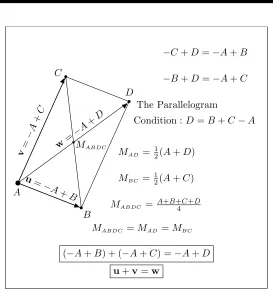
The quadrangle (also known as a quadrilateral; see [13, p. 52]) ABDC turns out to be a parallelogram in Euclidean geometry, shown in Figure 1, since its two diagonals,ADandBC, intersect at their midpoints, that is,
1
2(A+D) = 1
◮ ◮
◮
MABDC
A
B C
D
The Parallelogram
Condition :D=B+C−A
MAD =1
2(A+D) MBC= 1
2(A+C) MABDC =A+B+C+D
4
MABDC =MAD =MBC
−C+D=−A+B
−B+D=−A+C
(−A+B) + (−A+C) =−A+D
u+v=w
u= −A
+B v=
−A
+C
w= −A
+D
Figure 1: The Euclidean parallelogram and its addition law in a Euclidean vector plane (R2,+,·). The diagonals AD and BC of parallelogram ABDC intersect each other at their midpoints. The midpoints of the diagonals ADand BC are, respectively,MAD andMBC, each of which coincides with the parallelogram center MABDC. This figure sets the stage for its hyperbolic counterpart in Figure 2.
Clearly, the midpoint equality (39) is equivalent to the parallelogram condition (38).
The vector addition of the vectors uand v that generate the parallelogram
ABDC according to (37), gives the vectorw by the parallelogram addition law, shown in Figure 1,
w:=−A+D= (−A+B) + (−A+C) =u+v. (40) Here, by definition,wis the vector formed by the diagonalADof the parallelogram
ABDC, as shown in Figure 1.
Vectors in the spaceVare, thus, equivalence classes of ordered pairs of points, which add according to the parallelogram law, shown in Figure 1.
Elements of Vc, called points and denoted by capital italic letters,A, B, P, Q, etc, give rise to gyrovectors in Vc, denoted by bold roman lowercase letters u,v, etc. Any two ordered points P, Q ∈ Vc give rise to a unique rooted gyrovector v∈Vc, rooted at the pointP. It has a tail at the pointP and a head at the point
Q, and it has the value⊖P⊕Q,
v=⊖P⊕Q . (41)
The gyrolength of the rooted gyrovectorv=⊖P⊕Qis the gyrodistance between the pointsP andQ, given by the equation
kvk=k⊖P⊕Qk. (42)
Two rooted gyrovectors⊖P⊕Qand⊖R⊕Sare equivalent if they have the same value, that is,
⊖P⊕Q ∼ ⊖R⊕S if and only if ⊖P⊕Q=⊖R⊕S (43) The relation ∼ in (43) between rooted gyrovectors is reflexive, symmetric and transitive, so that it is an equivalence relation that gives rise to equivalence classes of rooted gyrovectors. To liberate rooted gyrovectors from their roots we define a gyrovectorto be an equivalence class of rooted gyrovectors. The gyrovector⊖P⊕Q
is thus a representative of all rooted gyrovectors with value⊖P⊕Q.
A point P of a gyrovector space (Vc,⊕,⊗) is identified with the gyrovector ⊖O⊕P,Obeing the arbitrarily selected origin of the spaceVc. Hence, the algebra of gyrovectors can be applied to points as well. Naturally, geometric and physical properties regulated by a gyrovector space are expected to be independent of the choice of the origin of the gyrovector space.
Let A, B, C ∈Vc be three non-gyrocollinear points of an Einstein gyrovector space(Vc,⊕,⊗), and let
u=⊖A⊕B
v=⊖A⊕C (44)
be two gyrovectors in Vthat possess the same tail, A. Furthermore, let D be a point ofVc given by the gyroparallelogram condition
D= (B⊞C)⊖A . (45)
Then, the gyroquadrangle ABDC is a gyroparallelogram in the Beltrami-Klein ball model of hyperbolic geometry in the sense that its two gyrodiagonals, AD
andBC, intersect at their gyromidpoints, that is,
1
2⊗(A⊞D) = 1
2⊗(B⊞C) (46)
The gyrovector addition of the gyrovectorsuandvthat generate the gyropar-allelogramABDC gives the gyrovectorw by the gyroparallelogram addition law, shown in Figure 2,
w:=⊖A⊕D= (⊖A⊕B)⊞(⊖A⊕C) =:u⊞v. (47) Here, by definition, w is the gyrovector formed by the gyrodiagonalAD of the gyroparallelogramABDC. The gyrovector identity in (47), whereD is given by (45), is explained in (50) below.
Gyrovectors in the ball Vc are, thus, equivalence classes of ordered pairs of points, which add according to the gyroparallelogram law shown in Figure 2.
The equivalence relation in vectors is origin independent. Hence, expressions appropriately derived from vectors are origin independent as well. Thus, in par-ticular, (i) the length of a vector, (ii) the angle between to vectors with a common tail, and (iii) the parallelogram addition of to vectors with a common tail, are origin independent.
In contrast, the equivalence relation in gyrovectors is origin dependent. For-tunately, however, some important expressions derived from gyrovectors are ori-gin independent. Thus, for instance, (i) the gyrolength of a gyrovector, (ii) the gyroangle between to gyrovectors with a common tail, and (iii) the gyroparallel-ogram addition of two gyrovectors with a common tail, are origin independent. A deep study of origin independence involves the study of gyroisometries, found in [79, Sections 3.11-3.12].
7. The Gyroparallelogram Addition Law
In Euclidean geometry a parallelogram is a quadrangle the two diagonals of which intersect at their midpoints. In full analogy, in hyperbolic geometry a gyropar-allelogram is a gyroquadrangle the two gyrodiagonals of which intersect at their gyromidpoints, as shown in Figure 2. Accordingly, if A, B and C are any three non-gyrocollinear points (that is, they do not lie on a gyroline) in an Einstein gy-rovector space, and if a fourth pointDis given by thegyroparallelogram condition
D= (B⊞C)⊖A , (48)
then the gyroquadrangleABDC is a gyroparallelogram, shown in Figure 2. Indeed, the two gyrodiagonals of gyroquadrangleABDCare the gyrosegments
ADandBC, shown in Figure 2, the gyromidpoints of which coincide, that is,
1
2⊗(A⊞D) = 1
2⊗(B⊞C) (49)
where, by (31), the result in (49) is equivalent to the gyroparallelogram condition (48).
◮
◮
◮
MABDC
A
B C
D
The Gyroparallelogram Condition : D= (B⊞C)⊖A
MAD =γAA+γDD
γA+γD =
1
2⊗(A⊞D) MBC =γBB+γCC
γB+γC =
1
2⊗(A⊞C) MABDC = γAA+γBB+γCC+γDD
γA+γB+γC+γD
MABDC =MAD =MBC
⊖C⊕D= gyr[C,⊖B]gyr[B,⊖A](⊖A⊕B)
⊖B⊕D= gyr[B,⊖C]gyr[C,⊖A](⊖A⊕C)
(⊖A⊕B)⊞(⊖A⊕C) =⊖A⊕D u⊞v=w
u= ⊖A⊕
B v=
⊖A ⊕C
w=
⊖A ⊕D
Figure 2: The Einstein gyroparallelogram and its addition law in an Einstein gy-rovector plane(R2
c,⊕,⊗). The gyrodiagonalsAD and BC of gyroparallelogram
ABDC intersect each other at their gyromidpoints. The gyromidpoints of the gyrodiagonals AD and BC are, respectively, MAD and MBC, each of which
co-incides with the gyroparallelogram gyrocenter MABDC. The analogies that this
figure shares with Figure 1 are obvious.
operation and cooperation, ⊕ and ⊞, are necessary for our mission to capture analogies between vector and gyrovector spaces.
LetABCbe a gyrotriangle in an Einstein gyrovector space(Rn
c,⊕,⊗)and letD
be the point that augments gyrotriangleABCinto the gyroparallelogramABDC, as shown in Figure 2. Then,D is determined uniquely by the gyroparallelogram condition (48), obeying the gyroparallelogram addition law [72, Theorem 5.5]
(⊖A⊕B)⊞(⊖A⊕C) = (⊖A⊕D) (50) shown in Figure 2. In full analogy with the parallelogram addition law of vectors in Euclidean geometry, (40), the gyroparallelogram addition law (50) of gyrovectors in hyperbolic geometry can be written as
whereu,vand ware thegyrovectors
u=⊖A⊕B v=⊖A⊕C w=⊖A⊕D
(52)
which emanate from the pointA [67, Chapter 5].
In his 1905 paper that founded the special theory of relativity [17], Einstein noted that his velocity addition does not satisfy the Euclidean parallelogram law:
“Das Gesetz vom Parallelogramm der Geschwindigkeiten gilt also nach unserer Theorie nur in erster Annäherung.”
A. Einstein [17]
[English translation: Thus the law of velocity parallelogram is valid according to our theory only to a first approximation.]
Indeed, Einstein velocity addition,⊕, is noncommutative and does not give rise to an exact “velocity parallelogram” in Euclidean geometry. However, as illustrated in Figure 2, Einstein velocitycoaddition, ⊞, which is commutative, does give rise to an exact “velocity gyroparallelogram” in hyperbolic geometry.
The breakdown of commutativity in Einstein velocity addition law seemed un-desirable to the famous mathematician Émile Borel. Borel’s resulting attempt to “repair” the seemingly “defective” Einstein velocity addition in the years following 1912 is described by Walter in [82, p. 117]. Here, however, we see that there is no need to repair Einstein velocity addition law for being noncommutative since, despite of being noncommutative, it gives rise to the gyroparallelogram law of gy-rovector addition, which turns out to be commutative. The compatibility of the gyroparallelogram addition law of Einsteinian velocities with cosmological obser-vations of stellar aberration is studied in [67, Chapter 13] and [72, Section 10.2]. The extension of the gyroparallelogram addition law of k = 2summands into a higher dimensional gyroparallelotope addition law ofk >2summands is presented in (54) – (55) below and studied in [67, Section 10.12] and [79, Section 6.4].
8. Gyroparallelotopes
The extreme sides of (33) give the equation
u⊞2v= 2⊗ γuu+γvv
2 + (γu−1) + (γv−1) (53)
Equation (53) is written in a form that suggests that the extension of the gyroparallelogram addition law (53), which involves two summands, to the gy-roparallelepiped addition law, which involves three summands, is given by the followinggyroparallelepiped law
u⊞3v⊞3w:= 2⊗ γuu+γvv+γww
2 + (γu−1) + (γv−1) + (γw−1) (54) u,v,w∈Rn
c.
Einstein coaddition (54) of three summands is commutative and associative in the generalized sense that it is a symmetric function of the summands. The gyroparallelepiped that results from the gyroparallelepiped law (54) is studied in detail in [67, Secions 10.9–10.12].
We may note that by (53) – (54) we haveu⊞3v⊞30=u⊞2v, as expected. However, unexpectedly we haveu⊞3v⊞3(⊖v)6=u.
The extension of (54) to the Einstein coaddition of k summands, k > 3 , is now straightforward, giving rise to the higher dimensionalgyroparallelotope lawin Rnc,
v1⊞kv2⊞k . . . ⊞kvk:= 2⊗
Pk i=1γvivi
2 +Pki=1(γvi−1) (55) vk∈G,k∈N. As expected, the gyroparallelotope law (55) is origin independent. An interesting study of parallelotopes in Euclidean geometry is found in [12].
In the Euclidean limit c → ∞, (i) gamma factors tend to 1, and (ii) the hyperbolic scalar multiplication, ⊗, of a gyrovector (see Section 9) by 2 tends to the common scalar multiplication of a vector by 2. Hence, in the Euclidean limit, the right-hand side of (55) tends to the vector sumPki=1vi inRn, as expected.
9. Einstein Scalar Multiplication
The rich structure of Einstein addition is not limited to its gyrocommutative gy-rogroup structure. Indeed, Einstein addition admits scalar multiplication (gy-romultiplication), giving rise to the Einstein gyrovector space. Remarkably, the resulting Einstein gyrovector spaces form the setting for the Cartesian-Beltrami-Klein ball model of hyperbolic geometry just as vector spaces form the setting for the standard Cartesian model of Euclidean geometry, as shown in [60, 64, 67, 69, 71, 72, 79].
Let k⊗v be the Einstein addition of k copies of v ∈ Rn
c, that is k⊗v =
v⊕v. . .⊕v(kterms). Then,
k⊗v=
1 + kvk
c
k
−
1−kvk
c
k
1 + kvk
c
k +
1−kvk
c
k
cv
forv6=0, andk⊗0=0.
The definition of scalar gyromultiplication in an Einstein gyrovector space re-quires analytically continuing k off the positive integers, thus obtaining the fol-lowing definition.
Definition 9.1. (Einstein Scalar Multiplication). An Einstein gyrovector space(Rnc,⊕,⊗)is an Einstein gyrogroup(Rnc,⊕)with scalar gyromultiplication⊗ given by
r⊗v=
1 + kvk
c
r
−
1−kvk
c
r
1 + kvk
c
r +
1−kvk
c
r
cv
kvk = tanh(rtanh −1kvk
c ) cv
kvk (57)
wherer is any real number,r∈R,v∈Rnc,v6=0, andr⊗0=0, and with which we use the notation v⊗r=r⊗v.
As an example, it follows from Def. 9.1 that Einstein half is given by the equation
1 2⊗v=
γvv
1 +γv , (58)
so that, as expected, γv
1+γv v⊕ γv
1+γv v=v.
Einstein gyrovector spaces are studied in [60, 64, 67, 69, 71, 72, 79]. Einstein scalar multiplication does not distribute over Einstein addition, but it possesses other properties of vector spaces. For any positive integer k, and for all real numbersr1, r2 ∈Randv∈R
n
c, we have
k⊗v=v⊕. . .⊕v kterms
(r1+r2)⊗v=r1⊗v⊕r2⊗v Scalar Distributive Law (r1r2)⊗v=r1⊗(r2⊗v) Scalar Associative Law
(59)
in any Einstein gyrovector space(Rn c,⊕,⊗).
Additionally, Einstein gyrovector spaces possess thescaling property
|r|⊗a kr⊗ak =
a
kak (60)
a∈Rn
c, a6=0, r∈R, r6= 0, thegyroautomorphism property
gyr[u,v](r⊗a) =r⊗gyr[u,v]a (61) a,u,v∈Rn
c, r∈R, and the identity gyroautomorphism
r1, r2 ∈R,v∈R n c.
Any Einstein gyrovector space(Rn
c,⊕,⊗)inherits an inner product and a norm
from its ambient vector spaceRn. These turn out to be invariant under gyrations,
gyr[a,b]u·gyr[a,b]v=u·v
kgyr[a,b]vk=kvk (63) for alla,b,u,v∈Rn
c.
10. Gyrovector Spaces
Taking the key features of Einstein scalar multiplication as axioms, and guided by analogies with vector spaces, we are led to the following formal gyrovector space definition in which gyrovector spaces turn out to form a most natural generalization of vector spaces.
Definition 10.1. (Real Inner Product Gyrovector Spaces[67, p. 154]). A real inner product gyrovector space (G,⊕,⊗) (gyrovector space, in short) is a gyrocommutative gyrogroup(G,⊕)that obeys the following axioms:
(1) Gis a subset of a real inner product vector spaceVcalled the ambient space ofG,G⊂V, from which it inherits its inner product,·, and norm,k·k, which are invariant under gyroautomorphisms, that is,
(V1) gyr[u,v]a·gyr[u,v]b=a·b Inner Product Gyroinvariance for all pointsa,b,u,v∈G.
(2) Gadmits a scalar multiplication,⊗, possessing the following properties. For all real numbersr, r1, r2∈Rand all pointsa∈G:
(V2) 1⊗a=a Identity Scalar Multiplication
(V3) (r1+r2)⊗a=r1⊗a⊕r2⊗a Scalar Distributive Law
(V4) (r1r2)⊗a=r1⊗(r2⊗a) Scalar Associative Law
(V5) |r|⊗a kr⊗ak =
a
kak, a6=0, r6= 0 Scaling Property
(V6) gyr[u,v](r⊗a) =r⊗gyr[u,v]a Gyroautomorphism Property (V7) gyr[r1⊗v, r2⊗v] =I Identity Gyroautomorphism.
(3) Real, one-dimensional vector space structure(kGk,⊕,⊗)for the setkGkof one-dimensional “vectors”.
with vector addition⊕and scalar multiplication⊗, such that for all r∈R anda,b∈G,
(V9) kr⊗ak=|r|⊗kak Homogeneity Property (V10) ka⊕bk ≤ kak⊕kbk Gyrotriangle Inequality.
Einstein (gyro)addition and scalar (gyro)multiplication inRnc thus give rise to the Einstein gyrovector spaces(Rnc,⊕,⊗),n≥2.
11. Relativistic and Classical Kinetic Energy
Kinetic energy depends on mass and relative velocity. The relativistic mass of an object with Newtonian massm(also calledrelativistically invariant mass) moving with velocityv∈R3
c relative to an inertial frameΣ0ismγv. Having Einstein half
(58) in hand, we can recast the relativistic kinetic energy of moving objects into a form that shares analogies with its classical counterpart. The relativistic kinetic energyKrel of an object with rest (Newtonian) massmthat moves uniformly with
velocityvrelative to an inertial frameΣ0is given by the equation [66]
Krel=c2m(γv−1), (64)
wherec is the vacuum speed of light. We manipulate (64) in the following chain of equations, some of which are numbered for subsequent explanation.
Krel
(1)
z}|{=== c2m(γv−1) = γv2 γv+ 1c
2m(γv−1)γv+ 1 γ2
v
=== γ
2 v γv+ 1c
2mγv2−1 γ2
v
(2)
z}|{=== γv2 γv+ 1mv
2= γvv
γv+ 1·mγvv
(3)
z}|{=== (1
2⊗v)·(mγvv),
(65)
mγv being the velocity dependent relativistic mass [73] of the moving object rel-ative toΣ0.
Derivation of the numbered equalities in (65) follows:
1. Follows from (64).
3. Follows from Einstein half (58).
The relativistic kinetic energyKrel in (65),
Krel= (12⊗v)·(mγvv), (66)
is given by the inner product of a “relativistic half-velocity” and a corresponding relativistic momentum, in full analogy with the classical kinetic energyKcls,
Kcls= 12mv2= (21v)·(mv), (67)
which is given by the inner product of a “classical half-velocity” and a correspond-ing classical momentum. The ability of Einstein scalar multiplication to capture analogies between modern and classical results thus emerges.
The analogies that (66) and (67) share demonstrate that the relativistic coun-terpart of the Newtonian massmis the relativistic, velocity dependent massmγv. The controversy around the relativistic mass is described in [73]. It is owing to analogies that Newtonian mass and Einsteinian relativistic mass share that the no-tion of barycentric coordinates in Euclidean geometry can be translated into the notion of gyrobarycentric coordinates in hyperbolic geometry, as shown in [71, 72] and [70, 75, 76], and in Sections 16-18.
12. Einstein Gyrolines – The Hyperbolic Lines
In applications to geometry, where the letters a, b, c are frequently used, it is convenient to replace the notation Rn
c for the c-ball of an Einstein gyrovector
space by thes-ball,Rn
s. We thus switch fromctosto avoid notational confusion.
Moreover, it is understood thatn≥2, unless specified otherwise. LetA, B∈Rn
s be two distinct points of the Einstein gyrovector space(Rns,⊕,⊗),
and lett∈Rbe a real parameter. Then, the graphLAB of the set of all points
LAB =A⊕(⊖A⊕B)⊗t , (68)
t∈ R, in the Einstein gyrovector space(Rn
s,⊕,⊗) is a chord of the ballRns. As
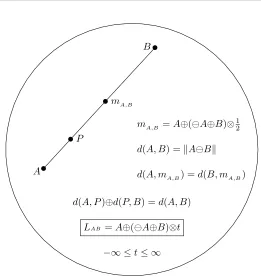
such, it is a geodesic line of the Beltrami-Klein ball model of hyperbolic geometry, shown in Figure 3 forn = 2. The geodesic line (68) is the unique gyroline that passes through the pointsAandB. It passes through the pointAwhent= 0and, owing to the left cancellation law, (7), it passes through the pointB whent= 1. Furthermore, it passes through the midpoint mA,B of A and B when t = 1/2.
Accordingly, the gyrosegment AB that joins the points A and B in Figure 3 is obtained from gyroline (68) with0≤t≤1.
A
B
mA,B
P
d(A, P)⊕d(P, B) =d(A, B)
LAB =A⊕(⊖A⊕B)⊗t
−∞ ≤t≤ ∞
mA,B =A⊕(⊖A⊕B)⊗12
d(A, B) =kA⊖Bk
d(A, mA,B) =d(B, mA,B)
Figure 3: Gyrolines, the hyperbolic linesLAB in Einstein gyrovector spaces, are
fully analogous to the straight lineA+ (−A+B)t,t∈R, in the Cartesian model of the Euclidean geometry of Rn. Here⊕=⊕
E is Einstein addition, as opposed to Figure 4 where ⊕= ⊕M is Möbius addition. The figure shows that Einstein gyrolines in the hyperbolic plane(R2
s,⊕,⊗)are Euclidean segments in the discR2s.
These interesting results are established by methods of differential geometry in [65], and are illustrated in Figures 3 and 4.
Each point of (68) with 0 < t < 1 is said to lie between A andB. Thus, for instance, the pointP in Figure 3 lies between the pointsA and B. As such, the pointsA,P andB obey thegyrotriangle equalityaccording to which
d(A, P)⊕d(P, B) =d(A, B), (69) in full analogy with Euclidean geometry. Here
d(A, B) =k⊖A⊕Bk, (70)
A, B ∈ Rn
s, is the Einstein gyrodistance function, also called the Einstein
A contact between Einstein gyrodistance function and differential geometry is provided by the Riemannian gyroline element of Einstein gyrovector spaces, studied in [64, Section 7.5] and [65]. It turns out that the Riemannian gyroline element of Einstein gyrovector spaces, given by
ds2=k(v+dv)⊖vk2 (71)
is identical with the well-known Riemannian line element of the Beltrami-Klein disc model of hyperbolic geometry.
13. Möbius Addition
The most general Möbius transformation of the complex open unit disc
D={z∈C: |z|<1} (72) in the complex planeCis given by the polar decomposition [2, 28],
z7→eiθ a+z
1 +az =e
iθ(a⊕
Mz). (73)
It induces the Möbius addition⊕Min the disc, allowing the Möbius transformation of the disc to be viewed as a Möbius leftgyrotranslation
z7→a⊕Mz= a+z
1 +az (74)
followed by a rotation. Hereθ∈Ris a real number,a, z∈D, andais the complex conjugate ofa.
In order to extend Möbius addition from the disk to the ball, let us identify complex numbers of the complex planeC with vectors of the Euclidean planeR2 in the usual way,
C∋u=u1+iu2= (u1, u2) =u∈R2. (75) Then
¯
uv+uv¯= 2u·v
|u|=kuk (76)
give the inner product and the norm inR2, so that Möbius addition in the discD
ofCbecomes Möbius addition in the disc
R2