Patron: Her Majesty The Queen Rothamsted Research Harpenden, Herts, AL5 2JQ
Telephone: +44 (0)1582 763133 Web: http://www.rothamsted.ac.uk/
Rothamsted Research is a Company Limited by Guarantee Registered Office: as above. Registered in England No. 2393175. Registered Charity No. 802038. VAT No. 197 4201 51. Founded in 1843 by John Bennet Lawes.
Rothamsted Repository Download
A - Papers appearing in refereed journals
Cashen, G. H. 1966. Thixotropy and dilatancy. Clay minerals. 6 (4), pp.
323-331.
The publisher's version can be accessed at:
•
https://dx.doi.org/10.1180/claymin.1966.006.4.06
The output can be accessed at:
https://repository.rothamsted.ac.uk/item/96xq9/thixotropy-and-dilatancy
.
© Please contact [email protected] for copyright queries.
T H I X O T R O P Y
A N D D I L A T A N C Y
G. H. C A S H E N
Physics Department, Rothamsted Experimental Station, Harpenden, lterts.
(Received 15 April 1966)
A B S T R A C T : The matric potential of water in gels of five-sixths neutralized aluminium montmorillonite (bentonite) and aluminium kaolinite changes during periods of shear and periods of rest. Shear increases the potential of water in bentonite gels, and in kaolinite gels containing little water, but decreases the potential in kaolinite gels containing more water. All these effects can be explained by changes in the curvature of water films at the gel-air interface. The difference between thixotropic and dilatant behaviour is the increasing and decreasing of the water potential on shearing. In dilatant pastes of silt-size particles, and for which the effects of electric charges are small, the pressure deficiency can reach large values after an increase in pore space, and this suffices to explain the characteristic features of dilatant behaviour.
Hydrogen exchanged aluminosilicate clays, however prepared, are unstable; aluminium ions are released from the lattice and in time the hydrogen clays change to the aluminium form. Cashen (1966) examined the hydrolysis of aluminium ions in solution by measuring the change in conductivity as alum solutions were titrated with sodium hydroxide; the results confirmed the conclusion of Brosset, Biedermann & Sill6n (1954) that the main product of hydrolysis in the acid range is a complex ion AI~(OH)153+ or one with the same hydroxyl to aluminium ratio. Similar titrations of an aluminium kaolinite indicated that the complex ion was formed on the surfaces of clay particles. The measurement of the cation exchange capacity of the clay is equivalent to the determination of the alkali required to convert the aluminium ion to the hydroxide, because the charge is then just balanced by sodium ions. Consequently at the five-sixths (83%) stage of neutralization, all the original aluminium ions are still retained as complex ions (in a Stern layer), balancing one-sixth of the charge. It was suggested (Cashen, ~-1966) that opportunity for bonding of particles by shared complex ions should then be maximal, and so account for the hitherto unexplained maximum, near 80% neutralization, in the viscosity of suspensions of 'hydrogen' or aluminium clays, for example in the work of Mattson (1929), Baver (1930), and Nash (1960).
324
G. H. Cashen
break on shear and reform at rest, so the 83% neutralized aluminium montmoril- lonite (bentonite) and kaolinite should be very suitable materials for study. Interest is usually given to the decrease in viscosity with increasing rates of shear, but in this paper another aspect of gel behavior is examined. The gel is placed in a sintered glass [unnel connected to a water manometer and an equilibrium is reached when the tendency of the clay to swell is balanced by the negative pressure ('suction' in cm of water). When the gel is liquified by stirring the suction decreases, and when the clay is allowed to re-gel the suction increases again. In homo-ionic clays, an increase in suction has been followed for weeks by Day & Ripple (1962) and for several days by Low (1960), but for gels of the 83% neutralized aluminium montmorillonite the recovery is greatest after an hour or so; the suction then decreases without any applied disturbance and, as the gel is losing fluid, this loss is characteristic of syneresis.
E X P E R I M E N T A L M E T H O D
Peerless No. 3 Kaolin, as received, was shaken with 0.05 N HC1 overnight and filtered on a Buchner funnel: this process was repeated three times and the kaolinite was then washed with distilled water until chloride free: after one wash with alcohol the kaolinite was allowed to dry at room temperature. Wyoming bentonite was shaken overnight as a 2% suspension in distilled water and then stood to allow coarse material to settle. The suspension was decanted and enough HC1 added to bring the concentration to 0.05 y. The flocculated suspension was stood for some days, when it was twice washed with 0"05 N HC1. The bentonite was then washed with distilled water until it appeared to be chloride free, although this was more difficult to judge than with kaolinite. The final product, kept as a suspension, was not entirely free from coarse material, but the amount was unimportant. After adding alkali to reach five-sixths neutralization (and concentrating the bentonite gel by means of a filter candle), the gels were placed in a funnel about 5 cm high, tapering from about 3"8 to 3"2 cm at the No. 4 sinter base, The gels were sheared by rotation of a No. 25 rubber stopper which is about 2-8 cm high and tapers from 3.2 to 2.5 cm. The manometer was of 0"5 m m internal diameter capillary. The speed of rotation was of the order of some hundreds of revolutions every minute. The measurements were made without any special temperature control and, except for covering the funnel with a slit Polythene disc, no attempt was made to prevent loss of water by evaporation.
R E S U L T S
Wyoming bentonite (Fig. 1). The results for a 7.5% gel of five-sixths neutralized
Thixotropy and dilatancy
325
contact of the gel with the sinter base and thorough mixing of the gel, but shear applied at 16.10 hours decreased the suction from about 11 to 6 cm of water, and the subsequent recovery to 12 cm of water took about 50 min. However the behaviour of the system is best illustrated by the results for the other days when longer recovery periods were allowed. While standing overnight the suction decreased to 8 cm of water (09.30 hours, day 2) and there was a further decrease on shear. At rest the suction increased to a maximum of 12 cm of water at 11.30 hours, but then decreased to about 9 cm of water over a period of 5 hr. There was a further decrease in suction on shearing at 16.30 hours, and a comparatively rapid rise at rest. The system was at rest from noon on day 3 until the morning of day 5. The new cycle then started reproduced the behaviour of day 2: decrease of suction during shear, rapid increase at rest to a maximum, and a slow decrease as syneresis became more obvious.
(a)
5
i
i i
I l l l l [ I 13 15 17
(b)
i
f
(c)
k.j
I t i J I I l [ l I L i I I ] I 1 9 11 13 15 17 10 12 1/, 16
Time of d a y ( h o u r s )
FIG. 1. Suction changes for Wyoming bentonite. (a) Day l ; (b) day 2, (c) day 5. S, Start of shear; O, periods of shear; O, periods of rest.
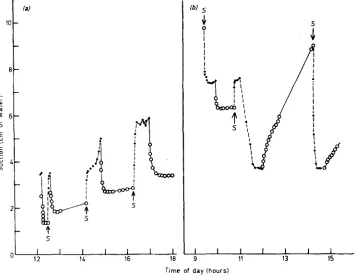
Peerless kaolinite (Fig. 2). Similar measurements on the five-sixths neutralized
326
G. H. Cashen
and lower wetter portions of the paste. During the first shearing the suction decreased to an apparently steady value and then decreased still further at rest. It is not easy to decide when the anomalous period ended. During the first 15 min of the next shear (10.45-11.00 hours, day 2) there was an increase in suction as on day 1, but thereafter the kaolinite paste behaved like the bentonite gel; it was thixotropie when at a moisture content about half that at the beginning. Other tests confirmed the thixotropic behaviour of kaolinite pastes of suitable moisture content and showed that the thixotropic behaviour noted above was real.
o~ n~
E *J
g
b'3
2
0 (a)
f--
9 i
w
s
$
I I I I 1 I I
12 14 16 18
(b) 5
'1, s
o , r
I
=
/,=
'./
Ld
i
L I
I I I I 1 I 1
9 11 13 15
Time of day (hours)
FIG. 2. Suction changes for Peerless kaolin. (a) Day 1 ; (b) day 2. S Start of shear; O, periods of shear; O, periods of rest.
D I S C U S S I O N
Thixotropy and dilataney
3 2 7 of the sodium ions should be as great immediately after stirring as later, that is, the ions had no effect on the gelation, and he attributed his measured increase in suction to the gradual formation of a coherent water structure that extended to a rather large distance from the particle surfaces. Although a surface adsorption could decrease the free energy of the water, an alternative explanation, which does involve the osmotic activity of the ions, can be advanced.In the Derjaguin-Verwey-Overbeek theory of the interaction between two diffuse double layers, the lowering of the free energy of the water by an excess of ions, relative to the solution outside the two plates, is balanced by an excess hydro- static or swelling pressure. In theory, swelling proceeds until there is an equilibrium between the osmotic repulsion and the van der Waals attraction (Verwey & Overbeek, 1948) and, as an infinite amount of solution is implied, such swelling can be regarded as taking place at constant, zero suction, The situation in a real system is different when the amount of solution is limited, for example initially just sufficient to fill the pore space, as the thickness of water films between particles can only increase at the expense of water withdrawn from the system-air interface; increased curvature of water films at the surface causes an increased pressure deficiency or suction, which limits the swelling. It is to be expected that film curvature will become significant at a clay concentration that just permits the formation of a network with its associated pore system, and it is now suggested that the suction variations found for the bentonite and kaolinite gels merely reflect changes in film curvature at the gel-air interface.
For the bentonite, after bonds have been broken by shear and shearing has been stopped, diffuse double layer repulsion leads to increased swelling and the suction consequently increases. The nature of the process or processes involved in the later stages of the resting periods can only be surmised. The fall in suction, after attainment of the maximum, suggests that a random structure is first formed but that swollen units or domains later contract, with the result that water leaves the gel, a process characteristic of syneresis. As two kinds of cation are present it is possible that some redistribution of cations occurs after contact between particles; any tendency for particles or domains to assume a more nearly parallel arrange- ment (because of the suction) will be enhanced by van der Waals forces, since the attraction between anisometric particles increases with the degree of parallelism (Void, t954). When shear is again applied the suction decreases and the accompany- ing movement of water out of the gel implies a further compression of diffuse double layers: this could occur if the flow was not streamline, that is, if there were a component of stress normal to the surfaces of domains of particles in parallel array, or if centrifugal forces were important in the experimental arrangement. Because of negative adsorption, the concentration of any electrolyte in the pore water will also change in the sense to oppose any change in spacing between the clay sheets.
3 2 8
G. H. Cashen
the explanation given for the bentonite should again apply, that is, after breaking of bonds by shear, the diffuse double layer repulsion should lead to swelling at rest and an increase in suction. If this is true, it should also hold for the wetter paste, although diffuse double layer effects should be smaller because of a greater average distance between particles. The fact that the suction decreased at rest in the wetter paste implies that some other mechanism was effective, over-riding the effect of electric charges, although it failed to achieve this in the drier paste. At rest in both the wetter and drier pastes there will be a pore geometry with a tendency to a uniform pore size and distribution; disturbance will tend to randomize this array and the pore size distribution will be altered to give more larger pores and more smaller pores. It is suggested that in the wetter paste the particles have more room to turn. In the bulk of the paste where all the pore space is filled with water the change in pore size distribution will have no effect on the matric water potential, but at the exposed surface where there are air-water boundaries, the suction can in- crease because of the redistribution of pore sizes or because there is no longer sufficient water to fill the surface pores. At rest the suction diminishes as the particles re-settle. The behaviour is somewhat similar to that of wet sand when stressed and, in so far as the water potential is concerned, the wetter kaolinite paste will be described as dilatant; this term implies an overall increase in volume, but the common feature that should be stressed is the change in film curvature. The resultant dilatant effect in the kaolinite paste is small, but it is of interest to consider the order of the suction in other systems where effects of charge can be neglected and where the liquid contents are smaller.
Thixotropy and dilatancy
3 2 9 space, There will, of course, be a tendency to pull water from regions of smaller suction and it is to be expected that the initial suctions will be larger the more rapid the motion; as a consequence of the increase in cohesion and internal friction for the disturbed region, which will tend to move as a whole, there will be a correspondingly rapid increase in the resistance to motion, in addition to any changes connected with the viscosity of the fluid. This is illustrated by the work of Freundlich & R6der (1938) with quartz particles of equivalent diameters of 0'75-1"5 ~ and 1-5 t~. These authors did not mention surface tension, possibly because of a preoccupation with the surface properties of the quartz particles. In carbon tetrachloride, bonding between particles of the smaller size range was strong enough for a paste containing only 10% solid/unit volume to set like a gel, which indicates that the particles must have been anisotropic. It was proved that in water the particles had a negative charge that permitted a closer packing of the 1-5 /z particles to 55 % solid/unit volume, and this is more characteristic of a deflocculated system that has settled. Although changes in hardness were observed between 55 and 45% solid/unit volume, they could not be so readily demonstrated as for pastes between 45 and 42% solid/unit volume. These dilatant pastes were by no means close-packed, but the relevant observation was that the particles appeared dry when, as the speed of a sphere of 6 m m diameter increased, the resistance rose lo 'inordinantly high values' and the particles were unable to 'make way'. In other experimental arrangements the shear m a y appear to be confined to one part of a system, but the whole of. the system is affected, and the same kind of argument will apply to 'shear-rate thickening" and 'shear-rate blockage' (Burgers & Scott Blair, 1949).Similar reasoning explains the negative Weissenberg effect observed by Bantoft (1959) for a paste of polyvinyl chloride in dialphanyl phthalate. In these experi- ments a centrally placed tube dipped into a beaker of the paste, and the paste was repelled from the outer tube wall when the tube was rotated at 15 rev/min. Because of the cylindrical symmetry, the disturbance and average distance between particles will be progressively smaller, the pressure drop across the air-fluid interfaces of the surface pores progressively greater, with distance fore the tube; atmospheric pressure is uniform over the surface, so there will be a suction gradient pulling the paste radially outwards.
The dilatancy of many pastes on shearing, and the dilatant contribution to the flow properties of the kaolinite paste, can thus be discussed in terms of rigid particles, and any charge is of importance only in so far as it permits a suitable initial packing. However, if dilatancy is defined as an .increase in suction on dis- turbance, the results of Croney & Coleman (1954) show that natural clays, pre- dominantly saturated with calcium and magnesium ions, exhibit a type of dilatancy when sheared (remoulding with a spatula); the suction increases even if more water is added. The suction-moisture content curve so obtained is unique for the clay, as it is also obtained if the clay is first brought to a thixotropic condition by slurrying in water, and then remoulded.
3 3 0 G . H . C a s h e n
the water films in calcium montmorillonite are about 10 A thick and ordinary treatments, such as remoulding, cannot affect the thickness of such films. Diffuse double layer repulsion will be confined to the calcium and magnesium ions on the outside faces of the domains giving the X-ray diffraction (Edwards & Quirk, 1962). Presumably the behaviour of calcium ions in other clays should be similar, and natural clays will consist of domains bonded together in some way (Aylmore & Quirk, 1959). If for simplicity a domain is taken as a small cube, then an angle of shear of 70 ~ (that required to increase the suction of the natural clay to the value for the unique curve, according to a private communication from Croney & Coleman) would m a k e a considerable difference to the shape of the domains; this could provide a qualitative explanation for the change in slope of the suction curve after shearing. At the same time, the area occupied by calcium ions not held between two sheets could increase by a factor of about four, and if extra diffuse double layer repulsion does lead to some swelling, this contribution to the dilatancy can occur only because the lattice is charged.
Although the breaking of bonds does not necessarily lead to purely thixotropic behaviour, as judged by the matric water potential, thixotropy can involve two processes that could differ in relative importance in different systems. F o r the 10% suspension of quartz particles in carbon tetrachloride examined by Freundlich & R6der (1938), it is probably only the bonding between particles that matters. F o r the clays used in the present work the rate of breaking and of re-making bonds, and the matric potential of the water, as affected by the state of diffuse double layers, could both play a p a r t - - a n increase in 'free' water with increasing rates of shear could in itself lead to a decrease in viscosity--but information as to the quantitative aspect is lacking.
It seems, therefore, that thixotropy in clays can be explained by two processes with an ionic basis, and it is not necessary to postulate adsorbed water films, or an orientation of water molecules, conditioned only by the surfaces of the clay particles.
R E F E R E N C E S
AYLMORE L.A.G. & QUIRK J.P. (1959) Nature, Lond. 183, 1752.
BANTOFT E. (1959) Rheology o/Disperse Systems, p. 105. Pergamon Press, London. BAVER L.D. (1930) Soil Sci. 29, 291.
BROSSET C., BIEDERMAN G . t~. SILLI~N LG. (1954) Acta chem. scand. 8, 1917.
BURGERS J.M. • SCOTT BLAIR G.W. (1949) Report on Principles o/Rheological Nomenclature.
North Holland Publishing Co., Amsterdam.
BUZAGH A. SZ~NT6 F. (1960) Magy kdm Foly. 66, 16; Chem. Abstr. 54, 15863c. CASHEN G.H. (1966) J. Soil Sci. 17, 303.
CRONEY D. • COLEMAN J.D. (1954) J. Soil Sci. 5, 75.
DAy P.R. & RIPPLE C.D. (1962) Project Report. University of California, Berkeley. EOWARDS D.G. & QtqRK J.P. (1962) J. Colloid Sci. 17, 872.
FISrIER R.A. (1926) J. agric. Sci., Camb. 16, 492. FISHER R.A. 0928) I. agric. Sci., Camb. 18, 406.
Thixotropy and dilatancy
331
GOODEVE C.F. (1939) Trans. Faraday Soc. 35, 342.HAINES W.B. (1925) J. agric. Sci., Camb. 15, 529. HAINES W.B. (1927) J. agric. Sci., Camb, 17, 264. HAINES W.B. (1930) J. agric. Sci., Camb. 20, 97. Low P.F. (1960) Clays Clay Miner. 8, 710. MATrSON S. (1929) Soil Sci. 28, 179. NASH V.E. (1960) Clays Clay Miner. 7, 328.
NORRISH K. & QUIRK J.P. (1954) Nature, Lond. 173, 255.
VERWEY E.J.W. & OVERBEEK J.TH.G. (1948) Theory o~ the Stability o/ Lyophobic Colloids.
Elsevier, Amsterdam.