Bond futures
INTRODUCTION
Bond futures contracts are futures contracts that allow investor to buy in the
future a theoretical government notional bond at a given price at a specific
date in a given quantity. Compared to other futures, bond futures are slightly
more complicated as the underlying bond of the futures contract is not a
physical bond but rather a theoretical notional bond determined by the basket
of available deliverable government bonds issued in the market. Bond futures
are very liquid futures contracts and among the most traded futures contracts.
The most common ones are:
In the US markets: US Treasury bond Futures, often referred to as T Bond
Future.
In Europe: Bund Future (Germany, Euro denominated), Gilt Future (UK,
British Pound denominated), Notionel contract (France, Euro
denominated).
Bond futures are widely used to hedge interest rate risk on long maturities,
especially by swap dealers that needs to cover their risk against various
points of the interest rate curve. Bond futures bear an additional risk often
referred to as the basis risk compared to swaps. Before reviewing the various
concepts of bond futures and its complicated delivery mechanism, let us give
CONTRACT DETAILS
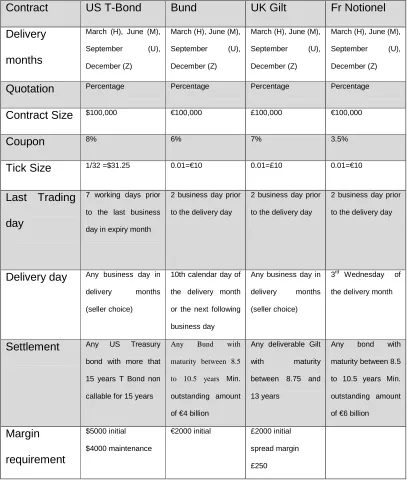
Table 1 gives the details of the most common bond futures: T-Bond, the Gild
Future, the Bund Future1 and the French notionel contract.
Contract US T-Bond Bund UK Gilt Fr Notionel
Delivery
months
March (H), June (M),
September (U),
December (Z)
March (H), June (M),
September (U),
December (Z)
March (H), June (M),
September (U),
December (Z)
March (H), June (M),
September (U),
December (Z)
Quotation Percentage Percentage Percentage Percentage
Contract Size $100,000 €100,000 £100,000 €100,000
Coupon 8% 6% 7% 3.5%
Tick Size 1/32 =$31.25 0.01=€10 0.01=£10 0.01=€10
Last Trading
day
7 working days prior
to the last business
day in expiry month
2 business day prior
to the delivery day
2 business day prior
to the delivery day
2 business day prior
to the delivery day
Delivery day Any business day in delivery months
(seller choice)
10th calendar day of
the delivery month
or the next following
business day
Any business day in
delivery months
(seller choice)
3rd Wednesday of
the delivery month
Settlement Any US Treasury bond with more that
15 years T Bond non
callable for 15 years
Any Bund with
maturity between 8.5
to 10.5 years Min.
outstanding amount
of €4 billion
Any deliverable Gilt
with maturity
between 8.75 and
13 years
Any bond with
maturity between 8.5
to 10.5 years Min.
outstanding amount
of €6 billion
Margin
requirement
$5000 initial
$4000 maintenance
€2000 initial £2000 initial
spread margin
[image:2.612.105.512.156.642.2]£250
Table 1: characteristics of common bond futures
1
INVOICE PRICE AND CONVERSION FACTOR
Government bond futures are based on a notional bond, which is a theoretical
bond whose price is inferred from market physically available bonds. The
potentially deliverable bonds need to satisfy certain criteria (see table 1). Like
for any other bond, the invoice price of the bond future has to account for the
accrued interest on the delivered bond.
Invoice price = Invoice Principal Amount + Accrued interest (1.1)
The invoice principal amount received by the short has to account for the
characteristic of the bond delivered. To adjust for these characteristics, the
short receives a total notional amount equal to the standard notional times the
conversion factor (CF). The idea behind the conversion factor is to make the
various bonds equal provided that the interest rate curve was flat with a given
yield2 (see conversion factor)
Invoice principal amount = Future price * Future Notional * CF (1.2)
2
The conversion factor is computing the value of the bond for a flat yield. In the case of the Bund futures contract, the conversion factor assumes a 6% yield while it is 8% for the T-Bond futures. For a bond with n coupon:
( )
Ci i=1..n paid at time( )
Ti i=1..n, this leads to(
) (
)
∑
= + ++ = n
i
T T
i
n i
C CF
1 1 6%
100
% 6
CHEAPEST TO DELIVER
In case of delivery, the short decides which bonds to deliver among the list of
potential bonds. Obviously, she chooses the cheapest-to-deliver, referred to
as the CTD.
When delivering the bond
i
:She receives the quoted futures price FT times the conversion factor i CF
plus the accrued interest AITi: Ti i T CF AI F * +
She pays a total cost of delivering the bond given by the dirty price of the
bond, that is equal to the clean price
B
Ti plus the accrued interest. i TAI
The cheapest to deliver bond is therefore the one that maximises her profit:
(
i)
T i T
i
F
CF
B
ArgMax
i
0=
−
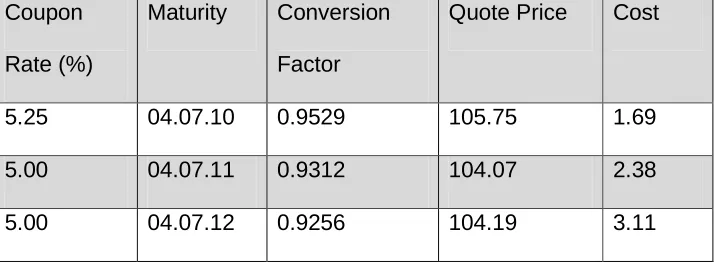
Example: using the example of the table 2 and that the Bund future price is
109.2, we get that the bond would cost respectively: 1.69 (=105.75-
0.9529*109.2), 2.38, 3.11. The cheapest to deliver would therefore be the first
bond.
Many parameters influence the cheapest to deliver bond. When yields are
higher than the assumed yield for the conversion factor (6% for the Bund
futures and 8% for the T-Bond future) the conversion methodology ten to
favour low coupon and long maturity bonds. Similarly, when yields are lower,
the yield curve is upward sloping (respectively downward sloping),
long-maturities (respectively short-long-maturities) bond are preferred. Lastly, some
bonds trade at a premium because of particularities that makes them
attractive like bonds whose coupon can be stripped easily from the bond.
MODELLING OF THE SHORT’S OPTIONS
More accurate modelling of the delivery of the bond is quite complicated.
There are a variety of embedded options that the short party holds. First, the
short is long an option to choose any bond within the deliverable bond basket,
referred to a switch or quality option. The short may hedge the bond futures
using an assumed cheapest to deliver (with its forward price computed
accurately) and a switch option to change from the assumed cheapest to
deliver to another bond. So even if she holds a specific bond against delivery,
it the curve shifts, she may decide to deliver another cheaper bond. There is
also a timing option when the bond hold for delivery pays a coupon higher
than the cost of financing of the spot position (the repo rate). If the bond
provides a coupon higher than the repo rate implied to calculate the forward
value of this bond, the short would be better off delivering the bond as late as
possible. When one uses Black Scholes to value these small details, one
finds that this is very negligible at first sight and can be ignored in most cases.
WILD CARD PLAY AND END OF THE MONTH OPTION
Two embedded options hold by the short have received more attention, as
T=-Bond futures. There is a time delay of roughly 2-hour between the close of the
CBOT Treasury bond futures market (at 2pm Chicago time) and the trading of
Treasury bond market (at 4pm Chicago time). Furthermore, the short can wait
until 8 pm to issue to the clearinghouse a notice of intention to deliver. This
gives the short the optionality, referred to the wild card play, to choose the
best timing to buy the bond at the cheapest price. Lastly the end of the month
option refers to the fact that the short can wait until the last day of the trading
month to decide whether to deliver or not while the last trading day is 7
business day prior to the end of the month for the T-bond and 2 business day
for the Bund futures contract.
Coupon
Rate (%)
Maturity Conversion
Factor
Quote Price Cost
5.25 04.07.10 0.9529 105.75 1.69
5.00 04.07.11 0.9312 104.07 2.38
[image:6.612.129.486.365.496.2]5.00 04.07.12 0.9256 104.19 3.11
Table 2: Example of deliverable bonds.
Entry category: futures
Scope: contract details, notional bond, Cheapest to deliver, delivery option,
uses, cost of carry, model for bond futures, repo.
Related articles: repurchase agreement, bond valuation.
Eric Benhamou3
Swaps Strategy, London, FICC,
Goldman Sachs International
3
References
Hull, John C, Options, Futures, and Other Derivatives, Fourth Edition,