Ann. Geophys., 28, 1625–1631, 2010 www.ann-geophys.net/28/1625/2010/ doi:10.5194/angeo-28-1625-2010
© Author(s) 2010. CC Attribution 3.0 License.
Annales
Geophysicae
The large-scale magnetospheric electric field observed by Double
Star TC-1
Z. H. He1, Z. X. Liu1, T. Chen1, C. Shen1, X. Li2, C. Carr3, and H. R`eme4
1State Key Laboratory of Space Weather, Center for Space Science and Applied Research, Chinese Academy of Sciences,
Beijing, China
2Laboratory for Atmospheric and Space Physics, University of Colorado, Boulder, CO, USA 3Space and Atmospheric Physics, the Blackett Laboratory, Imperial College, London, UK 4CESR, Toulouse, France
Received: 22 September 2009 – Revised: 28 July 2010 – Accepted: 27 August 2010 – Published: 3 September 2010
Abstract. The relationship between the average structure of
the inner magnetospheric large-scale electric field and geo-magnetic activity levels has been investigated by Double Star TC-1 data for radial distancesρbetween 4.5REand 12.5RE
and MLT between 18:00 h and 06:00 h from July to October in 2004 and 2005. The sunward component of the electric field decreases monotonically asρincreases and approaches zero as the distance off the Earth is greater than 10RE. The
dawn-dusk component is always duskward. It decreases at about 6REwhere the ring current is typically observed to be
the strongest and shows strong asymmetry with respect to the magnetic local time. Surprisingly, the average electric field obtained from TC-1 for low activity is almost comparable to that observed during moderate activity, which is always duskward at the magnetotail (8RE∼12RE).
Keywords. Magnetospheric physics (Electric fields)
1 Introduction
The variation of the large-scale electric field near the equa-torial plane of the inner magnetosphere associated with ge-omagnetic activity is very closely related to the physics of plasma dynamics and energy transport in the inner magne-tosphere, such as plasma injection into and earthward of geosynchronous orbit and overall particle transport during geomagnetic substorms and storms (Reeves, 1998; Li et al., 1998). The electric field in the inner magnetosphere has been generally believed to consist of the dawn-dusk convection
Correspondence to: Z. H. He (he [email protected])
electric field and the corotation electric field. A number of electric potential models have been developed based on ex-perimental data and theoretical hypotheses. One of the most widely used to study the inner magnetospheric electric field is Volland-Stern model, which includes a semiemperical con-vection and the pure corotation electric field (Volland, 1973; Stern, 1975; Maynard and Chen, 1975). An analytic func-tion representing the quiet time magnetospheric electric field has been constructed based on particle drifts by McIlwain (1972). The numerous models related to the inner and midtail electric field have been developed to study the ring current asymmetry (Jordanova et al., 2006) and predict the Dst index (Liemohn et al., 2001). The Rice Convection Model includ-ing the effects of magnetoshoeric shieldinclud-ing, subauroral ion drifts and region-2 currents produced by pressure gradients associated with the inner edge of the plasma sheet have been used to magnetic storm case studies (Sayzkin et al., 2000; 2002; Toffelloto et al., 2003).
Several studies based on the explorations of DMSP satel-lite (Yeh et al., 1991) and Akebono satelsatel-lite (Shinbori et al., 2005) have shown that the large-scale strong electric field with the magnitude more than 10 mV m−1 is usually ob-served aroundL=3 during geomagnetic storms. Baumjo-hann et al. (1985) and BaumjoBaumjo-hann and Haerendel (1985) have concluded that the electric field between 06:00 and 21:00 LT at certain radial position (L=6.6) scaled with both geomagnetic activity (Kp) and the solar wind electric field. A statistical analysis on measurements from Goddard Space Flight Center electric field instrument on ISEE-1 showed that the magnitude of the electric field in the equatorial plane (L=2.5−5.0) varied between 0.2 and 0.8 mV m−1and ex-ceeding 2.0 mV m−1during the intense activity (Maynard et al., 1983). Furthermore, Rowland and Wygant (1998) made a
1626 Z. H. He et al.: Large-scale magnetospheric electric field observed by Double Star TC-1 more detailed survey of the CRRES electric field in the
mag-netic local time sector between 12:00 and 04:00 within an L-value range from 2.5 to 8.5. They found that character of the enhanced electric field can be described as a function of mag-netic activity (Kp index) and theEycomponent is enhanced
betweenL=4 andL=6 in the dusk to midnight region dur-ing geomagnetically active periods of Kp>4.0. However, the sunward component of the electric field has not been studied, and the character of theEycomponent of the electric field in
the dawnside has not yet been described due to lack of ob-servations in that section. The data used in CRRES survey was about 4100 h while the ISSE-1 orbital coverage in the equatorial region for one year was about 200 h.
In this paper, the character of the large-scale electric field in the inner magnetosphere will be investigated by perform-ing a statistical analysis on the magnetospheric electric field data obtained from the Double Star TC-1 satellite (Liu et al., 2005). There is no actual instrument that measure electric field on the TC-1, but using measured magnetic field from the FGM (Fluxgate Magnetic) instrument (Carr et al., 2005) and the ion bulk velocity obtained from the HIA (Hot Ions Analyze) instrument (R`eme et al., 2005), one may construct an electric field estimate from the equationE= −V×B. One work has compared the−V×B with EDI and EFW instruments from Cluster observation, and results are good (Eriksson et al., 2006). The HIA and FGM instrument on Double Star are the same with Cluster mission. So we as-sume that the items of divergences of the pressure tensor, inertia effects, and resistivity in the Generalized Ohm’s Law are small.
The organization of this paper is as follows. The data description is in Sect. 2. The statistical results of the sun-ward and dawn-dusk components including the average fea-ture and standard deviations are presented in Sect. 3. Com-parisons with previous electric field observations and the Volland-Stern electric field model are made in Sect. 4. Fi-nally, conclusions are given in Sect. 5.
2 Data
The Double Star TC-1 satellite was launched on 30 De-cember 2003 into a near-equatorial orbit (orbital inclination 28.5◦), with an orbital period of 27.4 h, an apogee of 13.4RE
and a perigee of 570 km (Liu et al., 2005). The spacecraft was closer to the equatorial plane during the magnetotail crossing from July through October 2004–2005, providing a great opportunity to investigate the large-scale electric field in this region. HIA and FGM take data every 4 s.
The statistical analysis of the large-scale electric field is performed by analyzing the TC-1 data over 2500 h from July to October 2004 and 2005. The Geocentric Solar Magneto-spheric System (GSM) is chosen to analysis the data. We de-fine the radial distanceρ=pX(GSM)2+Y (GSM)2, and all
the valid data withρparameter betweenρ=4.5 and ρ=12.5
and magnetic local time (MLT) between 18:00 and 06:00 and Z(GSM) between −1.5RE and 1.5RE have been
in-cluded. The corotation electric field, Ecor=(r/RC/RE
E)2er and
C=92.4KVRE, has been subtracted in the data analysis. The
ρparameter is used for the variablerinstead of the L-shell because near the earth the L-shell andρare comparable. The error from the difference radiance distance definition is very small, about 5%.
The data are divided into five Kp bins, each of them are subdivided into eight bins according toρ value with 1RE
wide. The numbers of hours of data for each bin are demon-strated in Fig. 1a. Because the satellite spends most of its orbit at large distances and the geomagnetic activity is more often quiet than active, there are about 250 h in the 1<Kp<2, 11.5< ρ <12.5 bin, while there are less than 10 h in the 4<Kp<5, 5.5< ρ <6.5 bin. The data are also divided into two parts: the magnetic quiet time Kp between 0 and 3− and moderate activity time for Kp between 3 and 5−, each of them are subdivided into eight bins according toρvalue with 1REwide, and eachρbin are subdivided into twelve bins
ac-cording to magnetic local time with 1 h wide from 18:00 to 06:00. Figure 1b and c shows the number of hours of data for each bin. The data obtained by TC-1 during the high geomagnetic activity, Kp>6, are not discussed in this paper because there is not enough data set to reach the reasonable conclusions.
3 Observational results
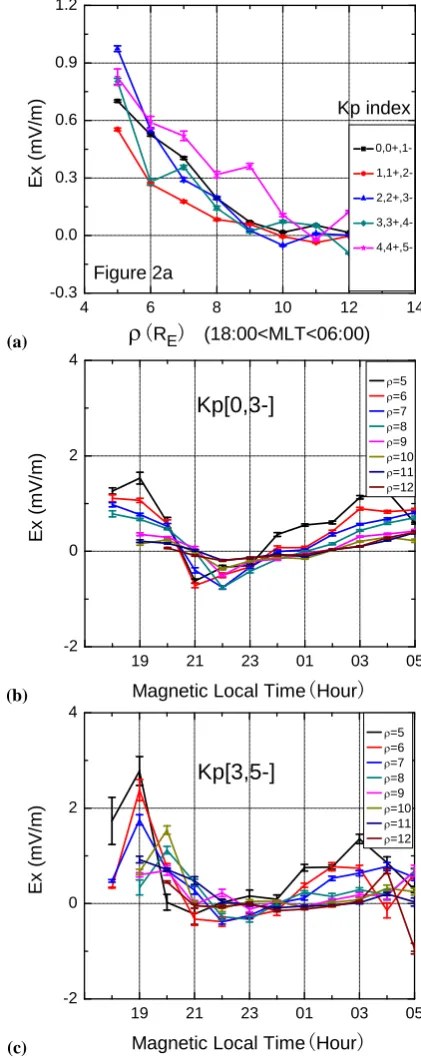
Figure 2a represents the variations of the sunward component (Ex) of electric field as a function ofρand Kp index. Five
colored curves denote the geomagnetic activity levels from 0 to 5−as mentioned in Sect. 2. Each data point is plotted in the center of the correspondingρbin from which the data were obtained. Error bars corresponding to the variance of the mean are plotted along with each point. The data indi-cate that theExcomponent decreases monotonically in
mag-nitude from 0.7 mV m−1to about 0 mV m−1as ρ increases from 4.5 to 12.5. It approaches zero as the distance off the Earth is greater than 10RE.
Figure 2b presents theExcomponent varies with the
dif-ferent magnetic local time (MLT) between 18:00 and 05:00 for low activity (0≤Kp<3) and Fig. 2c contains data for moderate activity (3≤Kp<5). The eight colored curves represent the eight different ρ values from 5 to 12. For 0≤Kp<3, theExcomponent is sunward and has gently
in-creased from about 0 mV m−1to 0.5 mV m−1for MLT from 23:00 to 05:00 and deeply decreased from over 1.0 mV m−1 to about 0 mV m−1 for MLT between 18:00 and 21:00 for low activity except for the region between 21:00 to 23:00, in which its direction is anti-sunward. For moderate activity, the region with anti-sunward velocity has disappeared. The average magnitudes of theExcomponents near the duskside
Z. H. He et al.: Large-scale magnetospheric electric field observed by Double Star TC-1 1627
(a)
1
4 5 6 7 8 9 10 11 12 13
0 50 100 150 200 250 4,4+,5-T
he number of
hours of dat a (H ours )
Value
Kp
18 19 20 21 22 23 00 01 02 03 04 05 0 15 30 45 60 75 T h e num ber of hours of dat a (Hours )
Magnetic Local Time
=5 =6 =7 =8 =9 =10 =11 =12 Kp[0,3-] (b) 1
4 5 6 7 8 9 10 11 12 13
0 50 100 150 200 250 4,4+,5-T
he number of
hours of dat a (H ours )
Value
Kp
18 19 20 21 22 23 00 01 02 03 04 05 0 15 30 45 60 75 T h e num ber of hours of dat a (Hours )
Magnetic Local Time
=5 =6 =7 =8 =9 =10 =11 =12 Kp[0,3-] (c) 2
Figure 1. (a) The number of hours of data in each ρbin for five different Kp bins. (b) The number of hours of data in each magnetic local time bin for eight different ρbins at magnetic quiet time Kp[0,3-]. (c) The number of hours of data in each magnetic local time bin for eight different ρ
bins at magnetic moderate activity time Kp[3,5-].
18 19 20 21 22 23 00 01 02 03 04 05 0 5 10 15 20 25 =5 =6 =7 =8 =9 =10 =11 =12 T h e num ber of
hours of dat
a
(Hours
)
Magnetic Local Time
Kp[3,5-]
Fig. 1. (a) The number of hours of data in eachρbin for five
differ-ent Kp bins. (b) The number of hours of data in each magnetic local time bin for eight differentρbins at magnetic quiet time Kp[0,3−].
(c) The number of hours of data in each magnetic local time bin for
eight differentρbins at magnetic moderate activity time Kp[3,5−].
are much greater than that near the dawnside for both low and moderate activity.
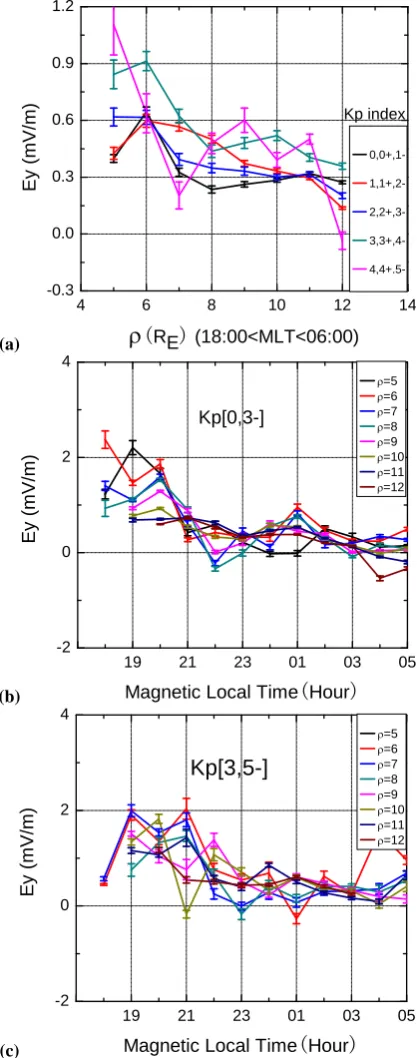
Figure 3a shows the variations of the dawn-dusk compo-nent (Ey) of the electric field as a function of ρ and Kp
index. The data indicate that theEy component is always
duskward over the magnetic local time range from 18:00 to
(a)
3
19 21 23 01 03 05
-2 0 2 4
Kp[0,3-]
=5 =6 =7 =8 =9 =10 =11 =12 Ex ( m V/ m )Magnetic Local Time(Hour)
4 6 8 10 12 14
[image:3.595.57.285.58.555.2]-0.3 0.0 0.3 0.6 0.9 1.2 Figure 2a Kp index 4,4+,5-Ex (m V/m )
(RE) (18:00<MLT<06:00)(b)
3
19 21 23 01 03 05
-2 0 2 4
Kp[0,3-]
=5 =6 =7 =8 =9 =10 =11 =12 Ex ( m V/ m )Magnetic Local Time(Hour)
4 6 8 10 12 14
[image:3.595.320.531.88.618.2]-0.3 0.0 0.3 0.6 0.9 1.2 Figure 2a Kp index 4,4+,5-Ex (m V/m )
(RE) (18:00<MLT<06:00)(c)
Figure 2. (a) The variation of the Ex component of the electric field as a function of ρvalue and geomagnetic activity Kp index. (b)The variation of the Ex component of the electric field as a function of magnetic local time for geomagnetic activity Kp less than 3. (c) The variation of the Ex component of the electric field as a function of magnetic local time for geomagnetic activity Kp between 3 and 5-.
19 21 23 01 03 05
-2 0 2 4 =5 =6 =7 =8 =9 =10 =11 =12
Kp[3,5-]
Ex ( m V/ m )Magnetic Local Time(Hour)
4 6 8 10 12 14
-0.3 0.0 0.3 0.6 0.9 1.2 Kp index 4,4+.5-Ey (mV/m)
(RE) (18:00<MLT<06:00)Fig. 2. (a) The variation of theExcomponent of the electric field as
a function ofρvalue and geomagnetic activity Kp index. (b) The variation of theExcomponent of the electric field as a function of
magnetic local time for geomagnetic activity Kp less than 3. (c) The variation of theExcomponent of the electric field as a function of
magnetic local time for geomagnetic activity Kp between 3 and 5−.
1628 Z. H. He et al.: Large-scale magnetospheric electric field observed by Double Star TC-1
(a)
4 Figure 2. (a) The variation of the Ex component of the electric field as a function of ρvalue and geomagnetic activity Kp index. (b)The variation of the Ex component of the electric field as a function of magnetic local time for geomagnetic activity Kp less than 3. (c) The variation of the Ex component of the electric field as a function of magnetic local time for geomagnetic activity Kp between 3 and 5-.
19 21 23 01 03 05
-2 0 2 4 =5 =6 =7 =8 =9 =10 =11 =12
Kp[3,5-]
Ex ( m V/ m )Magnetic Local Time(Hour)
4 6 8 10 12 14
-0.3 0.0 0.3 0.6 0.9 1.2 Kp index 4,4+.5-Ey (mV/m)
(RE) (18:00<MLT<06:00)(b)
5 Figure 3. (a)The variation of the dawn-dusk component of the electric field as a function of ρvalue and geomagnetic activity Kp index. (b) The variation of the Ey component of the electric field as a function of magnetic local time for geomagnetic activity Kp less than 3. (c) The variation of the Ey component of the electric field as a function of magnetic local time for geomagnetic activity Kp between 3 and 5-.
19 21 23 01 03 05
-2 0 2 4 =5 =6 =7 =8 =9 =10 =11 =12 Kp[0,3-] Ey ( m V/ m )
Magnetic Local Time(Hour)
19 21 23 01 03 05
-2 0 2 4 =5 =6 =7 =8 =9 =10 =11 =12
Kp[3,5-]
Ey ( m V/ m )Magnetic Local Time(Hour)
(c)
5 Figure 3. (a)The variation of the dawn-dusk component of the electric field as a function of ρvalue and geomagnetic activity Kp index. (b) The variation of the Ey component of the electric field as a function of magnetic local time for geomagnetic activity Kp less than 3. (c) The variation of the Ey component of the electric field as a function of magnetic local time for geomagnetic activity Kp between 3 and 5-.
19 21 23 01 03 05
-2 0 2 4 =5 =6 =7 =8 =9 =10 =11 =12 Kp[0,3-] Ey ( m V/ m )
Magnetic Local Time(Hour)
19 21 23 01 03 05
-2 0 2 4 =5 =6 =7 =8 =9 =10 =11 =12
Kp[3,5-]
Ey ( m V/ m )Magnetic Local Time(Hour)
Fig. 3. (a) The variation of the dawn-dusk component of the
elec-tric field as a function ofρvalue and geomagnetic activity Kp index.
(b) The variation of theEycomponent of the electric field as a
func-tion of magnetic local time for geomagnetic activity Kp less than 3.
(c) The variation of theEycomponent of the electric field as a
func-tion of magnetic local time for geomagnetic activity Kp between 3 and 5−.
06:00, in a manner consistent withE×B convection from tail toward the dayside, and is generally stronger for higher Kp. These results are supported by the early balloon mea-surements (Mozer and Lucht, 1974), ISSE 1 observations (Maynard et al., 1983) and CRRES (Wygant et al., 1997).
The error bars in Figs. 2 and 3 are represented the vari-ances of the mean of the data rather than the standard devi-ations. Generally, these variances are small except for mod-erate activity levels and lowρ values. The variance of the mean describes the variability of the average electric field in a givenρvalue-Kp bin from the average. The standard devi-ation of a single point from the mean is larger than the mean value of the electric field in a givenρvalue and Kp bin, in-dicating the highly variable nature of the electric field in this region. The error bars in this paper are comparable to the one with Rowland and Wygant’s work (1998).
The inner edge of the plasma sheet tends to shield the in-ner magnetosphere from the main electric convection field. If the convection field suddenly decrease, due to a northward turning of the IMF, there is suddenly a backwards electric field (dusk to dawn) in the inner magnetosphere temporarily, until the shielding layer readjusts. This is called overshield-ing. Undershielding is temporarily penetration of dawn-dusk electric field in times of increasing convection (Sayzkin et al., 2000). The most striking feature of the Ey component
is the peak value atρ=6, which separate two trends thatEy
component changes with theρ. The dawn-dusk component increases with the ρ increasing when the ρ is less than 6, while the total oppositional trend is observed forρ between 6 and 8. The inner edge of the plasma sheet is located atρ=6, and it may move earthward for Kp>4. The TC-1 observation shows undershielding effect in the inner magnetosphere be-cause average dawn-dusk electric field is positive forρ less than 6. Whenρ between 8 and 12, the dawn-dusk compo-nent of electric field reaches 0.5 mV m−1 for Kp≥3, while maintains about 0.3 mV m−1for Kp<3. It is well known that theEycomponent of Volland-Stern electric field always
in-creases with the radial distance. It is contradictory to the re-sults of this paper and also is not consistent with the Wygant et al. (1997) work, especially for the geomagnetic storm time. It should be noticed that the convection electric field changes with the different magnetic local time from 18:00 to 05:00 for low (Fig. 3b) and moderate activity (Fig. 3c). The Ey component varies between 0 mV m−1 and about
0.5 mV m−1 from MLT=23:00 to MLT=05:00 for both low and moderate activity. For the magnetic local time be-tween 18:00 and 23:00, the magnitude for moderate activity strengthens slighter than the low one.
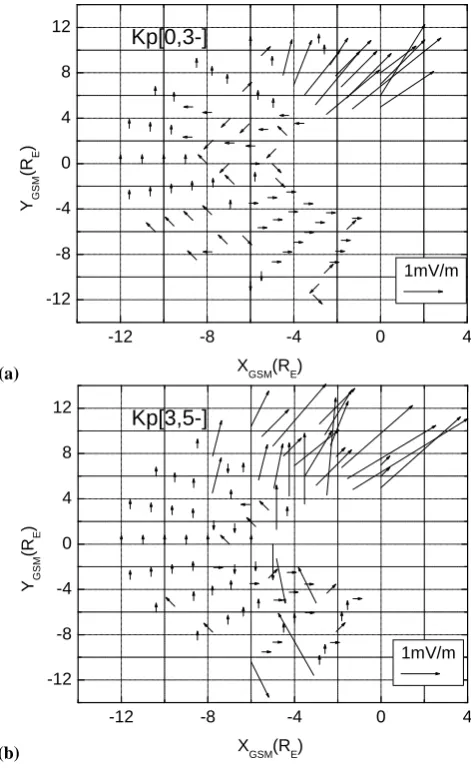
Figure 4a and b demonstrates the electric field vector in equatorial plane for low and moderate geomagnetic activ-ity separately. Figure 4a shows that the electric field in the dawnside always points to sunward direction with the magni-tude about 0.3 mV m−1, while it turns rather turbulent when the geomagnetic activity is moderate. Near the duskside, the magnitude of the electric field is above 1.5 mV m−1for low
[image:4.595.63.272.82.612.2]Z. H. He et al.: Large-scale magnetospheric electric field observed by Double Star TC-1 1629 activity, and it becomes much greater for moderate activity;
the angle between electric field vector and the dawn-dusk meridian is mainly less than 40 degrees. It is surprising that in the magnetotail between 9REand 12RE(|YGSM|<5RE),
the electric field which almost appears duskward with magni-tude about 0.3 mV m−1 for moderate activity is comparable to that for low activity.
4 Discussion
This paper has studied the large-scale electric field in the inner and middle magnetosphere as a function of geomag-netic activity. Observations from Akebono/EFD have indi-cated that theExcomponent fairly coincides with the
coro-tation electric field in the quiet time (Nishimura et al., 2006), while the statistical results by TC-1 data show that even for the lowest geomagnetic activity level (Kp<1) there should be some other electric field source, which contributes to the sunward component of the electric field except for the coro-taion electric field. The structure of the electric field from Akebono/EFD shows a strong asymmetry with respect to the noon-midnight meridian as well as the dawn-dusk meridian; TC-1 observation indicates a strong asymmetry with respect to the magnetic local time that the electric field at duskside is at least three times more than the one at dawnside.
Several modeling studies of the storm-time ring current (Chen et al., 1993; Fok et al., 1996; Sazykin et al., 2002; Liemohn et al., 2001; Wang et al., 2004) suggest that an en-hanced convection electric field in the magnetosphere, which is induced by a continuous southward interplanetary mag-netic field (IMF), is responsible for steady particle trans-port into the inner magnetosphere during the storm main phase. The enhanced convection is envisioned to be weak-ened, or cease after the main phase in response to the de-crease of southward IMF, leading to the formation of a rela-tively symmetric ring current around the Earth during the re-covery phase. Surprisingly, in the magnetotail between 9RE
and 12RE(|YGSM|<5RE), the electric field almost appears
duskward with magnitude about 0.3 mV m−1 for moderate activity is comparable to that for low activity. Fortunately, that is supported by a Geotail spacecraft investigation dur-ing storm time, which found that durdur-ing both the main and recovery phases the electric field was relatively steady and weak with average magnitude about 0.3 mV m−1, and was almost comparable to that observed during the quiet times (Hori et al., 2005). As inferred from the bulk ion flow ve-locity from Shen et al. (2008), the convection is rather weak, which agrees with the TC-1 observations well.
Wygant et al. (1997) reported that the convection electric field increases withρless than 6.0REfor low activity, while
for the higher activity the dawn-dusk electric field can pene-trate deeply into the inner radiation belt. This phenomenon can also be seen from the TC-1 observation; furthermore the shielding position identified in this work is about 6.0RE.
(a)
6 Figure 4. (a) The electric field vector in equatorial plane for kp between 0 and 3-. (b) The electric field vector in
equatorial plane for kp between 3 and 5-.
-12 -8 -4 0 4
-12 -8 -4 0 4 8 12
YGSM
(R
E
)
XGSM(RE)
1mV/m
Kp[0,3-]
-12 -8 -4 0 4
-12 -8 -4 0 4 8 12
1mV/m YGSM
(R
E
)
XGSM(RE)
Kp[3,5-]
(b)
6 Figure 4. (a) The electric field vector in equatorial plane for kp between 0 and 3-. (b) The electric field vector in
equatorial plane for kp between 3 and 5-.
-12 -8 -4 0 4
-12 -8 -4 0 4 8 12
YGSM
(R
E
)
XGSM(RE)
1mV/m
Kp[0,3-]
-12 -8 -4 0 4
-12 -8 -4 0 4 8 12
1mV/m YGSM
(R
E
)
XGSM(RE)
Kp[3,5-]
Fig. 4. (a) The electric field vector in equatorial plane for Kp
be-tween 0 and 3−. (b) The electric field vector in equatorial plane for Kp between 3 and 5−.
However, the convection electric field decreases at about 6.0REwith the increasingρ, and maintains a constant at the
magnetotail over about 9.0RE. This trend is completely
op-posite to that of the Volland-Stern electric field.
5 Conclusion
The relationship between the average structure of the inner magnetospheric electric field and geomagnetic activity levels is investigated by Double Star TC-1 withρ between 4.5RE
and 12.5REand MLT between 18:00 h and 05:00 h from July
to October in 2004 and 2005 andZ(GSM) between−1.5RE
and 1.5RE. The conclusions made by data analysis are as
follows.
TheExcomponent decreases monotonically in the
mag-nitude from 0.7 mV m−1to nearly 0 mV m−1asρ increases from 4.5 to 12.5. The average dawn-dusk component (Ey) of
[image:5.595.310.546.62.448.2]1630 Z. H. He et al.: Large-scale magnetospheric electric field observed by Double Star TC-1 the electric field is always duskward, scaling in the
magni-tude from 0 mV m−1to 0.7 mV m−1as Kp increasing from 0
to 5−. The structure of the electric field shows strong asym-metry with respect to the magnetic local time. The electric field at duskside is at least three times more than the one at dawnside. The shielding distance, which the electric field is shielded out of the inner magnetosphere, can be located at aboutρ=6 and moves earthward when Kp is larger.
The average electric field obtained for low activity is al-most comparable to that observed during moderate activity and is always duskward at the magnetotail (8RE∼12RE).
A revised model may be much better than the Volland-Stern model for interpreting the electric field at magnetotail (−12RE≤R≤ −6RE).
Acknowledgements. The authors would like to thank
For-rest S. Mozer and another referee for evaluating this paper. This work was supported by the National Natural Science Foun-dation of China Grant No. 40731054, 40904044, 40774081, G2006CB806305 and the Specialized Research Fund for State Key Laboratories.
Topical Editor I. A. Daglis thanks F. S. Mozer and another anonymous referee for their help in evaluating this paper.
References
Baumjohann, W., Haerendel, G., and Melzner, F.: Magnetospheric convection observed between 0600 and 2100 LT: Variations with Kp, J. Geophys. Res., 90, 393–398, 1985.
Baumjohann, W. and Haerendel, G.: Magnetospheric convection observed between 0600 and 2100 LT: Solar wind and IMF de-pendence, J. Geophys. Res., 90, 6370–6378, 1985.
Carr, C., Brown, P., Zhang, T. L., Gloag, J., Horbury, T., Lucek, E., Magnes, W., O’Brien, H., Oddy, T., Auster, U., Austin, P., Ay-dogar, O., Balogh, A., Baumjohann, W., Beek, T., Eichelberger, H., Fornacon, K.-H., Georgescu, E., Glassmeier, K.-H., Ludlam, M., Nakamura, R., and Richter, I.: The Double Star magnetic field investigation: instrument design, performance and high-lights of the first year’s observations, Ann. Geophys., 23, 2713– 2732, doi:10.5194/angeo-23-2713-2005, 2005.
Chen, M. W., Schulz, M., Lyon, L. R., and Gorney, D. J.: Storm time transport of ring current and radiation belt ions, J. Geophys. Res., 98, 3835–3849, 1993.
Eriksson, A. I., Andr´e, M., Klecker, B., Laakso, H., Lindqvist, P.-A., Mozer, F., Paschmann, G., Pedersen, A., Quinn, J., Tor-bert, R., Torkar, K., and Vaith, H.: Electric field measure-ments on Cluster: comparing the double-probe and electron drift techniques, Ann. Geophys., 24, 275–289, doi:10.5194/angeo-24-275-2006, 2006.
Fok, M.-C., Moore, T. E., and Greenspan, M. E.: Ring current development during storm main phase, J. Geophys. Res., 101, 15311–15322, 1996.
Hori, T., Lui A. T. Y., Ohtani, S., Cson Brandt, P., Mauk, B. H., McEntire, R. W., Maezawa, K., Mukai, T., Kasaba, Y., and Hayakawa, H.: Storm-time convection electric field in the near-Earth plasma sheet, J. Geophys. Res., 110, a04213, doi:10.1029/2004ja010449, 2005.
Jordanova, V. K., Miyoshi, Y. S., Zaharia, S., Thomsen, M. F., Reeves, G. D., Evans, D. S., Mouikis, C. G., and Fennell, J. F.: Kinetic simulations of ring current evolution during the Geospace Environment Modeling challenge events, J. Geophys. Res., 111, A11S10, doi:10.1029/2006JA011644, 2006.
Li, X., Baker, D. N., Temerin, M., Reeves, G. D., and Belian, R. D.: Simulation of dispersionless injections and drift echoes of ener-getic electrons associated with substorms, Geophys. Res. Lett., 25(20), 3763–3766, doi:10.1029/1998GL900001, 1998. Liemohn, M. W., Kozyra, J. U., Thomsen, M. F., Roeder, J. L.,
Lu, G., Borovsky, J. E., and Cayton, T. E.: Dominant role of the asymmetric ring current in producing the stormtime Dst, J. Geophys. Res., 106, 10883-10904, 2001.
Liu, Z. X., Escoubet, C. P, Pu, Z., Laakso, H., Shi, J. K., Shen, C., and Hapgood, M.: The Double Star mission, Ann. Geophys., 23, 2707–2712, doi:10.5194/angeo-23-2707-2005, 2005.
Maynard, N. C. and Chen, A. J.: Isolated cold plasma regions: Ob-servations and their relation to possible production mechanisms, J. Geophys. Res., 80, 1009–1013, 1975.
Maynard, N. C., Aggson, T. L., and Heppner, J. P.: The plasmas-pheric electric field as measured by ISEE 1, J. Geophys. Res., 88, 3991–4003, 1983.
McIlwain, C. E.: in: Earth’s Magnetospheric Processes, edited by: McCormac, B. M., D. Reidel, Dordrecht-Holland, p. 268, 1972. Mozer, F. S. and Lucht, P.: The average auroral zone electric field,
J. Geophys. Res., 79, 1001–1006, 1974.
Nishimura, Y., Shinbori, A., Ono, T., Iizima, M., and Ku-mamoto, A.: Storm-time electric field distribution in the inner magnetosphere, Geophys. Res. Lett., 33, L22102, doi:10.1029/2006GL027510, 2006.
Reeves, G. D.: New perspectives on substorm injections, Proceed-ings of the Fourth International Conference on Substorms, ICS-4, Hamanako, Japan, March 1998.
R`eme, H., Dandouras, I., Aoustin, C., Bosqued, J. M., Sauvaud, J. A., Vallat, C., Escoubet, P., Cao, J. B., Shi, J., Bavassano-Cattaneo, M. B., Parks, G. K., Carlson, C. W., Pu, Z., Klecker, B., Moebius, E., Kistler, L., Korth, A., Lundin, R., and the HIA team: The HIA instrument on board the Tan Ce 1 Double Star near-equatorial spacecraft and its first results, Ann. Geophys., 23, 2757–2774, doi:10.5194/angeo-23-2757-2005, 2005.
Rowland, D. E. and Wygant, J. R.: Dependence of the large-scale, inner magnetospheric electric field on geomagnetic activity, J. Geophys. Res., 103, 14959–14964, 1998.
Sazykin, S.: Theoretical Studies of Penetration of Magnetospheric Electric Fields to the Ionosphere, PhD Dissertation, University of Utah, 2000.
Sazykin, S., Wolf, R. A., Spiro, R. W., Gombosi, T. I., De Zeeuw, D. L., and Thomsen, M. F.: Interchange instability in the inner magnetosphere associated with geosynchronous particle flux decreases, Geophys. Res. Lett., 29(10), 1448, doi:10.1029/2001GL014416, 2002.
Shen, C., Liu, Z. X., Escoubet, C. P., et al.: Surveys on magne-tospheric plasmas based by the Double Star Project (DSP) ex-ploration, Science in China Series E: Technological Sciences, 51(10), 1–9, 2008.
Shinbori, A., Nishimura, Y., Ono, T., Iizima, M., Kumamoto, A., and Oya, H.: Electrodynamics in the duskside inner magne-tosphere and plasmasphere during a super magnetic storm on March 13– 15, Earth Planets Space, 57, 643–659, 2005.
Z. H. He et al.: Large-scale magnetospheric electric field observed by Double Star TC-1 1631
Stern, D. P.: The motion of a proton in the equatorial magneto-sphere, J. Geophys. Res., 80, 595–599, 1975.
Toffoletto, F., Sazykin, S., Spiro, R., and Wolf, R.: Inner magne-tospheric modeling with the Rice Convection Model, Space Sci. Rev., 107, 175–196, 2003.
Volland, H.: A semi empirical model of large-scale magnetospheric electric fields, J. Geophys. Res., 78, 171–180, 1973.
Wang, C.-P., Lyons, L. R., Chen, M. W., and Toffoletto, F. R.: Modeling the transition of the inner plasma sheet from weak to enhanced convection, J. Geophys. Res., 109, A12202, doi:10.1029/2004JA010591, 2004.
Wygant, J., Rowland, D., Singer, H. J., Temerin, M., Mozer, F., and Hudson, M. K.: Experimental evidence on the role of the large spatial scale electric field in creating the ring current, J. Geophys. Res., 103, 29527–29544, 1998.
Yeh, H.-C., Foster, J. C., Rich, F. J., and Swider, W.: Storm time electric gield penetration observed at mid-latitude, J. Geophys. Res., 96, 5707–5721, 1991.