Soliton
comb
generation
using
add-drop
ring
resonators
IS Amiri
1*, MZ Zulkifli
2, H Ahmad
31*,2,3
Photonics Research Centre, University of Malaya, Malaysia
*Corresponding author: Dr. IS Amiri, Photonics Research Centre, University of Malaya,50603 Kuala Lumpur, Malaysia. E-mail: [email protected], Tel.:+60127420567
Add-drop ring resonator system is the fundamental building block of the optical transmission and communication systems. The microring resonator (MRR) made of semiconductor with a length of 750 μm,
1
2
0
.
02
, is used to filter the input spectrum of Gaussian laser beam and generatethe comb frequency of soliton pulses, where the transmission characteristics and group delay profile of the through and drop port output signals are presented. The semiconductor material (InGaAsP/InP) is used to generate the add-drop ring resonator. The operating wavelength is 1550 nm andthe iterative method is used to generate the results based on practical parameters of the system.
Keywords: Microring resonator, Gaussian laser beam, soliton signal, add-drop system, comb generation
INTRODUCTION
Add-drop filters using Microring Resonators (MRRs) have shown great promise for practical applications (Cai et al., 2000; Amiri I. S. et al., 2012a; I. S. Amiri et al., 2013a; I. S. Amiri et al., 2013b; I. S. Amiri and J. Ali, 2014a; I. S. Amiri et al., 2014f). Microrings have been studied more thoroughly due to their ease of fabrication and on chip structure (Popovíc et al., 2006; Xiao et al., 2008; Iraj Sadegh Amiri et al., 2014b; Sayed Ehsan Alavi et al., 2014).
Wavelength selective optical add-drop filter is required for adding and dropping a particular Wavelength Division Multiplexing (WDM) channel at each subscriber node in the WDM based optical access networks. Add-drop filter used in DWDM based optical networks should have a good reflection characteristic, a temperature stability, a narrow spectral bandwidth, and a low implementation cost(Iraj Sadegh Amiri and Abdolkarim Afroozeh, 2014).For those reasons, many researchers have been proposed various technologies to generate a comb frequency of soliton using the add-drop filter(A Nikoukar et al., 2014; I. S. Amiri and J. Ali, 2014b; I. S. Amiri and J. Ali, 2014c; Y. S. Neo et al., 2014). Although add-drop filters, including those devices have good operating performances, their cost is too expensive to apply for DWDM based optical access network. The main contribution of this study is to generate multiple soliton wavelengths, train of signals or a soliton comb which is widely applicable in optical communications. MRRs are made up of waveguide by fabrication technology. Optical MRRs, filters, and switches have been successfully demonstrated in the two important GaAs-AlGaAs and GaInAsP-InP material systems (Heebner and Boyd, 1999; Hryniewicz et al., 2000). The fabrication process of the vertically coupled InP devices was developed by R. Grover (Grover et al., 2001). The III/V semiconductors (InGaAsP/InP) on the basis of InP with a direct band gap is used to fabricate the ring resonator.
OPTICAL TRANSFER FUNCTION
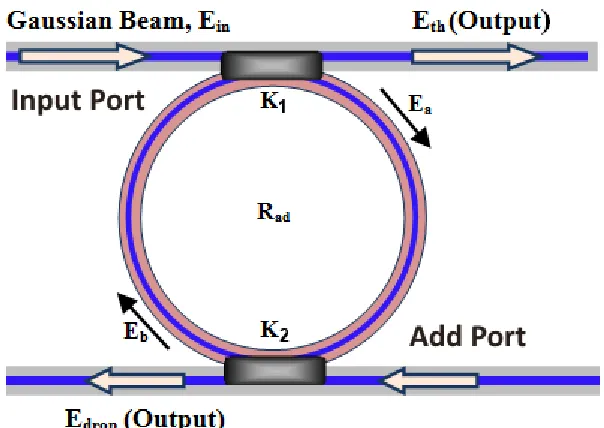
The system of the add-drop ring resonator is shown in Figure 1. We propose the system when the stationary Gaussian pulse is introduced into the system as shown in Figure 1.The material platform can be a waveguide or a semiconductor.
Vol. 1(1), pp. 002-008, August, 2014. © www.premierpublishers.org, ISSN: XXXX-XXXX
Research Article
modelling the system.
Figure 1. Schematic Diagram of an add-drop System
The input optical field
(
E
in)
in the form of the Gaussian pulse can be expressed by Equation (1)
i
t
L
z
E
t
z
E
D
in 0 0
2
exp
)
,
(
(1)Here
E
0andzare the optical field amplitude and propagation distance, respectively(S. E. Alavi et al., 2014). The dispersion length of the soliton pulse can be defined as LD T02
2 , where the frequency carrier of the soliton is
0 and 2 is the coefficients of the second order terms of the Taylor expansion of the propagation constant (Amiri I. S. et al., 2012b).T
0represents a soliton pulse propagation time(A. Afroozeh et al., 2015; I. S. Amiri et al., 2015).Here, the soliton represents a pulse that keeps its width invariance as it propagates, known as a temporal or spatial soliton (I. S. Amiri et al., 2014b). The intensity of soliton peak is
|
2/
T
02|
. When a temporal soliton pulse propagates inside themicroring device, a balance should be achieved between the dispersion length
(
L
D)
and the nonlinear length )/ 1
(LNL
NL , where
n
2
k
0, is the length scale over which disperse or nonlinear effects causes the beam becomes wider or narrower. For a soliton pulse when the balance between dispersion and nonlinear lengths is achieved, henceNL
D
L
L
. The total refractive index (n) of the system is given by(Amiri I. S. et al., 2010),
)
(
20 2
0
P
A
n
n
I
n
n
n
eff
(2)trip. The normalized output of the light field is defined as the ratio between the output and input fields (
E
out(
t
)
andEin(t)) in each round-trip. Thus, it can be expressed as(Amiri I. S. et al., 2012c; I. S. Amiri and A. Afroozeh, 2014;I. S. Amiri et al., 2014e)
)
2
(
sin
1
1
4
)
1
1
1
(
)
)
1
(
1
(
1
)
1
(
)
(
)
(
2 1 2 1 1 2
x
x
x
t
E
t
E
inout (3)
Here,
is the coupling coefficient,x
exp
L
/
2
represents a round-trip loss coefficient,
0
kLn
0and2 2 in NL
kLn
E
are the linear and nonlinear phase shifts and k 2
/
is the wave propagation number(Amiri I. S. et al., 2013). HereL
and
are the waveguide length and linear absorption coefficient, respectively(Nikoukar et al., 2012; Parisa Naraei et al., 2014). To retrieve the signals from the chaotic noise, we propose to use an add-drop system with appropriate parameters (Afroozeh et al., 2011; Seyed Mohammad Reza Khalifeh Soltanian and Iraj Sadegh Amiri, 2014). The input powers expressed by Equations (1) and (2), insert into the input and add ports of the add-drop interferometer system (Popović et al., 2006). Interior optical signals of the system can be expressed by Equations 4 and 5. ad n ad ad n ad L jk L L jk L add in ae
e
j
E
j
E
E
2 2 1 2 2 2 1 2 1)
1
(
)
1
(
1
)
1
(
(4) 3 2 2 1 2 2 1 2 2 2 1 2 2 2 2 1)
1
(
)
1
(
1
)
1
(
)
1
(
)
1
(
)
1
(
1
)
1
(
j
E
e
e
j
E
e
e
j
E
E
add L jk L L jk L add L jk L L jk L in b ad n ad ad n ad ad n ad ad n ad
(5), where
1 and
2 are the coupling coefficients,L
ad
2
R
ad andR
ad is the radius of the add-drop system.E
addis the input Gaussian pulse into the add port of the system. The through and drop ports output signals from the system are given by(Amiri I.S. et al., 2011; Amiri I. S. and Ali, 2014):1 2
2 2
1
1
inL jk L
b
th
E
j
e
E
E
ad n ad (6) 2 2 2 22
1
add L jk L adrop
E
j
e
E
E
ad n ad
(7)
, where
E
thandE
droprepresent the optical electric fields of the through and drop ports, respectively. Therefore (Amiri I.S. and Ali, 2013; Abdolkarim Afroozeh et al., 2014; I.S. Amiri et al., 2014c),2
2 2
1
2 1 2
2 2
1
2 2 2 2 1
1
)
1
(
)
1
(
1
1
)
1
(
)
1
(
1
add L
jk L
L jk L add
L jk L
jk in
drop
E
e
e
E
e
e
E
E
ad n ad
ad n ad
ad n ad
n
(9)
The waveguide (ring resonator) loss is
0
.
5
dBmm−1(A.Zeinalinezhad et al., 2014; I. S. Amiri et al., 2014a; Iraj Sadegh Amiri et al., 2014a), where the fractional coupler intensity loss is
0
.
1
(Iraj Sadegh Amiri et al., 2014c).RESULTS AND DISCUSSION
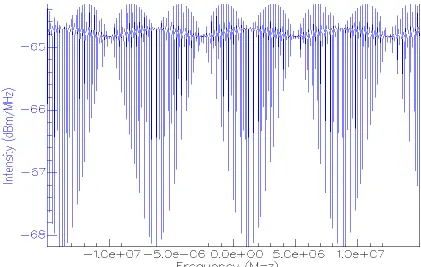
The Gaussian pulse is input into the input and add ports of the system. The operating wavelength is 1550 nm. The iterative method is used to generate the results based on practical parameters of the system. The throughput output signals of the add-drop filter system with two waveguide and coupling factor of
1=
2=0.02 in both symmetrical couplers is shown in Figure 2. The 3dB band width and the free spectral range of the pulses can be adjusted respect to different configuration and the designs of the ring resonator systems. In this study single ring resonator add-drop filter system is analysed.Figure 2. Throughput output signals of the add-drop ring resonator with
L=750µm,
1=
2=0.02, α=0In the following new parameter will be used for simplifying:
2 1
) 1 (
D
)
2
exp(
L
D
x
,y
1
1
1 andy
2
1
2(10)
(11)
and for the drop port:
(12)
(13)
The on-off ratio of an add-drop filter system is given by:
(14)
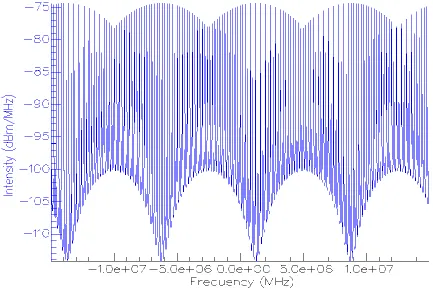
The output intensity at the drop port will is shown in Figure 3, which indicates that the resonance wavelength is fully extracted by the resonator when
1=
2and α=0.Figure 3. Drop port output of an add-drop ring resonator with
R=750µm,
1=
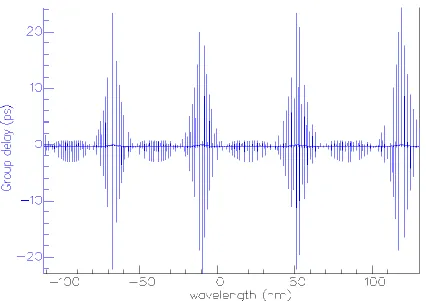
2=0.02, α=0The group delay profile of the drop port output referenced to the input port is shown in Figure 4. This group delay is simulated from drop port respect to the input port. Resonance in this case occurs when θ = (2N+1) π, where N is the mode number and the required equations to obtain the group delay are given in reference (Schwelb, 2004).
2 2 1
2 2 1 max
)
1
(
)
(
x
y
y
x
y
y
T
2 2 1
2 2 1 min
)
1
(
)
(
x
y
y
x
y
y
T
2 2 1
2 2 2
1 max
)
1
(
.
)
1
(
.
)
1
(
x
y
y
x
y
y
T
2 2 1
2 2 2
1 min
)
1
(
.
)
1
(
.
)
1
(
x
y
y
x
y
y
T
x
y
y
x
y
y
port
drop
T
port
put
through
T
.
)
1
(
.
)
1
(
)
(
)
(
)
(
2 2 2
1
2 2 1
min max
Figure 4. Group delay of the add-drop ring resonator with R=750µm,
1=
2=0.02, α=0CONCLUSION
The add-drop system is used to show constructive interference of the inputs optical Gaussian laser beam. Its transmission characteristics are theoretically derived and confirmed by the results. Here the transmission characteristics of the optical through and drop ports output powers and the group delay are presented.
ACKNOWLEDGEMENTS
I. S. Amiri would like to thank the, Photonics Research Centre, Department of Physics, Faculty of Science, University of Malaya, 50603 Kuala Lumpur, Malaysia for providing the research facilities. The authors acknowledge the financial support from University Malaya/MOHE under grant number UM.C/625/1/HIR/MOHE/SCI/29.
REFERENCES
Afroozeh A, Sadegh Amiri and Alireza Zeinalinezhad (2014). Micro Ring Resonators and Applications. Saarbrücken, Germany, LAP LAMBERT Academic Publishing.
Afroozeh A, Amiri IS (2014).Spatial and Temporal Soliton Pulse Generation By Transmission of Chaotic Signals Using Fiber Optic Link. Advances in Laser and Optics Research. New York, Nova Science Publisher. 11.
Afroozeh A, Amiri IS, Bahadoran M (2011). Simulation and Analysis of Multisoliton Generation Using a PANDA Ring Resonator System. Chinese Physics Letters 28(10): 104205.
Afroozeh A, Amiri IS, Chaudhary K, Ali J and Yupapin PP (2014).Analysis of Optical Ring Resonator. Advances in Laser and Optics Research. New York, Nova Science.
Afroozeh A, Amiri IS, Jalil MA, Kouhnavard M, Ali J and Yupapin PP (2011). Multi Soliton Generation for Enhance Optical Communication. Applied Mechanics and Materials 83: 136-140.
Ahsan R, Amiri IS, Shahidinejad A, Ali J and Yupapin PP (2012a). Characterisation of bifurcation and chaos in silicon microring resonator. IET Communications 6(16): 2671-2675.
Alavi SE, Amiri IS, Bahadoran M, Afroozeh A, Idrus SM (2014e). Nanometer Bandwidth Soliton Generation and Experimental Transmission within Nonlinear Fiber Optics Using an Add-Drop Filter System. Journal of Computational and Theoretical Nanoscience (CTN).
Alavi SE, Amiri IS, Idrus' SM (2014d). Solitonic Pulse Generation and Characterization by Integrated Ring Resonators. 5th International Conference on Photonics 2014 (ICP2014). Kuala Lumpur, IEEE.
Alavi SE, Amiri IS, Idrus SM, Supa’at ASM, Ali J and Yupapin PP (2014). All Optical OFDM Generation for IEEE802.11a Based on Soliton Carriers Using MicroRing Resonators. IEEE Photonics Journal 6(1).
Alavi SE, Amiri IS, Idrus SM., Nikoukar A and Ali J (2013b). IEEE 802.15.3c WPAN Standard Using Millimeter Optical Soliton Pulse Generated By a Panda Ring Resonator. IEEE Photonics Journal 5(5): 7901912.
Ali J, Amiri IS (2014). Picosecond Soliton pulse Generation Using a PANDA System for Solar Cells Fabrication. Journal of Computational and Theoretical Nanoscience (CTN) 11(3): 693-701.
Ali J, Amiri IS (2014b). Generating Highly Dark–Bright Solitons by Gaussian Beam Propagation in a PANDA Ring Resonator. Journal of Computational and Theoretical Nanoscience (CTN). 11(4): 1092-1099.
Ali J, Amiri IS, Gifany D (2013). Ultra-short Multi Soliton Generation for Application in Long Distance Communication.
Journal of Basic and Applied Scientific Research (JBASR) 3(3): 442-451.
Ali J, Amiri IS, Naraei P (2014b). Review and Theory of Optical Soliton Generation Used to Improve the Security and High Capacity of MRR and NRR Passive Systems. Journal of Computational and Theoretical Nanoscience (CTN) 11(9): 1875-1886.
Amiri IS and Ali J (2013). Data Signal Processing Via a Manchester Coding-Decoding Method Using Chaotic Signals Generated by a PANDA Ring Resonator. Chinese Optics Letters 11(4): 041901(041904).
Amiri IS and Ali J (2014a). Femtosecond Optical Quantum Memory generation Using Optical Bright Soliton. Journal of Computational and Theoretical Nanoscience (CTN). 11(6): 1480-1485.
Amiri IS and Ali J (2014c). Optical Quantum Generation and Transmission of 57-61 GHz Frequency Band Using an Optical Fiber Optics. Journal of Computational and Theoretical Nanoscience (CTN). 11(10): 2130-2135.
Amiri IS, Alavi SE and Ali J (2013a). High Capacity Soliton Transmission for Indoor and Outdoor Communications Using Integrated Ring Resonators. International Journal of Communication Systems.
Amiri IS, Alavi SE, Shahidinejad A, Nikoukar A, Anwar T, Supa’at ASM, Idrus SM and Yen NK (2014). Characterization of Ultra-Short Soliton Generation Using MRRs. The 2014 Third ICT International Student Project Conference (ICT-ISPC2014). Thailand IEEE.
Cai M, Painter O and Vahala KJ (2000). Observation of critical coupling in a fiber taper to a silica-microsphere whispering-gallery mode system. Physical Review Letters 85(1): 74-77.
Grover R, Absil P, Van V, Hryniewicz J, Little B, King O, Calhoun L, Johnson F and Ho P-T (2001). Vertically coupled GaInAsP--InP microring resonators. Optics letters 26(8): 506-508.
Heebner JE and Boyd RW (1999). Enhanced all-optical switching by use of a nonlinear fiber ring resonator. Optics
letters 24(12): 847-849.
Hryniewicz J, Absil P, Little B, Wilson R and Ho P (2000). Higher order filter response in coupled microring resonators.
IEEE Photonics Technology Letters 12(3): 320-322.
Idrus SM, Amiri IS, Alavi SE (2015). RF signal generation and wireless transmission using PANDA and Add/drop systems. Journal of Computational and Theoretical Nanoscience (CTN).
Idrus SM, Amiri IS, Alavi SE, Supa'at ASM, Ali J, Yupapin PP (2014f). W-Band OFDM Transmission for Radio-over-Fiber link Using Solitonic Millimeter Wave Generated by MRR. IEEE Journal of Quantum Electronics. 50(8): 622 - 628.
Afroozeh A, Amiri IS (2014). Ring Resonator Systems to Perform Optical Communication Enhancement Using Soliton. USA, Springer.
Amiri IS, Ali Nikoukar and Sayed Ehsan Alavi (2014a). Soliton and Radio over Fiber (RoF) Applications. Saarbrücken, Germany, LAP LAMBERT Academic Publishing.
Amiri IS, Sayed Ehsan Alavi and Sevia Mahdaliza Idrus (2014c). Soliton Coding for Secured Optical Communication Link. USA, Springer.
Amiri IS, Sayed Ehsan Alavi, S. M. Idrus, Abdolkarim Afroozeh and Jalil Ali (2014b). Soliton Generation by Ring Resonator for Optical Communication Application. Hauppauge, NY 11788 USA, Nova Science Publishers.
Neo YS, Idrus SM, Rahmat MF, Alavi SE and Amiri IS (2014). Adaptive Control for Laser Transmitter Feedforward Linearization System. IEEE Photonics Journal6(4).
PANDA ring resonator for secure network communication. Computer and Communication Engineering (ICCCE) Conference Malaysia, IEEE Explore.
Nikoukar A, Amiri IS, Shahidinejad A, Shojaei A, Ali J and Yupapin P (2012). MRR quantum dense coding for optical wireless communication system using decimal convertor. Computer and Communication Engineering (ICCCE) Conference. Malaysia, IEEE Explore.
Parisa Naraei, Amiri IS and Iman Saberi (2014). Optimizing IEEE 802.11i Resource and Security Essentials for Mobile and Stationary Devices. Elsevier.
Popovíc MA, Barwicz T, Watts MR, Rakich PT, Socci L, Ippen EP, Kärtner FX and Smith HI (2006). Multistage high-order microring-resonator add-drop filters. Optics letters 31(17): 2571-2573.
Popović MA, Ippen EP and Kärtner FX (2006). Universally balanced photonic interferometers. Optics Letters 31(18): 2713-2715.
Rahim FJ, Amiri IS, Alavi SE, Idrus SM (2014c). Analytical Treatment of the Ring Resonator Passive Systems and Bandwidth Characterization Using Directional Coupling Coefficients. Journal of Computational and Theoretical Nanoscience (CTN).
Rahman R, Amiri IS, Naim I, Imran M, Ali J (2010). The use of lidar system in determination of attenuation coefficient of water and fused glass. 2nd Topical Meeting on Laser and Optoelectronics 2010 (2nd TMLO2010) Redang, Malaysia, Universiti Malaya.
Sayed Ehsan Alavi, Amiri IS and Abu Sahmah M. Supa’at (2014). Analysis of VFSO System Integrated With BPLC. Amazon, Lap Lambert Academic Publishing.
Schwelb O (2004). Transmission, group delay, and dispersion in single-ring optical resonators and add/drop filters-a tutorial overview. Journal of Lightwave Technology 22(5): 1380.
Seyed Mohammad Reza Khalifeh Soltanian and Amiri IS (2014). Detection and Defeating Distributed Denial of Service (DDoS) Attacks. USA, Amazon.
Xiao S, Khan MH, Shen H and Qi M (2008). Silicon-on-insulator microring add-drop filters with free spectral ranges over 30 nm. Journal of Lightwave Technology 26(2): 228-236.
Yazdavar AH, Amiri IS, Ebrahimi M, Gorbani S, Alavi SE, Idrus SM and Ali J (2014a). Transmission of data with orthogonal frequency division multiplexing technique for communication networks using GHz frequency band soliton carrier. IET Communications. 8(8): 1364 – 1373.
Yupapin PP, Amiri IS, Ali J (2012b). Enhancement of FSR and Finesse Using Add/Drop Filter and PANDA Ring Resonator Systems. International Journal of Modern Physics B 26(04): 1250034.
Zeinalinezhad A, Pourmand SE, Amiri IS and Afroozeh A (2014). Stop Light Generation using Nano Ring Resonators for ROM. Journal of Computational and Theoretical Nanoscience (CTN).
Accepted 19 August, 2014.
Citation: Amiri IS, Zulkifli MZ, Ahmad H (2014). Soliton comb generation using add-drop ring resonators. International Research Journal of Telecommunications and Information Technology, 1(1): 002-008.